
Teachers group files suit over charter school

The state teachers lobby filed a fraud lawsuit Friday against the creators of a planned charter school in south Alabama accusing them of misleading a state commission about their finances and level of community support. The lawsuit filed by the Washington County chapter of the Alabama Education Association seeks to block public funds from going to Woodland Preparatory school in Washington County. “The citizens of Washington County do not want this school,” AEA Associate Executive Director Theron Stokes said in a press conference. The lawsuit claims the planned charter school does not have significant support from the community, as required by law, and is a front for a private education company. A lawyer representing Woodland Prep disputed the accusations and said local supporters wanted a school choice option because of concerns about test scores at traditional public schools in the county. “While we’ve been trying to give students and parents an option for a better education, the opposition in Washington County has been led by teachers afraid of losing their jobs and union bosses who fear losing union dues,” a statement released on behalf of Woodland Prep said. The suit names Washington County Students First, the locally incorporated group, that applied to start the school, and consultant Soner Tarim and his company Unity School Services who were hired by to operate Woodland Prep. Stokes said they believe that the group who applied to open the school is a front for Tarim. “We feel like this is an attempt from someone who wants to get a payday,” Stokes said. Woodland Prep’s statement said the school’s board picked Tarim “to bring about an innovative and challenging educational opportunity” to students in Washington County. The Alabama Public Charter School Commission gave the permission to open the charter school. The approval came despite that the National Association of Charter School Authorizers found the application “does not meet the standard for approval,” according to the lawsuit. Woodland Prep was supposed to open this month but received an extension. The lawsuit also accused the school of improperly seeking students from Mississippi to attend the school that would be funded with Alabama tax dollars. Woodland Prep denied that but said it has been targeting parents from Washington County who are currently sending their children to schools in Mississippi “in hopes of a better education.” Public charter schools are schools that receive government funds but operate independently. Alabama lawmakers authorized the creation of charter schools in 2015. A few have opened but more are planned. Stokes said AEA is not opposed to all charter schools. “This is not about charter schools. This is about bad charter schools,” said Tom Loper, an attorney representing the plaintiffs in the case. Republished with permission of the Associated Press.
Poll: Support for school choice growing among Republicans
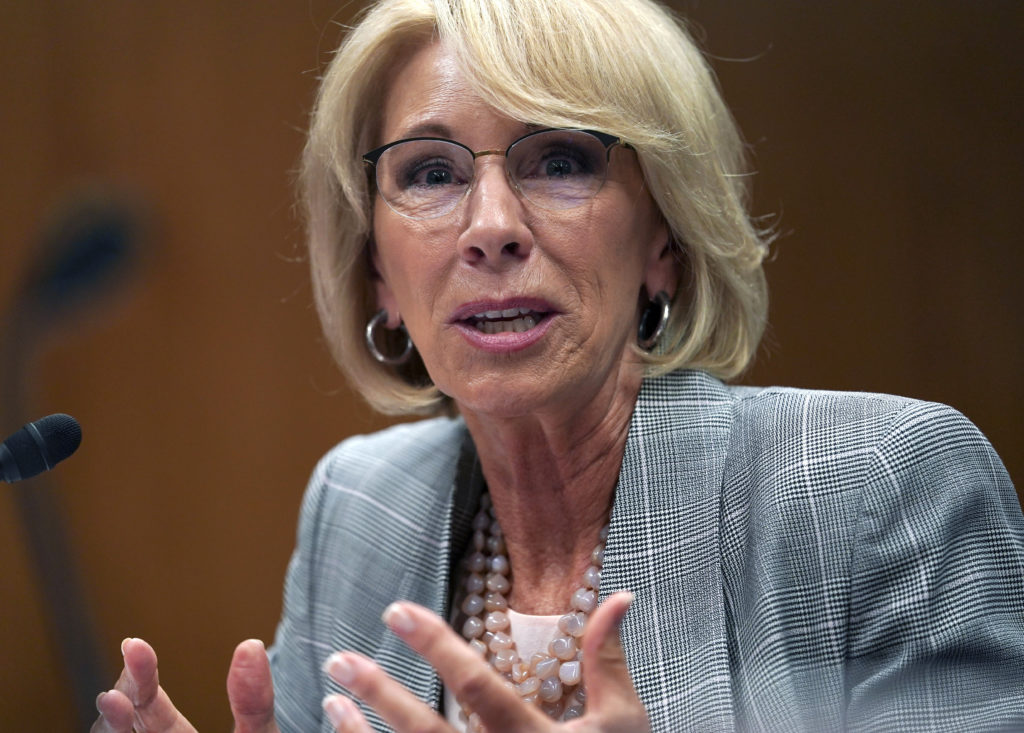
Support for charter schools and private school voucher programs has gone up over the past year, with Republicans accounting for much of the increase, according to a survey published Tuesday. The findings by Education Next, a journal published by Harvard’s Kennedy School and Stanford University, come as Education Secretary Betsy DeVos promotes alternatives to traditional public schools. Forty-four percent of respondents in the poll conducted in May said they support the expansion of charter schools, compared to 39 percent in 2017. The gain of 5 percentage points, however, did not fully offset the drop in support from 51 percent in 2016. When broken down according to party affiliation, 57 percent of Republicans and 36 percent of Democrats voiced support for charter schools, compared to 47 percent of Republicans and 34 percent of Democrats in 2017. “Support is up among Republicans for various strategies to expand school choice, and the Trump administration’s embrace of those policies is a likely explanation,” said Martin West, associate professor of education at Harvard University and a co-author of the report. Nina Rees, president of the National Alliance for Public Charter Schools said the findings “demonstrate through the educational choices they make for their children – families want high-quality charter school options for their kids. “Above all else, parents care that their child has access to an excellent school, and as education advocates it is our job to ensure that wish becomes a reality,” Rees added. Robin Lake, director of the Center on Reinventing Public Education, noted that support for charters has risen mostly among Republicans. “I hate to see an issue turn into a partisan question,” Lake said. “I don’t think that an education policy that’s designed to get better outcomes for kids should ever be a partisan issue.” Support for publicly funded vouchers given to low-income families to help them pay tuition at private school rose from 37 percent to 42 percent over the past year. The Education Department welcomed the results of the poll. “The data consistently show that parents want more education options for their kids and when they are empowered with options, they like it and their kids benefit,” said press secretary Elizabeth Hill. “Education freedom is the future.” Meanwhile, Americans seem to be more satisfied with their local police and the post office than with their neighborhood school. While 51 percent of respondents said they would give their local schools a grade of A or B, 68 percent gave the local post office a similar grade and 69 percent the local police. “It makes sense that only 50 percent of Americans are giving their public school a good grade of an A or a B that they would express support for alternatives to those public schools,” said Patrick McGuinn, a professor of political science and education at Drew University. In the Black Lives Matter era, African-American respondents gave their local police much lower marks than other respondents, but their views of their local schools were even worse. Thirty-nine percent gave their local schools an A or a B, while the local police force received such marks from 43 percent of African-American respondents. The study also found that many Americans favor raising teacher salaries and increasing school funding in the aftermath of teachers walking out of schools in six states earlier this spring to protest pay and other issues. Informed about average teacher earnings in their state, nearly half said they support raising teacher pay. That number was 67 percent when respondents were not told explicitly how much their local teachers were making. Nationally, the average teacher’s salary was $58,950 in 2017, according to the National Center for Education Statistics. “The sense of economic insecurity for teachers is very strong and there is growing support for higher pay, not just from teachers but from the broader community,” said Evan Stone, CEO of Educators For Excellence, a teachers’ advocacy organization. West said that while many believe teachers should be making more, there is disagreement over whether they should be compensated based on how much their students learn or using some other metric. “To the extent that the debate moves from how much are teachers are paid to how they are paid, there is potential for continued conflict,” West said. The Education Next survey was based on interviews with 4,601 adults across the country. The margin of error was 1.4 percentage points. Republished with permission from the Associated Press.
Betsy DeVos undeterred by critics even as agenda remains stalled
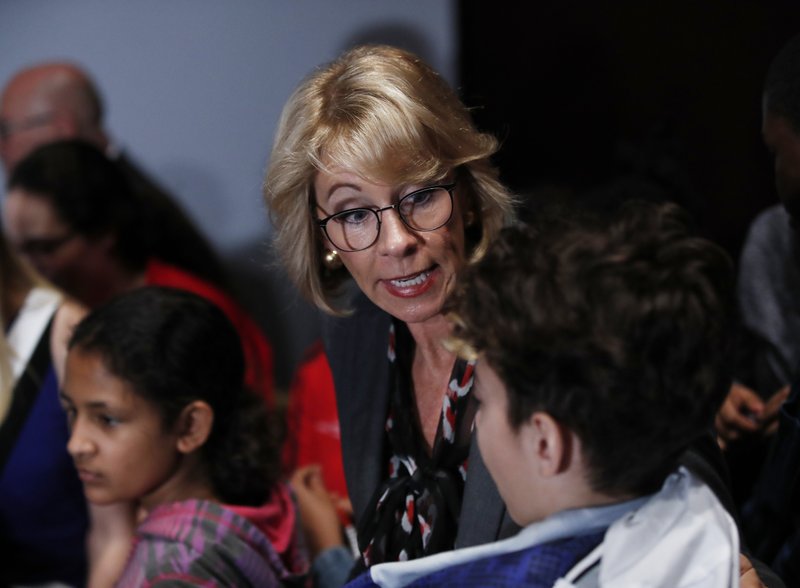
Among the paintings and photographs that decorate Education Secretary Betsy DeVos‘ sunlit, spacious office is the framed roll call from her Senate confirmation. It’s a stark reminder of the bruising process that spurred angry protests, some ridicule and required the vice president’s tie-breaking “yes” vote. Six months on the job, DeVos is no less divisive. Critics see her as hostile to public education and indifferent to civil rights, citing her impassioned push for school choice and her signing off on the repeal of some protections for LGBT students. Conservatives wish she had been less polarizing and more effective in promoting her agenda, noting that the department’s budget requests are stalled in Congress and no tangible school choice plan has emerged. DeVos is undeterred. “We have seen decades of top-down mandated approaches that protect a system at the expense of individual students,” DeVos told The Associated Press. “I am for individual students. I want each of them to have an opportunity to go to a school that works for them.” In her first comprehensive sit-down interview with a national media outlet since taking office, DeVos touched on some of the most pressing issues in K-12 and higher education. She said Washington has a role to “set a tone” and encourage states to adopt choice programs without enacting “a big new federal program that’s going to require a lot of administration.” At the same time, she confirmed that a federal tax-credit voucher program was under consideration as part of a tax overhaul. “It’s certainly part of our discussion,” DeVos said. DeVos, 59, appeared confident, but reserved during the 30-minute interview last week in her office, where photographs of her children and grandchildren and drawings and letters from young students are prominent. Large windows overlook the Capitol. Across the street, visitors lined up outside the National Air and Space Museum, which DeVos toured this year with Ivanka Trump to promote science and engineering among girls. DeVos defended her decision to rewrite Obama-era rules intended to protect students against being deceived by vocational nondegree programs, saying that “the last administration really stepped much more heavily into areas that it should not.” Liberals accuse DeVos of looking out for the interests of for-profit schools, and they point to Trump University, the president’s for-profit school that was sued for fraud. Supporters say the Obama regulations unfairly targeted for-profits and failed to track students’ long-term careers. The decision by the departments of Education and Justice to roll back rules allowing transgender students to use school restrooms of their choice enraged civil rights advocates, who said already vulnerable children could face even more harassment and bullying. Conservatives saw DeVos fulfilling a promise to return control over education issues to states, cities, school districts and parents. “We really believe that states are the best laboratories of democracy on many fronts,” DeVos said. On the issue of school choice, DeVos was resolute. Another major flashpoint: charter schools, which are publicly funded but usually independently operated, and voucher programs that help families cover tuition at private schools. They’re often criticized for a lack of transparency, and studies about their effectiveness have produced mixed results. DeVos disagrees. “I think the first line of accountability is frankly with the parents,” she said. “When parents are choosing school they are proactively making that choice.” For DeVos, who spent more than two decades promoting charter schools in her home state of Michigan, the closure of some low-performing charters was evidence of accountability. “At the same time, there have been zero traditional public schools closed in Michigan for performance and I think that’s a problem,” she said. DeVos got off to a rocky start in the Trump Cabinet. She was satirized for some of her gaffes during the confirmation hearing, such as saying that guns are needed in schools to protect students from grizzly bears. Teacher unions accused her of seeking to privatize public education. Parents and teachers jammed Congress phone lines to oppose her nomination. It took Vice President Mike Pence‘s historic vote – the first by a vice president to break a 50-50 tie on a Cabinet nomination – to secure her position after two Republican senators defected. DeVos is still sometimes met with protesters at public events, and her security detail has been bolstered at an additional cost of $7.8 million. But DeVos isn’t retreating. She actively advocates for school choice, once comparing education to ride-sharing services such as Uber and Lyft, and saying that parents, like riders, need options. Of the 17 K-12 schools that she has visited so far, only seven were traditional public schools. DeVos didn’t attend public school herself or send her children to a public school. Randi Weingarten, president of the American Federation of Teachers, said in a recent speech that DeVos was a “public school denier” and quipped that DeVos can start talking about school choice even in reply to a simple greeting. Conservatives say she may have oversold. “She has made things harder for herself by acting as the secretary for school choice instead of the secretary of education,” said Mike Petrilli, president of the conservative Thomas B. Fordham Institute. “She has missed the opportunity to make it clear that she wants to see all schools succeed.” Moderates are upset. “I have feared that in trying to rush in with a simplified notion of choice – that she will love charters to death,” said Robin Lake, director of the Center on Reinventing Public Education, a pro-charter group. “At this point, six months in, I don’t see any evidence that we are farther along on helping with achievement, equity, with moving the country forward.” Asked to name some of the strengths of public schools that she has observed in her job, DeVos said only that she is “a very strong supporter of public schools.” “But we also need to encourage schools, public schools that are doing a great job to not rest on their laurels but to continue to improve because unless you’re constantly oriented around
Poll: Most unfamiliar with school choice but like the idea

Even as fierce political battles rage in Washington over school choice, most Americans know little about charter schools or private school voucher programs. Still, more Americans feel positively than negatively about expanding those programs, according to a new poll released Friday. “I wonder what the fuss is about,” said Beverly Brown, 61, a retired grocery store worker in central Alabama. Brown, who doesn’t have children, says American schools need reform, but she is not familiar with specific school options and policies. “Educational standards have to be improved overall.” All told, 58 percent of respondents say they know little or nothing at all about charter schools and 66 percent report the same about private school voucher programs, according to the poll conducted by The Associated Press-NORC Center for Public Affairs Research. Charters are schools funded by taxpayer money, but they operate independently of school districts and thus have more freedom in setting their curriculum and hiring staff. Vouchers are publically funded scholarships given to low-income families to help cover tuition in private schools, including religious ones. Using taxpayer money to aid struggling public schools or diverting it to fund more charter schools or make private schools available to more families has been hotly debated since Donald Trump was elected president. During the campaign, Trump promised to fund a $20 billion school choice program. He picked a long-time charter and private school advocate, Betsy DeVos, as his education secretary. Last week the president welcomed a group of students who were voucher recipients to the White House and asked Congress to work with him to make school options available nationwide. Those efforts face fierce resistance from Democrats and teachers unions, who say that school choice drains funds from public schools while leaving charter and private schools unaccountable in terms of academic standards and civil rights protections. Patrick McGuin, an education professor at Drew University, said he was surprised by the fact that most Americans had little knowledge about school choice options. “That’s pretty remarkable given the growth and high-profile politics around charters,” McGuin said. “As much as policymakers are talking the heck about this, the debate really hasn’t permeated the general public’s discussion yet.” Charter schools currently operate in 42 states and the District of Columbia. D.C. has only the federally funded voucher program, while 30 states have voucher or similar education choice programs. Even though they are unfamiliar to many, Americans have largely positive reactions to charter schools and vouchers. While 55 percent of respondents say parents in their communities had enough options with regard to schools, about 4 in 10 feel that that the country in general would benefit from more choice. Forty-seven percent say they favor opening more public charter schools, 23 percent are opposed, and 30 percent feel neutral about it. Meanwhile, 43 percent of respondents support giving low-income families tuition vouchers for private schools, 35 percent are opposed and 21 percent don’t have a strong opinion either way. Republicans are slightly more likely than Democrats to favor opening more charter schools, 53 percent to 42 percent, but there is little partisan variation for voucher programs. At the same time, opposition to vouchers is highest among those who have heard the most about them. John Rekers, a 46-year-old mortgage broker in California, has five kids and all of them are attending charter schools. He believes charter schools are more innovative and progressive. “They are not so oriented to sitting at desks and doing stuff,” he said. “The charter school is much better oriented in teaching children,” Rekers said. “They have higher standards.” Marc Culbreath, a janitor in Philadelphia, spent several years renting a house in the suburbs so that his children could go to quality public schools, but when the family moved into the city, they were appalled by neighborhood schools. “Kids in the city — their public schools are terrible,” Culbreath said. Culbreath sent his son, now in 10th grade, to a charter school and he is now on track to go to college. “They treat the kids in the city same as they treat the kids in the suburbs,” he said of the charter school. But Madolyn Stall, 22, a college student in Kansas, doesn’t support voucher programs. “If you cannot afford to go to a private school, then public school is fine,” she said. “I don’t really want to pay more of my tax money to send people to private school when they can go to public school.” About 7 in 10 respondents feel that both charter schools and private schools funded with taxpayer money should meet the same education standards as public schools. School choice critics point to the fact that most private school don’t need state accreditation to operate and that some private schools teach creationism in science classes. Still, Americans are more likely to say that private schools, both locally and nationally, provide a good quality of education than say the same of public schools. The AP-NORC poll of 1,036 adults was conducted April 20-23 using a sample drawn from NORC’s probability-based AmeriSpeak panel, which is designed to be representative of the U.S. population. The margin of sampling error for all respondents is plus or minus 4.0 percentage points. Respondents were first selected randomly using address-based sampling methods, and later interviewed online or by phone. Republished with permission of The Associated Press.
William J. Canary: Public charter schools provide value to business’s future

Citizens from across Alabama again this month will gather in Montgomery for School Choice Week scheduled Jan. 22-28 to show support for improving the quality of education and expanding access to highly effective schools. The Business Council of Alabama will participate in Alabama’s National School Choice Week rally at the Renaissance Montgomery Hotel & Conference Center on Jan. 27 at 11 a.m. Please join hundreds of students, parents, educators, legislators, and business leaders who believe that no child in Alabama should receive less than an adequate education simply due to his or her ZIP code or street address. With the BCA’s urging, the Legislature passed the Alabama School Choice and Student Opportunity Act in 2015. Alabama is now the 43rd state with a charter school law that allows parents to enroll their children in adequate schools without having to move. The potential is great for two public charter schools this fall. Stay tuned. In schools where the absence of student achievement is obvious and previous efforts to improve performance have failed, parents and students should be offered options for likely success. Competition forces businesses to improve quality, services, and products. School choice does the same by providing failing schools incentives to improve or risk losing students. If Alabama is to continue to attract the aerospace, automobile, and rocket manufacturing facilities that have made us the envy of the rest of the nation, and if we are going to foster growth of our biotech, high-tech, and research industries, we must provide our children the education and skills that those jobs demand. The future is for all of us. At the BCA we are dedicated to doing our part. ••• William J. Canary is president and CEO of the Business Council of Alabama.
William J. Canary: Public charter schools are valuable to business’ future
We are encouraged by the progress made toward creating public charter schools, schools that promise to be a vital part of the well-educated workforce that will work in and run Alabama businesses well into the middle of this century. Last year, thousands of parents, students, and teachers gathered in Montgomery for School Choice Week to urge the Legislature to give parents a choice. With the Business Council of Alabama’s urging, the Legislature responded and passed the Alabama School Choice and Student Opportunity Act. Alabama is now the 43rd state with a charter school law. Later this month, people from across Alabama again will gather in Montgomery for School Choice Week that is designated Jan. 25-29, to show support for improving the quality of education and expanding access to highly effective schools. The Alabama celebration of School Choice Week will be 11 a.m. Jan. 26 on the south lawn of the Capitol. We encourage participation in this endeavor that is an important part of Alabama’s goal of growing our role as a leader in a global economy. Students are expected to enroll next year in inaugural public charter schools that are now being planned, giving parents a say in where their children attend school without having to move. Public charter schools will be innovative in teaching and managing. Public charter schools will be held accountable and will have safety and health regulations. Students also will take state assessment exams. If parents and their children find public charter school are good learning environments and foster high academic expectations, then the schools will continue to turn out students that their parents envision. Right now if you have money or you can afford to move, you might send your children to private school. The BCA believes that all children deserve a chance for a quality education and that all parents should be given the opportunity to seek it. Charter schools can be an attractive alternative to parents of children who, due to geography, are locked into a situation where they cannot reach their full potential. Public charter schools will be another tool to use as we strive for education excellence and prepare our children for a fulfilling future. In 2014, the Business Education Alliance of Alabama – an organization that joins education and business – called for pursuing the goal of attaining a 90 percent high school graduation rate by the year 2020. Right now our graduation rate is 86 percent and increasing. While that is good news, one-third of our students need remedial courses for college and student proficiency of mastery of content is well below average. The success of Alabama’s business community depends on a public education system that produces graduates with skills required for the 21st century work place. If Alabama is to continue to attract the aerospace, automobile, and rocket manufacturing facilities that have made us the envy of the rest of the nation, and if we are going to foster growth of our biotech, high-tech, and research industries, we must provide our children the education and skills that those jobs demand. At the BCA we are dedicated to doing our part because the future is for all of us. William J. Canary is president and CEO of the Business Council of Alabama.
Charter schools expected to open in Alabama in 2017

Charter schools are expected to open in Alabama in 2017. Ed Richardson, chairman of the Alabama Public Charter School Commission, said Tuesday that the fall of 2017 is when the first charter school is expected to open in the state. The commission on Tuesday worked on an application template for groups interested in starting charter schools. The template is expected to be approved within a few months. Applicants will have to submit information about their financial management, operations plan and curriculum. Charter schools are publicly funded schools that are free from the regulations put on other schools and may be run by private groups. The Alabama Legislature last year approved GOP-backed legislation to allow charter schools in the state for the first time. Republished with permission of the Associated Press.
Committee OKs plan to remove BOE from charter schools
The House Education Policy Committee approved a bill on Tuesday that would remove the Alabama State Board of Education from confirming a new charter school commission. Republicans who sponsored Alabama’s newly passed charter school legislation expressed frustration at the state school board’s refusal to confirm a list of nominees for the commission. The charter school commission is responsible for hearing appeals of charter school applications rejected on the local level. Bill sponsor Republican Rep. Terri Collins of Decatur said the bill is needed to ensure the commission is in place by the June 1 deadline. “The bill has to go through so many steps in order to pass,” she said. “Getting that simply done by June 1 will be an effort. If they were to actually pass the state commission at any point during that, then the bill could just stop, but I’m probably not going to postpone the bill until they do something.” Republicans have passed charter school legislation this session after making it a priority for several years. Board members have said they wanted more time to interview and research candidates nominated by the governor, lieutenant governor, House speaker and Senate president pro tem. Several state board members have said they agree with being removed from the process. “I think they deserve the entire decision making process on this,” board member Ella Bell said last week. “They created the charter schools. This was not the decision of the people of this state.” Democratic Rep. Patricia Todd of Birmingham voted against the bill. She said it’s too soon to cut the school board out of the process. Todd said it seems reasonable to allow for the board to have more time talk with the candidates, even if it means extending the June 1 deadline. “They have had one round to look at people,” she said. “I don’t think just one round and all of a sudden boom they’re going to appoint them and take their authority away is good policy.” Other bills this session already have taken away major responsibilities from the state school board. Gov. Robert Bentley signed a bill removing the state’s two-year college system from BOE oversight. Another bill, which died in a Senate committee, would have created term limits for the board’s elected members but would have raised their pay. Republished with permission of The Associated Press.
