
Martha Roby bill to combat horrific crimes against children passes House

America’s children are one step closer to being a littler safer after a bill sponsored by Alabama 2nd District U.S. Rep. Martha Roby passed the House on Tuesday. H.R. 6847: the Preventing Child Exploitation Act of 2018, combats crimes such as child pornography and global sex tourism, and contains tools to fight child abuse and strengthens protections for children under the law. It also renews funding for the National Sex Offender Registry. “It is our responsibility here in Congress to provide the strongest, most effective tools available to confront, fight, punish, and ultimately prevent horrific crimes against children,” said Roby. “Our children are perhaps the greatest and most precious responsibility given to us. They are vulnerable, innocent, and wholly dependent upon us to protect them. Because of this, both our legal protections for children and the punishments for those who do them harm must be as strong as possible.” The bill itself contains four Judiciary Committee bills that have previously been approved by the House of Representatives: H.R. 1842: the Strengthening Children’s Safety Act — makes communities safer by enhancing penalties for sex offenders who fail to register in the national sex offender registry and then commit a crime of violence. It also ensures enhanced penalties for child exploitation crimes apply equally to all dangerous sex offenders by assuring those convicted of certain sex offenses under the Uniform Code of Military Justice are subject to the enhanced penalties applicable to recidivists under current law. H.R. 1862: the Global Child Protection Act — authored by Rep. Roby, the legislation combats global sex tourism by closing loopholes that allow child predators to go unpunished for their abuse of children overseas. Specifically, the bill expands the conduct covered for child sexual exploitation cases that involve abuse occurring abroad to include sexual contact. It also broadens the offenses covered in the recidivist enhancement provisions in current law to protect the youngest of child victims. H.R. 1761: the Protecting Against Child Exploitation Act — protects child pornography victims by remedying a federal court ruling in United States v. Palomino-Coronado. This decision allowed a defendant to walk free from production of child pornography charges, despite photographic evidence that he had engaged in sexual abuse of a seven-year-old child, because the court found that he lacked the specific intent to produce child pornography prior to abusing the child. To address this loophole in the law, the Protecting Against Child Exploitation Act adds additional bases of liability to the crime of child pornography production to prevent this heinous crime and bring criminals to justice. H.R. 1188: the Adam Walsh Reauthorization Act — reauthorizes the two primary programs of the Adam Walsh Act—the Sex Offender Registration and Notification Act and the Sex Offender Management Assistance Program—for five years and makes targeted changes to make the system more efficient and just. These programs help prevent child abuse by ensuring the public has access to information on known sex offenders who may live in their neighborhoods. The bill passed the House by a voice vote. It now moves to the Senate for consideration. Watch Roby discuss the bill on the House floor:
Illegal immigrant in Alabama arrested for child abuse, now being held by ICE

A mother in Foley, Ala. was arrested Wednesday after police say she tortured her 6-year-old son with a scalding hot spoon. According to reports, 26 year old Maria Cortes was disciplining her child Friday, Sept. 8, when she heated a spoon on the eye of the stove, then pressed it to the lips of her child resulting in 3rd-degree burns. School officials notified authorities on Monday that the child was missing from school and the police went to the Cortes home to investigate. “She kept the child home and didn’t get him medical attention, because she knew she would be in some trouble,” said Thurston Bullock, Asst. Police Chief with the Foley Police Department. “Third degree burns to the lips you know that’s soft tissue area and just the singeing of that area. It was swollen and the child went without medical care for three days.” Cortes was arrested with a $10,000 preset bond. She was almost released, when police discovered she was in the country illegally. A judge then reset her bond to $100,000 and U.S. Immigration and Customs Enforcement (ICE) placed a permanent hold on her release. The boy received necessary medical treatment and was released into his father’s custody. Cortes has until October 10, 2017 to request a hearing.
Robert Bentley issues executive order calling for child sex abuse prevention plan
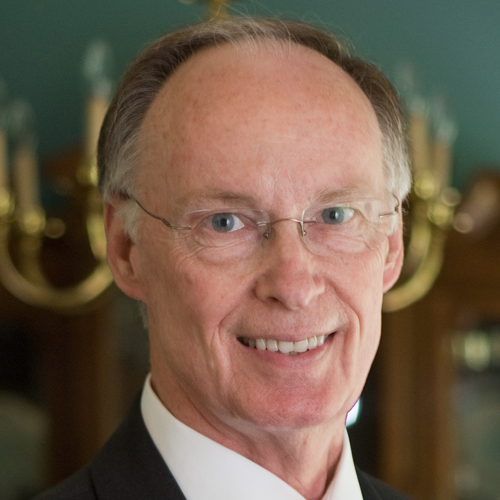
The last month or so has been quite a rough patch for Gov. Robert Bentley. His administration is fighting for its life as Bentley publicly fends off allegations of personal and official misconduct both in the media and among his fellow Republicans in Montgomery. But even an embattled governor scores a victory every now and then using the highest office in state governmentc, and it appears Bentley was aiming for one on Thursday. Bentley issued an executive order authorizing county Policy Councils designed to fight child sex abuse to work with local Child Advocacy Centers to develop a statewide abuse prevention plan based on local needs. The order, Executive Order 20, also requires the coordinating councils to submit a report on their plan to the governor by July 1, 2017. The order is in furtherance of an earlier initiative which created a task force on child sexual abuse prevention under a 2015 state law called “Erin’s Law,” which toughened penalties for abusers and called for the creation of comprehensive prevention standards. “Children are our state’s most precious resource, and protecting Alabama’s children from abuse is critical,” said Bentley in a statement. “With this executive order, child sexual abuse prevention plans will be created based on the needs at the local county level.” “The Alabama Children’s Policy Council, county children’s policy councils and Child Advocacy Centers work together and are a strong voice for protecting children from sexual abuse. I appreciate each group’s dedication to fighting for children,” added Bentley.
Bill would protect children, establish Alabama Child Abuse Hotline
A bill from Rep. Becky Nordgren (R-Gadsden) would create the Alabama Child Abuse Hotline, a toll-free number where child abuse can be reported. The text of HB353 specifies that the Department of Human Resources (ADHR) would be tasked with adopting rules regarding the establishment and management of the hotline, which is to be advertised in a place of prominence in every public and charter school throughout the state. According to numbers available on the Alabama Network of Children’s Advocacy Centers’ website, more than 1,500 children died as a result of child abuse in 2011. Of those, about 75 percent suffered neglect, 15 percent suffered physical abuse and just under 10 percent suffered sexual abuse. Children under the age of one suffered the highest rates of victimization. According to ADHR’s 2014 report, which is the most recent available on the department’s website, more that 32,000 cases of child abuse or neglect were investigated – involving more than 50,000 children. That number has increased every year since 2011. A report by the Children’s Defense Fund puts it this way – in Alabama, a child is abused or neglected every 56 minutes and a child dies before his or her first birthday every 14 hours. Though the legislation currently has no co-sponsors, it is likely to gain wide support in the House and Senate, where Republicans have made families a centerpiece of their 2016 agenda. Nordgren did not respond to a request for comment.
Robert Bentley signs ‘Winston’s Law’
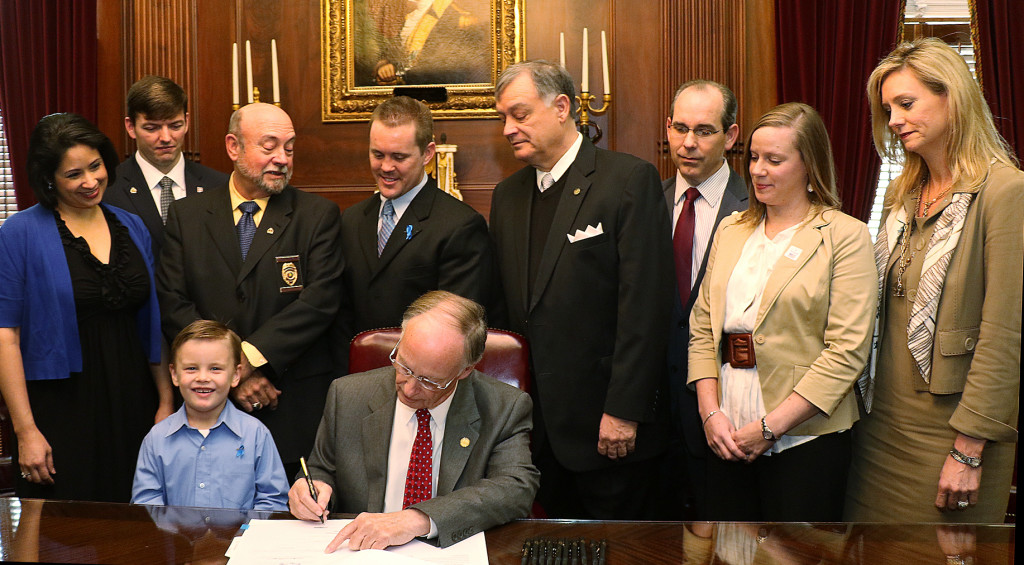
In a signing ceremony Tuesday afternoon, Gov. Robert Bentley signed his name to “Winston’s Law” as the bill’s namesake looked on. SB23, sponsored by Sen. Clyde Chambliss (R-Prattville) and carried in the House by Rep. Paul Beckman (R-Prattville), makes aggravated child abuse a Class A felony for children under six. The crime now carries a potential punishment of life in prison and a $60,000 fine. The bill’s name comes from an Elmore County boy whose mother was indicted for charges of chemical endangerment of a child and aggravated child abuse. During committee hearings on the bill, testimony was given that the boys injuries were so severe that pictures could not be shared with the press or the public. During the signing ceremony, Bentley joked and teased the boy and presented him with one of the pens used in signing the legislation. Further, Bentley noted that he was signing the actual bill – a departure from other ceremonies where bill copies have been used. On hand for the ceremony were Chambliss, Beckman and a host of child activists and family members. “This is a good bill,” Bentley said, thanking lawmakers for drafting the legislation. “This is an important issue dealing with the protection of our children.” Before the signing of “Winston’s Law,” prosecutors were only able to charge child abusers with lesser crimes, often resulting in a punishment not strict enough for the crime. With this legislation, prosecutors will be able to seek maximum penalties for the most vicious abusers. A second bill dealing with child abuse penalties, “Ava’s Law,” which strengthens penalties for offenders whose abuse results in the death of a child, was passed by the legislature last week.
Senate Judiciary Committee gives favorable report on 2 child abuse bills

The Senate Judiciary Committee (JUDY) met Wednesday morning to discuss two bills aimed at more thoroughly prosecuting those who commit “aggravated child abuse.” Sen. Clyde Chambliss (R-Prattville) spoke before the committee today on “Winston’s Law,” SB23, which will make aggravated child abuse of children between infancy and six years old a Class A felony. “It’s unfortunate that we have to come here today and even talk about this issue,” Chambliss said. “But it’s reality.” The bill is named for a 4-year-old boy named Winston, who was found nearly comatose in a car where his mother’s boyfriend had taken him to a court hearing. “It’s the worst case of child abuse I’ve ever seen where the child lived,” said District Attorney Randall Houston, who referenced pictures of the child too disturbing to be viewed by the public. Sen. Vivian Figures (D-Mobile) encouraged that the age limit be increased to protect more children. “When a child has been subjected to aggravated abuse, it should be life without parole,” Figures said through tears. “Because you have given that child a life sentence, people who go through that will suffer from the residual of that for years to come.” A second bill, SB22, would make death in cases of aggravated child abuse eligible for a murder conviction. Currently, offenders can find leeway in the fact that the intent of child abuse may not be to kill the child, but Assistant District Attorney Jessica Ventiere believes that death in cases of child abuse should warrant more than a manslaughter charge. She referenced the case of “Ava,” who said is “forever four years old” after a kicking death at the hands of her mother’s boyfriend. The bill would provide prosecutors with the ability to provide lengthier sentences to offenders in cases such as this. The committee voted unanimously to provide a favorable report on both bills, which will make their way to the legislature soon.
Samuel J. McLure: Conviction and Contentment: Surveying Alabama’s Strategies to Care for Abused and Neglected Children
Using the word orphan to describe children who have been abused and neglected is, let’s be honest, not en vogue. But, and again let’s be honest, a child whose parents are more concerned about meth binges than feeding them might as well be an orphan. For those readers who consider themselves religious, classifying abused and neglected children as orphans has enormous consequences. After all, the sacred Christian text says that “pure religion” is comprised of caring for orphans. (James 1:27). With this conviction in mind, the eyes of Alabama’s lawmakers have aft turned to visiting these orphans in their affliction. Lamentably, as John Steinbeck foreshadowed in the early 20th century, “the best laid schemes of mice and men go aft awry.” In April of 2013, Governor Robert Bentley signed into law the heralded Best Interest of the Child Act. This new law, armored with the conviction that something should be done to make adoption and foster care better in Alabama, was a collaborative effort of the Speaker of the House, Mike Hubbard, the Commissioner of DHR, Nancy Buckner, the foster care and adoption community at large, and yours truly. The Best Interest of the Child Act, with the combined mental powers of its crafters, was lauded as the silver bullet to resolve Alabama’s single most prolific problem in its child welfare system. Namely, some juvenile court judges’ failure to provide permanency to the abused and neglected children under their care. Our research indicated that children, to their rank detriment, often languished in foster care for years without permanency, for no justifiable reason. This new law sought to legislatively “hand cuff” the juvenile court judges by requiring them to hear cases within 90 days of all parties receiving notice and requiring the juvenile court judges to make a decision about permanency within 30 days of the hearing. The conviction to see these practical orphans find permanency in loving families seemed tangibly closer. Steinbeck would not be surprised by the stark reality that our plans went lamentably awry. The Alabama Court of Appeals has repeatedly held that the time limits prescribed by the Best Interest of the Child Act are, at best, advisory. On April 24, 2015, in the case entitled J.L. v. Morgan County Department of Human Resources, the Court of Appeals held that the Best Interest of the Child Act only had to be followed if “the failure to comply with the statute impaired [a biological parent’s] rights.” In the real world, such a finding will most likely never take place. So, where does that leave us? The best minds in the State (excepting yours truly from that category) palpably failed to realize fruit from our conviction to visit these practical orphans in their affliction. We wasted our time and resources – we failed – we failed the abused and neglected children of our State. Where does that leave us? With contentment. Not complacency – by no means, complacency. Just contentment. Contentment in the fact that we will fail, yet we will fight on. In the words of Theodore Roosevelt, “[t]he credit belongs to the man who is actually in the arena, whose face is marred by dust and sweat and blood; who strives valiantly; who errs, who comes short again and again, because there is no effort without error and shortcoming.” This legislative session, drowned out by the raucous noise of gambling, lottery, and tax increases are two bills driven on by the conviction of caring for practical orphans. The Ombudsman Act, which seeks to establish a third-party investigative agency to hold DHR accountable in their placement of vulnerable children, and The Permanency for At Risk Kids (PARK) Act, which seeks to address a broad array of weaknesses in the legal structure of caring for these practical orphans. Most likely The Ombudsman Act and The PARK Act will be tabled for this legislative session; and with this we must be content. Perhaps the groundwork is being laid now for these bills to be passed in a later session. For now, we must be content that these bills are a symbol of the undying conviction of those who strive, by a strength outside of themselves, to visit orphans in their affliction. Sam McLure is the Founder of The Adoption Law Firm.
