
Former U.S. Treasury secretary says unemployment rate needs to rise to curb inflation
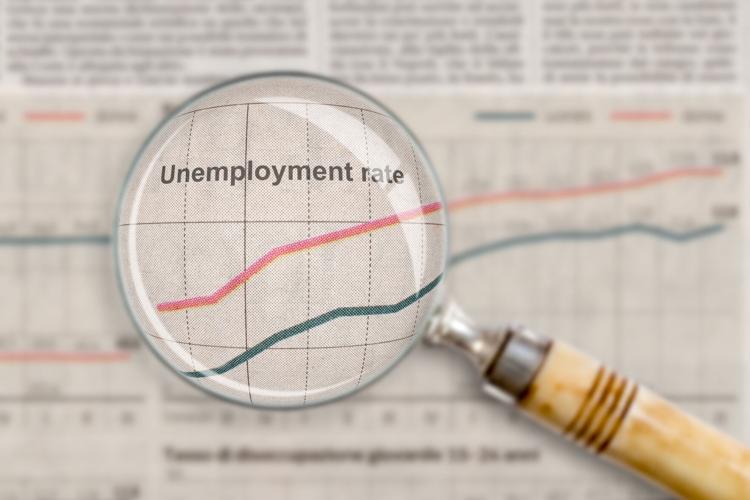
The unemployment rate needs to rise in order to ease the effects of inflation, former U.S. Treasury Secretary Larry Summers says. According to the Consumer Price Index, the annual inflation rate in the U.S. is 8.6%, the highest seen in 40 years. To ease the effects of such high inflation rates, Summers said the unemployment rate would have to rise above 5% for five years. “We need five years of unemployment above 5% to contain inflation – in other words, we need two years of 7.5% unemployment or five years of 6% unemployment or one year of 10% unemployment,” Summers said in a speech in London on Monday, Bloomberg reported. The current U.S. unemployment rate sits at 3.6% for May 2022. Summers’ comment comes as many discuss the potential for the U.S. to enter a recession. According to a report by the Conference Board, a non-profit research group, most CEOs believe a recession is imminent. “More than 60% of CEOs globally say they expect a recession in their primary region of operations before the end of 2023 or earlier,” the Conference Board said. Another 15% say their regions are already in the midst of a recession. However, the Biden administration’s opinions differ starkly from what most business leaders say. In response to a reporter stating that most economists say a recession is “even more likely than ever,” President Joe Biden said most economists aren’t saying that. “Not the majority of them aren’t saying that; come on, don’t make things up, OK, now you sound like a Republican politician,” Biden said. “I’m joking, that was a joke, but all kidding aside, no, I don’t think it is. I was talking to Larry Summers this morning. There’s nothing inevitable about a recession.” Biden’s comment contrasts with what Summers said in an interview with NBC’s Chuck Todd on Sunday. “I don’t think there are historical precedents for inflation at the rate we now have it coming down to the target the Fed has set of 2% without a recession,” Summers, an economist who served as the Treasury secretary from 1999 to 2001, said. “I think all the precedents point towards a recession.” Current U.S. Treasury Secretary Janet Yellen’s opinions also diverge from what most business leaders and economists are saying. “It’s natural now that we expect a transition to steady and stable growth, but I don’t think a recession is at all inevitable,” Yellen said in an interview with ABC News on Sunday. Retail sales fell in May by 0.4%, according to estimates released by the U.S. Census Bureau, indicating a decrease in consumer spending, which could contribute to the possibility of a recession, but again, Yellen said she disagrees. “I think consumer spending remains very strong, there’s month-to-month volatility, but overall spending is strong although patterns of spending are changing,” Yellen said. “Higher food and energy prices are certainly affecting consumers and making them change their patterns of spending, but bank balances are high.” Republished with the permission of The Center Square.
MSNBC’s Chuck Todd takes show to Alabama ahead of Tuesday’s special election
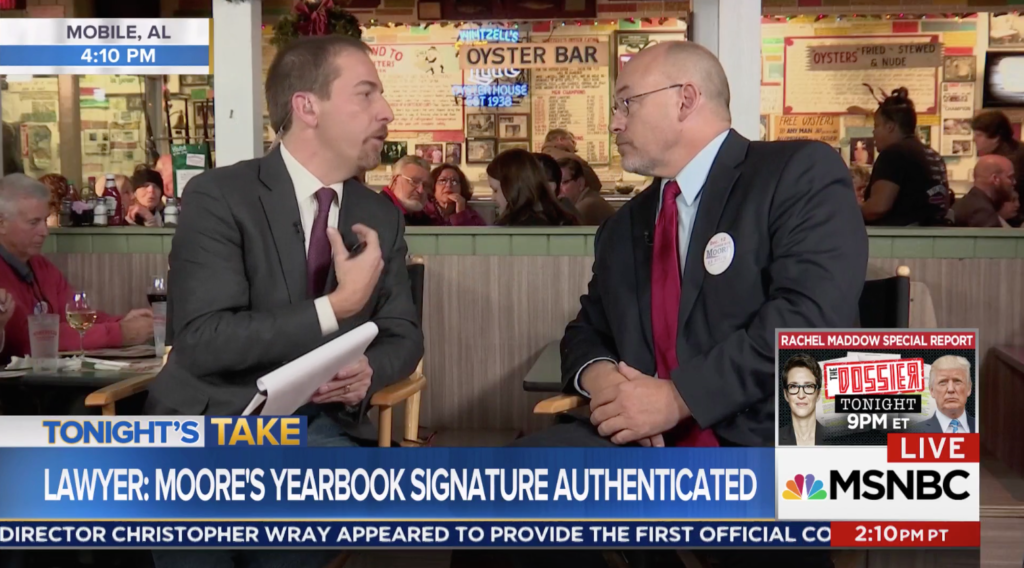
With just four days to go before the special election, MSNBC’s Chuck Todd took “MTP Daily,” a spinoff of the Sunday show “Meet the Press,” on the road to Alabama Friday ahead of the state’s Tuesday Senate race. “It’s snowing heavily in Alabama, really, and that’s nowhere near the craziest thing that’s happening here,” said Todd from Wintzell’s Oyster House in downtown Mobile, Ala. introducing the show. There, he sat down with several guests to discuss the heated race between Republican Roy Moore and Democrat Doug Jones. Todd sits down with Dean Young His first guest of the show was Dean Young, campaign strategist for Roy Moore. Young told Todd that Moore will help the country “get back to the Constitution and godly principles that made this country great” and he has “no doubt” his candidate will win on Tuesday. “How does he effectively serve in the United States Senate, when his fellow republican senator, if he gets elected, Richard Shelby, didn’t won’t to vote for him, said he wrote somebody in. Mitch McConnell doesn’t want him there. I’d say at least half of the Republican Senate conferences on the record, saying they want to see him potentially expelled from the Senate. How can he represent Alabama effectively?” Todd queried. “He’ll be effective,” Young responded. “Look at what’s happening now, so when he goes up to Washington, they count on him standing for what’s right, what’s just and what’s fair.” When pressed whether or not he had any doubt as to whether Moore would win, Young simply answered, Nope.”
Donald Trump looking to Sarah Huckabee Sanders in tough moments
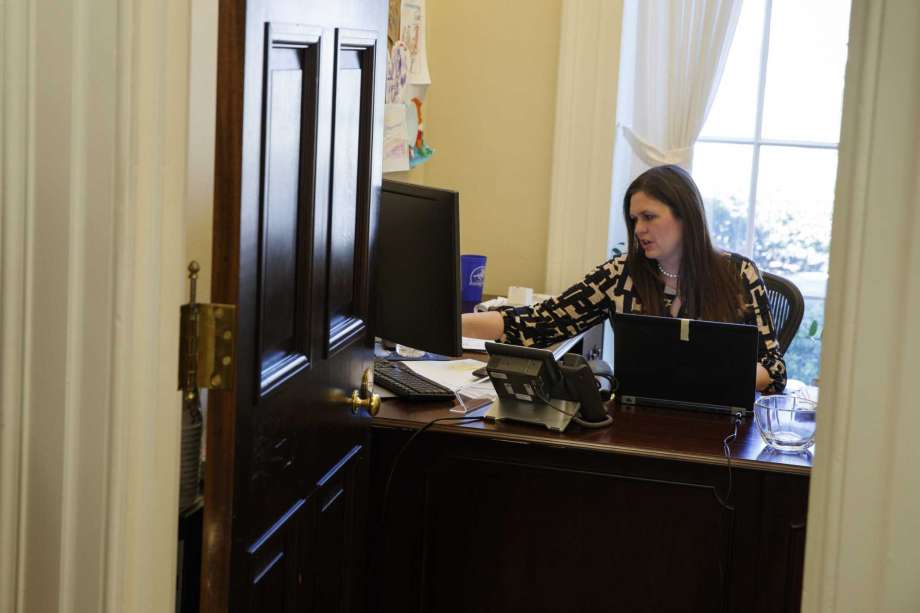
Faced with aggressive on-air questioning about the president’s wiretapping claims, Sarah Huckabee Sanders didn’t flinch, she went folksy. Speaking to George Stephanopoulos on “Good Morning America,” she pulled out a version of an old line from President Lyndon Johnson: “If the president walked across the Potomac, the media would be reporting that he could not swim.” The 34-year-old spokeswoman for President Donald Trump was schooled in hardscrabble politics — and down-home rhetoric — from a young age by her father, former Arkansas Gov. Mike Huckabee. Her way with a zinger — and her unshakable loyalty to an often unpredictable boss — are big reasons why the deputy press secretary is a rising star in Trump’s orbit. In recent weeks, Sanders has taken on a notably more prominent role in selling Trump’s agenda, including on television and at White House press briefings. As White House press secretary Sean Spicer’s public profile has fluctuated in recent weeks amid criticism of his performance, Sanders has increasingly become a chief defender of Trump in some of his toughest moments. Sanders’ rise has fueled speculation that she’s becoming the president’s favored articulator, a notion she disputes. “It’s hard for any one person to maintain a schedule of being the singular face all day every day,” she said. She argued that more than one press aide spoke for President Barack Obama. “When Eric Schultz went on TV did anybody say Josh Earnest is getting fired?” Sanders asked. “Was that story ever written?” Spicer echoed that message: “My goal is to use other key folks in the administration and the White House to do the shows.” Indeed, speaking on behalf of this president is a challenging and consuming job. Trump often presents his own thoughts directly on Twitter in the early hours of the morning and is known to closely follow his surrogates on television, assessing their performances. He has been happy with Sanders’ advocacy, said Kellyanne Conway, a counselor to the president. “She understands America. She understands the president. And she understands how to connect the two,” said Conway, who noted that Sanders had appeared on television throughout the campaign as well. “The president has a great deal of trust in Sarah.” On some days recently Sanders has been the administration’s messenger of choice, even when news outlets aren’t thrilled. Last Sunday, NBC’s Chuck Todd said on-air that “Meet the Press” had sought a “senior administration official or a Cabinet secretary,” but that the “White House offered a deputy press secretary. And so we declined.” Sanders credits her larger-than-life dad with helping her learn how to deliver a message. Huckabee, a frequent political commentator, has long been famed for his pithy rhetoric. The two speak most mornings before 6 a.m. “I’ll call and say, ‘What do you think if I say this?’ He’ll say, ‘That’s really good. You might try to say it a little bit more like X,’” she said. On advocating for the unconventional Trump, Sanders admits that even in the press office, they don’t always get a heads up before Trump tweets. But she says part of Trump’s appeal is that he “directly communicates with the American people on a regular basis.” Arkansas-raised, Sanders moved her young family to Washington to be part of the administration. She is married to a Republican consultant and they have three young children. She joined the Trump campaign not long after her father’s second presidential bid — which she managed — fizzled out in the 2016 Iowa caucuses. She said she was drawn to Trump’s message of economic populism and his outsider attitude. “One of the big things my dad was running on was changing Washington, breaking that cycle,” Sanders said. “I felt like the outsider component was important and I thought he had the ability to actually win and defeat Hillary.” She also said she was drawn to the Trump family’s close involvement in the campaign, “having kind of been in the same scenario for my dad’s campaign.” Being part of an effort to defeat Hillary Clinton had extra significance for Sanders, whose father entered the Arkansas governor’s mansion just a few years after Bill Clinton exited and who shared advisers and friends in the state. Sanders said at times it was difficult to be aggressive, but she “so disagreed” with Hillary Clinton’s policies, that she kept on. Sanders entered politics young, helping with her father’s campaigns as a child and then working her way up the ranks until she had the top job in 2016. In 2007, she moved to Iowa to run her father’s operation in the leadoff caucus state, where he was the surprise winner. She has also served in the Education Department under President George W. Bush and worked on a number of Senate and presidential campaigns. Mike Huckabee said his daughter was always a natural. “When most kids at 7 or 8 are jumping rope, she’s sitting at the kitchen table listening to Dick Morris doing cross tabs on statewide polls,” said Huckabee, referring to the adviser-turned-adversary to President Bill Clinton. Those Arkansas ties continue to hold strong. Sanders has consulted with friends from the state about her new role, including Mack McLarty, the former Clinton chief of staff, who she said counseled her to appreciate the “historic opportunity” to work in the White House. Her rising profile has come with ups and downs. Sanders says she is turning off social media alerts because she has been flooded with criticism. For now, she has not been treated to a portrayal on “Saturday Night Live” — like Spicer and Conway. But her dad says that if that comes next, she should roll with it. “One of the great honors of life is to be parodied,” Huckabee said. “It’s kind of an indication that you’ve arrived at a place of real power.” Republished with permission of The Associated Press.
Donald Trump auditions Cabinet prospects high above Manhattan

Donald Trump held court from his perch high above Manhattan on Monday, receiving a line of former rivals, longtime allies and TV executives while overseeing a presidential transition that at times resembles a reality show like the one he once hosted. Trump met with nearly a dozen prospective hires, all of whom were paraded in front of the cameras set up in the Trump Tower lobby as they entered an elevator to see the president-elect. Out of public view himself, he fell back on his TV star roots by filming a video that touted his legislative goals once he takes office. Trump; did not immediately announce any appointments after the meetings, which came on the heels of a two-day whirlwind of interviews at his golf course in Bedminster, New Jersey. Unlike his predecessors, who often spoke with Cabinet candidates under a cloud of secrecy, Trump has turned the search into a very public audition process. The extraordinary exercise took on a routine feel on Monday: First, former Massachusetts Senator Scott Brown stepped off the gold-plated elevator into the marble-coated lobby after his meeting to declare to waiting reporters that he was “the best person” to become Veterans Affairs secretary. Next, Oklahoma Gov. Mary Fallin, a candidate for interior secretary, did much the same, striding off the lift to say she had “a wonderful discussion” with Trump. Former Texas Governor Rick Perry declined to speak to reporters, but he did take time for a photo with the Naked Cowboy, the underwear-sporting, guitar-strumming New York institution who is normally a fixture at Times Square but has spent recent days camped out at Trump Tower singing about the president-elect. Democratic Hawaii Rep. Tulsi Gabbard, who resigned her post on the Democratic National Committee after endorsing Bernie Sanders over Hillary Clinton, also met with Trump but entered and exited out of sight. She later defended crossing party lines to meet with Trump about U.S. involvement in Syria, saying in a statement she would never “play politics with American and Syrian lives.” Former House Speaker Newt Gingrich, a longtime Trump ally, also arrived with his wife, Callista, and told reporters that he indicated to Trump that he was interested in being a “senior planner” to coordinate long-term political efforts among the Republicans in control of all three branches of government. Senior adviser Kellyanne Conway said of the visitors, “Not all of them will be in his Cabinet and his federal government, but they are all incredibly important in offering their points of views, their experience and certainly their vision of the country.” No one was saying whether Trump would announce more appointments before heading to Florida for Thanksgiving. He was planning to leave Tuesday or Wednesday to spend the holiday at his Mar-a-Lago estate, while Vice President-elect Mike Pence will spend Thanksgiving in Mississippi, where his Marine son is stationed. Trump has largely remained out of sight since winning the election, save for a flurry of brief public appearances over the weekend, often with Pence at his side, to flash thumbs-ups and provide quick updates on his progress in building a government. He remained in the upper floors of his skyscraper Monday, seeking counsel on the phone and interviewing candidates all while keeping an eye on the cable news coverage of the day’s events. He appeared in a two-and-a-half minute video released late Monday in which he pledged to the American people that he was appointing “patriots” to his administration and reiterated a number of his campaign promises, including plans to renegotiate trade deals, scrap excessive regulations and institute a five-year ban on executive officials becoming lobbyists. The video — which made no mention of key pledges to build a border wall with Mexico or repeal the Affordable Care Act — continues the president-elect’s practice of trying to go over the heads of the media and take his case directly to the American public. Since Election Day, he has twice ditched the group of reporters designated to follow his movements and has so far eschewed the traditional news conference held by the president-elect in the days after winning. Trump has not held a full-fledged news conference since July. But the media were clearly on his mind as he met with executives and on-air personalities from TV networks. He frequently singled out the media — declaring them “so dishonest” — for criticism during the campaign, but it’s not unusual for presidents to hold off-the-record meetings with journalists when trying to promote policies or programs. Among the attendees were NBC anchor Lester Holt and “Meet the Press” host Chuck Todd, ABC’s “Good Morning America” host George Stephanopoulos and anchor David Muir, CBS’ “Face the Nation” host John Dickerson, CNN’s Wolf Blitzer and several executives at the networks. None of the attendees would discuss the meeting with reporters in the lobby, though Conway said it was “very cordial, very productive, very congenial.” Those Trump met with over the weekend included former Massachusetts Gov. Mitt Romney, a former critic now being considered for secretary of state; retired Marine Corps Gen. James Mattis, who Trump dubbed an “impressive” prospect for defense secretary, and billionaire investor Wilbur Ross, who is under consideration for Commerce secretary. “We’ve made a couple of deals,” Trump said Sunday. He gave assurances that “incredible meetings” would be bringing “incredible people” into the government. Republished with permission of the Associated Press.
Wrong number? Donald Trump’s TV telephone interviews in spotlight

In television news, a telephone interview is typically frowned upon. Donald Trump‘s fondness for them is changing habits and causing consternation in newsrooms, while challenging political traditions. Two organizations are circulating petitions to encourage Sunday morning political shows to hang up on Trump. Some prominent holdouts, like Fox’s Chris Wallace, refuse to do on-air phoners. Others argue that a phone interview is better than no interview at all. Except in news emergencies, producers usually avoid phoners because television is a visual medium — a face-to-face discussion between a newsmaker and questioner is preferable to a picture of an anchor listening to a disembodied voice. It’s easy to see why Trump likes them. There’s no travel or TV makeup involved; if he wishes to, Trump can talk to Matt Lauer without changing out of his pajamas. They often put an interviewer at a disadvantage, since it’s harder to interrupt or ask follow-up questions, and impossible to tell if a subject is being coached. Face-to-face interviews let viewers see a candidate physically react to a tough question and think on his feet, said Chris Licht, executive producer of “CBS This Morning.” Sometimes that’s as important as what is being said. Trump tends to take over phone interviews and can get his message out with little challenge, Wallace said. “The Sunday show, in the broadcast landscape, I feel is a gold standard for probing interviews,” said Wallace, host of “Fox News Sunday.” ”The idea that you would do a phone interview, not face-to-face or not by satellite, with a presidential candidate — I’d never seen it before, and I was quite frankly shocked that my competitors were doing it.” Since Trump announced his candidacy in June 2015, Wallace has conducted three in-person interviews with him on “Fox News Sunday,” and four via satellite. Chuck Todd, host of NBC’s “Meet the Press,” has done phoners with Trump but now said he’s decided to stick to in-person interviews on his Sunday show. He’s no absolutist, though. “It’s a much better viewer experience when it’s in person,” Todd said. “Satellite and phoners are a little harder, there’s no doubt about it. But at the end of the day, you’ll take something over nothing.” Morning news shows do phoners most frequently. At the outset of the campaign, Trump was ratings catnip. The ratings impact of a Trump interview has since settled down, but it’s still hard to turn him down. He’s the leading contender for the Republican presidential nomination. He’s news. There appear to be no network policies; different shows on the same network have different philosophies. Licht has turned Trump down for phoners on CBS but concedes there may be exceptions for breaking news. “CBS This Morning,” in fact, aired Trump commenting by phone following Tuesday’s attack in Belgium. Since the campaign began, Trump has appeared for 29 phone interviews on the five Sunday political panel shows, according to the liberal watchdog Media Matters for America. Through last Sunday, ABC’s “This Week” has done it 10 times, CBS’ “Face the Nation” seven and six times each on “Meet the Press” and CNN’s “State of the Union.” None of these shows has done phoners with Ted Cruz, John Kasich, Hillary Clinton or Bernie Sanders, said Media Matters, which is urging that the practice be discontinued. The activist group MomsRising said the disparity “sends the message that some candidates can play by different rules, without consequences, and that’s just un-American.” A study by mediaQuant and The New York Times estimated that Trump has received the equivalent of $1.9 billion in free advertising given the media attention paid to his campaign. A Trump spokeswoman did not immediately return a request for comment. What’s unclear is whether other candidates were denied opportunities given to Trump. CNN chief executive Jeff Zucker said Trump opponents frequently turn down interview requests. During an appearance on CNN last week, former GOP candidate Carly Fiorina complained about media attention paid to Trump, leading Anderson Cooper to shoot back: “Donald Trump returned phone calls and was willing to do interviews, which was something your campaign, frankly, was unwilling to do.” Cruz spokeswoman Catherine Frazier tweeted last week that she saw Trump being interviewed via phone on “Fox & Friends” a day after Cruz was told that he couldn’t do a phone interview with the show. Fox said that since then, “Fox & Friends” has offered to conduct a phone interview with Cruz five times and has been turned down each time. Cruz did appear in the studio Wednesday. Frazier did not return requests for comment. NBC’s Todd believes that complaints about phoners are a surrogate for people who want to blame the media for Trump’s success. “You’re shooting the messenger while you’re ignoring what he is tapping into,” he said. “It becomes a little silly when you look at the bigger picture here. The media is getting criticized for interviewing Donald Trump. If we weren’t questioning him, we’d be criticized for not questioning him.” For years, cautious candidates have tended to be stingy with press access. Trump is the complete opposite. In a fast-moving information age, he may be changing the expectations for how often a candidate submits to interviews. Todd doesn’t believe it’s a coincidence that he’s had more access to Clinton during the past six weeks than he had during the six years she was in the Obama administration. Both Clinton and Cruz appeared in phone interviews following the Belgium attacks. “Trump’s opponents fall into two camps: Those who complain and continue to get crushed by the media wave, or those who grab a surfboard and try to ride it,” said Mark McKinnon, veteran Republican political operative and co-host of Showtime’s political road show, “The Circus.” Republished with permission of the Associated Press.
On MTP, Jeb Bush says Marco Rubio has “given up” on his day job
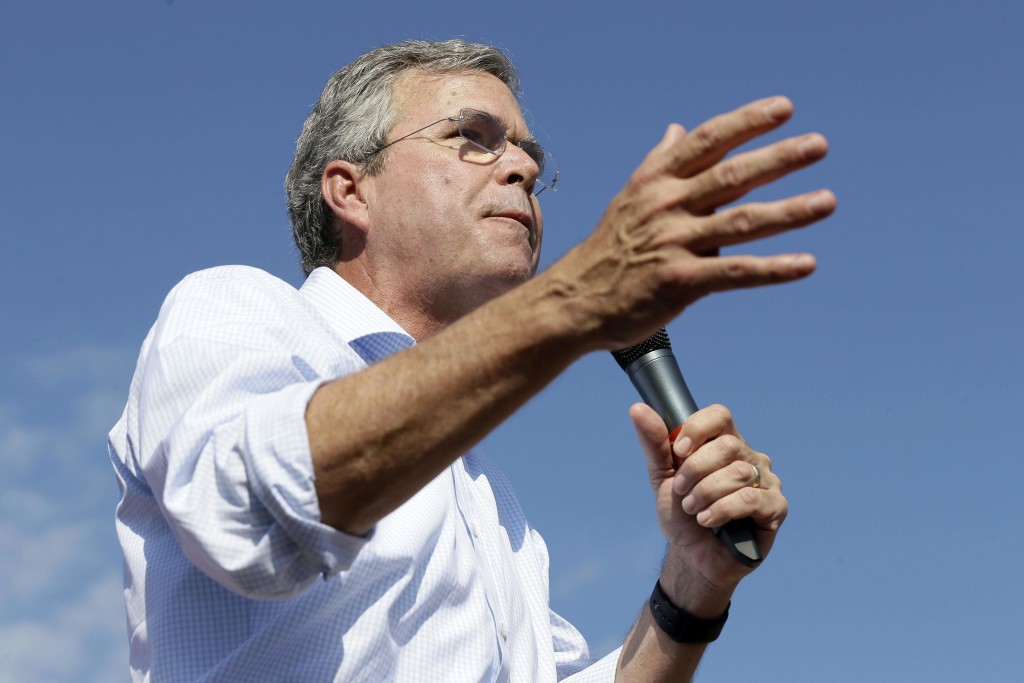
Although he’s been hammered by the punditry class for getting schooled by Marco Rubio for daring to bring up his poor voting record in the U.S. Senate at last week’s GOP presidential debate, Jeb Bush said today that he has no regrets about doing so. “I got to be governor of a state and accomplish big things,” Bush told Meet The Press’s (MTP) Chuck Todd in an interview taped on Saturday in Miami and aired on Sunday morning. “And in this era of gridlock, it’s really hard to break through, and I think he’s given up. And I think that’s the wrong thing to do. This is about public service, about solving problems. If you look at the three people on the stage from the United States Senate, all three of them have a combined two bills that became law that they’ve sponsored. If you look at Hillary Clinton, in ten years, three bills she sponsored that became law. This is the gridlock that I’m running to try to break up. I can change the culture in Washington.” Bush insisted that he hadn’t seen the 112-page memo from his presidential campaign detailing why Rubio is a “risky bet” for the Republican Party before it leaked. “I didn’t see it,” he said. “Well, I read about it when it was leaked for sure. I didn’t know about the PowerPoint.” Bush told Todd that while he knows he needs to get better at debates after being considered to done poorly at last Wednesday night’s affair in Boulder, he hasn’t watched a tape of it, and doesn’t intend to. Bush answered a question by CNBC’s Carl Quintanilla about whether there should be an investigation of daily fantasy sports products DraftKings and FanDuel, but Chris Christie seemed to be impugning both men afterwards in expressing revulsion at such a question asked at a debate. Bush seemed to concede that he should have answered it differently. “My focus in the debate, I will change the whole conversation,” he told Todd. “So if someone asks me about Fantasy Football next time, which was kind of bizarre if you think about it, I’ll talk about the people I’ve met that are really worried that they have declining income.” Bush will appear in Tampa, Orlando and Jacksonville on Monday. He said that his speech in Tampa will be about how Republicans need to be hopeful and optimistic and have an aspirational message, which doesn’t seem like something he hasn’t been saying on the stump for sometime. Bush said he maintain a belief he’s had for decades – that there should be no litmus tests for Supreme Court Justice appointees, which is usually said in reference to the abortion issue. Interestingly, he said he’s having an internal debate about his feelings on the death penalty. “I’m conflicted,” he confessed to Todd.”I am. It was the law of the land when I was governor, and I faithfully dealt with it. To be honest with you, it is not a deterrent anymore because it’s seldom used. It clogs up the courts, it costs a ton of money. And– CHUCK TODD: Are you one of those that look at the fiscal part of it and say, “You know what? Maybe it makes more fiscal sense to not do it”? JEB BUSH: Here’s the one thing, and it’s hard for me, as a human being, to sign the death warrant, to be honest with you. I’m informed by my faith in many things, and this is one of them. So I have to admit that I’m conflicted about this. But here’s the deal, when you meet people, this happens in rare cases where the death penalty’s given out and you meet family members that have lost a loved one and it’s still in their heart. It’s etched in their soul. And this is the way that they get closure, I get more comfortable with it, to be honest with you. But we should reform it. If it’s to be used as a deterrent, it has to be reformed. It can’t take 25 years. That does no one any good. Neither the victims nor the state is solving this problem with that kind of tangled judicial process. CHUCK TODD: So you’re still in favor of it, but? JEB BUSH: Yeah, but I’m just saying, look, this is life, Chuck. It’s not all either/or. Sometimes you can see both sides. And I believe life is truly a gift from God, and innocent life particularly should be protected at all cost, for sure. But people that commit these crimes, there should be– justice can’t be denied. And it shouldn’t be delayed. And maybe there’s a better way to do this where victims feel as though they’re being served, because that should be front and center, the first obligation of the state.
