
Clinton team sees recount effort as waste of resources
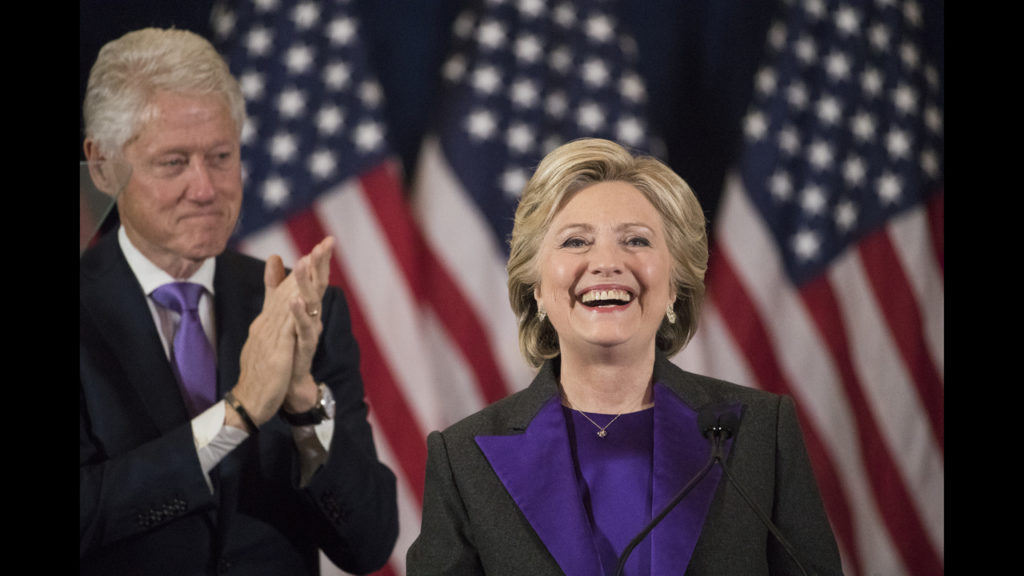
Hillary Clinton‘s aides and supporters are urging dispirited Democrats to channel their frustrations about the election results into political causes — just not into efforts to recount ballots in three battleground states. The former Democratic presidential candidate and her close aides see the recount drive largely as a waste of resources, according to people close to Clinton. The effort is being fueled by Green Party candidate Jill Stein, who’s formed an organization to try to force recounts in Wisconsin, Michigan and Pennsylvania. “Believe me if there was anything I could do to make Hillary Clinton the next president of the United States I would,” said former Pennsylvania Gov. Ed Rendell, a longtime Clinton supporter. “But this is a big waste of time.” Aides say Clinton is focused on moving past her unexpected defeat and has devoted little attention to the recount or thinking about her political future. She’s been spending time with her grandchildren and going for walks near her Westchester home. Sightings of Clinton hiking with her dogs and shopping at a Rhode Island bookstore went viral on social media. “There have been a few times this past week where all I wanted to do was curl up with a good book and our dogs and never leave the house again,” Clinton said in an emotional speech at a gala for the Children’s Defense Fund, her one public appearance since her loss. Former President Bill Clinton, meanwhile, has been poring over the election results, second-guessing decisions by top campaign aides and intensely trying to figure out how his wife lost the white working-class voters who were the base of his electoral coalition, say people familiar with the campaign. Clinton’s team was aware of possible discrepancies soon after the election, telling top donors on a conference call four days after the election that they were looking into potential problems in the three states. But while many campaign staffers believe Russian hacking influenced the outcome of the election, blaming foreign actors for incursions into campaign and Democratic National Committee emails, they’ve found no evidence of the kind of widespread ballot box tampering that would change the results of the race — or even flip a single state. Still, some dejected Clinton supporters have been unwilling to accept the results. Stein has raised $6.5 million for her recount campaign, according to a count posted on her campaign website on Tuesday. That’s nearly double the roughly $3.5 million she raised during her entire presidential bid. Some former Clinton aides have asked frustrated supporters to donate their dollars to what they view as more constructive causes, like state parties or the Democratic candidate in Louisiana, where a Dec. 10 runoff will be the party’s last chance to pick up a Senate seat this year. “I wouldn’t give a dollar to Jill Stein,” said Adam Parkhomenko, a longtime Clinton aide. “Volunteers, supporters and Democrats, they want to pick themselves up and get back out there. The best vehicle to do that is the Louisiana Senate race.” Clinton’s team conducted an exhaustive investigation into the possibility of outside interference in the vote tally, tasking lawyers, data scientists and political analysts to comb over the results. They contacted outside experts, examined the laws governing recounts and double-checked all the vote tallies. The campaign found no “evidence of manipulation,” wrote Marc Elias, the general counsel for Clinton’s campaign, in an online essay. But, he said, Clinton agreed to minimal participation in Stein’s effort, largely to make sure that her interests are represented. They put out a call for volunteers to monitor the proceedings and are relying on local lawyers to handle filings and other legal matters. Clinton is under pressure to participate from her supporters, some of whom have struggled to accept the election results given her lead in the popular vote, which has grown to more than 2.3 million in the weeks after the Nov. 8 election. “Now that a recount is underway, we believe we have an obligation to the more than 64 million Americans who cast ballots for Hillary Clinton to participate in ongoing proceedings to ensure that an accurate vote count will be reported,” Elias wrote. Clinton’s lawyers filed motions with a Wisconsin judge on Tuesday looking to join Stein’s lawsuit demanding that Wisconsin officials recount ballots by hand. The state elections commission will formally began the recount on Thursday. Stein’s organization has also filed for recounts in six of Pennsylvania’s largest counties and says it plans to file a petition Wednesday demanding a Michigan recount. “It’s election law malpractice to not have your lawyers sitting around the table with Jill Stein’s lawyers,” said Adam Ambrogi, elections program director at the bipartisan Democracy Fund. “It is just due diligence.” Republished with permission of The Associated Press.
Joe Henderson: Can America bridge the Great Divide?

Pundits and political pros have been talking about the Great Divide Among Americans, and we all know it is there. It always has been. People in a country this large and diverse are going to have different ways of looking at things, but we usually come together at some point and work out the problems. At least, that’s how it used to be. I’m starting to wonder, though, if those days are gone for good. For Exhibit A, I bring you The Washington Post/ABC News poll released Sunday. The Post wrote, “Never in the history of the Post-ABC poll have the two major party nominees been viewed as harshly as (Hillary) Clinton and (Donald) Trump.” That’s some plain talk, but let’s make it even more blunt. Boiled down to its essence, this poll indicates about half of the registered voters in America will literally hate whoever wins the election to lead this country. When Clinton supporters were asked why they would vote for her, 48 percent said it’s because they oppose Trump. It was the same story with Trump, where 53 percent of respondents said they’ll go for him because they can’t stomach Clinton. And 86 percent of those people said they could never vote for Clinton. Also, there’s this nugget: 48 percent of Trump’s supporters said he doesn’t represent the GOP’s core values, but they’ll vote for him anyway because they hate Hillary that much. Maybe we should have seen this coming, because there is no compromise on some of the sharpest issues that divide us. There is never going to be middle ground on a hot-button issue like abortion, but now you stir divisive topics like LGBT rights, immigration, climate change, gun control, police behavior and, yes, even the national debt into the stew. With so many information outlets available masquerading as “news services,” people aligned with one side or the other can find a source that reinforces their beliefs. And discourse being what it is – Trump has raised shouting and debasement to an art form – voila! Hatred becomes a platform. Bringing the nation together is a noble sentiment, and either Trump or Clinton will vow to do that come November. The numbers say that will be just another campaign promise neither can keep.
Democratic advertising blitz awaits Donald Trump
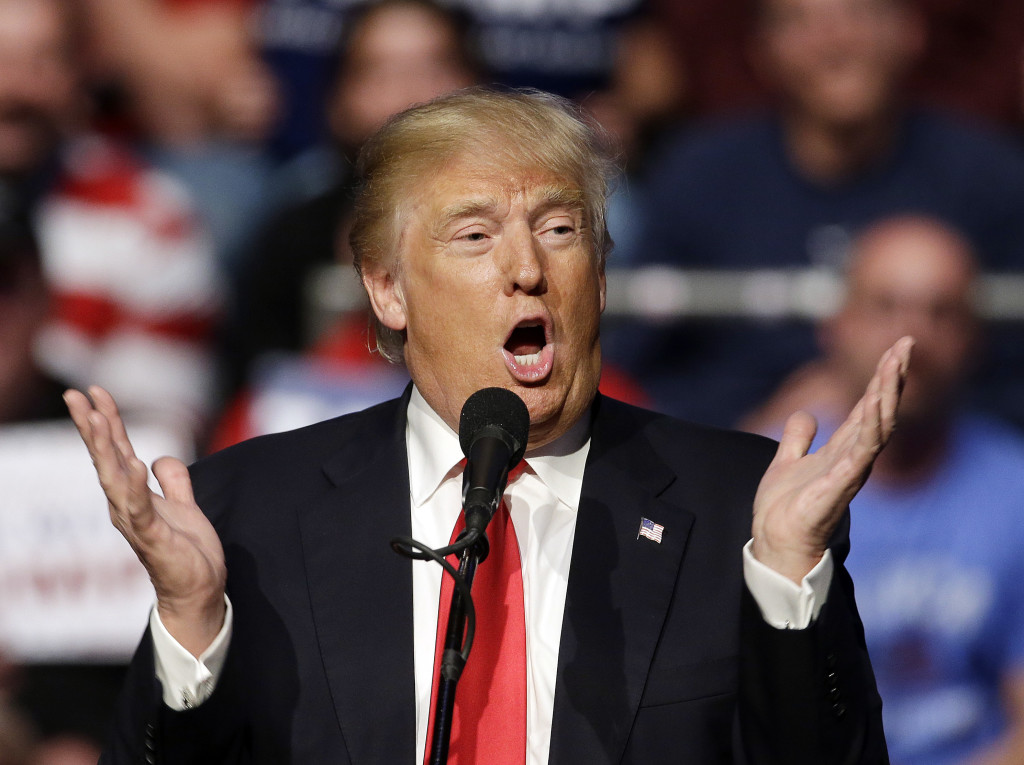
Long before Donald Trump swatted away his Republican presidential rivals, his likely Democratic opponent and her allies began laying traps for him. Priorities USA, the lead super PAC backing Hillary Clinton, has already reserved $91 million in television advertising that will start next month and continue through Election Day. In addition, Clinton’s campaign and Priorities USA have both debuted online videos that cast Trump in a negative light — a preview of what voters will see on TV over the next six months. So far, Priorities USA is the only group on either side that has rolled out such an ambitious advertising plan geared toward the general election. The group’s leaders say they’re trying to avoid what they see as the core mistake made by Trump’s Republican rivals — not pushing hard enough against him until it was too late. “There’s a reason that we have a head start,” said Justin Barasky, a Priorities USA spokesman, “and it’s that we’ve taken Donald Trump seriously all along, unlike the Republicans.” The group’s ad strategy will test what has been a hallmark of Trump’s GOP primary rise: his ability to withstand — even thrive in the face of — tens of millions of dollars in attack ads. An Associated Press review of Priorities USA’s TV buys, collected by Kantar Media’s Campaign Media Analysis Group, reveals a formidable 22-week advertising blitz through what the group considers key battleground states: Colorado, Florida, Iowa, Nevada, New Hampshire, Ohio and Virginia. In those states, Priorities USA will start ads in major metropolitan areas, then broaden its outreach to smaller cities as the November election approaches. The group will also start ads on satellite TV in September. According to the CMAG data, Priorities USA plans to spend about $4 million a week through most of June. The group then slows spending through July, taking off the weeks of the Republican and Democratic conventions, when widespread television coverage essentially provides free media time for the candidates. Priorities USA returns to the airwaves in August and begins unloading $60 million in ads between September and Election Day. The week of the election, Priorities USA plans to spend about $8 million in the seven battleground states. The heaviest concentration is in Florida, where the group has reserved $23 million in time, mostly in Orlando and in Tampa. The group also plans to spend about $19.5 million in the traditional presidential bellwether state of Ohio. More than half is for Cleveland, Akron and Columbus. There’s no substantive GOP counterweight to the pro-Clinton effort — partly because Trump has repeatedly trashed big donors and called the outside groups that can raise unlimited money from them “corrupt.” As the presumptive GOP nominee, Trump is now beginning his outreach to donors. But even if he fully embraces outside help, he’s far behind: One super PAC backing him, Great America, was almost $700,000 in debt at the end of March. Another group that was a major player in the 2012 race, American Crossroads, is still “evaluating what our specific role will be,” said spokesman Ian Prior. Television ads are only one part of Priorities USA’s strategy. It is putting at least $35 million into online advertising between June and Election Day, Barasky said. Those ads will largely aim to drive up turnout among core Democratic groups: African-Americans, Hispanics, women and younger voters, Barasky said. Trump is already getting a taste of what some these ads will say. On Thursday, Priorities USA overlaid audio of Trump talking about “unifying” the Republican Party with images of violence that has erupted inside and outside of his massive rallies. “I think we’re going to win in November,” Trump says at the end. “NOPE,” reads text on the screen. “Vote for Hillary Clinton.” That follows an online video the Clinton campaign put out Wednesday that features clips of prominent Republicans, including his former rivals, bashing Trump in every possible way. “He needs therapy,” says former Florida Gov. Jeb Bush at the end of the spot. Republished with permission of the Associated Press.
Hillary Clinton aims to reset campaign with focus on black voters
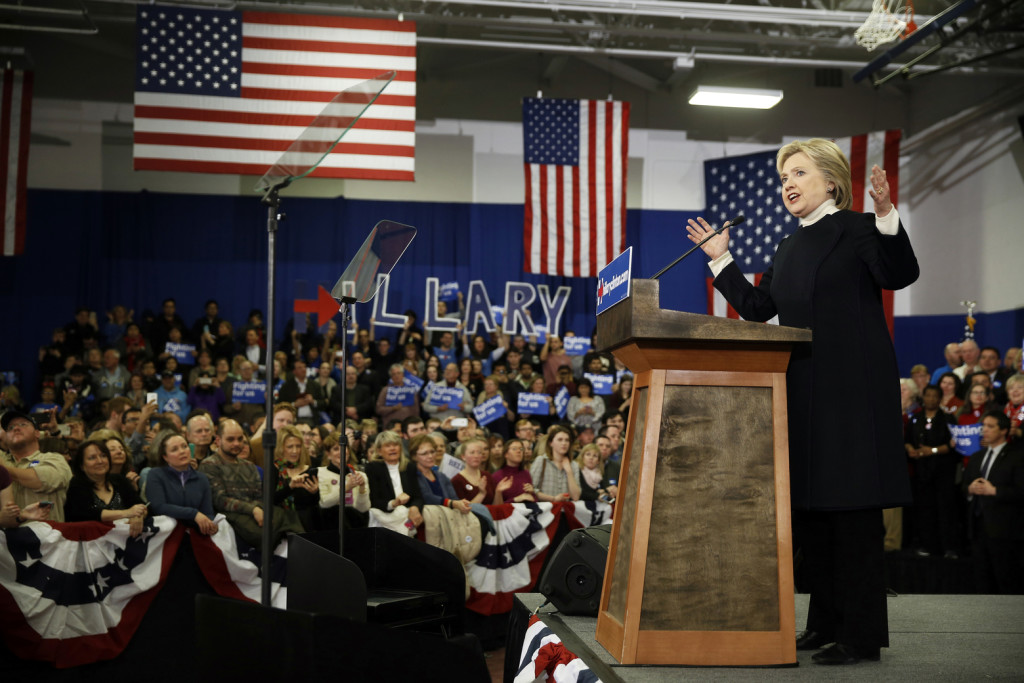
After an overwhelming loss in New Hampshire, Hillary Clinton is staking a campaign comeback on her ability to woo black and Latino voters, placing outreach to those communities at the center of her strategy to retool her 2016 bid. The 22-point loss to rival Bernie Sanders in this week’s primary heightened concerns among Democrats that Clinton’s message is failing to win over both women and young voters — two key parts of the coalition that twice elected Barack Obama to the White House. The New Hampshire defeat, along with Clinton’s razor-thin win in the leadoff Iowa caucuses, raised the stakes for Clinton to rally minority voters — another pillar of the Obama coalition — in the contests coming up in Nevada and South Carolina. As the contest fans out across the country, Clinton’s campaign is casting her as a stalwart advocate for racial justice, tracing back to her days working for the Children’s Defense Fund in the 1970s. She will tie her future even closer to Obama, a deeply beloved figure among black Americans. Clinton also plans to intensify her focus on issues of importance to minority voters, such as immigration, civil rights and gun control, dispatching African-American supporters to make her case and launching a flurry of attacks to undermine any credibility Sanders may be building within the black community. Focus-group surveys conducted by Clinton’s campaign with undecided black voters in Charleston found that the former secretary of state has retained a high degree of trust with African-Americans, even as her numbers on trust and honesty have declined overall, according to Clinton aides. While the voters were open to Sanders and liked his economic message, their views shifted after hearing about his plans to replace the Affordable Care Act with a single-payer health care system and his past opposition to gun control measures, the aides said. “One candidate voted to give immunity to the gun manufacturers and opposed the Brady bill. … I can’t get past that,” said Rep. Cedric Richmond, D-La., on Thursday as the Congressional Black Caucus’ political action committee endorsed Clinton. While Clinton still holds a big lead among party insiders known as superdelegates, who can support the candidate of their choice, the first two contests made clear that Sanders has undermined her once dominant position as the nomination favorite. Her aides believe the next two contests and the primaries that follow in March, where minority voters make up a larger slice of the electorate than in overwhelmingly white Iowa and New Hampshire, could essentially decide the race. She already has a head start with black voters. An NBC News/Wall Street Journal/Marist Poll in late January showed African-American voters said they preferred Clinton to Sanders, 74 percent to 17 percent Since New Hampshire, Clinton has launched a full-scale press, unveiling endorsements from top African-American leaders. At the CBC event on Thursday, Georgia Rep. John Lewis, a civil rights icon, said he would travel to South Carolina this weekend to campaign for her. Clinton’s team will also be rolling out the support of 119 black legislators in the March voting states. And she’ll be endorsed by faith leaders in Flint, Michigan, adding to the 28 ministers and 50 black mayors who’ve already expressed support. Meanwhile, Clinton supporters are targeting Sanders’ record on issues like racial equality and criminal justice, even playing down his early support for the civil rights movement as a college student who joined the 1963 March on Washington. “Thousands of people walked on Washington. What are the real policy issues or legislation that he has presented?” said Dr. Hazel Dukes, president of the NAACP’s New York State Conference. On Friday, Clinton will head to rural Bamberg County, South Carolina, a poor, majority-black area, to hold a town hall on racial and economic disparities. She’s holding a Monday campaign event in Riviera Beach, Florida, a majority African-American city, before meeting with civil rights leaders on Tuesday and holding a campaign event with the mother of Sandra Bland, the Chicago-area woman whose death in a Texas jail cell has become a rallying cry for criminal justice reform. Former President Bill Clinton is being dispatched to Memphis, Atlanta and Florence, South Carolina, and the Clintons’ daughter, Chelsea, is heading to Flint, where the crisis over water has become a symbol of racial and economic inequality. Sanders’ campaign plans to promote his personal story, arguing that his early work as a college civil rights activist and his message of economic equality will help diversify his support. On Wednesday, he held a heavily publicized breakfast with civil rights activist Al Sharpton in Harlem, and Ta-Nehisi Coates, an influential writer on racial issues, said he would vote for Sanders. But his team also acknowledges that his constituency may be far stronger in states with less diverse Democratic electorates, like Oklahoma, Minnesota, and Massachusetts — all states where they launched new ads on Wednesday. “Bernie Sanders has an incredibly powerful story to tell,” said adviser Tad Devine. “His fight for equality and civil rights, his fight against inequality and economic injustice is very, very powerful. It’s going to resonate with the African-American community.” Republished with permission of the Associated Press.
Hillary Clinton proposes $275 billion in new infrastructure spending

Hillary Rodham Clinton called for hundreds of billions in new federal spending on infrastructure on Sunday, kicking off what her campaign says will be a month-long focus on job creation. Standing before a backdrop of union workers and students, the Democratic presidential frontrunner vowed to rebuild “ladders of opportunity” and give a greater number of Americans a “middle-class lifestyle.” “Investing infrastructure makes our economy more productive and competitive,” she said at the launch of “Hard Hats for Hillary,” a new effort by her campaign to mobilize union workers. “To build a strong economy for our future, we must start by building strong infrastructure today.” Clinton was joined by Boston Mayor Marty Walsh, who recently endorsed her campaign, and a number of labor unions backing her bid. “Get your sledgehammers ready because we have a glass ceiling to demolish,” Walsh told a cheering audience crowded into historic Faneuil Hall. The new infrastructure proposals make up the most expensive portion of Clinton’s economic agenda, which her campaign said would exceed the $350 billion she’s already proposed for a college affordability plan. Along with the $275 billion in infrastructure funds, she plans to call for new investments in manufacturing and research in the coming weeks. Her announcement comes as Clinton faces down challenges from Vermont Sen. Bernie Sanders and former Maryland Gov. Martin O’Malley, who’ve both stressed the need to increase direct federal spending. Sanders has proposed legislation that would provide more than $1 trillion in new infrastructure spending over the next five years, paid for by raising taxes on the wealthy and corporations. Clinton’s campaign said she would allocate $250 billion to direct investment by the federal government in crumbling roads, bridges, public transit and airports. An additional $25 billion would fund a national infrastructure bank, an idea unveiled by President Barack Obama in his first term that has been blocked repeatedly by congressional Republicans. The bank would support $225 billion in loans intended to spur private investment in struggling projects, adding a total of $500 billion in new infrastructure funds into the economy, her campaign estimates. Her campaign says their plans would create “good-paying, middle-class jobs,” citing a recent study that found wages for infrastructure workers at $38,810, several thousand dollars higher than the national median. The new federal spending would be paid for by closing corporate loopholes, according to her campaign, which did not detail which tax breaks would be targeted. The Republican National Committee accused Clinton of treating American tax dollars like “every day is black Friday.” “The real reason Hillary Clinton isn’t saying how she’ll pay for her trillion-dollar spending increase is because she knows it means raising taxes on the middle class,” said spokesman Michael Short. Clinton’s campaign says she would limit her tax increases to wealthy Americans. They argue that her chief Democratic rival, Sanders, would require middle-class Americans to pay higher taxes to fund his single-payer health care plan — a charge his campaign disputes. “I’m the only Democrat in this race pledged to raise your income, not your taxes,” Clinton said, in a subtle swipe at Sanders. Sanders’ campaign says that his single-payer health system would save taxpayers money in the long run because it would eliminate wasteful health spending. Republished with permission of the Associated Press.
Bill Clinton opening fundraising spree for wife’s campaign
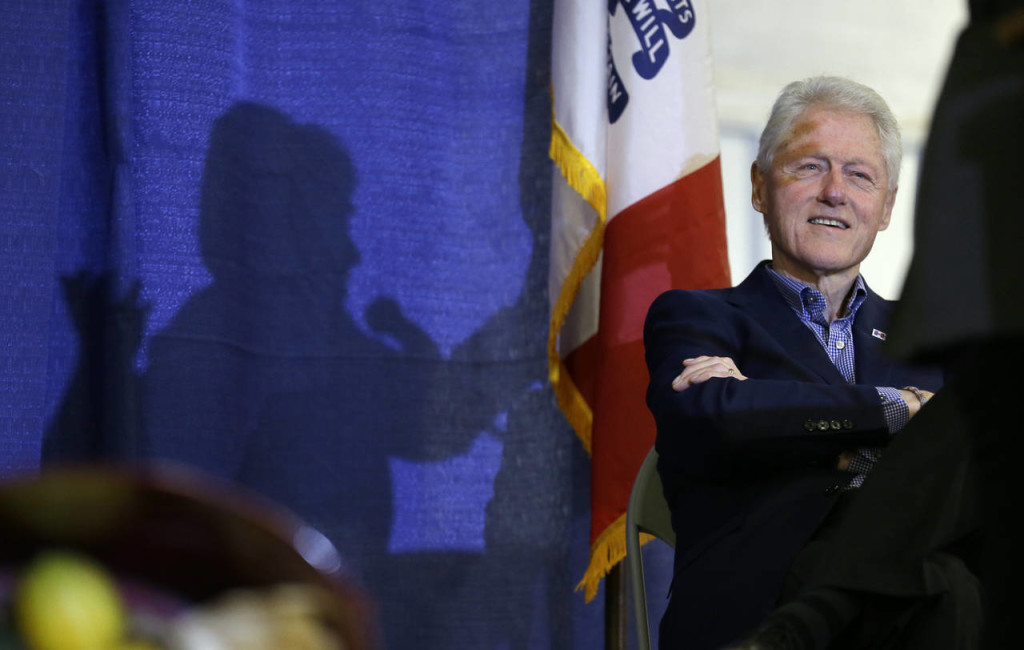
Former President Bill Clinton is going on a fundraising swing reminiscent of his presidential campaigns of the 1990s. But this time he’s doing it for his wife. Hillary Rodham Clinton‘s presidential campaign has scheduled more than a dozen December events featuring the former president as her team prepares for an end-of-year finance deadline ahead of the first contests in Iowa and New Hampshire. The fundraising blitz, Bill Clinton’s most aggressive stretch of the year, shows how Hillary Clinton’s campaign can multiply her money largesse with the help of her husband, one of the Democratic party’s most prolific rainmakers. Working together, the couple will hold at least five fundraising events on some single days in December. After staying behind the scenes for much of the year, Bill Clinton has slowly begun taking a larger public role in the campaign. And it isn’t just with fundraising. He introduced pop singer Katy Perry at a concert before the Iowa Democratic Party’s Jefferson-Jackson dinner last month and appeared with his wife at a party barbecue in Ames, Iowa, last week. “No one knows her better than him and no one knows the process better, so it’s a natural fit,” said Ira Leesfield, a Miami attorney and longtime Clinton donor. “It’s like Derek Jeter taking the field when he was 38.” The fundraising push comes as Vermont Sen. Bernie Sanders, Hillary Clinton’s main Democratic challenger, makes campaign finance reform a central part of his message. Hillary Clinton’s ties to Wall Street and financial industry donors will influence her agenda, Sanders has said. Bill Clinton kicks off December with fundraisers in Seattle, Los Angeles, the Phoenix area and in Laredo, Texas, where he will join with Rep. Henry Cuellar, a Texas congressman who represents the state’s Rio Grande Valley. The former president then raises money on Dec. 7 in Rhode Island with the state’s Democratic governor, Gina Raimondo, and Rhode Island’s congressional delegation. He headlines events in North Carolina later that same day. Later that week, the couple will show how they can spread their fundraising clout around the country. On Dec. 10, Hillary Clinton raises money in New York City while her husband meets with donors in Pennsylvania with stops in Pittsburgh, Bethlehem and Scranton. The next day, the former secretary of state will fundraise in Tulsa, Oklahoma, and St. Louis while her husband appears at events in the Chicago area and Munster, Indiana. In mid-December, the ex-president will raise money in Washington, D.C., including an event at the home of longtime Democratic powerbrokers Vernon and Ann Jordan. He will travel to Richmond later that day for a fundraiser with Virginia Gov. Terry McAuliffe, a friend and fundraiser for the Clintons. The Clintons will head into the holidays with a New York City dinner concert with musician Sting on Dec. 17. The event will benefit a new joint fundraising committee called the Hillary Victory Fund and will range from $33,400 per person to $100,000 for couples who serve as event chairs. David Brock, a Clinton supporter who runs several progressive groups aiding her candidacy, said Bill Clinton is a “gifted orator who has the ability to move people.” Brock recalled how in the spring of 2013 the former president spoke at a donor conference for two of his projects, American Bridge 21st Century and Media Matters. It was no standard stump speech, Brock said. “Rather, off the cuff, he wove an intricate tapestry for probably 45 minutes about the history of news and its relation to democracy,” he said. The 150 donors in the New York hotel ballroom were “in a trance,” Brock said. “There’s no one else at his level who is that good,” Brock said. “He says things about you that you can’t say about yourself, making him quite an effective endorser and validator.” Republished with permission of the Associated Press.
Jeb Bush and Hillary Clinton seek to grab leadership mantle after Paris

In a presidential campaign that has suddenly shifted in focus to terrorism and security, Democrat Hillary Rodham Clinton and Republican Jeb Bush both see opportunities to cast themselves as best prepared to be commander in chief in tumultuous times. In back-to-back foreign policy speeches this week, Clinton and Bush outlined blueprints for defeating the Islamic State, the extremist group blamed for last week’s attacks in Paris that killed 129 and left hundreds more wounded. While some of the details differed, most notably on the role of U.S. ground forces, the plans of both candidates are grounded in a belief the next president must be more aggressive than the current one in order to defeat the Islamic State group. “It is time for American leadership again,” Bush said Wednesday in remarks from The Citadel. Clinton echoed that sentiment one day later, declaring: “This is a time for American leadership.” Bush and Clinton’s dueling speeches were a reminder of a time when the 2016 general election seemed destined to be a contest between members of two prominent American political families seeking a return to the White House. Clinton’s campaign has so far proceeded largely according to plan. After spending the summer struggling with questions about her use of a private email account and server while secretary of state, she has steadied her campaign and appears to be in strong position to fend off a challenge from Vermont Sen. Bernie Sanders, an independent seeking the Democratic nomination. Bush’s bid for the Republican nomination, however, has so far been a stunning disappointment to many of his supporters. While the former Florida governor raised eye-popping sums of money for his super PAC, he’s struggled to connect with voters and gain traction in a crowded GOP field dominated to date by political novices Donald Trump and Ben Carson. Bush backers have long predicted — and more recently, nervously hoped — that as voting draws closer, Republican voters would begin evaluating candidates less on their visceral appeal and more on competency and policy expertise. Bush’s speech at The Citadel had been planned for weeks, but the Paris attacks gave him an opportunity to remind voters that the next president will quickly confront vexing problems. “If these attacks remind us of anything, it is that we are living in serious times that require serious leadership and that the free world needs to act,” Bush said. He advocated bolstering the U.S. military’s presence on the ground in Syria and Iraq, but didn’t say how many troops he envisioned sending into the chaotic region, nor did he outline what functions they would carry out. Bush’s remarks were generally well-received by Republicans, though there was little sense that they marked a turning point for his struggling candidacy. “What he said was fine,” said former Sen. Jim Talent, a Republican from Missouri who has advised GOP presidential candidates on foreign policy. “I don’t know that it breaks him out of the pack through.” Clinton’s remarks Thursday served as a reminder of her fluency on international issues, cultivated in part during her four years as President Barack Obama‘s secretary of state. Her biggest risk comes from being associated with Obama’s foreign policy, given that polls show the public is increasingly pessimistic about the president’s handling of world affairs. While Clinton has been careful to avoid criticizing Obama’s approach to the Middle East, she emphasized in her remarks the ways she would tackle the situation differently, including setting up a no-fly zone over Syria. Bush, too, supports a no-fly zone, as well as the creation of “safe zones” to offer protection to Syrians. Bush and Clinton were also in agreement in their calls for arming the Kurds, one of the most effective fighting forces in the region, and bolstering the involvement of Arab partners. “They’re both part of a broader political consensus that seems to have developed over the course of the campaign that the U.S. needs to do more,” said Nick Heras, a Middle East researcher at the Center for New American Security, a Washington-based think tank. The candidates’ starkest difference came on the issue of sending American ground troops into Iraq and Syria to directly fight the extremists. While Bush said that step was imperative, Clinton said she would resist deploying ground forces even if the U.S. were directly attacked. Asked whether it would really be possible to resist calls for such action in the wake of a terror attack on U.S. soil, Clinton conceded there would be enormous pressure. But, she added, “I think it would be a mistake.” Republished with permission of the Associated Press.
Hillary Clinton targeted in ad from group tied to Koch brothers

Democratic presidential front-runner Hillary Rodham Clinton on Friday makes her first appearance in a negative advertisement funded by the wealthy Republican donors tied to billionaires Charles and David Koch. A 30-second ad aimed at Internet users in South Carolina and Florida shows headlines about the number of veterans who have died while awaiting health care. Then it shows a recent MSNBC interview with Clinton, who said of problems at the Department of Veterans Affairs, “It’s not been widespread as it has been made out to be.” “Not widespread?” text in the ad says. “Our veterans deserve better.” The digital ad, backed by at least $100,000 from Concerned Veterans for America, a nonprofit group that does not identify its donors, is timed to run as Clinton participates in a Democratic candidate forum in South Carolina. Clinton is “completely out of touch” with VA issues, which are “inarguably widespread,” Dan Caldwell, a spokesman for Concerned Veterans for America, told The Associated Press on Thursday. After Republicans criticized her remarks in the MSNBC interview, Clinton’s campaign said she was “outraged” by VA delays in providing care. Concerned Veterans for America is one of a half-dozen political and policy groups funded by the Kochs and hundreds of like-minded donors. That network is poised to spend a generous portion of at least $750 million over this year and next on issues relevant to the presidential race. The ad marks the first major paid media effort by a Koch group to ding Clinton’s 2016 candidacy. As she gains steam in a three-candidate Democratic primary, while the Republican nominating process is far from settled, GOP groups are beginning their Clinton attack efforts. The veterans ad follows a television commercial a week ago by a political group called Future 45. That ad focused on Clinton’s work as secretary of state, particularly in Libya, concluding with a narrator saying: “Responsible for a disaster. More threats. More war.” Although the group spent only about $65,000 airing the spot a few times, according to Kantar Media’s CMAG ad tracker, there are signs that more Clinton attacks are on the way. On Monday at a New York fundraiser for Republican opposition group America Rising, headlined by 2012 GOP nominee Mitt Romney, donors were encouraged to support Future 45, an attendee told the AP. The attendee was not authorized to share details from the private event and requested anonymity. Republican hedge-fund billionaires Paul Singer of New York and Kenneth Griffin of Chicago are among those who have already written six-figure checks to Future 45, a fundraising report filed in July shows. The group’s name references the 45th president, who will be elected next November. Republished with permission of the Associated Press.
Lincoln Chafee ends his presidential campaign
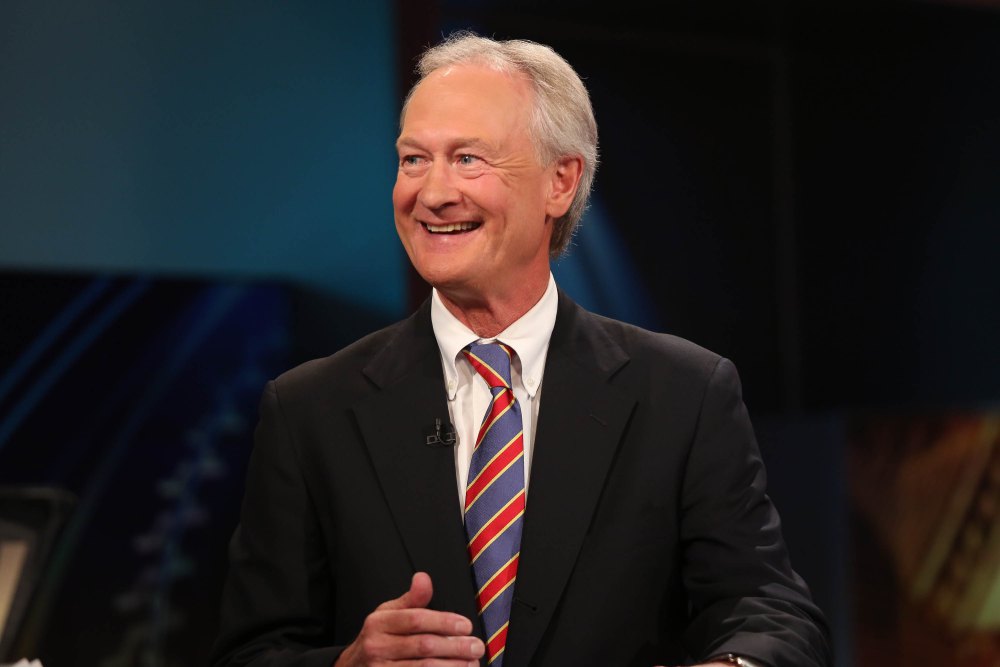
Former Rhode Island Gov. Lincoln Chafee announced Friday he would end his quixotic Democratic presidential campaign after failing to gain traction against Hillary Rodham Clinton and Bernie Sanders. “After much thought I have decided to end my campaign for president today,” Chafee said at a women’s forum held by the Democratic National Committee. “But I would like to take this opportunity one last time to advocate for a chance be given to peace.” Chafee delivered a widely panned debate performance earlier this month and has struggled to raise money and generate enthusiasm in a field that has been dominated by Clinton, a former secretary of state, and Sanders, the Vermont independent senator. Chafee’s departure comes days after Vice President Joe Biden declined to join the field and former Virginia Sen. Jim Webb announced he was leaving the Democratic campaign and would consider an independent bid. It leaves Clinton, Sanders and former Maryland Gov. Martin O’Malley as the three main contenders for the nomination. All three are appearing Saturday at a major Iowa Democratic fundraising dinner in Des Moines, an event that helped fuel President Barack Obama‘s rise in the fall of 2007. The former Rhode Island senator surprised many when he formed a presidential exploratory committee last spring and raised eyebrows when he called for the U.S. to switch to the metric system during a formal campaign kickoff in Virginia last June. His poll numbers were so low that comedian Conan O’Brien came up with a song for Chafee’s longshot bid and encouraged viewers to boost his poll numbers from 0 percent to 1 percent because “it seems like the nice thing to do.” Often driving from his Rhode Island home, Chafee visited the first primary state of New Hampshire several times but failed to draw large crowds. In the first Democratic debate, Chafee referred to himself as a “block of granite” when it came to issues and said he was most proud of his judgment, particularly his vote against the Iraq war. He frequently said U.S. foreign policy should promote peace but his performance was widely panned, prompting questions about whether he would continue his campaign. Chafee raised just $11,000 in the most recent fundraising quarter. Most of his money has come from more than $360,000 that he has loaned his campaign. During his past campaigns, he relied on an old New England family fortune amassed over generations. Chafee told reporters he decided to end his campaign last weekend after Clinton’s strong performance in the debate. Biden’s announcement and Clinton’s testimony before the House Select Committee on Benghazi reaffirmed his thinking, Chafee said, adding he no longer saw her use of a private email system as a disqualifying issue. “Obviously it’s a good week for Secretary Clinton,” he said. “I’m moving on now. It’s time to move on and support the party any way I can.” The presidential bid represented an unusual twist for the unconventional 62-year-old lawmaker and the son of late Sen. John Chafee. In the Senate, the younger Chafee stood out as a liberal Republican in an increasingly conservative party. He was the lone Republican in 2002 to vote against going to war in Iraq, a moment that he tried to make a cornerstone of his campaign. He was elected governor in 2010 as an independent and twice backed Obama’s White House campaigns. He joined the Democrats in 2013 and used his presidential campaign to urge the U.S. to help reinvigorate the United Nations as a way to promote peace and stability. DNC Chair Debbie Wasserman Schultz, a Florida congresswoman, called Chafee a “class act” and recalled his decision to join the Democratic party. “Let’s remember that that was a big deal,” Wasserman Schultz told the audience. “Because when he joined our party, he made clear that his former party had left him.” Republished with permission of the Associated Press.
