
Georgia again certifies election results showing Joe Biden won

Georgia’s top elections official on Monday recertified the state’s election results after a recount requested by President Donald Trump confirmed once again that Democrat Joe Biden won the state, and the governor then recertified the state’s 16 presidential electors. “We have now counted legally cast ballots three times, and the results remain unchanged,” Secretary of State Brad Raffensperger said during a news conference at the state Capitol before the results were recertified. Georgia law allows a losing candidate to request a recount if the margin between the candidates is within 0.5%. Trump requested the recount after the results certified by Raffensperger showed that Biden led by a margin of 12,670 votes, or 0.25% of the roughly 5 million ballots cast. During the recount, which was done using scanners that read and tally the votes, there were discrepancies in vote totals in some counties. Since the results of a recount become the official results, those counties had to recertify their results. Once that was done the secretary of state recertified the statewide results, his office said in a news release. Brian Kemp then recertified the state’s slate of 16 presidential electors — all prominent Democrats — as required by state law, spokesman Cody Hall said. The recertification of results comes before the federal “safe harbor” deadline on Tuesday — electors named by that date in accordance with state law cannot be disregarded by Congress. The recount was the third tally of votes in the presidential race in the state. After the initial count following Election Day, Raffensperger selected the presidential race for an audit required by state law. The tight margin meant the audit required the roughly 5 million votes in that contest to be recounted by hand, he said. That count also affirmed Biden’s victory. The total number of votes in the recount results certified Monday and posted on the secretary of state’s website was 766 fewer than the number certified when the ballots were first tallied after the election. Biden’s lead dropped from 12,670 to 11,779. That appears to be largely due to a discrepancy in Fulton County, the state’s most populous county that includes most of Atlanta. Fulton County’s recount results showed 880 fewer votes than the results certified after election night, with an overwhelming majority of those votes coming from Biden’s total in the county. Gabriel Sterling, who oversaw the implementation of the state’s new voting system, called the discrepancy in the county “a little worrisome” but said it’s a big county that’s had managerial issues. He also noted the difference isn’t enough to change the overall outcome of the election. Also Monday, a federal judge dismissed a lawsuit filed on behalf of would-be Republican presidential electors by former Trump lawyer Sidney Powell. The suit alleged widespread fraud and sought to decertify the results of the presidential race in Georgia, among other things. In the lawsuit, “the plaintiffs essentially ask the court for perhaps the most extraordinary relief ever sought in any federal court in connection with an election. They want this court to substitute its judgment for that of 2 and a half million Georgia voters who voted for Joe Biden and this I am unwilling to do,” U.S. District Judge Timothy Batten as he dismissed the suit following a hearing. Separately, an election challenge filed Friday by Trump, his campaign, and Georgia Republican Party Chairman David Shafer was rejected by the Fulton County Superior Court because the paperwork was improperly completed and it lacked the appropriate filing fees. Even as lawsuits filed by Trump and his allies have been rejected around the country, the president has continued to make repeated baseless claims of widespread fraud. In Georgia, he has rained criticism on Raffensperger and Kemp, both fellow Republicans. Raffensperger, meanwhile, has been steadfast in his defense of the integrity of the election in the state and Kemp has said he has no power to intervene in elections. “I know there are people that are convinced the election was fraught with problems, but the evidence, the actual evidence, the facts tell us a different story,” Raffensperger said during the news conference Monday. Hours before coming to Georgia for a rally Saturday night, Trump called Kemp and asked him to call a special legislative session. The governor declined. In a tweet Sunday, Trump criticized Kemp and Lt. Gov. Geoff Duncan for inaction and again called for a special session. After four Republican state lawmakers on Sunday also requested a special session, Kemp and Duncan put out a statement saying that convening a special session to select a different slate of presidential electors would not be allowed under state or federal law. Republished with the permission of the Associated Press.
Donald Trump headed to Georgia as turnout driver, but also a threat
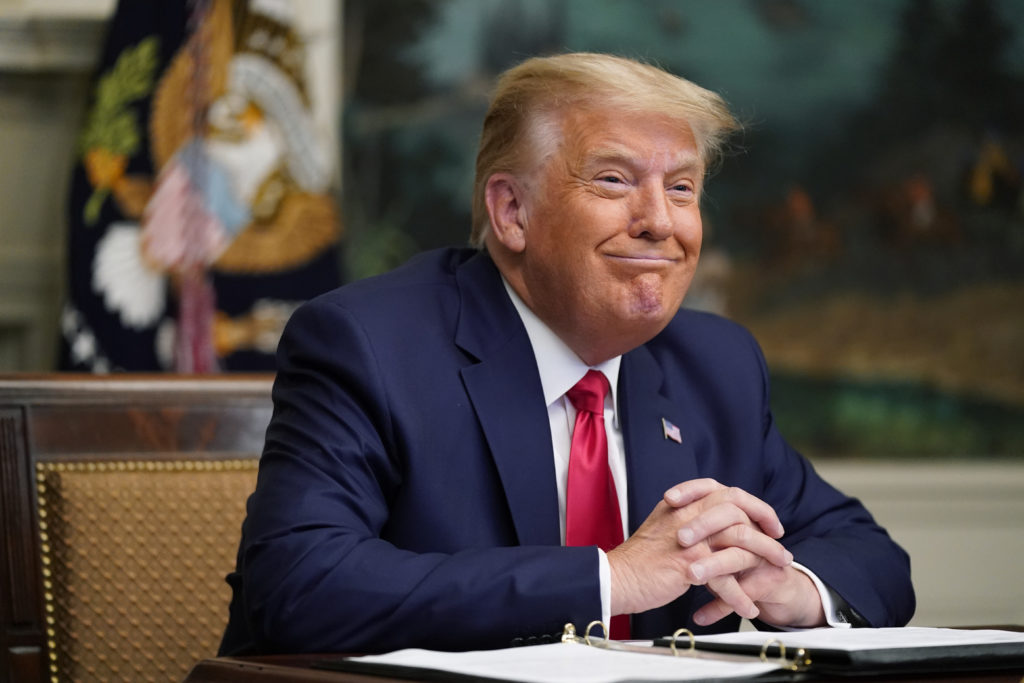
Some establishment Republicans are sounding alarms that President Donald Trump’s conspiratorial denials of his own defeat could threaten the party’s ability to win a Senate majority and counter President-elect Joe Biden’s administration. The concerns come ahead of Trump’s planned Saturday visit to Georgia to campaign alongside Sens. David Perdue and Kelly Loeffler, who face strong Democratic challengers in Jan. 5 runoffs that will determine which party controls the Senate at the outset of Biden’s presidency. Republicans acknowledge Trump as the GOP’s biggest turnout driver, including in Georgia, where Biden won by fewer than 13,000 votes out of about 5 million cast. That means every bit of enthusiasm from one of Trump’s signature rallies could matter. But some Republicans worry Trump will use the platform to amplify his baseless allegations of widespread voter fraud — arguments roundly rejected in state and federal courts across the country. That could make it harder for Perdue and Loeffler to keep a clear focus on the stakes in January and could even discourage Republicans from voting. “The president has basically taken hostage this race,” said Brendan Buck, once a top adviser to former House Speaker Paul Ryan. Especially fraught are Trump’s continued attacks on Georgia’s Republican state officials and the state’s election system, potentially taking away from his public praise of Loeffler and Perdue. “Trump’s comments are damaging the Republican brand,” argued Republican donor Dan Eberhart, who added that the president is “acting in bad sportsmanship and bad faith” instead of emphasizing Republicans’ need to maintain Senate control. The GOP needs one more seat for a majority. Democrats need Jon Ossoff to defeat Perdue and Raphael Warnock to defeat Loeffler to force a 50-50 Senate, positioning Vice President-elect Kamala Harris as the tie-breaking majority vote. Trump on Monday blasted Gov. Brian Kemp as “hapless” for not intervening to “overrule” Secretary of State Brad Raffensperger’s certification of Biden’s win. A day earlier, Trump told Fox News he was “ashamed” he’d endorsed Kemp in his 2018 GOP primary for governor. Kemp’s office noted in response that state law gives Kemp no authority to overturn election results, despite Trump’s contention that Kemp could “easily” invoke “emergency powers.” Meanwhile, Raffensperger, a Trump supporter like Kemp, has accused the president of throwing him “under the bus” for doing his job. Perdue and Loeffler have attempted to stay above the fray. They’ve long aligned themselves with Trump and even echoed some of his general criticisms of the fall elections, jointly demanding Raffensperger’s resignation. But the crux of their runoff argument — that Republicans must prevent Democrats from controlling Capitol Hill and the White House — is itself a tacit admission that Biden, not Trump, will be inaugurated Jan. 20. And at one recent campaign stop, Perdue heard from vocal Trump supporters who demanded that he do more to help Trump somehow claim Georgia’s 16 electoral votes. Republicans see three potential negative outcomes to Trump fanning the flames. Some GOP voters could be dissuaded from voting again if they accept Trump’s claims that the system is hopelessly corrupted. Among Republicans more loyal to Trump than to the party, some could skip the runoff altogether out of anger at a party establishment the president continues to assail. Lastly, at the other end of the GOP spectrum are the moderate Republicans who already crossed over to help Biden win Georgia and could be further alienated if the runoff becomes another referendum on Trump. Josh Holmes, a top adviser to Senate Majority Leader Mitch McConnell, said Republicans “haven’t seen any evidence of lack of enthusiasm in the Senate races.” But none of those potential bad effects would have to be sweeping to tilt the runoffs if they end up as close as the presidential contest in Georgia. “We’ll see how it plays out. It changes day by day and week by week. But so far, so good,” Holmes said. In Georgia, any Republican concerns are more circumspect. Brian Robinson, a former adviser to Kemp’s Republican predecessor as governor, said Trump should “drive a strong, forward-looking message” about what’s at stake for a Republican base that “is fervently devoted to him.” “The best thing he can do for the party,” Robinson said, “is to talk about the importance of having a Republican Senate majority to project his policy legacy and to make sure the Democrats can’t reverse a lot of what he has put in place that Republicans support.” Asked what Trump should avoid, Robinson circled back to what he believes the president should say. Former U.S. Rep. Jack Kingston, a Trump ally, downplayed the potential for GOP splintering, framing an “inner-family squabble” as a sideshow to the “incredible” consequences that define the runoffs. “Followers of Trump will follow Trump, but they’re not blind to the huge stakes. And neither is he,” Kingston said. “He knows to keep his legacy. He’s got to get these people reelected.” Trump, Kingston argued, is “keeping the base interested,” a necessary component of any successful runoff campaign since second rounds of elections often see a drop-off in voter participation. Robinson added that Democrats face their own challenge in replicating record turnout for Biden. “What’s the best motivator? Fear,” he said. Before November, Democrats dreaded a second Trump term more than Republicans feared Trump losing, Robinson reasoned. “Republicans have reason to be scared now,” he said, because of the prospect that Democrats could control both ends of Pennsylvania Avenue. “That could make a difference in turnout” beyond anything Trump says, Robinson concluded. For their part, the senators continue their public embrace of all things Trump ahead of the visit. “I couldn’t be more excited to welcome” the president “back to Georgia,” Loeffler wrote on Twitter after Trump confirmed his plans. Perdue’s campaign quickly retweeted the comment, which Loeffler punctuated with a reminder that the runoffs are “an all-hands-on-deck moment.” It’s not clear, though, if all Republicans will be on hand at all. Kemp, the governor who appointed Loeffler upon Sen. Johnny Isakson’s retirement last year, has on previous Trump visits
Calls for voting extension in Georgia after Zeta

A group of civil rights organizations is asking Georgia’s governor to extend early voting hours Friday after the storm disrupted voting Thursday in the battleground state. Groups including the Georgia NAACP and Fair Fight Action called on Republican Gov. Brian Kemp to use emergency powers to order voting be extended through 9 p.m. Friday in affected areas. Voting was disrupted at some sites in metro Atlanta and north Georgia after the storm caused power outages. Several polling places opened late. Georgia secretary of state Brad Raffensperger says that 15 counties were affected. At least one county said it would not hold voting at all Thursday. Friday is Georgia’s last day of early in-person voting. Record numbers of voters have cast ballots early in the state. Kemp spokesman Cody Hall did not immediately respond to a request for comment. Republished with the permission of the Associated Press.
