
Donald Trump belittles accusers as more turn up with sordid stories

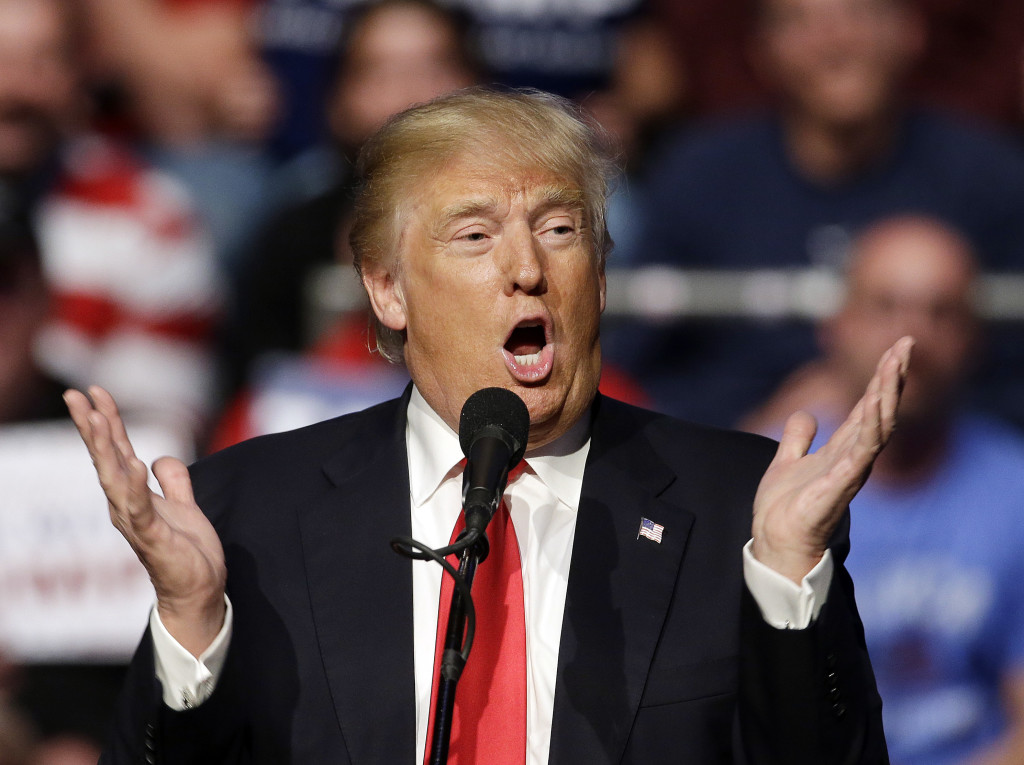
Donald Trump acted out onstage an accuser’s allegations and suggested another wasn’t worthy of his attention the same day two more women came forward with years-old stories of unwanted sexual encounters with the Republican presidential nominee. With eight women accusing Trump of unwanted kissing, groping or more, the New York businessman maintained his innocence and his denunciation of opponent Hillary Clinton and an international media conspiracy aimed at denying him the White House. “100 percent fabricated and made-up charges, pushed strongly by the media and the Clinton Campaign, may poison the minds of the American Voter. FIX!” Trump tweeted on Saturday morning. Clinton maintained a relatively low profile as Trump stormed, but more hacked emails from WikiLeaks raised anew questions about her private versus public pronouncements. Those released Friday showed her campaign had asked former President Bill Clinton to cancel a speech to an investment firm last year because of concerns that the Clintons might appear to be too cozy with Wall Street just as she was about to announce her candidacy. Such revelations were no match for the sordid new accusations against Trump. Summer Zervos, a former contestant from Trump’s NBC show “The Apprentice,” said the series’ star became sexually aggressive at a Beverly Hills hotel in 2007. He kissed her open-mouthed and touched her breasts in a private room, she said during a news conference. Late Friday night, the Trump campaign released a statement in which a cousin of Zervos said he was “shocked and bewildered” by her account. John Barry of Mission Viejo, California, said Zervos “wishes she could still be on reality TV, and in an effort to get that back she’s saying all of these negative things about Mr. Trump.” In response, Summer’s lawyer, Gloria Allred, said in a statement that Barry worked at Zervos’ family restaurant until several months ago, “when his employment ended. Since then he has expressed hostility and ill will toward Summer.” In a story published online Friday, Kristin Anderson told The Washington Post that she was sitting on a couch with friends at a New York nightclub in the early 1990s when a hand reached up her skirt and touched her through her underwear. She said she pushed the hand away, turned around and recognized Trump as the man who had groped her. Trump called his accusers liars and “sick” women seeking fame or money. During a rally in North Carolina, Trump dismissed one of them by saying, “She would not be my first choice, that I can tell you.” In alleging a widespread conspiracy, Trump assailed The New York Times in particular, noting its connection to Mexican billionaire Carlos Slim, a major shareholder in the media company. Spokesman Arturo Elias Ayub later said Slim doesn’t know Trump at all “and is not the least bit interested in his personal life.” The WikiLeaks release of emails stolen from Clinton campaign chairman John Podesta‘s personal account showed aides having to convince the former first lady to persuade her husband to cancel the Wall Street speech ahead of her campaign rollout. The Clintons’ paid speeches have been an issue throughout the campaign, particularly lucrative speeches to financial interests. In remarks at a fundraiser Friday, Hillary Clinton spoke of a need for national healing. “I take no satisfaction in seeing what Trump does and says because it hurts — it hurts me and it hurts our country,” she said. Polls suggest Trump has fallen further behind Clinton nationally and in most battleground states. Early in-person voting is underway in 20 states, including Ohio, where President Barack Obama railed against Trump a day after first lady Michelle Obama declared in a passionate speech, “Enough is enough.” The Obamas both seized on Trump’s words, captured in a video released last week, bragging about kissing and groping women without their permission. The 70-year-old billionaire has apologized, but also repeatedly dismissed his comments as “locker room talk.” “You don’t have to be a husband or a father to know that that kind of language, those kinds of thoughts, those kinds of actions are unacceptable. They’re not right. You just have to be a decent human being,” President Obama charged in Columbus, Ohio. Even before the mounting allegations, there was evidence that Trump’s troubles were hurting the Republican Party’s ability to raise money. The Republican National Committee has raised about 25 percent less over the past three months than it did over the same period four years ago, when Mitt Romney was atop the ticket. The RNC said Friday that it raised $39.4 million last month, compared to $48.4 million in September 2012. It says it has raised $262.3 million since January 2015, about $20 million more than it had by this time in 2012. Republished with permission of the Associated Press.
Donald Trump’s trap: GOP nominee can’t let go of perceived slights

For Donald Trump, it’s become a familiar pattern. The Republican nominee can’t let go of a perceived slight, no matter the potential damage to his presidential campaign or political reputation. Trump spent the days after winning the Republican nomination criticizing a U.S. district court judge’s Mexican heritage. The morning after accepting the Republican nomination at the party’s convention, Trump re-litigated months-old grievances with primary rival Ted Cruz. Now, he’s sparring with an American Muslim family whose son was killed in Iraq. Republican leaders have urged Trump to drop his attacks on Khizr and Ghazala Khan, who appeared at last week’s Democratic convention and harshly criticized the GOP nominee. It’s not just the optics of picking a fight with a military family that has GOP officials eager for Trump to move on, but the timing of his attacks: Election Day is just three months away. Those who have worked with Trump say that in private meetings, he can often appear amenable to putting a controversy aside. But the businessman can quickly be drawn back in by an interview, especially if he believes he’s already answered the question, or if he grows irritated by commentary on cable television. “It’s just who he is,” said Stuart Jolly, a former campaign staffer and current political director for the pro-Trump Great America PAC. Others who have worked with Trump say the only way to ensure he moves on is to wait for him to tire of an issue or get drawn into another matter. Newt Gingrich, the former House speaker who has advised Trump, said the candidate’s inability to back away from a political land mine “makes him vulnerable.” “His whole experience up until running for office was in a very combative New York media market,” Gingrich said. “He’s been doing it now for over 30 years. It’s a very deeply held habit.” Khizr Kahn delivered an emotional address at last week’s Democratic convention, with his wife standing by his side. The Pakistan-born Khan told the story of his son, U.S. Army Capt. Humayun Khan, who was posthumously awarded a Bronze Star and Purple Heart after his death in 2004. Khan said that if Trump were president and enacted his proposed temporary ban on foreign Muslims coming to the U.S., a position Trump has backed away from in recent weeks, his son would have never been allowed into the country. He also questioned whether Trump had ever read the Constitution. Trump responded by implying Ghazala Khan’s religion preventing her from speaking at the convention, though she later said talking publicly about her late son was still too difficult. On Monday, Trump tweeted that he was being “viciously attacked” by Khizr Khan. Trump’s unwillingness to let the matter subside sparked outrage Monday from a chorus of Republicans. Arizona Sen. John McCain, a former prisoner of war, said Trump did not have “unfettered license to defame those who are the best among us.” Rep. Mike Coffman, a vulnerable Republican in a competitive Colorado district, said he was “deeply offended when Donald Trump fails to honor the sacrifices of all of our brave soldiers who were lost in that war.” Missouri Sen. Roy Blunt said the Khans “deserve to be heard and respected.” “My advice to Donald Trump has been and will continue to be to focus on jobs and national security and stop responding to every criticism whether it’s from a grieving family or Hillary Clinton,” Blunt said in a statement. However, none of the Republican lawmakers pulled back their support of Trump’s White House campaign. In his first rally after a weekend of controversy, Trump spoke at length and took several questions at an event Monday in Columbus, Ohio — never once mentioning the Khans. But when asked about Khizr Khan on Fox News Channel’s “Hannity,” Trump responded, “I guess it’s part of my life.” “His son died 12 years ago,” Trump added. “If I were president, his son wouldn’t have died, because I wouldn’t have been in the war, if I was president back then.” Trump backers attending the Ohio rally dismissed the issue, underscoring how the businessman was able to survive numerous such firestorms in the GOP primaries. “I think the Democrats laid a trap for him,” said Tom McClanahan, a 54-year-old from Johnston, Ohio. “I think they knew what they were doing when they asked that family to speak at the convention. They knew he’d respond.” Dale Brown, a maintenance supervisor from Grove City, Ohio, whose son is in the Navy, said Democrats were blowing Trump’s comments out of proportion and had “politicized this by asking that family to speak.” But the real test for Trump isn’t the opinion of the loyal supporters who attend his rallies. It’s the broader general election audience, a far more diverse group still weighing Trump’s readiness for the White House. Republished with permission of the Associated Press.
Democratic advertising blitz awaits Donald Trump
Long before Donald Trump swatted away his Republican presidential rivals, his likely Democratic opponent and her allies began laying traps for him. Priorities USA, the lead super PAC backing Hillary Clinton, has already reserved $91 million in television advertising that will start next month and continue through Election Day. In addition, Clinton’s campaign and Priorities USA have both debuted online videos that cast Trump in a negative light — a preview of what voters will see on TV over the next six months. So far, Priorities USA is the only group on either side that has rolled out such an ambitious advertising plan geared toward the general election. The group’s leaders say they’re trying to avoid what they see as the core mistake made by Trump’s Republican rivals — not pushing hard enough against him until it was too late. “There’s a reason that we have a head start,” said Justin Barasky, a Priorities USA spokesman, “and it’s that we’ve taken Donald Trump seriously all along, unlike the Republicans.” The group’s ad strategy will test what has been a hallmark of Trump’s GOP primary rise: his ability to withstand — even thrive in the face of — tens of millions of dollars in attack ads. An Associated Press review of Priorities USA’s TV buys, collected by Kantar Media’s Campaign Media Analysis Group, reveals a formidable 22-week advertising blitz through what the group considers key battleground states: Colorado, Florida, Iowa, Nevada, New Hampshire, Ohio and Virginia. In those states, Priorities USA will start ads in major metropolitan areas, then broaden its outreach to smaller cities as the November election approaches. The group will also start ads on satellite TV in September. According to the CMAG data, Priorities USA plans to spend about $4 million a week through most of June. The group then slows spending through July, taking off the weeks of the Republican and Democratic conventions, when widespread television coverage essentially provides free media time for the candidates. Priorities USA returns to the airwaves in August and begins unloading $60 million in ads between September and Election Day. The week of the election, Priorities USA plans to spend about $8 million in the seven battleground states. The heaviest concentration is in Florida, where the group has reserved $23 million in time, mostly in Orlando and in Tampa. The group also plans to spend about $19.5 million in the traditional presidential bellwether state of Ohio. More than half is for Cleveland, Akron and Columbus. There’s no substantive GOP counterweight to the pro-Clinton effort — partly because Trump has repeatedly trashed big donors and called the outside groups that can raise unlimited money from them “corrupt.” As the presumptive GOP nominee, Trump is now beginning his outreach to donors. But even if he fully embraces outside help, he’s far behind: One super PAC backing him, Great America, was almost $700,000 in debt at the end of March. Another group that was a major player in the 2012 race, American Crossroads, is still “evaluating what our specific role will be,” said spokesman Ian Prior. Television ads are only one part of Priorities USA’s strategy. It is putting at least $35 million into online advertising between June and Election Day, Barasky said. Those ads will largely aim to drive up turnout among core Democratic groups: African-Americans, Hispanics, women and younger voters, Barasky said. Trump is already getting a taste of what some these ads will say. On Thursday, Priorities USA overlaid audio of Trump talking about “unifying” the Republican Party with images of violence that has erupted inside and outside of his massive rallies. “I think we’re going to win in November,” Trump says at the end. “NOPE,” reads text on the screen. “Vote for Hillary Clinton.” That follows an online video the Clinton campaign put out Wednesday that features clips of prominent Republicans, including his former rivals, bashing Trump in every possible way. “He needs therapy,” says former Florida Gov. Jeb Bush at the end of the spot. Republished with permission of the Associated Press.
