
Nick Saban: Alabama will be “very cautious” in COVID-19 protocols
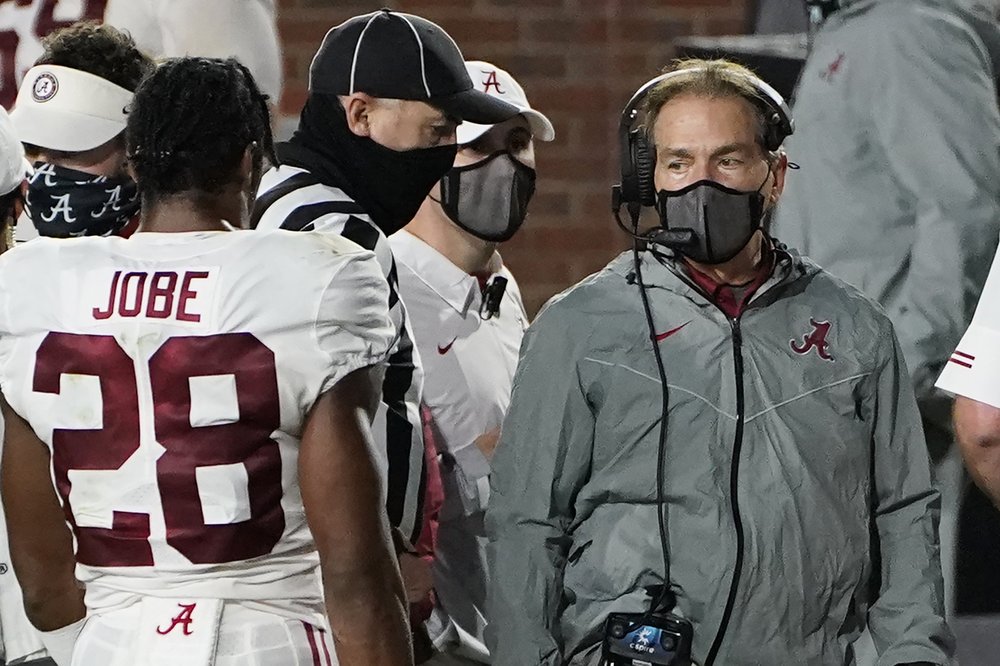
Alabama coach Nick Saban isn’t taking any chances with COVID-19 with the season approaching. Saban says the team will use the 2020 safety protocols for “the next six weeks or so” even though the vast majority of his players are fully vaccinated. “We’re still going to be very cautious indoors and in meetings and so forth on trying not to have an issue with the COVID,” Saban said Thursday ahead of the defending national champions’ first preseason practice. “We’re hopeful that we’ll be able to have full capacity in the stadium. I’m hopeful that more and more people will get vaccinated so they’ll have the opportunity to do that. But that’s everybody’s personal choice.” Saban spoke to reporters at a ceremony where the city renamed a street after his charity, Nick’s Kids. Alabama opens the season on Septempber 4 against Miami in Atlanta. Saban said at Southeastern Conference media days last month that some 90% of his players are fully vaccinated. Alabama, meanwhile, remains the least vaccinated state in the nation with some 35% of Alabamians fully vaccinated, according to the CDC. Republished with the permission of the Associated Press.
U.S. plans to require COVID-19 shots for foreign travelers
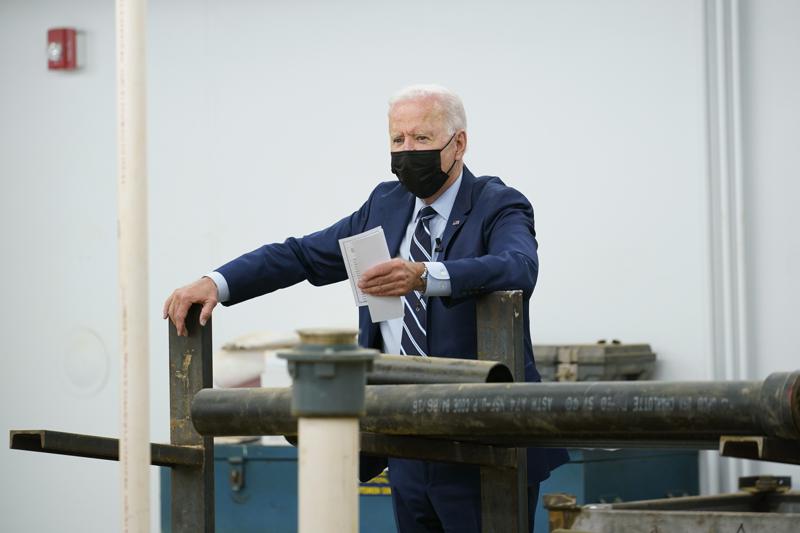
The Joe Biden administration is taking the first steps toward requiring nearly all foreign visitors to the U.S. to be vaccinated for the coronavirus, a White House official said Wednesday. The requirement would come as part of the administration’s phased approach to easing travel restrictions for foreign citizens to the country. No timeline has yet been determined, as interagency working groups study how and when to safely move toward resuming normal travel. Eventually, all foreign citizens entering the country, with some limited exceptions, are expected to need to be vaccinated against COVID-19 to enter the U.S. The official spoke on the condition of anonymity to preview the policy under development. The Biden administration has kept in place travel restrictions that have severely curtailed international trips to the U.S., citing the spread of the delta variant of the virus. Under the rules, non-U.S. residents who have been to China, the European Schengen area, the United Kingdom, Ireland, Brazil, South Africa, and India in the prior 14 days are prohibited from entering the U.S. All travelers to the U.S., regardless of vaccination status, are required to show proof of a negative COVID-19 test taken within three days of air travel to the country. The Biden administration has faced pressure to lift some restrictions from affected allies, the air travel industry, and families who have been kept separated from loved ones by the rules. Many have complained that the travel restrictions don’t reflect the current virus situation — particularly as caseloads in the U.S. are worse than in many of the prohibited nations. Republished with the permission of the Associated Press.
Virus hospitalizations in Alabama approach 1,600 amid surge
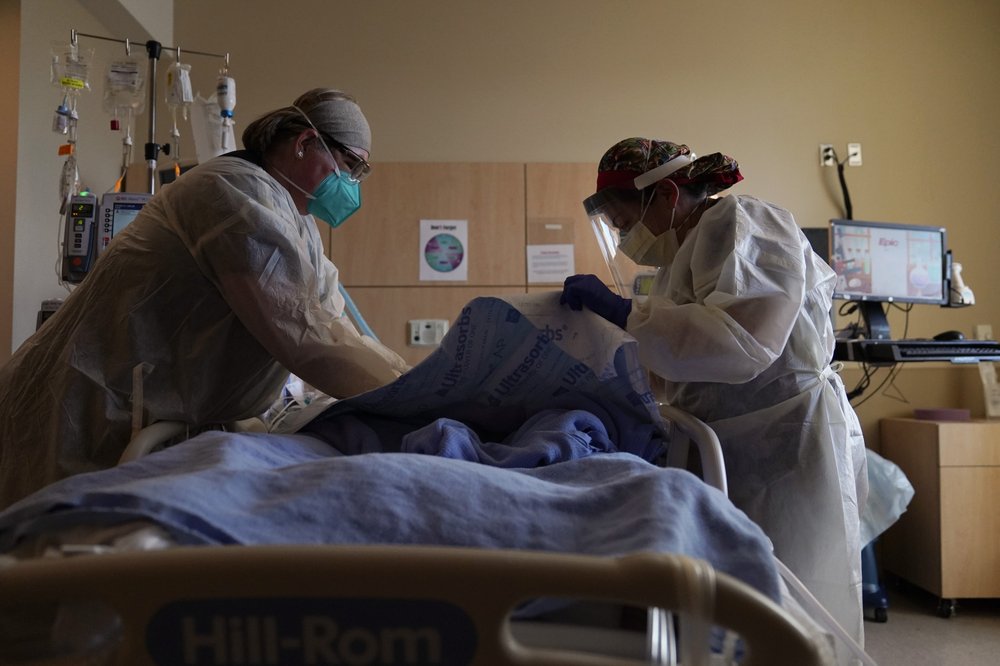
The number of coronavirus patients in Alabama hospitals rose to its highest levels in six months Monday as health officials urged schools to require masks and other measures during a “critical juncture” in the pandemic. Dr. Don Williamson, the former state health officer who now heads the Alabama Hospital Association, said the 1,583 hospitalized people include 38 children. The state last saw numbers that high in early February. A month ago, there were a little over 200 people hospitalized. The 1,583 patients in state hospitals is a little more than half of the number in January when there were 3,000 hospitalized. But Williamson said he is concerned the state is rapidly approaching the previous high-water mark. Alabama’s status as one of the two least vaccinated states in the country — plus studies suggesting that the delta variant is just a contagious as chickenpox and that even vaccinated people can spread the illness to others — have caused health officials to worry about what is ahead and to emphasize the need for mask-wearing and vaccinations. Alabama, in the last two weeks, has seen one of the sharpest rises in COVID-19 cases in the country, ranking eighth among the states, according to researchers at Johns Hopkins University. The seven-day rolling average of daily new cases in Alabama has risen over the past two weeks from 799.57 new cases per day on July 17 to 2,391.14 new cases per day on July 31. Only 34.4% of Alabama’s population is fully vaccinated, which is the lowest percentage in the nation, according to numbers from the U.S. Centers for Disease Control and Prevention. Mississippi has 34.5% of its population fully vaccinated. The Alabama Department of Public Health Monday officially released guidance that encourages K-12 public schools to implement universal masking, including on school buses, when classes resume. Dr. Karen Landers, a medical officer and pediatrician with the Alabama Department of Public Health, wrote that it is imperative for adults to take action since children under age 12 are not eligible for the vaccine. “With low vaccine rates in Alabama, it will be a matter of a few weeks after school resumes before we see a rise in cases in the educational system,” Landers wrote in the document. “Alabama is at a critical juncture. All of us want our children to be able to learn and thrive,” she wrote. Gov. Kay Ivey Monday also released a video with State Health Officer Scott Harris answering questions about the vaccine and encouraging people to get vaccinated. “Because we have this delta variant circulating, it is so infectious that anybody who gets it is likely to spread it to three or four other people,” Harris said. Republished with the permission of the Associated Press.
Kay Ivey interviews Scott Harris to help answer COVID-19 vaccine questions and concerns
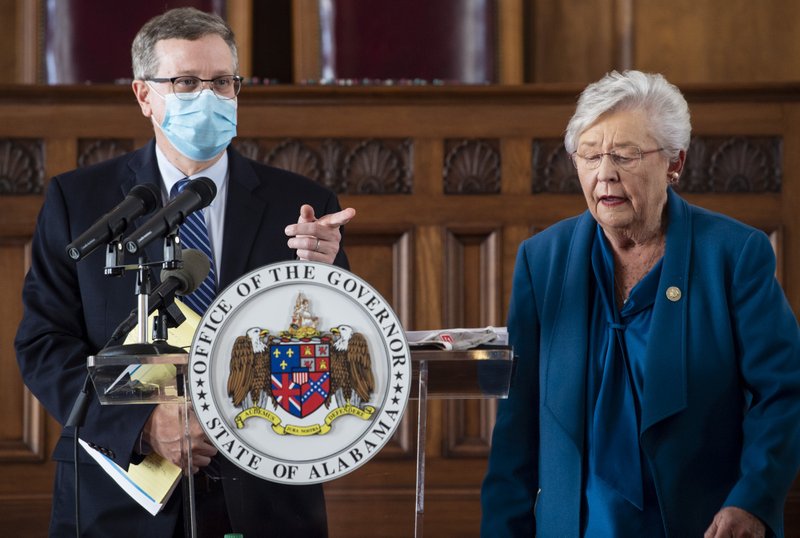
Gov. Kay Ivey posted a video on Twitter, interviewing state Health Officer Dr. Scott Harris to ask questions related to COVID-19 vaccine hesitancy. Only 34% of Alabama’s population is fully vaccinated, which is the lowest in the nation reported the Associated Press. There has been an increase in the vaccination rate recently, but it’s unknown if it will help stem the flood of new cases since it takes weeks for a newly vaccinated person to be fully protected. Kay Ivey stated on Twitter, “In honor of #ImmunizationAwarenessMonth, I sat down with State Health Officer Dr. Scott Harris to ask some #COVID19 questions related to vaccine hesitancy.” Ivey has come under fire for not promoting shot incentives more heavily. Despite Ivey’s refusal to offer incentives to the public, the state prison system is offering $5 in commissary credits for inmates who get vaccinated. The University of Alabama is giving $20 credit on a student debit card to any student who proves they are vaccinated by Aug. 28. Additionally, the Montgomery-area government, public schools, and the state health department are providing free state fair tickets to people who get fully vaccinated in the capital. In an opinion piece published Tuesday by The Washington Post, Ivey defended her approach. “There are those who believe that government should mandate the vaccine or that we should bribe people to take it. That’s not going to happen in my state, no matter how many times the media ask me,” Ivey wrote. The Alabama Department of Health is also sponsoring a TikTok contest to encourage younger people to get vaccinated.
Anthony Fauci: More ‘pain and suffering’ ahead as COVID cases rise
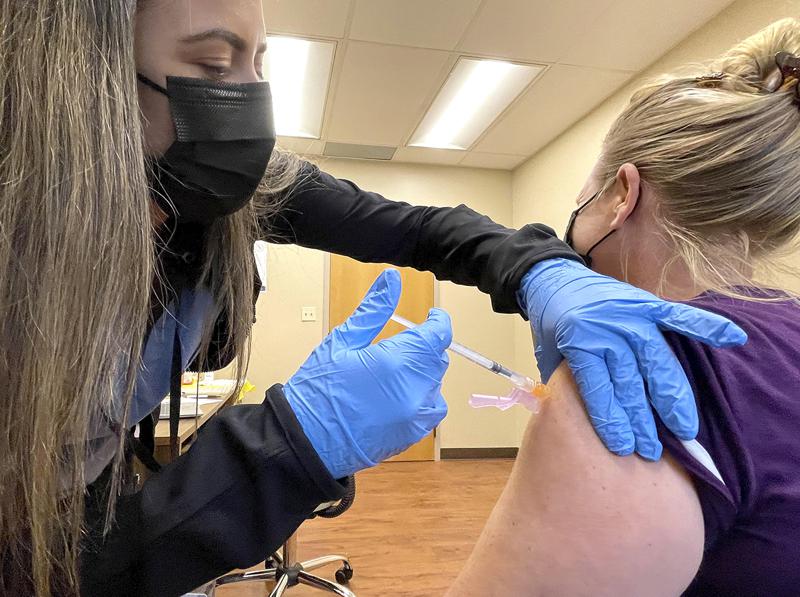
Dr. Anthony Fauci warned Sunday that more “pain and suffering” is on the horizon as COVID-19 cases climb again and officials plead with unvaccinated Americans to get their shots. Fauci, the nation’s top infectious disease expert, also said he doesn’t foresee additional lockdowns in the U.S. because he believes enough people are vaccinated to avoid a recurrence of last winter. However, he said not enough are inoculated to “crush the outbreak” at this point. Fauci’s warning comes days after the Centers for Disease Control and Prevention changed course to recommend that even vaccinated people return to wearing masks indoors in parts of the U.S. where the delta variant is fueling infection surges. With the switch, federal health officials have cited studies showing vaccinated people can spread the virus to others. Most new infections in the U.S. continue to be among unvaccinated people. So-called breakthrough infections can occur in vaccinated people, and though the vast majority of those cause mild or no symptoms, the research shows they can carry about the same amount of the coronavirus as those who did not get the shots. “So we’re looking, not, I believe, to lockdown, but we’re looking to some pain and suffering in the future because we’re seeing the cases go up, which is the reason why we keep saying over and over again, the solution to this is get vaccinated, and this would not be happening,” Fauci said on ABC’s “This Week.” According to data through July 30 from Johns Hopkins University, the seven-day rolling average for daily new cases in the U.S. rose from 30,887 on July 16 to 77,827 on July 30. The seven-day rolling average for the country’s daily new deaths rose over the same period from 253 on July 16 to 358 on July 30, though death reports generally lag weeks after infections and even longer after hospitalizations. Currently, 58% of Americans 12 years and older are fully vaccinated, according to the CDC’s data tracker. However, people are “getting the message,” and more are rolling up their sleeves amid the threat of the delta variant, according to the director of the National Institutes of Health. Dr. Francis Collins said on CNN’s “State of the Union” that vaccinations are up 56% in the U.S. in the last two weeks. Louisiana, which has the most new cases per capita among states in the past 14 days, has seen vaccinations up threefold over that period, Collins said. “That’s what desperately needs to happen if we are going to get this delta variant put back in its place because right now it’s having a pretty big party in the middle of the country,” Collins said. Collins also said that even with the prevalence of the delta variant, the shots are working “extremely well” and reduce a person’s risk of serious illness and hospitalization “25-fold.” The guidance for vaccinated people to start wearing masks indoors again in certain places with worsening outbreaks, he said, is mostly meant to protect unvaccinated and immunocompromised people. The CDC has also recommended indoor mask-wearing for all teachers, staff, students, and visitors at schools nationwide, regardless of vaccination status. Republished with the permission of the Associated Press.
Doctor: COVID-19 ‘raging’ in Alabama as many refuse shots
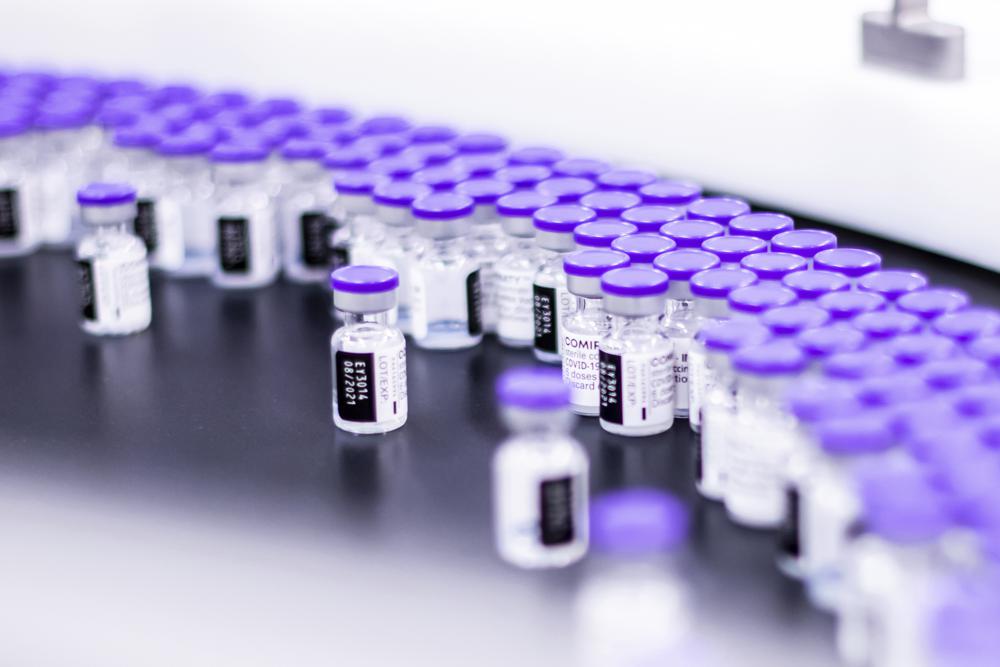
COVID-19 is “raging” through Alabama as thousands refuse vaccinations that nearly always prevent serious illness and a highly contagious strain races through communities where many have quit taking basic safety precautions, a health leader said Thursday. With more than 1,250 people hospitalized statewide with the illness caused by the new coronavirus — nearly all of whom aren’t inoculated — Alabama now has the nation’s highest positivity rate, and there’s no sign the rapid increase in cases will end soon, Dr. Sarah Nafziger said. The vaccines against COVID-19 would have prevented the surge and saved lives if only more people got them, said Nafziger, vice president of clinical services at UAB Hospital. “Unfortunately, it looks like it’s going to get worse before it gets better,” she told a news briefing. Only 34% of Alabama’s population is fully vaccinated, which is the lowest in the nation. Health officials were encouraged by a recent increase in the vaccination rate, but it’s unclear whether the small boost could help stem the flood of new cases since it takes weeks for a newly vaccinated person to be fully protected. While some school systems and government installations, including the Army’s Redstone Arsenal, have announced a return to mandatory face mask rules, Nafziger said she sees few masks in public and worries that many people will simply ignore new recommendations, as has happened throughout the pandemic. Nafziger said she and her family recently returned to wearing masks in public places because of how quickly the pandemic is worsening as the delta variant spreads even faster than the original coronavirus. “We hate it. But it’s what we have to do to keep ourselves safe and our neighbors safe,” she said. More than 11,500 people have died of COVID-19 in Alabama, which is 17th highest nationally overall and seventh-highest per capita at 236 deaths per 100,000 people, according to researchers at Johns Hopkins University. Over the past two weeks, the rolling average number of daily new cases has increased by 1,402, a jump of 265.2%. Republished with the permission of the Associated Press.
Health officials recommend all Alabama students wear masks

Alabama public health officials are recommending that all students and teachers wear masks in the classroom because of a surge in COVID-19 cases, a spokesperson said Wednesday. The Alabama Department of Public Health will recommend universal masking in schools due to the high levels of COVID-19 in the state, department spokesperson Ryan Easterling said. The recommendation will be included in the “school toolkit,” suggesting guidelines to mitigate pandemic risk. “Schools can choose to follow guidelines or not. However, these guidelines represent the best evidence available to protect students, teachers, and staff by reducing the transmission of COVID-19, along with disease, potential hospitalization, and risk of death from this virus,” Easterling wrote in an email. The U.S. Centers for Disease Control and Prevention on Tuesday recommended indoor masks for all teachers, staff, students, and visitors at schools nationwide, regardless of vaccination status. The recommendation comes amid a sharp uptick in COVID-19 fueled by the highly contagious delta variant of the virus. Some Alabama school systems have announced they will require students and teachers to wear face masks indoors following new federal guidelines to curb the spread of COVID-19. The Birmingham, Huntsville, Bessemer, and Opelika school systems are among those that have said that masks will be required indoors. A spokesperson for the Alabama Department of Education said Tuesday that mask mandates will be a local decision unless they get specific new guidance from state officials. “Due to the upward trend of COVID transmission and the current local positivity rate, this decision is in the best interest of our students and staff at this time,” Opelika City Schools Superintendent Mark Neighbors said in a statement. However, state education officials so far are not requiring face coverings. “For the coming school year, face masks are not mandated in Alabama schools. That will remain the case unless there is specific guidance from the Alabama Department of Public Health (ADPH) to suggest otherwise,” spokesperson Michael Sibley said Tuesday. “However, local superintendents and school boards can determine for themselves if they want to enforce masking. That would be a local decision.” State Health Officer Scott Harris said earlier this week that the state was waiting for the new CDC guidance before issuing their recommendations to school systems. “The issue of masks in schools is like everything else — highly controversial. They really shouldn’t be,” Harris said. A spokesperson for Alabama Gov. Kay Ivey last week told reporters that she was opposed to requiring masks in schools. Her office has not commented on the new CDC guidelines, but in an opinion piece published Tuesday by The Washington Post, Ivey promoted vaccinations over masks and distance learning. “Here is the truth: Closing businesses will not defeat covid-19. Wearing masks will not defeat covid-19. And keeping our students from in-classroom learning will not defeat covid-19,” Ivey wrote. Alabama has seen a sharp increase in the number of COVID-19 cases. The number of people in state hospitals has risen to more than 1,000, the most the state has seen since winter when there were 3,000 people hospitalized at the pandemic’s peak. Republished with the permission of the Associated Press.
University of Alabama offers monetary COVID-19 vaccination incentive to students

As Universities across the nation are bracing to host thousands of students in the classroom this upcoming Fall, many have forced students to supply proof of their COVID-19 vaccination, while other institutions have opted to offer a wide array of benefits. The University of Alabama sent an email to students Friday, offering to insert an automatic $20 within the students’ “Bama Cash” account if students notify the school that they have been vaccinated by August 28, 2021. The school email clarifies, “All students currently enrolled for the Fall 2021 Semester are eligible and qualify after their first dose. Check the status of your $20 Bama Cash reward through the eAccounts app, Apple Wallet, Google Pay, or the Action Card website. For a list of locations that accept Bama Cash and more information, visit the Bama Cash website.” The message includes no further information regarding the source of these awarded funds, which adds to the stack of ethical and legal concerns the incentive opportunity raises. The American Psychological Association additionally forewarned institutions in March against socially engineering individuals to receive the COVID-19 vaccine stating, “Direct monetary incentives are likely to backfire.” A March cover story analyzed the intersection between psychological science and vaccine hesitancy as they cautioned, “Research led by psychologist and marketing professor Cynthia Cryder, Ph.D., of Washington University in St. Louis, found that paying people to participate in potentially risky research studies made the participants believe that the studies were riskier than if they weren’t paid (Social Science & Medicine, Vol. 70, No. 3, 2010). The money ‘conveys that this is a risky thing that you don’t want to do unless we’re paying you,’ Chapman says.” However, the University of Alabama is not the only American college gearing up with carrot-and-stick measures designed to persuade students to become vaccinated before returning to school this Fall. A U.S. News and World Report reveals some of the current benefits universities are offering, “One college, Rowan University in New Jersey, is both requiring all students to be vaccinated and also providing monetary incentives: up to $1,000 in credit toward tuition and housing.” Opponents of this nationwide phenomenon argue these monetary vaccination incentives lack equity and fairness when accounting for the multitude of students across the nation who have already been granted religious or medical exemptions from receiving the vaccine.
Alabama offering $5 incentive for inmates to get shots
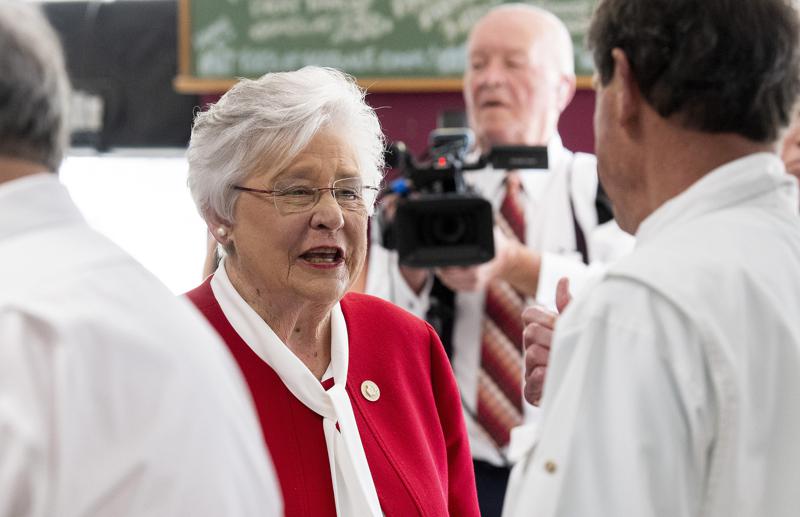
With Alabama trailing the nation in COVID-19 vaccinations, infections rising, and the governor refusing incentives to encourage more people to get shots, state prisons are offering $5 canteen credits to inmates to encourage more inoculations. The Department of Corrections, which said less than half of its more than 24,000 inmates have been vaccinated, is offering the canteen “grab bag” to inmates who get vaccinations and those who’ve already received shots, spokeswoman Kristi Simpson said. Items like snacks, candy, and personal hygiene products typically are offered to inmates in prison stores. “Facility wardens (have) also been authorized to provide other incentives to encourage staff and inmates to receive a vaccination at their respective facilities,” she said in an email to The Associated Press. Nearly all of the latest infections and deaths are among people who have not been vaccinated, health officials have said. Gov. Kay Ivey has opposed incentives to encourage members of the general public to get shots, saying instead that “common sense” should be enough for people to get the free shots. A spokeswoman didn’t immediately return an email seeking comment on the prison incentives. Statistics from the Centers for Disease Control and Prevention show that only 33.9% of the state’s population is fully vaccinated, the lowest in the nation. Questioned by reporters about what more could be done, Ivey sharpened her tone Thursday, expressing frustration that more people weren’t being vaccinated. “Folks are supposed to have common sense,” she said. “It’s time to start blaming the unvaccinated folks, not the regular folks. It’s the unvaccinated folks that are letting us down. … I’ve done all I know how to do. I can encourage you to do something, but I can’t make you take care of yourself.” Ivey, who has rejected suggestions that new health precautions may be needed to counter rising illness, did not announce new measures to combat the pandemic, which has killed more than 11,470 people statewide to give Alabama what researchers at Johns Hopkins University say is the nation’s 17th highest death count. Asked about Ivey’s remarks, White House press secretary Jen Psaki said Friday: “I don’t think our role is to place blame.” “But what we can do is provide accurate information to people who are not yet vaccinated about the risks they are incurring not only on themselves but also the people around them,” she said. Over the past two weeks, the rolling average number of daily new cases has increased by 858, a surge of 311%. There were 258 new cases per 100,000 people in Alabama over the past two weeks, which was seventh worse nationally. While hospitalizations are far below levels from January when more than 3,000 people were being treated for COVID-19, caseloads are rising sharply and nearly 730 people were being treated Friday. Just 166 were hospitalized with COVID-19 on June 20. Republished with the permission of the Associated Press.
Anthony Fauci, Rand Paul clash on virus origins, trade charges of lying
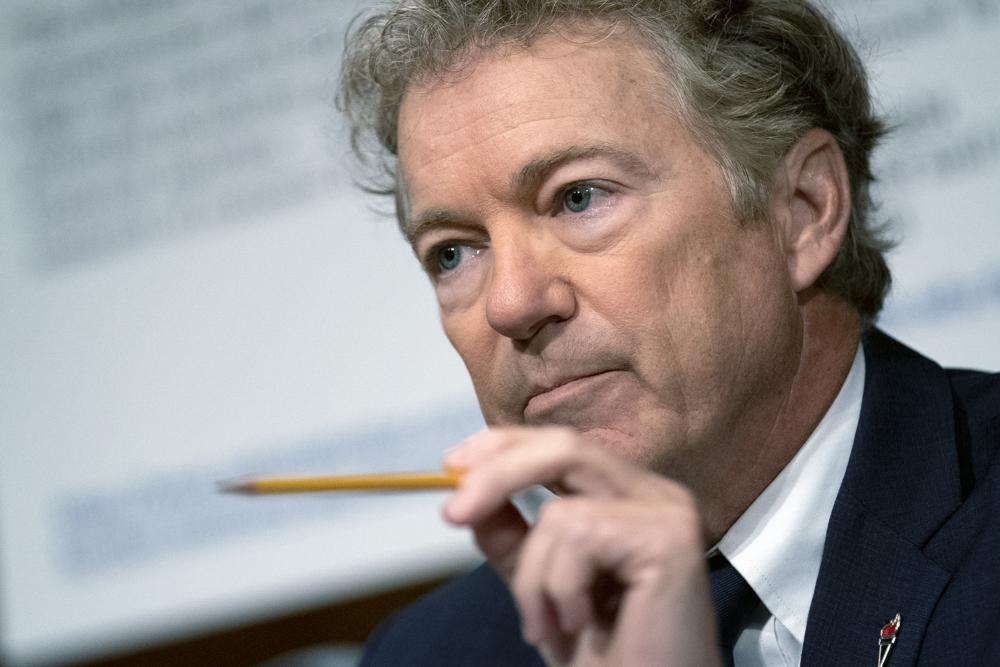
Dr. Anthony Fauci, the nation’s top infectious disease expert, angrily confronted Kentucky GOP Sen. Rand Paul on Tuesday in testimony on Capitol Hill, rejecting Paul’s insinuation that the U.S. helped fund research at a Chinese lab that could have sparked the COVID-19 outbreak. Paul suggested that Fauci had lied before Congress when in May, he denied that the National Institutes of Health funded so-called “gain of function” research — the practice of enhancing a virus in a lab to study its potential impact in the real world — at a Wuhan virology lab. U.S. intelligence agencies are currently exploring theories that an accidental leak from that lab could have led to the global pandemic. “I have not lied before Congress. I have never lied. Certainly not before Congress. Case closed,” Fauci told Paul before the Senate Health, Education, Labor, and Pensions Committee, saying a study the senator mentioned referenced a different sort of virus entirely from the one responsible for the coronavirus outbreak. “Senator Paul, you do not know what you’re talking about, quite frankly,” Fauci said. “And I want to say that officially. You do not know what you’re talking about.” He added, “If anybody is lying here, senator, it is you.” It was the latest in a series of clashes between Paul and Fauci over the origins of the virus that caused the global pandemic. Republished with the permission of the Associated Press.
Alabama suffers ‘self-inflicted wound’ of worsening COVID-19
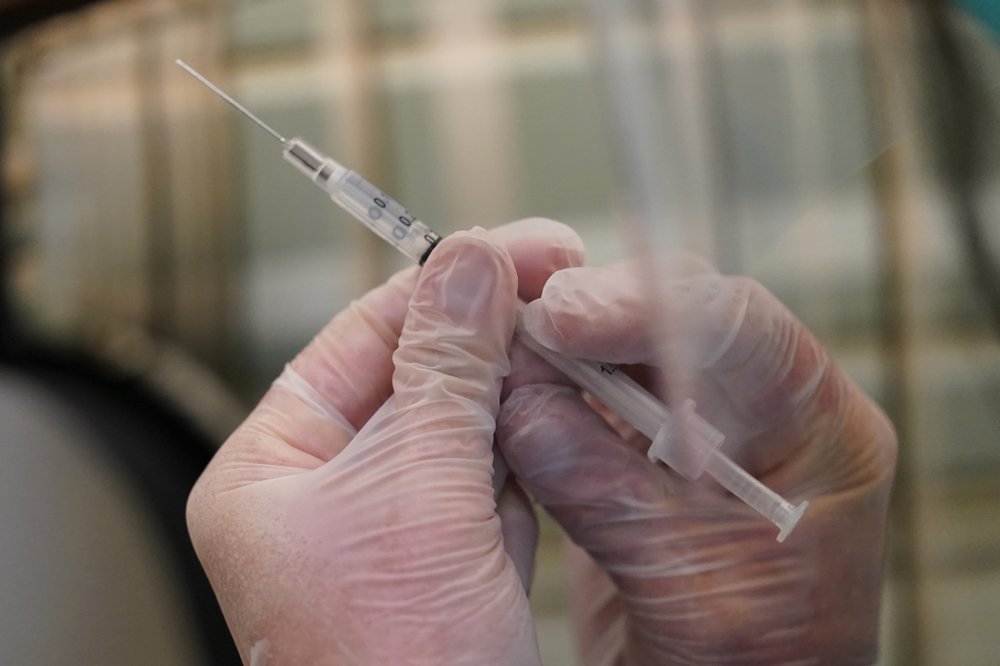
Alabama is suffering a “self-inflicted wound” from COVID-19, with hospitals again filling up as the state trails the nation in vaccinations and pandemic precautions like face masks and social distancing are all but forgotten, a health leader said Tuesday. Only 166 people were hospitalized statewide a month ago with COVID-19 after thousands were vaccinated and before a new variant took hold. But that low point has been followed by a rapid rise, and more than 550 people were being treated for the virus now, statistics showed. Hospitals are far from the critical point they reached in January when some 3,000 people were being treated at one time, but the fast-spreading Delta variant threatens to worsen the situation barring a rapid increase in vaccinations, said Dr. Donald Williamson, president of the Alabama Hospital Association. “There’s just a sense of frustration,” said Williamson, who used to head the Alabama Department of Public Health. “The fact that cases are rising is a self-inflicted injury.” Statistics show that only 50 people would currently be hospitalized if everyone who is eligible for a shot had gotten one, Williamson said, and chances are their illnesses wouldn’t be as severe. “This is the plague of our generation, and certainly of our lifetime. And now it could be so easily averted, but we’re failing to do that,” he said. Only 38% of the state’s population has gotten at least one vaccine dose, and just 31% is fully vaccinated, state statistics showed, yet the daily pace of vaccinations has slowed to roughly the same amount that were being given months ago when doses were scarce. Relatively few people still take precautions in public, and businesses full of people are a common sight. Without a rapid turnaround in vaccinations, Williamson said, health officials worry that cases will continue increasing as highly contagious virus variants spread through the population at stores, churches, restaurants, bars, sports contests, and other public events. Rather than reimposing restrictions like mandatory mask-wearing, capacity limits for businesses, or shutdowns, Gov. Kay Ivey has said the only thing she supports is encouraging people to use their “common sense,” show personal responsibility and get shots. To encourage vaccinations, the city of Gadsden said it would offer $100 to residents who received the first dose Tuesday or later and are fully vaccinated by Oct. 15. Two drawings for $5,000 will be held for every 500 residents who qualify. The three-campus University of Alabama system, with more than 70,000 students total, said anyone not fully vaccinated would be expected to wear a face mask and practice social distancing inside campus buildings this fall. Vaccines won’t be required in accordance with state law, however. “Data continue to show that vaccinated individuals remain protected from COVID-19. Widespread vaccination is the best way to sustain continued on-campus operations,” said Dr. Selwyn Vickers, dean of the medical school at the University of Alabama at Birmingham. Over the past two weeks, the rolling average number of daily new cases in Alabama has increased by 694, a spike of 573%. There were about 197 new cases per 100,000 people during the period, which ranked 11th nationally, with the largest increases along the coast in Mobile and Baldwin counties. Some 11,460 people have died of COVID-19 in Alabama, giving the state the 17th highest death rate nationally. Alabama has reported more than 560,000 positive tests, and the percentage of tests coming back positive is on the rise. Republished with the permission of the Associated Press.
Alabama hospital sending COVID-19 vaccination team to Peru

A south Alabama hospital that vaccinated thousands of people against COVID-19 plans to send a team to do immunizations in Peru, which has been hit hard by the pandemic. USA Health said more than 20 volunteers will travel to the country’s Cusco region. CerviCusco, a nongovernmental agency in Peru, sought the assistance, the health system said in a statement. “Our plan is to travel to Peru in mid-August, establish processes and protocols for safe and efficient vaccine distribution in the region with a goal of providing 5,000 doses to the people of Peru,” said Natalie Fox, assistant administrator, and chief nursing officer for USA Health Physicians Group. USA Health has provided more than 75,000 doses of COVID-19 vaccines on the Gulf Coast, including at mass clinics where more than 2,200 people received injections daily. To raise money for expenses, Mobile-based Synergy Laboratories is matching up to $10,000 in donations to the USA Health outreach campaign. Republished with the permission of the Associated Press.
