
Donald Trump restores some Cuba penalties, rejecting ‘oppressors’
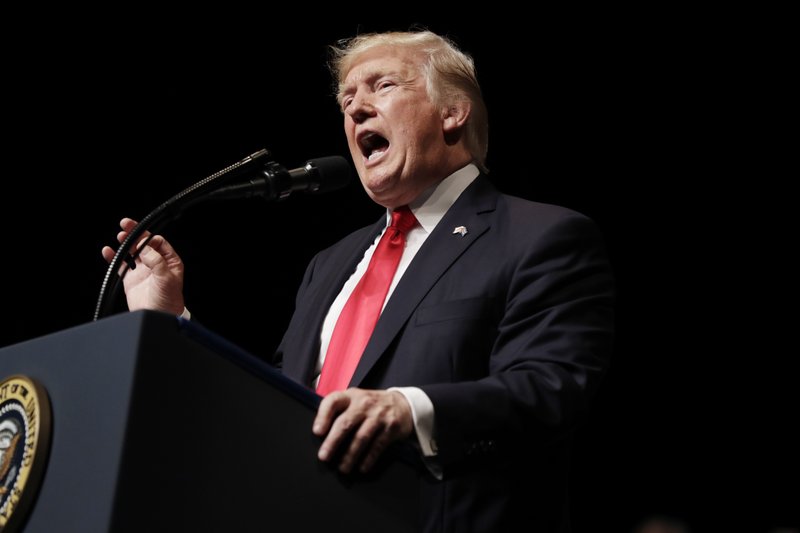
President Donald Trump declared Friday he was restoring some travel and economic restrictions on Cuba that were lifted as part of the Obama administration’s historic easing. He challenged the communist government of Raul Castro to negotiate a better deal for Cubans and Cuban-Americans. Announcing the rollback of President Barack Obama’s diplomatic opening during a speech in Miami, Trump said Cuba had secured far too many concessions from the U.S. in the “misguided” deal but “now those days are over.” He said penalties on Cuba would remain in place until its government releases political prisoners, stops abusing dissidents and respects freedom of expression. “America has rejected the Cuban people’s oppressors,” Trump said in a crowded, sweltering auditorium. “They are rejected officially today — rejected.” Though Trump’s announcement stops short of a full reversal of the Cuba rapprochement, it targets the travel and economic engagement between the countries that has blossomed in the short time since relations were restored. The goal is to halt the flow of U.S. cash to the country’s military and security services in a bid to increase pressure on Cuba’s government. Embassies in Havana and Washington will remain open. U.S. airlines and cruise ships will still be allowed to serve the island 90 miles south of Florida. The “wet foot, dry foot” policy, which once let most Cuban migrants stay if they made it to U.S. soil but was terminated under Obama, will remain terminated. Remittances to Cuba won’t be cut off. But individual “people-to-people” trips by Americans to Cuba, allowed by Obama for the first time in decades, will again be prohibited. And the U.S. government will police other such trips to ensure there’s a tour group representative along making sure travelers are pursuing a “full-time schedule of educational exchange activities.” Trump described his move as an effort to ramp up pressure to create a “free Cuba” after more than half a century of communism. “I do believe that end is in the very near future,” he said. Trump’s move was a direct rebuke to Obama, for whom the diplomatic opening with Cuba was a central accomplishment of his presidency. The new president’s action is broadly opposed by American business groups. “U.S. private sector engagement can be a positive force for the kind of change we all wish to see in Cuba,” said Myron Brilliant, the U.S. Chamber of Commerce executive vice president and head of international affairs. “Unfortunately, today’s moves actually limit the possibility for positive change on the island and risk ceding growth opportunities to other countries that, frankly, may not share America’s interest in a free and democratic Cuba that respects human rights.” In Cuba, Granma, the official organ of the nation’s Communist Party, covered Friday’s speech in a real-time blog, saying “Trump’s declarations are a return to imperialist rhetoric and unilateral demands, sending relations between Havana and Washington back into the freezer.” On the stage in Miami, Rep. Mario Diaz-Balart, R-Fla., said the U.S. would no longer have to witness the “embarrassing spectacle” of an American president glad-handing with a dictator. “President Trump will treat the Castro regime as a malevolent dictatorship that it is,” Diaz-Balart said. “Thank you, President Trump, for keeping your commitments. You have not betrayed us — you kept your promise.” Obama announced in December 2014 that he and Cuban leader Raul Castro were restoring diplomatic ties between their countries, arguing that a new approach was needed because the policy the U.S. had pursued for decades had failed to democratize the island. Less than a year later, the U.S. Embassy in Havana re-opened. The U.S. severed ties with Cuba in 1961 after Fidel Castro’s revolution, and spent subsequent decades trying to either overthrow the Cuban government or isolate the island, including by toughening an economic embargo first imposed by President Dwight D. Eisenhower. The trade embargo remains in place under Trump. Only the U.S. Congress can lift it, and lawmakers, especially those of Cuban heritage, like Sen. Marco Rubio, another Florida Republican, have shown no interest in doing so. Rubio staunchly opposed Obama’s re-engagement with Cuba, and he lauded Trump as he took the stage. “Today, a new president lands in Miami to reach out his hand to the people of Cuba,” Rubio said. Republished with permission of The Associated Press.
Florida ports drop trade with Cuba, Port of Mobile to pick up slack
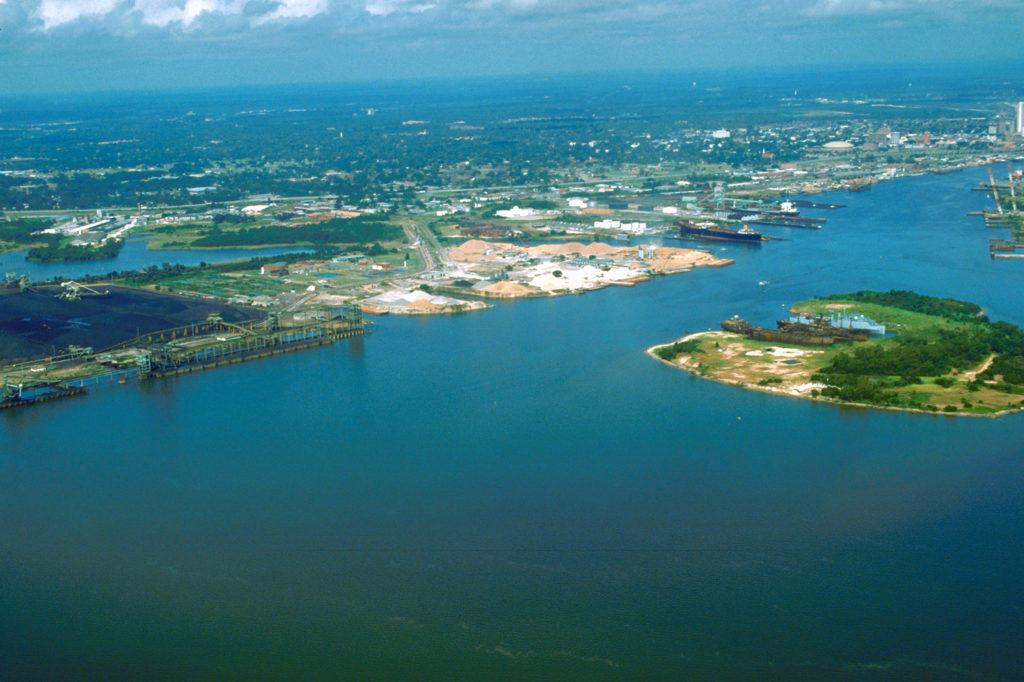
Alabama officials were in Tampa Thursday to ink a trade agreement with Cuba, one that Florida ports cannot. Seaports in Mobile and Havana are agreeing to do business in the future in a deal similar to one that had been between three ports in Florida. That is until last week, when Gov. Rick Scott threatened to pull funding to ports shipping to Cuba. John Kavulich, president of the New York-based U.S.-Cuba Trade and Economic Council, told the Tampa Bay Times: “This feels like Cuba’s way of saying if Florida doesn’t want our business, Alabama does … And they are coming onto your turf to do it.” Representatives for Alabama and Cuba were attending “Planning for Shifting Trade,” an international conference sponsored by the American Association of Port Authorities, held at the Tampa Marriott Waterside Hotel & Marina. So far, the U.S. allows only a limited number of exports to Cuba, which is still under a trade embargo imposed half a century ago after Cuban leader Fidel Castro established communism on the island nation. A 2000 law allows some exceptions, such as agricultural goods and food. Castro died in November 2016. Mobile has the fifth highest number of exports to Cuba among U.S. ports, Kavulich told the Times. Currently, Tampa ports send no shipments to Cuba.
Barack Obama ends visa-free path for Cubans who make it to US soil
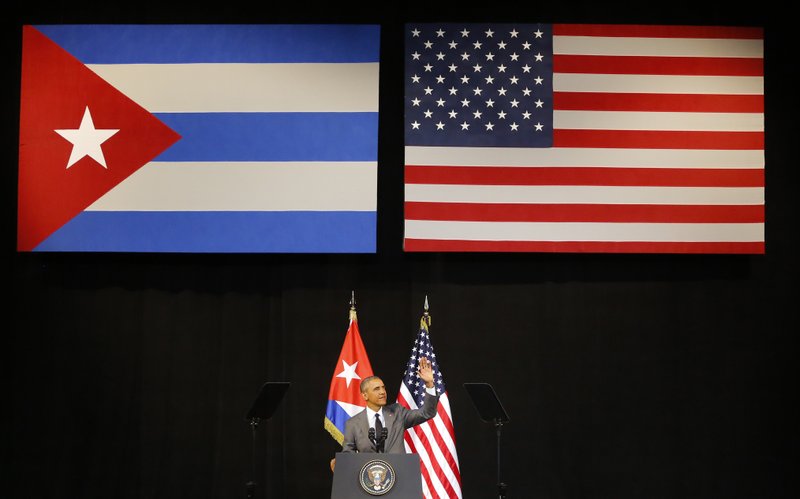
President Barack Obama announced Thursday he is ending a longstanding immigration policy that allows any Cuban who makes it to U.S. soil to stay and become a legal resident. The repeal of the “wet foot, dry foot” policy is effective immediately. The decision follows months of negotiations focused in part on getting Cuba to agree to take back people who had arrived in the U.S. “Effective immediately, Cuban nationals who attempt to enter the United States illegally and do not qualify for humanitarian relief will be subject to removal, consistent with U.S. law and enforcement priorities,” Obama said in a statement. “By taking this step, we are treating Cuban migrants the same way we treat migrants from other countries. The Cuban government has agreed to accept the return of Cuban nationals who have been ordered removed, just as it has been accepting the return of migrants interdicted at sea.” The Cuban government praised the move. In a statement read on state television, it called the signing of the agreement “an important step in advancing relations” between the U.S. and Cuba that “aims to guarantee normal, safe and ordered migration.” Obama is using an administrative rule change to end the policy. Donald Trump could undo that rule after becoming president next week. He has criticized Obama’s moves to improve relations with Cuba. But ending a policy that has allowed hundreds of thousands of people to come to the United States without a visa also aligns with Trump’s commitment to tough immigration policies. President Bill Clinton created “wet foot, dry foot” policy in 1995 as a revision of a more liberal immigration policy that allowed Cubans caught at sea to come to the United States become legal residents in a year. The two governments have been negotiating an end to “wet foot, dry foot” for months and finalized an agreement Thursday. A decades-old U.S. economic embargo, though, remains in place, as does the Cuban Adjustment Act, which lets Cubans become permanent residents a year after legally arriving in the U.S. Under the terms of the agreement, Cuba has agreed to take back those turned away from the U.S., if the time between their departure from Cuba and the start of deportation hearings in the U.S. is four years or less. Officials said the timeframe is required under a Cuban law enacted after Congress passed the Cuban Adjustment Act. “For this to work, the Cubans had to agree to take people back,” said Ben Rhodes, Obama’s deputy national security adviser. Administration officials called on Congress to repeal the Cuban Adjustment Act. Officials said the changes would not affect a lottery that allows 20,000 Cubans to come to the U.S. legally each year. But Rhodes cast the shift as a necessary step toward Cuba’s economic and political development. “It’s important that Cuba continue to have a young, dynamic population that are clearly serving as agents of change,” he said. Rhodes also cited an uptick in Cuban migration, particularly across the U.S.-Mexico border — an increase many have attributed to an expectation among Cubans that the Obama administration would soon move to end their special immigration status. Since October 2012, more than 118,000 Cubans have presented themselves at ports of entry along the border, according to statistics published by the Homeland Security Department, including more than 48,000 people who arrived between October 2015 and November 2016. Relations between the United States and Cuba were stuck in a Cold War freeze for decades, but Obama and Cuban President Raul Castro established full diplomatic ties and opened embassies in their capitals in 2015. Obama visited Havana last March. Officials from both nations met Thursday in Washington to coordinate efforts to fight human trafficking. Obama said the Cuban Medical Professional Parole Program, which was started by President George W. Bush in 2006, is also being rescinded. The measure allowed Cuban doctors, nurses and other medical professionals to seek parole in the U.S. while on assignments abroad. The president said those doctors can still apply for asylum at U.S. embassies around the world. “By providing preferential treatment to Cuban medical personnel, the medical parole program … risks harming the Cuban people,” Obama said. People already in the United States and in the pipeline under both “wet foot, dry foot” and the medical parole program will be able to continue the process toward getting legal status. Reaction to the announcement in Havana was muted Thursday afternoon. “This was bound to happen at some point,” said taxi driver Guillermo Britos, 35. “It could impose a more normal dynamic on emigration, so that not so many people die at sea, but it could also take an escape valve away from the government, which was getting hard currency from the emigrants.” Anti-Castro Cubans in Miami were mixed in their responses, with some expressing anger at Obama for what they called another betrayal of ordinary Cubans. Others said they thought the measure would increase pressure for change in Cuba. “People who can’t leave, they could create internal problems for the regime,” said Jorge Gutierrez, an 80-year-old veteran of the Bay of Pigs invasion. But he added, “From the humanitarian point of view, it’s taking away the possibility of a better future from the people who are struggling in Cuba.” Rep. Illeana Ros-Lehtinen, a Florida Republican who emigrated from Cuba as a child, decried the elimination of the medical parole programs, calling it a “foolhardy concession to a regime that sends its doctors to foreign nations in a modern-day indentured servitude.” Republish with permission of The Associated Press.
Two US officials to attend Fidel Castro’s funeral in Cuba
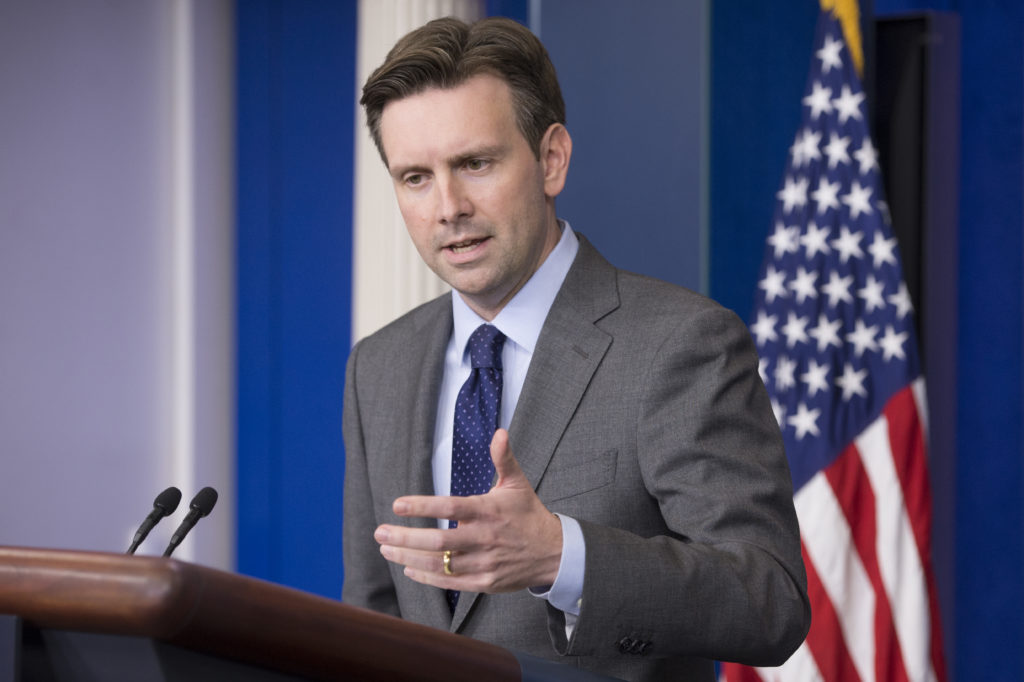
White House spokesman Josh Earnest says a high-ranking presidential adviser and the top diplomat to Cuba will represent the United States at Fidel Castro‘s funeral. Earnest is emphasizing that the two are not part of a formal delegation to the service, but the appearance of deputy national security adviser Ben Rhodes and Jeffrey DeLaurentis shows a commitment to an “ongoing, future-oriented relationship with the Cuban people.” DeLaurentis is awaiting Senate confirmation to be U.S. ambassador to Cuba. Earnest says Rhodes was already scheduled to be on the island this week. He notes that Rhodes played a leading role in crafting agreements to normalize relations with Cuba. Earnest says Rhodes’ and DeLaurentis’ attendance is “an appropriate way to show respect,” while acknowledging the differences that remain between the two nations. Republished with permission of the Associated Press.
Donald Trump aides say Cuban government will have to change
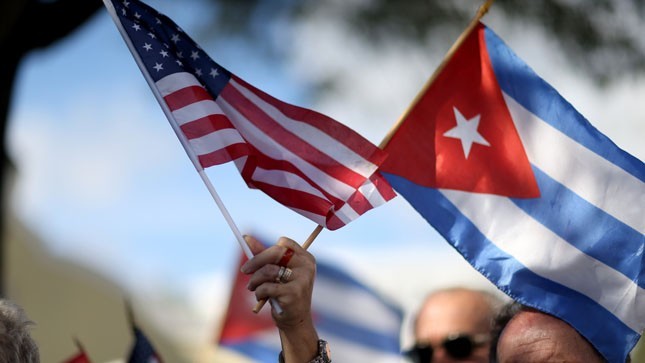
The Cuban government must move toward enacting greater freedoms for its people and giving Americans something in return if it wants to keep warmer U.S. relations initiated by President Barack Obama, top aides to President-elect Donald Trump said Sunday. The comments by Trump advisers Kellyanne Conway and Reince Priebus followed the death of former Cuban leader Fidel Castro. Castro’s younger brother, 85-year-old Raul Castro, took control in 2006, and later negotiated with Obama to restore diplomatic relations. Priebus, Trump’s incoming chief of staff, said Trump would “absolutely” reverse Obama’s opening to Cuba unless there is “some movement” from the Cuban government. “Repression, open markets, freedom of religion, political prisoners – these things need to change in order to have open and free relationships, and that’s what President-elect Trump believes, and that’s where he’s going to head, ” Priebus told “Fox News Sunday.” Conway made similar remarks and noted that any diplomatic deal will have to benefit American workers. “To the extent that President Trump can open up new conversations with Cuba, it would have to be a very different Cuba,” she told ABC’s “This Week.” She added: “He wants to make sure that when the United States of America, when he’s president, engages in any type of diplomatic relations or trade agreements … that we as America are being protected and we as America are getting something in return.” Conway said nothing on Cuba has been decided. But she noted that the U.S. is allowing commercial aircraft to do business with a repressive Cuban government and Cuban military. And she said the “first order of business” is to rally the international community around trying to free political prisoners. While Obama opened some U.S. investment and travel to Cuba through executive order, vast restrictions tied up in the trade embargo remain at the insistence of Republican lawmakers. Separate memorial services have been scheduled for Tuesday and later in the week in Cuba for Castro, and some world leaders and celebrities were expected to attend. As of Sunday, though, the White House had not said whether anyone from the U.S. government would attend. Republican Sen. Marco Rubio of Florida, whose parents were born in Cuba, says he is heartened by Trump’s past hard-line rhetoric on Cuba. Rubio told CNN’s “State of the Union” that the U.S. focus must be its own security and other interests and encouraging a Cuban democracy. “We should examine our policy toward Cuba through those lenses,” he said. “And if there’s a policy that helps that, it remains in place. And if it’s a policy that doesn’t, it’s removed.” During the campaign, Trump said he would reverse “concessions” to the Cuban government by Obama unless the Castro government meets his demands. On Saturday, while Obama offered condolences to Castro’s family and said the U.S. extends “a hand of friendship to the Cuban people,” Trump tweeted: “Fidel Castro is dead!” Trump later released a statement noting his administration “will do all it can to ensure the Cuban people can finally begin their journey toward prosperity and liberty.” Republished with permission of the Associated Press.
Weeping, hopeful, Cubans look to future without Fidel Castro
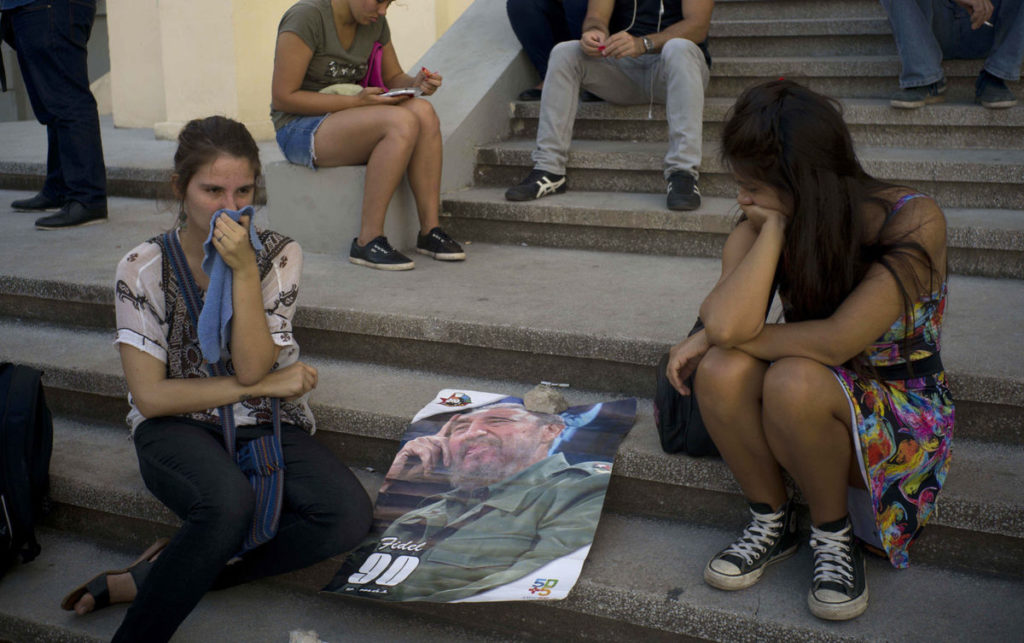
Music fell silent, weddings were canceled and people wept in the streets Saturday as Cubans faced their first day without the leader who steered their island to both greater social equality and years of economic ruin. Across a hushed capital, dozens of Cubans said they felt genuine pain at the death of Fidel Castro, whose words and image had filled schoolbooks, airwaves and front pages since before many were born. And in private conversations, they expressed hope that Castro’s passing will allow Cuba to move faster toward a more open, prosperous future under his younger brother and successor, President Raul Castro. Both brothers led bands of bearded rebels out of the eastern Sierra Maestra mountains to create a communist government 90 miles from the United States. But since taking over from his ailing brother in 2006, the 85-year-old Raul Castro has allowed an explosion of private enterprise and, last year, restored diplomatic relations with Washington. “Raul wants the country to advance, to do business with the whole world, even the United States,” said Belkis Bejarano, a 65-year-old homemaker in central Havana. “Raul wants to do business, that’s it. Fidel was still holed up in the Sierra Maestra.” In his twilight years, Fidel Castro largely refrained from offering his opinions publicly on domestic issues, lending tacit backing to his brother’s free-market reforms. But the older Castro surged back onto the public stage twice this year — critiquing President Barack Obama‘s historic March visit to Cuba and proclaiming in April that communism was “a great step forward in the fight against colonialism and its inseparable companion, imperialism.” Ailing and without any overt political power, the 90-year-old revolutionary icon became for some a symbol of resistance to his younger sibling’s diplomatic and economic openings. For many other Cubans, however, Fidel Castro was fading into history, increasingly at a remove from the passions that long cast him as either messianic savior or maniacal strongman. On Saturday, many Cubans on the island described Fidel Castro as a towering figure who brought Cuba free health care, education and true independence from the United States, while saddling the country with an ossified political and economic system that has left streets and buildings crumbling and young, educated elites fleeing in search of greater prosperity abroad. “Fidel was a father for everyone in my generation,” said Jorge Luis Hernandez, a 45-year-old electrician. “I hope that we keep moving forward because we are truly a great, strong, intelligent people. There are a lot of transformations, a lot of changes, but I think that the revolution will keep on in the same way and always keep moving forward.” “Fidel’s ideas are still valid. But we can’t look back even for a second,” says Edgardo Casals, a 32-year-old sculptor In 2013, Raul Castro announced that he would step aside by the time his current presidential term ends in 2018, and for the first time named an heir-apparent not from the Castro’s revolutionary generation — Miguel Diaz-Canel, 56. Fidel Castro’s death “puts a sharper focus on the mortality of the entire first generation of this revolution,” said Philip Peters, a Cuba analyst and business consultant, “and brings into sharper focus the absence of a group of potential leaders that’s ready to take over and politically connected to the public.” For Cubans off the island, Castro’s death was cause for celebration. In Miami, the heart of the Cuban diaspora, thousands of people banged pots with spoons, waved Cuban and U.S. flags in the air and whooped in jubilation. “We’re not celebrating that someone died, but that this is finished,” said 30-year-old Erick Martinez, who emigrated from Cuba four years ago. The Cuban government declared nine days of mourning for Castro, whose ashes will be carried across the island from Havana to the eastern city of Santiago in a procession retracing his rebel army’s victorious sweep from the Sierra Maestra to Havana. State radio and television were filled with non-stop tributes to Castro, playing hours of footage of his time in power and interviews with prominent Cubans affectionately remembering him. Bars shut, baseball games and concerts were suspended and many restaurants stopped serving alcohol and planned to close early. Official newspapers were published Saturday with only black ink instead of the usual bright red or blue mastheads. Many Cubans, however, were already imagining the coming years in a Cuba without Fidel Castro. “Fidel’s ideas are still valid,” said Edgardo Casals, a 32-year-old sculptor. “But we can’t look back even for a second. We have to find our own way. We have to look toward the future, which is ours, the younger generations’.” Republished with permission of the Associated Press.
Cuba’s Fidel Castro, who defied U.S. for 50 years, dies at 90

Former President Fidel Castro, who led a rebel army to improbable victory in Cuba, embraced Soviet-style communism and defied the power of 10 U.S. presidents during his half-century rule, has died at age 90. With a shaking voice, President Raul Castro said on state television that his older brother died at 10:29 p.m. Friday. He ended the announcement by shouting the revolutionary slogan: “Toward victory, always!” Castro’s reign over the island-nation 90 miles (145 kilometers) from Florida was marked by the U.S.-backed Bay of Pigs invasion in 1961 and the Cuban Missile Crisis a year later that brought the world to the brink of nuclear war. The bearded revolutionary, who survived a crippling U.S. trade embargo as well as dozens, possibly hundreds, of assassination plots, died 10 years after ill health forced him to hand power over to Raul. Castro overcame imprisonment at the hands of dictator Fulgencio Batista, exile in Mexico and a disastrous start to his rebellion before triumphantly riding into Havana in January 1959 to become, at age 32, the youngest leader in Latin America. For decades, he served as an inspiration and source of support to revolutionaries from Latin America to Africa. His commitment to socialism was unwavering, though his power finally began to fade in mid-2006 when a gastrointestinal ailment forced him to hand over the presidency to Raul in 2008, provisionally at first and then permanently. His defiant image lingered long after he gave up his trademark Cohiba cigars for health reasons and his tall frame grew stooped. “Socialism or death” remained Castro’s rallying cry even as Western-style democracy swept the globe and other communist regimes in China and Vietnam embraced capitalism, leaving this island of 11 million people an economically crippled Marxist curiosity. He survived long enough to see Raul Castro negotiate an opening with U.S. President Barack Obama on Dec. 17, 2014, when Washington and Havana announced they would move to restore diplomatic ties for the first time since they were severed in 1961. He cautiously blessed the historic deal with his lifelong enemy in a letter published after a month-long silence. Obama made a historic visit to Havana in March 2016. Carlos Rodriguez, 15, was sitting in Havana’s Miramar neighborhood when he heard that Fidel Castro had died. “Fidel? Fidel?” he said, slapping his head in shock. “That’s not what I was expecting. One always thought that he would last forever. It doesn’t seem true.” “It’s a tragedy,” said 22-year-old nurse Dayan Montalvo. “We all grew up with him. I feel really hurt by the news that we just heard.” Fidel Castro Ruz was born Aug. 13, 1926, in eastern Cuba’s sugar country, where his Spanish immigrant father worked first recruiting labor for U.S. sugar companies and later built up a prosperous plantation of his own. Castro attended Jesuit schools, then the University of Havana, where he received law and social science degrees. His life as a rebel began in 1953 with a reckless attack on the Moncada military barracks in the eastern city of Santiago. Most of his comrades were killed and Fidel and his brother Raul went to prison. Fidel turned his trial defense into a manifesto that he smuggled out of jail, famously declaring, “History will absolve me.” Freed under a pardon, Castro fled to Mexico and organized a rebel band that returned in 1956, sailing across the Gulf of Mexico to Cuba on a yacht named Granma. After losing most of his group in a bungled landing, he rallied support in Cuba’s eastern Sierra Maestra mountains. Three years later, tens of thousands spilled into the streets of Havana to celebrate Batista’s downfall and catch a glimpse of Castro as his rebel caravan arrived in the capital on Jan. 8, 1959. The U.S. was among the first to formally recognize his government, cautiously trusting Castro’s early assurances he merely wanted to restore democracy, not install socialism. Within months, Castro was imposing radical economic reforms. Members of the old government went before summary courts, and at least 582 were shot by firing squads over two years. Independent newspapers were closed and in the early years, homosexuals were herded into camps for “re-education.” In 1964, Castro acknowledged holding 15,000 political prisoners. Hundreds of thousands of Cubans fled, including Castro’s daughter Alina Fernandez Revuelta and his younger sister Juana. Still, the revolution thrilled millions in Cuba and across Latin America who saw it as an example of how the seemingly arrogant Yankees could be defied. And many on the island were happy to see the seizure of property of the landed class, the expulsion of American gangsters and the closure of their casinos. Castro’s speeches, lasting up to six hours, became the soundtrack of Cuban life and his 269-minute speech to the U.N. General Assembly in 1960 set the world body’s record for length that still stood more than five decades later. As Castro moved into the Soviet bloc, Washington began working to oust him, cutting U.S. purchases of sugar, the island’s economic mainstay. Castro, in turn, confiscated $1 billion in U.S. assets. The American government imposed a trade embargo, banning virtually all U.S. exports to the island except for food and medicine, and it severed diplomatic ties on Jan. 3, 1961. On April 16 of that year, Castro declared his revolution to be socialist, and the next day, about 1,400 Cuban exiles stormed the beach at the Bay of Pigs on Cuba’s south coast. But the CIA-backed invasion failed. The debacle forced the U.S. to give up on the idea of invading Cuba, but that didn’t stop Washington and Castro’s exiled enemies from trying to do him in. By Cuban count, he was the target of more than 630 assassination plots by militant Cuban exiles or the U.S. government. The biggest crisis of the Cold War between Washington and Moscow exploded on Oct. 22, 1962, when President John F. Kennedy announced there were Soviet nuclear missiles in Cuba and imposed a naval blockade of the island. Humankind held its
Lawmakers to join anti-embargo group to promote U.S.-Cuba relations
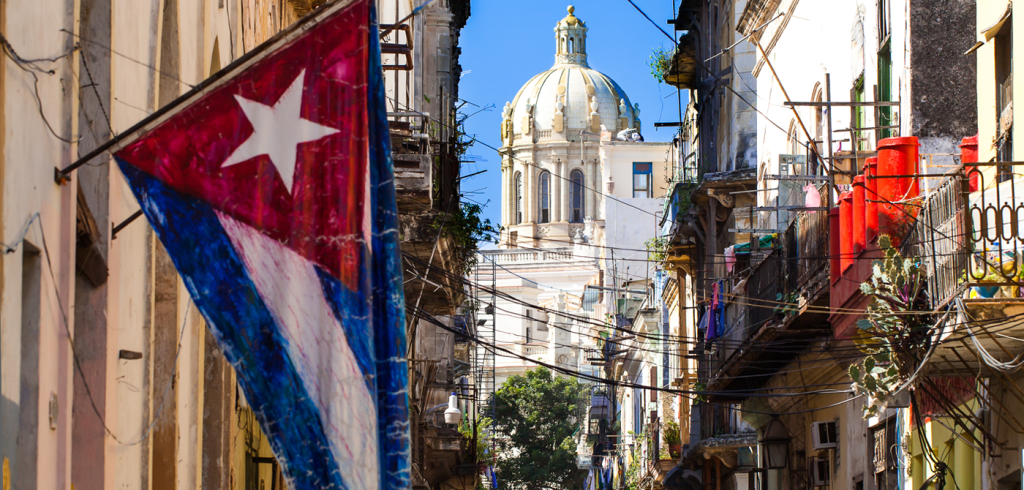
Prominent state lawmakers will join with a national advocacy group aimed at promoting economic ties between the United States and its island neighbor to the south to announce a new move to improve relations between the two nations. Leaders of a group called Engage Cuba will be joined by Democratic Sen. Vivian Figures and Republican Sen. J. T. “Jabo” Waggoner along with state business leaders to announce the creation of the Engage Cuba Alabama State Council. The group has launched similar councils in eight others states — Arkansas, Georgia, Iowa, Louisiana, Minnesota, Ohio, Tennessee, and Texas — and plans another state-level group in Mississippi this week. Executive Director of the Alabama Poultry Association, Johnny Adams, and a Commissioner John McMillan of the Department of Agriculture & Industries will also be on hand for the announcement. According to the group’s website, the state councils aim to “push for an end to trade and travel restrictions with Cuba” and “build a movement across the country for congressional action on ending the trade and travel ban.” The group touts support from top American corporations like Choice Hotels, Comcast and P&G.
J.T. Waggoner offers resolution to lift Cuban trade embargo
As the Senate session got underway Tuesday, Sen. J.T. Waggoner (R-Vestavia Hills) offered a resolution urging Congress to normalize relations with Cuba and lift the trade embargo which has been in place for more than 50 years. SJR43 claims that the embargo creates “significant restrictions and prohibitions on 20 American-Cuban relationships, notable on trade, travel, and 21 financial transactions.” Further, the resolution alleges that such restrictions make access to American goods “burdensome,” if not completely prohibited. As a result, Waggoner’s resolution suggests that the easing of restrictions against Cuba would create “new opportunities to grow our nation’s agricultural sector and create jobs in rural communities across the U.S.,” adding that Cuba is home to 11 million consumers, and in close proximity to the U.S., which makes it a “logical target for expanded U.S. food and agricultural exports.” The resolution further states that easing restrictions against the island would improve the quality of life for Cuban citizens and significantly boost the Cuban economy. Waggoner’s resolution is currently pending action in the Senate Rules Committee.
In final year, Barack Obama seeks to stave off lame-duck status
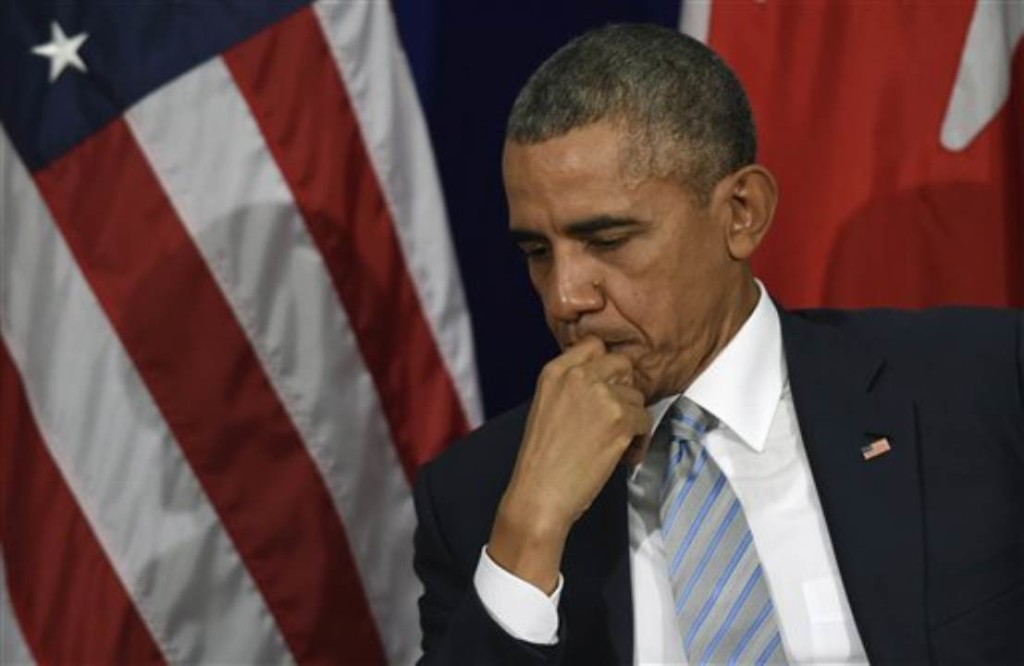
In June, during one of the best stretches of his presidency, Barack Obama strode through a West Wing hallway exclaiming, “Offense! Stay on offense!” It was a rallying cry for a White House that suddenly seemed to find its footing in the final quarter of Obama’s tenure. An Asia-Pacific trade agreement was moving forward, as was the diplomatic opening with Cuba and work on an historic nuclear accord with Iran. The Supreme Court upheld a key tenant of the president’s long-embattled health care law and legalized gay marriage nationwide. Even in the depths of tragedy following a church shooting in Charleston, South Carolina, the president struck an emotional chord with his stirring eulogy for the victims. “I said at the beginning of this year that interesting stuff happens in the fourth quarter — and we are only halfway through,” Obama said during his annual year-end news conference. But the seventh year of Obama’s presidency also challenged anew his cautious and restrained approach to international crises, particularly in the Middle East. Attacks in Paris and San Bernardino, California, heightened fears of terror on American soil and Obama’s attempts to reassure Americans fell flat. And a seemingly endless string of mass shootings elsewhere in the country exposed the sharp limits of Obama’s power to implement the gun control measures he speaks of with passion. Obama now stares down 11 months before his successor is chosen in an election shaping up to be a referendum on his leadership at home and abroad. He stirs deep anger among many Republicans, a constant reminder of his failure to make good on campaign promises to heal Washington’s divisiveness. But he remains popular among Democrats and foresees a role campaigning for his party’s nominee in the general election. The president is packing his final year with foreign travel and has about a half-dozen trips abroad planned, including a likely visit to Cuba. The White House’s legislative agenda is slim and centers mostly on areas where he already has overlapping priorities with Republicans, including final passage of the Trans-Pacific Partnership trade pact and criminal justice reform. But he’s also eyeing provocative executive actions, including an expansion of background checks for gun purchases and the closure of the Guantanamo Bay detention center. “We recognize there’s limited time left,” said Jennifer Psaki, Obama’s communications director. • • • At times, Obama’s second term has appeared to play out in reverse. He struggled to capitalize on his decisive re-election victory in 2012, stumbling through a two-year stretch that exposed the limits of his power and made him a political liability for his party. Then in an unexpected twist, his party’s devastating defeats in the 2014 midterm election spurred one of the most productive years of his presidency, positioning Obama to be a valuable political ally for Democratic presidential front-runner Hillary Clinton. “Barack Obama will loom over the election,” said Dan Pfeiffer, a longtime Obama adviser who left the White House earlier this year. Advisers say the Supreme Court’s ruling in May, which upheld the subsidies at the heart of Obama’s health care law, came as a particular relief to the president. The decision ensures the law survives his presidency, even as Republican candidates campaign on pledges to repeal it. Obama sees the Iran nuclear accord, Pacific Rim trade pact and sweeping climate change agreement finalized in Paris earlier this month as examples of how America should wield its power on the world stage. The agreements have driven the debate in the presidential campaign for long stretches — a point of pride for a White House eager to show that the president remains the country’s most relevant politician even as he eyes the exist. Yet Obama hasn’t been able to escape the Middle East. No matter how many times he tries to pivot to Asia or rebrand U.S. foreign policy as more about diplomacy than military might, the volatile region continues to be the dominant force in the way his foreign policy is viewed. Nearly every candidate running for president — including Clinton, his former secretary of state — is calling for more aggressive action to fight the Islamic State group. Obama has inched the military deeper into the conflict, including backtracking on his refusal to put U.S. troops on the ground in Syria, but has largely stuck with his initial strategy of combating the extremist group from the air. The terror attacks in Paris and California, however, have taken a worrying but distant fight against the Islamic State militants and made it top-of-mind for many Americans. White House advisers say Obama is well aware that he misjudged the public’s level of anxiety about terrorism and must scramble to counter what he sees as overheated rhetoric from Republican presidential candidates that filled the void he created by his tepid initial response. Aides say outlining an alternative to Republicans on foreign policy and other matters will be a central part of his final State of the Union address to Congress on Jan. 12. The address was purposely scheduled earlier than usual to give the president space to make his case before primary voting begins. He departed for his annual Hawaii vacation with a draft of the speech in hand. Julian Zelizer, a political historian at Princeton University, said a well-crafted speech can only go so far in helping Obama reassure the public of his national security stewardship. “The only way he regains ground is concrete victories where people can literally see progress made,” Zelizer said. “This is an area where he has to have policy gains” • • • As he closed out 2015, Obama promised he wouldn’t fade into the background in his final year in office. But he’s also realistic about the limited legislative opportunities for a Democratic president and Republican-led Congress in a presidential election year. His relatively modest congressional agenda includes final passage of the TPP trade pact, criminal justice reforms, dealing with Puerto Rico’s debt crisis and funding programs to address the spike in opioid use. At
Marco Rubio discusses hard-line Cuba stance, island’s future
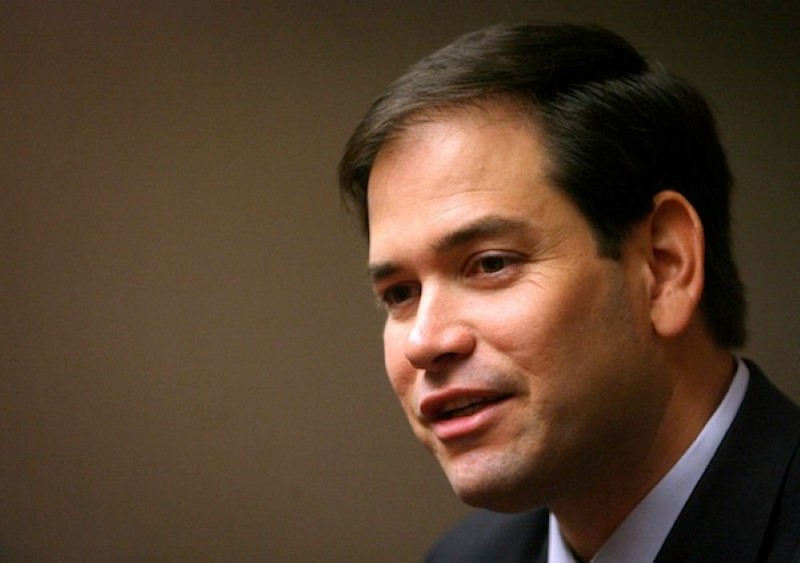
By the time the next president enters the Oval Office, U.S. airlines could be flying regularly scheduled flights to Cuba, a result of President Barack Obama‘s detente with the island. American businesses are eager to invest. U.S. citizens are already making more tourist trips to the island and Cuban-Americans are free to send more money to their relatives. Politicians are sometimes loath to make policy changes that take rights away from people. But Marco Rubio says he has no qualms about fully rolling back the opening set in motion by Obama and Cuban President Raul Castro — Fidel’s 84-year-old brother — about a year ago. He also thinks U.S. business people tantalized by the prospect of investing in the island will change their minds after the reality of dealing with the Castro government sets in. Cuban law generally prohibits majority foreign ownership of businesses on the island, although it allows joint ventures with the government and has allowed majority ownership in a new free trade zone. “American companies think they want to invest in Cuba,” Rubio said. “They have no idea what the terms are. The terms are, they don’t own anything. You can’t go to Cuba and open a business and own it.” He applies a similar theory to public opinion polls finding most Americans support Obama’s opening with Cuba. Most poll respondents “are just giving their opinion on an issue that they really don’t pay attention to,” Rubio said. “I think when you present to people the reality, those numbers begin to change.” Cuba has released some political prisoners as part of the detente and made some changes favored by businesses. Rubio sees those changes as largely cosmetic and says Obama essentially gave the Castros a financial lifeline to maintain their power and possibly entrench the current system after the brothers die. While Rubio agrees with little Obama has done in office, he pointed to the president’s diplomatic opening with Myanmar, also known as Burma, as a more effective model for dealing with authoritarian governments. After years of estrangement, the U.S. restored full diplomatic relations with Myanmar after the country’s leaders made a series of sweeping economic and political changes, including a transition from military rule to a quasi-civilian government. This month Myanmar took another step forward by electing a fully civilian government for the first time, with opposition hero Aung San Suu Kyi’s party emerging victorious. “I’m not telling you what’s happened with Burma is perfect,” Rubio said. “But even that opening came with some elements of democratic opening that allowed opposition groups and forces and ideas to enter the political marketplace.” “Nothing was asked of Cuba,” Rubio added. To the White House and supporters of Obama’s opening with Cuba, Rubio is living in the past. Fifty years of hostilities did nothing to push the Castros from power and Obama administration officials say there’s no indication that sticking with the same policy will suddenly achieve that outcome. Rubio knows his hard-line views on Cuba are also competing against a surge of public interest in the island. Even with continued travel restrictions, Americans are flocking to Cuba in record numbers for modern times. The island has attracted the occasional vacationing celebrity and plenty of U.S. media attention. Rubio says he shares the curiosity with Cuba. He enjoys watching the television show “Cuban Chrome,” which explores how people keep decades-old American cars running even though spare parts are hard to come by under the U.S. embargo. And he wants to go to the island one day and see the cemetery where his relatives are buried and the farmlands his grandfather told him about as a boy. “It’s all very interesting,” Rubio said. “My problem is when people come back and say, ‘I visited Cuba and it’s a wonderful place, the people are happy, the government is great.’ That’s what I mind.” Republished with permission of the Associated Press.
A conversation with Marco Rubio on Cuba, family ties
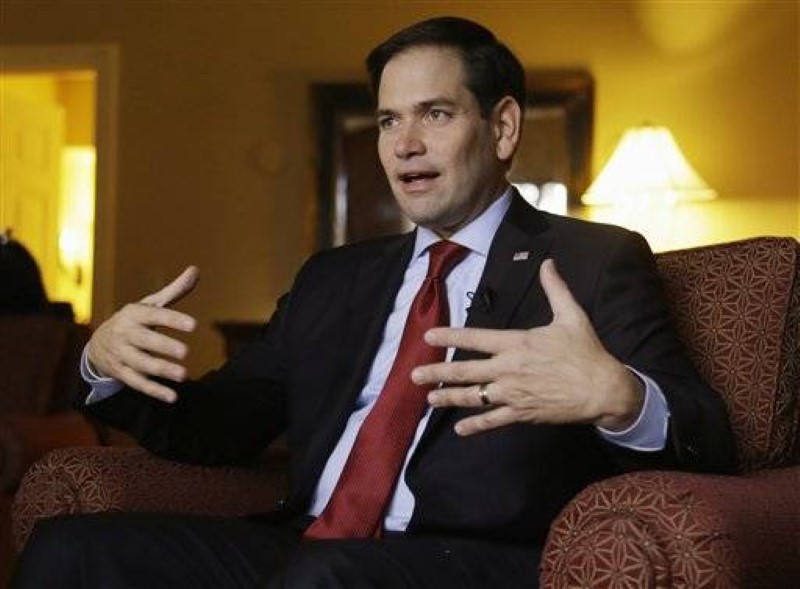
As Marco Rubio campaigns for the Republican presidential nomination, he’s pledging to bring generational change to Washington. Yet Rubio’s policy toward Cuba hinges on reinstating a half-century-old diplomatic freeze that failed to unseat the communist government on the island where his parents were born. The Florida senator sees no contradiction between his pledge to usher in new ideas and his call to restore an old, punitive relationship with Cuba. “People think it’s because we’re being stubborn or holding on to old policies,” Rubio, 44, said in an interview with The Associated Press. “I’m prepared to change strategies toward Cuba, but it has to be one that yields results.” In the traditional litany of promises candidates pledge to fulfill on “Day One” in the White House, rolling back President Barack Obama‘s detente with Cuba is near the top of Rubio’s list. He’d downgrade the newly opened American Embassy in Havana to a diplomatic interests section — the status of bilateral relations before Obama’s rapprochement with Cuba — and put back in place tougher limits on U.S. government and business dealings with the island. Still, Rubio says there are ways to move forward. He would be willing to allow U.S. companies to invest in telecommunications in Cuba in exchange for free and unfettered Internet access on the island. He can envision restoring full diplomatic relations with Havana, but only if the government there allows opposition political parties and gives them freedom to organize. Rubio says he’s also open to modifying the Cuban Adjustment Act, more commonly known as the “wet foot, dry foot” policy. For Cubans fleeing to the U.S., it grants those who reach land permanent residency after one year, while most of those caught in the waters between the two countries are sent back. Rubio won’t say what he would replace it with, but he calls the policy “hard to justify” when Cuban-Americans now have more ability to travel back and forth to the island. “When you have people who are coming and a year and a day later are traveling back to Cuba 15 times a year, 12 times, 10 times, eight times, that doesn’t look like someone who is fleeing oppression,” Rubio said. “And other people turn to us and say, `What’s the justification for this special status?’ That’s a very legitimate point.” Rubio speaks about Cuba with practiced fluency. It’s little surprise, given that his ties to the island have been central to his political rise. In his hometown of Miami, he forged political alliances with the city’s Cuban-American kingmakers and rose to be speaker of the Florida House, then U.S. senator. In a presidential race where he’s gaining momentum, his family’s history gives his campaign a sweeping emotional core. The outlines of that history are by now well-known. He rarely lets an event pass without mentioning his parents’ decision to leave Cuba and how they worked to give their children a better life in the U.S., his father a bartender, his mother a maid. “For them, Cuba was a place that had painful memories, but also obviously it was their homeland and they had love for it,” Rubio said. The story of the Rubio family’s arrival in the U.S. has evolved. Rubio previously referred to himself as the son of exiles, using the words of those who fled the island after Fidel Castro took power in 1959. Under questioning from journalists, Rubio later changed the timeline, saying his parents came to the U.S. in 1956, before Castro’s revolution. Rubio’s father died in 2010, but his mother still lives in Miami. The senator, his Colombian-American wife, Jeanette, and four children live in a home not far from where he grew up. The senator has never traveled to Cuba, but he said he tries to keep the country’s traditions alive for his young children. Meals at the Rubio house often include croquetas and other Cuban dishes. The family’s main Christmas celebration is on Dec. 24 and includes a whole pig roast, a tradition many Cubans who fled have continued in their new homeland. Still, even in a city like Miami that pulses with Cuban culture, Rubio sees the ways his children are becoming more a part of the country they live in than the one where their elders came from. “America is a very powerful culture with very powerful values and traditions,” he said. “You can see it. You see it within one generation, certainly by two generations.” Republished with permission of the Associated Press.
