
Tommy Tuberville accompanies President Donald Trump during Dallas visit
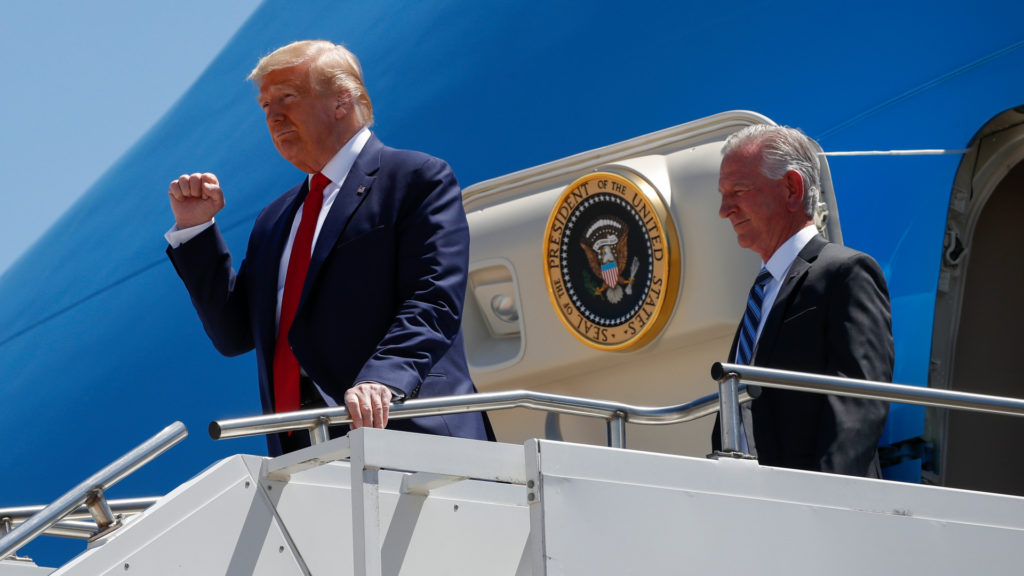
U.S. Senate hopeful, former Auburn University football coach Tommy Tuberville accompanied President Donald Trump on Thursday as he visited Dallas for an address on the economy and other domestic matters. Tuberville deplaned Air Force One alongside Trump upon arrival at Love Field in Dallas. He did not travel to Dallas with Trump. Instead, he met him at the airport for a meeting. As they met aboard Air Force One, Tuberville said he the president discussed the status of the Alabama Senate race and “ways to Make America Great Again.” In a stunning blow to his former Attorney General, Trump endorsed Tuberville ahead of the GOP primary runoff back in March. “Tommy Tuberville is running for the U.S. Senate from the Great State of Alabama,” Trump tweeted. “He is a REAL LEADER who will never let MAGA/KAG, or our country down!” Tuberville faces former U.S. Attorney General Jeff Jeff Sessions in the Republican primary runoff on July 14. The winner will go on to face Democrat U.S. Sen. Doug Jones in the general election in November.
Constables: who they are, and what they do
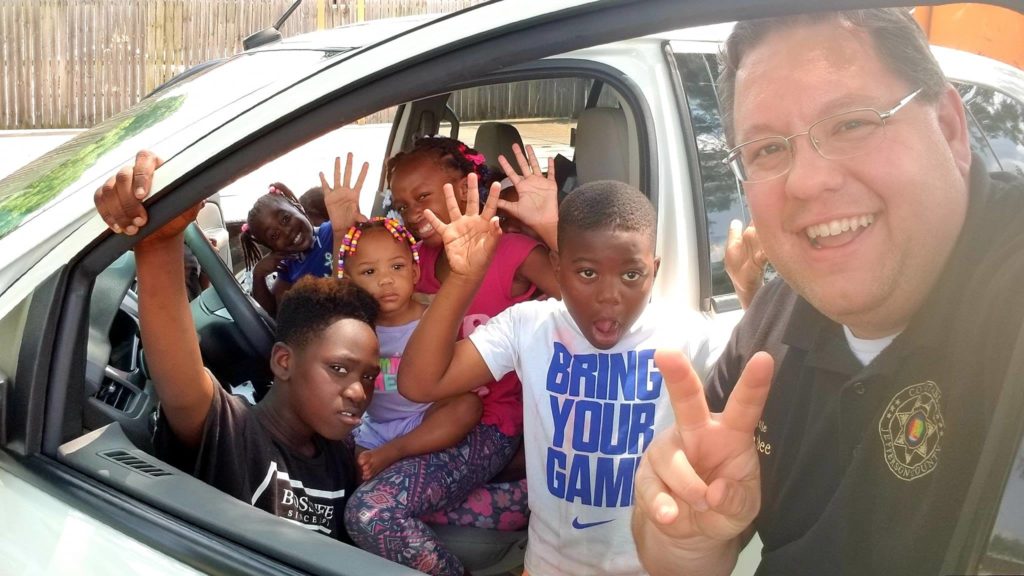
Only 24 counties, out of the 67 in Alabama, have constables. But who are they, and what do they do? The Code of Alabama defines constables as an elected or appointed “conservator of the peace within his county,” and according to the Alabama Constables Association, they are one of the only two remaining elected peace officers in the world. Their duties include: attending the circuit court of the county when summoned by the sheriff for that purpose; executing and returning all summons, executions and other process directed to him by any lawful authority; paying over moneys collected by virtue of his office to the person entitled thereto performing such other duties as are or may be required of him by law Constables are also permitted to carry a gun, are authorized to make arrests, stop and question, search for dangerous weapons, escort weddings and funerals, and enforce traffic at churches and schools. Although not permitted to write a traffic ticket, they can also pull over vehicles who disobey traffic laws. According to a 2015 AL.com article, the qualifications to become a constable are very few. “You must be a citizen of the county you’re running in, have no criminal record, and be old enough to carry a firearm.” The report continues to name the counties have constables including: Barbour, Colbert, Conecuh, Coosa, Dallas, Dekalb, Elmore, Etowah, Franklin, Green, Jackson, Jefferson, Marengo, Marion, Mobile, Monroe, Russell, Sumter, Talladega, Tallapoosa, Walker, Wilcox and Winston. Tallapoosa County will only have constables until 2020, after which they will be abolished according a court ruling in April of this year.
On Dallas trip, Barack Obama will try to make sense of shootings
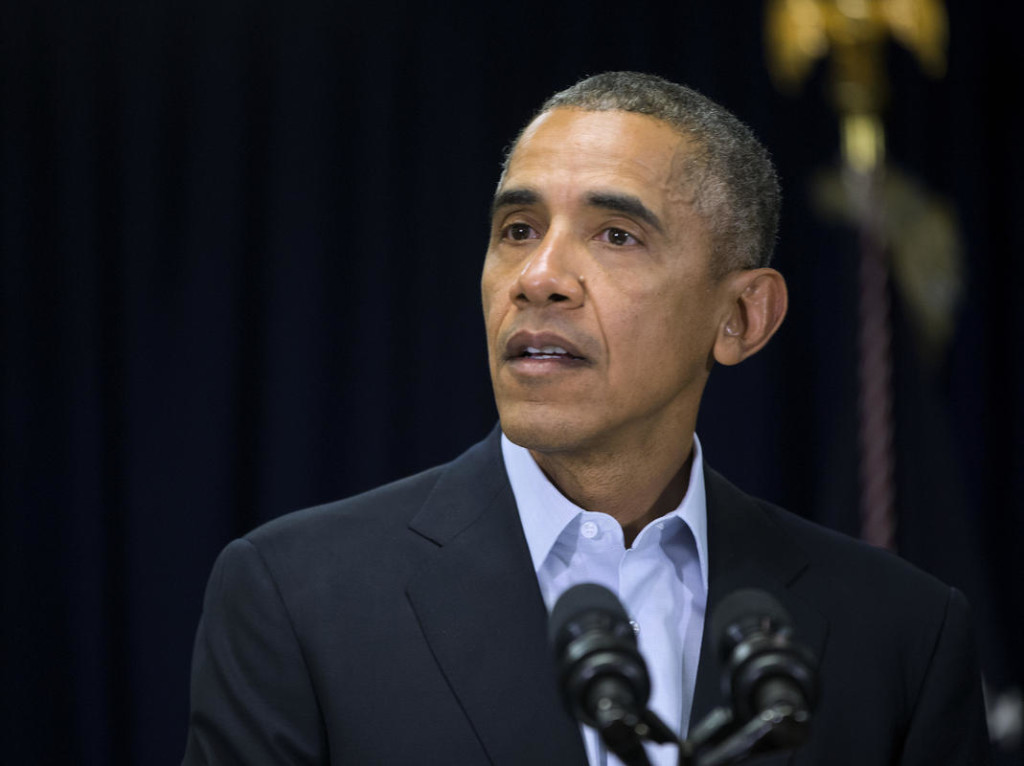
For President Barack Obama, the decision to return early from an overseas trip after a series of shocking shootings will prove to be easy compared to his next challenge: Comforting an America rattled by the violence. After arriving from Spain late Sunday, Obama will fly Tuesday to Dallas, the scene of the massacre of police officers that, on the heels of two caught-on-video police shootings, has emerged as a tipping point in the national debate about race and justice. Obama is due to deliver remarks at an interfaith memorial service and is expected to meet with victims’ families and with local law enforcement officials mourning their own. Former President George W. Bush, his wife, Laura, and Vice President Joe Biden will also attend, and the ex-president will deliver brief remarks. To some degree, the trip is a familiar ritual for a president who has embarked in recent years on similar consolation missions with relentless frequency. But it’s clear that Obama views the moment as distinct. In choosing to the deliver a high-profile speech, the president has tasked himself with ministering to Americans as they make sense of a frustrating cloud of issues swirling around the shootings. The president sees delivering this sort of guidance a core part of his leadership, so much so that some of his memorable speeches were in honor of mass shooting victims, including his challenge to protect children from guns in Newtown, Conn. – “We’re not doing enough.” – and his singing of “Amazing Grace” after the shooting in a black church in Charleston, S.C. But it’s far from clear whether these moments fostered movement – either on legislation or race relations – and Obama has had to face the limits of his rhetoric. As he has in the past, Obama will search this week for a way to break through. As he traveled to Poland and Spain last week for meetings with European leaders, the president was publicly working through his thoughts. At times, he acknowledged “anger” and “confusion” in the public, and at other times he seemed to downplay the enormity of events. On the shootings by police of black men in Minnesota and Louisiana, Obama called for more activism and reforms. And he sought to impress upon white Americans what he said he and other African Americans already know: The problem is real. On the shooting in Dallas, Obama cast Micah Johnson, the sniper killed in a standoff with police, as “demented” and his motives as unknowable. People should not believe that “the act of a troubled individual speaks to some larger political statement across the country,” he said. “It doesn’t.” Obama also pointed to other forces driving discontent at home and in Europe – lone-wolf terrorism or economic instability wrought by globalization – and tried to sell his policies aimed at each. The comments highlighted this president’s rationality and a tendency to analyze people’s fears rather than validate them – both traits that at times have limited his ability to connect. Asked Saturday about rising worries about safety, Obama cited crime statistics. He bluntly dismissed comparisons to the domestic turbulence of the 1960s as overblown. “That’s just not true,” he said. Obama’s remarks also captured the president continuing to try to serve as bridge builder between white and black Americans, protesters and police. It’s a role that helped catapult him to political stardom, but one he’s struggled to inhabit as president during a period of sharp political polarization and continued racial tensions. Still, Obama wasn’t about to cede the role this week. White House officials said the decision to trim his trip to Spain by one day was driven in part by not wanting other, divisive voices to fill the void left in his absence. On Sunday, a few hours before returning home, Obama tried again to walk a center line, as he issued a plea for better understanding between police and demonstrators taking part in the protests across the country. “I’d like all sides to listen to each other,” he said. Republished with permission of the Associated Press.
Shooting of Dallas officers spurs acts of kindness to police
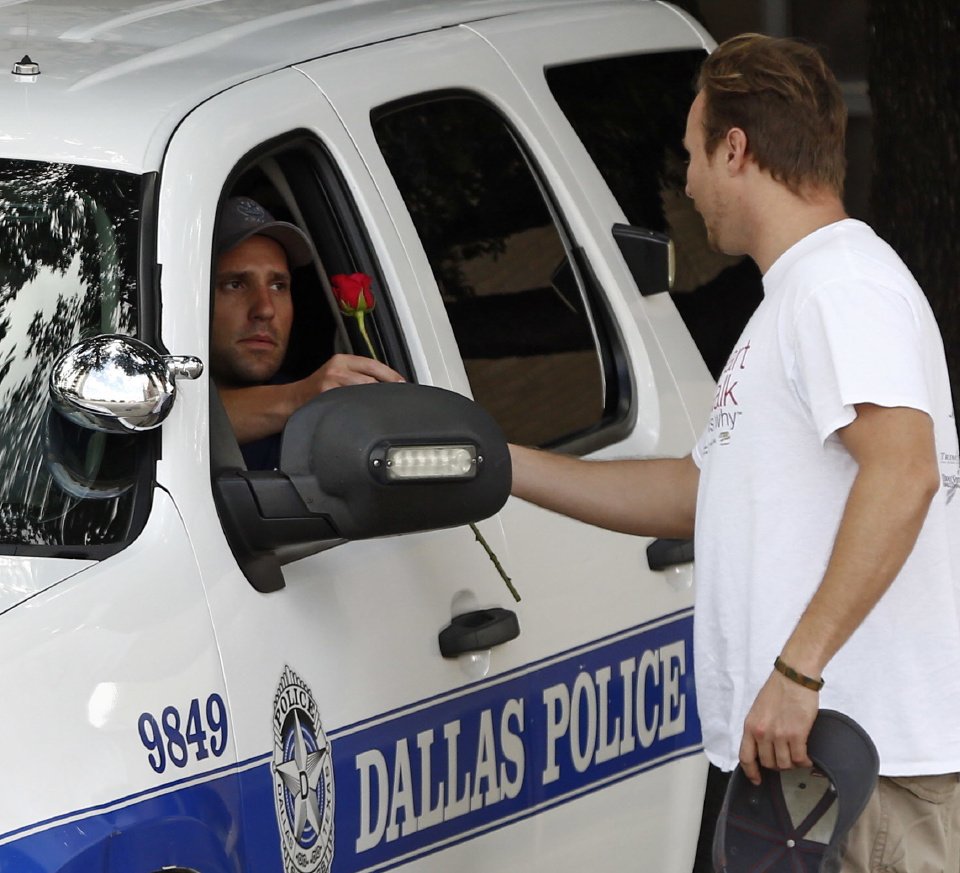
The Dallas shooting that killed five officers has spurred an outpouring of support for police, not only in Texas but hundreds of miles away. Around the country, people have showed up at local departments with flowers, sent social media messages or called to say thanks. They delivered coffee, pizzas, cakes and moments of solace for officers grieving after the deadliest day for U.S. law enforcement since the Sept. 11, 2001, attacks. SHARED SORROW One after another, members of the public lined up to hug uniformed officers at a community prayer service Friday in Dallas. Two patrol cars serving as a memorial outside of police headquarters were adorned with flowers, signs and flags by some of the people pausing to pay their respects to the five officers killed and seven wounded. John Fife, with his ball cap in hand, passed a red rose to an officer sitting in a vehicle guarding those headquarters. In another corner of the country, a Seattle officer accepted a matching flower from Jasen Frelot, one of several people from the faith community there who set out to show police support. ‘WE NEED THEM’ Officers also received roses in the Cleveland suburb of South Euclid, where they found single stems on their cruiser windshields Friday morning. The Rev. Carmen Cox Harwell, a Beachwood pastor and a former police chaplain, said she put flowers on Beachwood and South Euclid officers’ cars as a sign of gratitude. “I just want them to know that they’re loved and they’re supported and we need them,” she told WOIO-TV. COMFORT FOOD Abigail Bullard had similar thoughts while home with her 6- and 10-year-old sons in suburban Philadelphia, where the younger boy’s fascination with emergency services personnel has developed into a friendship with a few Radnor Township officers. Bullard had observed the kinship within their profession and knew they’d be affected by this week’s news, so she and her sons delivered cookies and soft pretzels as comfort. “It was important to me to say, here we have two young black children that are trying to do the right thing because friends of ours have had a death in the family,” she said. When she shared the story on Facebook, she concluded it simply: “Not all young black men are bad, and not all police officers are bad.” A few miles down the road, the Lower Merion Police Department said its officers had heavy hearts but full bellies after another woman and her son delivered a stack of pizzas Friday. They also received coffee and doughnuts, a gesture reported by numerous police departments this weekend. One of them, the Voorhees Police Department in New Jersey, said such actions “have made us feel better during a very sad time to be a police officer.” STOPPED FOR THANKS Still others simply stopped officers on the street to chat or offer hugs. “It’s just been amazing. Our guys can’t go out this morning without getting stopped by people wanting to thank them,” Dustin Dwight, a spokesman for Louisiana State Police Troop L, told NOLA.comThe Times-Picayune on Friday. In Chattanooga, Tennessee, officers were getting extra handshakes from strangers at a local concert Friday night. “They always comfort and, I guess, wrap their arms around us, to protect us as well as we protect them,” Chattanooga Sgt. Tommy Meeks told WRCB-TV. ‘ROUGH FEW DAYS’ In Ballwin, Missouri, where a suburban St. Louis policeman was shot and critically hurt during a Friday traffic stop, Andrew Kulha brought the investigators water. He told KMOV-TV he thought it had “been a rough few days to be an officer.” The Dallas shooting occurred during a Thursday night protest over fatal police shootings of black men in Minnesota and Louisiana earlier in the week. Republished with permission of the Associated Press.
