
Intel officials say Russia boosting Donald Trump candidacy
The warning raises questions about the integrity of the presidential campaign.
Dan Coats will leave his job as national intelligence director
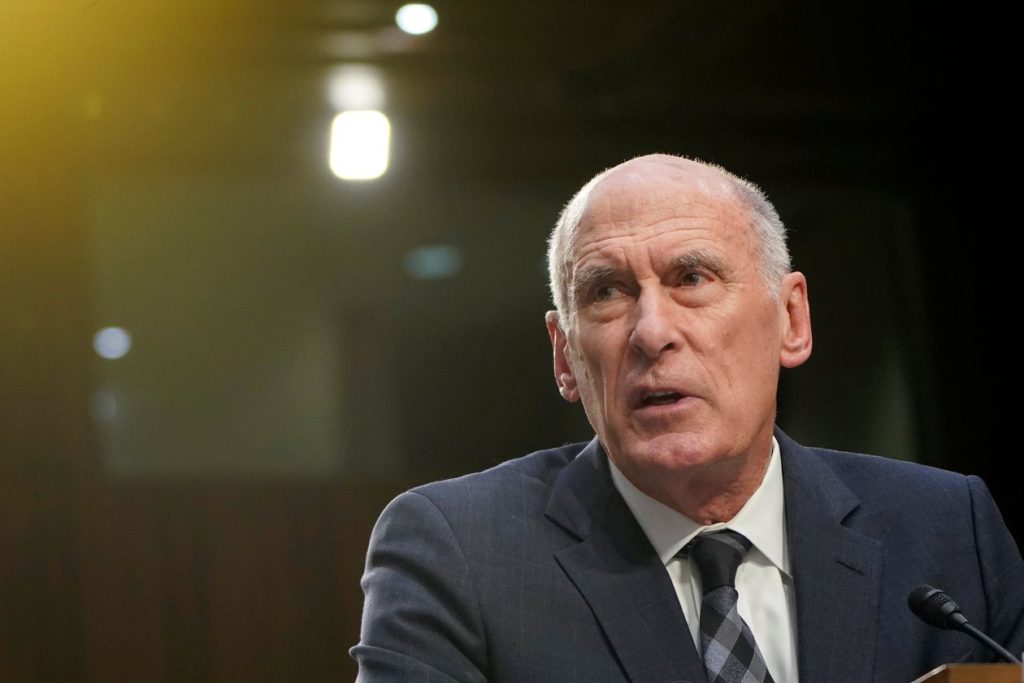
Dan Coats, director of national intelligence, will leave his job next month, President Trump announced, after a turbulent two years in which Coats and the president were often at odds over Russian interference in the 2016 election. Trump announced Coats’ departure as Aug. 15 in a tweet on Sunday that thanked Coats for his service. He said he will nominate Rep. John Ratcliffe, Republican-Texas, to the post and that he will name an acting official in the coming days. Ratcliffe is a frequent Trump defender who fiercely questioned former special counsel Robert Mueller during a House Judiciary Committee hearing last week. Coats often appeared out of step with Trump and disclosed to prosecutors how he was urged by the Republican president to publicly deny any link between Russia and the Trump campaign. The frayed relationship reflected broader divisions between the president and the government’s intelligence agencies. Coats’ public, and sometimes personal, disagreements with Trump over policy and intelligence included Russian election interference and North Korean nuclear capabilities. Trump had long been skeptical of the nation’s intelligence agencies, which provoked his ire by concluding that Russia interfered in the 2016 presidential election with the goal of getting him elected. In a letter of resignation released Sunday night, Coats said serving as the nation’s top intelligence official has been a “distinct privilege” but that it was time for him to “move on” to the next chapter of his life. He cited his work to strengthen the intelligence community’s effort to prevent harm to the U.S. from adversaries and to reform the security clearance process. A former Republican senator from Indiana, Coats was appointed director of national intelligence in March 2017, becoming the fifth person to hold the post since it was created in the wake of the Sept. 11, 2001, attacks to oversee and coordinate the nation’s 17 intelligence agencies. Coats had been among the last of the seasoned foreign policy hands brought to surround the president after his 2016 victory, of whom the president steadily grew tired as he gained more personal confidence in Oval Office, officials said. That roster included Defense Secretary Jim Mattis and Secretary of State Rex Tillerson, and later national security adviser H.R. McMaster. Coats developed a reputation inside the administration for sober presentations to the president of intelligence conclusions that occasionally contradicted Trump’s policy aims.His departure had been rumored for months, and intelligence officials had been expecting him to leave before the 2020 presidential campaign season reached its peak. Sen. Mark Warner of Virginia, the ranking Democrat on the Senate’s intelligence committee, tweeted Sunday: “The mission of the intelligence community is to speak truth to power. As DNI, Dan Coats stayed true to that mission.” Senate Majority Leader Mitch McConnell said he was sorry to see Coats leave and praised him, saying he had been reassured knowing that such a man as his former Senate colleague who “took such a deliberate, thoughtful, and unbiased approach was at the helm of our intelligence community.” Trump’s announcement that Coats would be leaving came days after Mueller’s public testimony on his two-year investigation into Russian election interference and potential obstruction of justice by Trump, which officials said both emboldened and infuriated the president. Coats had been among the least visible of the president’s senior administration officials but, in his limited public appearances, repeatedly seemed at odds with the administration, including about Russia. For instance, he revealed to Mueller’s investigators how Trump, angry over investigations into links between his campaign and Russia, tried unsuccessfully in March 2017 to get him to make a public statement refuting any connection. “Coats responded that the Office of the Director of National Intelligence (ODNI) has nothing to do with investigations and it was not his role to make a public statement on the Russia investigation,” Mueller’s report said. Trump later called Coats to complain about the investigation and how it was affecting the government’s foreign policy. Coats told prosecutors he responded that the best thing to do was to let the investigation take its course. In February, he publicly cast doubt on the prospects of persuading North Korea to end its nuclear weapons program despite the diplomatic efforts of the administration, which has touted its outreach to the isolated country as one of its most important foreign policy achievements. Coats, in testimony to Congress as part of annual national intelligence assessment, said North Korea would be “unlikely” to give up its nuclear weapons or its ability to produce them because “its leaders ultimately view nuclear weapons as critical to regime survival.”Trump publicly bristled at the testimony of Coats, the head of the CIA and other officials who contradicted his own positions on Iran, Afghanistan and the Islamic State group as well as North Korea. The intelligence officials were “passive and naive,” he said in a tweet.Last July, Coats and the president appeared at odds following Trump’s widely panned news conference in Helsinki alongside Russian President Vladimir Putin. Trump said he saw no reason to believe Russia had interfered in the 2016 election, drawing bipartisan criticism and a rebuttal from his intelligence chief. “We have been clear in our assessments of Russian meddling in the 2016 election and their ongoing, pervasive efforts to undermine our democracy, and we will continue to provide unvarnished and objective intelligence in support of our national security,” Coats said.The president later said he misspoke in Helsinki. That same month, Coats appeared to scoff when told in an interview that Trump had invited Putin to Washington. “Say that again,” Coats said, cupping his hand over his ear on live television. He took a deep breath and continued: “OK. That’s going to be special.” He later said his comments at the Aspen Security Forum in Colorado were “in no way meant to be disrespectful or criticize the actions of the president.” In December, Coats said he was “deeply saddened” when Mattis resigned in protest of Trump’s foreign policy, including the decision to withdraw American troops from Syria. Coats called Mattis a
Donald Trump fumes over NYT op-ed; top officials swiftly deny role
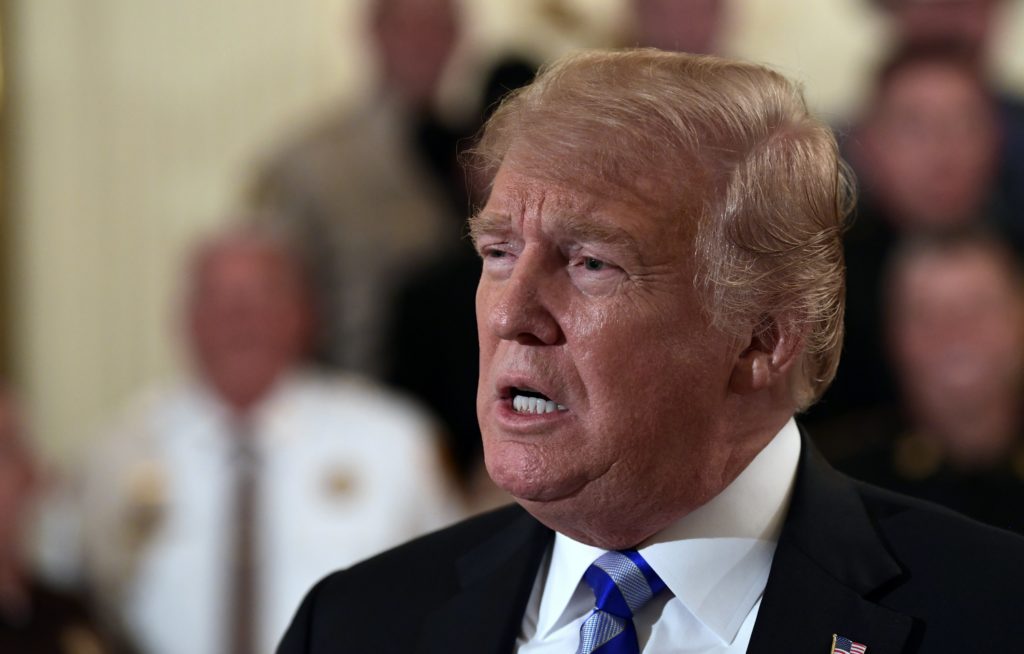
Pushing back against explosive reports his own administration is conspiring against him, President Donald Trump lashed out against the anonymous senior official who wrote a New York Times opinion piece claiming to be part of a “resistance” working “from within” to thwart his most dangerous impulses. Perhaps as striking as the essay was the recognition of the long list of administration officials who plausibly could have been its author. Many have privately shared some of the same concerns expressed about the president with colleagues, friends and reporters. Washington was consumed by a wild guessing game as to the identity of the writer, and swift denials of involvement in the op-ed came Thursday from top administration officials, including from Vice President Mike Pence’s office, Secretary of State Mike Pompeo and Dan Coats, director of national intelligence, and other Cabinet members. Trump was furious, tweeting Thursday morning that “The Deep State and the Left, and their vehicle, the Fake News Media, are going Crazy – & they don’t know what to do.” The Deep State and the Left, and their vehicle, the Fake News Media, are going Crazy – & they don’t know what to do. The Economy is booming like never before, Jobs are at Historic Highs, soon TWO Supreme Court Justices & maybe Declassification to find Additional Corruption. Wow! — Donald J. Trump (@realDonaldTrump) September 6, 2018 On Wednesday night, Trump tweeted a demand that if “the GUTLESS anonymous person does indeed exist, the Times must, for National Security purposes, turn him/her over to government at once!” White House press secretary Sarah Huckabee Sanders called on the “coward” who wrote the piece to “do the right thing and resign.” White House officials did not immediately respond to a request to elaborate on Trump’s call for the writer to be turned over to the government or the unsupported national security ground of his demand. To some observers, the ultimatum appeared to play into the very concerns about the president’s impulses raised by the essay’s author. Trump has demanded that aides identify the leaker, according to two people familiar with the matter, though it was unclear how they might go about doing so. The two were not authorized to speak publicly and spoke on the condition of anonymity. In a “House of Cards”-style plot twist in an already over-the-top administration, Trump allies and political insiders scrambled to unmask the writer. But the op-ed also brought to light questions that have been whispered in Washington for more than a year: Is Trump truly in charge? And could a divided executive branch pose a danger to the country? Former CIA Director John Brennan, a fierce Trump critic, called the op-ed “active insubordination … born out of loyalty to the country.” “This is not sustainable to have an executive branch where individuals are not following the orders of the chief executive,” Brennan told NBC’s “Today” show. “I do think things will get worse before they get better. I don’t know how Donald Trump is going to react to this. A wounded lion is a very dangerous animal, and I think Donald Trump is wounded.” The anonymous author, claiming to be part of the “resistance” to Trump “working diligently from within” his administration, said, “Many Trump appointees have vowed to do what we can to preserve our democratic institutions while thwarting Mr. Trump’s more misguided impulses until he is out of office.” “It may be cold comfort in this chaotic era, but Americans should know that there are adults in the room,” the author continued. “We fully recognize what is happening. And we are trying to do what’s right even when Donald Trump won’t.” Trump raged about the piece in the White House, calling around to confidants to vent about the disloyalty of the author and fuming that the so-called Deep State within the federal government had conspired against him, according to a person familiar with the president’s views but not authorized to discuss them publicly. The text of the op-ed was pulled apart for clues: The writer is identified as an “administration official”; does that mean a person who works outside the White House? The references to Russia and the late Sen. John McCain — do they suggest someone working in national security? Does the writing style sound like someone who worked at a think tank? In a tweet, the Times used the pronoun “he” to refer to the writer; does that rule out all women? The newspaper later said the tweet referring to “he” had been “drafted by someone who is not aware of the author’s identity, including the gender, so the use of ‘he’ was an error.” The Beltway guessing game seeped into the White House, as current and former staffers alike traded calls and texts trying to figure out who could have written the piece, some turning to reporters and asking them for clues. For many in Trump’s orbit, it was stunning to realize just how many people could have been the op-ed’s author. And some of the most senior members of the Trump administration were forced to deny they were the author of the attack on their boss. Hotly debated on Twitter was the author’s use of the word “lodestar,” which pops up frequently in speeches by Pence. Could the anonymous figure be someone in Pence’s orbit? Others argued that the word “lodestar” could have been included to throw people off. In a rare step, Pence’s communications director Jarrod Agen tweeted early Thursday that “The Vice President puts his name on his Op-Eds. The @nytimes should be ashamed and so should the person who wrote the false, illogical, and gutless op-ed. Our office is above such amateur acts.” Pompeo, who was in India, denied writing the anonymous opinion piece, saying, “It’s not mine.” He accused the media of trying to undermine the Trump administration and said he found that “incredibly disturbing.” Coats later issued his own denial, followed by Housing Secretary Ben Carson, Treasury Secretary Steve Mnuchin, budget director Mick
U.S. officials raise alarm about 2018, 2020 election security
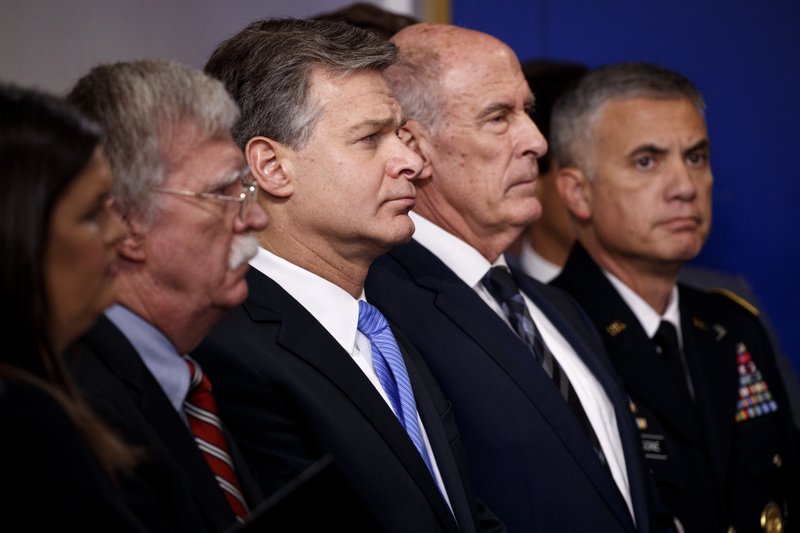
President Donald Trump has directed a “vast, government-wide effort” to protect American elections after Russian attempts to interfere in 2016, the White House said Thursday. Responding to bipartisan criticism that it has no clear national strategy to protect the country during the upcoming midterms and beyond, John Bolton, the national security adviser, wrote in a letter to Senate Democrats that “President Trump has not and will not tolerate interference in America’s system of representative government.” The warning to American adversaries came as top U.S. intelligence and homeland security officials raised alarms about potential efforts to influence the 2018 and 2020 elections. Homeland security chief Kirstjen Nielsen said: “Our democracy is in the crosshairs.” “We continue to see a pervasive messaging campaign by Russia to try to weaken and divide the United States,” Director of National Intelligence Dan Coats said. Their comments during a White House briefing followed weeks after Trump publicly undermined the conclusions of American intelligence agencies regarding Russian interference. After suffering a bipartisan outcry, Trump later said he accepted those conclusions. They, along with National Security Agency director Gen. Paul Nakasone and FBI Director Christopher Wray, appeared at the White House Thursday to try to reassure the American people they are doing everything in their power to address the threat. “We’re throwing everything at it,” Coats said. Nielsen, Wray and Nakasone had all gathered earlier this week in New York City with leaders of top finance, energy and telecommunications companies for a cybersecurity summit, where they spoke of the urgent need for a collective, collaborative approach to security. At the event, Nielsen said the cyberthreat that now exceeds the danger of a physical attack against the U.S. by a hostile foreign group. Wray told reporters that compared to 2016, in 2018, “We are not yet seeing the same kind of efforts to specifically target election infrastructure,” but that other efforts to influence public opinion continue. He added that the FBI has active investigations on foreign influence across all 56 of its field office. “Make no mistake, the scope of this foreign influence threat is both broad and deep,” he said. But Nielsen said that U.S. agencies have “seen a willingness and a capability on the part of the Russians” to attack U.S. election infrastructure. On Capitol Hill, lawmakers in both parties have pushed election security toward the top of the coming fall agenda amid heightened concerns about interference by Russians and others ahead of the midterm elections. Asked this week how confident he was in the integrity of election systems ahead of the fall midterms, the No. 2 Republican, Sen. John Cornyn of Texas, said, “I’m confident we’re doing the best we can.” Beyond Russian interference with social media campaigns to influence voters, lawmakers are increasingly looking at how to bolster election infrastructure in the states — even though Congress shot down a recent effort to boost federal funding for local and state systems. Both Republicans and Democrats have criticized the administration’s response as fragmented, without enough coordination across federal agencies. And with the midterms only three months away, critics are calling on Trump to take a stronger stand on an issue critical to American democracy. Sen. Mark Warner of Virginia, the ranking Democrat on the Senate intelligence committee who has criticized Trump for not taking a stronger leadership role on election security, said he was heartened by the White House news conference. “Glad to see the White House finally do something about election security — even if it’s only a press conference,” Warner tweeted. “Now, if only it was actually backed up by anything the president has said or done on Russia.” The Senate is working on a bipartisan package backed by GOP leaders that would boost federal assistance to state and local election officials with cybersecurity guidelines, data sharing and security clearances. It’s expected in September. GOP lawmakers are wary of being seen as imposing any new regulations on states that have resisted federal control. Bolton said Trump is “leading unprecedented action to punish Russia” for its efforts to disrupt American elections. Republished with the permission of the Associated Press.
Dan Coats says Donald Trump hasn’t made up his mind on VP
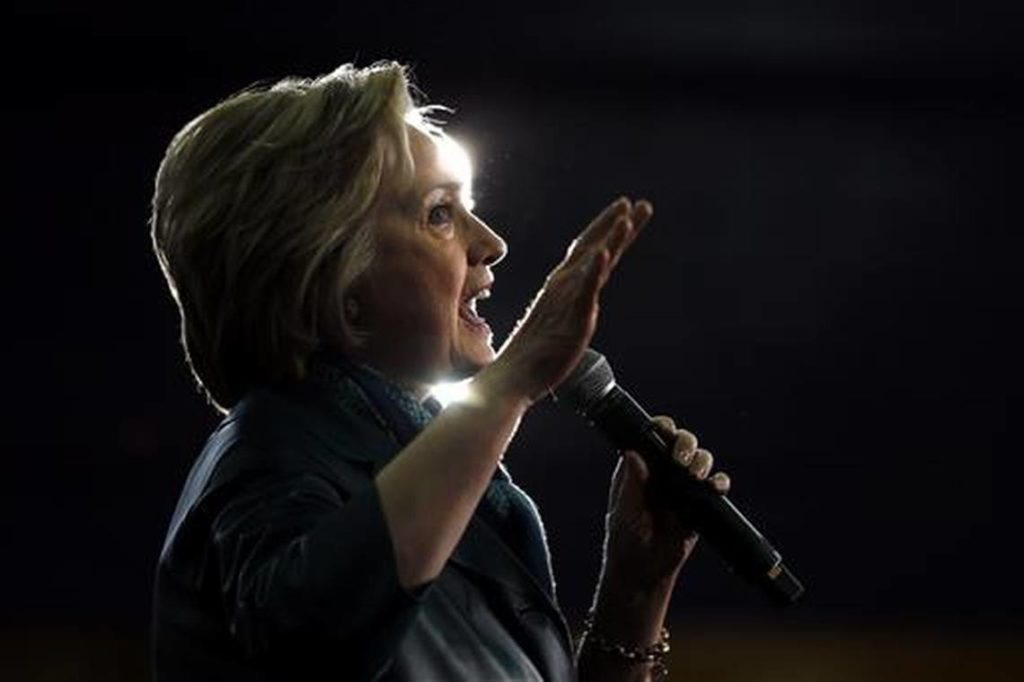
The Latest on the 2016 presidential campaign ahead of the Republican and Democratic national conventions (all times EDT): 1:30 p.m. Indiana Sen. Dan Coats says Donald Trump hasn’t made up his mind about who to select as his running mate. Coats told The Associated Press Wednesday that he spoke with Gov. Mike Pence late Tuesday — one of the names on Trump’s shortlist of potential running mates — and Pence told him there’s still no decision. “I think he’s the front-runner,” Coats said, adding, “I think he ought to be the front-runner.” Coats said Pence is “pretty calm about the whole thing.” He added that Trump is cognizant that he needs to make a decision by Friday given gubernatorial succession rules in Indiana. But he concluded that “reading Donald Trump’s mind is not the easiest thing to do.” ___ 1:20 p.m. Hillary Clinton says the Republican Party of Abraham Lincoln has been transformed into “the party of Trump.” Rattling off a series of attacks against her GOP rival, Clinton says Trump is “dangerous,” ”divisive,” ”fear-mongering” and is “pitting American against American.” Even stalwart Republicans, she says, should be alarmed by Trump’s policies and racist rhetoric. Clinton is casting Trump as ignorant of the Constitution, dismissive of U.S. law and lacking the character to be trusted with American security. “Imagine if he had not just Twitter and cable news to go after his critics and opponents, but also the IRS – or for that matter, our entire military,” she says. “Do any of us think he’d be restrained?” ___ 1:07 p.m. Hillary Clinton is calling on the country — including herself — to “do a better job of listening” rather than fueling political and other divisions after a series of high-profile shootings. Clinton says the country must address both gun violence, criminal justice reform and find ways to better support police departments. “I know that just saying these things together may upset some people,” she says. “But all these things can be true at once.” Clinton is speaking in the Illinois Old State House chamber in Springfield, the site of Abraham Lincoln’s his famous address about the perils of slavery. She is trying to use the symbolic site to contrast her call for civility with what she sees as rival Donald Trump’s polarizing campaign. Clinton said she has work to do, as well. She says that as someone “in the middle of a hotly fought political campaign, I cannot claim that my words and actions haven’t sometimes fueled the partisanship that often stands in the way of our progress.” Clinton adds, “I recognize that I have to do better too.” ___ 12:29 p.m. Donald Trump is meeting with finalists for the job of his vice presidential running mate. Trump met Tuesday with New Jersey Gov. Chris Christie and his family. Early Wednesday, Trump and his children met with Indiana Gov. Mike Pence and his family. Former House Speaker Newt Gingrich also was said to be a finalist. All three have auditioned for the job by opening for Trump at campaign rallies over the past week. Trump was expected to make an announcement on Friday. ___ 10:20 a.m. Republican Donald Trump huddled with Indiana Gov. Mike Pence at the governor’s mansion in Indiana on Wednesday morning amid swirling speculation about Trump’s vice presidential deliberations. Pence and Trump walked out of the residence together just before 10:30 a.m. The pair was joined inside by Pence’s wife, Karen, as well as Trump’s daughter, Ivanka, and his son-in-law Jared Kushner. Trump is said to have narrowed his short list down to a trio of top contenders, including Pence. Pence joined Trump at a fundraiser and a rally on Tuesday where he received a warm reception from the crowd. ___ 10:15 a.m. The lead super PAC backing Democratic presidential candidate Hillary Clinton has begun targeting Spanish-speaking voters in Colorado, Nevada and Florida as part of a $35 million online effort it announced earlier this year. An online ad from Priorities USA features video clips of Trump calling Hispanics “drug dealers” and “criminals” and leading his supporters in the chant: “Build that wall! Build that wall! Build that wall!” In Spanish, an on-screen message declares that “hatred is growing in our country.” The ad campaign also includes a website: unidoscontratrump.org, which means “united against Trump.” The same message will appear in banner ads on social media. The three targeted states all have significant Latino populations. Trump insists he can do better among Hispanics than the less-than-30 percent Republican Mitt Romney drew in 2012 after calling for “self-deportation” for immigrants in the country illegally. ___ 7:35 a.m. Bernie Sanders says he agrees with the harsh remarks that Justice Ruth Bader Ginsburg has made about Republican presidential candidate Donald Trump. The Vermont senator declined to say whether it is appropriate for a sitting Supreme Court justice to openly criticize a White House contender. But he tells ABC’s “Good Morning America” that he agrees Trump is a “total opportunist” and said “the record clear is quite clear that he lies just a whole lot of the time.” Ginsburg in a series of interviews with The Associated Press, The New York Times and CNN has called Trump unqualified to be president and joked that she would move to New Zealand if he won. Trump said in a tweet that Ginsburg should resign. Sanders’s comments came a day after he formally endorsed Hillary Clinton as the Democratic nominee for president. Asked if he is open to being her running mate, Sanders said, “I doubt that will happen.” He said his focus is on helping Clinton win. He says, “We cannot have a man with Trump’s temperament with the nuclear code and running this country.” 5:25 a.m. Hillary Clinton is turning to the symbolism of Abraham Lincoln’s “House Divided” speech to argue that the nation needs to repair its divisions after high-profile shootings in Texas, Louisiana and Minnesota. Clinton’s campaign says the Democratic presidential candidate will talk about the importance of uniting
