
Homeland Security Chair blasts Joe Biden as Coast Guard catches more migrants

By Casey Harper | The Center Square President Joe Biden is under fire after a new report that the number of illegal immigrants caught by the Coast Guard trying to enter the U.S has doubled in recent years. That data came from Heather MacLeod, director of Homeland Security and Justice at the Government Accountability Office during a hearing this week. “The Coast Guard interdicted more than 12,000 migrants in both fiscal year 2022 and 2023 – more than double the fiscal year 2021 total, according to Coast Guard data,” MacLeod said in prepared testimony. House Homeland Security Committee Chairman Mark Green, R-Tenn., responded to The Center Square’s reporting on the increased interdictions, saying President Biden’s immigration policies are endangering U.S. servicemembers. “Historic numbers of encounters at our Southwest border are certainly the main driver of this unprecedented crisis, but they aren’t the only one,” Green told The Center Square. “Illegal aliens also try to take advantage of America’s maritime borders. This route is incredibly dangerous for not only the aliens, but also the men and women of the U.S. Coast Guard and the Air and Marine Operations officers tasked with interdicting the flow of illegal immigration and deadly narcotics along these routes.” Green blasted Biden for the illegal immigration crisis, which has soared since Biden took office with about ten million illegal immigrants entering the U.S. since January of 2021. “Every day, the Coast Guard plays a crucial role in securing our waterways, and it is unconscionable that Secretary Alejandro Mayorkas and President Biden continue to make their job harder through their policies of mass catch-and-release that have encouraged more individuals to attempt this route, and emboldened the cartels to traffic more drugs,” Green said. MacLeod said the U.S. should expect that number to rise. While land crossings make up the vast majority of migrant crossings, water transport could allow groups to ship bigger quantities of illicit drugs. “Every year, thousands of people attempt to migrate via maritime routes, many utilizing services of organized smuggling operations and often in dangerously overloaded, unseaworthy, or otherwise unsafe vessels,” Rear Admiral Jo-Ann Burdian, Assistant Commandant for Response Policy (CG-5R) for the U.S. Coast Guard, testified at the same hearing. “Many of the migrant interdiction cases handled by the Coast Guard begin as search and rescue missions. “The Coast Guard employs cutters, boats, fixed-wing aircraft, and helicopters to identify and interdict migrant vessels as far from U.S. shores as possible,” Burdian added. In one 2021 case, the Department of Justice announced that six Colombian nationals had pleaded guilty to conspiracy to use “narco-submarines” to ship nearly 20,000 kilos of cocaine to the Sinola Cartel in the U.S. MacLeod testified that the number of migrants attempting to enter the U.S. by sea will likely continue to rise. “From fiscal years 2011 through 2020, drug interdiction accounted for 13 percent of [the U.S. Coast Guard’s] estimated operating expenses, migrant interdiction 8 percent, and other law enforcement 2 percent, which includes preventing IUU fishing,” MacLeod said. “The operating expenses of these three missions annually averaged more than $1.5 billion over this time period.” The U.S. Coast Guard works with DHS and the Department of Defense to stop the flow of illicit drugs into the U.S.. Coast Guard and Maritime Transportation Subcommittee Chairman Daniel Webster, R-Fla., led the hearing this week and pointed out the dangers to the migrants attempting these water voyages as well as the Americans being poisoned by drugs like fentanyl, which has killed tens of thousands of Americans in recent years. “The Coast Guard is our nation’s premier maritime law enforcement agency and is actively engaged in countering illicit maritime activity,” Webster said in his opening remarks at the hearing. “This includes stopping the flow of illegal drugs to our shores, interdicting illegal maritime migration, and protecting the environment through efforts to curb illegal fishing.” Republished with the permission of The Center Square.
Prospective speakers multiply in House as all wait on Paul Ryan
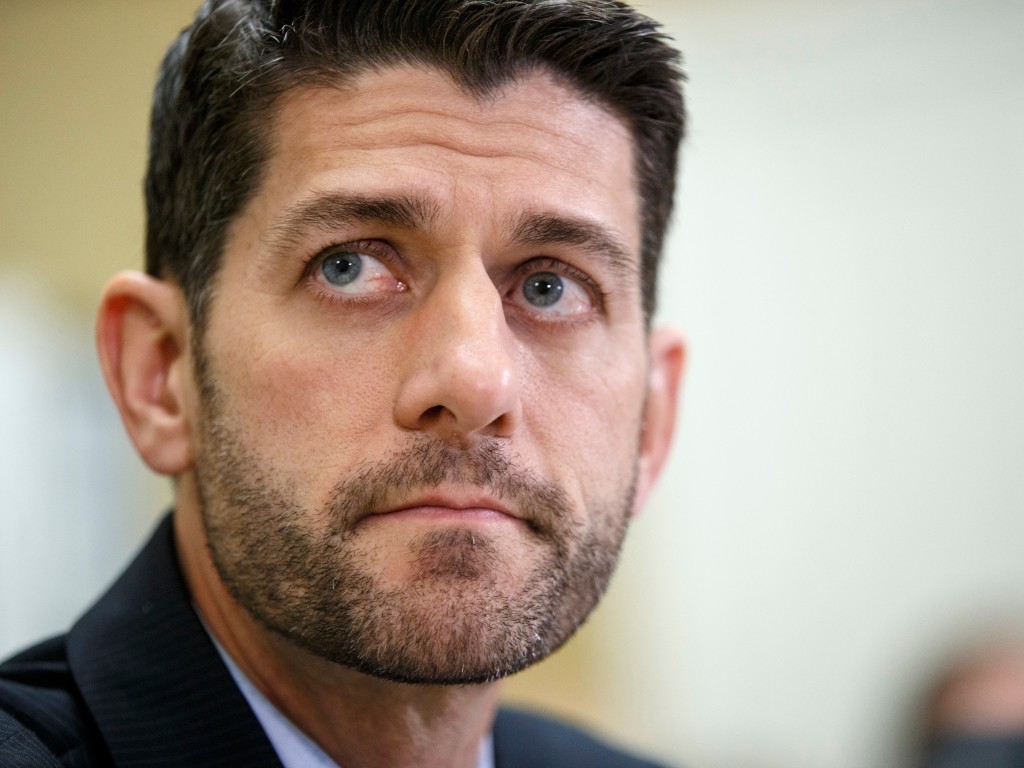
Every day another Republican lawmaker seems to wake up and decide that he – and in at least one case, she – might make a pretty good speaker of the House. The profusion of potential candidates, now approaching double digits, is happening even with all attention focused on Wisconsin Rep. Paul Ryan, the former GOP vice presidential nominee widely seen as the best person for the job. Ryan, who has made clear he does not want to be speaker, is home in Janesville, Wisconsin, thinking it over anyway under pressure from top party leaders. And with Congress out of session for a weeklong recess, Capitol Hill has fallen quiet after a series of wild days during which Speaker John Boehner shocked the House by announcing his planned resignation, and Boehner’s heir apparent, Majority Leader Kevin McCarthy, abruptly took himself out of the running. The stunning developments left a leadership vacuum at the pinnacle of Congress. Now into it are stepping a growing number of Republican lawmakers from around the country, some relative newcomers, others with experience to point to, united by a chance to lunge at the once-in-a-lifetime opportunity to become speaker of the U.S. House, second-in-line to the presidency. Why any of them would want a job that defeated the current occupant and scared off his No. 2 is another question. The daunting rift between establishment-minded lawmakers and the hard-line conservatives who pushed Boehner to the exits shows no sign of dissipating, and threatens to complicate life for whoever next occupies the speaker’s chair. Congress also faces a series of formidable tasks over the next several months, including increasing the federal borrowing limit to avoid a default and paying the government’s bills to stave off a shutdown. Nevertheless, the wannabe speakers are multiplying. “I am humbled to have my name mentioned as a potential candidate, and I am considering the pursuit of the speakership in response to those requests,” Rep. Bill Flores, R-Texas, wrote in a letter to fellow House members Wednesday. “If we all spend enough time on our knees praying for each other, we can heal our divisions and truly work together to restore America to the ‘Shining City on a Hill’ that President Reagan challenged us to become.” Rep. Mike Pompeo, R-Kansas, released a statement observing: “I know every member of the House is looking for the right person. If I can serve the American people and the conservative movement in any way, sign me up. However, a couple weeks ago I was floated as a presidential candidate, so I might be pretty busy.” And a freshman congressman from Montana, Ryan Zinke, got into the action. “We’re looking at it. Our phones are ringing off the hook because I think America wants something different,” Zinke said. “I haven’t decided, but what I have decided is that Congress better do our duty and defend our values of this country.” Several of the lawmakers sought to make clear that they were being urged by their fellow Republicans to run for speaker; not doing so out of their own ambitions. And several also took pains to make clear that they would run only if Ryan does not. “We are all hopeful that Paul is going to say that he would appreciate the opportunity to serve as speaker,” said Rep. Marsha Blackburn of Tennessee, adding that she’s been encouraged by colleagues to look at the job. “It is going to take a listening ear and a steady head to walk our conference through some of these issues,” she said. Others who’ve suggested their interest in the speakership, or contacted fellow lawmakers to sound them out, include GOP Reps. Michael McCaul and Michael Conaway of Texas, Lynn Westmoreland of Georgia, and Darrell Issa of California. Reps. Daniel Webster of Florida and Jason Chaffetz of Utah were running against McCarthy before he dropped out, and remain in the race. Still others, such as Rep. Matt Salmon of Arizona, have seen their names pushed by outside groups seeking new leadership for the House GOP. “These are all really, really, good people, and I think if they could convince the conference that they would run the conference in a way that’s more member-oriented, many of them could be good speakers,” GOP Rep. Mick Mulvaney of South Carolina, a founding member of the hard-line House Freedom Caucus, said in an interview after several potential candidates contacted him to gauge support. Although Ryan would be the prohibitive favorite for the job if he does seek it, Mulvaney and others disputed arguments that he’s the only one who could unite the House GOP. Ryan, an expert on budgetary matters who chairs the tax-writing Ways and Means Committee chairman, is already drawing criticism from some on the right for his support for comprehensive immigration legislation and government bailouts. “I like him and I respect him, and I think there are a number of directions he might take us that I don’t want to go, and immigration is one of those,” said Rep. Steve King, R-Iowa. “I don’t think he would be one who would transform (the House) and turn it into a membership-driven organization and I think this is our one chance to do that.” Republished with permission of the Associated Press.
Majority Leader Kevin McCarthy withdraws his candidacy for speaker
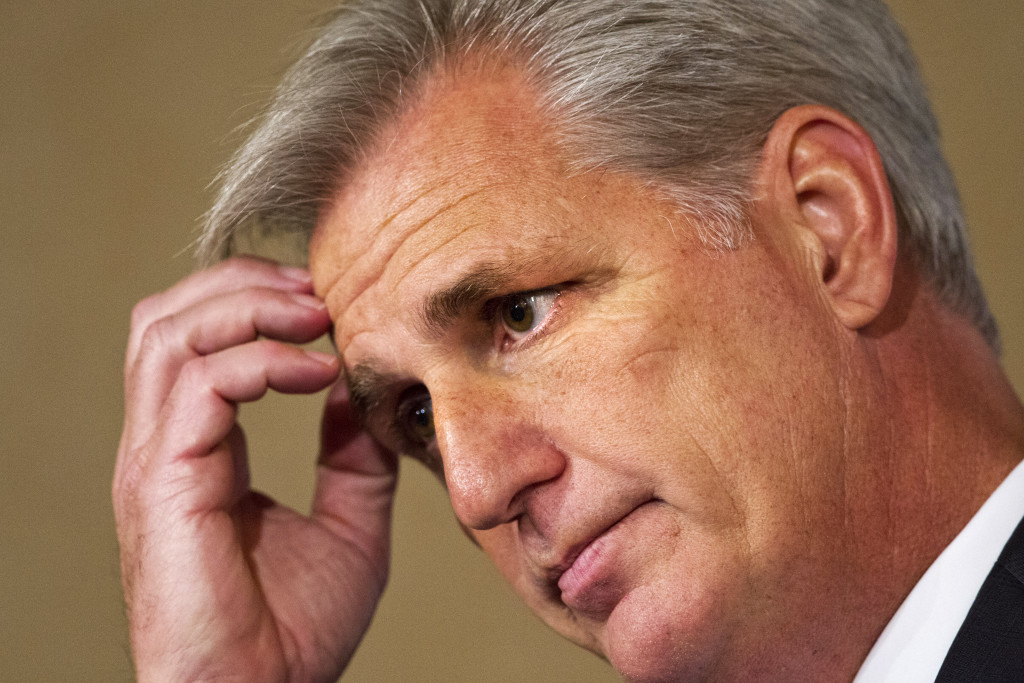
In a stunning move, Majority Leader Kevin McCarthy withdrew his candidacy for House speaker Thursday, throwing Congress’ Republican leadership into chaos. McCarthy was heavily favored to win his GOP colleagues’ endorsement for the post, but a vigorous challenge from hardline House conservatives threatened a smooth ratification when the full House voted Oct. 29. It is uncertain now when that vote will occur to replace Speaker John Boehner, who is to retire at the end of the month. McCarthy shocked his colleagues at the start of Thursday’s closed meeting, telling them he was not the right person for the job. He recommended that the election be postponed and Boehner delayed it. “There was total shock, and then total silence,” said Rep. Robert Pittenger, R-N.C. Lawmakers were in near disbelief at the announcement, which came as Republicans began a meeting for what they thought would be the election of a new speaker nominee. “I’ve never seen anything like this,” said Rep. Ryan Costello, R-Pa. Rep. John Fleming, R-La., said he was “thunderstruck.” “We don’t know why he did it,” said Rep. Mick Mulvaney, R-S.C. McCarthy’s decision plunged the House GOP into further turmoil, just weeks after Boehner’s decision to resign had left Republicans reeling. Just hours earlier, McCarthy and his two rivals to replace Boehner addressed a closed-door meeting of the GOP rank and file in the basement of the Capitol, making final pitches ahead of elections. Rep. Kevin Brady of Texas, who supported McCarthy, said the 50-year-old Californian pitched himself as “a proven leader, a generational change in the speakership.” “Plus he listens very carefully,” Brady said, “and as a result our conference will continue to have more power over the agenda, which is what we all want.” But McCarthy had failed to win over a small but crucial bloc in the House GOP: the hardline Freedom Caucus. This group of 30-plus uncompromising conservatives drove Boehner to resign by threatening a floor vote on his speakership. On the eve of Thursday’s vote they announced they would oppose Boehner’s No.2, McCarthy, and back one of his rivals instead, Rep. Daniel Webster of Florida, a former speaker of the Florida House. That was a blow to McCarthy, although there had been little expectation that the group would back the Californian. “Power doesn’t like to give up its power, and so that’s why many of us have gotten behind Mr. Webster,” Rep. John Fleming of Louisiana, a Freedom Caucus member, said outside Thursday’s meeting. “We feel that conservatives have been greatly marginalized by the current leadership.” Despite the opposition, McCarthy clearly had been expected to emerge the winner Thursday over Webster and a third rival, Republican Rep. Jason Chaffetz of Utah, who chairs the House Oversight and Government Reform Committee. That would have made McCarthy the House GOP nominee for speaker. But his true test will come Oct. 29, when the full House will vote for speaker in open session. With Democrats certain to back Minority Leader Nancy Pelosi, a Republican will need to win a 218-vote majority to prevail. If no candidate wins that majority, it would send the House into uncertain territory. It hasn’t happened in decades, but in years past speaker elections have required multiple ballots before any candidate prevailed. Some of the more establishment-aligned lawmakers are voicing fears about such an outcome on Oct. 29. Republished with permission of the Associated Press.
As contributions fall, U.S. House GOP rebels blame party leaders
As he began his first re-election run in early 2013, Tea Party Rep. Thomas Massie had no trouble raising money from business interests. Then came 2015. The Kentucky Republican voted against returning Republican John Boehner of Ohio to the speaker’s job and opposed an effort by GOP leaders to avoid a standoff with President Barack Obama over immigration that threatened to shut down the Department of Homeland Security. In the first three months of 2013, Massie reported $46,000 rolling in from tobacco, trucking, health care and other industries. During the first quarter of 2015, Massie has collected just $1,000 from political action committees, which funnel contributions to candidates from business, labor or ideological interests. That money came from the conservative Eagle Forum. Massie and some other conservatives say the reason their business contributions have fallen is simple: GOP leaders are retaliating for their defiance. “Those who don’t go along to get along aren’t going to get as many PAC checks,” Massie said last week, using the acronym for political action committees. None offers concrete proof that top Republicans are behind the contribution falloff. But they say the evidence is clear. “I’m an engineer with a science background. I look at empirical evidence. If you have enough data points, you can prove something,” Massie said. Conservatives point out that leadership has targeted them before, and they cite Boehner’s removal of some rebels from coveted committee assignments. In March, an outside group allied with GOP leaders ran radio and Internet ads accusing some House Republicans who opposed efforts to end the Homeland Security impasse of being “willing to put our security at risk.” GOP leaders deny they have orchestrated an effort to deny business support to recalcitrant conservatives, arguing that they want to protect Republican-held seats. But they acknowledge that votes can have consequences with business groups whose political spending plays major roles in congressional campaigns. “If they agree with what the speaker is trying to accomplish and you don’t support the speaker, why should they support you?” said Oklahoma Republican Rep. Tom Cole, a Boehner ally. Reports filed with the Federal Election Commission show that many GOP rebels are having a harder time raising cash from corporate interests, while others are not. In a public show of disloyalty that party leaders scorn, 25 House Republicans voted against Boehner to be speaker in January, including one who voted “present.” Of the 24 expected to seek re-election next year, 15 saw their contributions from PACs fall between this year’s opening quarter and the same period in 2013. For a few who did not file reports for the first quarter of 2013, this year’s data was compared with the earliest report from their 2014 campaign. None of the 24 has received contributions yet this year from political committees run by Boehner and the other two top GOP leaders, Majority Leader Kevin McCarthy of California and Majority Whip Steve Scalise of Louisiana, according to FEC reports. The three leaders have donated to dozens of other House Republicans, chiefly those facing tight re-elections. All except perhaps three of the 24 mutinous Republicans are in safe GOP districts and should breeze to re-election. In the first quarter of 2015, maverick Tim Huelskamp of Kansas saw his contributions from political committees fall in half from the $35,000 he reported raising during that period in 2013. He says lobbyists have told him of a “do not give list” from top Republicans that names about 35 GOP lawmakers. “Folks understood, ‘Hey, you may not get what you want if you’re helping the folks’” on the list, Huelskamp said. Leading Republicans deny such a list exists. “That is beyond conspiracy theory, because if someone was going to do the list, it would be me,” said California Republican Rep. Devin Nunes, a Boehner friend and frequent critic of his party’s insurgents. Top Republicans say campaign contributions can vary over time for several reasons, including a preference by many donors to help incumbents in tight races or freshmen as well as lawmakers’ own money-raising efforts. They note that the first quarter of a non-election year is early, with plenty of time for donations before the November 2016 election. “You can blame failure on a lot of fathers,” said Oregon Republican Rep. Greg Walden, who leads the National Republican Congressional Committee, the House GOP campaign organization. Not all rebellious Republicans whose business contributions have dropped blame party leaders, and many have found ways to offset the smaller amounts they’ve raised from political committees. Of the 24 House Republicans who opposed Boehner’s re-election, half have raised more this year than they did in early 2013 and 18 have fatter campaign treasuries than they did then. Florida GOP Rep. Daniel Webster, got 12 votes for speaker in January. His political committee contributions plummeted from $38,000 in the first quarter of 2013 to $3,000 this year. But thanks to a huge jump in individuals’ donations, Webster raised $233,000 overall from January through March of 2015, nearly $100,000 more than in early 2013. He says he’s not aware of GOP leaders steering business money away from him. “I would suspect if people like the job I’m doing, they’re going to give to us,” he said. Republished with permission of The Associated Press.
