
Ex-Donald Trump adviser arrives to testify in impeachment inquiry
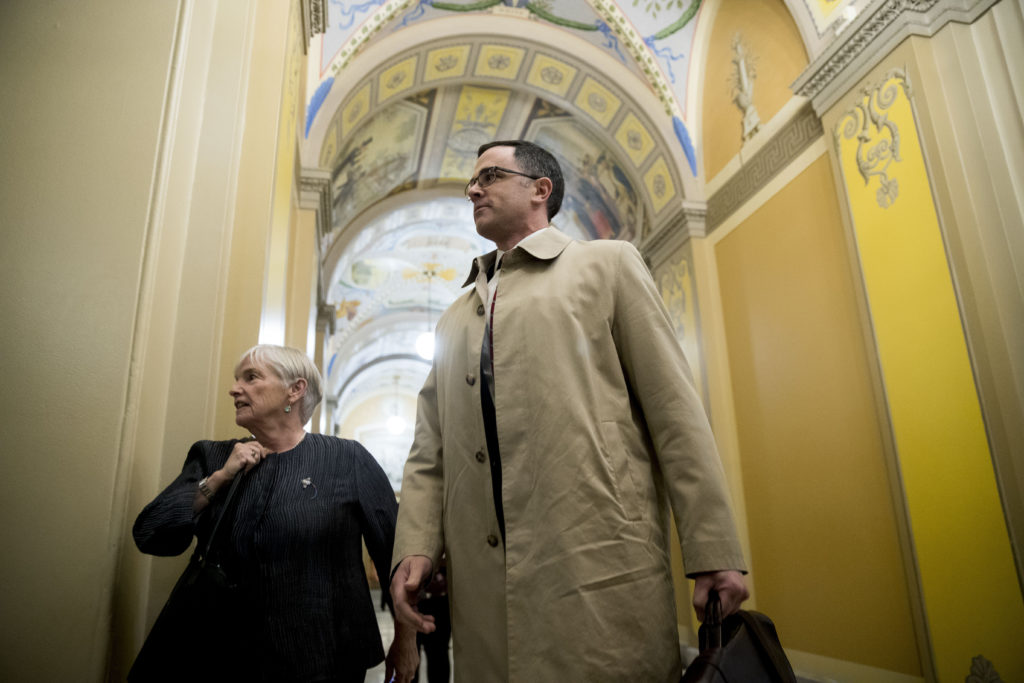
President Donald Trump’s former top adviser for Russian and European affairs arrived on Capitol Hill Thursday to testify to House impeachment investigators, a day after leaving his job at the White House. Tim Morrison, the first White House political appointee to testify, didn’t respond to reporters’ questions about his testimony, which takes place behind closed doors, but his information might be central to a push to remove the president from office. Morrison, who served on the National Security Council, stepped down from that post Wednesday, and a senior administration official said he “decided to pursue other opportunities.” The official, who was not authorized to discuss Morrison’s job and spoke only on the condition of anonymity, said Morrison has been considering leaving the administration for “some time.” He has been in the spotlight since August when a government whistleblower said multiple U.S. officials had said Trump was “using the power of his office to solicit interference from a foreign country in the 2020 U.S. election.” Morrison will be asked to explain that “sinking feeling” he got when Trump demanded that Ukraine’s president investigate former Vice President Joe Biden and meddling in the 2016 election. Morrison was brought on board by then-national security adviser John Bolton to address arms control matters and later shifted into his current role as a top Russia and Europe adviser. It was there that he stepped into the thick of an in-house squabble about the activities of Trump’s personal attorney Rudy Giuliani, who had been conversing with Ukrainian leaders outside of traditional U.S. diplomatic circles. Known as a “hawk” in national security circles, Morrison is the first political appointee from the White House to testify before impeachment investigators. The probe has been denounced by the Republican president, who has directed his staff not to testify. Regardless of what he says, GOP lawmakers will be hard-pressed to dismiss Morrison, formerly a longtime Republican staffer at the House Armed Services Committee. He’s been bouncing around Washington in Republican positions for two decades, having worked for Rep. Mark Kennedy, Republican-Minnesota, Sen. Jon Kyl, Republican-Arizona, and as a GOP senior staffer on the House Armed Services Committee, including nearly four years when it was chaired by Rep. Mac Thornberry, Republican-Texas. Morrison’s name appeared more than a dozen times in earlier testimony by William Taylor, the acting U.S. ambassador in Ukraine, who told impeachment investigators that Trump was withholding military aid unless the new Ukrainian president, Volodymyr Zelenskiy, went public with a promise to investigate Trump’s political rival Joe Biden and his son Hunter. Taylor’s testimony contradicts Trump’s repeated denials that there was any quid pro quo. Taylor said Morrison recounted a conversation that Gordon Sondland, America’s ambassador to the European Union, had with a top aide to Zelenskiy named Andriy Yermak. Taylor said Morrison told him security assistance would not materialize until Zelenskiy committed to investigate Burisma, a Ukrainian gas company that once employed Biden’s son. A White House meeting for Zelenskiy also was in play. “I was alarmed by what Mr. Morrison told me about the Sondland-Yermak conversation,” Taylor testified. “This was the first time I had heard that the security assistance — not just the White House meeting — was conditioned on the investigations.” Taylor testified that Morrison told him he had a “sinking feeling” after learning about a Sept. 7 conversation Sondland had with Trump. “According to Mr. Morrison, President Trump told Ambassador Sondland that he was not asking for a quid pro quo,” Taylor testified. “But President Trump did insist that President Zelenskiy go to a microphone and say he is opening investigations of Biden and 2016 election interference, and that President Zelenskiy should want to do this himself. Mr. Morrison said that he told Ambassador Bolton and the NSC lawyers of this phone call between President Trump and Ambassador Sondland.” Morrison told people after Bolton was forced out of his job that the national security adviser had tried to stop Giuliani’s diplomatic dealings with Ukraine and that Morrison agreed, according to a U.S. official, who was not authorized to discuss Morrison’s role in the impeachment inquiry and spoke only on condition of anonymity. The official said Morrison told people that with the appointment of Robert O’Brien as Bolton’s successor, his own future work at the NSC was in a “holding pattern.” Bolton had brought Morrison into the NSC in July 2018 as senior director for weapons of mass destruction and biodefence. He’s known as an arms control expert or an arms treaty saboteur, depending on who you ask. Morrison, who earned a bachelor’s degree from the University of Minnesota and a law degree from George Washington University, keeps nuclear strategist Herman Kahn’s seminal volume on thermonuclear warfare on a table in his office. Daryl Kimball, executive director of the Arms Control Association, said Bolton and Morrison are likeminded. Kimball said both have been known for calling up GOP congressional offices warning them against saying anything about arms control that didn’t align with their views. “Just as John Bolton reportedly did, I would be shocked if Morrison did not regard Giuliani’s activities as being out of bounds,” said Kimball, who has been on opposite sides of arms control debates with Morrison for more than a decade. By Deb Riechmann Associated Press Associated Press writers Zeke Miller and Matthew Lee contributed to this report. Republished with the permission of the Associated Press.
Experts see risks in U.S. plan to dismantle North Korea’s nukes
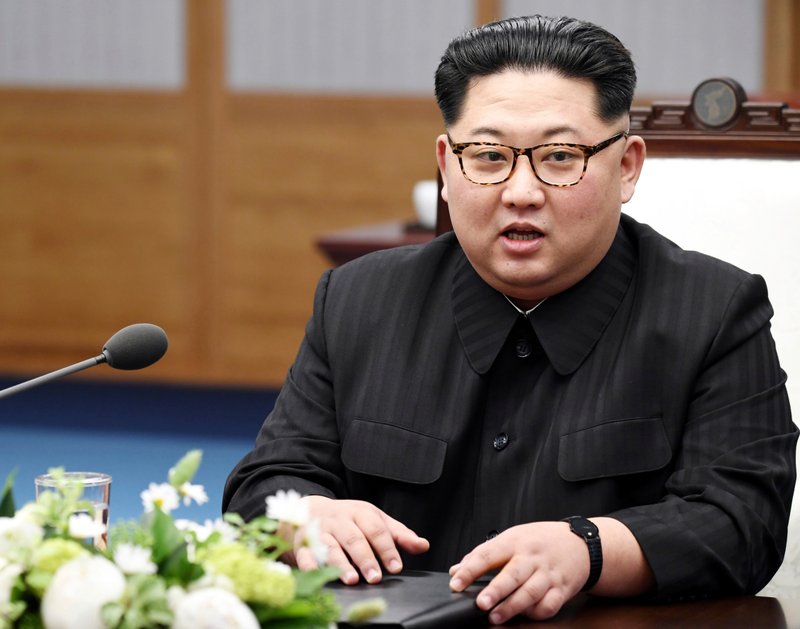
As Secretary of State Mike Pompeo prepares to travel this week to North Korea, experts cautioned that the Trump administration’s plan to dismantle the North’s nuclear weapons and missiles in a year is both unrealistic and risky. The State Department said Pompeo would arrive Friday on his third visit to Pyongyang in three months. It will be the first visit by a senior U.S. official since President Donald Trump‘s historic meeting with Kim Jong Un on June 12 in Singapore, where the North Korean leader committed to “complete denuclearization” of the Korean Peninsula. Trump’s questionable claim afterward that the North was no longer a nuclear threat was soon displaced by doubts about how to achieve denuclearization, a goal that has eluded U.S. administrations for the past quarter-century since Pyongyang began producing fissile material for bombs. The president tweeted Tuesday that talks on the next steps with North Korea are “going well” and claimed his efforts had defused any nuclear threat. “If not for me, we would now be at War with North Korea!” Trump tweeted. He said: “no Rocket Launches or Nuclear Testing in 8 months. All of Asia is thrilled.” But experts say there is no proof North Korea’s halt of nuclear and missile tests means the North will take concrete steps to give up such weapons. They also say the U.S. has an unrealistic approach to North Korea’s denuclearization. Less than three weeks ago, Pompeo said the United States wanted North Korea to take “major” nuclear disarmament steps within the next two years — before the end of Trump’s first term in January 2021. Even that was viewed as bullish by nonproliferation experts considering the scale of North Korea’s weapons program and its history of evasion and reluctance to allow verification of disarmament agreements. On Sunday, Trump’s national security adviser, John Bolton, publicized the more ambitious one-year plan that he said Pompeo will be discussing with the North Koreans. Bolton, who has expressed hardline views on North Korea, said that if Pyongyang has decided to give up its nuclear weapons program and is cooperative, then “we can move very quickly” and they can win sanctions relief and aid from South Korea and Japan. The rapid timeline he proposed contrasts with more measured, methodical strategies that most North Korea experts insist are needed to produce a lasting denuclearization agreement. They say any solid deal will require Kim to be completely transparent about his program — at a time when intelligence reports suggest he will try to deceive the United States about the extent of his covert weapons or facilities. The one-year plan is predicated on the North Koreans “rolling over and playing dead,” said Joel Wit, a former State Department official who helped negotiate a 1994 agreement that temporarily froze Pyongyang’s nuclear program. “If it’s our going-in position, it’s fine. We should give it a try and see where it goes. If it’s our bottom line, it’s dead on arrival and then provides a pretext for John Bolton to make mischief.” To date, Kim has halted nuclear and missile tests and has destroyed tunnels at the North’s nuclear test site, but the authoritarian nation has yet to take concrete steps toward abandoning its weapons programs. Recent think tank analyses using satellite imagery suggest that Pyongyang may even be expanding some facilities linked to its missile and nuclear programs. The Washington Post on Saturday cited unnamed U.S. intelligence officials as concluding that North Korea does not intend to fully surrender its nuclear stockpile. Evidence collected since the summit points to preparations to deceive the U.S. about the number of nuclear warheads in North Korea’s arsenal as well as the existence of undisclosed facilities used to make fissile material for nuclear bombs, according to the report. Some aspects of the updated intelligence were reported Friday by NBC News. A U.S. official told The Associated Press that the Post’s report was accurate and that the assessment reflected the consistent view across U.S. government agencies for the past several weeks. The official was not authorized to comment publicly on the matter and spoke on condition of anonymity. North Korea and Washington have yet to negotiate the terms under which the North would relinquish its weapons, so Pyongyang can be expected to seek leverage in those discussions. But those reported activities could add to misgivings in the United States, which has seen agreements with the North flounder before, often amid allegations of evasion or cheating. Pyongyang has often had its own complaints about Washington over slow delivery of aid and imposition of sanctions. “Denuclearization is no simple task. There is no precedent for a country that has openly tested nuclear weapons and developed a nuclear arsenal and infrastructure as substantial as the one in North Korea to give up its nuclear weapons,” Daryl Kimball, executive director of the Arms Control Association, wrote in a commentary published Monday. A strategy by David Albright at the Institute for Science and International Security suggests the U.S. needs to get Kim to disclose a complete list of all his nuclear program sites and materials, including uranium and plutonium. He also said Trump and Kim should decide whether to move the nuclear weapons out of North Korea to dismantle them or do it inside the country. Even if North Korea is cooperative, the magnitude of dismantling its weapons of mass destruction programs, believed to encompass dozens of sites, will be tough, according to Stanford University academics, including nuclear physicist Siegfried Hecker, a leading expert on the North’s nuclear program. The Stanford team has proposed a 10-year roadmap, based on its belief that “North Korea will not give up its weapons and its weapons program until its security can be assured.” Republished with the permission of the Associated Press.
