
2020 campaigns go digital amid fears of coronavirus spread

Gone are the rope lines, selfies with supporters and entourages of traveling press.
Donald Trump drama rolls on: Disputes, falsehoods hit transition

The drama, disputes and falsehoods that permeated Donald Trump‘s presidential campaign are now roiling his transition to the White House, forcing aides to defend his baseless assertions of illegal voting and sending internal fights spilling into public. On Monday, a recount effort, led by Green Party candidate Jill Stein and joined by Hillary Clinton‘s campaign also marched on in three states, based partly on the Stein campaign’s unsubstantiated assertion that cyberhacking could have interfered with electronic voting machines. Wisconsin officials approved plans to begin a recount as early as Thursday. Stein also asked for a recount in Pennsylvania and was expected to do the same in Michigan, where officials certified Trump’s victory Monday. Trump has angrily denounced the recounts and now claims without evidence that he, not Clinton, would have won the popular vote if it hadn’t been for “millions of people who voted illegally.” On Twitter, he singled out Virginia, California and New Hampshire. There has been no indication of widespread election tampering or voter fraud in those states or any others, and Trump aides struggled Monday to back up their boss’ claim. Spokesman Jason Miller said illegal voting was “an issue of concern.” But the only evidence he raised was a 2014 news report and a study on voting irregularities conducted before the 2016 election. Trump met Monday with candidates for top Cabinet posts, including retired Gen. David Petraeus, a new contender for secretary of state. Trump is to meet Tuesday with Tennessee Sen. Bob Corker, who is also being considered more seriously for the diplomatic post, and Mitt Romney, who has become a symbol of the internal divisions agitating the transition team. Petraeus said he spent about an hour with Trump, and he praised the president-elect for showing a “great grasp of a variety of the challenges that are out there.” “Very good conversation and we’ll see where it goes from here,” he said. A former CIA chief, Petraeus pleaded guilty last year to a misdemeanor charge of mishandling classified information relating to documents he had provided to his biographer, with whom he was having an affair. Vice President-elect Mike Pence, who is heading the transition effort, teased “a number of very important announcements tomorrow” as he exited Trump Tower Monday night. Pence is said to be among those backing Romney for State. Romney was fiercely critical of Trump throughout the campaign but is interested in the Cabinet position, and they discussed it during a lengthy meeting earlier this month. Other top Trump allies, notably campaign manager Kellyanne Conway, have launched a highly unusual public campaign to warn the president-elect that nominating Romney would be seen as a betrayal by his supporters. Conway’s comments stirred speculation that she is seeking to either force Trump’s hand or give him cover for ultimately passing over Romney. Three people close to the transition team said Trump had been aware that Conway planned to voice her opinion, both on Twitter and in television interviews. They disputed reports that Trump was furious at her and suggested his decision to consider additional candidates instead highlighted her influence. Conway served as Trump’s third campaign manager and largely succeeded in navigating the minefield of rivalries that ensnared other officials. Trump is said to have offered her a choice of White House jobs — either press secretary or communications director. But people with knowledge of Conway’s plans say she is more interested in serving as an outside political adviser, akin to the role President Barack Obama‘s campaign manager David Plouffe played following the 2008 election. The wrangling over the State Department post appears to have slowed the announcements of other top jobs. Retired Gen. James Mattis, who impressed Trump during a pre-Thanksgiving meeting, was at the top of the list for Defense secretary, but a final decision had not been made. Trump was also considering former New York City Mayor Rudy Giuliani for Homeland Security secretary, according to those close to the transition process. Giuliani was initially the front-runner for State and is still in the mix. But questions about his overseas business dealings, as well as the mayor’s public campaigning for the job, have given Trump pause. Those close to the transition insisted on anonymity in commenting because they were not authorized to publicly discuss the private process. Even as Trump weighs major decisions that will shape his presidency, he’s been unable to avoid being distracted by the recount effort. He spent Sunday on a 12-hour Twitter offensive that included quoting Clinton’s concession speech, in which she said the public owed Trump “an open mind and the chance to lead.” His final tweets challenging the integrity of an election he won were reminiscent of his repeated, unsubstantiated assertions during the campaign that the contest might be rigged. Those previous comments sparked an outcry from both Clinton and some Republicans. Clinton lawyer Marc Elias said the campaign has seen “no actionable evidence” of voting anomalies. But the campaign still plans to be involved in Stein’s recount to ensure its interests are legally represented. Trump narrowly won Wisconsin, Pennsylvania and Michigan. All three would need to flip to Clinton to upend the Republican’s victory, and Clinton’s team says Trump has a larger edge in all three states than has ever been overcome in a presidential recount. Republished with permission of the Associated Press.
Presidential Primary Brief: 379 days until Election Day
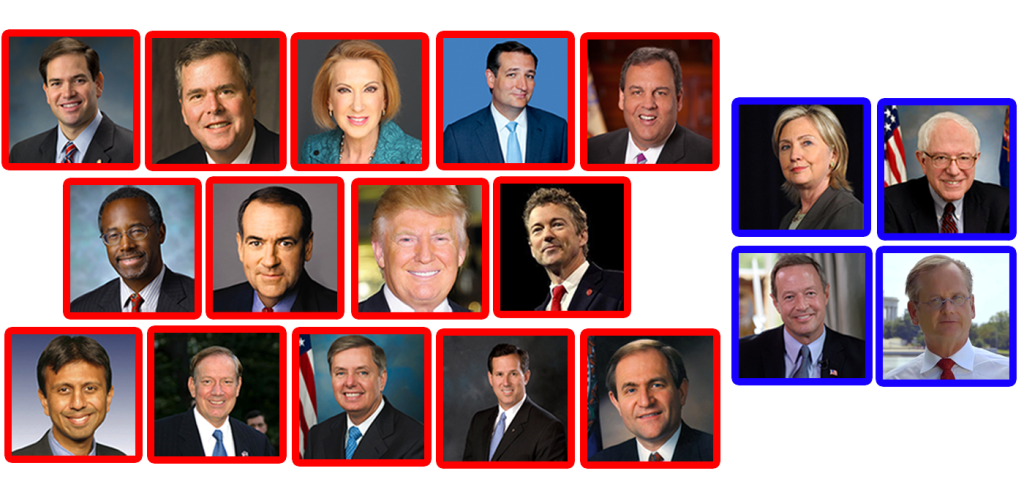
125 days until AL Presidential Primary 379 days until Election Day Convention Dates: Republican July 18-21 2016, Democratic July 25-28 2016 Weekly Headlines: Lincoln Chafee ends his presidential campaign Joe Biden says no to 2016 presidential race Jim Webb drops out as a Democrat, but could run as Independent Press Clips: Poll: Republicans view Donald Trump as strongest presidential candidate (PBS News 10/25/15) Republican voters view Donald Trump as their strongest general election candidate, according to an Associated Press-GfK poll that highlights the sharp contrast between the party’s voters and its top professionals regarding the billionaire businessman’s ultimate political strength. Seven in 10 Republican and Republican-leaning registered voters say Trump could win in November 2016 if he is nominated, and that’s the most who say so of any candidate. By comparison, 6 in 10 say the same for retired neurosurgeon Ben Carson, who, like Trump, has tapped into the powerful wave of antiestablishment anger defining the early phases of the 2016 contest. Longtime Obama ally David Plouffe endorses Hillary Clinton (MSNBC 10/24/15) Barack Obama’s 2008 campaign manager David Plouffe endorsed Hillary Clinton Saturday, just ahead of a key Democratic Party event here, where Obama’s campaign first showed major signs of breaking past the thought-to-be inevitable Clinton. “Now, to be honest, during the most intense days of the 2008 primary, I would never have imagined writing this piece. And I doubt Team Clinton felt any differently about me,” Plouffe wrote in a post on Medium. Marco Rubio’s ‘Sanctuary City’ Law And The 2016 Election: Can Republicans Win Without Latino Voters? (IB Times 10/20/15) When Kate Steinle, a young, white woman, was shot on a San Francisco pier by an undocumented immigrant in July, Republican presidential candidates responded with outrage. Undocumented immigrants are often criminals, Republican presidential front- runner Donald Trump had been saying, and Steinle’s death was cited as proof. Among the GOP leaders who subsequently launched a war against sanctuary city policies like the one embraced by San Francisco, Florida Sen. Marco Rubio vowed to end federal funding for local governments that don’t comply with federal immigration laws. The harsh rhetoric marked a sudden shift for Rubio, a leading Republican presidential candidate who was once seen as the new diverse face of the GOP and a link to the nation’s increasingly important Hispanic voters. Jeb Bush hunkers down with family to assess his candidacy (CBS News 10/23/15) Jeb Bush will attend a finance meeting this weekend in Houston convened by former President George H. W. Bush and attended by Bush’s brother, former President George W. Bush, CBS News has learned. The session, designed to assess where Bush’s candidacy stands in the face of large-scale staff cutbacks and underwhelming poll numbers, will also be attended by Bush’s mother, Barbara Bush. The governor’s campaign confirmed the meeting will be held Sunday and Monday. 11-Hour Benghazi Hearing Brings Out the Many Faces of Hillary Clinton (NBC News 10/23/15) In eleven hours of testimony, former secretary of state and current Democratic presidential candidate Hillary Clinton answered questions in a long-awaited appearance before a House committee investigating the Benghazi attacks on Thursday. It’s the eighth Congressional investigation and the third time Clinton has testified on the death of four Americans, including Ambassador Chris Stevens, at the U.S. compound in the Libyan city in 2012. Behind Ben Carson’s rebellious public image, a DC insider is hard at work (Reuters 10/25/15) Oct 25 U.S. presidential candidate Ben Carson may be the farthest Republican voters can get from the party’s establishment: A retired neurosurgeon with a penchant for inflammatory comments who has never held, much less run, for elected office. While many of his rivals are concentrating on hiring staff and renting offices in key states like New Hampshire and Iowa, Carson is pursuing a more unorthodox campaign, sometimes less visible to the naked eye, that has fueled his rise to the top of the polls. He is just behind Donald Trump, the front-runner for the Republican 2016 presidential nomination. Donald Trump: No apology for questioning Ben Carson’s Seventh-day Adventist faith (Washington Post 10/25/15) Republican presidential candidate Donald Trump said Sunday that he saw no reason to apologize for raising the issue of rival Ben Carson’s Seventh-day Adventist faith during a recent campaign rally. “I would certainly give an apology if I said something bad about it. But I didn’t. All I said was I don’t know about it,” Trump said during an interview on ABC’s “This Week,” one of three Sunday talk shows on which the billionaire businessman talked about recent polls that showed Carson pulling ahead of him in Iowa. Bernie Sanders Wants To Bring Back Your 40-Hour Workweek (Huffington Post 10/24/15) Democratic presidential candidate Sen. Bernie Sanders (I-Vt.) thinks Americans may have forgotten about the 40-hour week. “A hundred years ago workers took to the streets” to fight for 40 hours, Sanders told The Huffington Post. “And a hundred years have come and gone, we’ve seen an explosion in technology, we’ve seen an explosion in productivity, we have a great global economy, and what do you have? The vast majority of people are working longer hours for lower wages.” American workers with full-time jobs work an average of 42.7 hours per week, according to the latest data from the Bureau of Labor Statistics. Including part-timers in the calculation puts the average American workweek at 39 hours. CNBC Sets Lineups for Republican Debates Next Week (NY Times 10/21/15) CNBC has set the stages for the Republican presidential debate next Wednesday. The 6 p.m. undercard will feature Rick Santorum, Gov. Bobby Jindal of Louisiana, George Pataki and Senator Lindsey Graham of South Carolina. They will be relegated to the early slot because their average national poll numbers in the last five weeks are below 2.5 percent. The main event, to begin shortly after 8 p.m., will have 10 candidates: Donald J. Trump, Ben Carson, Senator Marco Rubio of Florida, Jeb Bush, Carly Fiorina, Senator Ted Cruz of Texas, Mike Huckabee, Gov. Chris Christie of New Jersey, Gov. John Kasich
As Democrats fret over ‘sharing economy,’ GOP moves in
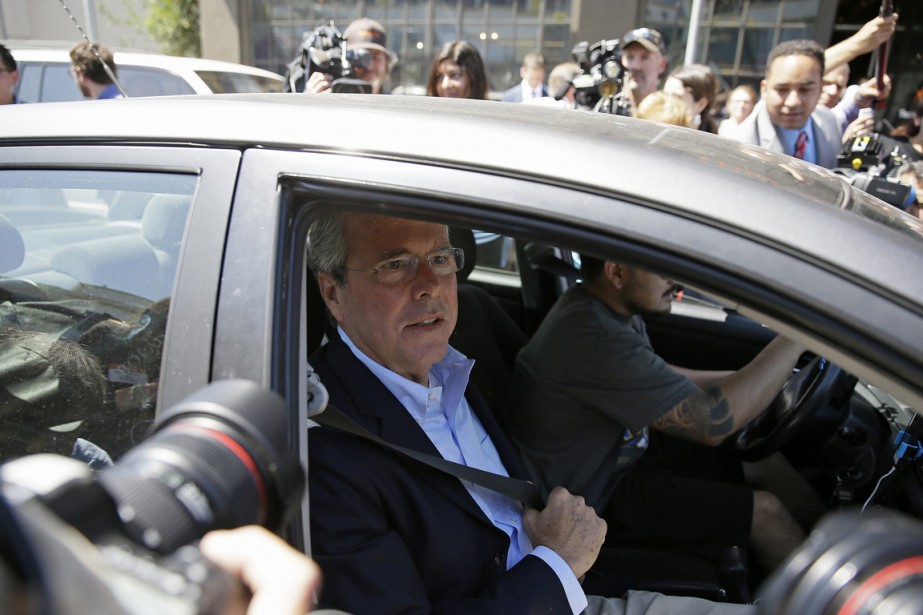
The debate over ride-hailing firm Uber is laying bare divides in the Democratic Party and on the left about how to handle the new “sharing” economy. Republicans are hungry to exploit that ambivalence and make inroads into a wealthy sector of the tech industry. In New York City this past week, liberal Mayor Bill de Blasio tried to limit the number of Uber drivers on the streets, only to be rebuked by the state’s more centrist governor, Andrew Cuomo. The mayor’s administration decided to allow Uber to expand in the city for another year. That followed a pledge by the party’s presidential front-runner, Hillary Rodham Clinton, to “crack down” on companies that classify workers as contractors rather than employees, as critics contend Uber and other companies often do. Clinton did not identify Uber, whose lobbying operation is run by former Obama campaign manager David Plouffe and stocked with Democratic operatives. But her allusion led Jeb Bush, a Republican technophile who says he prefers his Apple watch to apple pie, to ride in an Uber vehicle during a campaign stop in San Francisco days later. For years, Republicans have struggled to gain support in the technology industry, an effort hobbled by in part by their stance on social issues and net neutrality, which is the idea that Internet service providers should not manipulate, slow or block data moving across their networks. But the bright-blue precincts of Silicon Valley have become a regular stop on the GOP circuit. Kentucky Sen. Rand Paul opened a campaign office at a San Francisco tech incubator that hosted a 24-hour “hack-a-thon” last month. Florida Sen. Marco Rubio won the backing of Oracle founder Larry Ellison. He held a fundraiser for the senator, whose new book has a chapter with this title: “Making America Safe for Uber.” “There’s a lot of folks out here who naturally fall into a libertarian place and in the past they were not feeling the love from the GOP,” said Scott Banister, an investor who is raising money for Paul. “Obviously, if the Democratic Party is going to come down on the side of ‘let’s shut down these businesses,’ that’s going to force the issue.” Liberals have increasingly questioned the impact of the industry during a time of scarce jobs and wage stagnation. Former Treasury Secretary Larry Summers has noted that Apple employs a far smaller share of people than companies of its size did in the past. Silicon Valley and the surrounding Bay Area have become a symbol of the income inequality that Democrats bemoan. But it is the recent, explosive growth of Uber and other “sharing economy” companies that have attracted the most concern. HomeJoy recently announced it would shut down in the face of four lawsuits alleging it should treat the people who clean homes on its behalf as employees rather than as independent contractors not entitled to the same workplace protections. “If a technologist wants to disrupt an industry that has middle-class jobs and replace them with insecure, not-as-good jobs, there has to be a conversation about that,” said Heath McGee, president of the liberal think-tank Demos. “Just because there’s an app doesn’t mean it’s anything different. … It’s a question as old as the economy.” Lyft, Uber or the grocery delivery service Instacart and others rely on independent contractors to provide services for a fee: driving, house cleaning, grocery shopping and the like. Uber takes a commission from fees charged to its riders. The drivers, who can work as many or as few hours as they would like, get the rest. Many Uber drivers work part time to supplement their income, while others rely on it entirely. Founded in 2009, it was operating in more than 250 cities and 21 countries by the end of last year. Such innovations have hit core Democratic constituencies. Among them are taxi companies that give generously to urban politicians such as de Blasio, and professors worried about the proliferation of online higher educational courses. But they also benefit another core group: the young, urban people who supported President Barack Obama. Former Obama adviser Dan Pfeiffer warned in a recent that “progressive politicians are making a major error by positioning against the sharing economy.” Banister, the investor helping Paul, said Democrats seem torn on the sharing economy, “not quite sure where the electorate wants them to be.” Republicans, he added, are “able to come back and say, ‘We’re not wishy-washy about this,’” because business, jobs and the economy form “the core of the GOP.” Larry Gerston, political science professor emeritus at San Jose State, said the Uber skirmishes will have limited impact in Silicon Valley, which is far more concerned with federal policy on matters such as patent protection. But Julie Samuels, executive director of Engine, a nonprofit that tries to connect startups with policy debates, said the tone of the debate is worrisome. “When any policymaker starts to ostracize the tech community, they’re ostracizing people who can make things better,” she said. Republished with permission of the Associated Press.
