
Donald Trump nominates Birmingham attorney Kevin Newsom to 11th Circuit Court

Birmingham attorney Kevin Newsom is the latest Alabamian to receive a high-profile appointment from the Donald Trump administration. On Monday, Trump nominated Newsom, Alabama’s former solicitor general who now chairs the appellate group at Bradley Arant Boult Cummings in Birmingham, to the U.S. Court of Appeals for the 11th Circuit. The 45-year-old Newsom, if approved, would succeed Montgomery-based Judge Joel Dubina, for the seat that covers Alabama, Georgia, and parts of Florida. Newsom was among the 10 judicial nominees named by the White House this week. According to YellowHammerNews.com, Newsom graduated from Harvard Law School in 1997, where he served as Harvard Law Review’s articles editor. He earned his undergraduate degree at Birmingham’s Samford University in 1994, graduating summa cum laude with a 4.0. After graduating law school, Newsom clerked for Judge Diarmuid O’Scannlain of the U.S. Court of Appeals for the 9th Circuit, and then for U.S. Supreme Court Justice David Souter from 2000-2001. Newsom later joined Covington & Burling’s Washington-based appellate litigation practice group, where he served for two years before becoming Alabama solicitor general in 2003, appointed by then-Alabama Attorney General Bill Pryor. In 2004, Pryor was named to the 11th Circuit, and was on Trump’s list of potential U.S. Supreme Court nominees. A biography online says Newsom personally argued four cases before the U.S. Supreme Court, and over 19 federal appellate court cases, as well as several in state appellate courts. In 2007, Newsom stepped down as solicitor general to join Bradley Arant, calling the “the SG gig … the job of a lifetime.” At Bradley Arant, U.S. Supreme Court Chief Justice John Roberts appointed Newsom twice to the U.S. Judicial Conference’s advisory committee on appellate rules, making him one of only three private practice attorneys to serve on the committee. “Kevin Newsom is an exceptional choice for this high honor. I am confident that his strong principles will enable him to apply the law in a fair and just manner,” Alabama Sen. Richard Shelby told YellowHammerNews.com. “President Trump has made the right decision in selecting Kevin to sit on the 11th Circuit, and I believe he will prove to be an asset to our nation’s judicial system as a federal judge.”
Martin Dyckman: Refusing to approve Obama nominee could hurt the Party of No in November
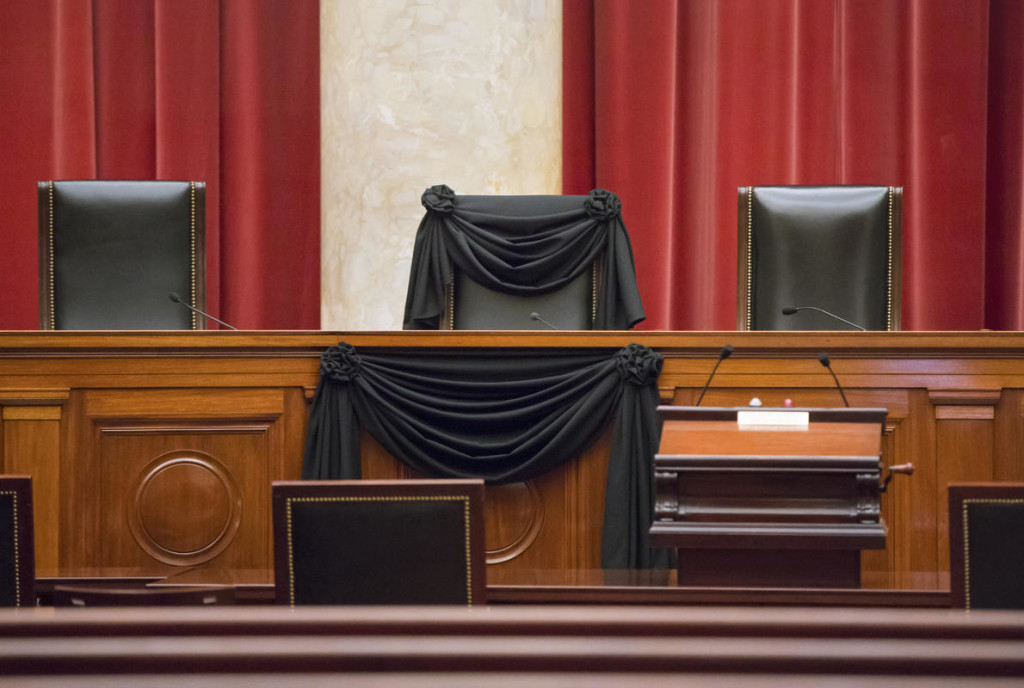
Mitch McConnell couldn’t even wait until Justice Antonin Scalia‘s corpse was cold before exploiting his death for partisan politics. The oleaginous majority leader means to keep the seat empty, no matter the likelihood of that paralyzing the sharply divided Supreme Court for a year, on the chance that voters might elect a Republican president to appoint Scalia’s replacement. The people, he said, “should have a voice in the selection of their next Supreme Court justice.” As Elizabeth Warren promptly reminded him, voters had that choice when they elected President Barack Obama and re-elected him four years ago with a winning margin of nearly 5 million votes. Most Americans understand that short of making or preventing war, the appointment of a Supreme Court justice has the longest-lasting consequences of anything a president does. They have trusted Obama with that responsibility. Twice. But the Party of No has never forgiven him for winning and has treated him with degrees of obstructionism and contempt that were never practiced by Democratic Congresses against Ronald Reagan or George W. Bush. The scheme of keeping Scalia’s seat empty for a year is consistent with the Party of No having shut down the executive branch to try win with extortion what it couldn’t win at the ballot box — the repeal of Obamacare. Belying the current Republican reinvention of history, there has never been a policy of deliberately perpetuating Supreme Court vacancies on the rare occasions when they occur during the last year of a president’s term. Quite the contrary. Some examples: There were only 10 months left in Reagan’s when the Senate unanimously confirmed Justice Anthony Kennedy, as Reagan urged it to do. John Adams had only four months left in his term when he appointed John Marshall to be chief justice in December 1800. That was easily the most consequential appointment ever. Thomas Jefferson, who had defeated Adams, could do nothing but gnash his teeth over the Federalists’ parting shot. Herbert Hoover was in the last year of his term, and facing all-but-certain defeat in the 1932 election, when he successfully nominated Benjamin Cardozo. When President Lyndon Johnson failed to promote Justice Abe Fortas to chief justice, it wasn’t because of timing but because Fortas had woeful ethical problems. There is nothing in the Constitution to require — or authorize — Congress to wait for an intervening election before carrying out any duty other than counting electoral votes. The 27th amendment merely postpones the effective date of any congressional salary increase until after the ensuing election for the House. That was James Madison‘s idea, 202 years before it was finally ratified, on the premise that lawmakers should think twice about giving themselves a pay raise of which the voters might disapprove. Today, there are Republican senators up for re-election who might want to rethink the McConnell scheme to hold the Supreme Court hostage for the next election. Five of the 17 seats the party is defending are in states, including Florida, which Obama carried four years ago. Obama will fulfill his constitutional duty to nominate a justice even if the Republican senators insist on defaulting on their duty to advise and consent. The voters will then have an opportunity to judge the senators. Two of the people said to be on Obama’s shortlist are circuit court of appeals judges whom the Senate confirmed unanimously two and three years ago. One would be the first Indian-American justice. The other is from Iowa and was enthusiastically supported by Iowa Sen. Charles Grassley, chairman of the judiciary committee, who is up for re-election this year. Is Grassley really prepared to stonewall her? Maybe not. He’s now saying he might hold hearings on a nominee although he still thinks the next president should make the appointment. At least the Party of No is making it vividly clear to voters what’s at stake for the Supreme Court — and for the entire concept of equal justice under law — this year. For the first time since Lyndon Johnson’s presidency, a majority of the court might be Democratic appointees. More to the important point, will the new justice be an ideologue like Scalia, or disposed to compromise like Sandra Day O’Connor and David Souter, both of whom were Republicans? They were the last justices who had ever held political office — O’Connor as a legislator and Souter as an attorney general — and the court was richer for that experience. The Supreme Court did its greatest work — Brown v. Board of Education comes to mind — when it valued consensus. It has been at its worst — think Citizens United — when an ideological majority insisted on scoring points that weren’t necessary to resolving the case. The American people want a new justice who will be judicious in every sense of the word. If Obama nominates such a person and the Republicans refuse to confirm him or her, it will be as good a reason as any for voters to reject the Party of No on Nov. 8. *** Martin Dyckman is a retired associate editor of the newspaper formerly known as the St. Petersburg Times. He lives in suburban Asheville, North Carolina.
