
House passes bill addressing Sheriff’s succession rules
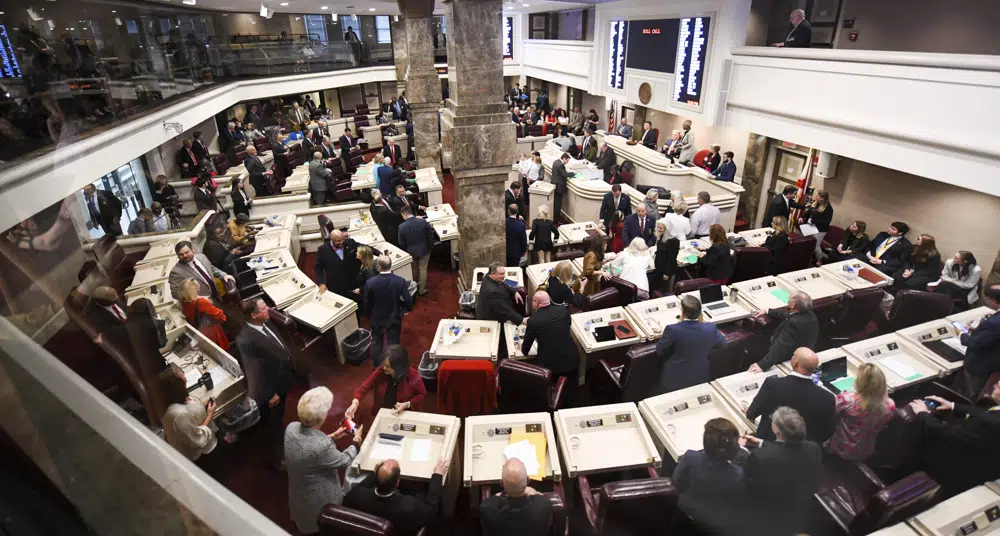
On Thursday, the Alabama House of Representatives passed legislation establishing that in the event of a sheriff dying, quitting, or being charged with a serious crime, the next senior officer in the department would take control of that department until the Governor appoints a successor. House Bill 276 (HB276) is sponsored by State Representative Ron Bolton. According to the synopsis, “Under existing law, when the office of the sheriff of a county is vacant or in certain other circumstances when existing law has provided that it is not appropriate for the sheriff to serve, the county coroner discharges the duties of the sheriff. This bill would provide that when the office of sheriff is vacant or when certain other circumstances exist, the highest ranking deputy sheriff in the county would serve as acting sheriff.” Bolton explained that in the event of a vacancy in the sheriff’s office, the highest-ranking member of that department would take control of the department. Bolton said, “They will automatically take control of that office until the governor makes the appointment.” Rep. David Standridge said, “I want to make sure that that deputy wouldn’t lose their job when a new sheriff is appointed if it is not him or her that is appointed.” Bolton said he would be open to amending the bill to include that stipulation when the bill is in the Senate. Rep. Pebblin Warren said, “The only thing that really concerns me is that the sheriff, in most cases, is the most liked person in the county. The chief deputy may not be well-liked. What is the current law?” Bolton said, “The current law puts the coroner in charge instead of the senior deputy.” Warren asked, “And that person will stay in office until the governor makes an appoint?” Bolton answered, “That is correct.” Warren said, “I personally know of a situation where the sheriff was popular, and the chief deputy was liked by no one.” Rep. John Rogers asked, “What if the highest-ranking deputy has some charges pending against him?” Bolton said, “He would be removed himself. It would go to the next-ranking deputy.” Rep. Juandalynn Givan asked, “Did you talk to the sheriffs about this, and specifically, did you talk with Jefferson County Sheriff Mark Pettway about this?” Bolton said, “I did. I taught Sheriff Pettway in the academy 27 years ago. The Sheriffs Association helped draft the bill, and I spoke with Sheriff Pettway about this when he is in town. Bolton said that the law establishing that the coroner assumes the powers of a sheriff in the event of a vacancy dates back to 1852. “It has been amended a number of times, but it has never been changed in terms of succession,” Bolton said. HB276 passed the House of Representatives 104 to 0. It now goes to the Senate for their consideration. HB276 was Rep. Bolton’s first bill to pass the House for the freshman lawmaker. Thursday was day 15 of the 2023 Alabama Regular Legislative Session. To connect with the author of this story or to comment, email brandonmreporter@gmail.com.
House committee advances legislation to send parents to jail if their child brings a gun to school

On Wednesday, the House Judiciary Committee voted to advance controversial legislation that would hold parents criminally responsible if their child brings their gun onto a school campus, even if the weapon is not used in any sort of criminal mischief. House Bill 123 (HB123) is sponsored by State Rep. Barbara Drummond. “This bill does not violate anyone’s Second Amendment right,” Drummond told the committee. “This is a bill that makes parents responsible.” State Rep. Tim Wadsworth asked, “A parent can be charged with a crime?” “Yes, if that weapon is not reasonably secured,” said Drummond. Drummond explained that “reasonably secured” could “be a trigger lock, in a lockbox, or a gun safe,” but is not defined exclusively by those means. Rep. Shane Stringer asked, “Can we do a bill that says if a weapon is used.” Drummond responded, “I don’t want to wake up tomorrow and see that weapon was used on a school. There is a responsibility to being a parent.” Drummond explained that the gun would have to belong to the parent or guardian. The committee approved an amendment to change the penalty from a Class D felony to a Class A misdemeanor. Rep. David Faulkner asked if the parent would be criminally liable if the child brought the gun to school, even if the gun was determined to be “reasonably secured” with a trigger lock. “If it is brought to school with a trigger lock, it would be ‘reasonably secured,’” under this bill, Drummond answered. Rep. David Standridge said, “I represent a rural district where hunting is popular.” Standridge explained that his area had had an incident where a student went hunting after school and forgot to take the rifle out of his truck, so they went to school the next day with the rifle still in the gun rack. Standridge asked if this bill would apply to an incident like that. “This is 17 and under,” Drummond replied. “That older student who is going hunting this would not address this.” Stringer asked, “How would this affect other people in the household?” “This is germane only to the parents,” Drummond said. “There is a ton of guns that are being confiscated on school campuses.” Wadsworth asked, “What if it was a grandparent?” Drummond answered, “This applies to parent or guardian.” “Most grandparents who look after their grandchildren do not get legal guardianship,” Wadsworth said. State Rep. Christopher England said, “What you are doing is not a foreign concept to the law. In juvenile court, we charge parents with contributing to the delinquency of a minor. All we are talking about is responsible gun owners. If you are a responsible gun owner you should not have a problem with this bill.” A total of three amendments were added to the bill in committee. HB123 received a favorable report in a close vote. The bill can be considered by the full House of Representatives as early as Thursday. Thursday will be day 10 of the 2023 Alabama Regular Legislative Session. To connect with the author of this story or to comment, email brandonmreporter@gmail.com.
Nathaniel Ledbetter announces third round of committee chairmanships
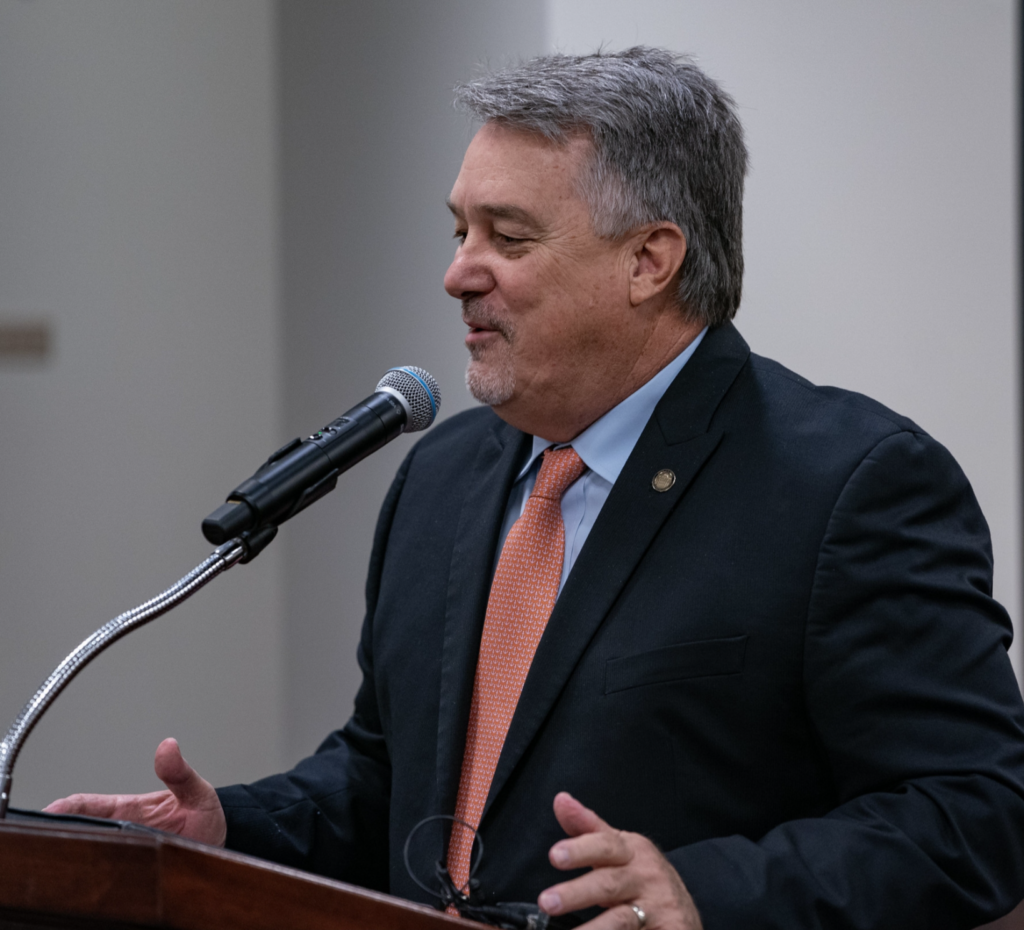
State Rep. Nathaniel Ledbetter announced his third round of intended committee chair appointments on Wednesday. Ledbetter was chosen to be the next Speaker of the House in November by the Alabama House Republican Caucus – which holds a commanding supermajority in the Alabama House of Representatives. The Republicans hold a 77 to 28 supermajority in the Alabama House of Representatives, so the selection of the House Republican Caucus will almost certainly be elected as the next Speaker of the House when the Legislature meets for its organizational session in January. Ledbetter has appointed Rep. Ginny Shaver as Chair of the Children and Senior Advocacy Committee. Ledbetter also appointed Rep. Chris Blackshear to chair the Financial Services Committee. Rep. Matt Simpson was appointed to chair the House Ethics and Campaign Finance Committee. Simpson is an attorney and former prosecutor. Rep. David Standridge will chair the Rural and Urban Development Committee. Standridge is the longtime chair of the House Rural Caucus. Rep. Corley Ellis was appointed to chair the House Insurance Committee. State Rep. Chris Sells will serve as the chairman of the State Government Committee. State Rep. Andy Whitt will be the chairman of the Economic Development and Tourism Committee. State Rep. Allen Treadaway will continue to chair the Public Safety and Homeland Security Committee. Treadaway is a retired Birmingham City assistant police chief. “These appointments represent a mix of veteran chairs with valuable experience and newly appointed members of the leadership team with fresh perspectives,” Ledbetter said. “All of them have the knowledge and skills necessary to lead their committees and ensure that bills and measures are well vetted before reaching the House floor.” All of Ledbetter’s appointments will formally go into effect once he is elevated to Speaker once the full body is in session for the organizational session. To connect with the author of this story, or to comment, email brandonmreporter@gmail.com.
Steve Flowers: Incumbency prevails in 2022 State House races
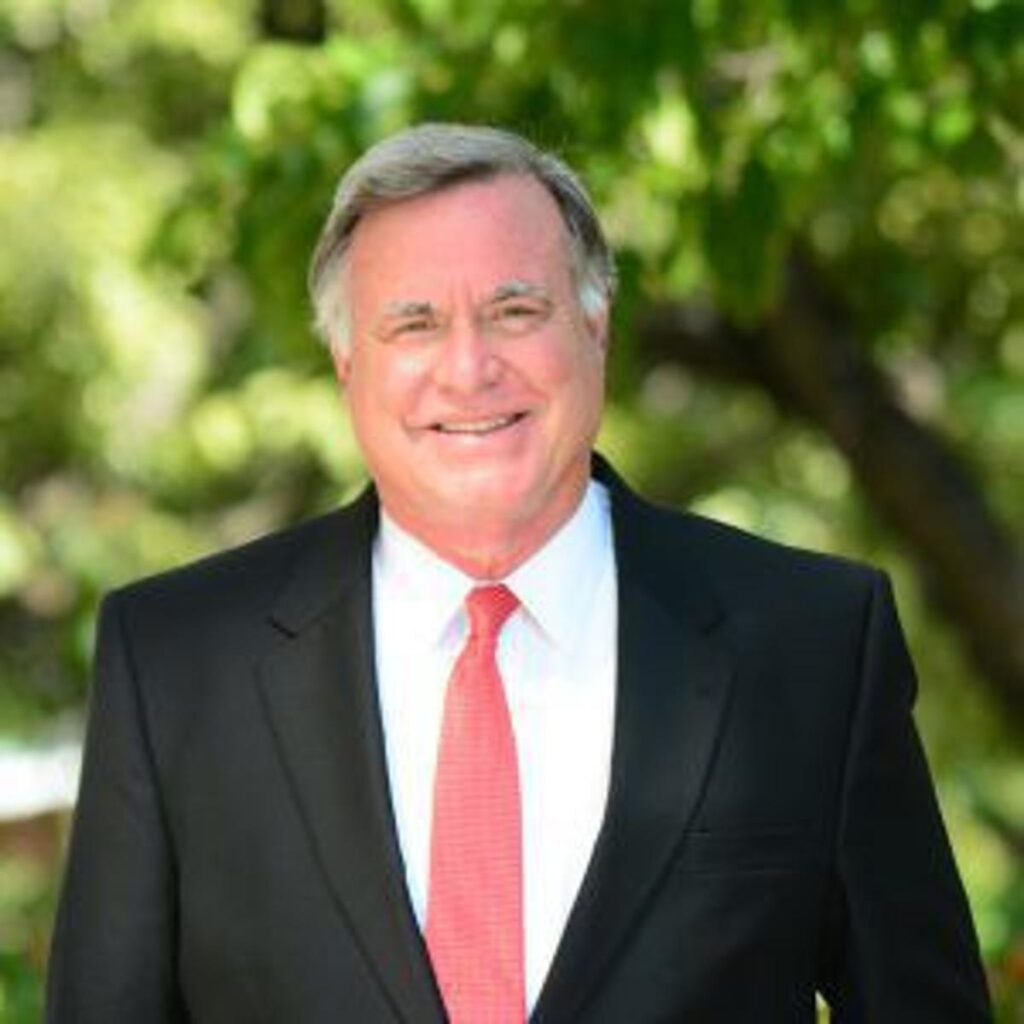
Folks, believe it or not, we are closing in on six months before next year’s election year. The primary election is set for May 24, 2022. In Alabama, all our major constitutional officers are on the ballot next year. The governor’s office is the premier race in the state, and that coveted and powerful post is set for its four-year quadrennial run. Therefore, this big political year is referred to as the gubernatorial year. Those of us who follow Alabama politics have been salivating with anticipation for a cavalcade of great races. However, the power of incumbency has devasted the big year into a yawn. All the major state offices are held by popular incumbents, who are either running unopposed or have minimal opposition. The consolation prize was that there would be the legislative races. After all, this is where the real power in the state rests. You can simply look at where the special interest and PAC money is spent to verify that fact. However, the omnipotent power of incumbency has also encroached on those races. The Alabama House of Representatives has 105 members. There are 77 Republicans and 28 Democrats. The large majority of incumbents are running for reelection – both Republicans and Democrats. The overwhelming majority of these incumbents will have no opposition. However, in the House, there will be some major changes in leadership because of retirement or moving on to new posts. Speaker of the House Mac McCutcheon is not running for reelection. This has created an interesting and spirited race within the Republican Caucus ranks for Speaker. In addition, Victor Gaston of Mobile, who is Speaker Pro Tem, is also retiring. Bill Poole of Tuscaloosa, who chaired the powerful House Ways and Means Education Budget Committee, has left the House to be the State Finance Director. House Rules Committee Chairman Mike Jones of Andalusia is running for the open Senate seat of retiring Senator Jimmy Holley. Two of the freshman House members are running for statewide office. Wes Allen of Troy is running for Secretary of State, and Andrew Sorrell of Tuscumbia is running for State Auditor. In addition, Connie Rowe of Jasper is leaving the House to become an administrative assistant to Lt. Gov. Will Ainsworth. Some of the veteran House members who are choosing to hang up their legislative cleats include Howard Sanderford of Huntsville, Mike Ball of Huntsville, K.L. Brown of Jacksonville, Kerry Rich of Marshall, Allen Farley of Jefferson, Harry Shiver of Baldwin, Mike Holmes of Elmore, and Becky Nordgren of Etowah. The most noteworthy retiree may be Representative Steve McMillan of Baldwin County, who is retiring after serving close to 43 years in the House. Steve has been a quiet yet very effective voice for the people of Baldwin County. They all will be missed. Some of the high profile and powerful members of the House, who will return for another four years with no or token opposition, are Steve Clouse of Ozark, Nathaniel Ledbetter of Dekalb County, and Danny Garrett, Jim Carns, David Wheeler, and David Faulkner of Jefferson. Danny Garrett has ascended to Chairman of the House Ways and Means Education. Other leaders returning are Chris Pringle, Reed Ingram, Randall Shedd, Tracy Estes, Chris Sells, David Standridge, Ginny Shaver, Jim Hill, Alan Baker, Joe Lovvorn, Chris Blackshear, Kyle South, Paul Lee, Jeff Sorrells, Rhett Marques, Steve Hurst, Joe Faust, and Margie Wilcox. The Democratic leadership will remain intact. There is an illustrious array of House Democratic leaders, including Anthony Daniels, Chris England, Laura Hall, Peb Warren, Barbara Boyd, A.J. McCampbell, Berry Forte, Dexter Grimsley, Thomas Jackson, Kevin Lawrence, Mary Moore, Juandalynn Givan, and veteran John Rogers. Two of the Democratic House veterans from Jefferson County, Louise Alexander and Merika Coleman, are both running for an open Jefferson County Senate Seat, leaving both their House seats up for grabs. There may be an increase in the number of females in the House of Representatives. It has already begun with the election of Cynthia Almond of Tuscaloosa, who was elected without opposition to replace Bill Poole. In addition, Patrice Penni McClammy won the Montgomery District 76 seat of her late father, Thad McClammy. She won with no opposition. See you next week. Steve Flowers is Alabama’s leading political columnist. His weekly column appears in over 60 Alabama papers. He served 16 years in the state legislature. Steve may be reached at www.steveflowers.us.
After debate, Houses passes controversial ‘In God we trust’ bill
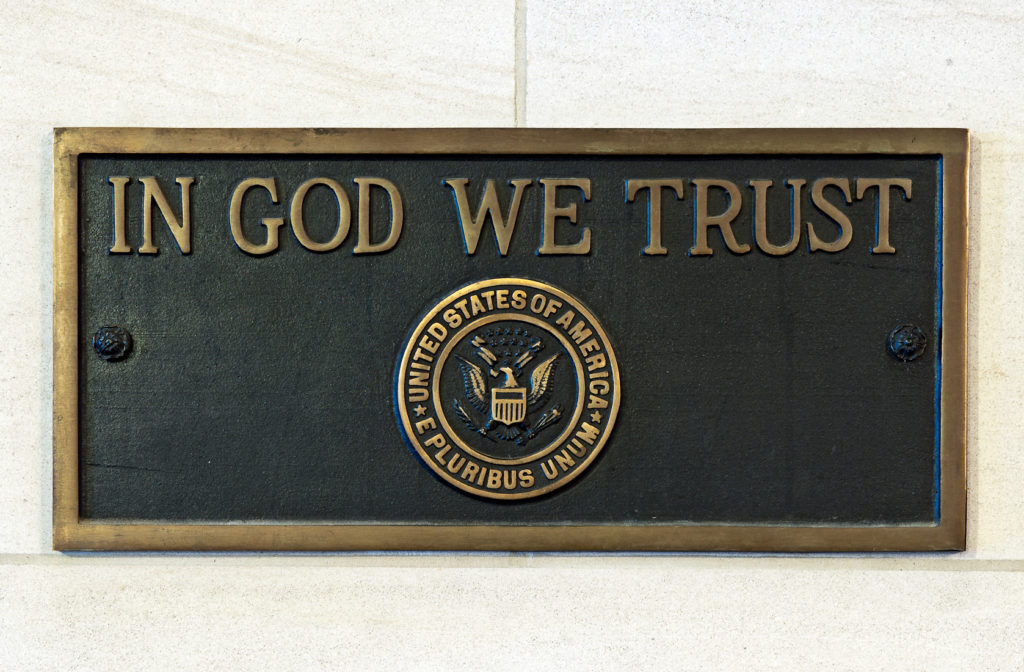
After lengthy debate, a bill passed through the state House on Tuesday that would allow “In God We Trust” to be displayed in public spaces across the state of Alabama. Hayden-Republican state Rep. David Standridge filed HB228: The National Motto “In God We Trust” Act ultimately passed 91-4. It would allow the national motto to be placed on government agencies and offices, in and on public buildings, including government office buildings, public school classrooms, and vehicles across the state. “In God We Trust” has been the official motto of the United States since 1956, but that didn’t stop legislators from discussing the bill and the origins of the phrase for over two hours. Where one state lawmaker, Indian Springs-Republican state Rep. Arnold Mooney, was accused of twisting history when he explained the phrase is from the national anthem, and added that Francis Scott Key once argued slaves on a captured ship should return to Africa. Black legislators said Mooney was wrong and didn’t know what he was talking about, as Key himself owned slaves and his third stanza is thought to celebrate the deaths of escaped slaves who actually fought with the British. It now moves to the Alabama Senate.
Move aside political correctness, state Rep. David Standridge files bill to allow ‘In God we trust’

“In God We Trust” has been the official motto of the United States since 1956, and a new bill proposed in the state Legislature would allow it to be displayed in public spaces across the state of Alabama. Hayden-Republican state Rep. David Standridge filed HB228: The National Motto “In God We Trust” Act on Tuesday. It would allow the national motto to be placed on government agencies and offices, in and on public buildings, including government office buildings, public school classrooms, and vehicles across the state. “Political Correctness has gone too far when our national motto becomes unwelcome in public settings,” Standridge said in a statement. “This bill makes it clear that schools, courthouses, law enforcement vehicles, public officials and government bodies may proudly display ‘In God We Trust.’” The proposed legislation will be considered by the House Committee on State Government in the coming weeks before being debated by the entire state House of Representatives.
Alabama legislative preview: May 3 — May 4, 2016
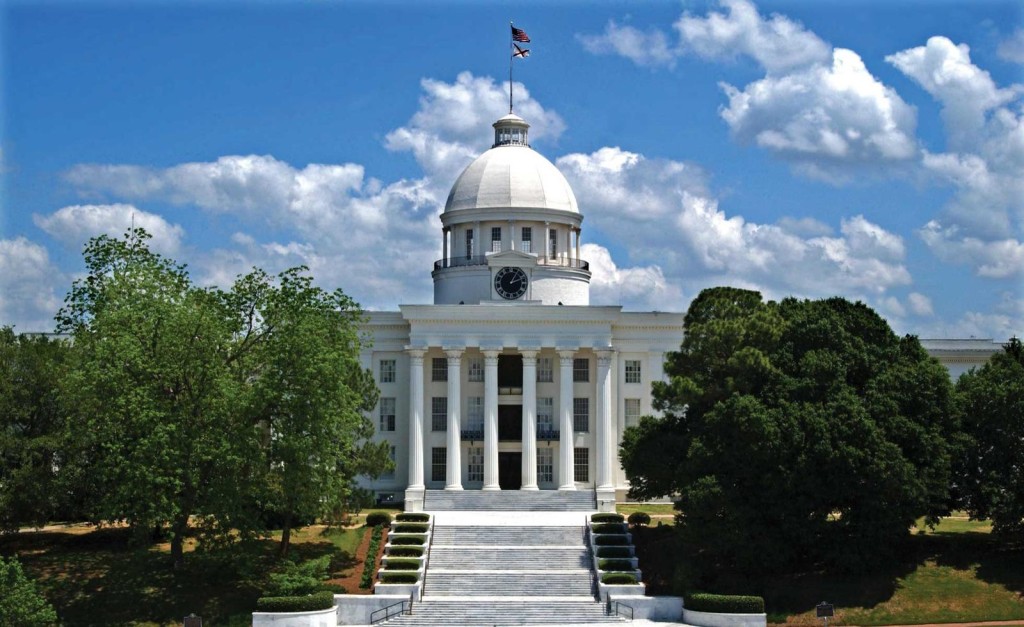
Two days. That’s all Alabama’s state lawmakers have to complete their legislative priorities for the year. Some bills will end up languishing in the annals of Alabama history, while others will get their day on the governor’s desk. The entire session has been covered in the grey cloud of scandal, between accusations of Gov. Robert Bentley‘s infidelity, and the impending ethics trial of Speaker Mike Hubbard, but legislators stayed on track … mostly. Some much-debated bills like the gas tax are dead for good this year, while others, like payday lending reform and industrial hemp legalization, are walking a blade-thin line to final passage. Here is what legislators have on their plate for the final two days of the 2016 Regular Session. Here is what legislators have on their plate for the final two days of the 2016 Regular Session. House — Convenes Tuesday at 1 p.m. SB372 creates a new provision in Alabama’s controversial “chemical endangerment of a child” law, allowing the consumption of controlled substances under the “good faith” supervision of a physician. The chemical endangerment law came under fire last fall after a searing investigation by AL.com and ProPublica. Sponsored by Sen. Clyde Chambliss (R-Montgomery) in the Senate and Rep. April Weaver (R-Alabaster) in the House. SB91 regulates Payday Lenders, restricting the interest rates and fees they may charge. The bill being considered in the House Tuesday is a watered-down version of one passed by the Senate in early April. Should it pass the House it would have to be reconsidered by the Senate in the waning hours of the Session on Wednesday. Sponsored by Sen. Arthur Orr (R-Decatur) in the Senate and Rep. Danny Garrett (R-Trussville) in the House. SB268 Currently, an inmate’s eligibility for Medicaid is terminated once they are incarcerated. SB268, already passed by the Senate, would change that termination to a suspension. The bill’s sponsors argue this will help reformed convicts land back on their feet when their sentences are complete. Sponsored by Sen. Cam Ward (R-Alabaster) in the Senate and Rep. Chris England (D-Tuscaloosa) in the House. SB347 which would give the Department of Agriculture and Industries the authority to study, regulate, and tax industrial hemp, and reclassify the plant as separate from marijuana. Similar bills have been passed previously in both the House and Senate, but because they weren’t identical they must be considered again. Sponsored by Sen. Paul Bussman (R-Cullman) in the Senate, and Rep. Ken Johnson (R-Moulton) in the House. Senate — Convenes Tuesday at 1 p.m. HB204 reorders the names appearing on primary ballots in presidential election years to present elected official positions first, and delegates to the national convention last. Currently, the delegates come directly after the presidential candidates themselves, an arrangement found to be confusing for many primary voters, as they had to sift through a litany of names they didn’t recognize to find the candidates for federal and state offices. Sponsored by Rep. Randy Wood (R-Saks) HB393 is the House version of the industrial hemp bill described above. HB433 prohibits a sexually exploited child from being “adjudicated, delinquent or convicted of a crime of prostitution.” Essentially, the bill protects children who are victims of sexual crimes or trafficking from being convicted of prostitution. The bill’s sponsor is a longtime advocate for harsher penalties for sex traffickers, and has fought to protect the victims of the deplorable practice. Sponsored by Rep. Jack Williams (R-Vestavia Hills) HB98 allows qualifying retirees from the U.S. Military to obtain concealed weapons permits from their county’s sheriff at no cost to them. The Sheriff may revoke the permit if cause is found. Sponsored by Rep. David Standridge (R-Hayden)
Alabama legislative preview: Mar. 14 – Mar. 18, 2016
The Legislative Session resumes Tuesday when the Alabama House of Representatives reconvenes at 1 p.m and the Senate an hour later. The Senate is slated to take up a slew of measures this week, including SB89 from Sen. Arthur Orr (R-Decatur) which would require all Alabama public school students to pass a civics test to graduate. SB148 from Sen. Jim McClendon (R-Springville), which would require all passengers in a vehicle to wear a safety belt, will also come up this week. The measure met with opposition when last it appeared on the floor, as lawmakers questioned the need for furthering meddling in people’s private matters. The “Fantasy Contests Act,” SB114 from Sen. Paul Sanford (R-Huntsville), will also come up for discussion this week, as well as SB14 from Sen. Gerald Allen (R-Tuscaloosa), which would authorize carrying weapons in vehicles without a permit. Over in the House, lawmakers will take up their version of the “Fantasy Contests Act,” as well as the lottery bill from Rep. Alan Harper (R-Northport). HB13 would allow people to vote on whether or not a lottery is allowed in the state, though it provides no details on how profits from such a lottery would be allocated. The body will also take up three bills from Rep. Mike Jones (R-Andalusia): HB332 which would abolish common law marriages; HB333, which would change laws related to judge’s ruling in divorce cases; and HB334, which would provide a process for grandparents to petition for visitation rights with their grandchildren. A slew of alcohol-related legislation is also scheduled to go before the House. The House was scheduled to take on the General Fund budget this week, but the activity calendar makes no mention of the legislation coming before the body. The Senate Committee on Agriculture, Conservation and Forestry is set to take up a bill that would legalize industrial hemp in the state on Wednesday and the Senate Judiciary Committee is slated to take up SB97 from Sen. Gerald Dial (R-Lineville), which would allow the Ten Commandments to be displayed on state and public school property. The Alabama Prison Transformation Initiative Act will once again appear before the Senate Committee on General Fund Finance and Taxation, where a vote is scheduled to take place. The House Committee on Public Safety and Homeland Security will take up HB98 from Rep. David Standridge (R-Hayden), which would provide a lifetime pistol permit to retired military veterans and the House Committee on Health will debate HB159 from Rep. Arnold Mooney (R-Birmingham), which would allow doctors to decline services that violates their conscience. The House Judiciary Committee will take up two marijuana-related bills: HB61, also known as “Leni’s Law,” from Rep. Mike Ball (R-Madison), which would decriminalize possession of the seizure-reducing medication cannabidiol, and HB257 from Rep. Patricia Todd (R-Birmingham), which would make possession of 1 ounce or less of marijuana punishable by only a fine.
Gov. Robert Bentley signs 2 bills
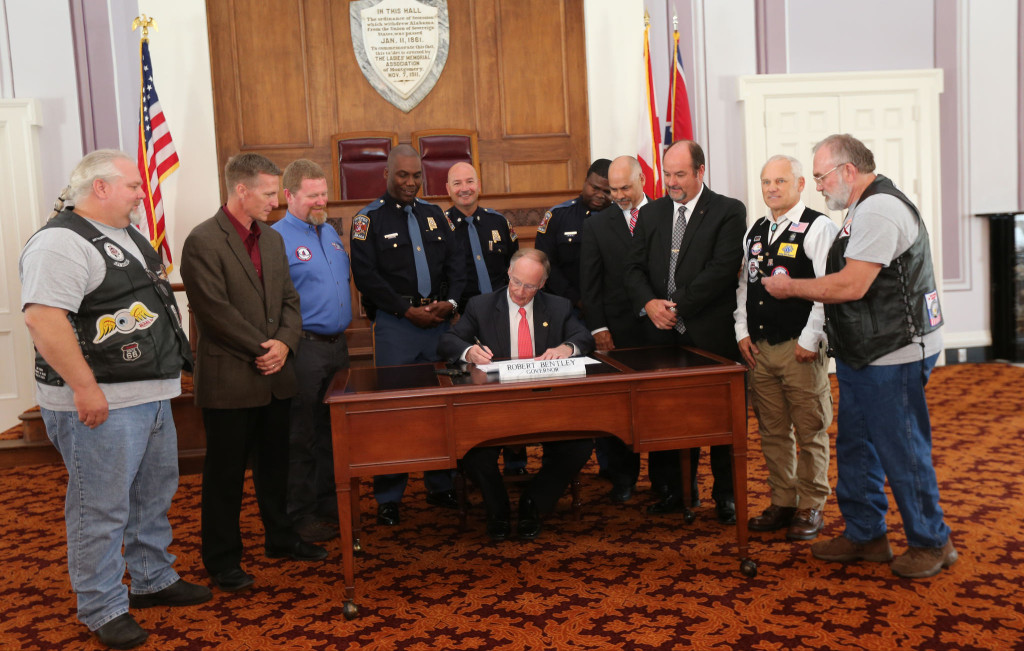
Gov. Robert Bentley gave his final approval to two bills Wednesday, signing House Bill 30 and House Bill 41 into law at a signing ceremony at the State House. Sponsored by State Rep. Allen Treadaway, a Republican of Morris, and State Sen. Paul Sanford, a Huntsville Republican, House Bill 30 allows firefighters and law enforcement peace officers to become eligible for compensation of state death benefits as a result of certain fatal occupational diseases. Also under HB 30, any application for the state death benefit submitted after April 29, 2010 that was denied because of the decedent being unemployed as a firefighter or law enforcement peace officer on the date of death, is eligible to be resubmitted within six months of HB 30 becoming law and the awarding authority is permitted to reconsider the application. “Alabama’s firefighters and law enforcement officers are among the best public servants in this nation, and House Bill 30 honors the men and women who make great sacrifices daily to protect our citizens,” Bentley said in a news release. “I appreciate the Alabama Legislature passing this bill so that family members of firefighters and law enforcement officers may be helped in the event that the service member may have died from an unforeseen occupational hazard.” Bentley also signed House Bill 41 which allows a voter who is physically disabled or over the age of 70 to move to the front of the line at a polling place if the voter requests. Sponsored by by Republican State Rep. David Standridge of Hayden, HB 41 will apply to general, primary and special elections. “Voting is a constitutional right for everyone, no matter their age, race, or religion,” Bentley said in a news release. “I am proud that Alabama now has a special provision for individuals who may need extra assistance or time casting their vote. House Bill 41 will provide elderly Alabamians and those physically disabled the opportunity to vote expeditiously and avoid waiting in long lines. It is critical for everyone to have their voices heard during the election process.”
