
Chaotic scene as Republicans disrupt impeachment deposition

Republicans briefly brought the Democrat-led impeachment investigation to a halt when around two dozen GOP House members stormed into a closed-door deposition with a Defense Department official. Democrats said the move compromised national security because some of the Republicans took electronic devices into a secure room. The protest by Republican lawmakers on Wednesday captured national attention, drawing the focus away from the testimony of a top U.S. diplomat who told lawmakers just a day earlier that he was told President Donald Trump was withholding military aid from Ukraine unless the country’s president pledged to investigate Democrats. The maneuver delayed a deposition with Laura Cooper, a senior Defense Department official who oversees Ukraine policy, until midafternoon. The interview began roughly five hours behind schedule, after a security check by Capitol officials, and ended after roughly four hours. As a series of diplomats have been interviewed in the impeachment probe, many Republicans have been silent on the president’s conduct. But they have been outspoken about their disdain for Democrats and the impeachment process, saying it is unfair to them even though they have been in the room questioning witnesses and hearing the testimony. “The members have just had it, and they want to be able to see and represent their constituents and find out what’s going on,” said Ohio Rep. Jim Jordan, the top Republican on the House Oversight and Reform panel. That committee is one of three leading the investigation, and its members are allowed into the closed-door hearings. Lawmakers described a chaotic scene. Rep. Debbie Wasserman Schultz, Democrat – Florida, said she had just walked into the room when the Republican lawmakers blew past Capitol police officers and Democratic staffers. The staff member who was checking identification at the entrance was “basically overcome” by the Republicans, she said. “Literally some of them were just screaming about the president and what we’re doing to him and that we have nothing and just all things that were supportive of the president,” Wasserman Schultz said. Later when the deposition began, Cooper answered questions from lawmakers and staffers in response to a subpoena, an official working on the impeachment inquiry said. She explained to lawmakers the process of distributing military aid and was asked whether the appropriate steps were followed on Ukraine, according to a person familiar with the interview. The official working on the impeachment inquiry and the person familiar with the interview spoke on the condition of anonymity to discuss the closed-door testimony. “The president’s allies in Congress are trying to make it even more difficult for these witnesses to cooperate,” said Adam Schiff, the chairman of the House intelligence committee. Democrats deny that Republicans are being treated unfairly, noting they have had equal time to question witnesses and full access to the meetings. Schiff says closed-door hearings are necessary to prevent witnesses from concealing the truth and has promised to release the transcripts when it will not affect the investigation. They also said the Republicans — several of whom do not sit on one of the three committees — compromised security at Wednesday’s closed-door deposition. The interviews are being held in what is called a Sensitive Compartmented Information Facility, or SCIF, which is a secure room where members can hear classified information. Several lawmakers leaving the facility said that some of the Republicans had their cellphones, even though electronics are not allowed. All members of Congress are familiar with the protocol of the SCIF, since they are often invited to classified briefings, and there are several such rooms around the Capitol. Several Republicans appeared to be tweeting from the secure room. North Carolina Rep. Mark Walker tweeted: “UPDATE: We are in the SCIF and every GOP Member is quietly listening.” Rep. Bennie Thompson, Democrat – Mississippi, who chairs the House Homeland Security Committee, alleged that Republicans “intentionally brought their electronic devices” into the secure area, violating congressional rules and the oath they take to gain access to classified information. The “unprecedented breach of security raises serious concerns” for committee chairs who maintain secure facilities in the Capitol, Thompson wrote in a letter to the House sergeant at arms asking for action to be taken against members of Congress involved in the breach.Sen. Lindsey Graham, Republican – South Carolina, criticized his Republican colleagues for the tactic, calling them “nuts” to make a “run on the SCIF.” “That’s not the way to do it,” he said. Graham later tweeted that he initially believed Republicans had taken the room by force and that it was actually a “peaceful protest,” adding his House GOP colleagues had “good reason to be upset.” The Republicans who took part in the protest were unbowed. Rep. Steve Scalise, the No. 2 House Republican, said Democrats are running a “Soviet-style process” that should “not be allowed in the United States of America.” “We’re not going to be bullied,” he said. The standoff came the day after William Taylor testified that he was told Trump withheld military aid to Ukraine until the country’s president went public with a promise to investigate Democrats. Trump wanted to put Ukraine’s leader “in a public box,” Taylor recalled. Democratic Rep. Ted Lieu of California said Republicans did not want to hear from Cooper because they were “freaked out” by that testimony. “They know more facts are going to be delivered that are absolutely damning to the president of the United States,” Lieu said. Associated Press writers Alan Fram, Robert Burns and Padmananda Rama contributed to this report. By Michael Balsamo and Mary Clare Jalonick Associated Press Republished with the permission of the Associated Press.
Supreme Court: Donald Trump can use pentagon funds for border wall

The Supreme Court cleared the way for the Trump administration to tap billions of dollars in Pentagon funds to build sections of a border wall with Mexico. The court’s five conservative justices gave the administration the green light on Friday to begin work on four contracts it has awarded using Defense Department money. Funding for the projects had been frozen by lower courts while a lawsuit over the money proceeded. The court’s four liberal justices wouldn’t have allowed construction to start. The justices’ decision to lift the freeze on the money allows President Donald Trump to make progress on a major 2016 campaign promise heading into his race for a second term. Trump tweeted after the announcement: “Wow! Big VICTORY on the Wall. The United States Supreme Court overturns lower court injunction, allows Southern Border Wall to proceed. Big WIN for Border Security and the Rule of Law!” The Supreme Court’s action reverses the decision of a trial court, which initially froze the funds in May, and an appeals court, which kept that freeze in place earlier this month. The freeze had prevented the government from tapping approximately $2.5 billion in Defense Department money to replace existing sections of barrier in Arizona, California and New Mexico with more robust fencing. The case the Supreme Court ruled in began after the 35-day partial government shutdown that started in December of last year. Trump ended the shutdown in February after Congress gave him approximately $1.4 billion in border wall funding. But the amount was far less than the $5.7 billion he was seeking, and Trump then declared a national emergency to take cash from other government accounts to use to construct sections of wall. The money Trump identified includes $3.6 billion from military construction funds, $2.5 billion in Defense Department money and $600 million from the Treasury Department’s asset forfeiture fund. The case before the Supreme Court involved just the $2.5 billion in Defense Department funds, which the administration says will be used to construct more than 100 miles (160 kilometers) of fencing. One project would replace 46 miles (74 kilometers) of barrier in New Mexico for $789 million. Another would replace 63 miles (101 kilometers) in Arizona for $646 million. The other two projects in California and Arizona are smaller. The other funds were not at issue in the case. The Treasury Department funds have so far survived legal challenges, and Customs and Border Protection has earmarked the money for work in Texas’ Rio Grande Valley but has not yet awarded contracts. Transfer of the $3.6 billion in military construction funds is awaiting approval from the defense secretary. The lawsuit at the Supreme Court was brought by the American Civil Liberties Union on behalf of the Sierra Club and Southern Border Communities Coalition. The justices who lifted the freeze on the money did not give a lengthy explanation for their decision. But they said among the reasons they were doing so was that the government had made a “sufficient showing at this stage” that those bringing the lawsuit don’t have a right to challenge the decision to use the money. Alexei Woltornist, a spokesman for the Justice Department, said in a statement, “We are pleased that the Supreme Court recognized that the lower courts should not have halted construction of walls on the southern border. We will continue to vigorously defend the Administration’s efforts to protect our Nation.” ACLU lawyer Dror Ladin said after the court’s announcement that the fight “is not over.” The case will continue, but the Supreme Court’s decision suggests an ultimate victory for the ACLU is unlikely. Even if the ACLU were to win, fencing will have already been built.House Speaker Nancy Pelosi, Democrat-California, issued a statement accusing Trump of trying to “undermine our military readiness and steal from our men and women in uniform to waste billions on a wasteful, ineffective wall that Congress on a bipartisan basis has repeatedly refused to fund.” She said the Supreme Court’s decision “undermines the Constitution and the law.” Senate Democratic Leader Chuck Schumer of New York called the decision “deeply regrettable and nonsensical.” Justices Ruth Bader Ginsburg, Sonia Sotomayor and Elena Kagan would not have allowed construction to begin. Justice Stephen Breyer said he would have allowed the government to finalize the contracts for the segments but not begin construction while the lawsuit proceeded. The administration had argued that if it wasn’t able to finalize the contracts by Sept. 30, then it would lose the ability to use the funds. The administration had asked for a decision quickly. The Supreme Court is on break for the summer but does act on certain pressing items. By Jessica Gresko Associated Press. Republished with permission of the Associated Press.
US submits extradition request for WikiLeaks founder Julian Assange

The United States government has formally submitted an extradition request to the United Kingdom for WikiLeaks founder Julian Assange, a Justice Department official said Tuesday. Assange faces an 18-count indictment that accuses him of soliciting and publishing classified information and of conspiring with former Army private Chelsea Manning to crack a Defense Department computer password. That indictment, which includes Espionage Act charges, was issued by the Justice Department last month and is pending in federal court in Alexandria, Virginia. The extradition request had been expected ever since U.S. authorities first announced a criminal case against Assange. Justice Department spokesman Marc Raimondi said it was submitted to the United Kingdom. The 47-year-old Assange was evicted on April 11 from the Ecuadorian Embassy in London, where he had been holed up since 2012 after Ecuador granted him political asylum. He was arrested by British police and is currently serving a 50-week sentence for jumping bail. Sweden also seeks him for questioning about an alleged rape, which Assange has denied. Assange was initially charged with a single computer crime violation on allegations that he worked with Manning to crack a government password. Some legal experts have said the additional Espionage Act charges might slow or complicate the extradition process to the extent the United Kingdom views them as political offenses and therefore exempt from extradition. Manning, who spent seven years in a military prison for delivering a trove of classified information to Assange before having her sentence commuted by then-President Barack Obama, has been jailed for civil contempt in Virginia after refusing to testify before a grand jury investigating WikiLeaks. By Eric Tucker Associated Press. Follow Eric Tucker on Twitter at https://www.twitter.com/etuckerAP Republished with the permission of the Associated Press.
Next-generation Navy ship to carry U.S. Rep. John Lewis’ name
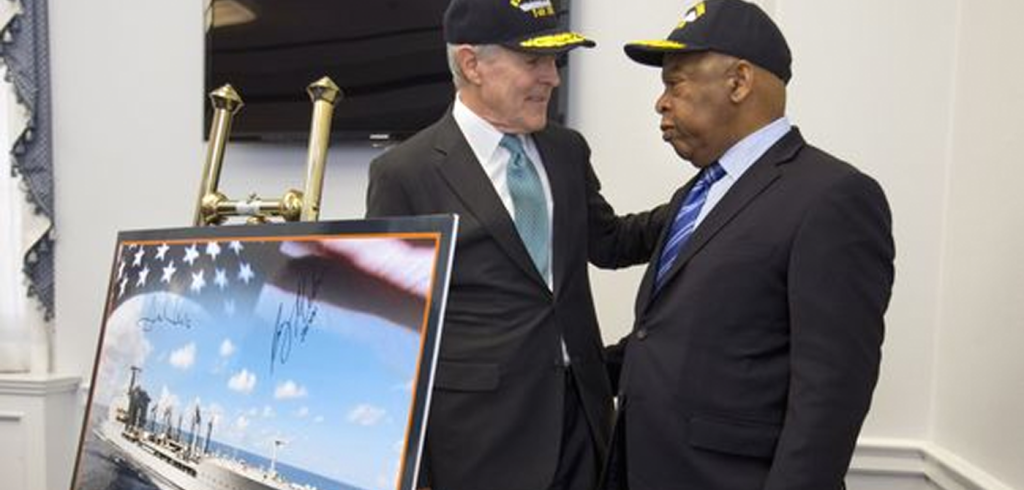
The Navy has announced it will name a new ship after civil rights leader and U.S. Rep. John Lewis. With Lewis in attendance, Secretary of the Navy Ray Mabus on Wednesday named the first ship of the next generation of fleet replenishment oilers the USNS John Lewis during a ceremony held at the Cannon House Office Building in Washington. Mabus says other ships in the class will be named after fellow civil right activists. Lewis, a Georgia Democratic congressman, is an Alabama native who worked closely with Martin Luther King Jr. He was the first speaker during the 50th anniversary of the Selma-to-Montgomery march last year. The Defense Department says a contract will be awarded for the ship this summer, with construction expected to begin in 2018. Republished with permission of the Associated Press.
