
Gary Palmer: What the Schumer Shutdown is really about

If you had to make a choice between funding our military and protecting the healthcare of America’s most vulnerable children or funding an unconstitutional program for people here illegally, which would you choose? Democrat senators were faced with that choice last night and they made the wrong choice. By opposing passage of a reasonable continuing resolution (CR) to extend funding for the United States government, the Democrats in the Senate led by Sen. Chuck Schumer further endangered the safety and security of the men and women who serve in the United States military forces. The Schumer Shutdown increases the potential for serious injury and death for the men and women who risk their lives in their training, in their operation of aircraft, ships and land equipment that are outdated and lacking adequate maintenance and for those serving in combat operations. The CR included six years of funding for the Children’s Health Insurance Program (CHIP), something Democrats traditionally support, that millions of low income Americans depend on for their children’s health care. Literally, the Schumer Shutdown has tied opposition to funding our military and CHIP to an attempt to force amnesty for the people, most of whom are now adults, who are in this country illegally. This is not only compromising our national security, it is compromising the health and safety of millions of American children and potentially causing resentment among American citizens against those who are here illegally as a result of the Obama Administration’s unconstitutional action called the Deferred Action for Childhood Arrivals (DACA). In general, I believe a majority of Republicans in the House and Senate are sympathetic to the plight of these young and older adults who were brought into the United States illegally as children. My colleagues and I want to provide a remedy that resolves the legal issue and helps them get right with the law and have an opportunity to earn the right to stay. As their vocal and disruptive demonstrations on Capitol Hill visibly show, they are not children anyone more, but adults who being used, not for their best interests, but as political pawns of the Democrat Party. By attaching their demand for full amnesty and citizenship in order to fully and adequately fund our military and CHIP, the Democrats in both the House and Senate have made hostages of our service men and women and children in low-income families. Literally, the Democrats are encouraging and supporting the disruptive demonstrations by illegal aliens at our nation’s Capitol while our soldiers and sailors go wanting for the support they desperately need and potentially leaving millions of children without health insurance in midst of the most dangerous flu epidemic in America. This is not only dangerous, it is shameful. If it was not already apparent, by now it should be to every American that by refusing to pass the CR, Sen. Schumer and the Democrats callously using the unconstitutional DACA program people in their quest for political power with a stunning reckless disregard for our military and the well-being of Americans families and their children. And whether the DACA demonstrators realize it or not, the Schumer Shutdown could make matters worse by diminishing their cause and their future acceptance among millions of otherwise sympathetic American people. Finally, as if it is not evident enough that what the Schumer Shutdown is really all about then consider this. The Democrats ensured that funding for our military, CHIP, and other government programs ended at the precise second that marked the first anniversary of Donald Trump taking office as President of the United States. There is a disturbing and obsessive inability of the Democrats in both the House and Senate to accept the will of the people who elected President Trump. It appears to me that the Schumer Shutdown is simply the latest attempt to bring down the Trump presidency and halt the amazing success President Trump has achieved in his first year. The Democrats have literally come to the point where they are not only compromising our military and the health and well-being of American children, they are compromising the cause of DACA recipients and their own legitimacy as well. ••• Gary Palmer represents Alabama’s 6th Congressional District in the U.S. Congress.
The key to a DACA deal: Stick to your principles

We’re at a crossroads in the United States of America when it comes to our immigration system. Many Americans’ feel like the system isn’t working to benefit them, but to benefit foreigners at the expense of people who are already American citizens. Many people who have spent their life working hard-labored jobs feel that the importation of immigrants from poor parts of the world have cost them their job or forced their wages to go down. The decline in wages and accessibility to these types of blue-collar jobs likely have more to do with the technological revolution and automation than with immigration, but that doesn’t mean people who feel this way don’t have a point. The reality is that America does bring in low-skilled immigrants and needs to transition to a more modern, merit-based immigration system. At the same time, immigrants from poor parts of the world are more likely to appreciate the American dream and have respect for values such as freedom of speech and free enterprise, which brings me to the Deferred Action for Childhood Arrivals (DACA) program. By all account the majority of the 800,000 recipients in the DACA program, are good people, and I don’t think anybody faults them for the law-breaking actions of their parents. These kids were brought here as minors and those who have been law-abiding, and sought out a job and an education deserve the opportunity to continue to be a part of the American dream. However, a pathway to citizenship cannot be provided for anybody who happens to be here illegally if we don’t secure our borders first. While the immigration debate can bring out the worst in some people, the need to secure our borders should be something that transcends ideology. The constitution demands that the United States government secure our border, which is something they have clearly failed to do over the past few decades. If a path to citizenship is provided for any group of undocumented immigrants, without the guarantee of first securing the border — that is simply poor public policy and an invite for people to bring their families across our border, with the guarantee that their kids get to stay. I believe that there is a dark side to today’s immigration debate. Folks on the far-right, whom will slur anybody prepared to go to the negotiating table as shills for “amnesty,” or “open borders,” even when those same people are demanding border security. Those on the far-left will ridicule Democrats who agree to border security as racist. Both Democrats and Republicans should understand that the loudest voices in the immigration debate don’t speak for the American people or the majority of either party’s voters. I urge all lawmakers on both sides: block out the noise and stick to your principles. Don’t be afraid to tick off some folks. Only then will real, comprehensive immigration reform be possible. ••• William Davis is a sophomore at the University of Alabama. There he is involved in various conservative groups and organizations.
Poll: Most don’t want young immigrants deported
Just 1 in 5 Americans want to deport young immigrants brought to the United States as children and now here illegally, the focus of a politically fraught debate between the White House and Congress. Americans also have largely negative opinions about President Trump’s signature immigration pledge to build a wall along the entire U.S.-Mexico border, according to a new poll by The Associated Press-NORC Center for Public Affairs Research. Just under half – 49 percent – oppose construction while 32 percent support it. On Sunday, Trump told lawmakers his hardline immigration priorities, including the wall, must be approved if he is to go along with protecting the young immigrants from deportation. About 800,000 young immigrants had been given a deportation reprieve under President Barack Obama‘s Deferred Action for Childhood Arrivals, also known as DACA, until Trump ended the program last month. He’s given Congress six months to act. About 60 percent of Americans favor allowing those young immigrants, commonly referred as “Dreamers,” to stay in the U.S. legally, compared to 22 percent who are opposed. Just 19 percent of respondents say all these childhood arrivals should be deported. Sixty-eight percent of Hispanics, 61 percent of blacks and 57 percent of whites favor extending protections. Eight in 10 Democrats favor allowing the young immigrants to stay legally. So do more than 4 in 10 Republicans. “For the ones who are already here, there should be a way for them to stay because it wasn’t their fault,” said Nik Catello, a 57-year-old independent film producer from Orange County, California. “But you have to give them a path to citizenship.” Showing sympathy for the young immigrants does not always translate into softer views on immigration. Catello, for example, favors the construction of a wall along the Mexican border. Among those who favor a border wall, 38 percent also favor allowing “Dreamers” to stay. “What you see is growing support within the voters overall in giving Dreamers a path to citizenship,” said Todd Schulte, president of FWD.us, an immigration advocacy group founded by Facebook CEO Mark Zuckerberg. “Giving Dreamers the ability to earn citizenship is the most popular bipartisan, not just immigration, issue, the single most united issue in the country.” When Trump ordered the phase-out of the DACA program last month, he gave 150,000 young immigrants the chance to quickly renew permits that are to expire before March 5. Officials say that more than 35,000 didn’t make his Oct. 5 deadline. And many others will see their status begin expiring after March 5, unless Congress acts before then. Trump suggested at the time that he was eager for a deal to settle the matter, telling reporters, “I have a love for these people and hopefully now Congress will be able to help them and do it properly.” He also tweeted that if Congress was unwilling to find a fix, he would “revisit this issue!” in six months. Trump had previously said he wanted a DACA deal to include significant money for border security and eventual funding for the wall. But the priorities released by the White House this week went far beyond that. The White House’s demands include limiting green cards to spouses and minor children of U.S. citizens and lawful permanent residents, hiring 10,000 more immigration enforcement officers and making it easier to deport unaccompanied children. The White House says the measures are to soften the impact on the U.S. caused by granting benefits to DACA recipients. Carolyn Kurtz, a 62-year-old retired engineer from Monument City, Colorado, who wants protections for young immigrants, said Trump hasn’t done “the research necessary” on immigration. “Do I believe that immigration should be more carefully monitored and maybe limited? Yes. But the way he wants to go about it is not the way to do it,” Kurtz said. She called the president’s stance “very close-minded.” Two-thirds of Americans – 64 percent – say they disapprove of Trump’s handling of immigration, and a similar percentage – 65 percent – say the same of his handling of foreign policy. Both of those are similar to Trump’s overall approval rating. The poll also revealed more Americans favor than oppose another aspect of Trump’s immigration policy – his latest travel ban. Forty-four percent favor it compared to 37 percent who say they are against the new rules. In September, the administration announced the most recent restrictions which affect citizens of Chad, Iran, Libya, North Korea, Somalia, Syria, and Yemen – and some Venezuelan government officials and their families. They are to go into effect Oct. 18. It was the administration’s third try at limiting travel after a broader ban sparked chaos in January and was challenged in courts across the country. The AP-NORC poll of 1,150 adults was conducted Sept. 28-Oct. 2 using a sample drawn from NORC’s probability-based AmeriSpeak panel, which is designed to be representative of the U.S. population. The margin of sampling error for all respondents is plus or minus 4.1 percentage points. Respondents were first selected randomly using address-based sampling methods, and later interviewed online or by phone. Republished with permission from the Associated Press.
Bradley Byrne: Ending illegal immigration must be a top priority

One of President Donald Trump’s most popular positions on the campaign trail last year was a commitment to securing our nation’s borders. Since taking office, this has been a shared top priority between President Trump and the House of Representatives. President Trump first demonstrated his commitment to restoring the rule of law and tackling illegal immigration when he appointed Jeff Sessions as his Attorney General. Jeff Sessions was the leader on immigration issues in the Senate, and he understands how allowing illegal immigration to go unchecked makes our country less safe and hurts the overall economy. Since taking office, President Trump and Attorney General Sessions have started to enforce our immigration laws again, deport criminal illegal immigrants, crack down on so-called “sanctuary cities,” and end the unconstitutional DACA program. These policies have resulted in illegal immigration across our southern borders being down over 70 percent since Trump took office. In the House, we are focused on doing our part to combat illegal immigration and ensure the Trump Administration has the resources they need to get the job done. Just a few weeks ago, the House passed a government funding bill that included $1.5 billion for border wall construction. This is the amount President Trump says he needs to start construction of a wall along our southern borders and make repairs to the current border wall. This funding bill is now headed to the Senate, where I fear it may get bogged down in their outdated procedures. Despite the problems in the Senate, I pledge to continue working with President Trump and his administration to ensure funding is provided to build the wall and boost our border security program. Keeping the American people safe and securing the border should not be a partisan issue. Earlier this year, we succeeded in getting a bill signed into law that represented the largest increase in border security funding in almost a decade. That funding bill allowed for the hiring of new border patrol agents and provided funding to purchase new, innovative border security technology. Cities who refuse to enforce federal immigration laws and do not cooperate with federal law enforcement, known as sanctuary cities, are a big issue. Knowing that, earlier this year I voted in favor of a bill to cut off federal funding sources for these sanctuary cities that refuse to enforce our nation’s laws. If a city refuses to enforce the laws of our country, then they should not receive a penny in federal funding. Another big issue stemming from out-of-control illegal immigration is criminal gangs, like MS-13. MS-13 is a brutal and violent criminal gang responsible for many murders across the United States. Recently, the House passed the Criminal Gang Member Removal Act. This commonsense legislation strengthens public safety by making it harder for members of criminal gangs to enter our country. Just as important, the bill makes being a part of a criminal gang a deportable offense. We must do everything in our power to keep gang members out of our country. I applauded the recent decision by President Trump to end President Barack Obama’s Deferred Action for Childhood Arrivals (DACA) program. This program, implemented through executive action, was an affront to the Constitution and our system of government. I am hopeful we can use this decision to pass important border security legislation while deciding how to best deal with those individuals who were brought to our country illegally as children. Ultimately, we must continue working to follow through on our shared priority of cracking down on illegal immigration. The safety, security, and well-being of the American people must always come first. • • • Bradley Byrne is a member of U.S. Congress representing Alabama’s 1st Congressional District.
Martha Roby: House takes steps to secure the southern border

Immigration was one of the most hotly debated issues during the last presidential election, so it’s no surprise that there continue to be significant developments on these policies. I wanted to provide an update and share some of the progress we’ve made in the House to change the course of our nation’s illegal immigration problem. As you probably know, the Trump Administration recently announced that it would end the Deferred Action for Childhood Arrivals (DACA) program. President Barack Obama established DACA in 2012 to allow undocumented immigrants who were brought to the United States as children to avoid deportation and obtain renewable work authorization. Since then as many as 800,000 individuals have been accepted into DACA. Whether you agree or disagree with the intention of the program, DACA was a blatantly unconstitutional abuse of executive power. Attorney General Jeff Sessions is right to phase out this program and allow Congress time to craft the appropriate policy in an orderly and constitutional manner. I believe our immigration policies should discourage illegal entry, not reward it. In addressing this problem, we must also recognize and sympathetic to the fact that these individuals were brought here as children and not of their own accord. This is just one of the many areas of immigration law that needs to be fixed, and I look forward to working with my Judiciary Committee colleagues to craft policies that restore the rule of law and promote America’s economic interests. When it comes to cracking down on illegal immigration, I believe most of us agree that we should start by targeting the dangerous criminals who put Americans at risk. That’s why I was proud to recently vote in favor of H.R. 3697, the Criminal Alien Gang Member Removal Act. This bill will amend the law to finally make a person’s history of involvement in a criminal gang grounds for inadmissibility into this country. This bill would also allow law enforcement agents to automatically detain and deport anyone found to be a criminal alien gang member. You might read this and wonder, “What gang violence?” The most notorious Latin American gang is known as MS-13. It began in the 1980s and has grown to an estimated 8,000 members in the United States. They have a violent history of organized crime in the areas of drug trafficking, kidnapping, human smuggling, sex trafficking, murder, assassinations, blackmail, and extortion. To paint a clear picture of just how violent MS-13 is, their motto is “Mata, Roba, Viola, Controla,” which translates to “Kill, Steal, Rape, Control.” If that isn’t enough to demonstrate the serious threat these individuals pose, MS-13 has been responsible for eight brutal murders in Northern Virginia alone just since last November. Our bill makes it crystal clear that criminal alien gang members are not welcome in this country, and if they should find themselves here, we are dedicated to getting them off the street. Also on the immigration front, the House took action to put a “down payment” on construction of a border wall. Our government-wide appropriations bill, the Make America Prosperous and Secure Appropriations Act, contains $1.6 billion for construction and security upgrades at the southern border. It is Congress’ responsibility to budget for national priorities, and securing the border is a top priority. We need bigger, stronger, and smarter barriers along our southern border, and that’s why our bill funds this down payment to begin construction. Immigration is a sensitive issue that many people on both sides of the argument have strong feelings about. There are no easy fixes, but I believe most Americans are ready for a sensible immigration system that promotes public safety, fairness, and economic growth. As a member of the Judiciary Committee, I will remain actively involved in this issue and I am optimistic we can continue to make real progress. ••• Martha Roby represents Alabama’s Second Congressional District. She lives in Montgomery, Alabama with her husband Riley and their two children.
Luther Strange remains untethered on DACA in constituent email, quickly clarifies position

In a Monday email response to a constituent, Sen. Luther Strange seemingly avoided taking a hard-lined position on Deferred Action for Childhood Arrivals, more commonly referred to as DACA, when asked about it by a constituent. Jack Kemp of Fosters, Ala. posted Strange’s email response on his Facebook page Tuesday, concerned that the Senator supports the Dream Act as he did not outright refute it in the email. In the constituent letter, Strange explained what both the Dream Act and DACA program were, saying he does not serve on the committee of jurisdiction over either issue, and thus avoided clearly defining his own position on the issues. “Currently, this bill is in the Senate Judiciary committee,” wrote Strange. “I do not serve on that committee, but if this bill comes to the Senate floor for debate and a vote, I will keep your views in mind.” When Alabama Today asked Strange for Senate campaign to clarify Strange’s position, they were quick to respond. “Luther Strange stands with Donald Trump and Jeff Sessions by believing the first thing our country needs to do is enforce our laws before any discussion on policy,” said campaign spokesperson Cameron Foster. “He is 100 percent opposed to amnesty for illegal immigrants. Unlike his opponent Roy Moore, Luther Strange stands with President Trump on building the wall on the Mexican border.” Foster’s response echoes Strange’s own words last week. Following news from former Alabama U.S. Senator and current U.S. Attorney General Jeff Sessions of the “orderly wind down” of President Barack Obama‘s DACA program, Strange appeared on Fox News’ Happening Now with Harris Faulkner Tuesday afternoon to discuss his first take on the situation and issued the following statement. “Since my tenure as Attorney General, I have been fighting, and winning, against Obama-era experiments with illegal amnesty. Today, the Trump administration rightly affirmed that Congress must lead the way in securing our borders and ending the crisis of illegal immigration,” said Strange. “We actually sued successfully to stop the Obama administration program to allow adults to stay here illegally (DAPA). I think this program is the same category – I think it’s unconstitutional… The President makes the best point – Congress should address this issue.”
Appeals court rules Donald Trump’s travel ban doesn’t include grandparents, other extended family

Grandparents, cousins and similarly close relations of people in the United States should not be prevented from coming to the country under President Donald Trump‘s travel ban, a federal appeals court has ruled in another legal defeat for the administration on the contentious issue. The decision Thursday from three judges on the 9th U.S. Circuit Court of Appeals upheld a ruling by a federal judge in Hawaii, who found the administration’s view of who should be allowed into the country under the ban is too strict. The unanimous ruling also said refugees accepted by a resettlement agency should not be banned. “Stated simply, the government does not offer a persuasive explanation for why a mother-in-law is clearly a bona fide relationship, in the Supreme Court’s prior reasoning, but a grandparent, grandchild, aunt, uncle, niece, nephew, or cousin is not,” the 9th Circuit said. The appeals panel wrote that under typical court rules, its ruling would not take effect for at least 52 days. But in this instance, the judges said, many refugees would be “gravely imperiled” by such a delay, so the decision will take effect in five days. “Refugees’ lives remain in vulnerable limbo during the pendency of the Supreme Court’s stay,” they wrote. “Refugees have only a narrow window of time to complete their travel, as certain security and medical checks expire and must then be reinitiated.” The Justice Department said it would appeal. “The Supreme Court has stepped in to correct these lower courts before, and we will now return to the Supreme Court to vindicate the executive branch’s duty to protect the nation,” the agency said in a statement. The U.S. Supreme Court said in June that President Donald Trump’s 90-day ban on visitors from Iran, Libya, Somalia, Sudan, Syria and Yemen can be enforced pending arguments scheduled for October, partially overturning lower-court rulings. But the justices said it should not apply to visitors who have a “bona fide relationship” with people or organizations in the U.S., such as close family ties or a job offer. That set the stage for much disagreement over what constitutes a bona fide relationship. The government interpreted such family relations to include immediate family members and in-laws, but not grandparents, cousins, aunts and uncles. The judge in Hawaii overruled that interpretation, expanding the definition of who can enter the country to the other categories of relatives. He also overruled the government’s assertion that refugees from those countries should be banned even if a resettlement agency in the U.S. had agreed to take them in. The administration argued that resettlement agencies have a relationship with the government, not with individual refugees. The appeals court rejected that, saying the Supreme Court was concerned with any harm the travel ban might impose on people or organizations in the U.S. Resettlement agencies have spent time and money securing rental housing, buying furniture and performing other tasks that would be in vain if the refugees were blocked, the 9th Circuit said. They also would lose out on government funding for the resettlement services. Lawyers for the government and the state of Hawaii, which challenged the travel ban, argued the case in Seattle last week. Deputy assistant attorney general Hashim Mooppan ran into tough questions as soon as he began arguing the government’s case, with Judge Ronald Gould asking him from “what universe” the administration took its position that grandparents don’t constitute a close family relationship. Mooppan conceded that people can have a profound connection to their grandparents and other extended relatives, but from a legal perspective, the administration had to draw the line somewhere to have a workable ban based largely on definitions used in other aspects of immigration law, he said. Hawaii is also one of 15 states that sued the Trump administration Wednesday over its plans to end the Deferred Action for Childhood Arrivals program that protects young immigrants from deportation. “Today’s decision by the 9th Circuit keeps families together. It gives vetted refugees a second chance,” state Attorney General Douglas Chin said in a statement. “The Trump administration keeps taking actions with no legal basis. We will keep fighting back.” Republished with permission from the Associated Press.
Paul Ryan aiming for mid- to low-20 percent corporate tax rate
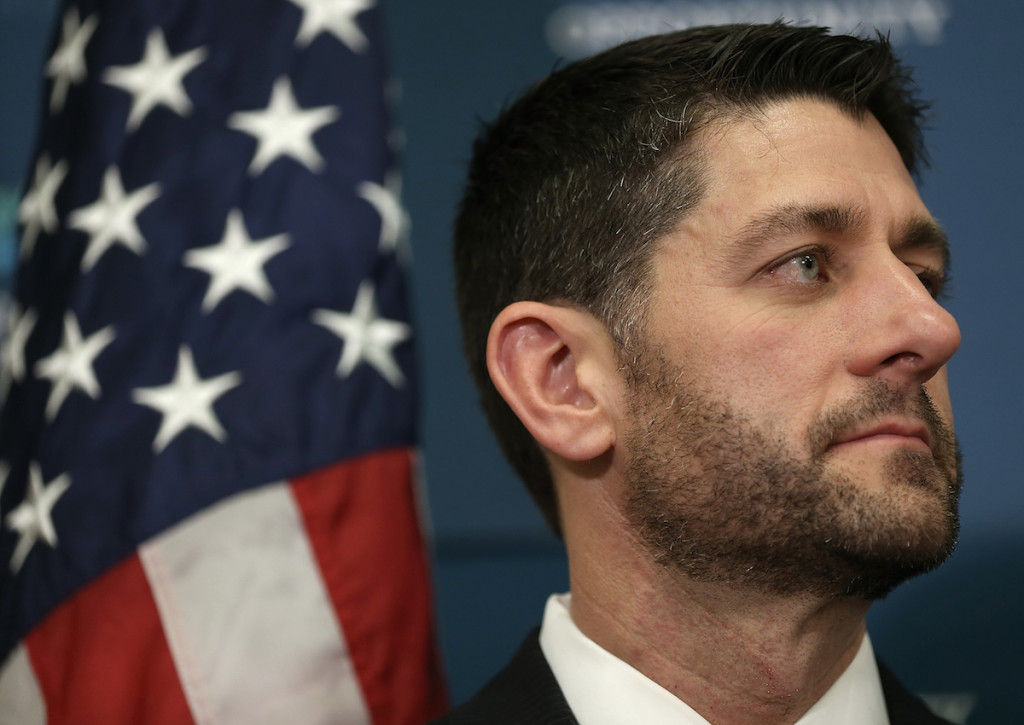
House Speaker Paul Ryan said Thursday the Republican tax plan will aim to reduce the corporate tax rate to mid- to low-20 percent – a smaller cut than what President Donald Trump wants. Ryan is providing some specifics as the GOP starts to write legislation overhauling the tax system, with help for the middle class a main goal. Trump, who made overhauling taxes a pillar of his push for economic growth, has called for a 15 percent tax rate for corporations. The rate now ranges from 15 percent to 35 percent. Some experts say a 15 percent rate isn’t possible without blowing a hole in the deficit. Ryan recognized that as he discussed a higher range during an appearance at a New York Times forum. “Numbers are hard to make that work,” he said. Ryan expects tax legislation to pass Congress this year. “This is our No. 1 priority this fall,” he said at a Capitol Hill news conference later Thursday. “It’s about growth. It’s about fairness. It’s about finally giving American families a tax break.” Revising the nation’s tax system for the first time in three decades is a GOP priority in the wake of the collapse of efforts to repeal and replace former President Barack Obama‘s health care law. But Hurricane Harvey and Trump’s decision to rescind a program protecting some 800,000 immigrants from deportation have saddled Congress with new challenges. When Trump blocked the program known as Deferred Action for Childhood Arrivals, created by Obama through administrative action in 2012, he gave Congress six months to act. To ensure money for hurricane relief, Trump overruled congressional Republicans and his own treasury secretary Wednesday to cut a deal with Democrats to keep the government operating and raise the U.S. debt limit. The already compressed timetable for coming up with an overhaul of the tax system came under further pressure with Congress’ additional and urgent workload. Treasury Secretary Steven Mnuchin said Thursday he thinks “it’s still very viable to get it done this year.” “We’ve made a lot of progress” in talks with GOP congressional leaders, Mnuchin said in an interview on Fox Business Network’s “Mornings with Maria.” ”Our objective is to get this done.” Asked whether he was worried about a revolt by Republicans in Congress if a tax overhaul isn’t achieved, Mnuchin said, “I’m not worried about any GOP revolt at all. You know we’ve been meeting with them on the tax plan. We have an understanding on this tax plan.” Republished with permission from the Associated Press.
Alabama politicians weigh-in on DACA decision by Trump administration
Former Alabama U.S. Senator and current U.S. Attorney General Jeff Sessions announced on Tuesday the “orderly wind down” of President Barack Obama‘s Deferred Action for Childhood Arrivals, or DACA, program, in six months. In which time, the government will stop processing new applications of the controversial program, which has permitted nearly 800,000 undocumented immigrants who were brought to the United States as children to receive work permits and deferral from deportation. According to Acting Homeland Security Secretary Elaine Duke, the six-month wind-down is meant to give Congress “time to deliver on appropriate legislative solutions.” “However, I want to be clear that no new initial requests or associated applications filed after today will be acted on,” Duke said in a written statement. Shortly after the announcement, members of the Alabama congressional delegation as well as state and local politicians began to weigh-in on the decision. Here’s what they had to say: Alabama 1st District U.S. Rep. Bradley Byrne: I agree with the decision from Attorney General Jeff Sessions and President Trump. The DACA program was unlawful and lacked any justifiable legal basis. It is the responsibility of Congress, not the President, to change our nation’s immigration laws. Alabama 2nd District U.S. Rep. Martha Roby: The Obama Administration’s DACA program illegally circumvented Congress and was one of many instances in which President Obama blatantly abused his executive authority. President Trump and Attorney General Sessions are right to phase out this program and allow Congress to craft the appropriate policy in an orderly and constitutional manner. Our immigration policies should discourage illegal entry – not reward it. In addressing this problem, we must also recognize and be sympathetic to the fact that these individuals were brought here as children and not of their own accord. This is just one of the many areas of immigration law that needs to be fixed, and I look forward to working with my Judiciary Committee colleagues to craft policies that restore the rule of law and promote America’s economic interests. Alabama 3rd District U.S. Rep. Mike Rogers: I applaud President Trump and Attorney General Sessions’ decision today to end the DACA program. Despite former President Obama’s reliance on executive orders to create unconstitutional immigrant amnesty programs, it is the Congress’ constitutional duty to write laws. Before considering any immigration reform, Congress should first pass legislation to fund the Border Wall. Only after securing the border, can Congress in good faith address immigration reform. Alabama 4th District U.S. Rep. Robert Aderholt: First, it is important to remember that DACA runs contrary to existing U.S. immigration law. It is the product of the Obama administration’s executive order where he, President Obama, disagreed with current law… I believe that before passing any legislation that deals with DACA, Congress must first address border control and stopping illegal crossings at will. For Congress to do nothing about securing the border would be a disservice to our nation. It would be foolish to deal with one problem, without first addressing the underlying cause, which is a lack of border security. Alabama Attorney General Steve Marshall: I am proud that U.S. Attorney General Jeff Sessions agreed with me that the DACA program is ‘an unconstitutional exercise of authority by the Executive Branch. Only Congress has the authority to make U.S. immigration law. The Trump Administration’s action is a victory for the Constitution and the rule of law and it restores Congress’s rightful role in overseeing U.S. immigration policy. Only the Legislative Branch of the Federal government can decide whether programs like DACA should become immigration law. That question is now back in the hands of Congress.
Harvey aid, debt on returning Congress’ daunting to-do list
Congress ends its five-week summer recess Tuesday as storm-ravaged states clamor for Harvey aid, the Trump administration demands a swift increase in the nation’s borrowing authority, and President Donald Trump‘s actions on immigration seem certain to upend the fall agenda. Lawmakers face a daunting workload and fast-approaching deadlines, including the need to fund the government and increase the United States’ $19.9 trillion debt ceiling by month’s end. A Republican-led Congress with no major legislative achievement in the first seven months of Trump’s presidency also is intent on overhauling the nation’s tax code, hoping for a political win after the failure of repealing and replacing Barack Obama‘s health care law. The immediate focus will be rushing a $7.9 billion disaster relief package to Harvey victims. Treasury Secretary Steve Mnuchin raised the stakes last weekend by calling on Congress to combine the aid with a contentious increase in the nation’s borrowing limit. Conservatives oppose raising the borrowing limit without getting something in exchange, such as deep cuts elsewhere in federal spending. “The president and I believe that it should be tied to the Harvey funding,” Mnuchin said Sunday. “If Congress appropriates the money, but I don’t have the ability to borrow more money and pay for it, we’re not going to be able to get that money to the state. So, we need to put politics aside.” The House and Senate are expected to vote quickly on the first $7.9 billion aid installment to help with immediate recovery and rebuilding needs in Houston and beyond. Additional billions will be tucked into a catchall spending bill later in the month that will keep the lights on in government past Sept. 30, when the current budget year ends. “Somebody who’s just been pulled off their roof doesn’t want to hear about our internecine squabbles and debates over procedure when they’ve lost their homes and are trying to figure out where they’re going to sleep the next night,” said Rep. Charlie Dent, R-Pa. Swift action on Harvey will give Congress and Trump the chance to look competent and remind voters that government can be a positive force. GOP lawmakers head into the final quarter of the year desperate to notch accomplishments and make headway on a sweeping tax overhaul, and the majority party is eager for the chance to turn around its dreary track record ahead of next year’s midterm elections. Trump may toss another tricky issue Congress’ way. The president was expected to announce that he will end protections for young immigrants who were brought into the country illegally as children, but with a six-month delay. The postponement in the formal dismantling of the Deferred Action for Childhood Arrivals, or DACA, program would be intended to give Congress time to address the issue. But it was unclear whether it could resolve the problem given that it has had several failures in attempts to enact comprehensive immigration reform. Some Republicans, led by House Speaker Paul Ryan, R-Wis., have urged Trump not to end the program and save nearly 800,000 from threat of deportation. Adding to the pile of work, a few important programs are expiring at the end of September and need to be renewed. They include children’s health insurance payments and a national federal flood insurance program that has bipartisan support but continually pays out more than it takes in through premiums. Republished with permission from the Associated Press.
U.S. to expand pool of people targeted for deportation

The Trump administration is greatly expanding the number of people living in the U.S. illegally who are considered a priority for deportation, including people arrested for traffic violations, according to agency documents released Tuesday. The documents represent a sweeping rewrite of the nation’s immigration enforcement priorities. The Homeland Security Department memos, signed by Secretary John Kelly, lay out that any immigrant living in the United States illegally who has been charged or convicted of any crime — and even those suspected of a crime — will now be an enforcement priority. That could include people arrested for shop lifting or minor traffic offenses. The memos eliminate far more narrow guidance issued under the Obama administration that resources strictly on immigrants who had been convicted of serious crimes, threats to national security and recent border crossers. Kelly’s memo also describes plans to enforce a long-standing but obscure provision of the U.S. Immigration and Nationality Act that allows the government to send some people caught illegally crossing the Mexican border back to Mexico, regardless of where they are from. One of the memos says that foreigners sent back to Mexico would wait for their U.S. deportation proceedings to be complete. This would be used for people who aren’t considered a threat to cross the border illegally again, the memo said. It’s unclear whether the United States has the authority to force Mexico to accept foreigners. That provision is almost certain to face opposition from civil libertarians and officials in Mexico. Historically, the government has been able to quickly repatriate Mexican nationals caught at the border but would detain and try to formally deport immigrants from other countries, routinely flying them to their home countries. In some cases, those deportations can take years as immigrants ask for asylum or otherwise fight their deportation in court. The memos do not change U.S. immigration laws, but take a far harder line toward enforcement. The pair of directives do not have any impact on President Barack Obama‘s program that has protected more than 750,000 young immigrants from deportation. The Deferred Action for Childhood Arrivals remains in place though immigrants in the program will be still be eligible for deportation if they commit a crime or otherwise are deemed to be a threat to public safety or national security, according to the department. Republished with permission of The Associated Press.
President Donald Trump says he’s torn over young immigrants

President Donald Trump spoke in unusually personal terms as he answered a question at a White House press conference about hundreds of thousands of young immigrants whose fate rests in his hands. “We’re going to show great heart. DACA is a very, very difficult subject for me, I will tell you. To me, it’s one of the most difficult subjects I have,” the president said Thursday in a rare admission of uncertainty. “Because you have these incredible kids, in many cases,” he said. Trump was referring to his predecessor’s Deferred Action for Childhood Arrivals program, which allows young people who were brought into the country illegally as children to stay and obtain work permits. The program has protected about 750,000 immigrants since its inception in 2012. Trump had promised during his campaign to “immediately terminate” what he’d deemed “President Obama’s two illegal executive amnesties.” But he has yet to move forward on the issue, despite pressure from immigration hard-liners, including Rep. Steve King of Iowa. While he had previously suggested those covered by the program would be safe from immediate deportation, the president has yet to say whether they will be allowed to continue living and working in a country that is the only many have known. On Thursday, Trump suggested he still has work to do to convince reluctant congressional leaders to get on board. “I have to deal with a lot of politicians, don’t forget. And I have to convince them that what I’m saying is, is right,” he said. But the president suggested that he’s been mulling a solution that goes beyond simply overturning DACA, as he had pledged. “You know, I love these kids. I love kids. I have kids and grandkids. And I find it very, very hard doing what the law says exactly to do,” he said. “And you know the law is rough. I’m not talking about new laws. I’m talking the existing law is very rough. It’s very, very rough.” Immigration lawyers, activists and those protected by the program have been waiting anxiously for any signs of what Trump might do since he took office last month. The issue returned to the headlines this week after a Seattle-area man participating in the program was detained by immigration agents. The U.S. Justice Department said Daniel Ramirez Medina, 23, admitted to having gang ties. But one of Ramirez’ lawyers, Mark Rosembaum, has said the allegations are false. Trump’s comments came as immigrants across the country were staying home from work and school as part of “A Day Without Immigrants” national protest. Many businesses have closed in solidarity to demonstrate the importance of immigrants to the American economy. Republished with permission of The Associated Press.
