
Like a showman, Donald Trump suggests Demilitarized Zone for ‘big event’
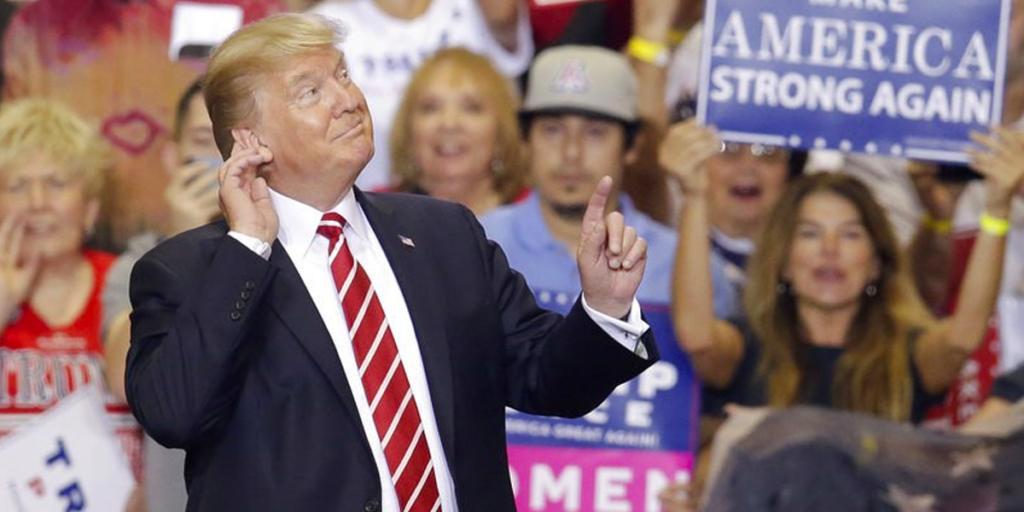
Like a consummate showman, President Donald Trump began rolling the drum Monday for his summit with North Korean leader Kim Jong Un, suggesting the “big event” take place in the Demilitarized Zone that divides the Koreas. That’s where Kim just met his South Korean counterpart. But Trump said that the Southeast Asian city state of Singapore was also in the running to host what few would have predicted when nuclear tensions were soaring last year — the first face-to-face meeting between the leaders of the United States and North Korea. While policy experts, and even his own national security adviser, voice skepticism that North Korea is sincere about giving up its nuclear efforts, Trump sounds like he’s gearing up for a date with history, and clearly wants the backdrop to be just right. First by Twitter, and then at a press conference in the White House Rose Garden, Trump said he likes the idea of going to the southern side of the demarcation line that separates the Koreas, where South Korean President Moon Jae-in met Kim on Friday. “There’s something that I like about it because you are there, you are actually there,” Trump said. “If things work out there’s a great celebration to be had on the site, not in a third-party country.” There’s been much speculation about where Trump and Kim might meet. Countries in Europe and Southeast Asia, in Mongolia and even a ship in international waters have all been suggested as possible venues. Monday was the first time that Trump had publicly named potential locations. His planned meeting with Kim will be the crucial follow-up to the summit between Kim and Moon on Friday where they pledged to seek a formal end this year to the Korean War — a conflict that was halted in 1953 by an armistice and not a peace treaty, leaving the two sides technically at war. They also committed to ridding the peninsula of nuclear weapons. Former reality television star Trump now has to help turn the Korean leaders’ bold but vague vision for peace into reality. Undaunted, he gave the impression Monday that governments were vying to host his face-to-face with Kim and share in the attention it would bring. “Everybody wants us. It has the chance to be a big event,” the president said on a bright spring day in Washington, alongside Nigerian President Muhammadu Buhari, whom he’d just met at the White House. “The United States has never been closer to potentially have something happen with respect to the Korean Peninsula that can get rid of the nuclear weapons, can create so many good things, so many positive things, and peace and security for the world.” It wasn’t clear whether his enthusiasm was stirred by the South Korean president’s suggestion Monday that Trump could take the Nobel Peace Prize if the two Koreas win peace. Moon’s remark came when he deflected a question about whether he might win the award as one of his predecessors, Kim Dae-jung, did in 2000 after the first ever inter-Korean summit. The United States has reached aid-for-disarmament deals with North Korea before, but they’ve ultimately failed. The most enduring effort negotiated by the Bill Clinton administration in 1994 halted the North’s production of plutonium for nearly a decade. But it collapsed over suspicions that North Korea had a secret program to enrich uranium, giving it an alternative route to make fissile material for bombs. Trump’s recently installed national security adviser, John Bolton, who has in the past advocated military action against North Korea, reacted coolly Sunday to its reported willingness to give up nuclear programs if the United States commits to a formal end to the war and a pledges not to attack. “We’ve heard this before,” Bolton told CBS’ “Face the Nation,” adding that the U.S. wanted to see concrete action “not just rhetoric.” This year, Kim has already suspended his nuclear and missile tests. According to South Korean officials, he told Moon that he’s going to shut down his country’s only known nuclear testing site and allow experts and journalists to observe. Trump cited that prospect with approval on Monday, saying Kim is “talking about no research, no launches of ballistic missiles, no nuclear testing.” But as usual, the president left open the possibility of pulling the plug on talks, saying: “If it’s not a success, I will respectfully leave.” Republished with the permission of the Associated Press.
Mike Pence warns NKorea ‘era of strategic patience is over’
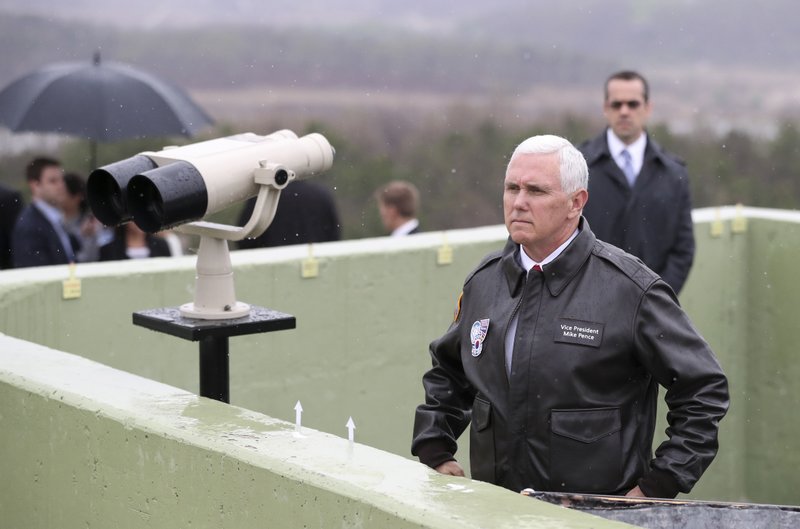
In a trip full of Cold War symbolism, U.S. Vice President Mike Pence traveled to the tense zone dividing North and South Korea and warned Pyongyang that after years of testing the U.S. and South Korea with its nuclear ambitions, “the era of strategic patience is over.” The unannounced visit Monday at the start of his 10-day trip to Asia was a U.S. show of force that allowed the vice president to gaze at North Korean soldiers from afar and stare directly across a border marked by razor wire. As the brown bomber jacket-clad vice president was briefed near the military demarcation line, two North Korean soldiers watched from a short distance away, one taking multiple photographs of the American visitor. Pence told reporters near the Demilitarized Zone that President Donald Trump was hopeful China would use its “extraordinary levers” to pressure the North to abandon its weapons program, a day after the North’s failed missile test launch. But Pence expressed impatience with the unwillingness of the regime to move toward ridding itself of nuclear weapons and ballistic missiles. Pointing to the quarter-century since the United States first confronted North Korea over its attempts to build nuclear weapons, the vice president said a period of patience had followed. “But the era of strategic patience is over,” he declared. “President Trump has made it clear that the patience of the United States and our allies in this region has run out and we want to see change. We want to see North Korea abandon its reckless path of the development of nuclear weapons, and also its continual use and testing of ballistic missiles is unacceptable.” In Moscow, Russian Foreign Minister Sergey Lavrov, speaking to reporters Monday evening, said he hopes “there will be no unilateral actions like those we saw recently in Syria and that the U.S. will follow the line that President Trump repeatedly voiced during the election campaign.” Meanwhile, China made a plea for a return to negotiations. Foreign Ministry spokesman Lu Kang said tensions need to be eased on the Korean Peninsula to bring the escalating dispute there to a peaceful resolution. Lu said Beijing wants to resume the multi-party negotiations that ended in stalemate in 2009 and suggested that U.S. plans to deploy a missile defense system in South Korea were damaging its relations with China. Later Monday, Pence reiterated in a joint statement alongside South Korean Acting President Hwang Kyo-ahn that “all options are on the table” to deal with threat and said any use of nuclear weapons by Pyongyang would be met with “an overwhelming and effective response.” He said the American commitment to South Korea is “iron-clad and immutable.” Noting Trump’s recent military actions in Syria and Afghanistan, Pence said, “North Korea would do well not to test his resolve,” or the U.S. armed forces in the region. The vice president earlier visited a military installation near the DMZ, Camp Bonifas, for a briefing with military leaders at the joint U.S.-South Korean installation, which is just outside the 2.5-mile wide (4 kilometers) DMZ. Under rainfall, Pence later stood a few meters from the military demarcation line outside Freedom House, gazing at the North Korean soldiers across the border, and then peered at a deforested stretch of North Korea from a lookout post in the hillside. In Tokyo, Japanese Prime Minister Shinzo Abe, speaking to a parliamentary session Monday, said: “Needless to say, diplomatic effort is important to maintain peace. But dialogue for the sake of having dialogue is meaningless.” “We need to apply pressure on North Korea so they seriously respond to a dialogue” with the international community, he said, urging China and Russia to play more constructive roles on the issue. Pence’s visit came amid increasing tensions and heated rhetoric on the Korean Peninsula. While the North did not conduct a nuclear test, the specter of a potential test and an escalated U.S. response has trailed Pence as he undertakes his Asian tour. Trump wrote Sunday on Twitter that China was working with the United States on “the North Korea problem.” His national security adviser, H.R. McMaster, said the U.S. would rely on its allies as well as Chinese leadership to resolve the issues with North Korea. McMaster cited Trump’s recent decision to order missile strikes in Syria after a chemical attack blamed on the Assad government, as a sign that the president “is clearly comfortable making tough decisions.” But at the same time, McMaster said on “This Week” on ABC that “it’s time for us to undertake all actions we can, short of a military option, to try to resolve this peacefully.” The Trump administration is hoping that China will help rein in North Korea in exchange for other considerations. Last week, Trump said he would not declare China a currency manipulator, pulling back from a campaign promise, as he looked for help from Beijing, which is the North’s dominant trade partner. Republished with permission of The Associated Press.
