
Donald Trump, Kim Jong Un share smiles, dinner before nuke talks
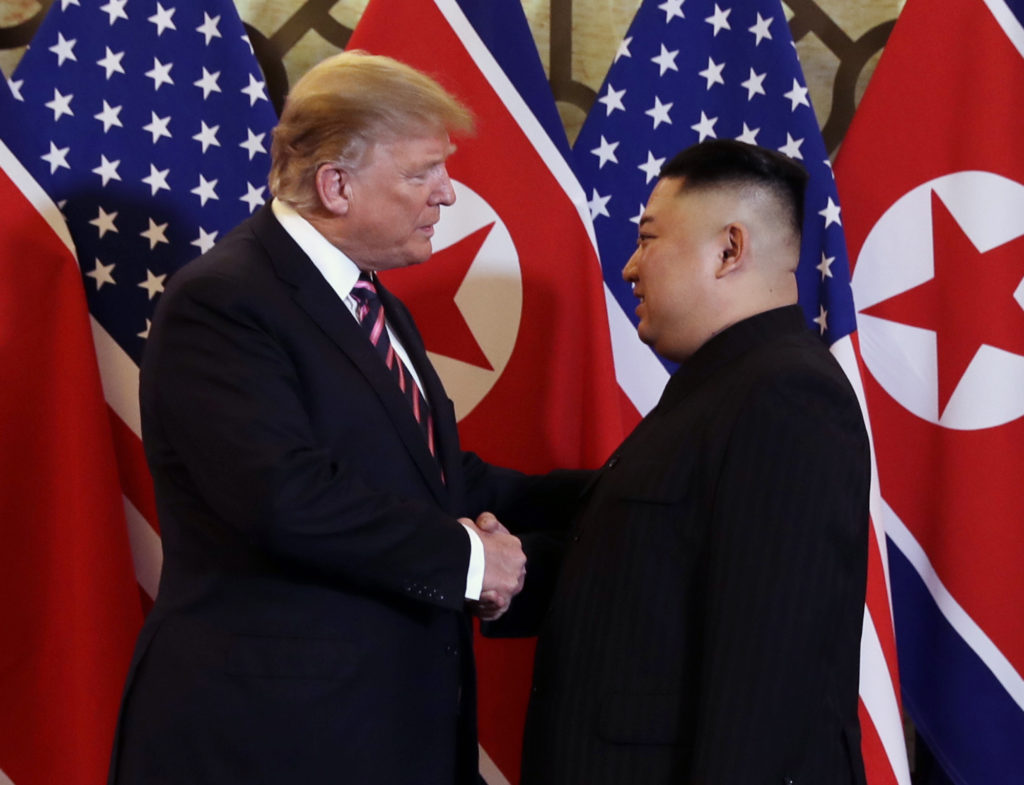
U.S. President Donald Trump and North Korean leader Kim Jong Un projected optimism Wednesday as they opened high-stakes talks about curbing Pyongyang’s pursuit of nuclear weapons, a problem that has bedeviled generations of leaders. The second summit between Trump and Kim came against the backdrop of the American president’s domestic troubles. As the leaders dined on steak and chocolate cake, Trump’s former personal attorney was readying explosive congressional testimony claiming the president is a “conman” who lied abut his business interests with Russia. The turmoil in Washington has escalated concerns that Trump, eager for an agreement, would give Kim too much and get too little in return. The leaders’ first meeting in June was heavy with historic pageantry but light on any enforceable agreements for North Korea to give up its nuclear arsenal. Still, both offered optimistic words before dinner. “A lot of things are going to be solved I hope,” Trump said as dinner began. “I think it will lead to a wonderful, really a wonderful situation long-term.” Kim said his country had long been “misunderstood” and viewed with “distrust.” “There have been efforts, whether out of hostility or not, to block the path that we intend to take,” he said. “But we have overcome all these and walked toward each other again and we’ve now reached Hanoi after 261 days” since their first meeting in Singapore. “We have met again here and I am confident that we can achieve great results that everyone welcomes,” he added. The leaders’ formal talks continue Thursday. Possible outcomes could include a peace declaration for the Korean War that the North could use to eventually push for the reduction of U.S. troops in South Korea, or sanctions relief that could allow Pyongyang to pursue lucrative economic projects with the South. Skeptics say such agreements would leave in place a significant portion of North Korea’s nuclear-tipped missiles while robbing the United States of its negotiating leverage going forward. Asked if this summit would yield a political declaration to end the Korean War, Trump told reporters: “We’ll see.” Trump’s schedule for Thursday promised a “joint agreement signing ceremony” after their meetings conclude. The two leaders were joined for dinner by Secretary of State Mike Pompeo, acting White House chief of staff Mick Mulvaney, Kim Yong Chol, a former military spy chief and Kim’s point man in negotiations, and North Korean Foreign Affairs Minister Ri Yong Ho. Interpreters for each side also attended. Trump did not answer a question from a reporter about his former attorney Michael Cohen‘s congressional testimony. Shortly after, White House press secretary Sarah Sanders excluded some U.S. reporters, including the reporter from The Associated Press who asked the president about Cohen, from covering Trump and Kim’s dinner. “Due to the sensitive nature of the meetings we have limited the pool for the dinner to a smaller group,” she said in a statement. Still, Trump was unable to ignore the drama playing out thousands of miles away, tweeting that Cohen “did bad things unrelated to Trump” and “is lying in order to reduce his prison time.” Cohen has been sentenced to three years in prison for lying to Congress. Sen. Lindsey Graham, R-S.C., a close White House ally, said the Cohen hearing was evidence that “Democrats’ hatred of Trump is undercutting an important foreign policy effort and is way out of line.” Anticipation for what could be accomplished at the summit ran high in Hanoi, and there were cheers and gasps as Trump’s motorcade barreled through this bustling city. Crowds three or four deep lined the streets and jockeyed to capture his procession with their mobile phones. The carnival-like atmosphere in the Vietnamese capital, with street artists painting likenesses of the leaders and vendors hawking T-shirts showing Kim waving and Trump giving a thumbs-up, contrasted with the serious items on their agenda: North Korea’s nuclear weapons program and peace on the Korean Peninsula. Trump has been trying to convince Kim that his nation could thrive economically like the host country, Vietnam, if he would end his nuclear weapons program. “I think that your country has tremendous economic potential — unbelievable, unlimited,” Trump said. “I think that you will have a tremendous future with your country — a great leader — and I look forward to watching it happen and helping it to happen.” The summit venue, the colonial and neoclassical Sofitel Legend Metropole in the old part of Hanoi, came with its own dose of history: Trump was trying to talk Kim into giving up his nuclear arsenal at a hotel with a bomb shelter that protected the likes of actress Jane Fonda and singer Joan Baez from American air raids during the Vietnam War. After their first summit, where Trump and Kim signed a joint statement agreeing to work toward a denuclearized Korean Peninsula, the president prematurely declared victory, tweeting that “There is no longer a Nuclear Threat from North Korea.” The facts did not support that claim. North Korea has spent decades, at great economic sacrifice, building its nuclear program, and there are doubts that it will give away that program without getting something substantial from the U.S. The Korean conflict ended in 1953 with an armistice, essentially a cease-fire signed by North Korea, China and the 17-nation, U.S.-led United Nations Command. A peace declaration would amount to a political statement, ostensibly teeing up talks for a formal peace treaty that would involve other nations. North and South Korea also want U.S. sanctions dialed back so they can resurrect two major symbols of rapprochement that provided $150 million a year to the impoverished North by some estimates: a jointly run factory park in the North Korean border city of Kaesong and South Korean tours to the North’s scenic Diamond Mountain resort. AP journalists Hau Dinh and Hyung-jin Kim in Hanoi and Kim Tong-hyung in Seoul, South Korea, contributed to this report. Republished with permission from the Associated Press.
Expectations low as Donald Trump looks for win in NKorea summit
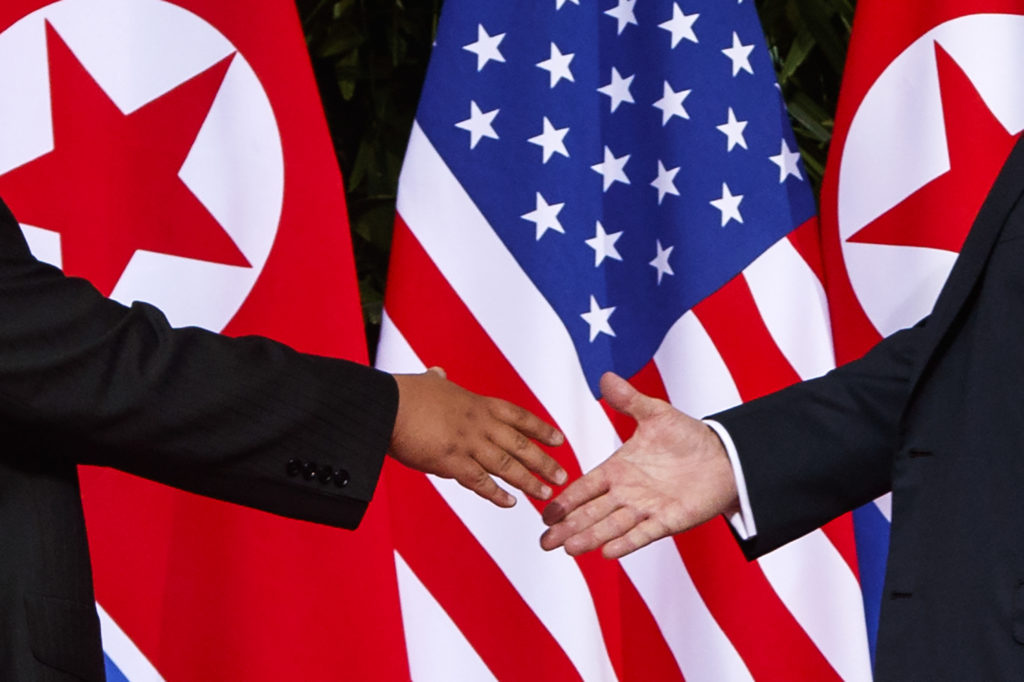
President Donald Trump will head into his second meeting with North Korea’s Kim Jong Un having reframed what would make a successful summit, lowering expectations for Pyongyang’s denuclearization while eager to declare a flashy victory to offset the political turmoil he faces at home. Trump was the driving force behind this week’s Vietnam summit, aiming to recreate the global spectacle of his first meeting with Kim, although that initial summit yielded few concrete results and the months that followed have produced little optimism about what will be achieved in the sequel. He once warned that North Korea’s arsenal posed such a threat to humanity that he may have no choice but to rain “fire and fury” on the rogue nation, yet on Sunday declared that he was in no hurry for Pyongyang to prove it was abandoning its weapons. “I’m not in a rush. I don’t want to rush anybody, I just don’t want testing. As long as there’s no testing, we’re happy,” Trump told a gathering of governors at the White House. Hours earlier, he ended a tweet about the summit by posing the key question that looms over their meeting in Vietnam: “Denuclearization?” He did not provide an answer. Though worries abound across world capitals about what Trump might be willing to give up in the name of a win, the president was ready to write himself into the history books before he and Kim even shake hands in Hanoi. “If I were not elected president, you would have been in a war with North Korea,” Trump said last week. “We now have a situation where the relationships are good — where there has been no nuclear testing, no missiles, no rockets.” Whatever the North Koreans have done so far, the survival of the Kim regime is always the primary concern. Kim inherited a nascent, incomplete nuclear program from his father, and after years of accelerated effort and fighting through crippling sanctions, he built an arsenal that demonstrates the potential capability to deliver a thermonuclear weapon to the mainland United States. That is the fundamental reason Washington now sits at the negotiating table. Kim, his world standing elevated after receiving an audience with a U.S. president, has yet to show a convincing sign that he is willing to deal away an arsenal that might provide a stronger guarantee of survival than whatever security assurance the United States could provide. The North Koreans have largely eschewed staff-level talks, pushing for discussions between Trump and Kim. Trump will arrive in Hanoi on Tuesday on Air Force One while his counterpart, lacking a modern aircraft fleet, travels via armored train. Though details of the summit remain closely held, the two leaders are expected to meet at some point one-on-one, joined only by translators. The easing of tension between the two nations, Trump and his allies believe, stems from the U.S. president’s own unorthodox and unpredictable style of diplomacy. Often prizing personal rapport over long-held strategic interests, Trump has pointed to his budding relationship with the young and reclusive leader, frequently showing visitors to the Oval Office his flattering letters from Kim. Trump, who has long declared that North Korea represented the gravest foreign threat of his presidency, told reporters recently that his efforts to defang Pyongyang had moved Japanese Prime Minister Shinzo Abe to nominate him for a Nobel Peace Prize, something Abe would not confirm or deny. And, always with an eye on his media coverage, Trump had delighted in the round-the-clock phenomenon created by the first Kim summit, held last June in Singapore. He urged reluctant aides as early as last fall to begin preparations for a second meeting. The images of the first face-to-face meeting between a U.S. president and his North Korean counterpart resonated across the globe. Four main goals emerged: establishing new relations between the nations, building a new peace on the Korean Peninsula, completing denuclearization of the peninsula and recovering U.S. POW/MIA remains from the Korean War. While some remains have been returned to the United States, little has been achieved on the other points. Korean and American negotiators have not settled on either the parameters of denuclearization or the timetable for the removal of both Korean weapons and American sanctions. “The key lessons of Singapore are that President Trump sees tremendous value in the imagery of diplomacy and wants to be seen as a bold leader, even if the substance of the diplomacy is far behind the pageantry,” said Abraham Denmark, director of the Asia Program at the Woodrow Wilson International Center for Scholars. U.S. intelligence officials testified before Congress last month that it remains unlikely Kim would fully dismantle his arsenal. And many voices in the Trump administration, including national security adviser John Bolton, have expressed skepticism that North Korea would ever live up to a deal. Mark Chinoy, senior fellow at U.S.-China Institute at the University of Southern California, made clear that after generations of hostility, the convivial atmosphere of Singapore “can’t be discounted.” But Chinoy noted that Trump had agreed to North Korean’s “formulation of ‘denuclearization of the Korean peninsula,’ which Pyongyang has long made clear meant an end to the US security alliance with South Korea and an end to the US nuclear umbrella intended to defend South Korea and Japan.” After the last summit, Trump unilaterally suspended some military drills with South Korea, alarming some in Seoul and at the Pentagon. But he was insistent this week that he would not drawdown U.S. troops from South Korea. And American officials, even as they hint at a relaxed timetable for Pyongyang to account for its full arsenal, have continued to publicly insist they would not ease punishing sanctions on North Korea until denuclearization is complete. A year ago, North Korea suspended its nuclear and long-range missile tests and said it dismantled its nuclear testing ground but those measures were not perceived as meaningful reductions. Experts believe Kim, who is enjoying warmer relations with South Korea and the easing of
Possible peace declaration looms large over Donald Trump-Kim Jong Un summit
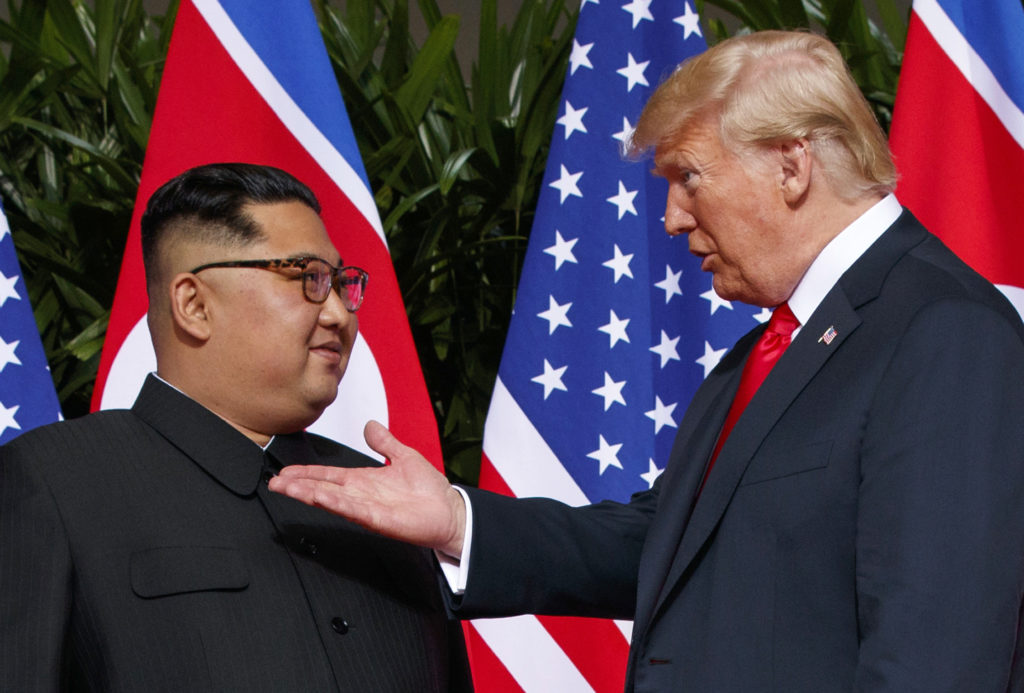
With their second summit fast approaching, speculation is growing that U.S. President Donald Trump may try to persuade North Korean leader Kim Jong Un to commit to denuclearization by giving him something he wants more than almost anything else: an announcement of peace and an end to the Korean War. Such an announcement could make history. It would be right in line with Trump’s opposition to “forever wars.” And, coming more than six decades after the fighting essentially ended, it just seems like common sense. But, if not done carefully, it could open up a whole new set of problems for Washington. Here’s why switching the focus of the ongoing talks between Pyongyang and Washington from denuclearization to peace would be a risky move — and why it might be exactly what Kim wants when the two leaders meet in Hanoi on Feb. 27-28. ___ THE STANDOFF The Korean Peninsula was divided at the 38th parallel after World War II, with the U.S. claiming a zone of influence in the south and the Soviet Union in the north. Within five years, the two Koreas were at war. Though the shooting stopped in 1953, the conflict ended with an armistice, essentially a cease-fire signed by North Korea, China and the 17-nation, U.S.-led United Nations Command that was supposed to be replaced by a formal peace treaty. But both sides instead settled ever deeper into Cold War hostilities marked by occasional outbreaks of violence. The conflict in Korea is technically America’s longest war. North Korea, which saw all of its major cities and most of its infrastructure destroyed by U.S. bombers during the war, blames what it sees as Washington’s unrelenting hostility over the past 70 years as ample justification for its nuclear weapons and long-range missiles. It claims they are purely for self-defense. The U.S., on the other hand, maintains a heavy military presence in South Korea to counter what it says is the North’s intention to invade and assimilate the South. It has also implemented a long-standing policy of ostracizing the North and backing economic sanctions. Trump escalated the effort to squeeze the North with a “maximum pressure” strategy that remains in force. A combination of that strategy and the North’s repeated tests of missiles believed capable of delivering its nuclear weapons to the U.S. mainland are what brought the two countries to the negotiating table. ___ WHY KIM WANTS A TREATY Getting a formal peace treaty has been high on the wish list of every North Korean leader, starting with Kim Jong Un’s grandfather, Kim Il Sung. A peace treaty would bring international recognition, probably at least some easing of trade sanctions, and a likely reduction in the number of U.S. troops south of the Demilitarized Zone. If done right, it would be a huge boost to Kim’s reputation at home and abroad. And, of course, to the cause of peace on the Korean Peninsula at a time when Pyongyang says it is trying to shift scarce resources away from defense so that it can boost its standard of living and modernize its economy with a greater emphasis on science and technology. Washington has a lot to gain, too. Trump has said he would welcome a North Korea that is more focused on trade and economic growth. Stability on the peninsula is good for South Korea’s economy and probably for Japan’s as well. Though Trump hasn’t stressed human rights, eased tensions could create the space needed for the North to loosen its controls over political and individual freedoms. But it’s naive to expect North Korea to suddenly change its ways. According to a recent estimate, it has over the past year continued to expand its nuclear stockpile. And even as it has stepped up its diplomatic overtures to the outside world, Pyongyang has doubled down internally on demanding loyalty to its totalitarian system. ___ PEACE OR APPEASEMENT? After his first summit with Kim, in Singapore last June, Trump declared the nuclear threat was over. He isn’t saying that anymore. Trump made no mention of the word “denuclearization” during his State of the Union address. Instead, he called his effort a “historic push for peace on the Korean Peninsula” and stressed that Kim hasn’t conducted any recent nuclear or missile tests and has released Americans who had been jailed in the North and returned the remains of dozens of Americans killed in the war. Kim, meanwhile, has good reason to want to turn his summits with Trump into “peace talks.” The biggest win for the North would be to get a peace declaration while quietly abandoning denuclearization altogether, or by agreeing to production caps or other measures that would limit, but not eliminate, its nuclear arsenal. Simply having a summit without a clear commitment to denuclearization goes a long way toward establishing him as the leader of a de facto nuclear state. Unless Washington is willing to accept him as such, that will only make future talks all the more difficult. The U.S. has, however, continued to take a hard line in lower-level negotiations leading up to the summit. Stephen Biegun, Trump’s new point man on North Korea, stressed in a recent speech that as a prerequisite for peace, Washington wants a “complete understanding of the full extent of the North Korean weapons of mass destruction missile programs,” expert access and monitoring of key sites and, ultimately, “the removal and destruction of stockpiles of fissile material, weapons, missiles, launchers, and other weapons of mass destruction.” The question is whether Trump will similarly challenge Kim or choose an easier and splashier — but less substantive — declaration of peace. ___ TALK VS TREATY If he chose to do so, Trump could unilaterally announce the end of the Korean War. It would be great TV. But it wouldn’t necessarily mean all that much. Trump can’t by himself conclude an actual peace treaty. China, and possibly a representative of the U.N. Command, would have to be involved. South Korea would naturally want
Trump-Kim shake hands, commit to ‘complete denuclearization’
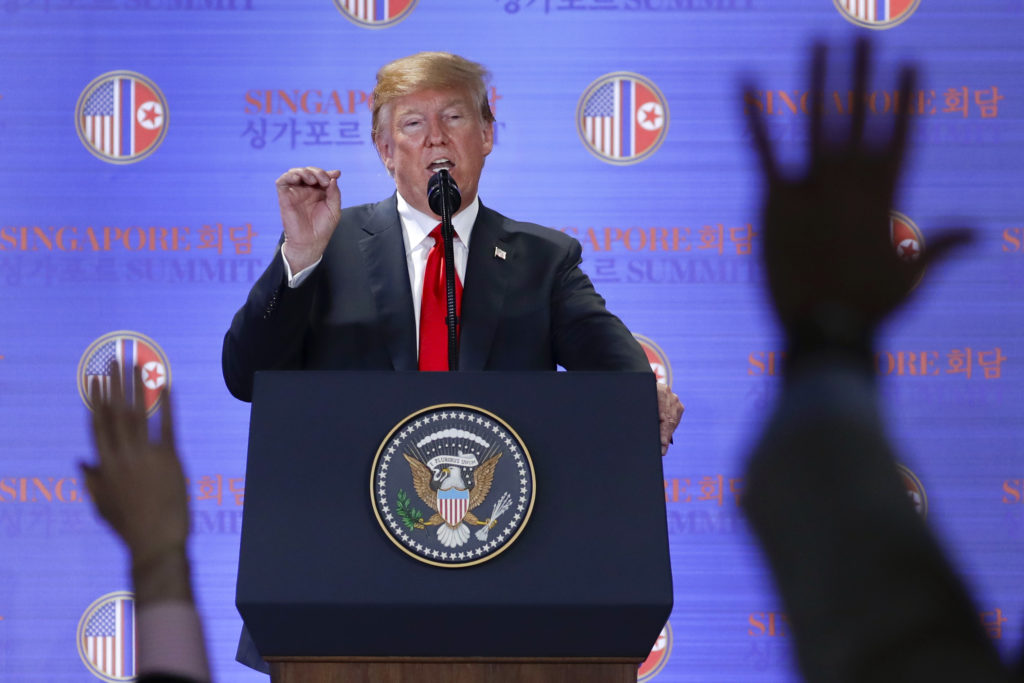
Clasping hands and forecasting future peace, President Donald Trump and Kim Jong Un committed Tuesday to “complete denuclearization” of the Korean Peninsula during the first meeting in history between a sitting U.S. president and a North Korean leader. Yet as Trump toasted the summit’s results, he faced mounting questions about whether he got too little and gave away too much — including an agreement to halt U.S. military exercises with treaty ally South Korea. Meeting with staged ceremony on a Singapore island, Trump and Kim came together for a summit that seemed unthinkable months ago when the two nations traded nuclear threats. The gathering of the two unpredictable leaders marked a striking gamble by the American president to grant Kim long-sought recognition on the world stage in hopes of ending the North’s nuclear program. Both leaders expressed optimism throughout roughly five hours of talks, with Trump thanking Kim afterward “for taking the first bold step toward a bright new future for his people.” Kim, for his part, said the leaders had “decided to leave the past behind” and promised: “The world will see a major change.” Soon, Kim was on a plane headed home, while a clearly ebullient Trump held forth for more than an hour before the press on what he styled as a historic achievement to avert the prospect of nuclear war. Along the way, Trump tossed out pronouncements on U.S. alliances, human rights, and the nature of the accord that he and Kim had signed. Light on specifics, the agreement largely amounted to an agreement to continue discussions, as it echoed previous public statements and past commitments. It did not, for instance, include an agreement to take steps toward ending the technical state of warfare between the U.S. and North Korea. Nor did it include a striking concession by Trump, who told reporters he would freeze U.S. military “war games” with ally South Korea while negotiations between the U.S. and the North continue. Trump cast the decision as a cost-saving measure, but also called the exercises “inappropriate” while talks continue. North Korea has long objected to the drills as a security threat. It was unclear whether South Korea was aware of Trump’s decision before he announced it publicly. U.S. Forces Korea said in a statement Tuesday it was unaware of any policy change. Trump phoned South Korean President Moon Jae-in after leaving Singapore to brief him on the discussions. Trump also said he’d obtained a separate concession from Kim to demolish a missile engine testing site, though it was just one site of many connected to the nuclear program. As Trump took a victory lap on the world stage, experts and allies struggled to account for what Trump and Kim had agreed to — and whether this agreement could actually be the first of its kind not to be broken by the North Koreans. The details of how and when the North would denuclearize appear yet to be determined, as are the nature of the unspecified “protections” Trump is pledging to Kim and his government. During his press conference, Trump acknowledged that denuclearization won’t happen overnight, but said, “once you start the process it means it’s pretty much over.” North Korea is believed to possess more than 50 nuclear warheads, with its atomic program spread across more than 100 sites constructed over decades to evade international inspections. Trump insisted that strong verification of denuclearization would be included in a final agreement, saying it was a detail his team would begin sorting out with the North Koreans next week. The agreement’s language on North Korea’s nuclear program was similar to what the leaders of North and South Korea came up with at their own summit in April. At the time, the Koreans faced criticism for essentially kicking the issue of North Korea’s nuclear arsenal down the road to the Singapore summit. Trump and Kim even directly referred back to the so-called Panmunjom Declaration, which contained a weak commitment to denuclearization and no specifics on how to achieve it. Between handshakes, a White House invitation, and even an impromptu tour of “The Beast,” the famed U.S. presidential limousine known for its high-tech fortifications, Trump sought to build a personal connection with Kim and said they have a “very good” relationship. The U.S. president brushed off questions about his public embrace of the autocrat whose people have been oppressed for decades. He added that Otto Warmbier, an American who died last year just days after his release from imprisonment in North Korea, “did not die in vain” because his death brought about the nuclear talks. In the run-up to Tuesday’s historic face-to-face with Kim, Trump has appeared unconcerned about the implications of feting an authoritarian leader accused by the U.S. of ordering the public assassination of his half brother with a nerve agent, executing his uncle by firing squad and presiding over a notorious gulag estimated to hold 80,000 to 120,000 political prisoners. In their joint statement, the two leaders promised to “build a lasting and stable peace regime” on the Korean Peninsula. Trump has dangled the prospect of economic investment in the North as a sweetener for giving up its nuclear weapons. The longtime property developer-turned-politician later mused about the potential value of condos on the country’s beachfront real estate. The formal document-signing, which also included an agreement to work to repatriate remains of prisoners of war and those missing in action from the Korean War, followed a series of meetings at a luxury Singapore resort. Ahead of the meeting Trump had predicted the two men might strike a nuclear deal or forge a formal end to the Korean War in the course of a single meeting or over several days. But in the hours before the summit, the White House unexpectedly announced Trump would depart Singapore earlier than expected — Tuesday evening — raising questions about whether his aspirations for an ambitious outcome had been scaled back. Aware that the eyes of the world were on a
US, South Korea work to keep North Korea summit on track
The United States and South Korea are laboring to keep the U.S. summit with North Korea on track even after President Donald Trump abruptly said “there’s a very substantial chance” it won’t go off as planned. “The fate and the future of the Korean Peninsula hinge” on the meeting, South Korea’s president told Trump in an Oval Office meeting Tuesday. The summit, scheduled for June 12 in Singapore, would offer a historic chance for peace. But there also is the risk of a diplomatic failure that would allow the North to revive and advance its nuclear weapons program. U.S. officials say preparations are still underway. “We’re driving on,” said Secretary of State Mike Pompeo, who was to testify before the House Foreign Affairs Committee on Wednesday. Trump’s newfound hesitation appeared to reflect recent setbacks in efforts to bring about reconciliation between the two Koreas, as well as concern whether the self-proclaimed deal-maker can deliver a nuclear accord with the North’s Kim Jong Un. Trump said Kim had not met unspecified “conditions” for the summit. But Trump also said he believed Kim was “serious” about negotiations, and South Korean leader Moon Jae-in expressed “every confidence” in Trump’s ability to hold the summit and bring about peace. “I have no doubt that you will be able to … accomplish a historic feat that no one had been able to achieve in the decades past,” Moon said. Trump said he didn’t want to “totally commit” himself on whether North Korea should denuclearize all at once or in phases. “It would certainly be better if it were all in one,” Trump said, before adding, “You do have some physical reasons that it may not be able to do exactly that.” Trump suggested the summit could be delayed rather than canceled: “It may not work out for June 12, but there is a good chance that we’ll have the meeting.” He did not detail the conditions he had laid out for Kim but said if they aren’t met, “we won’t have the meeting.” His spokeswoman, Sarah Huckabee Sanders, said Trump was referring to a commitment to seriously discuss denuclearization. Skepticism about the North’s intentions have mounted in recent weeks after Kim’s government pulled out of planned peace talks with the South last week, objecting to long-scheduled joint military exercises between U.S. and South Korean forces. The North also threatened to abandon the planned Trump-Kim meeting over U.S. insistence on rapidly denuclearizing the peninsula, issuing a harshly worded statement that the White House dismissed as a negotiating ploy. Trump expressed suspicion that the North’s recent aggressive barbs were influenced by Kim’s unannounced trip to China two weeks ago — his second in as many months. Trump said he’d noticed “a little change” in Kim’s attitude after the trip. “I don’t like that,” he said. The president said he hoped Chinese President Xi Jinping was actually committed to the goal of denuclearizing the Korean Peninsula, calling him a “world-class poker player.” Trump said he was displeased by China’s softening of border enforcement measures against North Korea. Trump encouraged Kim to focus on the opportunities offered by the meeting and to make a deal to abandon his nuclear program, pledging not only to guarantee Kim’s personal security but also predicting an economic revitalization for the North. “I will guarantee his safety, yes,” Trump said, noting that promise was conditioned on an agreement to complete, verifiable and irreversible denuclearization. Trump said if such an agreement is reached, China, Japan and South Korea would invest large sums to “make North Korea great.” Republished with permission from the Associated Press.
