
House votes to allow concealed handguns without permit

The Alabama House of Representatives on Tuesday approved legislation ending the requirement for a person to get a permit in order to carry a concealed handgun in public. Lawmakers voted 65-37 for the bill after Republicans in the chamber limited debate to two hours. The bill now moves to the Alabama Senate. Gun rights advocates have championed the proposal they call “constitutional carry,” arguing that people should not have to get a permit, which requires a background check and paying a fee, to carry a handgun they legally own. Many state sheriffs and other law enforcement officials have opposed the legislation, arguing the permits provide a crucial tool to combat crime and enhance public safety. “This bill does not change who can and cannot carry a gun. The people that are prohibited now will still be prohibited,” Republican Rep. Shane Stringer of Citronelle said of his bill. Stringer, a former law enforcement officer, disputed arguments that the permits enhance public safety. “The fact of the matter is, criminals don’t obey laws. This $20 piece of plastic, a permit, is not going to stop an evil person from committing a crime or doing wrong and it will not protect our law enforcement from getting hurt or killed.” Alabama currently requires people to get a concealed carry permit, which requires a background check, to carry a handgun under their clothes or in a purse or bag when they go in public. The bill would do away with the requirement, but people could still choose to get a permit if they wanted. It would also do away with the current requirement for people without concealed carry permits to keep handguns unloaded and secured when driving. Rep. Pebblin Warren, a Democrat who represents Tuskegee, said the change will encourage young people to “just go wild in the street with guns.” “We’re opening the door to really encourage violence,” Warren said. Warren, the wife of a former state sheriff, read a letter from Montgomery County Sheriff Derrick Cunningham, who now heads the Alabama Sheriffs Association, opposing passage of the bill. Republican Rep. Allen Farley, a retired assistant sheriff and the only Republican to vote against the bill in committee, said the permits are a tool “for us to catch those people who should not have a firearm.” Farley said the permit fees help fund small sheriffs’ offices and that the arrests for permit violations have led to seizures of drugs and the solving of crimes. “Why are we making the thin blue line in Alabama thinner?” Farley said. There are 21 states that allow concealed weapons in public without a permit, according to Stateline, an initiative of the Pew Charitable Trusts. Proponents of the bill said the Alabama Law Enforcement Agency is developing a database, authorized by a state law creating a lifetime concealed carry permit option, that officers will be able to use to flag people not legally entitled to carry a handgun. Stringer maintained that will be a better tool for law enforcement officers to remove guns from people who can not legally possess them. Lee County Sheriff Jay Jones last week said the intent of the database is good but said he did not think it could take the place of permits because there will be inevitable gaps in collecting data. Republished with the permission of the Associated Press.
Sheriff John Williams remembered as dedicated peace officer
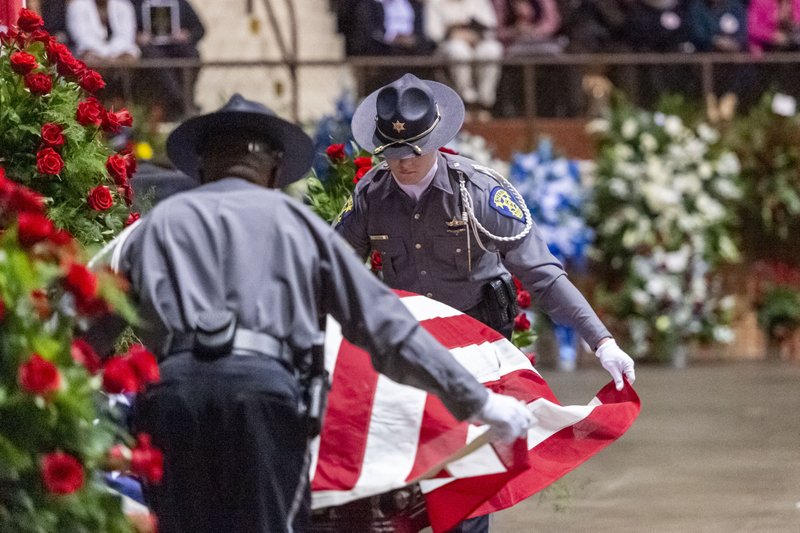
A slain Alabama sheriff was remembered Monday as a dedicated peace officer who loved serving the people of his county. More than 2,000 mourners filled an auditorium for funeral services for Lowndes County Sheriff John Williams. Williams was shot and killed Nov. 23 at a gas station in the county where he served as sheriff. William Chase Johnson, 18, is charged with murder in the sheriff’s death. Sometimes known as “Big John” for his towering frame, the 62-year-old sheriff was remembered as a selfless law enforcement officer who showed respect to everyone. “He didn’t care if you were rich or poor. He didn’t care if you were black, white, green, purple…. John was going to treat you like family. John was going to do everything in his power to help you,” said Russell County Sheriff Heath Taylor, who serves as head of the state sheriffs association. Taylor said Williams was example to follow, both as a man and a law enforcement officer. “When this call for assistance came in, he didn’t pass it to a deputy… he took it himself, just like he had done thousands of times,” Taylor said. Speakers at the services described Williams’ big laugh and bigger heart. They remembered him as a man who freely gave out his cellphone number to folks in his county so they could reach him if they needed, doted on his grandchild and patrolled his county in his truck with a distinctive air raid siren-sounding horn that always let people know he was coming. Williams was elected as sheriff in 2010 after decades working in law enforcement in his home county. Williams’ flag-draped coffin sat at the front of the coliseum that was selected for the funeral because of the expected large crowd. A black wreath was placed on the hood of a sheriff’s truck at the back of the coliseum. Montgomery County Sheriff Derrick Cunningham said his friend was a “true peace maker.” “He would give you the shirt off his back. He’s a true law enforcement officer,” Cunningham said. “He loved y’all. He loved Lowndes County and he loved being sheriff.” U.S. Sen. Doug Jones said Williams was keeping the peace in Lowndes County “until his last breath.” Republished with the Permission of the Associated Press.
Governor Kay Ivey: Sheriff John Williams shot, killed in line of duty
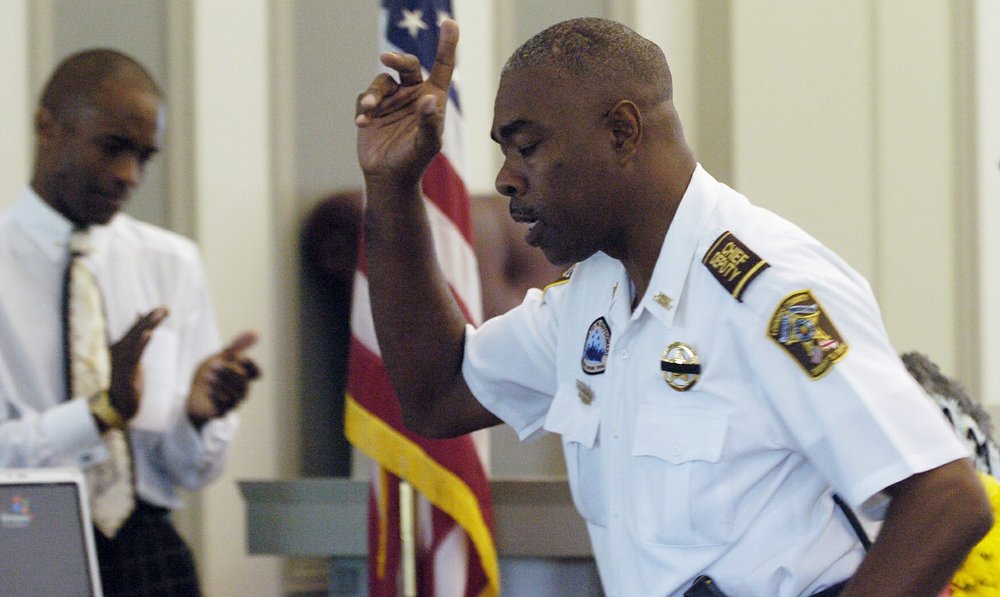
An Alabama sheriff was fatally shot Saturday evening in a community near the state’s capital, authorities announced, later saying they were seeking a man considered to be a “serious risk” who may be traveling on foot. Gov. Kay Ivey tweeted that Lowndes County Sheriff John Williams had been “tragically killed” in the line of duty and that she offered her prayers and sympathy to his family and the Lowndes County Sheriff’s Department. Montgomery County Sheriff Derrick Cunningham told news outlets that Williams was shot at a gas station in the community of Hayneville, about 20 miles (32 kilometers) southwest of Montgomery. Details remained sketchy as law enforcement agents converged on the community. Video from WSFA-TV showed a heavy law enforcement presence late Saturday outside a QV gas station. Alabama Law Enforcement Agency spokesman Cpl. Jess Thornton told reporters the State Bureau of Investigation was en route to the scene. Meanwhile, the state issued what it called an “emergency BLUE alert” that it was seeking an 18-year-old white man last seen at a QV gas station in the area at 8:15 p.m., the time of the reported shooting. The statement made no mention of the shooting or a possible connection to the man. The tall sheriff was known as “Big John.” Ivey paid tribute to him online, writing that in his years of service in the U.S. Marine Corps and “his many years working in law enforcement, he dedicated his life to keeping other people safe.” The sheriff was first elected in 2010, running as a Democrat. He was a Lowndes County native who started volunteering as a reserve deputy in 1978. He also worked for Hayneville police before joining the sheriff’s department full-time in 1987 and being appointed chief deputy in 1990. “Sheriff Williams always wanted to make a difference in his community and felt there was no better way to help his community than to protect and serve them in law enforcement,” the biography read. Lowndes County is predominantly black. It had a population of around 11,000 in the 2010 census. In 2007, more than 60 people gathered at the Lowndes County Courthouse to protest then-Gov. Bob Riley’s appointment of a white law enforcement officer to replace the county’s deceased sheriff. At the time, the county commission president said all five commissioners and other elected officials had recommended Williams, who is black, for the position. During his decades long career with the sheriff’s office, Williams notably in 2000 was the arresting officer of Jamil Abdullah Al-Amin, a 1960s black militant who was known as H. Rap Brown before converting to Islam. Al-Amin was wanted and later convicted in the fatal 2000 shooting of a Fulton County sheriff’s deputy in Atlanta. Republished with the permission of the Associated Press.
