
Alabama lawmakers pass one of two marijuana bills

On Wednesday, two Alabama bills to lower penalties for marijuana possession went before House and Senate Judiciary Committees. Birmingham-Democrat state Rep. Patricia Todd’s bill, HB272, which sought to change sentencing for possession of one ounce or less to a violation, and to add fines which would not appear on a person’s criminal record, even after repeat offense, failed to pass the House Judiciary Committee. “I’m sad, but it’s an election year. And a lot of people who voted no told me to my face that they were going to vote yes. And I think the roll-call vote scared a lot of people (who) don’t want to look like they’re soft on drugs. But most people sitting there have no concept or understanding of marijuana,” Todd told the Associated Press. The committee voted 7-5 against the bill, Moody-Republican state Rep. Jim Hill, the chairman of the House Judiciary Committee, believes the bill went too far in saying that possession would be only a violation even after repeat offenses. “I think we’re probably headed toward either some type of either decriminalization or lesser emphasis being placed on marijuana, but it’s illegal. And to say that no matter how many times you use it, how many times it’s personal use, it never rises to the level of a misdemeanor, I just think that’s a mistake,” Hill told AL.com. However, Montgomery-Republican state Sen. Dick Brewbaker’s bill, SB51, was approved by the Senate Judiciary Committee, his bill seeks to up the minimum amount of marijuana needed to be convicted of trafficking from 2.2 pounds to 10 pounds. “Nobody in here wants to hang felonies or drug conviction misdemeanors on a bunch of college kids,” Brewbaker told AL.com. “We’re arresting more people for marijuana than opioids.” Brewbaker’s bill passed on a 6-4 vote, it now moves to the Senate floor, but will also need to be passed by the House to become a law. Although the bill passed through the Senate committee, it already faces some opposition on the Senate floor. Rainbow City-Republican Sen. Phil Williams has gone on record saying he will filibuster the bill if, or when, it comes to the Senate floor.
Commissioner Ronda Walker announces run for Ala. Senate District 25
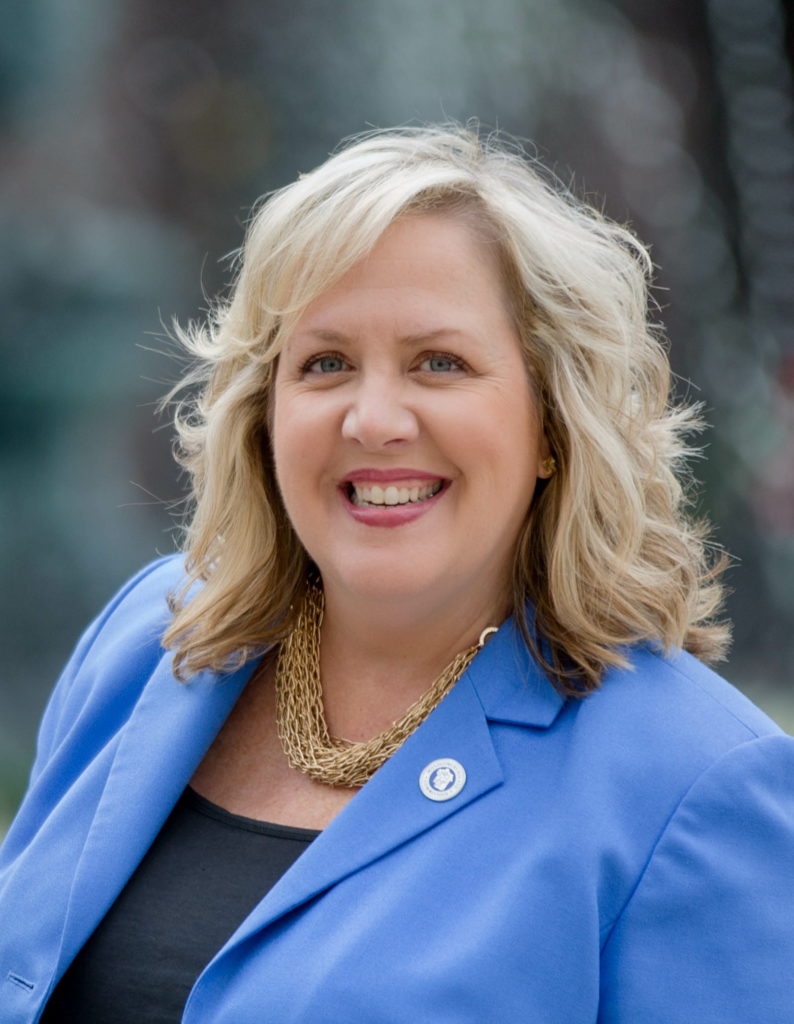
Vice Chairman of the Montgomery County Commission Ronda Walker announced her candidacy for Alabama State Senate District 25 on Tuesday. The district, which encompasses nearly 158,000 Alabamians in parts of Montgomery, Elmore, and Crenshaw counties, is currently represented by Pike Road-Republican Sen. Dick Brewbaker who has held the seat since 2010. Walker, also a Republican, says the state “is stuck in neutral because elected officials are more concerned about political expediency and keeping lobbyists happy than the good of the state.” “Voter trust has been shattered and confidence in state government is at an all-time low,” said Walker in her announcement. “The great state of Alabama is stuck in neutral because elected officials are more concerned about political expediency and keeping lobbyists happy than the good of the state. I am running for the Alabama Senate, because I believe Alabama can and must do better.” Walker grew up in Montgomery and graduated from Robert E. Lee High School in 1990. After high school, she attended Troy University earning a B.A. degree in History and Political Science. She later earned her Master’s degree from the University of Hawaii in Honolulu in 2002. While this may be her first state Legislature run, Walker’s no stranger to politics. Between receiving her B.S. and Masters degrees, Ronda spent several years in Washington, D.C. working on the legislative staff of Alabama’s senior senator, Richard Shelby. She went on to serve on the Congressional staff of Alabama 2nd District U.S. Rep. Martha Roby as a Field Representative. In that role, she traveled throughout the District meeting with Mayors, County Commissioners, business and community leaders assisting them with various projects and needs. In 2014, she was elected to the Montgomery County Commission helping to usher in expanded opportunities for businesses and residents as well as bringing jobs to the area; all while being a fiscally responsible steward of the money the commission oversees. Citing her achievements there, Walker said, “In 2016, Montgomery saw more job growth than any other area of the state. This happened because the City, County, and Chamber of Commerce leaders, myself included, worked very hard to create an environment that encouraged companies to locate and expand their businesses in our area. We all came together to do what was best for the River Region. I believe true leaders will reach across the aisle, build relationships, and make decisions that ensure the best outcome for all citizens.” Walker continued, “The people of District 25 deserve a leader who can look them in the eye and tell the truth. A person of integrity. A person committed to service above self. A person with a new and unique perspective, like that of a wife, mother of four, and cancer survivor. I’m a proven fighter – for my children, for my community, and against cancer, for my life. I know what it takes to overcome adversity and rise above your circumstances with confidence and persistence. That is why I’m running for State Senate.” Walker is also heavily involved in the community. She’s the President of the Troy University Alumni Chapter in Montgomery, and a member of several other community organizations including the Montgomery Rotary Club, Montgomery YMCA, Capital City Republican Women, and Alpha Gamma Delta Alumni Association. Ronda and her husband Jason have four children, Margaret (5), Eli (7), Grant (14), and Hugh (15).
Alabama lawmakers pre-file bills to limit judges’ ability to impose death-penalty

Alabama’s death-penalty law is the only one of its kind in the United States. There, a judge may sentence someone to death against a jury’s recommendation. Elsewhere in the country, every other state with the death-penalty — all 30 of them — require unanimity from a jury in the phases of sentencing. But in Alabama, a judge can overrule jurors’ findings regardless of the decision and impose his the death-penalty on his own accord. And it’s more than conjecture — of the 57 executions since the death-penalty was reinstated in 1983, 29 of them were the result of a judicial override. Two Alabama lawmakers are hoping to change that in 2017. Montgomery-Republican state Sen. Dick Brewbaker and Tuscaloosa-Democrat state Rep. Chris England have both pre-filed bills in their respective chambers that call for an end to judicial override. “We know of at least three cases in Alabama where an innocent (later exonerated) person was convicted of capital murder and the judge overrode the jury’s recommendations for life,” said Patrick Mulvaney of the Southern Center for Human Rights in an article published in the The Yale Law Journal. “We think that override is really a problem.” Brewbaker and England, are hoping SB16 and HB32 are the answers. 184 people who currently on death row in Alabama are likely hoping they are as well.
Ala. State Sens. Dick Brewbaker, Paul Bussman resign from Republican Caucus
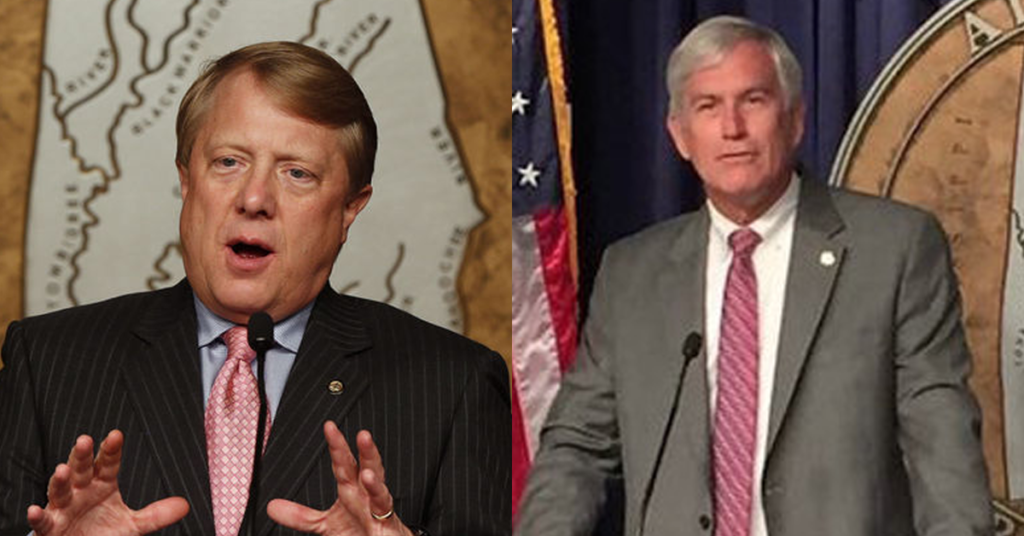
Montgomery State Sen. Dick Brewbaker has resigned from the Alabama Senate Republican Caucus. The two-term Republican, who announced in November he does not plan to seek re-election in 2018, resigned Friday to protest the way various lottery proposals have been handled in the current special session of the Alabama Legislature. Monday, Brewbaker said he assumes his resignation means he will lose his seat as chairman of the Senate Education and Youth Affairs Committee. Brewbaker was joined by Cullman State Sen. Paul Bussman. Both lawmakers have said they remain Republican, but have sent formal letters to Senate leadership withdrawing from the majority caucus. “In order for the Alabama Senate to operate fairly, we have set rules by which all members must abide,” Bussman said in a Facebook post Tuesday explaining his resignation. “This organized process is crucial to a fair and transparent government. It is when these rules are not followed that the breakdown of the system occurs. The process broke down last week when these rules were violated. These rules cannot be used when convenient and discarded when it is inconvenient.” Bussman continued, “I can no longer sit back and ignore the actions of the Alabama Senate Republican Caucus leadership which are misguided, unequally applied, punitive and divisive. As a result, the caucus has made a significant shift in priorities since 2010. In order for us to be successful in Alabama, we cannot return to the old ways of doing business. We are expected to do better and we must do better.” Despite the defections, the GOP will still hold the supermajority in the Alabama Senate with 24 members. There are only eight Democrats and one independent.
Bill banning speed cameras in police cars passes House committee
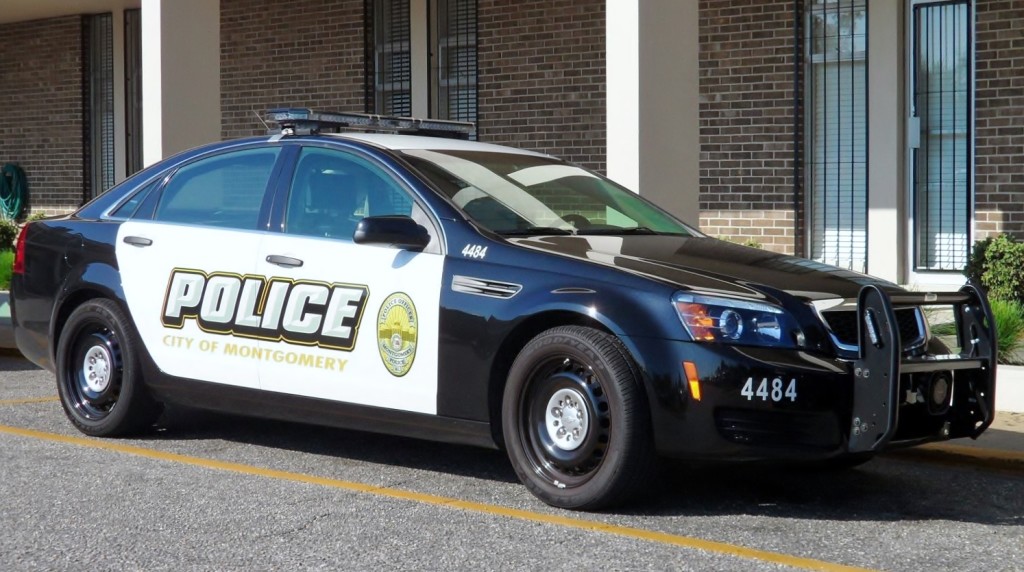
The House Committee on Montgomery County Legislation approved a bill Tuesday that would prohibit Montgomery police from using traffic cameras in unoccupied cars, a practice approved by the Alabama Legislature in 2011. SB201, sponsored by Sens. Dick Brewbaker (R-Montgomery) and Quinton Ross (D-Montgomery), comes out of public resentment for the police practice, which essentially establishes decoy cars throughout the city and issues tickets via mail. The 2011 bill specifies that the tickets should be mailed to residents within 30 days of the offense and include a picture of the offending vehicle and license plate, a description of the offense and the time, date and location of the violation. An amendment to the legislation was offered, which would have allowed the cars to be used in residential and school areas but prohibit them on four-lane roads, federal and state highways and in construction zones, but the committee tabled it. In a statement on Facebook, Montgomery Mayor Todd Strange said he was “disappointed” with the committee’s decision, saying that the cameras in residential and school areas are “a tremendous force multiplier that supplement manned enforcement by our traffic officers while allowing other police personnel to fight crime, protect and serve,” explaining “our neighborhoods, our schools and our children” would stand to lose the most. “We will continue to oppose this bill when it reaches the floor of the Alabama House and again ask the members of the Montgomery delegation to seek the opinion of the neighborhood associations and schools regarding the effectiveness of the speed car cameras in unmanned marked police cars,” Strange continued. “Speed cameras work.” The cameras generated just over $136,000 in annual revenue in 2015 — less than 6/10 of 1 percent of the city’s general fund — for a department whose budget is slated to surpass $230 million this year. The legislation, which simply states that the 2011 bill be completely repealed, has already passed the Senate and is now cleared to go before the House of Representatives.
Senate passes slew of bills with nearly empty chamber
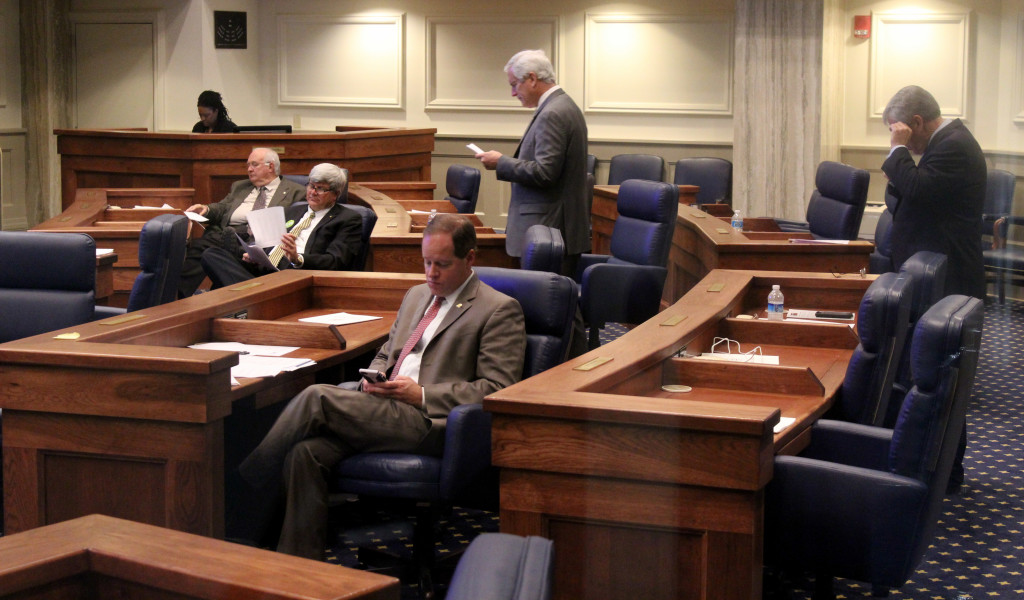
During Thursday’s legislative session, a variety of bills were passed on the Senate floor with at one point, only 13 lawmakers attending. The number of senators slowly dwindled throughout the session until a most were absent. Among the bills passed with a nearly empty chamber were SB95 from Sen. Dick Brewbaker (R-Montgomery), which allows foster children to visit friends without the permission of the foster agency; SB131 from Sen. Paul Sanford (R-Huntsville), which provides a tax break for the money people pay into their Health Savings Accounts; SB103 from Sen. Tom Whatley (R-Auburn), which would increase the cost of waterfowl stamps; and SB215 from Sen.Jimmy Holley (R-Elba), which allows for “automated civil enforcement” of school bus violations and at least five others. The only bill that faced real conversation was SB148 from Sen. Jim McClendon (R-Springville), which would require all passengers in a car to wear a seat belt. Currently, everyone under 15 years of age is required to buckle a safety belt in the back seat of a car. McClendon’s bill would require everyone to do so. Sen. Trip Pittman (R-Montrose) opposed the measure on the grounds that it is an overreach to require all car riders to fasten a safety belt, which McClendon asserts would save lives. Sen. Vivian Figures (D-Mobile), who noted her support for wearing seat belts, contested the requirement that drivers be charged with the folly of their passengers. The Senate carried McClendon’s bill over and adjourned shortly thereafter.
LGBT rights bill to get public hearing in state Senate

An Alabama Senate committee is planning to hear from the public on a bill to offer employment protections for the LGBT community. Senate Bill 482 would ban state officials from discriminating against employees based on sexuality and gender expression, in addition to of race, ethnicity, or religion. The bill does not apply to private sector employers. Sen. President Pro Tem Del Marsh, said that he sees the LGBT rights bill as an economic development issue after hearing concerns from businesses considering moving to Alabama. “We want to dispel any thoughts that we’re not a state that protects all people,” Marsh said. Dispelling that perception, according to Sen. Marsh, means that a proposal to give officiants the right to refuse to perform marriage ceremonies may not pass the Senate. “What I do not want to do is have a perception that Alabama is attacking any group,” Marsh told reporters after the committee meeting. “I don’t expect those other bills to come to the floor.” Marsh also said timing would be a factor in getting any measures on LGBT discrimination passed this session. Senate Bill 482 was introduced Tuesday and the Senate Governmental Affairs committee met Thursday to discuss the bill. Sen. Dick Brewbaker said the quick turnaround leaves little time for concerns from both sides to be properly considered. “People who want to have a say didn’t get notice,” he said. “We have to let people have their say.” He later added, “The committee can vote with 48 hours notice. There’s no need to wait until next Wednesday.” Brewbaker and others also expressed concern about the language in the bill, saying that the state could not offer protections to state employees, but not recognize protections for employees in the private sector. The narrow scope could mean that Senate Bill 482 is unconstitutional, according to Sen. Phil Williams. “You can’t separate classes,” said Brewbaker. “You can offer protections to state employees and not another.” Another bill in the House would apply to all employers. House Bill 615 sponsored by Rep. Chris England is in the House judiciary committee and has not been scheduled for a vote.
Local control plays big role in virtual schools bill’s success
Later this week, Gov. Robert Bentley is expected to sign Senate Bill 72 into law, making Alabama the 30th state with a comprehensive policy for full-time online education schools for high school students. Sen. Dick Brewbaker, who sponsored the legislation, has called the bill “groundbreaking,” highlighting its potential to expand choices for quality education for Alabama students. For some advocates, the agreement on virtual schools came as a surprise after an extended debate over school choice in the state. Duncan Kirkwood, Alabama state director for the Black Alliance for Educational Options, said keeping virtual schools as part of the public school system is one important reason for its popularity among legislators. A key feature of the bill is that students enrolled in the virtual school would be considered public school students, subject to the same testing and graduation requirements as their peers. However, local school boards are able to design or contract virtual school options that meet the needs of its students. The potential, Kirkwood said, is that students who excel in certain subjects will be able to attend college-level classes online and no longer be limited by what their local high school can provide. “This is transformational. In just a few years, we’ve gone Alabama being a place where your zip code determines the education you get to one where parents can choose the right options for their kids – without the burden of private school funding.” During Thursday’s House vote, Rep. Alan Baker applauded the bill’s reliance on local judgment and management of options for students. “I think that technology is rapidly changing how we deliver education. Students sometimes don’t ‘plug in’ to traditional education,” Baker said. “I love the local option so school boards can determine the best delivery method for their students.” If Bentley signs the virtual schools proposal, high school students statewide would be able to attend online classes as early as the 2016-2017 school year.
Senate bill would let the people enact laws by popular vote
Major questions like same-sex marriage, education standards, and voting requirements could be put before Alabama voters if lawmakers pass a bill now sitting in the Senate. Senate Bill 73 would amend the state constitution to establish a process for enacting general laws and constitutional amendments by voter initiative measure, rather than through legislation. Sponsored by Sen. Dick Brewbaker, the bill requires lawmakers to treat proposals with enough valid voter signatures like any other bill put before the legislature. If lawmakers reject the proposal, or fail to act on it by the end of the session, the question would be put before voters during the next election. Lawmakers could also write their own alternative proposal for popular vote on the same ballot. If SB 73 passes, Alabama would join 24 other states with an initiative or referendum process. While states often use ballot initiatives to decide on taxes, state spending, and administrative issues, voters in several states used a process similar to the one in SB 73 to decide major, controversial issues: (Examples courtesy of Ballotpedia, a nonpartisan project sponsored by the Lucy Burns Institute) Mississippi voters in 2004 decided that marriage could only take place and be valid only between a man and a woman. Michigan voters decided in favor of stem cell research during the 2008 election. That year, Michigan also used a ballot initiative to legalize medical marijuana; Massachusetts voters did the same two years later. In 2011, Ohio residents voted for exemption from national health care mandates. In 2012, Maine became one of the first states to approve same sex marriage through a popular vote, rather than a court decision or legislative act. With just 14 days left in the 2015 legislative session, Senate Bill 73 still awaits debate in the Senate Committee on Constitution, Ethics and Elections.
