
Regions bank CEO John Turner only AL based CEO of “Diversity and Inclusion” program with mandated unconscious bias training
Regions Bank, locally headquartered in Alabama, joins the increasing efforts of banks across the nation to incorporate greater diversity and inclusion measures within the workplace. Taleisha (Nikki) Ming-White, the organizational and leadership development administrator for Regions Bank’s Learning and Development team, has led many social justice efforts. In October of 2020, she joined a diversity and inclusion fellowship hosted by CEO Action for Diversity & Inclusion, or CEO Action. Established in 2017, CEO Action consists of 1,300-plus CEOs campaigning to advance diversity and inclusion in the workplace. Beginning in October 2020, the group launched a fellowship program, attracting individuals from a plethora of industries and fields to craft policy designed to combat racism and achieve greater levels of social justice. Based on Regions Bank’s newfound membership of the CEO Action coalition, the bank was selected to participate in the newfound fellowship program. Notably, Ming-White was also afforded the opportunity to represent Regions for a maximum of two years with the CEO Action for Racial Equity fellowship program. Within the past several years, Ming-White has made it a goal to incorporate diversity measures by creating diversity and inclusion training materials, collaborating with colleagues in Human Resources to incorporate diversity measures in the hiring process, and streamlining the bank’s diversity tracking and reporting system. She also currently serves as co-chair for the Junior League of Birmingham’s Diversity, Equity, and Inclusion Taskforce. John M. Turner, Jr., CEO of Regions Bank, additionally made a point to sign the CEO Action’s official CEO Pledge, which vows to increase the equity of all, namely Blacks, Latinos, Asians, Native Americans, LGBTQ, disabled, veterans, and women. The pledge, which 2,000 CEOs have already supported, commences in an apologetic claim that business leaders just aren’t doing enough. It then delves into 4 separate commitments, with one of them advocating for an expansion of re-education policies to guarantee free “unconscious bias education modules.” The pledge concludes by voicing the need for greater enforcement mechanisms for the group’s agenda as it states, “We also pledge to create accountability systems within our companies to track our own progress and to share regular updates with each other in order to catalog effective programs and measurement practices.” The CEO Action for Diversity & Inclusion’s website states, “Simply put, organizations with diverse teams perform better.”
Alabama Power honored for diversity efforts at Birmingham Equal Opportunity Dinner
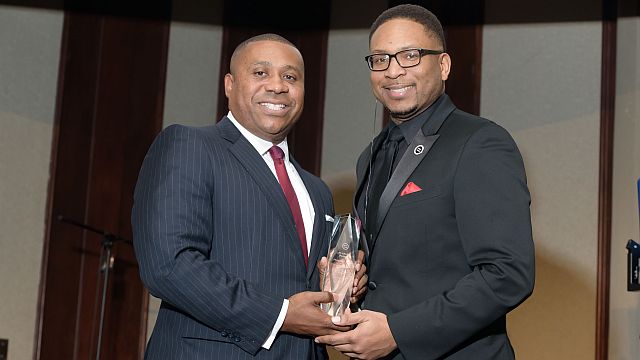
The Birmingham Urban League honored corporate citizens and community leaders Saturday, Dec. 8 at its Equal Opportunity Dinner. According to its organizers, the annual gala recognizes efforts that help in advancing equal opportunity for all. Alabama Power received the President’s Award for contributions to the community and its consistent support of the organization and diversity. Birmingham Division Vice President Jonathan Porter accepted the award on behalf of the company. “Alabama Power is proud of the continued partnership with organizations such as the Birmingham Urban League to help propel our community forward,” said Porter. The dinner was also held to commemorate the Birmingham Urban League‘s 50 years of service to the community. U.S. Sen. Doug Jones and U.S. Rep. Terri Sewell were the event co-chairs. National Urban League president Marc Morial was the keynote speaker for the evening. Morial recognized Birmingham’s first African-American mayor, Richard Arrington, saying the nation should appreciate Birmingham. Former Mayor William Bell was also honored for his leadership and his work in revitalizing the City of Birmingham. Mayor Bell shared a light moment with the audience, saying that even after completing his term serving the city, his wife still encourages him to “get out and go be great.” Other organizations such as Alpha Kappa Alpha Sorority, United Way of Central Alabama and Peacemakers was honored as well. More than 200 guests were treated to comedy and entertainment at the dinner. Republished with permission from the Alabama NewsCenter.
Primary takeaways: Establishment loses, diversity grows
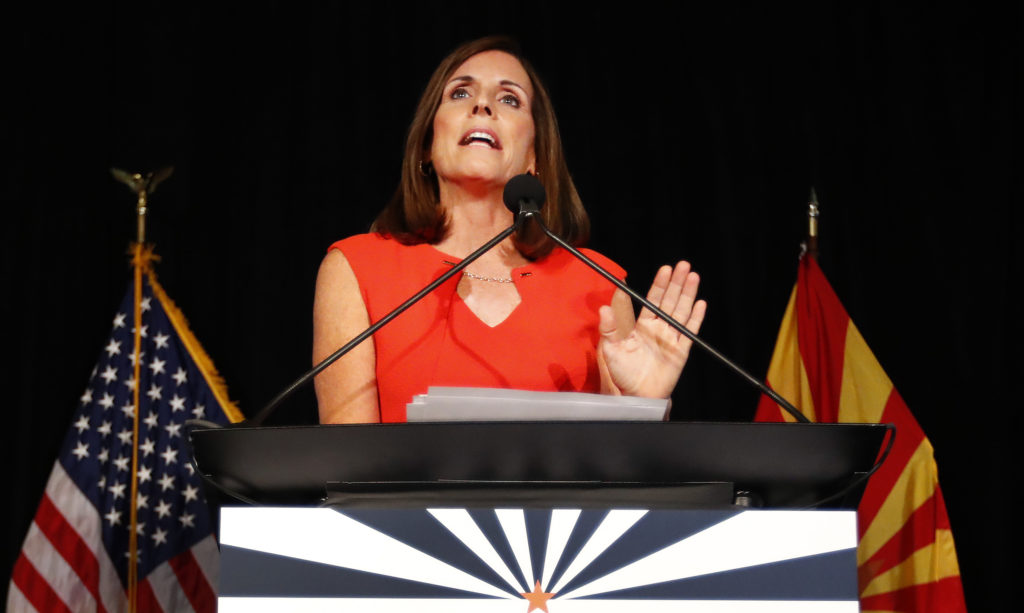
President Donald Trump got his man in battleground Florida, but he watched a prominent immigration ally fall in Arizona in what was another eventful night in the 2018 midterm season. Arizona and Florida held primaries Tuesday, both of which tested Trump’s influence. There were also new signs of diversity on the Democratic side. Takeaways from one of the final rounds of voting ahead of midterm elections: FLORIDA ESTABLISHMENT FAIL The political establishment in both parties had a bad night in Florida’s high-profile race for governor. On the Republican side, Trump got his man, Republican congressman Ron DeSantis, who beat out the establishment favorite, state Agriculture Commissioner Adam Putnam. Despite Trump’s support, DeSantis was not the strongest general election candidate in the race, operatives in both parties suggest. The three-term Republican congressman who makes frequent Fox News appearances is known as an immigration hard-liner in a state where Hispanic voters hold outsized sway. And lest there be any question about his allegiance to Trump’s divisive immigration policies, DeSantis encourages his toddler to “build the wall” with blocks in one campaign ad. That’s a message that may play well among a general electorate in West Virginia, where Trump won by more than 40 percentage points in 2016, but Trump carried Florida by only a single percentage point. On the Democratic side, liberal champion Andrew Gillum, the mayor of Tallahassee, bested a crowded field that included establishment favorite Gwen Graham, the former congresswoman and daughter of Florida political icon Bob Graham. Graham, who was considered a centrist, was viewed as a more attractive general election candidate in the purple state. Gillum is more liberal, having earned the backing of Vermont Sen. Bernie Sanders and billionaire Tom Steyer. To win the governor’s office for the first time since 1999, Democrats will have to come together quickly. The results on both sides underscore the outsized influence of each party’s most passionate voters in lower-turnout off-year elections. McSALLY’S CHALLENGE Martha McSally won the GOP nomination for Arizona Senate, but the results show how divided the party is and the challenge that lies ahead. A significant number of Republicans backed former Maricopa County Sheriff Joe Arpaio and fellow immigration hard-liner Kelli Ward. Now McSally has to bring together the party — including some of Trump’s most devoted supporters — going into the fall against Democrat Krysten Sinema, who is widely considered well-positioned. The race gives Democrats one of their best pickup opportunities in the nation. Meanwhile, it would be wrong to assume that McSally’s win is a repudiation of the tough rhetoric of her challengers, who essentially split the conservative vote. The 86-year-old man known nationwide as Sheriff Joe, who personifies the tough immigration policies that define the modern-day Republican Party, may never serve in public office again after his loss Tuesday. (For those who forget, Arpaio was convicted of criminal contempt last year for ignoring a judge’s order to stop detaining immigrants in the country illegally. Trump later pardoned him.) MISSING: BLUE WAVE IN FLORIDA If a Democratic wave is coming to Florida, it may have to be supplied by independents. With just a handful of precincts left to count, Republicans cast more than 1.6 million Florida ballots, while registered Democrats were on track to fall just below 1.5 million. Beyond the raw vote totals, the GOP count also was a larger share of its last presidential election turnout. That measure is a useful way to assess which party is more excited about a midterm election, and it’s particularly useful in Florida because the state limits primaries only to voters registered by party. The GOP total came to almost 35 percent of what Trump won in Florida in 2016. The Democrats’ total was about 33 percent of Hillary Clinton‘s 2016 turnout. Of course, it doesn’t mean Republicans are guaranteed big wins in Florida this fall. But it does show the GOP base in Florida is anything but depressed, turning out in solid numbers to nominate DeSantis after he was endorsed by Trump. The scenario cuts against the grain of a midterm election cycle that’s been defined by energy on the left in other states, and it puts an added burden on Florida Democratic candidates to attract voters who didn’t participate in Tuesday’s primaries. FLORIDA MONEY PIT There was less drama on the Senate side in battleground Florida, but the stage is now set for what will likely be the nation’s most expensive midterm contest. Florida Gov. Rick Scott easily captured the Republican nomination in the GOP’s bid to unseat Democratic incumbent Sen. Bill Nelson. At 75 and seeking his fourth term, Nelson is considered particularly vulnerable as voters continue to show disdain for candidates with deep ties to the establishment. Scott, an independently wealthy businessman, has already spent more than $27 million on the race compared to Nelson’s $6 million. The conservative Koch network has identified the Senate seat as a top target, and outside groups on both sides are expected to dump millions more in the contest. The extraordinary price tag of running a statewide campaign in Florida, which features 10 media markets, will test each side’s resolve and resources — particularly on the Democratic side. Republicans know Scott can and will dump millions more of his own personal wealth into his campaign. Democrats aren’t so lucky. National Democrats are already weighing how best to invest their limited dollars considering their challenges in other states where their incumbents are on the defensive. Yet if Democrats lose Nelson’s seat in Florida, their already narrow path to the Senate majority becomes virtually nonexistent. DIVERSITY WAVE GROWS In his upset victory, Gillum joins two other African-American gubernatorial nominees on the November ballot, Georgia Democrat Stacey Abrams and Maryland Democrat Ben Jealous, in what may be the party’s most diverse midterm class in history. No state is currently represented by a black governor. The nominations, of course, do not mean the candidates will continue to re-write history. Republicans have cast Gillum, like the other black nominees, as part
Darryl Paulson: Do universities discriminate in hiring?
Universities are touted as bastions of diversity whose prime role is to encourage students to engage in critical thinking, ask tough questions and expose themselves to a diversity of ideas and opinions. If that is the mission of the university, they have dismally failed. Diversity is respected, up to a point, as long as it doesn’t include ideological diversity. As liberal commentator Nicholas Kristof observed in a recent New York Times op-ed, “We progressives believe in diversity, and we want women, blacks, Latinos, gays and Muslims at the table — er, so long as they aren’t conservative.” Welcome to the modern American university, where almost every type of diversity is encouraged, except for ideological diversity. Try challenging liberal dogma as a student or professor, and you will likely find yourself facing counseling and academic discipline. Where are all the conservative faculty? How many conservative faculty did you, your children or grandchildren encounter as part of their university education? If you are like most, the answer is very few. In fact, two scholars recently found that there were twice as many Marxists in the humanities and social sciences than Republicans. Most university will have their token conservative professor. Harvard has Harvey Mansfield, Princeton has Robert George, and Yale has Donald Kagan. I was one of the few conservative professors at the University of South Florida, and doubt that I would have been hired if my conservative views were known. I believe I was hired because I had spent the prior year as a National Teaching Fellow at Florida A & M University. Anyone who taught at a historically black university had to be a liberal. In addition, my doctoral dissertation was on the emergence of the black mayor in America in the aftermath of the civil rights movement. Only a liberal would be interested in writing about African-American politicians. John Hasnas, a Georgetown University professor recently explained the faculty recruitment process to the Wall Street Journal. Every recruitment meeting, wrote Hasnas, begins with a strong exhortation from the administration about diversity and the need for more woman and minority faculty. No recruitment committee has ever been instructed about the need to have a more ideologically diverse faculty. How rare are conservative professors? Where the nation is fairly evenly split between Republicans and Democrats, a recent study found that only 13 percent of law school faculty are Republicans. A similar study by the Georgetown Law Journal found that 81 percent of law professors at the top 21 law schools donated money to Democrats and 15 percent to Republican candidates. Daniel Klein, an economist at George Mason University, studied 1,000 professors around the nation and found Democrats outnumbered Republicans seven to one in the humanities and social sciences. In anthropology and sociology, the margin was 30 to 1. Johnathan Haidt, a renowned social psychiatrist at New York University, was so startled by the lack of conservative academics that he started a website, Heterodox, to foster more ideological diversity. In his own profession, 96 percent of social psychiatrists were left of center, 3.7 percent were centrist, and 0.03% were right of center. How would you like to be that sole right-of-center social psychiatrist? In one of the largest studies of ideological diversity on college campuses, the North American Academic Study Survey (NAASS) examined 1,643 faculty from 183 universities in 1999. 72 percent of faculty described themselves as liberals and 15 percent as conservatives. The same year as the NAASS study, the Harris Poll found that 18 percent of Americans described themselves as liberals and 37 percent called themselves conservative. Clearly, academia does not mirror the nation. Even in supposedly conservative academic enclaves, liberals outnumbered conservatives by 51 to 19 percent in engineering and 49 to 39 percent in business. Why are there so few conservative faculty on college campuses? Alan Kors, a conservative professor at Penn, argues that conservatives face a “hostile and discriminatory” environment. Conservatives seeking academic jobs are “outed” by their group associations, major professors, or dissertation topic. Not long ago, Harvard University found that only two of its doctoral students in the Government Department failed to get an academic placement. Harvey Mansfield advised both students, widely recognized for his conservative views. Liberals argue that there is no discrimination against conservatives. George Lakoff, a liberal linguistics professor at Berkeley, argues that liberals seek academic careers because “unlike conservatives, they believe in working for the public good and social justice.” In other words, conservatives are simply out for the money while liberals seek the betterment of society. Lakoff is proof positive of why we need more conservatives in academia. Look for Part II: Do universities discriminate? – The attack on free speech ••• Darryl Paulson is Professor Emeritus of Government at the University of South Florida in St. Petersburg.
