
Liz Cheney braces for loss as Donald Trump tested in Wyoming and Alaska
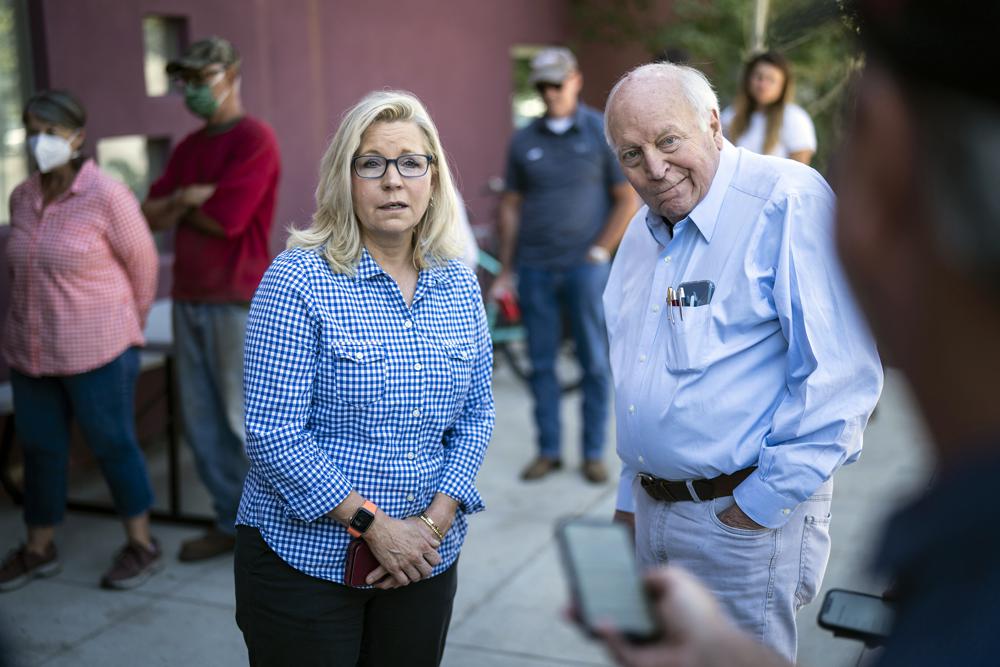
Wyoming Rep. Liz Cheney, a leader in the Republican resistance to former President Donald Trump, is fighting to save her seat in the U.S. House on Tuesday as voters weigh in on the direction of the GOP. Cheney is bracing for a loss against a Trump-backed challenger in the state in which he won by the largest of margins during the 2020 campaign. Win or lose, the 56-year-old daughter of a vice president is vowing to remain an active presence in national politics as she contemplates a 2024 presidential bid. But in the short term, Cheney is facing a dire threat from Republican opponent Harriet Hageman, a Cheyenne ranching industry attorney who has harnessed the full fury of the Trump movement in her bid to expel Cheney from the House. “Today, no matter what the outcome is, is certainly the beginning of a battle that is going to continue,” Cheney told CBS News after casting her vote Tuesday, standing alongside her father, former Vice President Dick Cheney. “We’re facing a moment where our democracy really is under attack and under threat. And those of us across the board — Republicans, Democrats, and independents who believe deeply in freedom and who care about the Constitution and the future of the country — have an obligation to put that above party.” Many of Wyoming’s voters don’t seem to agree with their three-term Republican congresswoman. “We like Trump. She tried to impeach Trump,” Cheyenne voter Chester Barkell said of Cheney. “I don’t trust Liz Cheney.” And in Jackson, Republican voter Dan Winder said he felt betrayed. “Over 70% of the state of Wyoming voted Republican in the last presidential election, and she turned right around and voted against us,” said Winder, a hotel manager. “She was our representative, not her own.” Tuesday’s contests in Wyoming and Alaska offer one of the final tests for Trump and his brand of hard-line politics ahead of the November general election. So far, the former president has largely dominated the fight to shape the GOP in his image, having helped install loyalists in key general election matchups from Arizona to Georgia to Pennsylvania. This week’s contests come just eight days after the FBI executed a search warrant at Trump’s Florida estate, recovering 11 sets of classified records. Some were marked “sensitive compartmented information,” a special category meant to protect the nation’s most important secrets. The Republican Party initially rallied behind the former president, although the reaction turned somewhat mixed as more details emerged. In Alaska, a recent change to state election law gives a periodic Trump critic, U.S. Sen. Lisa Murkowski, an opportunity to survive the former president’s wrath, even after she voted to convict him in his second impeachment trial. She is the only Senate Republican running for reelection this year who backed Trump’s impeachment. The top four primary Senate candidates in Alaska, regardless of party, will advance to the November general election, where voters will rank them in order of preference. In all, seven Republican senators and 10 Republican House members joined every Democrat in supporting Trump’s impeachment in the days after his supporters stormed the U.S. Capitol as Congress tried to certify President Joe Biden’s victory. Just two of those 10 House members have won their GOP primaries this year. The rest have lost or declined to seek reelection. Cheney would be just the third to return to Congress if she defies expectations on Tuesday. Murkowski is facing 18 opponents — the most prominent of which is Republican Kelly Tshibaka, who has been endorsed by Trump — in her push to preserve a seat she has held for nearly 20 years. On the other side of the GOP’s tent, Sarah Palin, the former Alaska governor and vice-presidential nominee, hopes to spark a political comeback on Tuesday. She’s actually on Tuesday’s ballot twice: once in a special election to complete former Rep. Don Young’s term and another for a full two-year House term starting in January. Back in Wyoming, Cheney’s political survival may depend upon persuading enough Democrats to cast ballots in her Republican primary election. While some Democrats have rallied behind her, it’s unclear whether there are enough in the state to make a difference. As of August 1, 2022, there were 285,000 registered voters in Wyoming, including 40,000 Democrats and 208,000 Republicans. Ardath Junge of Cheyenne, said she recently changed her registration from Democratic to Republican. “I did it just to vote for Cheney because I believe in what she’s doing,” said Junge, a retired schoolteacher. Many Republicans in the state — and in the country — have essentially excommunicated Cheney because of her outspoken criticism of Trump. The House GOP ousted her as the No. 3 House leader last year. And more recently, the Wyoming GOP and Republican National Committee censured her. Anti-Trump groups such as U.S. Rep. Adam Kinzinger’s Country First PAC and the Republican Accountability Project have worked to encourage independents and Democrats to support Cheney in recent weeks. They are clearly disappointed by the expected outcome of Tuesday’s election, although some are hopeful about her political future. “What’s remarkable is that in the face of almost certain defeat, she’s never once wavered,” said Sarah Longwell, executive director of the Republican Accountability Project. “We’ve been watching a national American figure be forged. It’s funny how small the election feels — the Wyoming election — because she feels bigger than it now.” Cheney has seemingly welcomed defeat by devoting almost every resource at her disposal to ending Trump’s political career since the insurrection. She emerged as a leader in the congressional committee investigating Trump’s role in the January 6 attack, giving the Democrat-led panel genuine bipartisan credibility. She has also devoted the vast majority of her time to the committee instead of the campaign trail back home, a decision that still fuels murmurs of disapproval among some Wyoming allies. And she has closed out the primary campaign with an unflinching anti-Trump message. “There is nothing more important she will ever do than lead the effort to make sure Donald Trump is
Joe Biden signs $1T infrastructure deal with bipartisan crowd
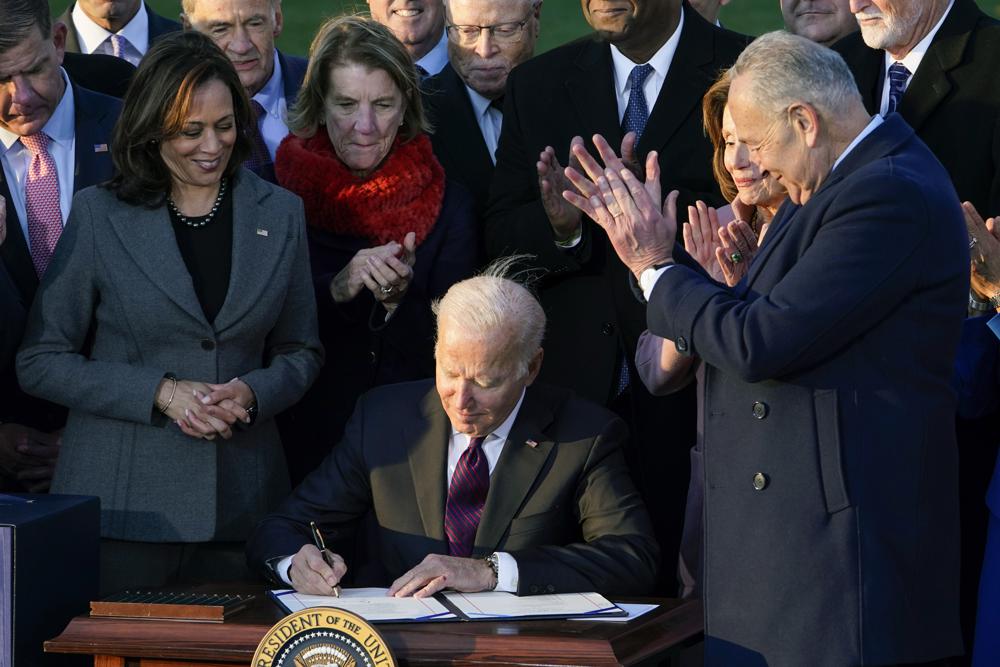
President Joe Biden signed his hard-fought $1 trillion infrastructure deal into law Monday before a bipartisan, celebratory crowd on the White House lawn, declaring that the new infusion of cash for roads, bridges, ports, and more is going to make life “change for the better” for the American people. But prospects are tougher for further bipartisanship ahead of the 2022 midterm elections as Biden pivots back to more difficult negotiations over his broader $1.85 trillion social spending package. The president hopes to use the infrastructure law to build back his popularity, which has taken a hit amid rising inflation and the inability to fully shake the public health and economic risks from COVID-19. “My message to the American people is this: America is moving again and your life is going to change for the better,” he said. With the bipartisan deal, the president had to choose between his promise of fostering national unity and a commitment to transformative change. The final measure whittled down much of his initial vision for infrastructure. Yet the administration hopes to sell the new law as a success that bridged partisan divides and will elevate the country with clean drinking water, high-speed internet, and a shift away from fossil fuels. “Folks, too often in Washington, the reason we didn’t get things done is because we insisted on getting everything we want. Everything,” Biden said. “With this law, we focused on getting things done. I ran for president because the only way to move our country forward in my view was through compromise and consensus.” Biden will get outside Washington to sell the plan more broadly in the coming days. He intends to go to New Hampshire on Tuesday to visit a bridge on the state’s “red list” for repair, and he will go to Detroit on Wednesday for a stop at General Motors’ electric vehicle assembly plant, while other officials also fan out across the country. The president went to the Port of Baltimore last week to highlight how the supply chain investments from the law could limit inflation and strengthen supply chains, a key concern of voters who are dealing with higher prices. “We see this as is an opportunity because we know that the president’s agenda is quite popular,” White House press secretary Jen Psaki said Monday before the signing. The outreach to voters can move “beyond the legislative process to talk about how this is going to help them. And we’re hoping that’s going to have an impact.” Biden held off on signing the hard-fought infrastructure deal after it passed on Nov. 5 until legislators would be back from a congressional recess and could join in a splashy bipartisan event. On Sunday night before the signing, the White House announced Mitch Landrieu, the former New Orleans mayor, would help manage and coordinate the implementation of the infrastructure spending. The gathering Monday on the White House lawn was uniquely upbeat with a brass band and peppy speeches, a contrast to the drama and tensions when the fate of the package was in doubt for several months. The speakers lauded the measure for creating jobs, combating inflation, and responding to the needs of voters. Ohio Sen. Rob Portman, a Republican who helped negotiate the package, celebrated Biden’s willingness to jettison much of his initial proposal to help bring GOP lawmakers on board. Portman even credited former President Donald Trump for raising awareness about infrastructure, even though the loser of the 2020 election voiced intense opposition to the ultimate agreement. “This bipartisan support for this bill comes because it makes sense for our constituents, but the approach from the center out should be the norm, not the exception,” Portman said. The signing included governors and mayors of both parties and labor and business leaders. In addition to House Speaker Nancy Pelosi and Senate Majority Leader Chuck Schumer, the guest list included Republicans such as Louisiana Sen. Bill Cassidy, Maine Sen. Susan Collins, New York Rep. Tom Reed, Alaska Rep. Don Young, and Maryland Gov. Larry Hogan. In order to achieve a bipartisan deal, the president had to cut back his initial ambition to spend $2.3 trillion on infrastructure by more than half. The bill that becomes law on Monday in reality includes about $550 billion in new spending over 10 years, since some of the expenditures in the package were already planned. The agreement ultimately got support from 19 Senate Republicans, including Senate GOP leader Mitch McConnell. Thirteen House Republicans also voted for the infrastructure bill. An angry Trump issued a statement attacking “Old Crow” McConnell and other Republicans for cooperating on “a terrible Democrat Socialist Infrastructure Plan.” McConnell said the country “desperately needs” the new infrastructure money, but he skipped Monday’s signing ceremony, telling WHAS radio in Louisville, Kentucky, that he had “other things” to do. Historians, economists, and engineers interviewed by The Associated Press welcomed Biden’s efforts. But they stressed that $1 trillion was not nearly enough to overcome the government’s failure for decades to maintain and upgrade the country’s infrastructure. The politics essentially forced a trade-off in terms of potential impact not just on the climate but on the ability to outpace the rest of the world this century and remain the dominant economic power. “We’ve got to be sober here about what our infrastructure gap is in terms of a level of investment and go into this eyes wide open, that this is not going to solve our infrastructure problems across the nation,” said David Van Slyke, dean of the Maxwell School of Citizenship and Public Affairs at Syracuse University. Biden also tried unsuccessfully to tie the infrastructure package to the passage of a broader package of $1.85 trillion in proposed spending on families, health care, and a shift to renewable energy that could help address climate change. That measure has yet to gain sufficient support from the narrow Democratic majorities in the Senate and House. Biden continues to work to appease Democratic skeptics of the broader package such as
Jerry Carl supports bill to allow flexibility in spending COVID-19 funds
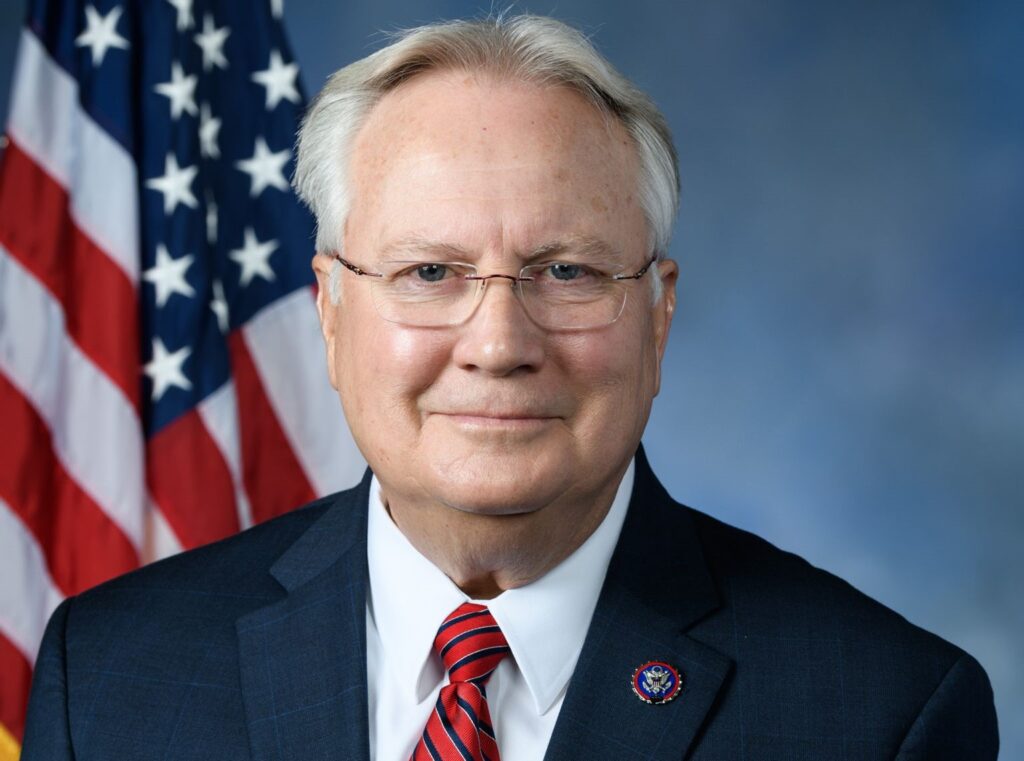
Congressman Jerry Carl announced he has co-sponsored a bipartisan bill to give state and local officials flexibility and time to spend the remainder of COVID-19 relief dollars. The State, Local, Tribal, and Territorial Fiscal Recovery, Infrastructure, and Disaster Relief Flexibility Act, introduced by Reps. Dusty Johnson and Carolyn Bourdeaux, aims to make various infrastructure investments eligible for payment with these funds. The legislation recently passed the U.S. Senate unanimously. Under the CARES Act, Congress did provide some flexibility for how COVID-19 funds could be spent, but the funds were not able to be used for infrastructure projects. This bill will give state and local officials additional flexibility and time to spend the remaining COVID-19 relief dollars responsibly. Carl supports the effort to add infrastructure spending as part of the COVID funding. Carl said in a statement, “South Alabama has a desperate need for investments in true infrastructure such as roads, bridges, ports, waterways, and broadband. As a former county commissioner, investing in our nation’s infrastructure is a top priority for me, so I’m proud to cosponsor this bipartisan bill to give states like Alabama the flexibility they need to spend unused COVID-19 relief dollars on critical investments in our nation’s infrastructure. “Unfortunately, Nancy Pelosi is holding the American people hostage by blocking this bill from being considered on the House floor. Despite passing the U.S. Senate unanimously and being introduced in the House by a large, bipartisan group, Nancy Pelosi is focused on raising our taxes, bankrupting America, and playing political games. It’s time to put the American people first and pass this bipartisan, commonsense bill.” South Dakota congressman Dusty Johnson posted on Twitter, “We need to cut the federal red tape. State governments need flexibility to administer remaining COVID-19 relief funds for critical infrastructure. Our bill would make that a reality & it’s already passed the Senate. Congress can get it done.” This legislation is cosponsored by Reps. Steve Scalise, Henry Cuellar, Rick Allen, Suzan DelBene, David Rouzer, Marilyn Strickland, Randy K. Weber, Jared Huffman, Steven Palazzo, Sanford D. Bishop, Jr., Andy Barr, Joseph Morelle, Dan Meuser, Albio Sires, Carlos A. Gimenez, Antonio Delgado, David B. McKinley, Kim Schrier, Peter Meijer, Darren Soto, Chris Pappas, Rick Crawford, Betty McCollum, William Timmons, Josh Gottheimer, Brad Wenstrup, Derek Kilmer, Don Young, and Tom O’Halleran.
