
Donald Trump says Ohio State attacker shouldn’t have been in US
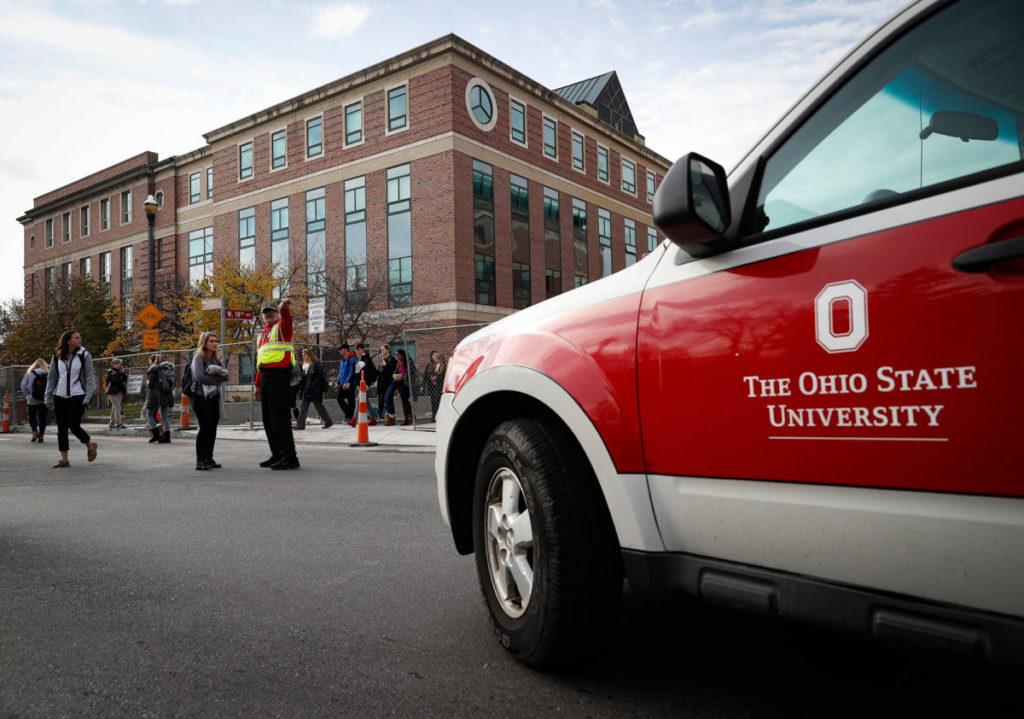
President-elect Donald Trump tweeted Wednesday that the 18-year-old Ohio State student who carried out a car-and-knife attack on his college campus “should not have been in our country.” It’s unclear from Trump’s tweet whether he thinks there was some failure in the screening system or whether he was offering this case as evidence to support his proposals to overhaul immigration policies, especially to restrict the entry of refugees. If Trump is arguing that Abdul Razak Ali Artan‘s family wasn’t properly checked out, there is no evidence of that. If Trump is referring to his plans to overhaul immigration, that may be difficult to accomplish. A look at both scenarios: — THE VETTING PROCESS Trump correctly described Artan, who was killed by police, as a refugee originally from Somalia. Artan and his family moved in 2014 to the United States after living in Pakistan since 2007. As part of that process of being admitted to the United States, the family was subjected to a lengthy background check that generally includes multiple in-person interviews, checks with federal law enforcement and intelligence agencies, and the collection of biometric data, including fingerprints. When the family arrived in the U.S., Artan had a secondary inspection by immigration officials, but no negative information was found and he was allowed into the country, according to a U.S. official briefed on the case. The official was not authorized to publicly discuss details on the case and spoke on the condition of anonymity. The government conducted a second background check on Artan when he became a legal permanent resident in 2015. — TRUMP’S PROPOSALS If Trump was referring to his proposal to end some refugee processing and to block migration from certain countries, that’s a different issue. During the presidential campaign, Trump initially proposed banning all Muslims “entering the United States until our country’s representatives can figure out what is going on.” He later suggested temporarily blocking migration from certain countries and adding “extreme vetting” to the process. He never specified which countries would be affected. It’s unclear how he would accomplish either an all-out ban on Muslims or select which countries no longer would be able to send people to the United States. There is no religious test for anyone asking to enter the United States. Adding one would likely lead to litigation from civil libertarians. Trump will have authority to control the volume of refugees entering the country, but may need legislative and likely diplomatic support to bar migration from certain countries. Republished with permission of The Associated Press.
US Supreme Court weighs bond hearings for detained immigrants

A seemingly divided Supreme Court on Wednesday tried to figure out whether the government can detain immigrants indefinitely without providing hearings in which they could argue for their release. The justices heard argument in a class-action lawsuit brought by immigrants who spent long periods behind bars, including many who are legal residents of the United States or are seeking asylum. The issue for the court is whether people the government has detained while it is considering deporting them can make their case to a judge that they should be released. The case pits the Obama administration against immigration advocates, and the court hearing comes as President-elect Donald Trump has said he will step up deportations. The San Francisco-based 9th U.S. Circuit Court of Appeals ruled for the immigrants, including Mexican immigrant Alejandro Rodriguez, who was detained for more than three years without a bond hearing. Rodriguez is a legal U.S. resident who was brought to the country as an infant. The Homeland Security Department detained him when it began deportation proceedings because Rodriguez had been convicted of possession of a controlled substance and driving a stolen vehicle, according to the appeals court. He spent no time in jail for the criminal convictions. In another case, an Ethiopian asylum-seeker was kept in detention partly because a DHS officer wrongly labeled him a Somali, according to the American Civil Liberties Union, which is representing the immigrants. The 9th Circuit ruled that immigrants generally should get bond hearings after six months in detention, and then every six months if they continue to be held. The government must show why they should remain locked up, the court said. Justice Stephen Breyer, voicing a sentiment that appeared to be shared by other liberal justices, expressed astonishment that the provisions of immigration law at issue would allow someone released after a hypothetical four-year prison term to be held the same amount of time by U.S. immigration authorities. “How can they be punished for four more years?” Breyer asked. Acting Solicitor General Ian Gershengorn defended the law, saying Congress clearly gave DHS considerable power to hold people in custody while determining whether to deport them. Ahilan Arulanantham, the ACLU lawyer representing the immigrants, told the justices the ultimate decision about whether to hold or release people was not at issue before the court. “We’re just talking about the need for an inquiry, the need for a hearing,” Arulanantham said. But the court’s conservative justices sounded skeptical of Arulanantham’s and the appeals court’s reading of immigration law. “The problem is, that looks an awful lot like drafting a statute or a regulation. … We can’t just write a different statute,” Chief Justice John Roberts said. Republished with permission of The Associated Press.
Carrier Corp. announces deal with Donald Trump to keep jobs in Indiana
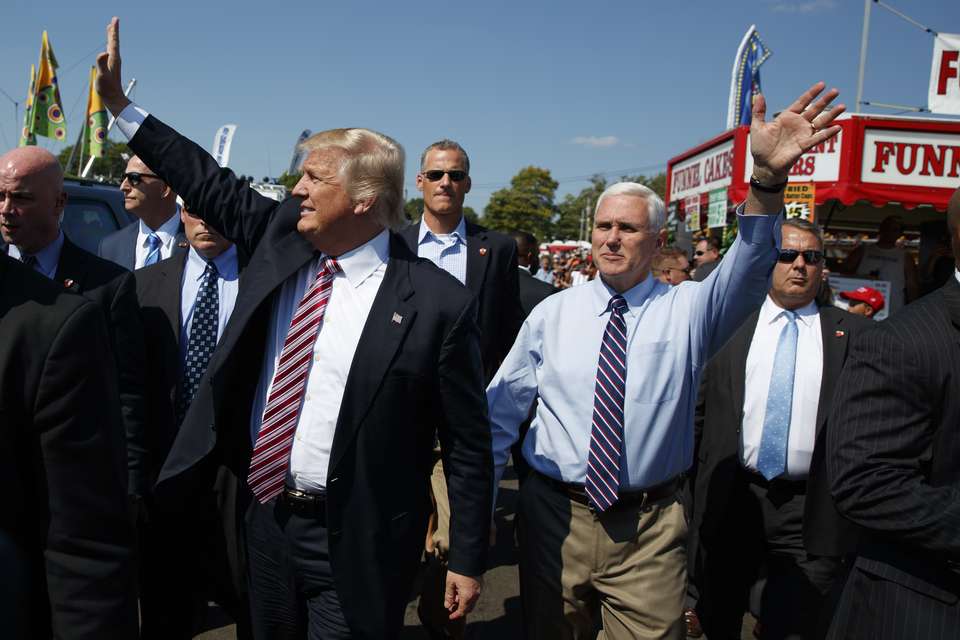
Air conditioning company Carrier Corp. says it has reached a deal with President-elect Donald Trump to keep nearly 1,000 jobs in Indiana. Trump and Vice President-elect Mike Pence plan to travel to the state Thursday to unveil the agreement alongside company officials. Trump confirmed the meeting on Twitter late Tuesday, promising a “Great deal for workers!” Trump spent much of his campaign pledging to keep companies like Carrier from moving jobs overseas. His focus on manufacturing jobs contributed to his unexpected appeal with working-class voters in states like Michigan, which has long voted for Democrats in presidential elections. The details of the agreement were unclear. Carrier tweeted that the company was “pleased to have reached a deal” with Trump and Pence to keep the jobs in Indianapolis. Neither Wilbur Ross, Trump’s pick for commerce secretary, nor Steven Mnuchin – the banker picked to be treasury secretary – would discuss specifics about the agreement on Wednesday. But Mnuchin told CNBC’s “Squawk Box” that Trump and his administration are “going to have open communications with business leaders.” He said Trump called the CEO of Carrier’s parent company and said it was “important to keep jobs here.” Both Trump and Pence, who is ending his tenure as Indiana governor, are expected to appear with Carrier officials Thursday. In February, Carrier said it would shutter its Indianapolis plant employing 1,400 workers and move its manufacturing to Mexico. The plant’s workers would have been laid off over three years starting in 2017. United Technologies Electronic Controls also announced then that it planned to move its Huntington manufacturing operations to a new plant in Mexico, costing the northeastern Indiana city 700 jobs by 2018. Those workers make microprocessor-based controls for the HVAC and refrigeration industries. Carrier and UTEC are both units of Hartford, Connecticut-based United Technologies Corp. – which also owns Pratt & Whitney, a big supplier of fighter jet engines that relies in part on U.S. military contracts. In a September debate against Democratic rival Hillary Clinton, Trump railed against Carrier’s plans. “So many hundreds and hundreds of companies are doing this,” Trump said. “We have to stop our jobs from being stolen from us. We have to stop our companies from leaving the United States.” Carrier wasn’t the only company Trump assailed during the campaign. He pledged to give up Oreos after Nabisco’s parent, Mondelez International, said it would replace nine production lines in Chicago with four in Mexico. He criticized Ford after the company said it planned to invest $2.5 billion in engine and transmission plants in Mexico. Chuck Jones, president of United Steelworkers Local 1999, which represents Carrier workers, said of Tuesday’s news: “I’m optimistic, but I don’t know what the situation is. I guess it’s a good sign. … You would think they would keep us in the loop. But we know nothing.” The event Thursday in Indiana will be a rare public appearance for Trump, who has spent nearly his entire tenure as president-elect huddled with advisers and meeting with possible Cabinet secretaries. He plans to make other stops later this week as part of what advisers have billed as a “thank you” tour for voters who backed him in the presidential campaign. Republished with permission of the Associated Press.
Donald Trump’s idea of ‘presidential’ diverges from past presidents

Donald Trump, that most unconventional of presidential candidates, last spring pledged that he would act perfectly presidential when the time was right. “I will be so presidential that you’ll call me and you’ll say, ‘Donald, you have to stop that, it’s too much,’” he promised during a March television interview. Less than two months from Inauguration Day, there are growing signs that Trump’s idea of what’s presidential may never sync up with past norms — to the delight of some and dismay of others. The president-elect has kept up his habit of sending unfiltered tweets, directly challenged the First Amendment right to burn the flag and selected a flame-throwing outsider for a top adviser. He’s shown no hesitation to traffic in unsubstantiated rumors, has mixed dealings in business and government, and has flouted diplomatic conventions to make his own suggestion for who should be Britain’s ambassador to the U.S., a job that happens to already be filled. He’s picked numerous fights with individual journalists, disregarded past practices on press access and dabbled in the name-calling that was commonplace during his candidacy. Trump’s search for Cabinet nominees has played out like a reality TV show, with a number of candidates engaged in unabashed self-promotion while their assets and liabilities are publicly debated by members of the president-elect’s own transition team. (It’s normally a hush-hush process until the unveiling of an appointee). Trump’s tweet that “Fidel Castro is dead!” had none of the diplomatic subtleties normally associated with such an international development. Is all of this, then, the “new normal” for what to expect from a Trump administration or a reflection of the growing pains associated with any presidential transition? President Barack Obama, who knows a thing or two about making the big leap to the Oval Office, has expressed hope that the weight of the office will ultimately have a sobering effect on Trump, cautioning people against assuming “the worst.” “How you campaign isn’t always the same as how you govern,” Obama said in one of a string of recent comments trying to provide some measure of reassurance to those concerned about the next president. “Sometimes when you’re campaigning, you’re trying to stir up passions. When you govern, you actually have reality in front of you, and you have to figure out, ‘How do I make this work.’” Republican Rep. Mark Meadows of North Carolina, a strong conservative and a Trump defender, said of the transition, “You gotta break a few eggs to make an omelet.” But Thomas Mann, a longtime scholar of government from the Brookings Institution, said that while people can hope for the best, “There’s no reason to take what’s going on with anything other than great uneasiness and caution about the kind of government that is preparing to take control in the United States.” “To call this the ‘new normal’ is to make light of the seriousness of what’s going on,” Mann said. Trump has “got to get some discipline,” said New York University’s Paul Light, another scholar of government. “He’s just got to get on this.” On the matter of Trump’s tweeting, Light said, “If he’s up at 3 a.m. about to tweet, he should start reading something about his agenda instead. He’s under-informed and so is his staff.” The concerns extend well beyond matters of style. — Trump’s out-of-the-blue tweet this week that people who burn the flag should face jail time or a loss of citizenship had Republicans stepping forward to defend First Amendment rights. — His unfounded charges that millions of Americans voted illegally sow distrust in the integrity of the U.S. electoral system. — On matters of press access, the idea that the whereabouts of the president or president-elect might be unknown in a time of national emergency has troubling implications beyond mere inconvenience for reporters. And experts on government ethics say that if the president doesn’t sell off his vast business buildings, he’ll be subject to a never-ending string of conflict-of-interest questions that will cast a cloud over his policy actions. For all of that, though, polls show Trump’s favorability ratings have ticked up since the election, even if they are still extremely low for an incoming president. A CNN survey released last week found that Trump’s favorability rating had gone from 36 percent a few weeks before the election to 47 percent 10 days after the vote. A little less than half of Americans said Trump’s actions since the election had made them more confident in his ability to serve as president. A Quinnipiac poll released last week found that nearly 6 in 10 Americans thought Trump should shut down his personal Twitter account. More than half were concerned that Trump might veto legislation that’s good for the nation if it hurt his business interests. Trump has offered postelection reassurances that he’ll be “very restrained” in his tweets and more going forward. His actions haven’t always confirmed that. Republished with permission of The Associated Press.
Donald Trump says he’s leaving businesses to avoid conflicts

President-elect Donald Trump said Wednesday he’s leaving his business empire to focus on being the nation’s 45th president, declaring he can successfully avoid conflicts of interest between governing and profiting in the private sector. “I will be leaving my great business in total in order to fully focus on running the country in order to make America great again,” he tweeted in a series of missives sent before dawn. “While I am not mandated to do this under the law, I feel it is visually important, as president, to in no way have a conflict of interest with my various businesses.” Trump did not provide any details about how he planned to separate from his businesses, though he said legal documents were being prepared. He has previously said that he’d leave his business operations to his three eldest children – Donald Jr., Eric and Ivanka. Ethics experts have pushed for Trump to fully exit the ownership of his businesses using a blind trust or equivalent arrangement. “Otherwise he will have a personal financial interest in his businesses that will sometimes conflict with the public interest and constantly raise questions,” Norman Eisen, President Barack Obama‘s chief ethics lawyer, and Richard Painter, who held the same post for President George W. Bush, said in a joint statement Wednesday. Trump was also moving forward with his Cabinet selections, choosing former Goldman Sachs executive Steven Mnuchin as treasury secretary and billionaire investor Wilbur Ross for commerce secretary. Mnuchin, 53, led Trump’s finance operations during the presidential campaign. But he has no government experience, which could prove a political hurdle. If confirmed by the Senate, Mnuchin would play a central role in shaping Trump’s tax policies and infrastructure plans. He would also lead an agency tasked with implementing international economic sanctions. Arriving at Trump Tower Wednesday morning for meetings, Mnuchin said the administration planned “the most significant middle income tax cut since Reagan.” He also called for lowering corporate taxes to encourage companies to stay in the United States. Trump was accompanying his decision to line his Cabinet with financial industry insiders with an announcement that the air conditioning giant Carrier Corp. planned to keep nearly 1,000 jobs in Indiana instead of moving them to Mexico. Trump and Vice President-elect Mike Pence, the outgoing Indiana governor, planned an event with Carrier officials Thursday to announce the plan. Details of the agreement were unclear. Trump spent much of his campaign pledging to keep companies like Carrier from moving jobs overseas, relying on the skills he used in business. Trump’s sprawling business empire is unprecedented for a sitting president, as is the complexity and opaqueness of his financial holdings. He refused to release his taxes during the campaign, citing an ongoing audit, and will be under no legal obligation to do so in the White House. Trump owns golf clubs, office towers and other properties in several countries. He holds ownership stakes in more than 500 companies. He has struck licensing deals for use of his name on hotels and other buildings around the world and has been landing new business in the Middle East, India and South America. Reince Priebus, Trump’s incoming White House chief of staff, was vague Wednesday in describing how the president-elect planned to separate himself from his businesses, saying “that’ll all be worked out.” Priebus told MSNBC’s “Morning Joe,” that Trump has “got the best people in America working on it.” Priebus demurred when asked if Trump planned to put his businesses in a blind trust – as presidents have traditionally done – or leave them in his children’s hands. “I’m not ready to reveal that really,” Priebus said. Priebus added that Trump’s business acumen and the many interests he has as a result of it are “nothing to be ashamed about.” He said the country hasn’t seen a president with such business holdings before and the rules and regulations “don’t contemplate this scenario.” Republished with permission of the Associated Press.
Steven Kurlander: Real grassroots transition required: Rebuilding the GOP
Steven Kurlander: Real grassroots transition required: Rebuilding the GOP So far, if you were to sum up the Donald Trump team transition, it’s pretty disappointing in terms of delivering important changes in how Washington works that the president-elect promised during the campaign. For the most part, the present transition period is dominated by insiders from the Grand OLD Party, threatening the promise of a freethinking Trump White House and the promised change that America yearns for. Trump’s victory was rooted in a hope for true change in not only in the way Washington governs, but also in terms of changing the political system to be more responsive and representative of the true majority of American people. That included remaking and revitalizing a stratified and lethargic Republican Party that not only did everything possible to thwart his candidacy, but has proved incapable of truly connecting with a majority of Americans nationwide. If one thing is certainly obvious, it’s that President-elect Donald Trump won the 2016 presidential election by putting together a truly grassroots populist campaign that won the hearts and minds of disillusioned Americans. These voters, many of whom had never voted or stopped voting, came to the polls to vote for Trump, or against Hillary. What defined this Trump swing group? These were the voters that both the Democratic and Republican parties had forsaken or taken for granted over the last two decades. Trump and his loyal, core staff ran a brilliant guerilla-style campaign, using unorthodox messaging and strategies that reached a 21st-century silent majority. Nowhere was this more true than in the make-or-break battleground of Florida. There, they fought with limited financial resources a victorious three front war against both the Democrats and Republican parties as well as the mainstream press, too. In fact, Florida was ground zero in that regard for Trump, whose team lead by seasoned political operative Karen Giorno and self-funded by the candidate not only knocked out former Florida Governor Jeb Bush before March 15, but leveled Senator Marco Rubio in his home state primary by winning 66 of 67 counties in the GOP primary. The agile, lean and mean Florida methodology crafted by Giorno became the populist Trump blueprint for victory in November as she was elevated to national coalitions and grassroots operatives, as well as the Director of Women’s Engagement and took the show on the road to North Carolina and Pennsylvania. It worked, carrying these states for Trump on Nov. 8 and gaining unheard of percentages in Democratic strongholds like Palm Beach County. “Karen Giorno understood how to win Florida for Mr. Trump and she did just that. Then she took that playbook to the other battlegrounds states. She’s a winner,” said former Hialeah Mayor Julio Martinez, who strongly supported Trump. But after such a brilliant victories in Florida and other states like Ohio, Pennsylvania and Michigan, the fear of the new Trump coalition has the GOP striking back — and leaving Trump loyalists like Giorno scratching their heads wondering how the RNC is taking credit for a victory they had very little if nothing to do with. Instead, the GOP that Trump conquered is now getting an undeserved second lease on life. They are also now rewriting the election narrative to claim sole credit for his win, especially in Florida. More troubling? you don’t hear anything at all about making changes to the Republican Party. In order for the GOP to survive, the achievement by Trump’s campaign of fusing the GOP faithful with independents and disenfranchised Democrats must be taken further to move the nation forward with a durable coalition. In addition to delivering on his campaign promises on trade, immigration and job creation, Trump also must “shake up” the present GOP party apparatus by bringing his original campaign and populist political philosophy into a new, rebuilt populist Republican Party. More importantly, unless Trump remakes a “Grand New Party” as his own brand of new American political reality, and includes members of his original “Trump” team from the campaign, he will quickly lose the goodwill of those that elected him to office. What looks right now like a “Bush-league” GOP domination of a Trump Administration certainly won’t result in making American Great Again, much less than ensuring a doomed presidency from the start. ___ Steven Kurlander blogs at Kurly’s Kommentary and writes for FloridaPolitics.com. He is an attorney and communications specialist living in Monticello, New York. He can be reached at kurlyskommentary@gmail.com.
HHS nominee Tom Price opposes Obamacare, backs Medicare vouchers
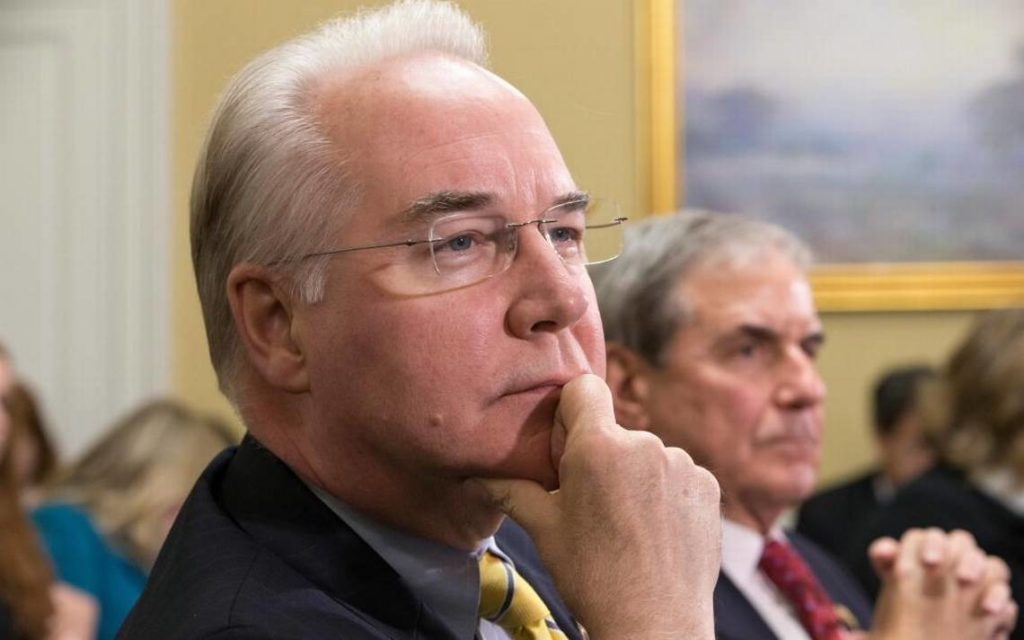
As a congressman, Georgia Republican Tom Price has been thwarted in his hopes to repeal the Affordable Care Act and transform Medicare into a voucher-like program for future participants. Now, as President-elect Donald Trump‘s choice to run the Department of Health and Human Services, Price will wield great power as Trump’s top health policy adviser and preside, Republicans hope, over the dismantlement of President Barack Obama’s signature health care law. Price, 62, carries himself with a surgeon’s confidence and possesses deep knowledge of health policy. He is one of very few Republicans to actually propose a replacement for Obamacare, and promises to be a staunchly conservative voice in Trump’s Cabinet. Price is buttoned down and unfailingly polite, but he is not shy about swinging his elbows in the heat of debate. As chairman of the House Budget Committee, Price emerged as a top advocate of Speaker Paul Ryan’s plan to transform Medicare from a program that supplies a defined set of benefits into a “premium support” model that would, similar to Obamacare, offer subsidies for participants to purchase health care directly from insurance companies. He also wants the Medicare eligibility age to rise to 67. Price also supports, as does Trump, a plan by House Republicans to sharply cut the Medicaid health program for the poor and disabled and turn it over to the states to run. Like Trump and most other Republicans, Price wants federal funding withdrawn from Planned Parenthood, which has come under attack for its practice of supplying tissue from aborted fetuses to medical researchers. Trump has said he opposes GOP plans to provide vouchers for future Medicare beneficiaries and GOP support for the idea has never been tested beyond its inclusion in non-binding budget blueprints. Price’s plan would require people who are now in their late 50s to accept the Medicare subsidies, which critics say would fail to keep pace with inflation and force higher out-of-pocket costs like deductibles and co-payments. Trump named Price on Tuesday and called him “a tireless problem solver and the go-to expert on health care policy, making him the ideal choice” to run HHS. “He is exceptionally qualified to shepherd our commitment to repeal and replace Obamacare,” Trump said. While Republicans are generally united in their desire to repeal Obama’s health law, there’s no consensus on what should replace it. Price has offered a solution that would provide tax credits to subsidize the purchase of individual and family health insurance policies. His proposal would also allow insurers to sell policies across state line, boost incentives for health savings accounts, and create high-risk pools to help individuals afford coverage, while barring assistance for nearly all abortions. It will fall to Price, once confirmed, to be the prime go-between Trump and Capitol Hill Republicans in what are certain to be difficult and complicated negotiations over replacing the health care law. Price serves on the powerful Ways and Means Committee, which has jurisdiction over Obamacare, but he hasn’t been seen as an inside player in much of the panel’s work. The HHS secretary also has great power over the workings of Medicare and Medicaid and the medical profession in general. Price led the House Republican Study Committee, a powerful band of conservative voices, during the first two years of the Obama administration. He lost a close election in 2012 to become the No. 4 Republican in House GOP ranks despite the support of Ryan, a friend and confidante. At the time, Republicans faced criticism for a lack of diversity in their leadership ranks, and GOP leaders like former Speaker John Boehner of Ohio swung behind Rep. Cathy McMorris Rogers of Washington. Democrats reacted with alarm, though they lack the power to block Price because of a change to filibuster rules they orchestrated when controlling the Senate. “Congressman Price has proven to be far out of the mainstream of what Americans want when it comes to Medicare, the Affordable Care Act, and Planned Parenthood,” said incoming Senate Minority Leader Charles Schumer, D-N.Y. “Thanks to those three programs, millions of American seniors, families, people with disabilities and women have access to quality, affordable health care. Nominating Congressman Price to be the HHS secretary is akin to asking the fox to guard the hen house.” Republished with permission of the Associated Press.
Donald Trump taps Tom Price to lead HHS, plans 2nd meeting with Mitt Romney
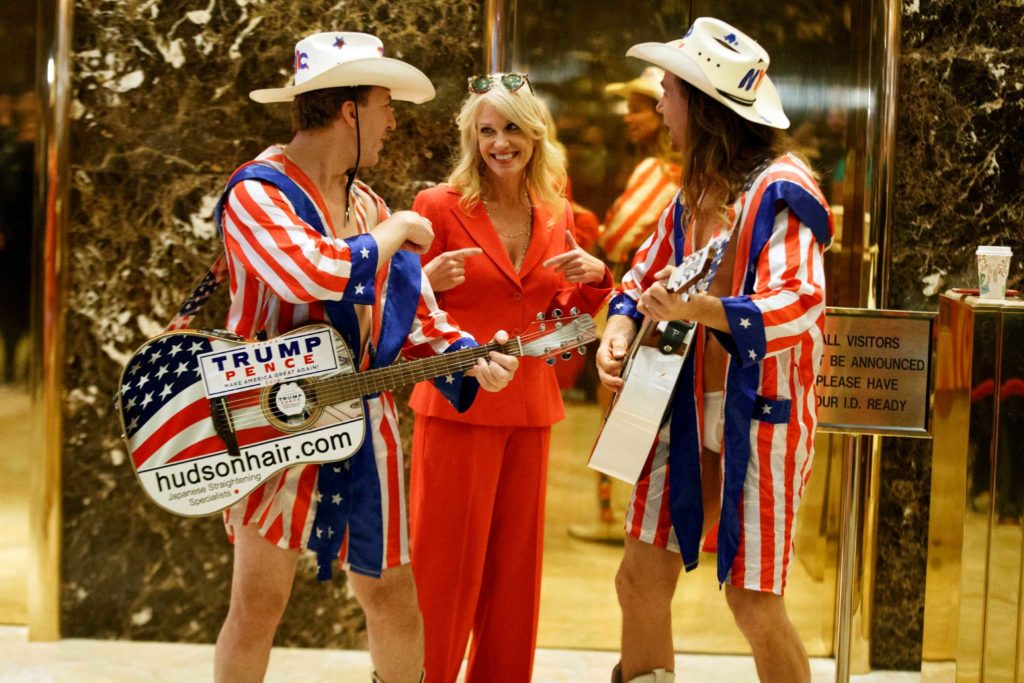
President-elect Donald Trump moved to fill out his Cabinet Tuesday, tapping Georgia Rep. Tom Price to lead the Department of Health and Human Services. Aides signaled that at least one other Cabinet nomination was imminent. The president-elect appeared to still be torn over his choice for secretary of state. He summoned former Massachusetts Gov. Mitt Romney to New York for dinner Tuesday night to discuss the post for a second time. He was also meeting with Tennessee Sen. Bob Corker, the chairman of the Senate Foreign Relations Committee who was getting new attention from Trump’s team. On Monday, Trump spent an hour with retired Gen. David Petraeus, another new contender. Trump’s decision to consider Romney for the powerful Cabinet post has sparked an unusual public backlash from some of his closest aides and allies. Campaign manager Kellyanne Conway has warned that it would be a “betrayal” to Trump supporters if he selected Romney, who was a fierce critic of the president-elect. Three people close to the transition team said Trump was aware that Conway planned to voice her concerns about Romney in public and they pushed back at suggestions that the president-elect was angry at her for doing so. Even as he weighed crucial Cabinet decisions, Trump appeared distracted by outside forces — or eager to create distractions himself. He took to Twitter early Tuesday to declare that “nobody should be allowed to burn the American flag.” He warned that those who do should face “perhaps loss of citizenship or year in jail!” Trump offered no context for his message. The Supreme Court has ruled that flag burning is protected by the First Amendment. The president-elect spent the weekend tweeting his opposition to a recount effort in up to three states that is led by Green Party candidate Jill Stein and joined by Hillary Clinton‘s team. He also falsely claimed that millions of people had voted illegally in the presidential election and provided no evidence to back up the baseless charge. Trump won praise from Republicans Tuesday for his pick of Price to serve as health and human services secretary. A six-term congressman and orthopedic surgeon, Price has been a leading critic of President Barack Obama‘s health care law. If confirmed by the Senate, he’ll be a leading figure in Republican efforts to repeal the measure. Incoming Senate Democratic Leader Chuck Schumer said Price “has proven to be far out of the mainstream of what Americans want” for programs that help seniors, women, families and those with disabilities. His nomination, Schumer said, is “akin to asking the fox to guard the henhouse.” Trump’s team also announced Tuesday that Seema Verma had been chosen to be administrator of the Centers for Medicare and Medicaid Services. Jason Miller, a transition team spokesman, said at least one other Cabinet post would be announced in the afternoon. He did not elaborate. Transition aides said Trump was likely at least a few days away from a decision on secretary of state. Romney has supposed from Vice President-elect Mike Pence, who is heading the transition efforts. Romney was fiercely critical of Trump throughout the campaign, including his preparedness for the foreign policy and national security decisions that confront a president. Still, he is said to be interested in serving in the administration and held a lengthy initial meeting with Romney before Thanksgiving. Other top Trump allies, notably Conway, have launched a highly unusual public campaign against a Romney nomination. Conway’s comments stirred speculation that she is seeking either to force Trump’s hand or give him cover for ultimately passing over Romney. Former New York City Mayor Rudy Giuliani, a loyal Trump ally, was initially seen as the leading contender to helm the State Department. But questions about his overseas business dealings, as well as his public campaigning for the job, have given Trump pause. Trump is now said to be considering Giuliani to head the Homeland Security Department, according to those close to the transition process. Republished with permission of the Associated Press.
Donald Trump suggests ‘consequences’ for any flag-burners
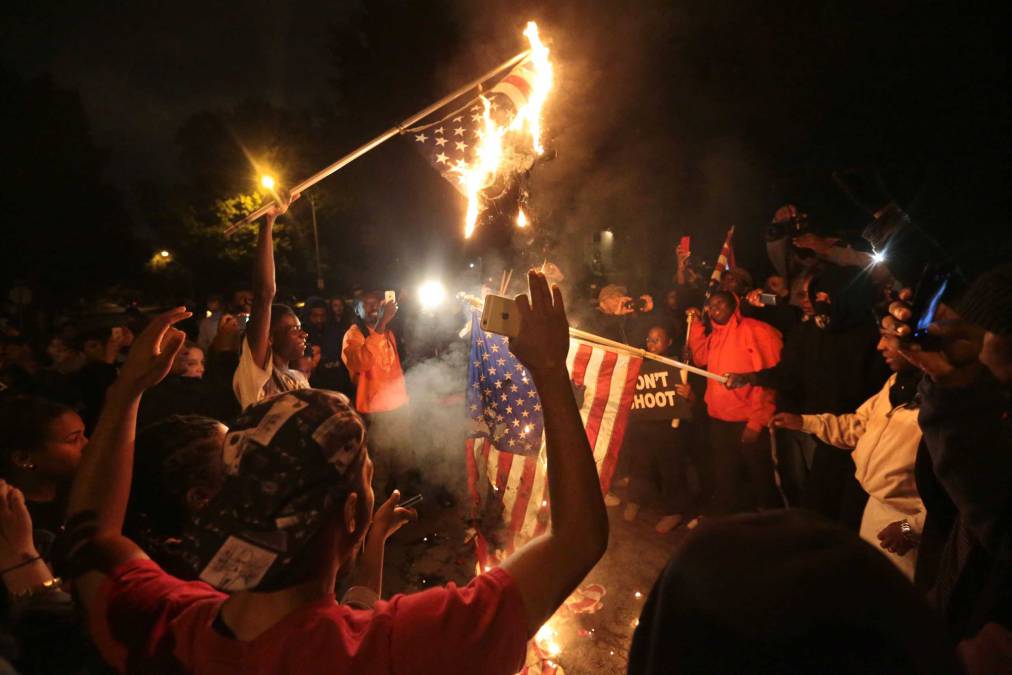
President-elect Donald Trump said Tuesday that anyone who burns an American flag should face unspecified “consequences,” such as jail or a loss of citizenship – a move that was ruled out by the Supreme Court nearly three decades ago. Trump took to Twitter early Tuesday morning, stating, “Nobody should be allowed to burn the American flag – if they do, there must be consequences – perhaps loss of citizenship or year in jail!” It was not immediately clear what prompted the tweet. The president-elect’s tweet is a direct conflict with free speech rights guaranteed by the First Amendment to the Constitution. It came as he prepared to name a secretary of state and transportation secretary. The Supreme Court ruled in 1989 that flag-burning is “expressive conduct” protected by the First Amendment. Rep. Sean Duffy, R-Wis., took issue with the tweet. “We want to protect those people who want to protest….I disagree with Mr. Trump on that,” Duffy said Tuesday on CNN’s “New Day”. Duffy is the chairman of the House Financial Services Committee’s panel on oversight and investigations. Republished with permission of the Associated Press.
Donald Trump drama rolls on: Disputes, falsehoods hit transition

The drama, disputes and falsehoods that permeated Donald Trump‘s presidential campaign are now roiling his transition to the White House, forcing aides to defend his baseless assertions of illegal voting and sending internal fights spilling into public. On Monday, a recount effort, led by Green Party candidate Jill Stein and joined by Hillary Clinton‘s campaign also marched on in three states, based partly on the Stein campaign’s unsubstantiated assertion that cyberhacking could have interfered with electronic voting machines. Wisconsin officials approved plans to begin a recount as early as Thursday. Stein also asked for a recount in Pennsylvania and was expected to do the same in Michigan, where officials certified Trump’s victory Monday. Trump has angrily denounced the recounts and now claims without evidence that he, not Clinton, would have won the popular vote if it hadn’t been for “millions of people who voted illegally.” On Twitter, he singled out Virginia, California and New Hampshire. There has been no indication of widespread election tampering or voter fraud in those states or any others, and Trump aides struggled Monday to back up their boss’ claim. Spokesman Jason Miller said illegal voting was “an issue of concern.” But the only evidence he raised was a 2014 news report and a study on voting irregularities conducted before the 2016 election. Trump met Monday with candidates for top Cabinet posts, including retired Gen. David Petraeus, a new contender for secretary of state. Trump is to meet Tuesday with Tennessee Sen. Bob Corker, who is also being considered more seriously for the diplomatic post, and Mitt Romney, who has become a symbol of the internal divisions agitating the transition team. Petraeus said he spent about an hour with Trump, and he praised the president-elect for showing a “great grasp of a variety of the challenges that are out there.” “Very good conversation and we’ll see where it goes from here,” he said. A former CIA chief, Petraeus pleaded guilty last year to a misdemeanor charge of mishandling classified information relating to documents he had provided to his biographer, with whom he was having an affair. Vice President-elect Mike Pence, who is heading the transition effort, teased “a number of very important announcements tomorrow” as he exited Trump Tower Monday night. Pence is said to be among those backing Romney for State. Romney was fiercely critical of Trump throughout the campaign but is interested in the Cabinet position, and they discussed it during a lengthy meeting earlier this month. Other top Trump allies, notably campaign manager Kellyanne Conway, have launched a highly unusual public campaign to warn the president-elect that nominating Romney would be seen as a betrayal by his supporters. Conway’s comments stirred speculation that she is seeking to either force Trump’s hand or give him cover for ultimately passing over Romney. Three people close to the transition team said Trump had been aware that Conway planned to voice her opinion, both on Twitter and in television interviews. They disputed reports that Trump was furious at her and suggested his decision to consider additional candidates instead highlighted her influence. Conway served as Trump’s third campaign manager and largely succeeded in navigating the minefield of rivalries that ensnared other officials. Trump is said to have offered her a choice of White House jobs — either press secretary or communications director. But people with knowledge of Conway’s plans say she is more interested in serving as an outside political adviser, akin to the role President Barack Obama‘s campaign manager David Plouffe played following the 2008 election. The wrangling over the State Department post appears to have slowed the announcements of other top jobs. Retired Gen. James Mattis, who impressed Trump during a pre-Thanksgiving meeting, was at the top of the list for Defense secretary, but a final decision had not been made. Trump was also considering former New York City Mayor Rudy Giuliani for Homeland Security secretary, according to those close to the transition process. Giuliani was initially the front-runner for State and is still in the mix. But questions about his overseas business dealings, as well as the mayor’s public campaigning for the job, have given Trump pause. Those close to the transition insisted on anonymity in commenting because they were not authorized to publicly discuss the private process. Even as Trump weighs major decisions that will shape his presidency, he’s been unable to avoid being distracted by the recount effort. He spent Sunday on a 12-hour Twitter offensive that included quoting Clinton’s concession speech, in which she said the public owed Trump “an open mind and the chance to lead.” His final tweets challenging the integrity of an election he won were reminiscent of his repeated, unsubstantiated assertions during the campaign that the contest might be rigged. Those previous comments sparked an outcry from both Clinton and some Republicans. Clinton lawyer Marc Elias said the campaign has seen “no actionable evidence” of voting anomalies. But the campaign still plans to be involved in Stein’s recount to ensure its interests are legally represented. Trump narrowly won Wisconsin, Pennsylvania and Michigan. All three would need to flip to Clinton to upend the Republican’s victory, and Clinton’s team says Trump has a larger edge in all three states than has ever been overcome in a presidential recount. Republished with permission of the Associated Press.
Ronda M. Walker: Beyond the Jeff Sessions’ nomination — the trickle down effect
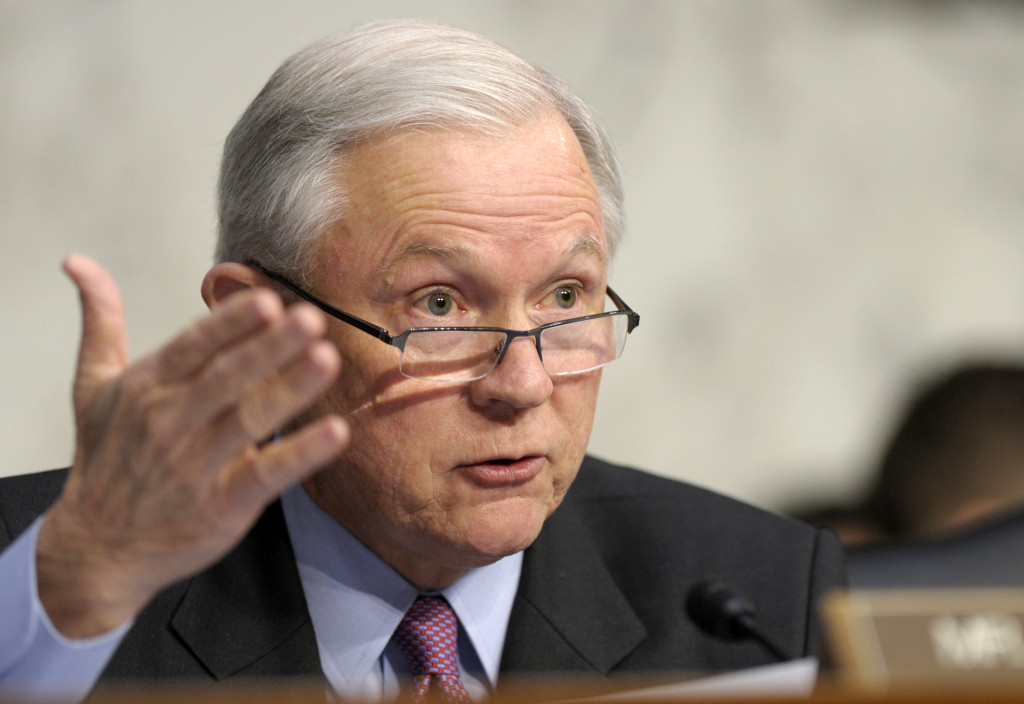
For the past eight years conservatives in Alabama have balked at the policies of the Barack Obama Administration. Now it’s the Republicans turn to govern. The Democrats had a few years, now the Republicans will have a few years. Americans, we are a pendulum people. We sway back and forth between conservative and liberal leadership every few years. A quick glance at contemporary Presidential history proves my point: Harry S. Truman (D) Dwight Eisenhower (R) John Fitzgerald Kennedy (D), assassinated and replaced by Lyndon Baines Johnson (D) Richard Nixon (R), resigned and replaced by Gerald Ford (R) Jimmy Carter (D) Ronald Reagan (R) George H.W. Bush (R) Bill Clinton (D) George W. Bush (R) Barack Obama (D) Donald Trump (R) I assume you see the pattern. The Republicans will soon control the White House and both Chambers of Congress. However, the same swing pattern is found in Congressional elections, specifically in a midterm, which likely means the 2018 Congressional midterms will likely not bode well for Republicans. But for now we have a Republican at the top making cabinet selections and an Alabamian has been nominated to serve as U.S. Attorney General. Several Alabamians have held cabinet-level positions including a few Surgeon Generals – Regina Benjamin of Mobile and David Satcher of Anniston. Condoleezza Rice of Birmingham is most definitely a favorite daughter and she served as the National Security Advisor and the Secretary of State. Winton M. Blount, born in Union Springs and settled in Montgomery, was Postmaster General for Richard Nixon back when Postmaster General was still a cabinet level position. So while this level of power is nothing new to Alabama, the nomination of Jeff Sessions is different. Sessions is a current statewide elected official. We know him. Personally. We’ve shaken his hand at barbecues in rural Alabama, we’ve bumped in to him on our visits to DC and he’s taken the time to say hello and ask about the family. Born in Selma and raised in Wilcox County Sessions attended Huntingdon College in Montgomery and the University of Alabama School of Law. He and his wife Mary now live in Mobile. Senator Sessions, while being one of the most powerful men in the world, is definitely one of us. And now one of us has been nominated by President-elect Donald Trump as the next Attorney General of the United States. Assuming Sessions’ confirmation by the U.S. Senate, Alabama will need a new U.S. Senator and the speculation is dizzying. But before we jump into the political what-ifs and maybes, I think it is important that we take a collective pause and enjoy the moment. The moment when our very own United States Senator, our highly respected native son, will likely transition from being a champion for Alabama to being a champion for America. That is a very big deal. But now let’s look beyond the Sessions’ nomination and consider the trickle down effect. Assuming Sessions’ confirmation to U.S. Attorney General, the Governor of Alabama has an appointment to make. As an appointee of Governor Robert Bentley myself, I will jump into the speculation fray and consider the route the Governor might take when making his nomination. In the summer of 2013 Jay Love announced he was leaving the Alabama House of Representatives, thus creating a vacancy in the House to be filled in a special election. Montgomery County Commissioner Dimitri Polizos was elected in that special election thus creating a vacancy on the County Commission. When a vacancy occurs on a County Commission, the Governor appoints an individual to fill the position until the next regular election. In December of 2013 I was interviewed by the Governor’s staff and subsequently asked to fill the remainder of Polizos’ Commission term. I was sworn in February 10, 2014 and had two years to serve before facing election to a full four-year term. So while the offices are vastly different, I would argue the Governor’s method of making an appointment will be somewhat similar in the case of Jeff Sessions. At the time the vacancy occurred on the Montgomery County Commission approximately twenty individuals reached out to the Governor and asked to be considered for the appointment. The same thing is happening now as individuals, both directly and through proxy, are making it clear to Governor Bentley they would like to receive the Senate appointment. While I was not privy to the internal deliberations, I can speculate on the scope of the conversations. First, the Governor wanted to appoint someone who knew Montgomery County, someone who understood the constituents they would represent. It was important that the appointee was knowledgeable of the issues facing the county. The Governor wanted someone who understood the strengths and weaknesses of local education, law enforcement, and economic development. Also, he wanted someone with a first-hand knowledge of the local personalities and flavor. And of course someone who had enough intelligence to differentiate between fact and fiction. That last consideration alone should keep several out of the running for Senate. I was raised in Montgomery County, educated in the public school system, and I made the decision to settle in Montgomery to raise my family. I know Montgomery; moreover I love Montgomery and want to see her succeed. Second, the Governor wanted an appointee who was willing to work with the current County Commission. The Governor had no interest in appointing someone who would cause trouble for the sake of causing trouble. Divisiveness and lines in the sand, he made clear, were counterproductive to progress. Governor Bentley wanted someone who was thoughtful and reasonable and willing to listen to all sides of an argument before making a decision. I believe my willingness to reach beyond partisan, racial, and ideological lines and do what was best appealed to the Governor. However, it was also important for the Governor that his appointee reflect the values and beliefs of the majority of the constituents of the district. The third commission district of Montgomery County is remarkably conservative. I am
Donald Trump aides say Cuban government will have to change
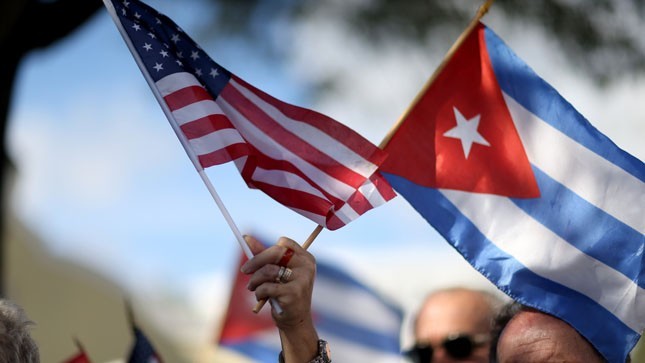
The Cuban government must move toward enacting greater freedoms for its people and giving Americans something in return if it wants to keep warmer U.S. relations initiated by President Barack Obama, top aides to President-elect Donald Trump said Sunday. The comments by Trump advisers Kellyanne Conway and Reince Priebus followed the death of former Cuban leader Fidel Castro. Castro’s younger brother, 85-year-old Raul Castro, took control in 2006, and later negotiated with Obama to restore diplomatic relations. Priebus, Trump’s incoming chief of staff, said Trump would “absolutely” reverse Obama’s opening to Cuba unless there is “some movement” from the Cuban government. “Repression, open markets, freedom of religion, political prisoners – these things need to change in order to have open and free relationships, and that’s what President-elect Trump believes, and that’s where he’s going to head, ” Priebus told “Fox News Sunday.” Conway made similar remarks and noted that any diplomatic deal will have to benefit American workers. “To the extent that President Trump can open up new conversations with Cuba, it would have to be a very different Cuba,” she told ABC’s “This Week.” She added: “He wants to make sure that when the United States of America, when he’s president, engages in any type of diplomatic relations or trade agreements … that we as America are being protected and we as America are getting something in return.” Conway said nothing on Cuba has been decided. But she noted that the U.S. is allowing commercial aircraft to do business with a repressive Cuban government and Cuban military. And she said the “first order of business” is to rally the international community around trying to free political prisoners. While Obama opened some U.S. investment and travel to Cuba through executive order, vast restrictions tied up in the trade embargo remain at the insistence of Republican lawmakers. Separate memorial services have been scheduled for Tuesday and later in the week in Cuba for Castro, and some world leaders and celebrities were expected to attend. As of Sunday, though, the White House had not said whether anyone from the U.S. government would attend. Republican Sen. Marco Rubio of Florida, whose parents were born in Cuba, says he is heartened by Trump’s past hard-line rhetoric on Cuba. Rubio told CNN’s “State of the Union” that the U.S. focus must be its own security and other interests and encouraging a Cuban democracy. “We should examine our policy toward Cuba through those lenses,” he said. “And if there’s a policy that helps that, it remains in place. And if it’s a policy that doesn’t, it’s removed.” During the campaign, Trump said he would reverse “concessions” to the Cuban government by Obama unless the Castro government meets his demands. On Saturday, while Obama offered condolences to Castro’s family and said the U.S. extends “a hand of friendship to the Cuban people,” Trump tweeted: “Fidel Castro is dead!” Trump later released a statement noting his administration “will do all it can to ensure the Cuban people can finally begin their journey toward prosperity and liberty.” Republished with permission of the Associated Press.
