
In White House math, certain places offer clues on outcome
Did Donald Trump succeed in at last winning over college-educated whites uneasy with the billionaire reality TV star? Did he drive a wave of working-class white voters? Did Hillary Clinton rebuild Barack Obama‘s winning coalition – young voters, urban liberals and minorities – while picking off moderate Republicans? Those questions are central to who will win Tuesday’s presidential election, and a handful of locales could provide some early answers on election night. The Associated Press has identified 10 counties seen as bellwethers for the Trump and Clinton strategies. All come from battleground states in the eastern time zone, where polls close the earliest. Their importance was determined from conversations with Republicans and Democrats, as well as AP’s own analysis. A look at the 10 counties: FLORIDA: In 2012, Obama won by about 74,000 votes (0.9 percentage points): DUVAL This Republican-leaning county, home to Jacksonville, has a solid white majority and sizable black minority, making it look more like the Deep South than south Florida. So a movement in Trump’s favor would mean returns closer to 2004, when George W. Bush won by 60,000 votes, than 2012, when Mitt Romney finished just 16,000 ahead of Obama. HILLSBOROUGH Bush and Obama each won Hillsborough (Tampa) twice, and both are two-term presidents. What makes Hillsborough stand out in 2016 is a growing Mexican-American population. There are already signs that Trump’s hard-line immigration stance is driving up the Hispanic vote: A quarter of the Hispanics who cast ballots in the opening days of early voting hadn’t voted at all in 2012. An expanded electorate (543,000 voted here in 2012) that is less white would benefit Clinton. MIAMI-DADE In Florida’s most populous county, older Cuban-Americans fuel Republicans (333,000 votes in 2012), while younger Cuban-Americans, other Hispanics and black voters drive Democratic totals (541,000 in 2012). If Clinton lags Obama’s vote totals with black voters, it could show up here. Trump, meanwhile, could struggle to match the usual Republican performance among Cuban-Americans. Watch for whether Trump’s Miami-Dade vote totals lag far behind those of Sen. Marco Rubio, a favorite among his fellow Cuban-Americans. — NORTH CAROLINA: In 2012, Obama lost by 92,000 votes (2 percentage points): NEW HANOVER Registered Republicans and Democrats are split almost evenly in Wilmington and surrounding New Hanover County, while independents have risen by 10,000 voters since 2012 to outnumber both parties. Obama lost here by 1.5 percentage points in 2008 and slipped to a 4.5 percentage point deficit in 2012. The margin Tuesday could signal how independents are breaking statewide and beyond North Carolina. WAKE In the state’s most populous county, the ranks of voters with no party affiliation have grown by almost 50,000 or 24 percent since 2012, while Republican and Democratic registrations have remained roughly level. How those new voters break in a county Obama won by 56,000 votes (11 points) will help determine the statewide outcome and could portend the leanings of urban independents elsewhere. WATAUGA This is one of the few nearly all-white counties in the country that split on Obama’s two elections. He won by 4 percentage points in 2008, but his vote totals slipped 13 percent in 2012, resulting in a 3-point loss. Appalachian State University in Boone anchors the population, which is more educated than the broader North Carolina electorate and includes thousands of students – key Clinton targets. Beyond campus, Watauga has lower income averages and a higher poverty rate, offering Trump an opening. — OHIO: In 2012, Obama won by 166,000 votes (3 percentage points) BELMONT This is one of three Ohio River counties Obama won in 2008 but lost in 2012. The county is more than 90 percent white. Fewer voters are college-educated than in the general population and median incomes are lower than the national marks – all factors that play to Trump’s strengths. He won here easily in the Republican primary, trouncing home-state Gov. John Kasich. Obama’s vote slipped 13 percent to about 14,000 here in his re-election campaign, while the Republican total climbed 8 percent to almost 17,000. Those totals alone won’t flip Ohio to the Republican column, but an uptick for Trump in Belmont could herald gains in similar-profile counties across the state, which has a higher proportion of working-class whites than other battlegrounds. HAMILTON This diverse county, home to Cincinnati, has pockets of everything both candidates are looking for. The city has a large black population. The surrounding areas have college-educated independent and Republican whites Clinton wants, along with working-class whites likely to back Trump. Obama got 225,000 and 220,000 votes here, winning each time by about 6 percentage points. A tighter margin would bode well for Trump. — PENNSYLVANIA: Obama won in 2012 by 310,000 votes (5.4 percentage points): CHESTER Obama lost by 0.2 percentage points in 2012, the only metro Philadelphia county he lost after sweeping the metro area in 2008. The Chester population is overwhelmingly white, almost half have college degrees and median income exceeds the national mark. All that makes this county a prime indicator of how Trump is faring among suburban voters who typically back Republicans but are skeptical about Trump. PHILADELPHIA In Obama’s re-election, his margin in Philadelphia County was much wider than his statewide margin. As rural and small-town counties trend more Republican, the pressure will be on Clinton to replicate that roughly 6-to-1 cushion approaching a 500,000-vote advantage. Republished with permission of the Associated Press.
The Latest: Republicans confident Trump will win Alabama

The Latest on Alabama elections (all times local): 8:25 a.m. Voting is underway in Alabama and Republicans are confident that Donald Trump will win the state. Democrat Hillary Clinton and Trump both visited Alabama during their respective primary battles, but both candidates have concentrated their efforts on battleground states. Secretary of State John Merrill has predicted a record number of voters will cast ballots Tuesday after voter registration hit a record high of 3.3 million. None of Alabama’s four U.S. House races or the lone Senate race on the ballot are expected to be very close given the name recognition and vast amounts of campaign money available to the Republican incumbents. Alabama voters also face 14 amendments that will affect everything from state parks to the age of public officeholders to beer. The polls will remain open until 7 p.m. 2:58 a.m. Donald Trump is expected to win Alabama, which has gone Republican in every presidential election since voting for Jimmy Carter in 1976. Republicans are confident in the deeply red state as polls open Tuesday. Democrat Hillary Clinton and Trump both visited Alabama during their respective primary battles, but both candidates have concentrated their efforts on battleground states since securing their respective party nominations. Following in their paths, volunteers from both parties have been dispatched to campaign in neighboring Florida where the race is considerably tighter. Secretary of State John Merrill has predicted a record number of voters will cast ballots Tuesday after voter registration hit a record high of 3.3 million. Polls are open Tuesday from 7 a.m. until 7 p.m. Republished with permission of the Associated Press.
Lines at voting precincts as polls open in Alabama
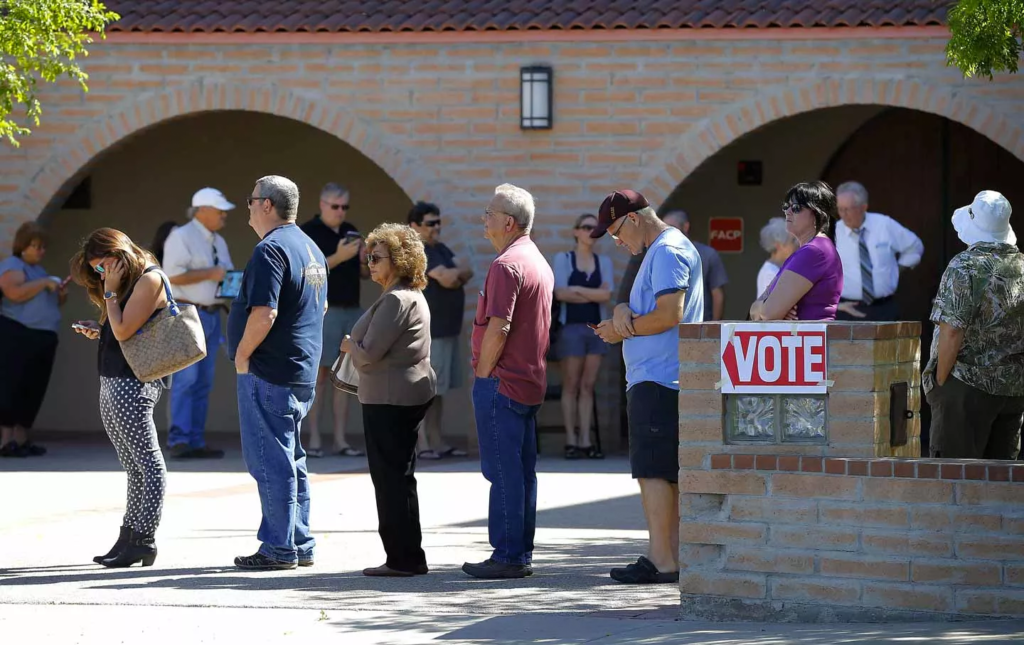
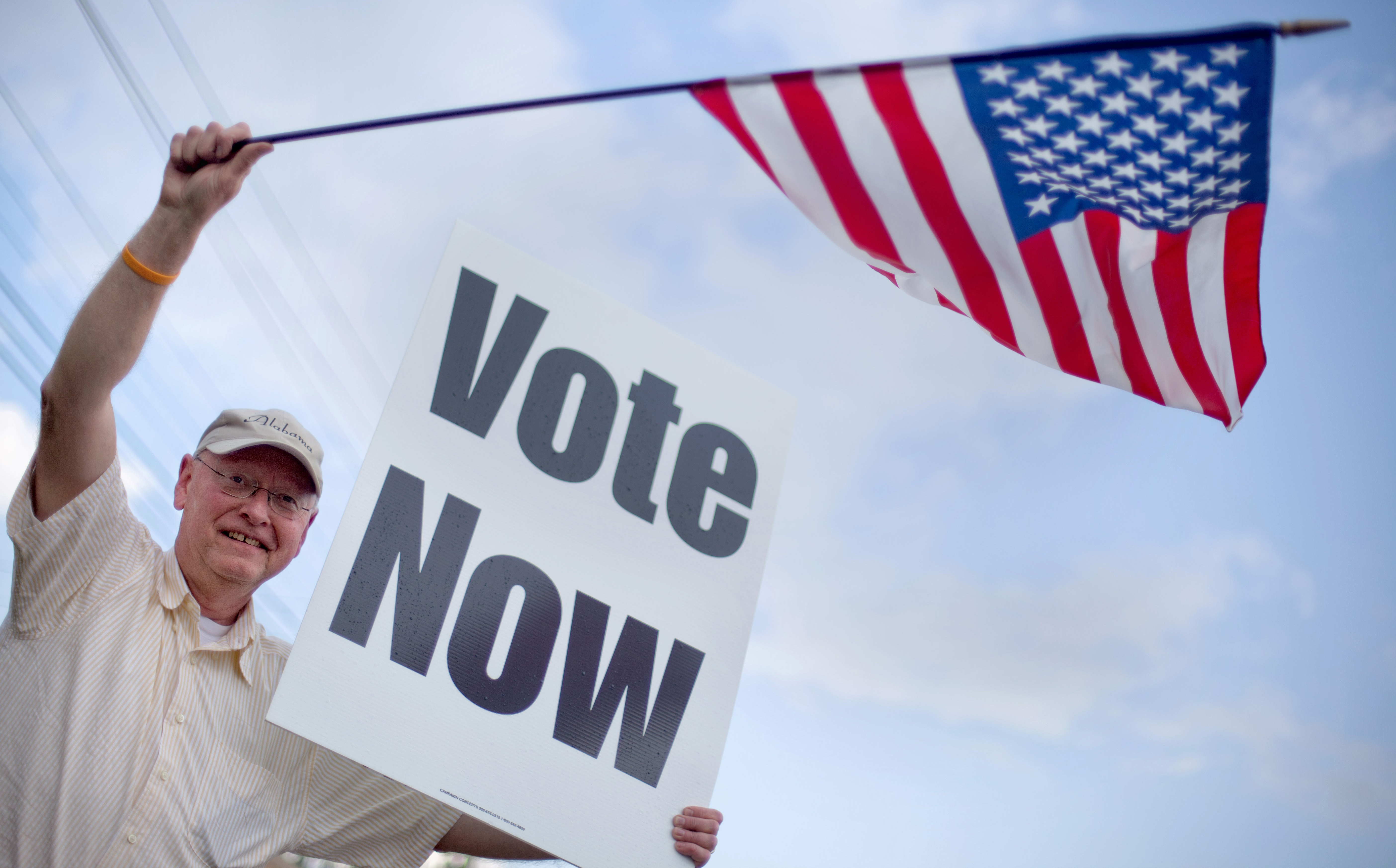
Lines stretched across fields and parking lots as polls opened in Alabama on Election Day. Officials are expecting big crowds after a rough-and-tumble presidential race, and those early predictions looked accurate. Rain won’t be a deterrent to potential voters, as forecasters predicted another dry day Tuesday amid a drought that has parched the state. Republican Donald Trump is a heavy favorite to carry the state over Democrat Hillary Clinton in the race for the White House, but other races and issues also will be decided. The ballot includes four U.S. House seats plus a U.S. Senate race, and voters will decide 14 statewide amendments. Here is a glance at some of the issues and questions on Election Day 2016 in Alabama: — HISTORY ON TRUMP’S SIDE Trump will carry Alabama over Clinton without a struggle if history and past voting patterns are an indication. Georgia peanut farmer-turned governor Jimmy Carter was the last Democrat to carry Alabama in a presidential election, and that happened in 1976. No Democrat has come very close since then to winning the state’s nine electoral votes, and the trend is getting worse for the party. Democratic presidential candidates have been stuck below 40 percent of the total vote in Alabama since 2000, when Tennessean Al Gore took nearly 42 percent of the vote compared to Republican George W. Bush. It will be interesting to see how Clinton fares compared to Democratic President Barack Obama, who carried 38 percent of the vote and lost Alabama by 22 percentage points to Republican Mitt Romney in 2012. — WHERE DO I VOTE? State election officials are predicting a possible record turnout by Alabama’s 3.3 million registered voters, but what if people are unsure where to vote? A phone call or a few mouse clicks can clear up that confusion. Voters who aren’t sure where to go on Election Day can call their county registrar’s office — the numbers are in the phone book, and most if not all are available online for Alabama’s 67 counties. For people with internet access, the website alabamavotes.gov may be a better solution. The site is operated by the secretary of state’s office. Residents can verify their registration to vote with a simple search at alabamavotes.gov, and another search pulls up information about voting precincts including addresses and polling times. At the same site, search panes also are available to view sample ballots for each county and to check the status of provisional and absentee ballots. — EYE ON VOTER INTIMIDATION Alabama’s top election agency said it won’t tolerate any attempts to intimidate voters on Election Day. A statement from the secretary of state’s office says anyone caught trying to dissuade others from voting on Tuesday will be prosecuted. Both Republican and Democratic campaigns often have volunteers serving as poll watchers. The statement from the secretary of state says poll watchers can’t disturb voters, try to influence them, campaign, or display any campaign material inside the polling place. Polls were open statewide from 7 a.m. until 7 p.m. — PHOTO ID REQUIRED This year marks the first time Alabama’s Republican-backed law requiring photo identification at the polls comes into play during a presidential election. Alabama requires voters to show photo ID such as a driver’s license, a passport, an Alabama non-driver ID, a university student ID or identification issued by the federal government. Voters without ID can still vote by regular ballot if they are positively identified by at least two election workers as being eligible to vote in a precinct. And voters who don’t have a valid ID will still be able to cast a provisional ballot. — CONSTITUTIONAL AMENDMENTS There’s a lot of fine print on Alabama ballots, and most of it spells out 14 statewide proposals to amend the state’s 1901 Constitution. The outcome will affect everything from state parks to the age of public officeholders to beer. Four of the amendments apply only to single counties. Here is a look at some of the other measures that have gotten the most attention: Amendment 2 aims to protect money for state parks and open the door to private companies getting more involved in park operations. The proposal specifies that park money can’t be diverted to other government functions unless revenues exceed $50 million. It would also allow private entities to run facilities at state parks. Amendment 8 guarantees that everyone has a right to work in the state regardless of whether they’re in a labor union. It mimics a state law already on the books. Amendment 13 would eliminate maximum-age limits for elected or appointed office with the exception of judicial offices. Trustees at public universities would be most likely to be affected. Amendment 14 would prevent hundreds of local laws — from sales taxes to draft beer rules — from being tossed out because of a dispute over legislative procedures in Montgomery. — CONGRESSIONAL RACES None of Alabama’s four U.S. House races nor the lone Senate race on the ballot is expected to be very close given the name recognition and vast amounts of campaign money available to the Republican incumbents, but there could be an exception. In the 2nd District of southeast Alabama, Rep. Martha Roby has faced a backlash by Trump supporters since publicly stating she wouldn’t support the GOP nominee because of his recorded comments about grabbing women. Democrat Nathan Mathis is hoping to capitalize on that dynamic, and Tea Party organizer Becky Gerritson is being promoted as a write-in candidate. On the Senate side, Republican incumbent Richard Shelby isn’t likely to have much problem against Democratic challenger Ron Crumpton, who is best known as an advocate for legalizing medicinal marijuana in the conservative state. Republished with permission of the Associated Press.
Analysis: Winner must help heal wound in American politics
We’ll know soon enough who won. We already know the prize: A big, ugly wound in the heart of American politics. Nearly two years of relentless campaigning and racially loaded rhetoric has exposed a country that is deeply fractured along lines that are hardening and raw. Race, gender and class appear to be ever more reliable predictors of whether Americans cast their ballots for Donald Trump or Hillary Clinton. And as Americans have retreated further into their corners, politicians have seen little motivation to understand the other side. The dynamic just played out, while America (and the world) cringed. This campaign often looked like a noisy and incoherent conversation taking place in parallel worlds, with Donald Trump and Hillary Clinton shouting across a daunting gulf between them. It may have been a race filled with unpredictable moments, but its near certainties are just as notable. As she heads into Election Day, Clinton is on track to win solid, and in some cases overwhelming majorities, of black, Hispanic and college-educated voters. Polls show Clinton, running to be the first female president, may also hit new levels of support among women. Trump, meanwhile, has been propelled by support from white, working-class voters, a group that according to polls may reject Clinton more decisively than any of her recent Democratic predecessors. These splits between whites and minorities, between men and women, between those with college degrees and those without, did not begin in 2016. Clinton’s coalition is likely to look much like the one President Barack Obama assembled in 2008 and 2012, and has its roots much deeper. But 2016 will be the year when the gaps widened, the lines hardened and the conversation, in turn, became more painful. It will be remembered as the time when a Republican candidate could call American cities “warzones” without apparent worry about the feelings of the people who call them home. It will be remembered as the election in which Clinton described half of Trump’s supporters as a “basket of deplorables,” and apologized only for her measurement. It will be remembered as a moment when Trump’s closing argument was that “everything’s wrong,” while Clinton asked “since when do we become pessimistic?” It’s hard not to blame Trump’s button-pushing candidacy for much of this strangeness. The Republican nominee’s bid made a mockery of party elders’ “autopsy” of the 2012 defeat of Mitt Romney, which bemoaned that the GOP “offends too many people unnecessarily.” But the party’s base nominated a man who questioned the legitimacy of the first black president. They chose a candidate who declared that Mexico was sending “rapists” across the border. They chose a 70-year-old reality-TV star who spent years making sexist remarks. The interviews should have given hints about Trump’s attitudes toward women, even before the tape in which he brags about grabbing women’s genitals. Trump’s fate now rests in the hands of the very people he’s offended. If blacks, Hispanics, young people and women turn out in large numbers, it becomes exceedingly difficult to find enough of his voters to win the day. Roughly 45 percent of the electorate are non-college educated white, the core of Trump’s base, noted Brookings Institution demographer William Frey. And that share is shrinking. They made up 50 percent in 2008, he said, and 57 percent in 2000. But Trump’s willingness to risk saying the thing others would not has no doubt connected with a substantial share of America’s voters. The New York businessman saw the opportunity to run against his party and those wanting to restore America to a lost moment. “I watch the speeches of these people, and they say the sun will rise, the moon will set, all sorts of wonderful things will happen. And people are saying, “What’s going on? I just want a job. Just get me a job. I don’t need the rhetoric. I want a job,” he said from the lobby of his Trump Tower high rise, when he announced his campaign. If Trump wins, it will be because he understood the depths of white anxiety. It will be because he galvanized the alienated and the angry, in corners of the country where people have felt ignored through eight years of the Obama administration. Democrats acknowledge they may have left Trump this opening. For much of her campaign, Clinton had all but given up talking to white, working class men. That was for surrogates like her husband, Bill Clinton, Vice President Joe Biden, both masters of communicating to “Bubba” voters – and even Obama. On Monday, Clinton began to acknowledge the work she had ahead of her. “Anger is not a plan, my friends,” she said. “If we’re going to harness our energy and try to overcome our problems, then we need to start talking to each other again.” Republished with permission of the Associated Press.
Watching Tuesday: America does the wave, east coast to west
Grab some snacks, the TV remote, your calculator and a schedule of poll closings. You might also want to caffeinate because it could be a late night. The tumult and tedium of Campaign 2016 finally culminates Tuesday as the nation chooses among Hillary Clinton, Donald Trump and a variety of third-party types. The action will roll from east coast to west, from pre-dawn voting in New Hampshire to late-night poll closes in Alaska. Some things to watch for as the autumn of our campaign discontent hurtles to a close (all times are EST): THE TIMELINE Look for the first burst of results when polls close at 7 p.m. in Georgia, Indiana, Kentucky, South Carolina, Vermont and Virginia. Look for bigger blasts of numbers just after 8 p.m. and 9 p.m., when polls close in a combined 30 states and the District of Columbia. The 11 p.m. batch of states includes big kahuna California, with 55 electoral votes. Alaska, where polls close at 1 a.m. on Wednesday, brings up the rear. — MOM WAS RIGHT Math really does matter. Election Day is all about which candidate can win enough states to get to 270 electoral votes. News organizations will keep a running tally. But you can go full nerd and play around with a Road to 270 calculator to get your favored candidate to the magic number. Beware: It can take a while for the picture on election night to clarify, simply because of how the vote rolls in across the country. In 2012, Republican Mitt Romney was still ahead in the electoral and popular vote at 10:30 p.m.; an hour later, President Barack Obama was on the brink of re-election. — NEW YORK, NEW YORK Thanks to early voting, more than 50 million people may have voted before Election Day. Not Clinton or Trump. Both are expected to make a show of trekking to their local polling places on Tuesday, Clinton in Chappaqua, New York, and Trump in New York City. Their running mates – Democrat Tim Kaine of Virginia and Republican Mike Pence of Indiana – will vote where they live, and later team up with their principals in New York. — EARLY TEA LEAVES For an early read on how things are going, keep an eye on Virginia in the presidential contest. If Clinton doesn’t get a winner’s call there by 9 p.m. or 10 p.m., it could be a positive sign for Trump. Watch Indiana for an early indicator in the tug-of-war for control of the Senate; if Evan Bayh can manage a comeback, that’ll be a good sign for Democrats hoping to retake the Senate. — EXIT POLL EXPLANATIONS Data collected from polling-place interviews with voters will offer a wealth of information to help explain why people voted the way they did. Among the questions to be answered by the exit polls: Do voters cast ballots for their candidates enthusiastically or holding their noses? Do blacks give strong backing to Clinton after recent worries about their turnout in early voting? Who wins college-educated whites, who typically skew Republican but are being courted by Clinton? In a race so often roiled by Trump’s comments about women, what does the gender gap look like? Did people care about Clinton’s problems with her private email setup? Were they worried about Trump’s temperament? — UTAH. REALLY. The reddest of the red states actually offers some drama this year. Keep an eye on the Utah vote for independent Evan McMullin, who’s been giving Trump heartburn in a state that should be a lock for him. (Polls close at 10 p.m. EST) — MAKING HISTORY If Clinton emerges the victor, it will be a historic moment for women as she shatters that “highest, hardest glass ceiling.” — THE BIG QUESTION The question has been dangling out there: Will Trump accept the results of the presidential election if he loses? “I’ll keep you in suspense,” he said at the last debate. The world is waiting for his answer. — A TIME TO HEAL Election night speeches have “tremendous power to heal,” says public speaking coach Ruth Sherman. Will the candidates rise to the moment? After such a long, ugly campaign, both winner and loser will have a responsibility to help to bring the country together. — WAIT, THERE’S MORE! The presidential race has sucked up most of the oxygen over the past year, but there will be lots more to take in on election night, with control of the Senate and House at stake, 12 states electing governors, and assorted ballot proposals around the country. In the House: Republicans hold a 247-188 majority, including three vacancies. Democrats could pick up 10 or more seats, perhaps even more than 20, but don’t expect to take control. In the Senate: Republicans are furiously working to protect their 54-46 majority, with a half-dozen races seen as toss-ups. A dozen governor’s offices also are up for grabs, at least seven appearing competitive. Among issues on ballot proposals: the death penalty, gun control and marijuana legalization. Republished with permission of the Associated Press.
The U.S. turns a corner in Tuesday’s election
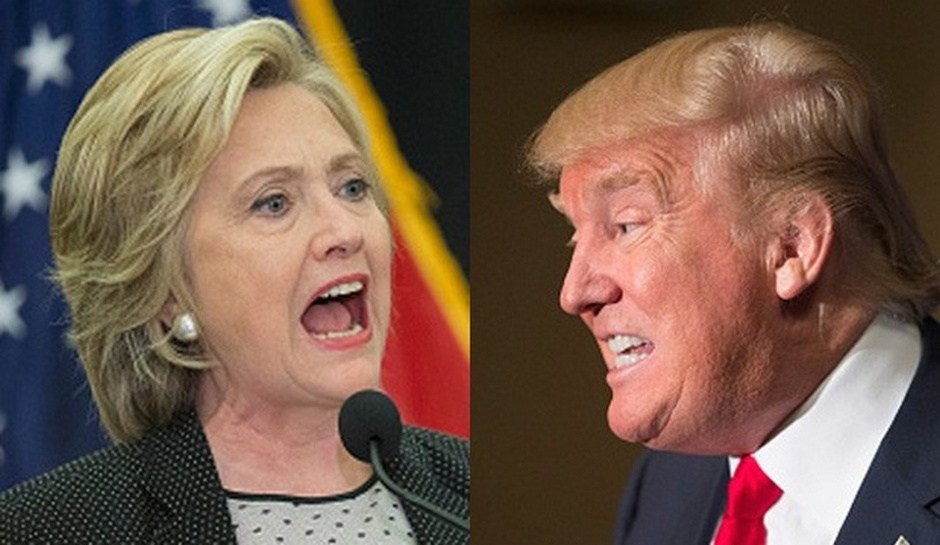
Americans are choosing a new president Tuesday, but not just that. They are making history, reshaping Congress, saying good riddance to a campaign of numbing negativity and setting the political calculus of a nation that won’t be healed any time soon. Whether the glass ceiling shatters or not, precedent will. Never before has the country had a woman as president, not to mention the spouse of an ex-president. Never before has the country had a president like, well, Donald Trump, unique in lacking the public-service background that everyone in our lifetimes and deeper into the past brought to the office (both his weakness and his strength). Whether the 45th president is Hillary Clinton or the billionaire outsider, the U.S. is turning a corner. CLINTON vs. TRUMP The two New Yorkers pounded each other relentlessly, each preaching that the other is wholly unqualified, as the race tightened in the final days after a persistent if elastic lead for Clinton, the Democrat, in preference polling. Those who dreamed of Bernie Sanders for the Democratic ticket or anyone but Trump for Republicans face their time of reckoning. Will they come home to their party, or just stay home? Clinton, inheritor of Barack Obama‘s vaunted campaign apparatus and a skillful (and well-financed) organizer in her own right, fielded an impressive professional and volunteer operation. She had big names on the stage, loads of people tracking down supporters and getting them to early-voting places, committed and well-heeled interest groups behind her and lots of money for sustained advertising. Trump’s effort paled in comparison, seeming as unpolished and improvised as the candidate himself. What he had, that she didn’t, were the pulse and the passion of huge crowds. Election Day should settle the question of which counted for more. To those in Trump country, no boastful, stomach-turning video about women, no “lock-her-up” insult from the stage, no toxic tweet in the wee hours, could peel them away from the man whose crudities only made him more authentic in their eyes. To many of the Republicans who didn’t come to the rallies – and to some of the lawmakers who faced the prospect of working with him in Washington – he was a disaster, a Republican Titanic sailing alongside Clinton’s Democratic Lusitania. To the country at large, and much of the world, he polarized, repelled, entertained, shocked and fascinated. Did that make Clinton less of a divisive figure? Not to the Republicans who are already itching to impeach her if she wins. — WHAT TO WATCH Virginia could be a harbinger for the night. An early win for Clinton in that state bodes well for her; a contest that drags on until 9 p.m. or 10 p.m. EST could mean a good night for Trump. Results begin to come out when polls close at 7 p.m. in Georgia, Indiana, Kentucky, South Carolina, Vermont and Virginia. More waves come just after 8 p.m. and 9 p.m., when polls will have closed in 30 states and the District of Columbia. Trump and Clinton fought fiercely over Florida, a big prize. Trump also made an audacious play for Minnesota and scared Clinton in Michigan, which drew both the Democratic nominee and President Barack Obama on the campaign’s final day. Republicans fretted about Utah, normally as GOP-friendly as can be. The state was courted by an independent who tapped anti-Trump sentiment among the state’s many Mormons. — FIZZLING OCTOBER SURPRISE FBI Director James Comey‘s disclosure that the agency discovered more emails potentially connected to its investigation of Clinton’s email practices roiled the race. That shadow lifted when Comey said Sunday that the review had found nothing to change the FBI’s recommendation in July that she not face charges. Between his two announcements, though, nearly 24 million ballots were cast in early voting. — SENATE SUSPENSE The night’s second big mystery is which party will control the Senate, now Republican dominated. Democrats need to gain five seats to take an outright majority. If they gain only four – and if Clinton is elected – her vice president will be able to break 50-50 Senate ties. Indiana could give an early hint of where the night is going. Nevada, New Hampshire, Pennsylvania, Missouri and North Carolina could tip either way. Republican incumbents were in particular danger in Illinois and probably Wisconsin. The math made it tough for the GOP: Republicans had to defend 24 seats compared with only 10 for the Democrats. Some were between a rock and a hard place – risking rejection from anti-Trump Republican voters if they were too close to him and rejection from his core supporters if they pushed him away. Squirmy rhetoric ensued. — HOUSE HUNTING Barring a shocker, Republicans will keep control of the House. They populate that chamber in numbers not seen since the 1930s. The breakdown is 247-188 for the GOP, with three vacancies. GOP losses of 10-15 seats have been predicted by people in both parties. Notable names: Republican Liz Cheney is expected to win the Wyoming seat once held by her father, Dick Cheney. GOP Rep. Darrell Issa of California, investigator of the Benghazi, Libya, episode and other Obama administration actions, could be upended. — RESUME REVIEW Rare is the U.S. president who has come to office without having held any previous public office. To be sure, some were branded resume lightweights in their campaigns: ex-governors George W. Bush of Texas, Bill Clinton of Arkansas and Ronald Reagan of California, among them. But they came from the tradition of having served somewhere – whether in Congress, states or in a high post in an administration. Dwight D. Eisenhower had no political experience but plenty of leadership cred – as well as war hero status – as allied commander in Europe in World War II. Trump comes purely from the business and reality-TV worlds, making him distinctly a political outsider even if he’s firmly part of the elite. No one questions Clinton’s breadth of experience, as secretary of state, a New York
What’s ahead for Donald Trump? Some clues from the campaign
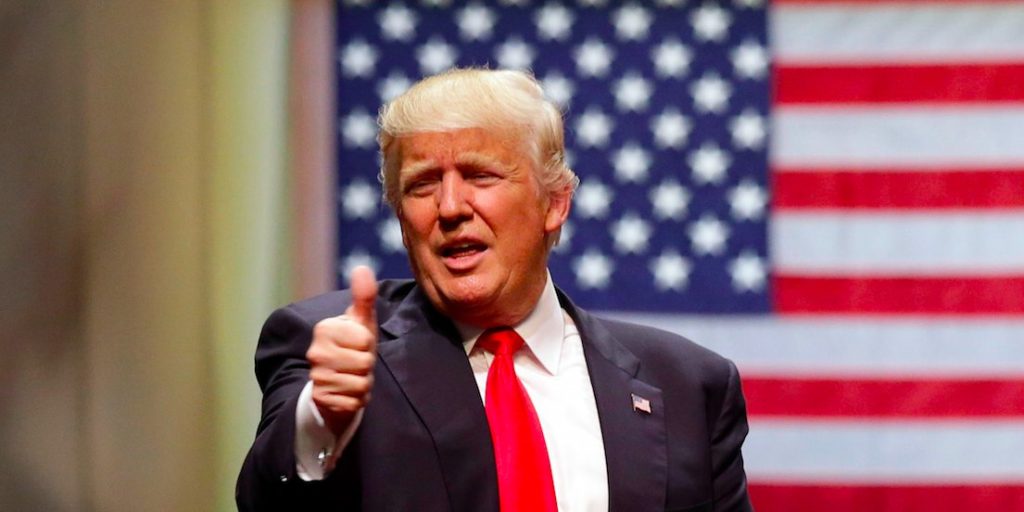
In a campaign for president packed with moments to remember, and more than a few decisions to forget, there are some that will resonate for Hillary Clinton and Donald Trump on Election Day. Here’s a look at five key points in Trump’s race for the White House that offer clues about what will happen as the campaign comes to its conclusion. — IMMIGRATION The Republican National Committee’s “autopsy” of Mitt Romney‘s 2012 loss urged that the GOP reach out to minority voters, in part by passing immigration reform. Trump had other ideas. In the first moments of his candidacy, Trump said that Mexican immigrants were “bringing drugs, they’re bringing crime, they’re rapists, and some, I assume, are good people.” He pledged to build a southern border wall, putting a hard-line immigration policy at the very heart of his campaign. The decision electrified a swath of the Republican base, many of whom felt immigrants had taken their jobs and threatened their position in society, and led to “Build the wall!” chants becoming a staple of his signature rallies. But while the plan helped separate Trump from the crowded Republican primary field, Democrats used it as means to mobilize Latino voters, and early voter turnout among Hispanics surged in battleground states like Nevada and Florida. — POPULIST MESSAGE A billionaire who lives in the penthouse of a Manhattan skyscraper that bears his name is an improbable choice to be a champion of the working-class. But Trump settled on a populist rhetoric, denouncing trade deals that he says have particularly hurt Rust Belt workers and tailoring his message to white-working class voters. That pitch has allowed Trump to play in traditionally Democratic strongholds in the Midwest; most polls have him close in Michigan, Ohio, Iowa and Pennsylvania. And, win or lose, it threatens to reshape his adopted party, potentially splintering the Republican’s working class base from the GOP establishment. — UNCONVENTIONAL CAMPAIGNING During the Republican primaries, Trump boasted that he was self-funding his lean campaign operation. While that was not entirely true, it foreshadowed Trump’s decision to run a small, unorthodox campaign that frequently pitted advisers against each other and he went through three campaign managers. He eventually reluctantly embraced fundraising, and while he proved skillful at collecting small donations, he was left far behind Clinton’s financial behemoth. Moreover, the campaign’s decision to largely outsource its voter outreach efforts to the Republican National Committee, which is not as robust as the joint Clinton-Democrats operation, could leave him at a disadvantage in turning out supporters to the polls. — PICKING FIGHTS Trump emerged from his party’s annual convention in Cleveland in July with a momentum and a- mostly- unified party behind him. But the following week, Khizr Khan took the stage at the Democratic National Convention. Khan praised his soldier son, who was killed in Iraq in 2004, and while waving a copy of the Constitution, denounced Trump’s plan to ban Muslim immigrants from entering the U.S. Trump lashed out, attacking both Khan and his wife – whom he suggested was forbidden from speaking in public due to her religion – in interviews and on Twitter, drawing bipartisan condemnation and opening a fault line with some military families, normally reliable Republicans. He made a similarly reckless decision after the first debate, during which Clinton mentioned a former Ms. Universe, Alicia Machado, who says Trump belittled her appearance. Trump couldn’t resist taking the bait, attacking Machado during a 3 a.m. “tweet storm.” The fight, which contributed to a plunge in the polls, underscored Trump’s difficulties with women and Latino voters. — PROBLEMS WITH WOMEN From the beginning, the reality TV star struggled with winning over women. The thrice-married businessman, whose personal life was fodder for the New York tabloids for decades, had very public, insulting feuds with female celebrities like Rosie O’Donnell and was known for describing women by their appearances, often in unflattering terms. And then things got dramatically worse. Last month, a 2005 video emerged of Trump riding on an “Access Hollywood” bus with then-host Billy Bush while using vulgar terms to describe women and talked about how his fame allowed him to force himself on women. And then in the aftermath of the second presidential debate, nearly a dozen women came forward and accused Trump of kissing or grabbing them without consent. Trump has denied the charges and threatened to sue his accusers – but his poll numbers with women only sank further. Republished with permission of the Associated Press.
Making a choice: Voters talk of decision and of tensions
Election Day has arrived at last, and Americans are heading to the polls to have their say in the choice of the next president. Some paused to talk about their decisions and the tensions of the moment. — Thomas Tillotson and Russ Van Deursen differed when they voted for president early Tuesday in Dixville Notch, New Hampshire, one of the first polling sites to open in the nation. But they were in solid agreement on one thing. “It’s very exciting to be the first in the nation,” said Van Deursen.”Your vote is right out there in the small little hamlet that we have of seven or eight voters and it feels like you’re a real part of democracy.” He voted for Democrat Hillary Clinton because “our country needs to move forward and I didn’t believe that a presidency with (Republican) Donald Trump would move forward in a positive way.” Polls in the town opened just after midnight closed as soon as everyone had voted. “It’s an honor and privilege to be first and this is my 11th time doing it and it never gets boring,” said Tillotson, a 71-year-old business consultant who voted for Libertarian Gary Johnson. He said both major parties have “gone in directions that really don’t fit who I am and what I believe.” — When Art Meadowcroft exited city hall in Plymouth, Minnesota, Monday after casting an early ballot, he reached into his pocket for a camouflage cap bearing Donald Trump’s slogan, “Make America Great Again,” and placed it on his head. “It was a tough decision because he certainly had his very rough sides,” Meadowcroft, 62, said of Trump, his choice for president. “But I don’t think there is a question mark when it comes down to what is in his heart and what he wants for the country.” Meadowcroft, a former college administrator, coach and real estate agent who is now retired, came to vote with his sister, bringing sandwiches to pass the time in a long line. A self-described independent, he said he’d voted in the past for Democrats, including once for Bill Clinton. But he voted for Trump because it is time to get back to the “true values” of the country. Meadowcroft said he believes firmly in immigration. But he wants better vetting to ensure “the right people are coming in, people that want to grasp our values… I think we’ve opened the doors too much, and made ourselves vulnerable.” — This election marks the first time that sisters Yadira and Catherine Jimenez have voted. They cast early ballots in West Jordan, Utah, and had no hesitation about their choice. Both voted for Hillary Clinton. For Yadira, whose husband has lived in the U.S. since he was a toddler but is not a citizen, the vote was partly a reaction to Donald Trump’s hard line on immigration. But the sisters, both young mothers and pregnant, said they also wanted to signal their approval of a woman as the country’s leader. “I thought it would be nice to be alive to see the first lady president,” said Yadira Jimenez, 24, who works the front desk at a pediatrician’s office and is expecting her first daughter. “It shows you can achieve anything in life and that not just men are capable of becoming president. I want to show my children that anybody can do anything as long as they work hard.” She and her sister said it was important that the winning candidate be someone who cares about people like them. But Trump is definitely not that person, they said. “He’s racist not only to Latinos, but to pretty much every race,” said Catherine Jimenez, who is 20 and studying to be a medical assistant. — Hallie Luckianow says she considered voting for either Hillary Clinton or Donald Trump. With a father who works in an oil industry hit by sagging prices, she was drawn to Trump’s America-first policy on energy. As a lesbian, she says she likes Clinton’s vocal support for gay rights. But Luckianow, taking a lunch break Monday in a Birmingham, Alabama park, said in the end she cast her vote for what she sees as a centrist choice. “I’m kind of pulled in both directions and that’s why I’m going to Gary Johnson. Because this entire election has been crazy,” said Luckianow, 27, a speech therapist. Luckianow said she liked the notion of electing the nation’s first female president. But she figures that time will come soon enough, even if Clinton loses. “I think it would be really empowering for women and empowering for little girls to see that someone other than a white male or a black male could be president,” Luckianow said. Republished with permission of the Associated Press.
New Hampshire delivers the very first Election Day results (Donald Trump took the lead)
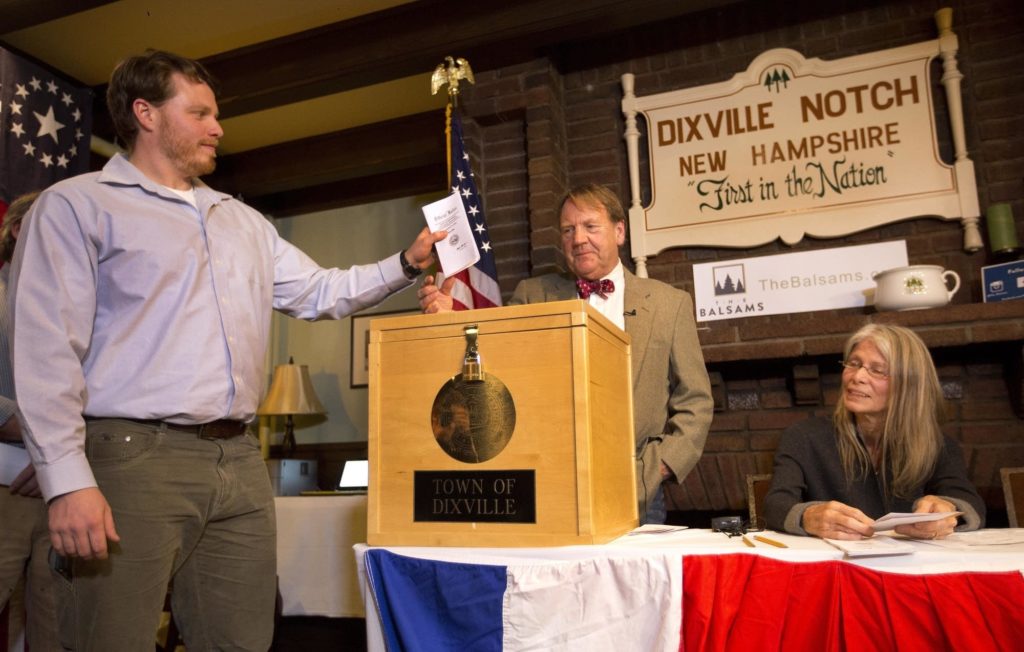
Donald Trump is off to a very early lead in the 2016 presidential election, winning over the voters of three New Hampshire precincts by a 32-25 margin over Hillary Clinton. Polls in the tiny New Hampshire towns of Dixville, Hart’s Location and Millsfield opened just after midnight Tuesday and closed as soon as everyone had voted. These die-hard voters are proud to have the first word on the big vote. Clinton won more votes in Dixville and Hart’s Location, but Trump was the overwhelming favorite in Millsfield, with a 16-4 edge. Libertarian Gary Johnson picked up three votes. Bernie Sanders, John Kasich and 2012 Republican presidential nominee Mitt Romney got write-in votes. Under New Hampshire state law, communities with fewer than 100 voters can get permission to open their polls at midnight and close them as soon as all registered voters have cast their ballots. Republished with permission of the Associated Press.
Elbowing each other all the way, Donald Trump, Hillary Clinton near finish
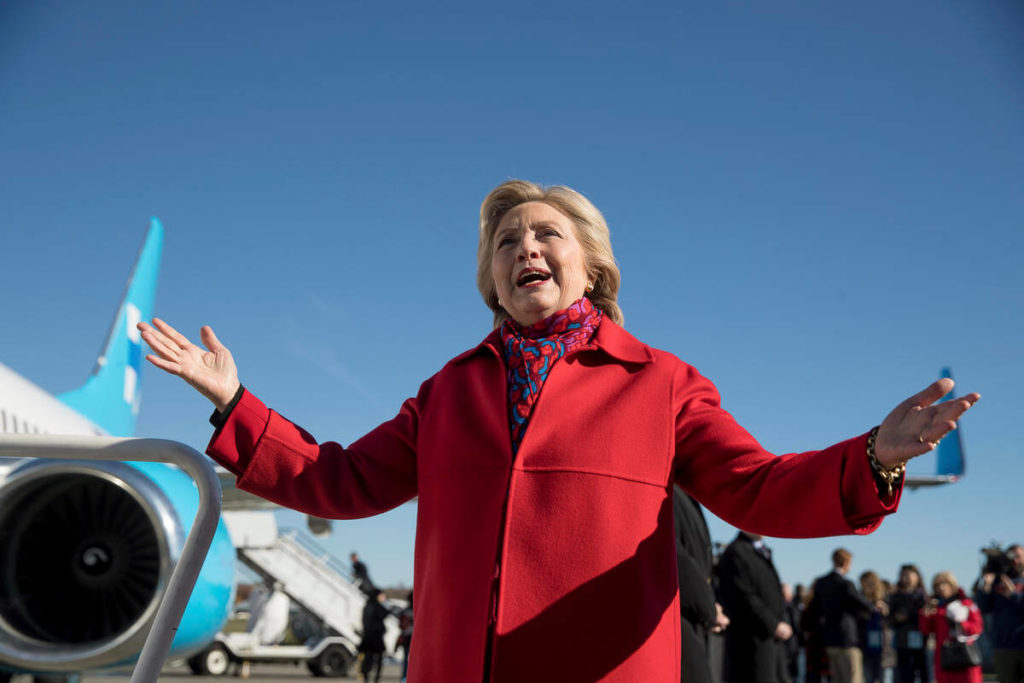
Closing out a wildly unpredictable White House race, Hillary Clinton and Donald Trump blitzed through battleground states Monday in a final bid to energize supporters. Clinton urged voters to embrace a “hopeful, inclusive, bighearted America,” while Trump called for supporters to “beat the corrupt system.” The candidates rallied voters late into the night, a frenzied end to a bitter election year that has laid bare the nation’s deep economic and cultural divides. Clinton campaigned with confidence, buoyed by FBI Director James Comey‘s announcement Sunday that he would not recommend criminal charges against her following a new email review. The inquiry had sapped a surging Clinton momentum at a crucial moment in the race, though she still heads into Election Day with multiple paths to the 270 Electoral College votes needed to become the nation’s first female president. “I think I have some work to do to bring the country together,” she acknowledged as she boarded her plane for her last battleground tour. “I really do want to be the president for everybody.” Looking beyond Election Day, Clinton said in a radio interview that she hopes Trump will play a “constructive role” in helping bring the country together if she defeats him. Trump at times struck a nostalgic tone during his final round of rallies, recalling the rivals he’d vanquished and how far he’s come. As he surveyed the crowd in Scranton, Pennsylvania, he declared, “It’s been a long journey.” Still, Trump was aggressive to the end, slamming Clinton as the “face of failure.” Having made the new FBI review a centerpiece of his closing case to voters, he argued that the Democrat was being protected by a “totally rigged system.” “You have one magnificent chance to beat the corrupt system and deliver justice,” Trump said. “Do not let this opportunity slip away.” The comments were a reminder that Comey’s news, delivered in a letter to lawmakers on Sunday, was a doubled-edged sword for Clinton. While it vindicated her claims that the emails would not yield new evidence, it ensured that a controversy that has dogged her campaign from the start would follow her through Election Day. Across the country, nearly 24 million early ballots were cast under the shadow of Comey’s initial announcement of a new email review. That number represents about half of the nearly 45 million people who had cast votes by Monday, according to Associated Press data. The inquiry involved material found on a computer belonging to Anthony Weiner, the disgraced former congressman and estranged husband of Huma Abedin, a longtime Clinton aide. Comey said Sunday the FBI reviewed communications “to or from Hillary Clinton while she was secretary of state.” Clinton tried to fly above the controversy Monday, making no mention of the FBI during her rallies. The centerpiece of her final day of campaigning was a nighttime event in Philadelphia with President Barack Obama and first lady Michelle Obama, along with rock stars Bruce Springsteen and Jon Bon Jovi. Nearing the end of his two terms in the White House, Obama was sentimental as he launched his own busy day of events, noting that he was probably making his last campaign swing for the foreseeable future. “Whatever credibility I have earned after eight years as president, I am asking you to trust me on this. I am voting for Hillary Clinton,” Obama said. Clinton is banking in part on high turnout – particularly among Obama’s young, diverse coalition of voters – to carry her over the finish line Tuesday. Roughly half the states with advance voting have reported record turnout, including Florida and Nevada, which have booming Hispanic populations, a possible good sign for Clinton. In Florida alone, Hispanic participation is up by more than 453,000 votes, nearly doubling the 2012 level. Black turnout is up compared to 2012, but that share of the total vote is lower due to bigger jumps among Latinos and whites, according to University of Florida professor Daniel Smith In Nevada, where more than three-fourths of expected ballots have been cast, Democrats also lead, 42 percent to 36 percent. Trump deputy campaign manager David Bossie downplayed the impact of increased Hispanic participation, telling reporters on a conference call, “We feel that we’re going to get a good share of those votes.” However, he sidestepped two questions about the level of Hispanic vote Trump needs to win the presidency. Without victories in Florida and Nevada, Trump’s path to 270 electoral votes would be exceedingly narrow. He already must win nearly all of the roughly dozen battleground states. Trump had planned to keep up his breakneck travel schedule deep into Election Day, but aides revised plans, keeping the businessman in New York. Midway through his final day of travel Monday, Trump praised his supporters for having created a “movement.” But he warned it would all slip away if he loses Tuesday. “Go vote,” he urged. “Or honestly, we’ve all wasted our time.” Republished with permission of the Associated Press.
Supreme Court refuses to issue order on voter intimidation

The U.S. Supreme Court and federal judges in two states turned down requests by the Democrats on Monday to head off what party leaders say are plans by Donald Trump‘s supporters to harass and intimidate voters on Election Day. The Democrats asked for restraining orders to prevent what they characterized as ballot-box vigilantism by Trump’s Republican presidential campaign and his friend Roger Stone’s political organization, Stop the Steal. But the Supreme Court issued a one-page denial in a case out of Ohio, with Justice Ruth Bader Ginsburg noting that state law already forbids voter intimidation. And the Democrats’ arguments in federal courts in Pennsylvania and North Carolina fell flat in those crucial battlegrounds, too. Warning repeatedly that the election is about to be stolen from him, Trump has called on his supporters to act as election observers in parts of the country to prevent fraud. That has stirred fears of minority voters being confronted and challenged by self-appointed poll watchers. In North Carolina, U.S. District Judge Catherine Eagles said she saw insufficient evidence the state’s Republicans and Trump want supporters to intimidate minorities on Tuesday. But she said she will keep an eye on the balloting and could revisit the case quickly if there’s evidence of a conspiracy to suppress voting. “These are difficult times,” Eagles said at a hearing. In Pennsylvania, U.S. District Judge Paul Diamond denied a request to pre-emptively ban Republicans from polling places, saying that Democrats had not produced any evidence there would be problems. He faulted the effort as a last-minute “mad scramble” and said it would be wrong to ask the Pennsylvania GOP chairman to travel across the state on a day’s notice for the hearing. A federal court in Nevada also planned a hearing Monday in a similar dispute. Last week, a federal judge in Cleveland issued a temporary restraining order warning that anyone, regardless of political affiliation, who engages in intimidation or harassment near or inside polling places will face contempt of court charges. But a federal appeals court blocked the order on Sunday after the Trump campaign argued that it tramples on the First Amendment right to free speech and was issued without evidence of voter intimidation during the early balloting that has been going on in Ohio for weeks. The U.S. Supreme Court refused to reinstate the restraining order. Ginsburg criticized Trump over the summer before apologizing for her remarks. Her comments raised questions about her impartiality and whether she would participate in election disputes involving Trump. Republished with permission of the Associated Press.
Jeff Sessions makes final push for Donald Trump in New Hampshire
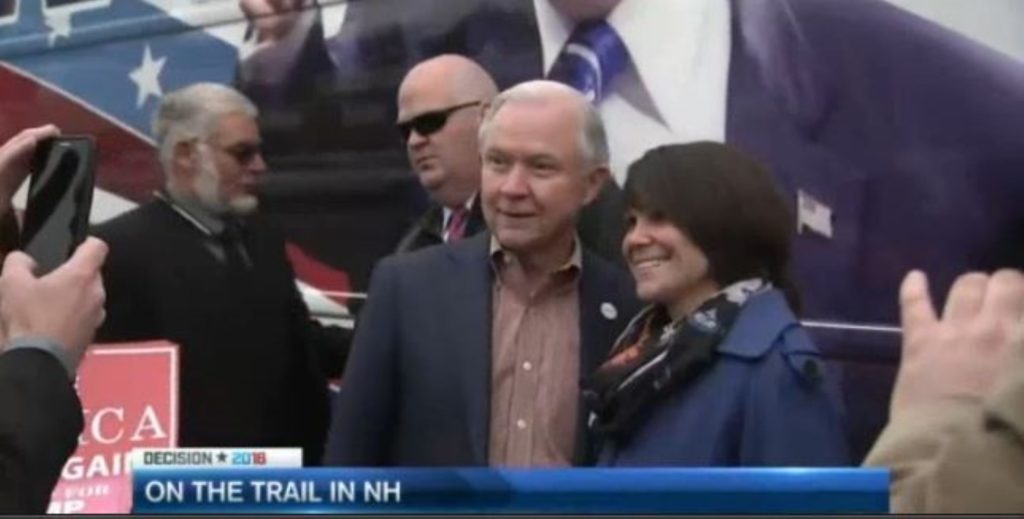
On Sunday, Donald Trump surrogate Jeff Sessions visited Windham, New Hampshire to inspire supporters to vote on Election Day. The Alabama Senator was welcomed by former New Hampshire Sen. Bob Smith, reports Alysha Palumbo of NECN. “I’ve been told repeatedly that you have probably the best-organized state in the nation and you’re working hard, you’re knocking on doors, making phone calls, doing the bread and butter work that takes us from a close election to victory,” Sessions told the crowd. Trump is scheduled to campaign in the state Monday.
