Donald Trump endorses challenger against Georgia elections chief

Former President Donald Trump on Monday endorsed a conservative Georgia congressman in his bid to unseat the Republican secretary of state who refused to help overturn the November election results. Rep. Jody Hice, a tea party favorite and Trump acolyte, is the first major challenger to Brad Raffensperger since the secretary of state certified President Joe Biden’s narrow victory in Georgia and disputed Trump’s false allegations of fraud. Trump’s endorsement marks his most direct attempt at retribution against those he blames for his loss and reaffirms his continued influence over the Republican Party. “Jody has been a steadfast fighter for conservative Georgia values and is a staunch ally of the America First agenda,” Trump said in a statement that repeated the unsupported allegations of fraud. “Unlike the current Georgia Secretary of State, Jody leads out front with integrity. I have 100% confidence in Jody to fight for Free, Fair, and Secure Elections in Georgia, in line with our beloved U.S. Constitution.” In a statement, Raffensperger criticized Hice for supporting Trump’s false fraud claims and likened him to former GOP Sens. David Perdue and Kelly Loeffler, who lost twin Senate runoffs in January after supporting Trump’s bid to subvert the election results. “Few have done more to cynically undermine faith in our election system than Jody Hice,” Raffensperger said. “We saw in January what Georgia voters will do to candidates who use that rhetoric.” Hice didn’t mention Trump in his announcement but has said previously that he expected the former president’s support, and he echoed Trump’s rhetoric about Raffensperger. “What Brad Raffensperger did was create cracks in the integrity of our elections, which I wholeheartedly believe individuals took advantage of in 2020,” Hice said in a statement Monday, without supporting evidence that would refute Georgia’s three statewide counts of nearly 5 million ballots. “Every Georgian, in fact, every American, has the right to be outraged by the actions and, simultaneously, the inaction of our Secretary of State,” Hice added. Trump has long made clear his intentions to target Raffensperger and Gov. Brian Kemp, also a Republican, for their parts in ratifying Biden’s victory. “I’ll be here in a year in a half campaigning against your governor and your crazy secretary of state,” Trump said at a Georgia rally on Jan. 4, the eve of the two U.S. Senate runoffs that Democrats swept to win control of the chamber. Both Kemp and Raffensperger have said they were simply following the state’s election law and fulfilling their required duties. The developments Monday drew immediate plaudits from the right. “The establishment still doesn’t get how popular Trump is with the base, but they will,” said Debbie Dooley, an early tea party organizer and Trump ally who is close to Hice. “We’ve known Raffensperger was dead, and Jody can excite the base and raise money. This is a serious challenge.” No heavyweight primary opponent has emerged yet against Kemp. Some Trump allies are looking to former Rep. Doug Collins as an ideal challenger. Others close to Collins, one of Trump’s most high-profile House defenders during impeachment proceedings, say he is more likely to make another bid for the Senate after his unsuccessful campaign last year in a special election ultimately won by Sen. Raphael Warnock, a Democrat. Collins was Trump’s choice in 2019 for a Senate vacancy, opened by Republican Johnny Isakson’s retirement. But Kemp opted for Loeffler. Collins finished third in a jungle primary behind Warnock and Loeffler last November before Warnock prevailed in the January runoff. Hice has not cut as high a profile since his election in 2014 as Collins did in Washington, but the 60-year-old has been a loyal Trump lieutenant. He was among the many Republican officials in Georgia who relentlessly pushed Trump’s false claims of voter fraud last fall. He endorsed a lawsuit filed by Texas against Georgia and other battleground states seeking to overturn Biden’s victory in the U.S. Supreme Court — a suit the high court rejected — and he objected to the certification of Electoral College votes even after a pro-Trump mob violently stormed the U.S. Capitol on Jan. 6. Trump’s ire has proven vexing for Raffensperger and Kemp. Kemp won Trump’s endorsement in a heated Republican primary for governor in 2018 and has never publicly criticized the president. He even reaffirmed recently that he’d back Trump if he sought the White House again in 2024. Raffensperger has pushed back more directly, arguing forcefully in national media interviews last fall that the election was accurate and fair. He wrote an op-ed saying he felt “thrown under the bus” by a president he’d supported. Weeks before the Capitol insurrection, a Raffensperger aide angrily predicted the president’s rhetoric would lead to violence. Since then, both Kemp and Raffensperger have tried, carefully, to appeal to the Republican base by calling for changes to the state’s election law. Most specifically, the two men support requiring voter identification for absentee voting to replace the current signature-match requirement. But some GOP lawmakers want to go considerably further, rolling back Georgia’s no-excuse absentee voting altogether, contracting weekend early voting options in some counties, and ending automatic voter registration. Raffensperger and Kemp have been more circumspect publicly about their positions on the more sweeping proposals, though the incumbent secretary of state has continued to vouch for the integrity of absentee voting and the success of automatic registration. Hice, despite his criticism of Raffensperger, also avoided any specifics about what changes he’d like to see in Georgia’s election, saying only that he is “encouraged to see the General Assembly taking it upon themselves to address some of the glaring issues in our elections.” Republished with the permission of the Associated Press.
Raphael Warnock and Kelly Loeffler work to consolidate voters for runoff

When Georgia Republican Kelly Loeffler and Democrat Raphael Warnock advanced to the Jan. 5 U.S. Senate runoff, they faced the immediate challenge of winning over the 2 million voters who chose one of the 18 other candidates in November’s election. Polls show they have largely succeeded, and that could give Loeffler, the incumbent, a small advantage. Republican U.S. Rep. Doug Collins came in third in the November vote that ended with the Republican candidates winning 48,000 more votes than the Democratic candidates. In Georgia’s second runoff election, Republican U.S. Sen David Perdue started with an even wider lead, having won 88,000 more votes in November than Democrat Jon Ossoff. Since he didn’t get a majority, however, Perdue was forced into a runoff. Turnout could be the deciding factor. Through Wednesday, nearly 2.1 million voters had cast ballots, roughly on pace with the Nov. 3 general election. It’s unclear how the Christmas holiday will affect the pace of balloting. In-person early voting runs as late as Dec. 31 in some counties. On Sunday night, President Donald Trump tweeted that he would visit Georgia on Jan. 4, the eve of the runoff, for a rally in support of Perdue and Loeffler. One thing helping line voters up is the decision of the candidates in both races to run as tickets, with joint appearances and advertisements. J. Miles Coleman of the University of Virginia Center for Politics said the joint effort has helped Warnock wrap up Democratic voters. “He and Ossoff have done a better job of running as a ticket,” Coleman said. “I think overall that’s going to benefit Warnock and help him consolidate some of his support.” With the candidates running as tickets, it’s unlikely the parties will split the seats. Two wins would put Democrats in control of the U.S. Senate with Vice President-elect Kamala Harris breaking a 50-50 tie. A split or two GOP wins would keep Republicans in control. Deborah Jackson, a former mayor of the Atlanta suburb of Lithonia, came in fourth in November, the runner-up Democrat behind Warnock. She benefitted from being a Black woman, a known quantity in the Democratic stronghold of DeKalb County and the first Democrat listed on a ballot so long that Warnock had to remind supporters to go all the way down to find his name. “I had tangible and practical experience,” Jackson said. “I think some people were interested in that.” She said some people were offended that leading state and national Democrats tried to clear the field for Warnock, but said she’s still supporting him without reservation. “The Democrats need to be in control of the Senate, or at least there needs to be a balance,” Jackson said. At least one of Jackson’s supporters agrees. Laura Durojaiye of Stonecrest said she’s already voted for Warnock. “I think he’ll get all her votes,” Durojaiye said, saying she thinks Warnock is someone who will learn in the Senate and back her priorities of addressing climate change and societal inequity. Shane Hazel, the Libertarian who won the key sliver of votes that forced Perdue and Ossoff into a runoff, said his voters may sit the runoff out, telling Hazel “they will never vote for anybody out of fear again.” One of the top early voting counties in the state is Rabun — in Georgia’s northeastern corner — where Trump and Perdue both won 78% of the vote. “I’m convinced the Democrats could run Mother Teresa and get 20%,” said Ed Henderson, secretary of the Rabun County Republican Party. As in the other counties in his northeast Georgia congressional district, Collins was the top vote-getter in the Senate special election. “This was Collins country,” Henderson said. Collins, though, has been a strong supporter of Loeffler and Perdue. Although nearly 40% of Rabun’s registered voters have already cast ballots, Henderson said he worries that Trump’s ceaseless attacks on the integrity of Georgia’s presidential election will hurt Republican turnout there, citing the “godlike reverence” residents have for the president, “My biggest problem this election cycle is there is a distrust of the system,” Henderson said, saying a handful of hardcore Republicans have told him they are sitting the election out, saying they believe Trump was cheated, despite little credible evidence of wrongdoing. Henderson also frets that Loeffler has never been to his county, so far from Atlanta that many watch out-of-state television. “It would be greatly helpful if they would come up here in person and tell our voters they would like to get our vote,” Henderson said of the Republican candidates. Democrats have their own trouble. Early voting is lagging in Georgia’s smaller urban areas including Savannah, Augusta, Macon, and Columbus, and Democratic vote totals have been disappointing in rural areas. “The Democrats have really struggled to turn out Black voters in rural parts of the state,” Coleman said. “Are the Democrats going to be able to do well enough in the rural parts of the state?” Republished with the permission of the Associated Press.
Republicans reprise warnings of leftism in Georgia races
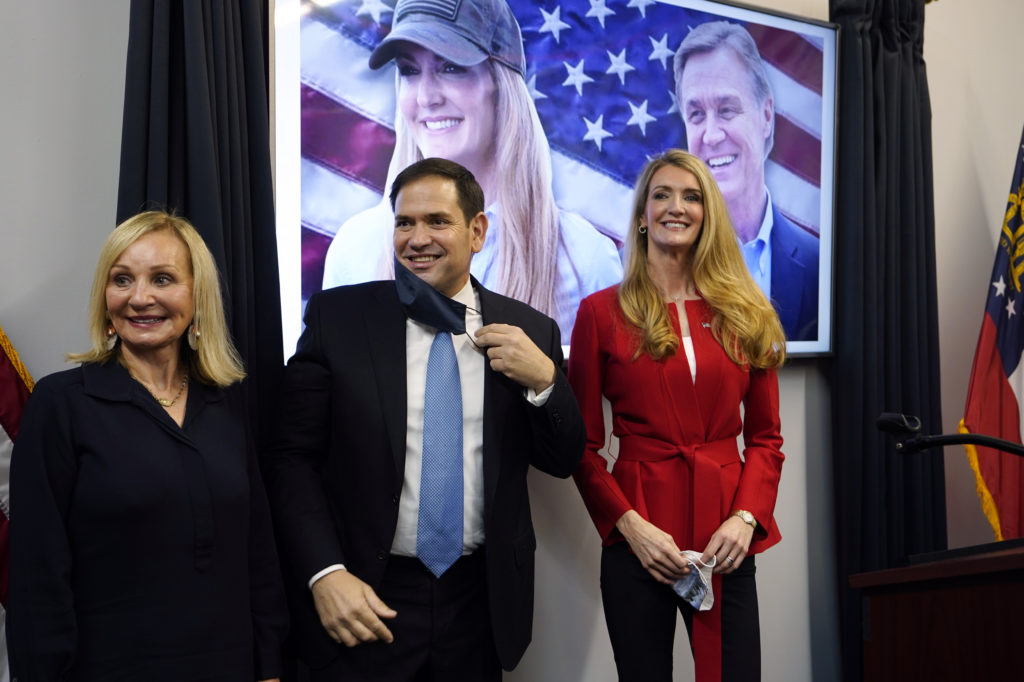
Socialists. Radical extremists. Marxists. Those over-the-top caricatures of Democrats make up Republicans’ opening arguments as they try to protect Georgia’s two U.S. senators who face strong challenges in Jan. 5 runoffs that’ll determine which party controls the chamber at the start of President-elect Joe Biden’s Democratic administration. Florida Sen. Marco Rubio led the charge Wednesday, campaigning in suburban Atlanta alongside Sen. Kelly Loeffler and warning that defeats for her and fellow Georgia Sen. David Perdue would hand over the U.S. government to “radical elements.” Loeffler went so far as to assert, without supporting details, that her Democratic challenger Raphael Warnock has “a Marxist ideology.” Loeffler took no questions after the event that filled the Cobb County Republican Party headquarters with hundreds of enthusiastic voters, many of them not wearing masks as coronavirus cases spike across the country. Warnock’s campaign pushed back, noting the Democrat’s policy preferences fall squarely within the U.S. political mainstream. Terrence Clark, a Warnock aide, said Loeffler is trying to “scare Georgians” while “misrepresenting” Warnock’s candidacy and obscuring her own record. It’s a familiar trope for Republicans to blast Democrats, especially in traditionally GOP-leaning states, as “too liberal” or even “socialist.” But the vehemence to open a two-month runoff blitz underscores the national stakes of Georgia’s unusual twin Senate contests and the sharp focus Republicans are putting on energizing core supporters for a second round of voting. The arguments come as Loeffler, Perdue, and other Georgia Republicans continue suggesting the Nov. 3 election — overseen by a Republican secretary of state — was rife with voting irregularities and tabulation errors, assertions made without evidence but that animate a GOP base still loyal to President Donald Trump even after his national defeat. “Turnout takes care of itself when the presidential race is on the ballot, so it can still boil down to persuasion in the middle,” said Republican consultant Chip Lake, a top adviser on Rep. Doug Collins’ unsuccessful bid against Loeffler. “In a runoff, it’s no longer about persuasion” Lake continued. “It’s about the bases.” Collins, now leading Trump’s recount efforts in Georgia, said the goal is to keep Republicans “fired up because they don’t want to see our country turn to a liberal perspective.” Republicans and Democrats are bracing for an unprecedented national-scale campaign in Georgia, a newfound two-party battleground where record turnout of roughly 5 million split almost evenly. Biden leads Trump by about 14,000 votes, but Secretary of State Brad Raffensperger announced plans Wednesday for an audit with a hand tally of ballots before certifying the results. Perdue, a staunch Trump ally first elected in 2014, led Democrat Jon Ossoff but fell short of the majority Georgia law requires for victory. Loeffler, appointed after Republican Sen. Johnny Isakson announced his retirement last year, trailed Warnock in an all-party primary to finish out the final two years of a six-year term. The Associated Press has called runoffs in both contests but hasn’t called Georgia’s 16 presidential electoral votes. Nationally, Republicans have secured 50 Senate seats to Democrats’ 48. Still, the GOP needs at least one of the Georgia seats to command a majority in January. In a 50-50 Senate, Democrats would have the tie-breaking vote in Vice President-elect Kamala Harris. Rubio and Loeffler warned of dire consequences, even as Rubio implicitly conceded the hyperbole. “To be fair, not all Democrats are socialists,” Rubio said. “But all socialists are Democrats.” Rubio alluded to failed presidential candidate Bernie Sanders, an independent who calls himself a democratic socialist and caucuses with Senate Democrats. Rubio nodded to progressive calls to “defund the police” and Democrats who support policies like “Medicare for All” single-payer health insurance or tuition-free public college nationwide. “All the energy” and “all the money” in the Democratic Party, Rubio insisted, come from such forces. Rubio didn’t mention Biden, who won the nomination and presidency as an establishment figure promising bipartisanship and compromise. Biden often noted as he campaigned that he defeated Sanders and other more liberal candidates for the nomination. “He thinks he’s running against someone else,” Biden quipped at Trump during an Oct. 22 debate when the president sought to label his challenger a socialist. Biden, for example, supports adding a “public option” government health care plan to existing insurance markets, but without ending private insurance. He backs significant public spending on green energy but opposes progressives’ push for quickly phasing out fossil fuels. Warnock and Ossoff have largely aligned behind Biden’s agenda, especially on a public option. Clark, Warnock’s spokesman, noted that Loeffler backs GOP efforts to roll back the 2010 Affordable Care Act that bars insurers from discriminating against customers based on their health history. He also saddled her with the GOP-run Senate’s failure to pass another coronavirus economic aid package as millions of Americans face the loss of jobless benefits, foreclosures, and evictions. Republicans nonetheless are doubling down after GOP Senate incumbents defeated well-financed challengers in more conservative states such as Iowa, Texas, and Montana, while Republican challengers knocked off several House Democrats who’d won moderate districts in 2018. Their bet is that Georgia, long a GOP stronghold before Biden’s performance in the presidential race, follows the same path. Republished with the permission of the Associated Press.
Georgia audit to trigger hand recount of presidential vote
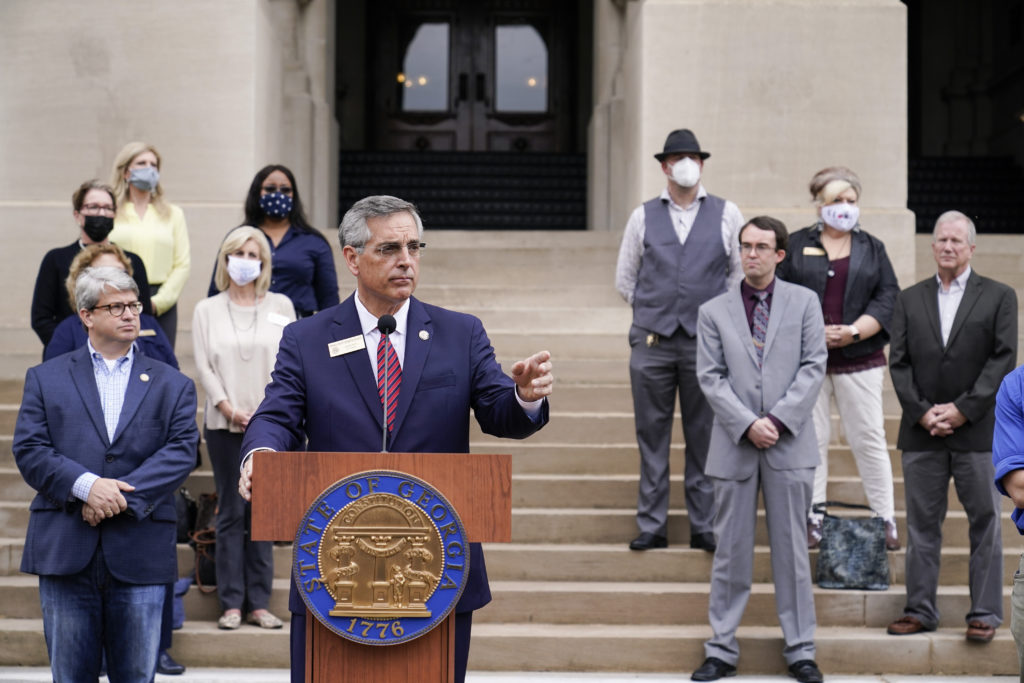
Georgia’s secretary of state on Wednesday announced an audit of presidential election results that he said will trigger a full hand recount. Secretary of State Brad Raffensperger said at a news conference that his office wants the process to begin by the end of the week and he expects it to take until Nov. 20, which is the certification deadline. President-elect Joe Biden leads President Donald Trump by about 14,000 votes out of nearly 5 million votes in the state. Nearly all ballots have been counted, though counties have until Friday to certify their results. Once county certification is complete and before the state certifies the results, the count must be audited. It is up to Raffensperger to choose which race to audit. The audit is a new requirement put in place by a law passed in 2019 that also provided for the new voting machines purchased last year. The state has chosen to do a risk-limiting audit, in which a random sample of ballots or receipts generated by voting machines are checked against results produced by vote-tallying equipment for accuracy. Raffensperger chose to audit the presidential race and said the tight margin means that the audit will result in a full hand recount. Asked if he chose the presidential race because of the Trump campaign’s call for a hand recount, Raffensperger said, “No, we’re doing this because it’s really what makes the most sense with the national significance of this race and the closeness of this race.” For the hand recount, election officers will work with the paper ballots in batches, dividing them into piles for each candidate. Then they will run the piles through machines to count the number of ballots for each candidate. The scanners will not read the data on the ballots, simply count them. Raffensperger said the process will have “plenty of oversight,” with both parties having the opportunity to observe. After results from the hand recount are certified, the losing campaign can then request another recount, which will be performed by scanners that would read and tally the votes, Raffensperger said. There is no mandatory recount law in Georgia, but state law provides that option to a trailing candidate if the margin is less than 0.5 percentage points. Biden’s lead stood at 0.28 percentage points as of Wednesday morning. U.S. Rep. Doug Collins, a Georgia Republican who’s leading Trump’s legal efforts in Georgia, called the upcoming audit a “first step.” He noted the Trump campaign had requested a hand recount. “This is a victory for integrity,” Collins said. “This is a victory for transparency.” In addition to the audit of the presidential race, Raffensperger announced that he’s consolidating runoff elections. A runoff for any state races was set to be held Dec. 1, while the runoffs for two U.S. Senate races was set for Jan. 5. Raffensperger said he’s consolidating those runoffs on Jan. 5. The one exception is the runoff for the special election to fill the remainder of U.S. Rep. John Lewis‘ term. That election will still be held Dec. 1. The person who wins that election will serve for about a month before Nikema Williams, who was just elected to succeed Lewis, who died in July. Republished with the permission of the Associated Press.
Donald Trump impeached by U.S. House on 2 charges
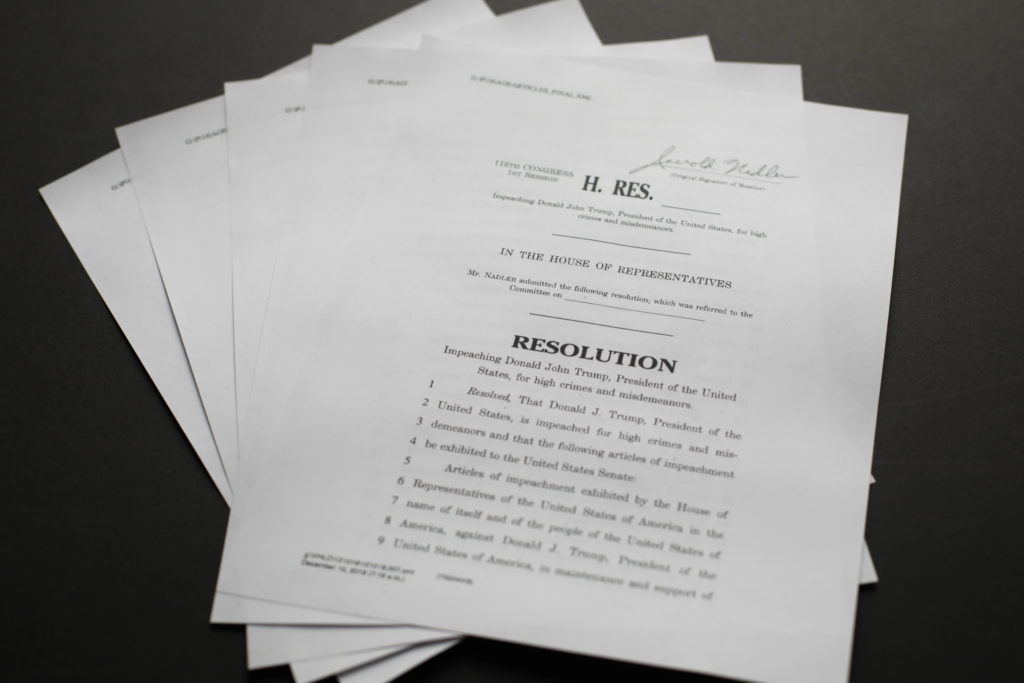
President Donald Trump was impeached by the U.S. House of Representatives Wednesday night, becoming only the third American chief executive to be formally charged under the Constitution’s ultimate remedy for high crimes and misdemeanors. The historic vote split along party lines, much the way it has divided the nation, over a charge that the 45th president abused the power of his office by enlisting a foreign government to investigate a political rival ahead of the 2020 election. The House then approved a second charge, that he obstructed Congress in its investigation. The articles of impeachment, the political equivalent of an indictment, now go to the Senate for trial. If Trump is acquitted by the Republican-led chamber, as expected, he still would have to run for reelection carrying the enduring stain of impeachment on his purposely disruptive presidency. He saw the blame flowing the other direction. He told a political rally in Michigan that “crazy Nancy Pelosi’s House Democrats have branded themselves with an eternal mark of shame.” The votes were 230 for impeachment and 197 against on the first count, 229-198 on the second. Democrats led Wednesday night’s voting, framed in what many said was their duty to protect the Constitution and uphold the nation’s system of checks and balances. Republicans stood by their party’s leader, who has frequently tested the bounds of civic norms. Trump called the whole affair a “witch hunt,” a “hoax” and a “sham,” and sometimes all three. The trial is expected to begin in January in the Senate, where a vote of two-thirds is necessary for conviction. While Democrats had the majority in the House to impeach Trump, Republicans control the Senate and few if any are expected to diverge from plans to acquit the president ahead of early state election-year primary voting. Pelosi, once reluctant to lead Democrats into a partisan impeachment, gaveled both votes closed, risking her majority and speakership to follow the effort to its House conclusion. “Today we are here to defend democracy for the people,” she said earlier during floor debate. Trump, who began Wednesday tweeting his anger at the proceedings, pumped his fist before an evening rally in Battle Creek, Michigan, boasting of “tremendous support” in the Republican Party and saying, “By the way it doesn’t feel like I’m being impeached.” No Republicans voted for impeachment, and Democrats had only slight defections on their side. Voting was conducted manually with ballots, to mark the moment. On the first article, abuse of power, two Democrats, Rep. Jeff Van Drew of New Jersey, who is considering switching parties to become a Republican, and Rep. Collin Peterson of Minnesota voted against impeaching Trump. On the second article, obstruction, those two and freshman Rep. Jared Golden of Maine voted against. Democratic Rep. Tulsi Gabbard of Hawaii, who is running for president, voted “present” on both. What Pelosi called a sad and solemn moment for the country, coming in the first year that Democrats swept control of the House, unfolded in a caustic daylong session that showcased the nation’s divisions — not only along party lines, but also by region, race and culture. The House impeachment resolution laid out in stark terms the two articles of impeachment against Trump stemming from his July phone call when he asked the Ukraine president for a “favor” — to announce it was investigating Democrats ahead of the 2020 election. He also pushed Ukrainian President Volodymyr Zelenskiy to probe unsubstantiated corruption allegations against Joe Biden, the former vice president and 2020 White House contender. At the time, Zelenskiy, a young comedian newly elected to politics, was seeking a coveted White House visit to show backing from the U.S. ally as it confronts a hostile Russia at its border. He was also counting on $391 million in military aid already approved by Congress. The White House delayed the funds, but Trump eventually released the money once Congress intervened. Narrow in scope but broad in its charge, the resolution said the president “betrayed the nation by abusing his high office to enlist a foreign power in corrupting democratic elections,” and then obstructed Congress’ oversight like “no president” in U.S. history. “President Trump, by such conduct, has demonstrated that he will remain a threat to national security and the Constitution if allowed to remain in office,” it said. Republicans argued that Democrats are impeaching Trump because they can’t beat him in 2020. “This vote is about one thing, and one thing only: They hate this president,” said Rep. Chris Stewart, R-Utah. “They want to take away my vote and throw it in the trash.” But Democrats warned the country cannot wait for the next election to decide whether Trump should remain in office because he has shown a pattern of behavior, particularly toward Russia, and will try to corrupt U.S. elections in 2020. “The president and his men plot on,” said Chairman Adam Schiff, Democrat-California, of the Intelligence Committee that led the inquiry. “The danger persists. The risk is real.” The outcome brings the Trump presidency to a milestone moment that has building almost from the time the New York businessman-turned-reality-TV host unexpectedly won the White House in 2016 amid questions about Russian interference in the U.S. election — and the rise of the “resistance.” Democrats drew from history, the founders and their own experiences, as minorities, women and some immigrants to the U.S., seeking to honor their oath of office to uphold the constitution. Rep. Lou Correa, Democrat-California, spoke in Spanish asking God to unite the nation. “In America,” said Rep. Hakeem Jeffries, Democrat-New York, “no one is above the law.” Republicans aired Trump-style grievances about what Arizona Rep. Debbie Lesko called a “rigged” process. “We face this horror because of this map,” said Rep. Clay Higgins, Republican-Alabama, before a poster of red and blue states. “They call this Republican map flyover country, they call us deplorables, they fear our faith, they fear our strength, they fear our unity, they fear our vote, and they fear our president.” The political fallout from the
Panel vote sends Donald Trump impeachment charges to full House
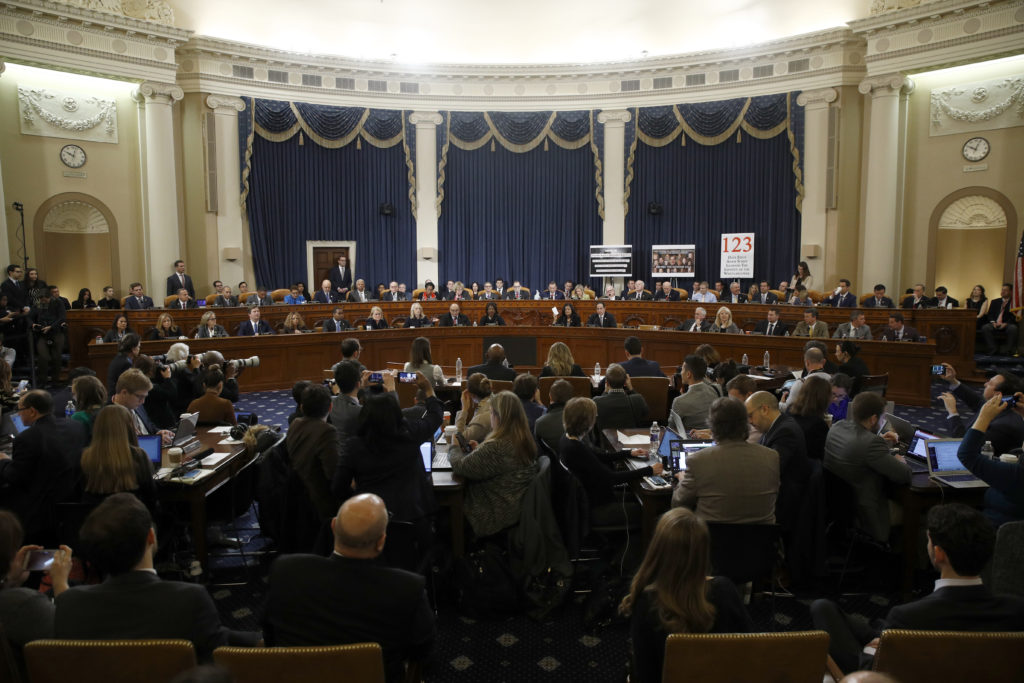
Democrats propelled President Donald Trump’s impeachment toward a historic vote by the full U.S. House on Friday, as the Judiciary Committee approved charges of abuse of power and obstruction of Congress. It’s the latest major step in the constitutional and political storm that has divided Congress and the nation. The House is expected to approve the two articles of impeachment next week, before lawmakers depart for the holidays. The partisan split in the committee vote — 23 Democrats to 17 Republicans — reflects the atmosphere in Congress. The Democratic-majority House is expected to approve the charges against Trump next week, but the Republican-controlled Senate is likely to acquit him after a January trial. Trump is accused, in the first article, of abusing his presidential power by asking Ukraine to investigate his 2020 rival Joe Biden while holding military aid as leverage, and, in the second, of obstructing Congress by blocking the House’s efforts to probe his actions. “Today is a solemn and sad day,” Chairman Jerrold Nadler, Democrat-New York, told reporters after the session, marking the third time in U.S. history the panel had voted to recommend impeaching a president. He said the full House would act ”expeditiously.”‘ After the milestone votes, Trump’s press secretary, Stephanie Grisham, labeled the proceedings a “desperate charade” and said, “The President looks forward to receiving in the Senate the fair treatment and due process which continues to be disgracefully denied to him by the House.” Voting was swift and solemn, with none of the fiery speeches and weighty nods to history that have defined the previous debating, including 14 hours that stretched nearly to midnight Thursday. Nadler abruptly halted that session so voting could be held in daylight, for all Americans to see. Nadler, who had said he wanted lawmakers to “search their consciences” before casting their votes, gaveled in the landmark but brief morning session. Lawmakers responded “aye” or “yes” for the Democrats, and simple:”no’s” from the Republicans. “The article is agreed to,” Nadler declared after each vote. The top Republican on the panel Rep. Doug Collins of Georgia immediately said he would file dissenting views. Minutes after the morning session opened, it was gaveled shut. Trump is only the fourth U.S. president to face impeachment proceedings and the first to be running for reelection at the same time. The outcome of the eventual House votes pose potentially serious political consequences for both parties ahead of the 2020 elections, with Americans deeply divided over whether the president indeed conducted impeachable acts and if it should be up to Congress, or the voters, to decide whether he should remain in office. The outcome came quickly after two days of hearings at the Capitol and the rancorous 14-hour session that was shut down when the Democratic majority refused to be forced, after a long and bitter slog through failed Republican amendments aimed at killing the impeachment charges, into midnight voting. Instead, the impeachment charges against Trump were aired in full view. Trump took to Twitter early Friday to praise the panel’s Republicans, saying “they were fantastic yesterday.” “The Dems have no case at all, but the unity & sheer brilliance of these Republican warriors, all of them, was a beautiful sight to see,” he tweeted. “Dems had no answers and wanted out!” The president has refused to participate in the proceedings, tweeting criticisms as he did Thursday from the sidelines, mocking the charges against him in the House’s nine-page resolution as “impeachment light.” But House Speaker Nancy Pelosi said the president was wrong and the case against him is deeply grounded. Democrats contend that Trump has engaged in a pattern of misconduct toward Russia dating back to the 2016 election campaign that special counsel Robert Mueller investigated. And they say his dealings with Ukraine have benefited its aggressive neighbor Russia, not the U.S., and he must be prevented from “corrupting” U.S. elections again and cheating his way to a second term next year. “It is urgent,” House Speaker Nancy Pelosi said. But Senate Majority Leader Mitch McConnell said late Thursday on Fox News, “There is zero chance the president will be removed from office.” He said he was hoping to have no GOP defections in the Senate trial next year. The Judiciary Committee session drew out over two days, much of time spent in fights over amendments. After lawmakers trudged through two days of hearings, tempers still flared Friday. “My vote is no,” said Rep. Louie Gohmert, Republican-Texas. Then, before the tally was announced, he inquired how his vote was recorded by the clerk. “I want to make sure.” Later he echoed Trump’s criticism of the proceedings: “It was a witch hunt.” Florida GOP Rep. Matt Gaetz said, “For Democrats, impeachment is their drug, it is their obsession, it is their total focus.” Nadler said late Thursday night, after presiding over the two-day session, “I want the members on both sides of the aisle to think about what has happened over these past two days and to search their consciences before they cast their final votes.” The Republicans on the panel, blindsided by the move to Friday, were livid. When Nadler announced it, they started yelling “unbelievable” and “they just want to be on TV.” Congress was to be out of session on Friday, and many lawmakers had other plans, some outside Washington. “This is the kangaroo court that we’re talking about” stormed Rep. Doug Collins of Georgia, the top Republican on the panel, who said he had not been consulted on the decision. Debate over amendments had dragged on with familiar arguments: Democrats cited evidence they said showed Trump’s misconduct, while Republicans insisted the entire investigation was bogus. Typical was the first amendment, offered by GOP Rep. Jim Jordan of Ohio, who tried to delete the first charge against Trump. “This amendment strikes article one because article one ignores the truth,” he declared. Rep. David Cicilline, Democrat-Rhode Island, argued there was “overwhelming evidence” that the president with his lawyer Rudy Giuliani, in pushing Ukraine to investigate rival Biden, was
Judiciary hearing sets stage for Donald Trump impeachment charges
Pushing ahead with articles of impeachment, the House Judiciary Committee convenes Monday to formally receive the investigative findings against President Donald Trump as the White House and its allies launch an aggressive attack on Democrats and the proceedings. Chairman Jerrold Nadler expects the committee to vote soon, possibly this week, on at least two or more charges against the Republican president. Democrats say Trump’s push to have Ukraine investigate rival Joe Biden while at the same time withholding U.S. military aid ran counter to U.S. policy and benefited Russia. It could result in impeachment charges of abuse of power, bribery and obstruction. “The central allegation is that the president put himself above his country several times, that he sought foreign interference in our elections several times, both for 2016 and 2020, that he sought to cover it up,” Nadler said. “All this presents a pattern that poses a real and present danger to the integrity of the next election, which is one reason why we can’t just wait for the next election to settle matters,” he said. In advance of the hearing, Nadler sent a letter to the White House late Sunday officially forwarding the House Intelligence committee’s report, along with additional evidence supporting impeachment. It also invites White House officials to review sensitive materials in a classified setting. The hearing sets off a pivotal week as Democrats march toward a full House vote expected by Christmas. In drafting the articles of impeachment, Speaker Nancy Pelosi is facing a legal and political challenge of balancing the views of her majority while hitting the constitution’s bar of “treason, bribery or other high crimes and misdemeanors.” Trump and his allies acknowledge he likely will be impeached in the Democratic-controlled House, but they also expect acquittal next year in the Senate, where Republicans have the majority. Trump’s team is turning attention elsewhere, including Monday’s release of a long-awaited Justice Department report into the 2016 Russia investigation. “Impeachment Hearing Hoax,” Trump tweeted Sunday. The White House is refusing to participate in the process it calls a sham and the top Republican on the panel, Rep. Doug Collins of Georgia asked to postpone the hearing, criticizing Democrats for moving too swiftly. One legal scholar testified last week it would be the quickest impeachment in modern history. “This is just how desperately they are — desperately focused on impeaching this president,” said Collins who said against Democrats unleashed thousands of pages of documents his side has no time to review before the session. ”This is a show. This is a farce. This is whatever you want to call it. The American people are having their tax dollars wasted on this impeachment of this president.” Trump is heading out for campaign rallies shifting attention away from the House. Over the weekend, Trump was focused on a related matter, the Justice Department Inspector General’s findings into the FBI’s decisions to investigate Russian interference in the 2016 election. The president has long called special counsel Robert Mueller’s Russia probe a “witch hunt,” but the Inspector General’s report is expected to reject the president’s claim that it was illegitimate, according to people familiar with its findings. Trump tweeted Sunday, “I.G. report out tomorrow. That will be the big story!” Democrats say Trump abused his power in the July 25 phone call when he asked Ukrainian President Volodymyr Zelenskiy for a favor in investigating Democrats and engaged in bribery by withholding nearly $400 million in military aide that Ukraine depends on to counter Russian aggression. Trump and his aides have made clear that they now see his impeachment in the House as inevitable and have shifted their focus. A vote to convict requires a two-thirds vote of the Senate, where Republicans hold 53 of 100 seats. It is unlikely that any Republican senators would cross party lines and vote to remove Trump from office. As Democrats draft the articles, Pelosi’s challenge will be to go broad enough to appease her liberal flank, which prefers a more robust accounting of Trump’s actions reaching back to Mueller’s findings, while keeping the charges more tailored to Ukraine as centrist lawmakers prefer. Democratic leaders will meet later Monday evening. Rep. Adam Schiff, Democrats-California, the chairman of the Intelligence Committee, said Democrats should approach the question of what to include in the articles the way a prosecutor bringing forward “‘the strongest and most overwhelming evidence and not try to charge everything, even though you could charge other things.” Schiff said, “I think we should focus on those issues that provide the greatest threat to the country. And the president is engaged in a course of conduct that threatens the integrity of the next election, threatens our national security.” Monday’s hearing is to receive the Intelligence panel’s report on the inquiry, with lawyers from both parties testifying in what is expected to be a day long session that will lay the groundwork for the impeachment charges. Nadler, in two television interviews, declined to say ultimately how many articles of impeachment Democrats will present but said they will involve “certainly abuse of power” and likely “obstruction of Congress.” He said final decisions will come after Monday’s hearing following discussions with House leadership and the Democratic caucus. Nadler pointed to a “pattern” of conduct by Trump in seeking foreign interference in elections but would not commit to including the evidence of obstruction of justice in special counsel Robert Mueller’s Russia investigation as part of the articles of impeachment. In his report, Mueller said he could not determine that Trump’s campaign conspired or coordinated with Russia in the 2016 election. But Mueller said he could not exonerate Trump of obstructing justice in the probe and left it for Congress to determine. House Republican leader Kevin McCarthy criticized Democrats for their timeline, which he said was unfairly aimed at preventing the nation’s voters from making their own choices in the 2020 election. “If they do not impeach him, they cannot beat him at the polls,” McCarthy, Republican-California. Trump said over the weekend that his personal attorney Rudy Giuliani wants to take the information gathered from Giuliani’s investigations and
Fiery disagreements as Donald Trump impeachment hearing opens
The House Judiciary Committee’s first impeachment hearing quickly burst into partisan infighting Wednesday as Democrats charged that President Donald Trump must be removed from office for enlisting foreign interference in U.S. elections and Republicans angrily retorted there were no grounds for such drastic action. The panel responsible for drafting articles of impeachment convened as Trump’s team was fanning out across Capitol Hill. Vice President Mike Pence met behind closed doors with House Republicans, and Senate Republicans were to huddle with the White House counsel as GOP lawmakers stand with the president and Democrats charge headlong into what has become a one-party drive to impeach him. Chairman Jerrold Nadler, Democrat-New York, gaveled open the hearing saying, “’The facts before us are undisputed.” Nadler said Trump’s phone call with Ukraine’s president last July wasn’t the first time Trump sought a foreign power to influence American elections, after Russian interference in 2016, and if left unchecked he could do again in next year’s campaign. “We cannot wait for the election to address the present crisis,” Nadler said. “The president has shown us his pattern of conduct. If we do not act to hold him in check, now, President Trump will almost certainly try again to solicit interference in the election for his personal political gain.” Republicans protested the proceedings as unfair to the president, the dredging up of unfounded allegations as part of an effort to undo the 2016 election and remove Trump from office. “You just don’t like the guy,” said Rep. Doug Collins of Georgia, the top Republican on the panel. He called the proceedings a “disgrace” and a “sham.” Several Republicans immediately objected to the process, interjecting procedural questions, and they planned to spend much of the session interrupting, delaying and questioning the rules. House Speaker Nancy Pelosi said Democrats “haven’t made a decision” yet on whether there will be a vote on impeachment. She also meeting privately with the Democratic caucus. But a vote by Christmas appears increasingly likely with the release of a 300-page report by Democrats on the House Intelligence Committee that found “serious misconduct” by the president. Intelligence Committee Chairman Adam Schiff, Democrat-California, told The Associated Press. “Americans need to understand that this president is putting his personal political interests above theirs. And that it’s endangering the country.” The Judiciary Committee heard Wednesday from legal experts, delving particularly into the issue of whether Trump’s actions stemming from the July 25 phone call with Ukraine’s president rose to the constitutional level of “bribery” or “high crimes and misdemeanors” warranting impeachment. The report laid out evidence that the Democrats say shows Trump’s efforts to seek foreign intervention in the U.S. election and then obstruct the House’s investigation. Trump told reporters in London, where he was attending a NATO meeting, that he doubted many people would watch the live hearing “because it’s going to be boring.” Trump did phone in to the House GOP’s morning meeting with Pence to talk with House Minority Leader Kevin McCarthy. The California Republican said impeachment didn’t come up. “The unity has been very positive,” he said. New telephone call records released with the report deepen Trump lawyer Rudy Giuliani’s known involvement in what House investigators called the “scheme” to use the president’s office for personal political gain by enlisting a foreign power, Ukraine, to investigate Democrats including Joe Biden, and intervene in the American election process. Trump told reporters he really doesn’t know why Giuliani was calling the White House’s Office of Management and Budget, which was withholding $400 million in military aid to the ally confronting an aggressive Russia at its border. “’You have to ask him,” Trump said. “Sounds like something that’s not so complicated. … No big deal.” At the hearing, the three legal experts called by Democrats backed impeachment. Noah Feldman, a Harvard Law School professor, said he considered it clear that the president’s conduct met the definition of “high crimes and misdemeanors/” Pamela Karlan, a Stanford Law School professor and former Obama administration Justice Department official, said the president’s action constituted an especially serious abuse of power “because it undermines democracy itself.” Republican witness Jonathan Turley, a law professor at George Washington University, said that the Democrats were bringing a “slipshod impeachment” case against the president, but he didn’t excuse the president’s behavior. “It is not wrong because President Trump is right,” according to Turley. “A case for impeachment could be made, but it cannot be made on this record,” he said. The political risks are high for all parties as the House presses only the fourth presidential impeachment inquiry in U.S. history. Based on two months of investigation sparked by a still-anonymous government whistleblower’s complaint, the Intelligence Committee’s Trump-Ukraine Impeachment Inquiry Report relies heavily on testimony from current and former U.S. officials who defied White House orders not to appear. The inquiry found that Trump “solicited the interference of a foreign government, Ukraine, to benefit his reelection,” Schiff wrote in the report’s preface. In doing so, the president “sought to undermine the integrity of the U.S. presidential election process, and endangered U.S. national security,” the report said. When Congress began investigating, it added, Trump obstructed the investigation like no other president in history. Along with revelations from earlier testimony, the new phone records raised fresh questions about Giuliani’s interactions with the top Republican on the intelligence panel, Rep. Devin Nunes of California. Nunes declined to comment. Schiff said his panel would continue its probe. Republicans defended the president in a 123-page rebuttal claiming Trump never intended to pressure Ukraine when he asked for a “favor” — investigations of Democrats and Biden and his son. They say the military aid the White House was withholding was not being used as leverage, as Democrats claim — and besides, the $400 million was ultimately released, although only after a congressional outcry. For Republicans falling in line behind Trump, the inquiry is simply a “hoax.” Trump criticized the House for pushing forward with the proceedings while he was overseas, a breach of political decorum that traditionally leaves partisan
Congress pushes ahead on Donald Trump impeachment with nation split
The House is plunging into a landmark impeachment week, with Democrats who once hoped to sway Republicans now facing the prospect of an ever-hardening partisan split over the question of removing President Donald Trump from office. Lawmakers were getting their first look at the House Intelligence Committee’s impeachment report Monday night behind closed doors. The findings are expected to forcefully make the Democrats’ case that Trump engaged in what Chairman Adam Schiff calls impeachable “wrongdoing and misconduct” in pressuring Ukraine to investigate Democrats and Joe Biden while withholding military aid to the ally. For Republicans offering an early rebuttal ahead of the report’s public release, the proceedings are simply a “hoax,” with Donald Trump insisting he did nothing wrong and his GOP allies in line behind him. Trump tweeted his daily complaints about it all and then added a suggestive, if impractical, question: “Can we go to Supreme Court to stop?” With the Judiciary Committee set to launch its first hearing Wednesday, the impeachment proceedings are presenting a historic test of political judgment in a case that is dividing Congress and the country. Departing for a NATO meeting in London, Trump criticized the House for pushing forward Monday with proceedings while he was heading overseas, a breach of political decorum that traditionally leaves partisan differences at the water’s edge. He predicted Republicans would actually benefit from the entire impeachment effort against him, though “it’s a disgrace for our country.” For the Democrats, House Speaker Nancy Pelosi faces a critical moment of her leadership as she steers the process ahead after resisting the impeachment inquiry through the summer, warning it was too divisive for the country and required bipartisan support. Speaking to reporters at the international climate conference in Madrid, Pelosi declined to engage with impeachment questions. “When we travel abroad, we don’t talk about the president in a negative way,” she said. “We save that for home.” Possible grounds for impeachment are focused on whether Trump abused his office as he pressed Ukrainian President Volodymyr Zelenskiy in a July 25 phone call to launch investigations into Trump’s political rivals. At the time, Trump was withholding $400 million in military aid, jeopardizing key support as Ukraine faced an aggressive Russia at its border. The report, which the Intelligence panel will vote on Tuesday and make public, also is expected to include evidence the Democrats say suggests obstruction of Congress, based on Trump’s instructions for his administration to defy subpoenas for documents and testimony. The next step comes when the Judiciary Committee gavels open its own hearing with legal experts to assess the findings and consider potential articles of impeachment ahead of a possible vote by the full House by Christmas. That would presumably send it to the Senate for a trial in January. The Democratic majority on the Intelligence Committee says its report, compiled after weeks of testimony from current and former diplomats and administration officials, will speak for itself in laying out the president’s actions toward Ukraine. Republicans pre-empted the report’s public release with their own 123-page rebuttal. In it, they claim there’s no evidence Trump pressured Zelenskiy. Instead, they say Democrats just want to undo the 2016 election. Republicans dismiss witness testimony of a shadow diplomacy being run by Trump lawyer Rudy Giuliani, and they rely on the president’s insistence that he was merely concerned about “corruption” in Ukraine — though the White House transcript of Trump’s phone call with Zelenskiy never mentions the word. “They are trying to impeach President Trump because some unelected bureaucrats chafed at an elected President’s ‘outside the beltway’ approach to diplomacy,” according to the report from Republican Reps. Devin Nunes of California, Jim Jordan of Ohio and Michael McCaul of Texas. Rep. Jim Jordan, Republican-Ohio, appeared to be the only lawmaker who viewed the Democratic report Monday evening when it became available behind closed doors for members of the intelligence panel. He said it was “long.” Jordan declined to discuss details, but said it’s the same “lame case” Democrats presented throughout impeachment hearings. “The president did nothing wrong,” Jordan said. “The facts are on our side.” Trump on Monday pointed to Zelenskiy’s recent comments as proof he did nothing wrong. The Ukrainian president said in an interview he never talked to Trump “from the position of a quid pro quo,” but he didn’t say Trump did nothing wrong. In fact, he had strong criticism for Trump’s actions in the Time magazine interview. With Ukraine at war with Russia, he said, its partners “can’t go blocking anything for us.” Schiff said the GOP response was intended for an audience of one, Trump, whose actions are “outside the law and constitution.” The finished Intelligence Committee report sets up the week’s cascading actions. Democrats could begin drafting articles of impeachment against the president in a matter of days, with voting in the Judiciary Committee next week. Republicans on the committee, led by Rep. Doug Collins of Georgia, plan to use procedural moves to stall the process and portray the inquiry as unfair to the president. The White House declined an invitation to participate, with Counsel Pat Cipollone denouncing the proceedings as a “baseless and highly partisan inquiry” in a letter to Judiciary Chairman Jerrold Nadler, Democart-New York. Trump had previously suggested that he might be willing to offer written testimony under certain conditions, though aides suggested they did not anticipate Democrats would ever agree to them. Cipollone’s letter of nonparticipation applied only to the Wednesday hearing, and he demanded more information from Democrats on how they intended to conduct further hearings before Trump would decide whether to participate. Nadler said Monday if the president really thought his call with Ukraine was “perfect,” as he repeatedly says, he would “provide exculpatory information that refutes the overwhelming evidence of his abuse of power.” House rules provide the president and his attorneys the right to cross-examine witnesses and review evidence before the committee, but little ability to bring forward witnesses of their own. Asked why not have his lawyers participate, Trump said
House panel to vote on Ukraine report as Donald Trump mulls defense
The House impeachment inquiry enters a pivotal stage this week, with investigators planning a vote Tuesday to approve their report making the case for President Donald Trump’s removal from office as he decides whether to mount a defense before a likely Senate trial. A draft report will be available for members of the House Intelligence Committee to view in a secure location before their planned vote on Tuesday, which would send their findings to the House Judiciary Committee to consider actual charges. Majority Democrats say the report will speak for itself in laying out possible charges of bribery or “high crimes and misdemeanors,” the constitutional standard for impeachment. Republicans want Democratic Rep. Adam Schiff, chairman of the Intelligence Committee, to testify, though they have no power to compel him to do so, as they try to cast the Democratic-led inquiry as skewed against the Republican president. “If he chooses not to (testify), then I really question his veracity in what he’s putting in his report,” said Rep. Doug Collins, the top Republican on the Judiciary Committee. “It’s easy to hide behind a report,” Collins added. “But it’s going to be another thing to actually get up and have to answer questions.” Schiff has said “there’s nothing for me to testify about,” that he isn’t a “fact” witness and that Republicans are only trying to “mollify the president, and that’s not a good reason to try to call a member of Congress as a witness.” Coming after two weeks of public testimony, the findings of the House Intelligence Committee report are not yet publicly known. But the report is expected to mostly focus on whether Trump abused his office by withholding military aid approved by Congress as he pressed Ukrainian President Volodymyr Zelenskiy to launch investigations into Trump’s political rivals. Democrats also are expected to include an article on obstruction of Congress that outlines Trump’s instructions to officials in his administration to defy subpoenas for documents or testimony. Democrats are aiming for a final House vote by Christmas, which would set the stage for a likely Senate trial in January. “I do believe that all evidence certainly will be included in that report so the Judiciary Committee can make the necessary decisions that they need to,” said Rep. Val Demings, Democrat – Florida, a member of both the Intelligence and Judiciary committees. She said Democrats had not yet finalized witnesses for the upcoming Judiciary hearings and were waiting to hear back from Trump on his plans to present a defense. “If he has not done anything wrong, we’re certainly anxious to hear his explanation of that,” Demings said. The Judiciary Committee’s first hearing is Wednesday. It’s expected to feature four legal experts who will examine questions of constitutional grounds as the committee decides whether to write articles of impeachment against Trump, and if so, what those articles will be. After weeks of deriding the process as a sham, Trump has yet to say whether he or his attorneys will participate in the Judiciary hearings. He’s previously suggested that he might be willing to offer written testimony under certain conditions. “The Democrats are holding the most ridiculous Impeachment hearings in history. Read the Transcripts, NOTHING was done or said wrong!” Trump tweeted Saturday, before falling silent on Twitter for much of Sunday. It’s unlikely that the president himself would attend on Wednesday, as Trump is scheduled to be at a summit with NATO allies outside London. The Judiciary Committee gave the White House until Sunday evening to decide whether Trump or his attorneys would attend. Trump must then decide by Friday whether he would take advantage of due process protections afforded to him under House rules adopted in October for follow-up hearings, including the right to request witness testimony and to cross-examine the witnesses called by the House. “Why would they want to participate in just another rerun?” asked Collins, noting that the Judiciary Committee previously heard from constitutional scholars on impeachable offenses during special counsel Robert Mueller’s Russia investigation. “This is a complete American waste of time of here,” Collins said, who is calling on the committee chairman, Rep. Jerrold Nadler, Democrat – New York, to expand the witness list to include those sought by Republicans. “This is why this is a problematic exercise and simply a made-for-TV event coming on Wednesday.” Still, Republican Rep. Tom McClintock of California, a Judiciary Committee member, said he believes Trump would benefit if he presents his own defense. “I think it would be to the president’s advantage to have his attorneys there. That’s his right,” he said. McClintock said he doesn’t believe Trump did anything wrong in the July 25 call with Zelenskiy that is at the heart of the investigation. “He didn’t use the delicate language of diplomacy in that conversation, that’s true. He also doesn’t use the smarmy talk of politicians,” McClintock said. To McClintock, Trump was using “the blunt talk of a Manhattan businessman” and “was entirely within his constitutional authority” in his dealings with Ukraine’s leader. Collins appeared on “Fox News Sunday” and Demings and McClintock were on ABC’s “This Week.” By Hope Yen Associated Press. Republished with the Permission of the Associated Press.