
Nancy Pelosi positive for COVID-19, was at White House with Joe Biden

House Speaker Nancy Pelosi has tested positive for COVID-19, a day after appearing unmasked at a White House event with President Joe Biden. Pelosi, D-Calif., received a positive test result for COVID-19 and is currently asymptomatic, her spokesman Drew Hammill said Thursday in a tweet. He said she had tested negative earlier in the week. “The Speaker is fully vaccinated and boosted and is thankful for the robust protection the vaccine has provided,” Hammill said. Pelosi, he said, will “quarantine consistent with CDC guidance, and encourages everyone to get vaccinated, boosted and test regularly.” The White House said Biden and Pelosi had only “brief interactions over the course of the last two days” and that the President was not considered a close contact of the speaker by CDC guidance — sustained unmasked contact within 6 feet for more than 15 minutes over a 24-hour period. “Last night, as a part of his regular testing cadence, the President tested negative,” the White House said in a statement. “He will continue to be tested regularly. The President wishes Speaker Pelosi a speedy recovery.” The 82-year-old Democratic leader’s announcement came ahead of her weekly press appearance on Capitol Hill, which was abruptly called off. The House is set to start a two-week spring recess. Pelosi also postponed a planned congressional delegation trip to Asia she was scheduled to lead. Washington has experienced a rush of new COVID-19 cases as restrictions have lifted and more events and gatherings are happening across Washington, D.C. On Wednesday, Attorney General Merrick Garland and Commerce Secretary Gina Raimondo announced positive tests. The officials were among more than a dozen attendees of the Saturday night Gridiron Club dinner to test positive for the virus. Pelosi did not attend the dinner, her spokesman said. Washington D.C. Mayor Muriel Bowser also announced Thursday that she tested positive for COVID-19 and would “work at home while following isolation protocols.” Several lawmakers have announced positive test results and are isolating, including Sen. Susan Collins, R-Maine. Collins’ office announced she had tested positive late Thursday, shortly after the Senate voted to confirm Supreme Court nominee Judge Ketanji Brown Jackson. The CDC says people vaccinated and boosted against COVID-19 are much less likely to suffer adverse outcomes, including serious illness and death, from the virus compared to those who are unvaccinated. White House press secretary Jen Psaki has faced a flurry of questions in recent days about the COVID-19 protocols surrounding Biden, as more members of the administration and others in Washington have tested positive for the coronavirus. Psaki said Biden planned to continue with his public schedule despite the uptick in cases, including hosting large events, such as one on Friday celebrating Jackson’s confirmation to the Supreme Court. “The most important message we’re sending to the public is that we have steps in place that we can take to continue to address it, and even as we’re continuing to fight COVID, we can, for the most part, return to our normal routines,” she said Thursday. Asked whether there was a concern that the Friday event could be a “super-spreader” for the virus, like President Donald Trump’s Rose Garden ceremony announcing the nomination of now-Justice Amy Coney Barrett, Psaki emphasized that the risks from the virus are now much lower now because of vaccinations and treatments. “At that point in time, vaccines were unavailable; people were not vaccinated; it certainly puts us in a different space,” Psaki said. Biden has not been identified as a close contact by the White House Medical Unit, despite being photographed hugging and kissing Pelosi, because they did not spend more than 15 minutes in close proximity over a 24 period — the CDC’s standard. Psaki said if he was ever identified as a close contact, Biden would follow the CDC’s guidance, including wearing a mask when around other people. “If he is in close contact, that is exactly what he will do,” she told reporters. Psaki also defended Vice President Kamala Harris’ decision not to wear a mask in the Senate chamber while presiding over the Jackson vote, despite being identified as a close contact of a staff member who tested positive for COVID-19. CDC guidance recommends close-contacts who are fully vaccinated wear a tight-fitting mask when around other people. “I know that she was alone kind of on the dais for most of that, but of course, she’s been wearing a mask otherwise,” said Psaki. Republished with the permission of the Associated Press.
Mitch McConnell warns White House against COVID relief deal
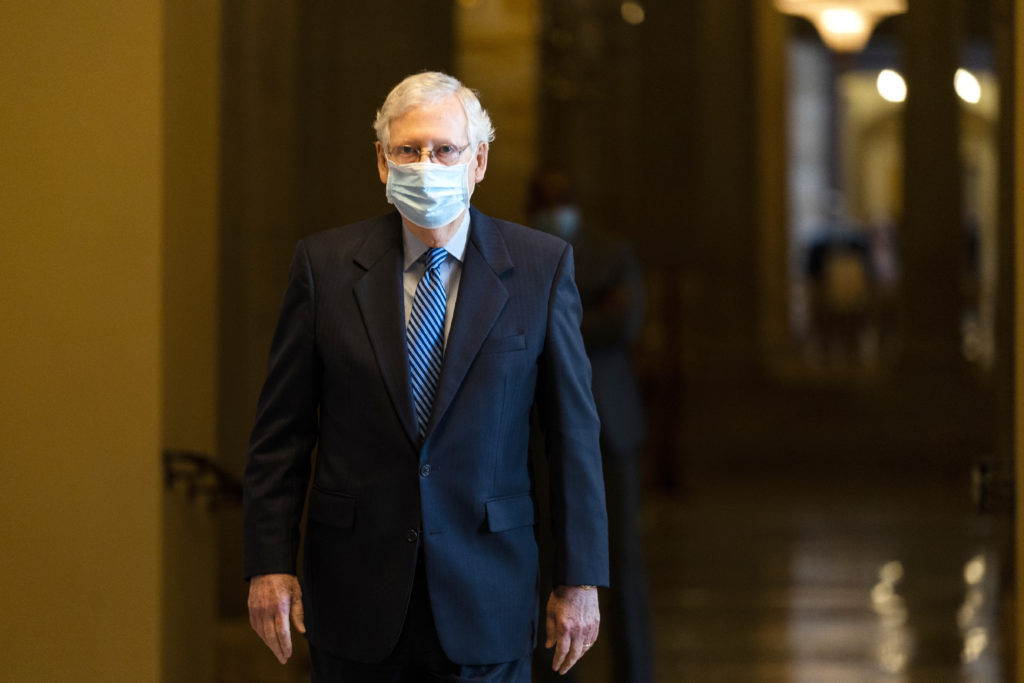
Washington negotiations on a huge COVID-19 relief bill took a modest step forward on Tuesday, though time is running out and Senate Majority Leader Mitch McConnell, President Donald Trump’s most powerful Senate ally, is pressing the White House against going forward. McConnell on Tuesday told fellow Republicans that he has warned the White House not to divide Republicans by sealing a lopsided $2 trillion relief deal with House Speaker Nancy Pelosi before the election — even as he publicly said he’d slate any such agreement for a vote. Pelosi’s office said talks with Treasury Secretary Steven Mnuchin on Tuesday were productive, but other veteran lawmakers said there is still too much work to do and not enough time to do it to enact a relief bill by Election Day. McConnell made his remarks during a private lunch with fellow Republicans on Tuesday, three people familiar with them said, requesting anonymity because the session was private. The Kentucky Republican appears worried that an agreement between Pelosi and Mnuchin would drive a wedge between Republicans, forcing them to choose whether to support a Pelosi-blessed deal with Trump that would violate conservative positions they’ve stuck with for months. Many Republicans say they can’t vote for another huge Pelosi-brokered agreement. McConnell said if such a bill passed the Democratic-controlled House with Trump’s blessing “we would put it on the floor of the Senate.” Those public remarks came after the private session with fellow Republicans. Trump is hoping for an agreement before the election, eager to announce another round of $1,200 direct payments going out under his name, but it’s increasingly clear that time has pretty much run out. If he wins, Trump is promising relief, but if he loses — as polls are indicating — it’s unclear that his enthusiasm for delivering COVID aid will be as strong. Recent history suggests that any post-election lame-duck session in the event of a Trump loss wouldn’t produce much. “It’s not a question of ‘íf.’ It’s a question of ‘when.’” said Senate GOP Whip John Thune of South Dakota. “We have to do more. We know that.” Pelosi said earlier Tuesday that she and Mnuchin remained at odds over refundable tax credits for the working poor and families with children, the size of a Democratic-sought aid package for state and local governments, and a liability shield for businesses and other organizations against lawsuits over their COVID preparations. Pelosi’s spokesman, Drew Hammill, wrote on Twitter that she and Mnuchin then spoke for 45 minutes and found “more clarity and common ground” and that “both sides are serious about finding a compromise.” Another conversation is slated for Wednesday. The Pelosi-Mnuchin talks also involve pandemic jobless aid, the second round of $1,200 direct payments, and money for schools, testing and vaccines. Pelosi had said Tuesday was a deadline day, but clarified in an interview with Bloomberg News that the aim is to spur the two sides to exchange their best proposals on a host of unresolved issues, not to close out all of their disagreements or have final legislative language at hand. “Let’s see where we are,” Pelosi said. “We all want to get an agreement.” Time is running out and Pelosi has instructed her committee chairs to try to iron out details, but the Senate GOP negotiators do not appear as eager as she is. “It’s getting to be toward the last minute and the clock keeps ticking away,” Senate Appropriations Chairman Richard Shelby, R-Ala., said Tuesday. “I’m not optimistic about doing anything.” Aides familiar with the talks say the price tag for a potential Pelosi-Mnuchin deal is inching close to $2 trillion. Senate Republicans are recoiling at both the size of the measure and Pelosi’s demands, even as Trump is beating the drums for an agreement. “I want to do it even bigger than the Democrats. Not every Republican agrees,” Trump said Tuesday on Fox News. “But they will.” McConnell, meanwhile, is pushing ahead with votes this week on GOP measures that stand little chance of advancing. On Tuesday, the GOP-held chamber went on record in favor of another round of payroll subsidies for businesses such as restaurants and hotels that are having particular difficulty during the pandemic. But while the vote put the Senate on record as supportive of the idea, it’s not aimed at advancing the measure through time-consuming procedural steps that could interfere with a floor schedule dominated by the nomination of Amy Coney Barrett to the Supreme Court. On Wednesday, Trump’s GOP allies in the Senate are slated to support a revote on a virus proposal with a net cost of about $500 billion, though it does not include the $1,200 direct payments that are so important to Trump. But the Senate GOP bill has failed once before, and Trump himself says it’s too puny. The goodwill and bipartisanship that powered the $1.8 trillion bipartisan CARES Act into law in March has largely dissipated. It passed by an overwhelming margin as the economy went into lockdown. Since then, Trump and many of his GOP allies have focused on loosening social and economic restrictions as the key to recovery instead of more taxpayer-funded help. Republished with the permission of the Associated Press.
House to stay in session until COVID-19 rescue pact
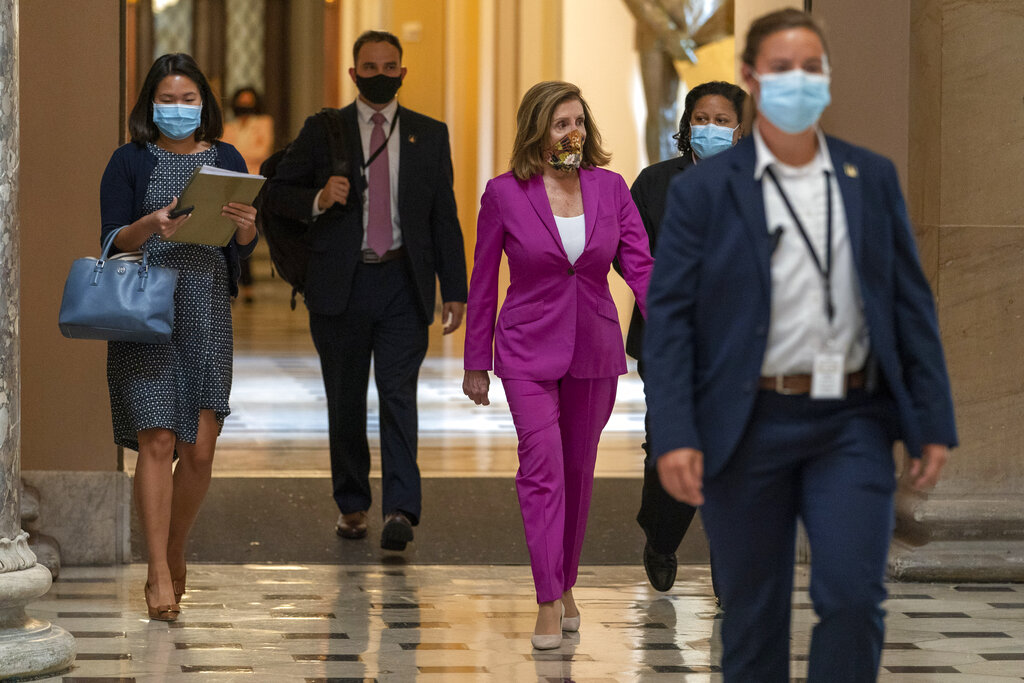
Pelosi told her Democratic colleagues on a morning conference call that “we have to stay here until we have a bill.”
Donald Trump’s economic aid could approach $1T, senators say
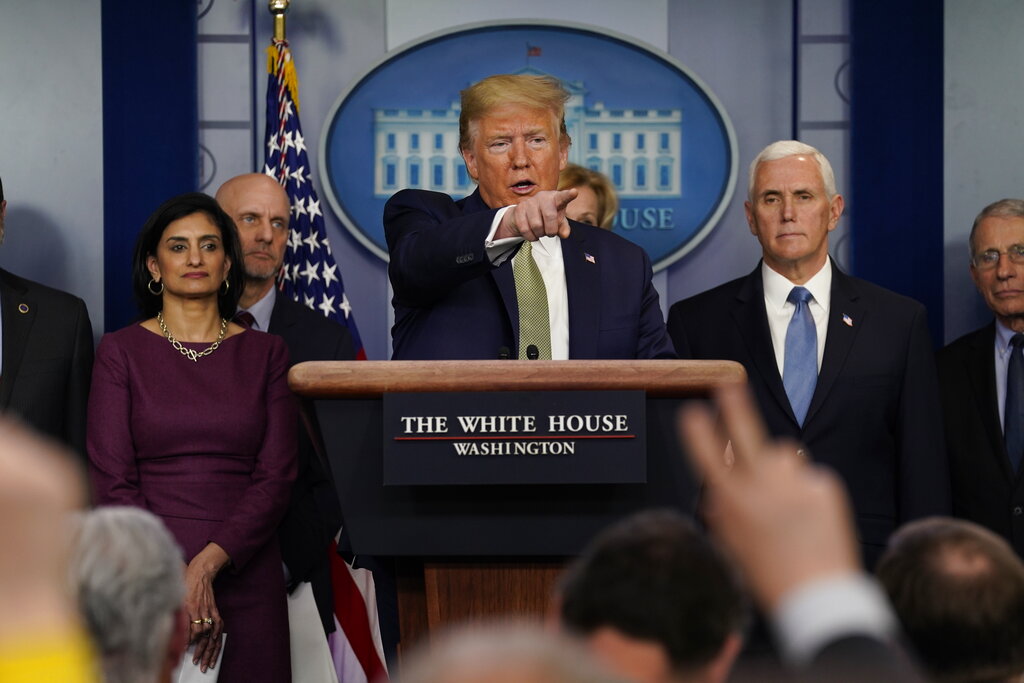
The Trump administration is asking congress to appropriate funds directly to Americans in an effort to shore up households and the economy.
