
In Selma, Joe Biden says right to vote remains under assault
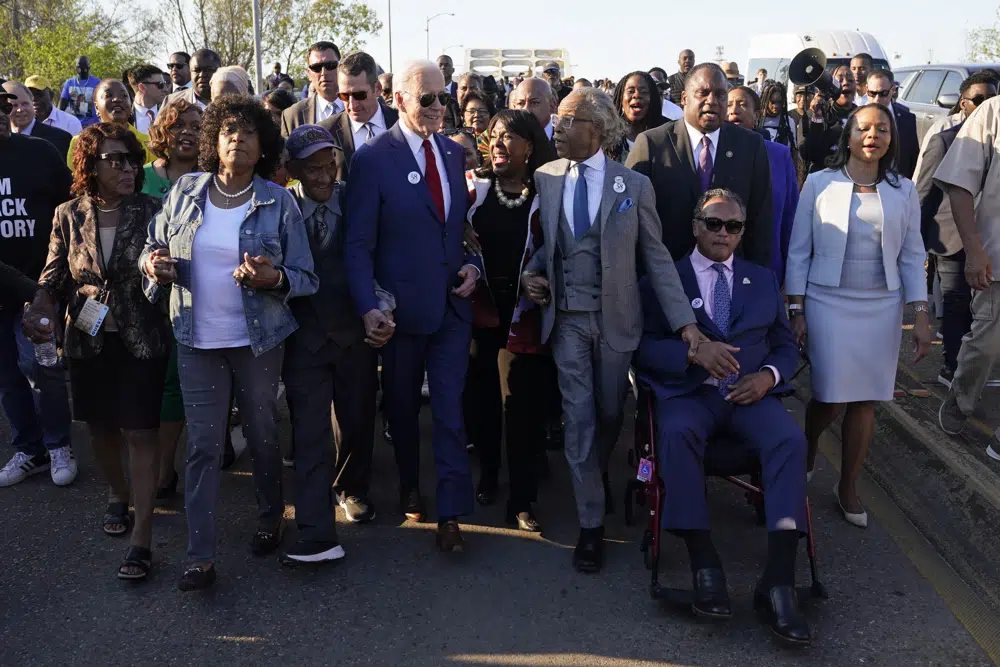
President Joe Biden used the searing memories of Selma’s “Bloody Sunday” to recommit to a cornerstone of democracy, lionizing a seminal moment from the civil rights movement at a time when he has been unable to push enhanced voting protections through Congress, and a conservative Supreme Court has undermined a landmark voting law. “Selma is a reckoning. The right to vote … to have your vote counted is the threshold of democracy and liberty. With it anything’s possible,” Biden told a crowd of several thousand people seated on one side of the historic Edmund Pettus Bridge, named for a reputed Ku Klux Klan leader. “This fundamental right remains under assault. The conservative Supreme Court has gutted the Voting Rights Act over the years. Since the 2020 election, a wave of states and dozens and dozens of anti-voting laws fueled by the ‘Big Lie’ and the election deniers now elected to office,” he said. As a candidate in 2020, Biden promised to pursue sweeping legislation to bolster protection of voting rights. Two years ago, his 2021 legislation, named after civil rights leader John Lewis, the late Georgia congressman, included provisions to restrict partisan gerrymandering of congressional districts, strike down hurdles to voting and bring transparency to a campaign finance system that allows wealthy donors to bankroll political causes anonymously. It passed the then-Democratic-controlled House, but it failed to draw the 60 votes needed to advance in a Senate under control by Biden’s party. With Republicans now running the House, passage of such legislation is highly unlikely. “We know we must get the votes in Congress,” Biden said, but there seems no viable path right now. The visit to Selma was a chance for Biden to speak directly to the current generation of civil rights activists. Many feel let down because of the lack of progress on voting rights, and they are eager to see his administration keep the issue in the spotlight. Few moments have had as lasting importance to the civil rights movement as what happened on March 7, 1965, in Selma and in the weeks that followed. Some 600 peaceful demonstrators led by Lewis and fellow activist Hosea Williams had gathered that day, just weeks after the fatal shooting of a young Black man, Jimmie Lee Jackson, by an Alabama trooper. Lewis and the others were brutally beaten by Alabama troopers and sheriff’s deputies as they tried to cross the Edmund Pettus Bridge at the start of what was supposed to be a 54-mile walk to the state Capitol in Montgomery as part of a larger effort to register Black voters in the South. “On this bridge, blood was given to help redeem the soul of America,” Biden said. The images of the police violence sparked outrage across the country. Days later, civil rights leader Martin Luther King Jr. led what became known as the “Turnaround Tuesday” march, in which marchers approached a wall of police at the bridge and prayed before turning back. President Lyndon B. Johnson introduced the Voting Rights Act of 1965 eight days after “Bloody Sunday,” calling Selma one of those rare moments in American history where “history and fate meet at a single time.” On March 21, King began a third march, under federal protection, that grew by thousands by the time they arrived at the state Capitol. Five months later, Johnson signed the bill into law. This year’s commemoration came as the historic city of roughly 18,000 was still digging out from the aftermath of a January EF-2 tornado that destroyed or damaged thousands of properties in and around Selma. The scars of that storm were still evident Sunday. Blocks from the stage where Biden spoke, houses sat crumbled or without roofs. Orange spray paint marked buildings beyond salvage with instructions to “tear down.” “We remain Selma strong,” Mayor James Perkins said, adding that “we will build back better.” He thanked Biden for approving a disaster declaration that helped the small city with the cost of debris cleanup and removal. ADVERTISEMENT Before Biden’s visit, the Rev. William Barber II, a co-chair of Poor People’s Campaign, and six other activists wrote Biden and members of Congress to express their frustration with the lack of progress on voting rights legislation. They urged Washington politicians visiting Selma not to sully the memories of Lewis and Williams and other civil rights activists with empty platitudes. “We’re saying to President Biden, let’s frame this to America as a moral issue, and let’s show how it effects everybody,” Barber said in an interview. Among those sharing the stage with Biden before the march across the bridge were Barber, the Rev. Jesse Jackson, Martin Luther King III, and the Rev. Al Sharpton. On the bridge crossing, marchers sang “This Little Light of Mine” and “We Shall Overcome,” and, following tradition, once they reached the point where Lewis and others were told in 1958 that they were on an unlawful march, they stopped and prayed. Water bottles were passed out to some who had gathered to hear Biden, and at least one person was taken away on a stretcher because of the upper-70s heat. Some had waited hours in the sun before relief came from shadows cast by nearby buildings. Delores Gresham, 65, a retired healthcare worker from Birmingham, arrived four hours early, grabbing a front-row spot so her grandchildren could hear the president and see the commemoration. “I want them to know what happened here,” she said. In his remarks, Biden said, “Everyone should know the truth of Selma.” And the president took a veiled dig at a high-profile Republican, Florida Gov. Ron DeSantis, when he said: “We should learn everything. The good, the bad, the truth, who we are as a nation.” DeSantis’ administration has blocked a new Advanced Placement course on African American studies from being taught in high schools, saying it violates state law and is historically inaccurate. Last year, he signed legislation that restricts certain race-based conversations and analysis in schools and businesses. More recently, his budget office called on state colleges to submit spending information on programs related to diversity, equity and inclusion, and critical
Alabama church of ‘Bloody Sunday’ on endangered places list
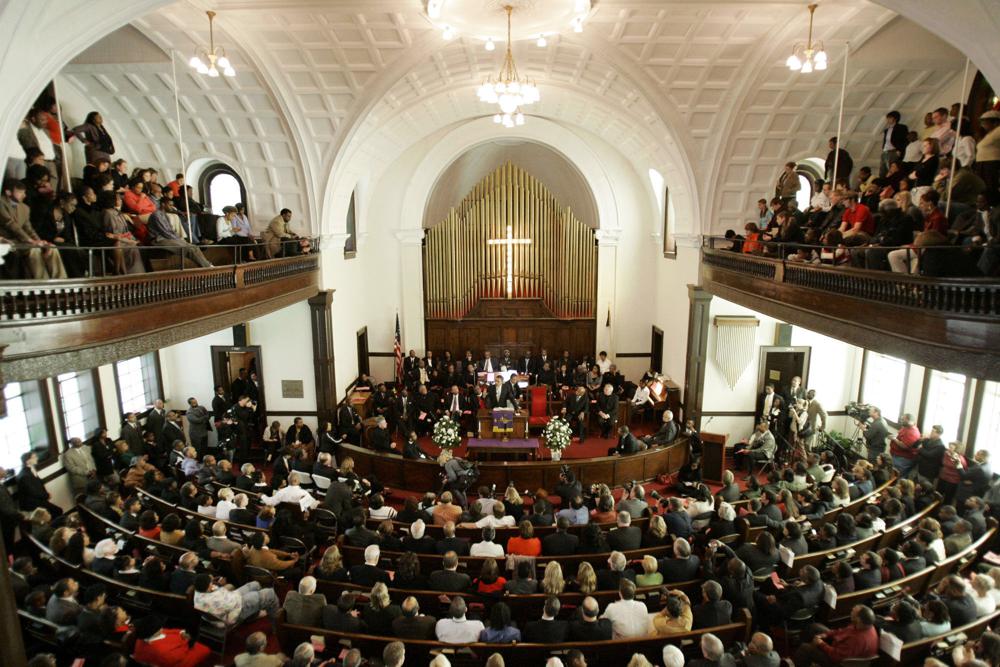
Like religious congregants all over, the people of historic Brown Chapel AME Church turned off the lights and locked the doors at the beginning of the COVID-19 pandemic because it wasn’t safe to gather for worship with a deadly virus circulating. For a time, the landmark church that launched a national voting rights movement in Selma, Alabama, was off-limits. What members found when they returned was heartbreaking: Termites had eaten so much wood that parts of the structure weren’t stable anymore, said member Juanda Maxwell, and water leaks damaged walls. Mold was growing in parts of the building, where hundreds met before Alabama state troopers attacked voting rights demonstrators on Bloody Sunday in 1965 at the Edmund Pettus Bridge. “It’s in horrible shape,” said Maxwell. “It’s a tough time. Because we were closed for a year, it exacerbated the problem with water coming in.” The red brick church, with distinctive twin bell towers and a domed ceiling, tops this year’s list of the nation’s most endangered historic places, according to the Washington, D.C.-based National Trust for Historic Preservation, a nonprofit organization which works to highlight and preserve sites that are in danger of being lost. Other places on the list include: — Chicano/a Murals painted on the sides of buildings in Colorado and inspired by the human rights and cultural movements of the 1960s and ’70s. — The Deborah Chapel, a Jewish mortuary building established in 1886 in Hartford, Connecticut. — Francisco Sanchez Elementary School, the closed centerpiece of the town in Umatac, Guam. — Minidoka National Historic Site, where more than 13,000 Japanese Americans were incarcerated during World War II in Jerome, Idaho. — Camp Naco, a base for Black Buffalo Soldiers dating back to 1919 along the U.S.-Mexican border in Naco, Arizona. — Picture Cave in Warrenton, Missouri, which holds indigenous artwork dating as far back more than 1,200 years by the Osage Nation. — Brooks Park Art and Nature Center, the home and art studio in East Hampton, New York, of James Brooks and Charlotte Park, who were important in the abstract expressionism movement in American art. — Palmer Memorial Institute, a boarding school built in 1902 for Black youths in Greensboro, North Carolina. — Olivewood Cemetery, an African American burial ground in Houston, Texas, dating to 1875 and containing more than 4,000 graves. — Jamestown, the site in Jamestown, Virginia, where enslaved people first arrived in America and where the first publicly elected assembly in the United States met. Brown Chapel, the first African Methodist Episcopal church in Alabama, was the site of preparations for a voting rights march from Selma to Montgomery on March 7, 1965, when police beat marchers led by the late Rep. John Lewis, then a young activist. Weeks later, thousands gathered there before the Selma-to-Montgomery march led by the Rev. Martin Luther King Jr. Maxwell is part of a group of Brown Chapel members serving on a foundation that’s trying to raise money for repairs estimated to exceed $4 million, she said. The church, located in a public housing community, has only a few dozen members in regular attendance, so it’s relying on grants and outside donations to fund the work. The National Park Service already has provided a grant of $1.3 million for the restoration of the church, which was constructed in 1908 by a formerly enslaved Black builder, A.J. Farley, and declared a National Historic Landmark in 1997. “Our goal is to try to receive over $3 million in grants to do the foundational work. After that we hope to get in more private donations,” Maxwell said. With members unable to gather in the building since repair work began in October, Maxwell said, the few who still attend continue meeting online. “We’re Zooming. The pastor is searching for a place,” she said. Republished with the permission of the Associated Press.
Plan advances to alter name of Edmund Pettus Bridge
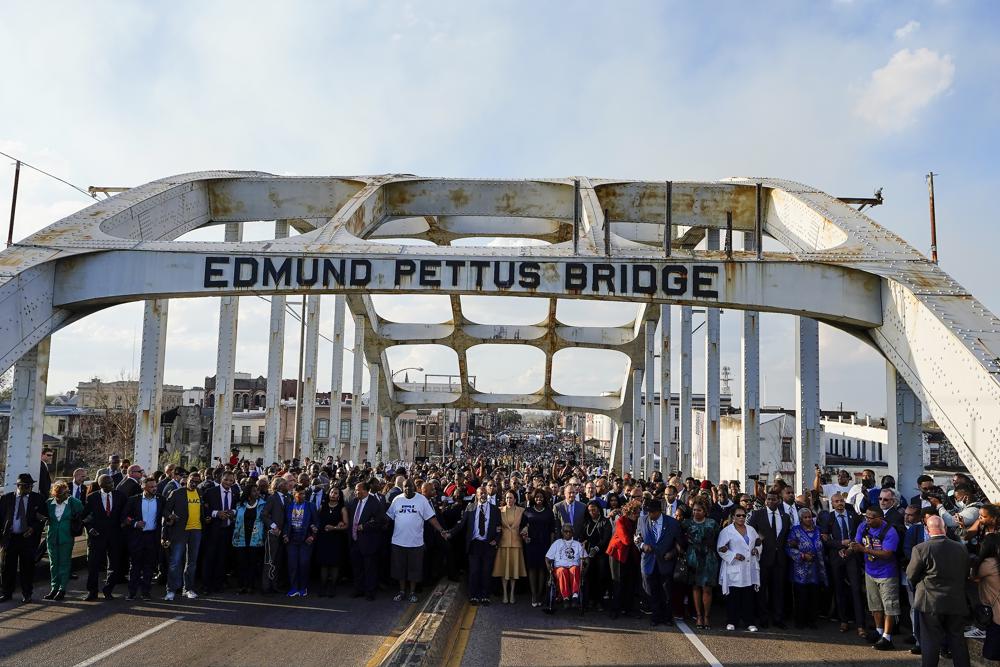
Alabama lawmakers on Tuesday advanced legislation that would alter the name of Selma’s Edmund Pettus Bridge to honor those who were beaten on the bridge as they marched for civil rights in 1965. The Alabama Senate voted 23-3 for legislation that would change the official name to the “Edmund W. Pettus-Foot Soldiers Bridge.” However, the lettering on the famous bridge would remain unaltered. The name “Foot Soldiers” would be on a separate sign that would include a silhouette of the marchers. The bill dubbed the “Healing History Act,” now moves to the Alabama House of Representatives with three meeting days remaining in the legislative session. The bridge in 1940 was named after Pettus, a Confederate general and reputed Ku Klux Klan leader. However, 25 years later, it became an enduring symbol of the civil rights movement after marchers were beaten by law enforcement officers on the bridge in 1965. The melee became known as Bloody Sunday and helped lead to passage of the Voting Rights Act of 1965. “Not a single letter would be touched. It would stay intact in its historical context. And at the same time… honor the history that is there and the history that came out of it,” said state Sen. Malika Sanders-Fortier, a Democrat from Selma. Through the years, some have proposed changing the name of the bridge, including a push to name it for the late U.S. Rep. John Lewis. The Georgia congressman was one of the demonstrators beaten on the bridge in 1965. Sanders-Fortier said many who marched for civil rights in her community do not want the bridge name changed entirely because of what the bridge has come to represent. State Sen. Gerald Allen, the author of a state law forbidding the removal and renaming of longstanding monuments and memorials, voted against the name alteration. The Alabama Memorial Preservation Act was approved as some cities began taking down Confederate monuments and emblems. Allen said the name of the Edmund Pettus Bridge is famous across the world. “If you add to it, you change it,” Allen said. The bill also would steer funds to provide for the commissioning and protection of new monuments and the preservation of sites that have significance to Alabama history. Sanders-Fortier said it is important to honor all of the state’s history and “to heal from our past so we can move forward as a state.” “Many of the events in our state’s history have been traumatizing, been traumatizing to African-American folk to Indigenous folk to white folk,” she said, adding that healing means considering the “hurt of each group.” Republished with the permission of the Associated Press.
Civil rights icon Rep. John Lewis lies in state at Capitol
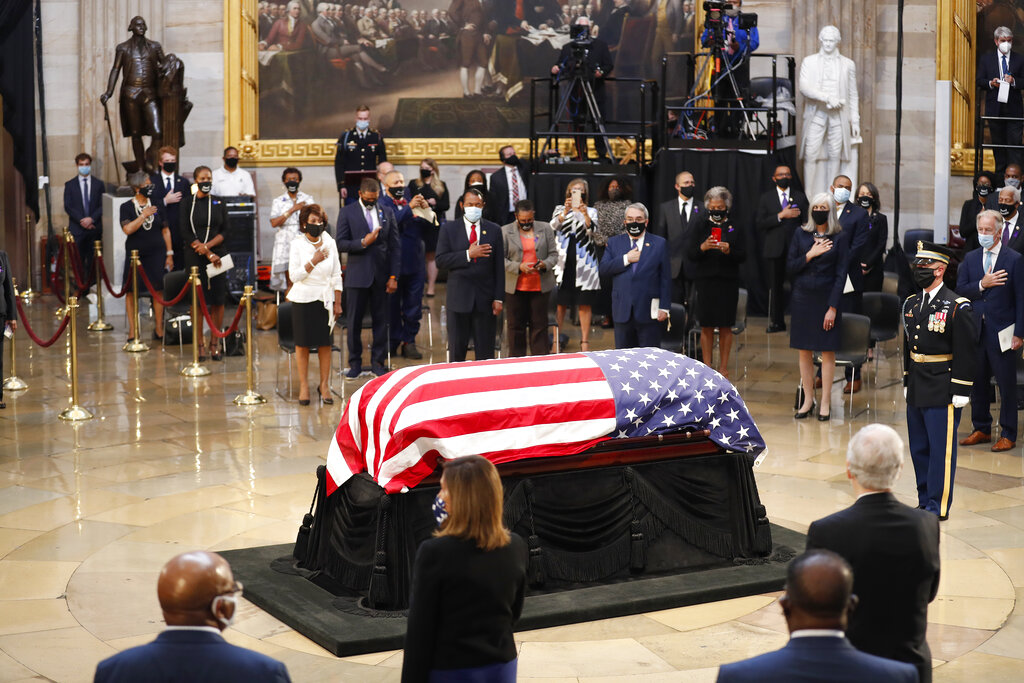
In a solemn display of bipartisan unity, congressional leaders praised Democratic Rep. John Lewis as a moral force for the nation on Monday in a Capitol Rotunda memorial service rich with symbolism and punctuated by the booming, recorded voice of the late civil rights icon. House Speaker Nancy Pelosi called Lewis the “conscience of the Congress” who was “revered and beloved on both sides of the aisle, on both sides of the Capitol.” Senate Majority Leader Mitch McConnell praised the longtime Georgia congressman as a model of courage and a “peacemaker.” “The arc of the moral universe is long, but it bends toward justice,” McConnell, a Republican, said, quoting the Rev. Martin Luther King Jr. “But that is never automatic. History only bent toward what’s right because people like John paid the price.” Lewis died July 17 at the age of 80. Born to sharecroppers during Jim Crow segregation, he was beaten by Alabama state troopers during the civil rights movement, spoke ahead of King’s “I Have a Dream” speech at the 1963 March on Washington and was awarded the Medal of Freedom by the nation’s first Black president in 2011. Dozens of lawmakers looked on Monday as Lewis’ flag-draped casket sat atop the catafalque built for President Abraham Lincoln. Several wiped away tears as the late congressman’s voice echoed off the marble and gilded walls. Lewis was the first Black lawmaker to lie in state in the Rotunda. “You must find a way to get in the way. You must find a way to get in trouble, good trouble, necessary trouble,” Lewis intoned in a recorded commencement address he’d delivered in his hometown of Atlanta. “Use what you have … to help make our country and make our world a better place, where no one will be left out or left behind. … It is your time.” Members of the Congressional Black Caucus wore masks with the message “Good Trouble,” a nod to Lewis’ signature advice and the COVID-19 pandemic that has made for unusual funeral arrangements. The ceremony was the latest in a series of public remembrances. Pelosi, who counted Lewis as a close friend, met his casket earlier Monday at Joint Base Andrews in Maryland, and Lewis’ motorcade stopped at Black Lives Matter Plaza near the White House as it wound through Washington before arriving at the Capitol. The Democratic speaker noted that Lewis, frail with cancer, had come to the newly painted plaza weeks ago to stand “in solidarity” amid nationwide protests against systemic racism and police brutality. She called the image of Lewis “an iconic picture of justice” and juxtaposed it with another image that seared Lewis into the national memory. In that frame, “an iconic picture of injustice,” Pelosi said, Lewis is collapsed and bleeding near the Edmund Pettus Bridge in Selma, Alabama, on March 7, 1965, when state troopers beat him and other Black Americans as they demanded voting rights. Following the Rotunda service, Lewis’ body was moved to the steps on the Capitol’s east side in public view, an unusual sequence required because the pandemic has closed the Capitol to visitors. Late into the night, a long line of visitors formed outside the Capitol as members of the public quietly, and with appropriate socially distant spacing, came to pay their respects to Lewis. Presumptive Democratic presidential nominee Joe Biden paid his respects late Monday afternoon. The pair became friends over their two decades on Capitol Hill together and Biden’s two terms as vice president to President Barack Obama, who awarded Lewis the Presidential Medal of Freedom in 2011. Notably absent from the ceremonies was President Donald Trump. Lewis once called Trump an illegitimate president and chided him for stoking racial discord. Trump countered by blasting Lewis’ Atlanta district as “crime-infested.” Trump said Monday that he would not go to the Capitol, but Vice President Mike Pence and his wife paid their respects. Just ahead of the ceremonies, the House passed a bill to establish a new federal commission to study conditions that affect Black men and boys. Born near Troy, Alabama, Lewis was among the original Freedom Riders, young activists who boarded commercial passenger buses and traveled through the segregated Jim Crow South in the early 1960s. They were assaulted and battered at many stops, by citizens and authorities alike. Lewis was the youngest and last-living of those who spoke on the steps of the Lincoln Memorial at the March on Washington. The Bloody Sunday events in Selma two years later forged much of Lewis’ public identity. He was at the head of hundreds of civil rights protesters who attempted to march from the Black Belt city to the Alabama Capitol in Montgomery. The marchers completed the journey weeks later under the protection of federal authorities, but then-Alabama Gov. George C. Wallace, an outspoken segregationist at the time, refused to meet the marchers when they arrived at the Capitol. President Lyndon Johnson signed the Voting Rights Act of 1965 on Aug. 6 of that year. Lewis spoke of those critical months for the rest of his life as he championed voting rights as the foundation of democracy, and he returned to Selma many times for commemorations at the site where authorities had brutalized him and others. “The vote is precious. It is almost sacred,” he said again and again. “It is the most powerful nonviolent tool we have in a democracy.” The Supreme Court scaled back the seminal voting law in 2012; an overhauled version remains bottle-necked on Capitol Hill, with Democrats pushing a draft that McConnell and most of his fellow Republicans oppose. The new version would carry Lewis’ name. Lewis crossed the Edmund Pettus Bridge for the last time Sunday on a horse-drawn carriage before an automobile hearse transported him to the Alabama Capitol, where he lay in repose. He was escorted by Alabama state troopers, this time with Black officers in their ranks, and his casket stood down the hall from the office where Wallace had peered out of
Retired Alabama Power vice president still marching from Selma to Montgomery
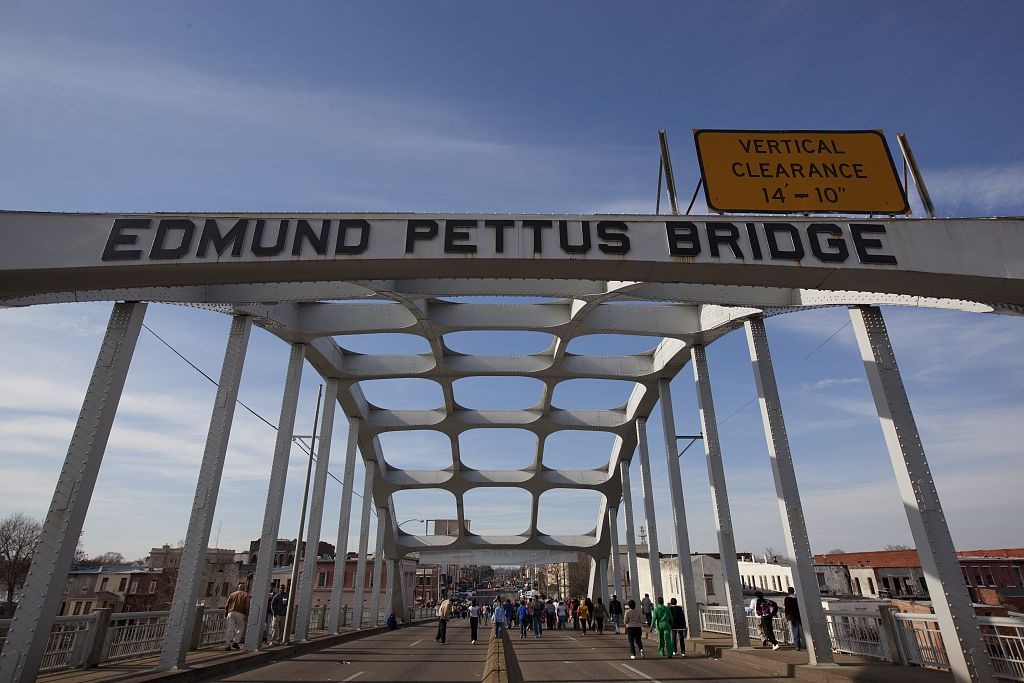
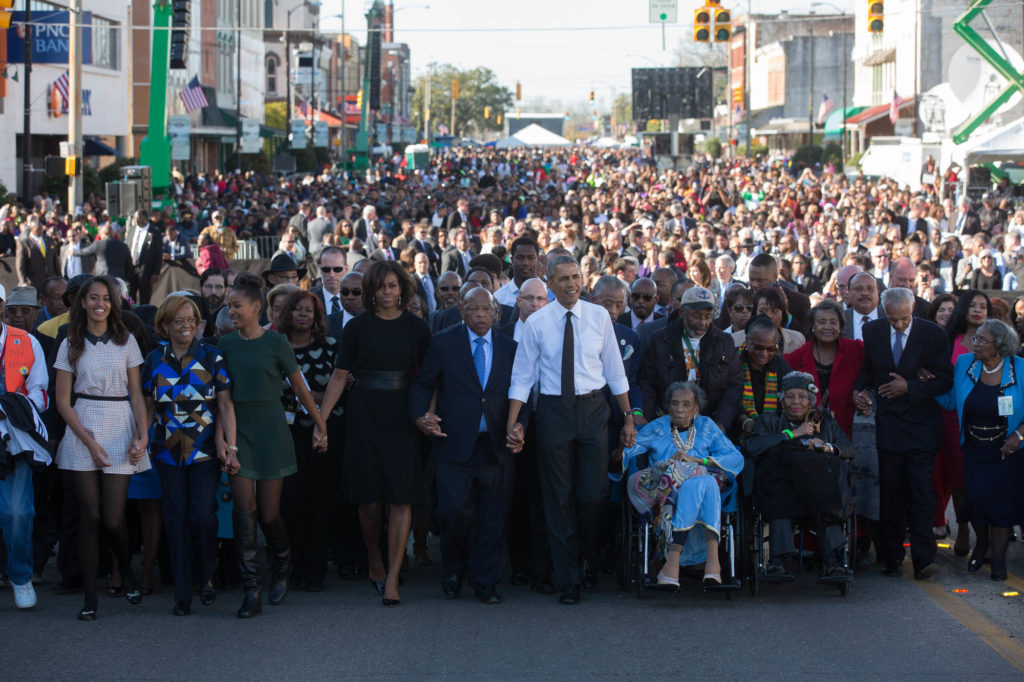
When former Alabama Power vice president Julian Smith retired in 2008, he continued overseeing fundraising efforts for the Selma to Montgomery March Foundation board. Born and raised in Selma, Smith was no stranger to the issues around civil rights. (The Voting Rights Act was signed by President Lyndon Johnson after the first march in 1965.) Smith’s involvement began when his longtime friend, State Sen. Hank Sanders, invited him to a breakfast meeting to discuss an upcoming march celebration. “Julian was with the Selma to Montgomery Foundation board from its inception,” Sanders said. “The official entity was set up in 2014, but Julian was doing sponsorship work decades before.” “Fundraising for the Selma to Montgomery March was a big passion,” Smith said. “While I was in college, I became focused on human rights and justice for all. It was my aim to get as many sponsors as possible to fund this incredible project.” Smith’s fundraising skills brought as much as $100,000 from corporate sponsors throughout the state during celebratory years, Sanders said. “Great sponsorships have enabled Selma to be better perceived nationally and internationally,” Smith said. “The image of Selma has been transformed into a positive light. It is seen as a more unified community.” “Julian had a fantastic understanding of human rights. He understood the people, the players and knew how to handle problems,” Sanders said. “Julian knew how to get things done. He knew how to touch people and he knew what situations took priority. He had a broad understanding of the critical issues in Alabama. He was concerned about everyone, not just one particular community.” Smith’s largest fundraising campaign was in 2015 when President Barack Obama attended the 50th anniversary of “Bloody Sunday,” the initial attempt to march that was cut short when marchers were beaten by lawmen at the foot of the Edmund Pettus Bridge. Memories of that attack on March 7, 1965, magnified contributions to the foundation. More than 100,000 people attended 50 commemorative events in Selma. Contributions from the foundation continue to aid the annual Bridge Crossing Jubilee, and associated entertainment, food, police protection and crowd control. After the foundation was formed, Smith made it a stronger entity, Sanders said, “but his greatest accomplishment was fundraising. “Julian is and will always be a gift to Alabama,” Sanders said. Members of the board include Chairman James Mitchell of Wallace Community College Selma, Johnny Johns of Protective Life Corp., Stephanie Bryan of the Poarch Band of Creek Indians, Ed McCurdy of Regions Bank, Felecia Pettway of Wallace Community College Selma, Selma attorney Carolyn Gaines-Varner, Sharon Wheeler of W2 Strategies. “There is a lot of teamwork that goes into fundraising,” Smith said. “None of this is possible without great board members. These folks are the glue that holds every plan in place.” Selma holds the nation’s largest annual civil rights celebration. Thousands of people attended the 53rd annual National Voting Rights Act, Bloody Sunday Commemoration and the Bridge Crossing Jubilee March 2-5. Smith recently retired from the foundation board. He remains a strong supporter of civil rights. This story originally appeared on Alabama News Center.
Commemoration of ‘Bloody Sunday’ set in Alabama
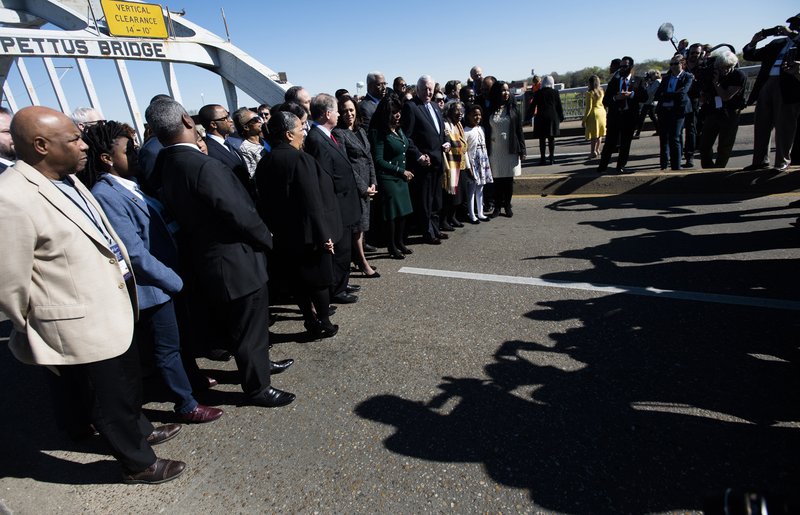
Several members of Congress have joined civil rights activists and others for the annual commemoration of a day of racial violence in Selma dating to 1965. A bipartisan group including Rep. John Lewis of Georgia led the crossing of the Edmund Pettus Bridge on Sunday afternoon. It was to recall “Bloody Sunday,” when voting rights protesters were attacked by police as they attempted to cross the bridge. Lewis, then a young organizer, was among those injured then. That violence set the stage for the Selma-to-Montgomery march, which helped build support for congressional approval of the Voting Rights Act months later. The annual celebration drew tens of thousands of people in 2015, when then-President Barack Obama spoke near the base of the bridge as former President George W. Bush listened. Republished with permission of The Associated Press.
Terri Sewell: Remembering Bloody Sunday
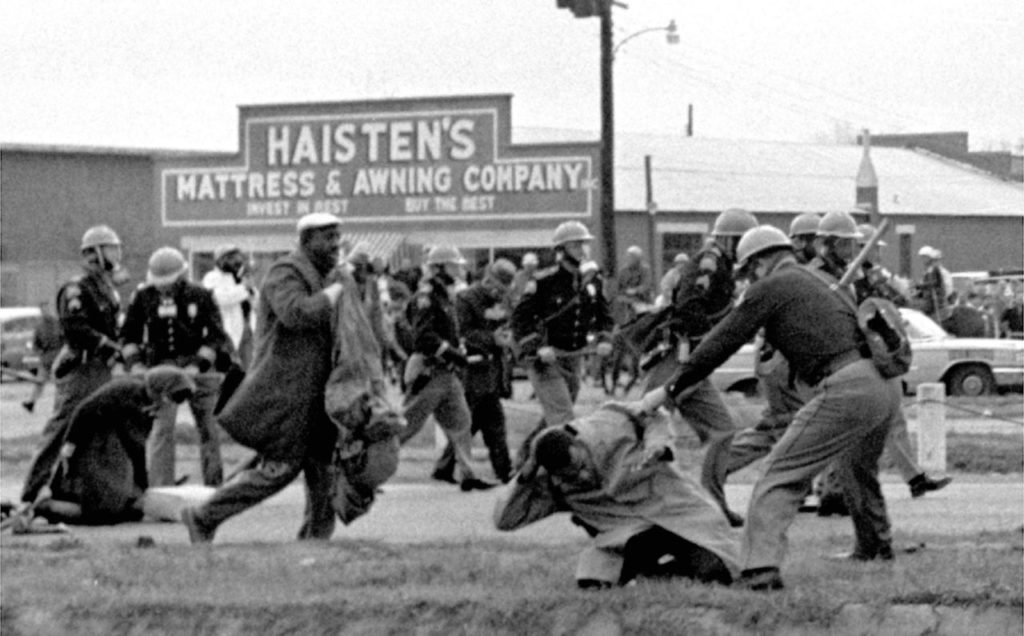
History is never stagnant. The saga of American democracy and the battle for the right to vote has its moments of inspiration, just as it has moments of defeat. The story this year’s chapter will tell is in our hands. Fifty-two years ago today, 600 marchers in Selma, Ala., brought the reality of racism and segregation into living rooms nationwide. That day, hundreds of voting rights supporters were viciously beaten by state troopers as they attempted to cross the Edmund Pettus Bridge. The brutal stories of Bloody Sunday reframed the issue of racism for the American public and ultimately led to passage of the Voting Rights Act of 1965 (VRA), our nation’s most powerful tool for protecting the vote. But the story of America’s fight for fair elections is never finished. After 48 years of bipartisan support from Congress and the White House, the VRA was gutted by the Supreme Court in its 2013 Shelby v. Holder decision, eliminating key protections for minority voters. On the 50th Anniversary of Bloody Sunday in 2015, our nation had an opportunity to undo that damage. That year, I joined President Barack Obama, President George W. Bush and a bipartisan group of more than 100 Members of Congress in Selma to commemorate the voting rights movement. It was an atmosphere of hope and unity in opposition to the hate and racism of our country’s past. Yet we returned to Washington, and Congress did nothing to restore the VRA. Today’s anniversary of Bloody Sunday is another opportunity to recommit to protecting voting rights for all Americans, but it is also a moment to reflect on the fresh urgency of that work. Old battles have become new again. This year’s commemoration of Bloody Sunday comes on the heels of the announcement that the Justice Department would drop challenges to a discriminatory Texas voter ID law, even after that law was struck down twice by courts for undermining minority voting rights. This year’s commemoration was also set against the backdrop of an executive order barring immigrants from Muslim-majority countries from coming into the United States. When Dr. Martin Luther King, Jr. completed his Selma to Montgomery march in 1965, after multiple attempts blocked by the police, he spoke to a crowd of nearly 50,000 supporters. In his speech, he told his audience that “no tide of racism can stop us.” This year I find those words have new resonance. Perhaps Dr. King was right – maybe hate is a tide: one that rolls in and out. This year, we face a rising tide of intolerance that’s had an immeasurable impact on my community. Last week, a bomb threat was called into a Birmingham Jewish community center in my district, the third threat in just one month’s time. I received messages from families who attend the center and were frightened for their safety and hurt by the threats against them. I’ve received messages from Muslim constituents who have family abroad, afraid that a travel ban will block them from seeing their loved ones. I’ve met with constituents worried for undocumented members of their community living in the United States. Looking back at photos from Bloody Sunday, the fear and pain that I see in the eyes of those who marched does not seem so foreign. I recognize the hurt of a people assaulted, threatened, and excluded because of who they are. But I also see courage. When I look at pictures of marchers like Amelia Boynton Robinson, I see a black woman who stood up to hate wherever she encountered it. This year, the 1965 Selma to Montgomery marches do not seem like a thing of the past, but instead a model for our work. We have to act as those in the voting rights movement did, and stand together for the rights of all Americans. I am a direct beneficiary of the movement. I was born the year that the Selma to Montgomery marches took place, and I owe those who fought, bled and died a debt of gratitude that I can never repay. But their story, and the story of America’s voting rights movement, is never finished. When Americans today suffer from some of the same injustices suffered 52 years ago, we cannot ignore the work left to be done. If the brutal stories of Bloody Sunday teach us anything this year, it’s that we must not only remember, but also dedicate ourselves to action. Together, we have a tide to turn back. ••• This article first appeared on TheHill.com. ••• Rep. Terri A. Sewell (D-Ala.) is serving her fourth term representing Alabama’s 7th District. She sits on the House Permanent Select Committee on Intelligence and was recently appointed to the House Ways and Means Committee.
Moral activists to hold Selma voting rights town hall Sunday
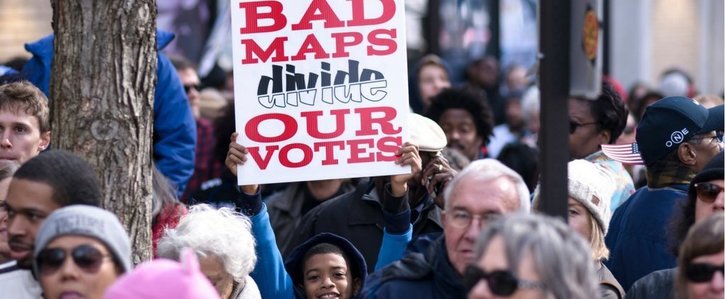
Fifty-two years after the “Bloody Sunday” attacks on marchers at the Edmund Pettus Bridge, a group of moral activists will a hold town hall meeting in Selma Sunday to demand Congress fully restore the 1965 Voting Rights Act. The town hall, co-sponsored by Repairers of the Breach and Forward Justice, will also call on Attorney General Jeff Sessions, himself the former U.S. senator from Alabama, to take a public stand on the full restoration of the Act. The event is open to the public and will be held 7 p.m. – 8:30 p.m. CT at the Dallas County Courthouse second floor courtroom, 102 N Lauderdale St. in Selma. Democratic State Sen. Hank Sanders of Selma will co-host and present at the town hall meeting. Repairers of the Breach is a national organization to develop, train and support state-based moral movements. Forward Justice, a law, policy and strategy center dedicated to civil rights, racial justice, and social and economic change in the South. Among the local leaders at the town hall include Rev. Dr. William J. Barber II, president and senior lecturer of Repairers of the Breach, pastor of Greenleaf Christian Church, and architect of the Moral Mondays movement; Attorney Penda Hair, legal director of Forward Justice; and Ari Berman, national voting rights advocate and author of “Give Us the Ballot.” Barber and Hair have led statewide efforts in North Carolina to fight voter suppression tactics, including their recent work to secure “a federal appeals court victory that stopped extremist legislators’ efforts to “target African-Americans with almost surgical precision,” as reported by The New York Times. “This Sunday marks 1,349 days since the 2013 Supreme Court decision, Shelby County v. Holder, weakened Section 5 of the VRA, opening the door to voting law changes without federal pre-clearance in states with a history of discrimination,” Barber said in a statement. “The Republican-led Congress has refused to fix and fully restore the Voting Rights Act, which means we have less voting rights protections today than on Aug. 6, 1965 when the VRA was passed. We know claims of vast voter fraud are proven lies, but the courts have shown that voter suppression efforts are alive and well in our country. This is especially true in the South.” On Friday, Barber, Hair, and a group of moral activists delivered an open letter to the Department of Justice calling on Sessions to take a public stand for the full restoration of the Voting Rights Act in 2017. The letter calls Sessions “to higher ground,” insisting that he use the office of Attorney General to “protect States and jurisdictions where extremist legislators are actively working to suppress black, brown and poor white voters.”
Selma to commemorate”Bloody Sunday” will host largest voting rights commemoration event in US
On Thursday, March 2 through Sunday, March 5, Selma, Ala. will host the largest voting rights commemoration event in the country — the Bridge Crossing Jubilee 2017 — remembering the 52nd anniversary of the Selma to Montgomery “Bloody Sunday” march. This annual event commemorates “Bloody Sunday,” when on March 7, 1965, a group of roughly 525 African American protesters planned to cross the Edmund Pettus Bridge on their civil rights march to Montgomery to demand the right to vote. At the bridge they where they were met by more than 50 state troopers and a few dozen men on horseback. When the demonstrators refused to turn back, they were brutally beaten, leaving at least 17 hospitalized, and 40 others injured. The violent attack, which was broadcast on national television, caught the attention of millions of Americans and was aptly dubbed “Bloody Sunday” and ultimately became a rallying point for civil rights leaders. While details of this year’s event are still being finalized, there will be workshops on the following topics: Voting Immigration Criminal Justice Education Economic Empowerment Health and Environment Special Workshop by SNCC Legends Additionally, the weekend will feature over 40 events including: Parade Blues Hip-hop and gospel music festival Step show Pageant Mock trial Unity breakfast Freedom Flame Awards Hip-hop summit Storytelling by Living History Makers March re-enactment and more Those interested in attending may purchase tickets online.
Diamond anniversary celebration set for Edmund Pettus Bridge
The city of Selma has celebrated its fair share of anniversaries this year, but there is one that hasn’t been celebrated yet – the diamond anniversary of the Edmund Pettus Bridge. The historic bridge, which has been the center of controversy over the last week, turned 75 years old in May. The Edmund Pettus Bridge was opened in May of 1940, where the bridge took the place of its wooden predecessor. Selma councilwoman Susan Keith, along with other council members, is planning a birthday celebration for the bridge. On June 9, Keith announced the celebration during the city council meeting for June 19 at 5:30 p.m. at the Songs of Selma Park at the foot of the bridge on the Selma side. Keith said she wanted to celebrate the bridge because of how much it means to so many people in Selma and across the world and what it stands for. The details of the birthday celebration were not released, but Keith did say she wanted the event to be about the bridge itself. With recent talks of renaming the bridge to the Journey to Freedom Bridge, Keith said she wanted the day to be solely about the bridge and not any of the controversy that was sparked after the Alabama Senate voted for a resolution to rename the bridge earlier this month. The resolution, which was sponsored by Sen. Hank Sanders, made it to the House of Representatives, but it was not voted on, essentially killing it. Sanders said people wanted the bridge renamed because Edmund Pettus was a grand dragon of the Ku Klux Klan, according to some historians. The Edmund Pettus Bridge became a symbol of the civil rights movement in 1965 after marchers were brutally beaten by Dallas County Sheriff Jim Clark‘s deputies and Alabama State Troopers on a day that became known as Bloody Sunday. More than 100,000 people made the trip to Selma the weekend of the 50th anniversary in March to see President Barack Obama speak at the foot of the bridge and to make the annual march across it to pay homage to those that did in 1965. Councilwoman Bennie Ruth Crenshaw said she wanted the history of the bridge and who Edmund Pettus was to be told, but Keith, along with councilman Cecil Williamson, agreed to shy away from the controversy during the celebration. Republished with permission of the Associated Press.
Roundup of Sunday editorials from Alabama’s leading newspapers
A round-up of Sunday editorials from Alabama’s leading newspapers: The Anniston Star – Our ‘frustration’ over the Alabama Legislature In recent years, Alabama’s modern-day lawmakers have shown no willingness to right the state’s sinking financial ship. No one in their right mind should have thought these lawmakers would be any different this go-around. They weren’t, obviously. Oh, they passed a $1.64 billion General Fund budget Thursday, but it mimicked Monopoly money. Its value was nil. It didn’t solve the state’s budget crisis. It didn’t repair the $200 million hole in the General Fund. It didn’t remove the specter of closed state agencies, laid off state employees and shuttered state parks. It also didn’t escape the governor’s wrath. “It annoys me that the Legislature did not do their job within the allotted period of time,” Gov. Robert Bentley said, “but you can’t get frustrated.” Really? That’s exactly what Alabamians should be — frustrated, or worse, that lawmakers continue to subscribe to the discredited theory that the only way to write a sensible state budget is to cut fat like the grocery-store butcher. They don’t give a hoot about the ramifications: on public safety, on prisons, on state parks, on state employees, on the state’s reputation. All they care about — particularly the Republican members of their ranks — is adhering to a low-tax, small-government mantra that sounds good on Election Day but isn’t practical in reality. Bentley vetoed the budget because it doesn’t move the ball forward. It checked off a box — budget passed, mission accomplished — and that’s it. Bentley, eschewing his party’s no-new-tax beliefs, rightly prefers the state face reality that new revenue, through tax increases, is the wisest choice. Feelings of frustration should overtake us all. Alabama got in this situation because Montgomery’s men (and women) have played their roles well. They’ve fought tax increases. They’ve argued against most forms of revenue creation. They’re preached sermons that say small government equals good government. They’ve played shell games with the state’s finances, moving money from one account to another, borrowing from a rainy day account, relying on federal dollars. Everyone knew that one day, barring a massive influx of new money, that the spigot from which cash flows into the state’s coffers would run dry. Legislators have been in session since March and found no viable solution. That’s not merely frustrating. That’s reprehensible. The Decatur Daily: Legislature failed to do its job Governmental dysfunction is not surprising when an executive branch and legislative branch are controlled by different parties with contrasting ideologies. It’s been a feature of our federal government since Republicans controlled first the House and then the Senate, while a Democrat occupied the White House. The results at the federal level have been maddening, if not surprising. The Republican Congress doesn’t trust the agenda of the Democratic president, and consequently doesn’t trust his advice. Whether the topic is Iran or international trade pacts or the federal budget, suspicion and mistrust lead to inaction. Such stalemates come as a surprise when the same party controls both the legislative and executive branches, as has been the case in Alabama since 2010. When it comes to budgetary matters, Gov. Robert Bentley, a former Republican legislator, is ideologically indistinguishable from the Republicans who control the Statehouse. Bentley is an advocate of smaller government. He resents taxes. He successfully won the governor’s seat twice by touting his fiscal conservatism. He spent his first term acting on these principles, cutting agencies to skeletal levels and swearing the state could function without new revenue. For Bentley, reality finally intruded. He still favored small government and low taxes, but his day-to-day management of state government convinced him the state would fail its citizens if revenue dropped. And he knew, as did his Republican colleagues in the Legislature, that revenue had to drop. Years of one-time windfalls that had propped up the state finally were at an end. Something had to be done before fiscal 2016, which begins in October. So Bentley did what no conservative wants to do. He proposed new taxes. He reminded legislators fiscal responsibility is a cornerstone of conservatism. He explained he already had cut $1 billion from state government, and any further cuts would irreparably harm Alabama. So what did the Legislature do with this information from one of their own? They rejected it. In a rebuff that made two-party Washington look harmonious, one-party Montgomery could not find the level of cooperation needed to run the state. The result is inefficiency in a government that does not have the luxury of being inefficient. After the Legislature passed a budget the legislators themselves agreed was irresponsibly austere, Bentley vetoed it. State agencies and the people they serve have no idea what preparations to make for fiscal 2016. Bentley has promised a special session, which will cost the state $320,000 it doesn’t have. Senate Finance and Taxation General Fund Committee Chairman Arthur Orr, R-Decatur, received enthusiastic applause from his colleagues on the last day of the session. Yet the Legislature rejected his budgetary advice as well. Orr called the session “extremely frustrating.” “Just the inability to come to a consensus,” he said. “It took time for an agreement that there really is a significant problem and that just passing a cut budget is not the best answer to the problem.” Extremely frustrating? Yes. Also expensive, irresponsible and embarrassing. The Gadsden Times: Celebrate open meetings Alabama will soon have a stronger Open Meetings Act, and that’s news worth celebrating. It’s a common misconception that open meeting laws are for the benefit of media companies. The reality is that open meeting laws are for the benefit of the public. Most people aren’t going to attend public meetings even if they have a direct stake in the actions above and beyond being concerned about how their tax money is being spent. They rely on media outlets to report on the actions. Without open meeting laws, it’s more difficult for media companies to get that information
State Senate seeks to rename Edmund Pettus Bridge

Alabama senators are seeking to rename Selma’s Edmund Pettus Bridge, a historic site in the voting rights movement that bears the name of a Ku Klux Klan officer. Senators on Wednesday approved a resolution to rename it the Journey to Freedom Bridge. The bridge became a symbol of the fight for voting rights after marchers were beaten by state troopers on the bridge on March 7, 1965. The bridge that spans the Alabama River is Selma’s most notable landmark. It is named for Pettus, a two-term U.S senator, a Confederate general and a KKK grand dragon. The KKK connection had faded from local memory until this year, when approaching the 50th anniversary of the “Bloody Sunday” beatings, a Selma student group launched an online petition to rename the landmark bridge. “There was a thought that every time you lift the name, you also lift the name of the KKK grand dragon,” said Selma Sen. Hank Sanders, who sponsored the resolution. “That bridge became a symbol of the struggle for freedom,” Sanders said. Sanders said several new potential names were kicked around, including “the Bloody Sunday Bridge.” He said “Journey to Freedom” is appropriate because “it says we are still on the journey.” However, Lee Sentell, director of the Alabama Tourism Department, said he worried changing the bridge’s name could threaten its status as a national historic landmark. “I believe its status would be in jeopardy because it would be altering the appearance of the structure from its historical period,” he said. The Alabama House of Representatives has not voted on the idea with just two more meeting days in the legislative session. Sanders said lawmakers named the bridge for Pettus in the 1940s. He said he thinks they can legally change the name by resolution. An Alabama Department of Transportation spokesman said it’s reviewing the resolution. Republished with permission of The Associated Press.
