
Kay Ivey signs legislation creating School of Cyber Technology and Engineering, Education Budget
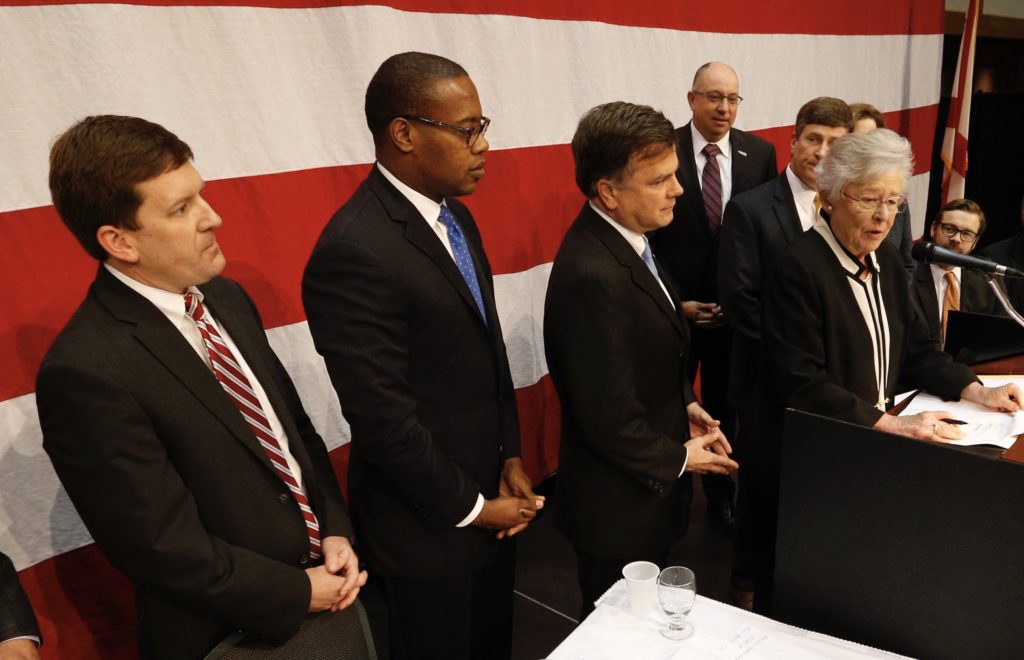
Governor Kay Ivey on Monday signed into law a pair of bills SB212 and SB175, which creates the Alabama School of Cyber Technology and Engineering and funding the 2019 education budget, respectively. SB212: Alabama School of Cyber Technology and Engineering Sponsored by Decatur-Republican State Sen. Arthur Orr and Huntsville-Democrat, House Democratic Leader State Rep. Anthony Daniels, SB212 creates the Alabama School of Cyber Technology and Engineering in Huntsville. The school will be an independent, residential school that is established for academically-motivated and gifted Alabama students with educational opportunities and experiences in the rapidly growing fields of cyber technology and engineering. The school will also assist teachers, administrators, and superintendents across the state in replicating cyber technology and engineering studies in their own schools. “The Alabama School of Cyber Technology and Engineering will prepare some of our state’s highest-achieving students to enter the growing fields of cyber technology and engineering,”Ivey said. “Just as Huntsville has always been on the leading edge of the rocket and aerospace industries, the Alabama School of Cyber Technology and Engineering will ensure that Alabama students are at the forefront of today’s emerging technologies.” Orr said he envisions students from across the country wanting to relocate and attend the school. “I see the school as a real magnet for gifted students not only from all over the state, but also from across the country who may want to relocate here to be able to access such a world class, cutting-edge education in the fields of cyber and engineering. The graduates of the school will be long term contributors to this state’s growth in these emerging areas,” explained Orr. “Today is an important day for Huntsville, our state and, most importantly, our young people. In addition to continuing to grow our reputation as an emerging hub in the tech and cybersecurity industry, this school will provide our students the opportunity to become the next generation of innovators by giving them a jump-start on careers in technology, engineering, and protecting our nation’s cyberinfrastructure,” added Daniels. The Huntsville/Madison County Chamber of Commerce was instrumental in coordinating efforts between the Chamber, Cyber Huntsville and the Alabama School of Cyber and Engineering Foundation. “We are pleased that the vision for an Alabama cyber technology and engineering magnet school has been acted upon by our state leaders,” said Alicia Ryan, Vice President of the Cyber Huntsville Board and President of the Alabama School of Cyber and Engineering Foundation. “This school will provide a wonderful opportunity for students from across Alabama to get early exposure to new STEM-based curriculum that will prepare them for exciting cyber and engineering career paths. By enabling unique educational opportunities today, we are building our workforce for the future.” A location for the school has yet to be selected. The legislation allows for the school to open and formally begin operation during the fall semester of 2020. SB175: Education Budget Ivey also signed the Education Budget on Monday, which was also sponsored by Decatur-Republican State Sen. Arthur Orr along with Tuscaloosa-Republican and Committee chair state Rep. Bill Poole. The 2019 budget provides a historic level of funding for all aspects of the state’s education system. It also includes a 2.5 percent raise for all education employees. “I am proud to have worked closely with the Legislature to pass a historic Education Budget which gives a raise to our teachers and school employees, increases funding for our voluntary Frist-Class Pre-K Program and provides more opportunities for higher-education students across Alabama,” Ivey commented. “I am committed to improving education in Alabama for everyone, regardless of where they live or the economic resources available to them.” The Education Trust Fund Budget is the largest investment in education in a decade, and was passed with overwhelming bipartisan support. “Alabama’s teachers and education support staff have an important task – educating our children – our children who are the key to our state’s success,” Ivey added. “It is important that we attract the best people possible to work in our education system and this pay raise will help us do that.” The budget covers the fiscal year 2019 which begins in October.
Alabama education budget moves one step closer to Kay Ivey’s desk

Alabama legislators moved one step closer to sending the Education Trust Fund budget to Gov. Kay Ivey’s desk on Tuesday. Lawmakers in the State House gave final approval to the conference committee report on HB175, a $6.6 billion education budget for Fiscal Year 2019, which starts October 1 on a 98 to 0 vote. It is the largest education budget for Alabama’s schools since the great recession of 2008. The funding includes a 2.5 percent pay raise for teachers. The measure now moves to the State Senate for final approval, before it could be sent to Ivey’s desk to be signed into law.
State Senate unanimously approves $6.6 billion Education Budget

The 2019 education budget unanimously passed the State Senate on Thursday. The body approved SB165, the $6.6 billion Education Trust Fund for Fiscal Year 2019, which starts October 1 on a 29 to 0 vote. It is the largest education budget for Alabama’s schools since the great recession of 2008. “Nothing is more important than ensuring a quality education for every student in Alabama, and this education budget is a statement of strong support for our teachers and schools,” said Decatur-Republican State Senator Arthur Orr, Chairman of the Finance and Taxation Education committee. “This is also a sustainable budget that protects taxpayers. From 2001 to 2011, proration – the midyear slashing of local school budgets because of irresponsible fiscal plans from the Legislature – occurred six times. Proration hasn’t happened once since 2011.” The FY19 education budget includes a $18.5 million increase for First Class, Alabama’s nationally-recognized, volunteer pre-kindergarten program. A University of Alabama at Birmingham study, released in February by the Department of Early Childhood Education, showed that students who participated in First Class outperformed their peers in reading and math assessments. First Class, currently available in 941 classrooms, has been named the nation’s best pre-kindergarten program in the nation for eleven years in a row by the National Institute for Early Education Research. The $18.5 million increase will help fund approximately 120 new Pre-K classrooms. “I want to commend Senator Orr and the Finance and Taxation Education committee for their hard work in passing the Education Trust Fund. This fiscally-responsible budget is another step in the right direction as we were able to include a pay raise for teachers, increased funds for school security, and additional money for classroom supplies,” added Anniston-Republican Senate Pro Tem Del Marsh. The Senate’s education budget is paired with a 2.5% pay raise for K-12 and two-year college education employees, at a cost of $102 million to Alabama taxpayers, along with a $1.1 uptick for K-12 career tech and a $6 million increase for K-12 transportation. “This budget is an investment in the future of Alabama. Conservatives in the legislature are strongly committed to fighting for Alabama’s students and teachers, and improving our schools to ensure that every student in every county in Alabama has access to a quality education,” said Jasper-Republican Senate Majority Leader Greg Reed. “We have set aside additional money for school security, given a much-deserved raise to teachers, and invested more money in our vital career tech programs.” The $6.6 billion FY19 education budget includes funds for a new robotics program for middle and high school students, and at the request of Governor Kay Ivey, allocates $500,000 for mental health counselors to be available for K-12 students in the aftermath of school shootings. The budget boosts spending on textbooks by $11 million, along with a $4 million increase for new technologies in classrooms. Earlier in the week, the Senate approved a proposal that will allow local school boards to use money from the Advancement and Technology Fund to improve school security by hiring new security officers and installing metal detectors at school entrances. The FY19 education budget now goes the House of Representatives for either concurrence with the Senate’s version, or a conference committee between the two chambers before it heads to the Governor’s desk.
$6.6 billion Education budget funds pay raise, heads to House floor next week

The Alabama House Ways and Means Education Committee on Wednesday unanimously approved a $6.6 billion education budget on Wednesday. The 2019 Education Trust Fund budget provides a 2.5 percent pay raises for education employees in K-12 and two year colleges, boost funding for pre-kindergarten by $20 million as well as additional programs, and fund 197 more teachers in middle school grades. “This budget reflects high-priority for classrooms and for supporting teachers, and that’s where the money ought to be,” said Interim State Superintendent Ed Richardson during budget talks on Monday afternoon. He said it’s a “strong budget.” Tuscaloosa-Republican and Committee chair state Rep. Bill Poole said he expects the budget to be on the House floor next Thursday. If passed, it will go into effect Oct. 1.
Alabama teachers are getting a raise

Most Alabama teachers will get a 4 percent raise in 2017. Thanks to the Alabama Legislature, which gave final approval to the state’s education budget Thursday. Working teachers and other school employees would get a 4 percent pay raise if they now make less than $75,000 per year, and employees with higher pay would see their pay go up by 2 percent. It’s the first take-home pay increase in years for Alabama public school teachers. Lawmakers have sent the $6.3 billion budget, which provides funding for K-12 schools, community colleges, four-year universities and other programs on to Gov. Robert Bentley for his signature. “Alabama’s future sits in classrooms today, and our state’s teachers and support staff work hard to prepare students for success,” said Bentley after the budget’s passage. “In my State of the State address in February, I prioritized a pay raise for teachers and support staff, and I commend the Alabama Legislature for passing this important piece of legislation. Alabama’s commitment to education is strong, and with this pay raise, state leaders are sending a clear message of support to our invaluable teachers and other support staff,” said Bentley.
Alabama Senate passes education budget, teacher pay raise

The Alabama Senate passed Wednesday evening the Education Trust Fund budget, funding education in the state, as well as the first pay raise for teachers in several years. In the largest education budget from the state since 2008’s financial crash which sent the state’s budgets careening, the $6.3 billion expenditure funds everything from K-12 public classrooms to the implementation of new educational technology. Senate President Pro Tem Del Marsh commended Sen. Arthur Orr (R-Decatur), the bill’s sponsor in the Senate, for his work in shepherding the legislation through the upper house, but said the state still has a long way to go in improving education. “Alabama is still 46th and 50th in reading and math, respectively, and only 16% of our high school graduates are college ready according to American College Testing (ACT),” Marsh said in a press release. “Education affects every part of this state and I cannot look of these numbers and accept the status quo. I am still committed to reforming our education system until there is noticeable improvement and all children are able to receive a high quality education. I look forward to working with those in the education community who share my concerns on new and innovative reforms for next year,” said Marsh. A separate bill will give 4 percent pay increases to teachers, educational staff, and administrators making less than $75,000 annually, as well as a 4 percent raise to all principals and assistant principals, and a 2 percent raise to other teachers and staff making above that amount. “They have not received a true pay raise since 2008,” said Orr. “Here we are looking at the 2017 budget. In education and most businesses, you have to attract good people, and the way to attract good people is how you compensate them. We need to compensate people in education accordingly to get the best that we can.” Though the original bill has already passed the House, it will likely be sent to a conference committee to reconcile small changes made during passage in the Senate.
Lawmakers resume talks on budget, education transfer
Alabama lawmakers are resuming budget talks after a late-night meeting failed to get an agreement. A conference committee will meet Tuesday morning to resume negotiations on a proposal to shift education funds to the cash-strapped general fund budget. The Alabama Senate on Monday evening debated a proposal to take $100 million of $225 million in use tax funds that now go to the state’s education budget. This passed through the Senate 19-11. Senate President Pro Tem Del Marsh said many senators see that as a reform to get growth revenue into the perpetually cash-strapped general fund budget. A House and Senate joint conference committee about the use tax funds and rolling reserve, was postponed until 10:30 AM Tuesday. They worked a late evening, adjourning at 10:30 PM Monday. Senators could also vote on a House-passed bill that would put a 25-cent-per-pack tax on cigarettes tomorrow. Lawmakers are in a special session to address a $200 million general fund shortfall for the fiscal year that begins in 16 days. Republished with permission of the Associated Press.
