
Mitch McConnell wants to consider gun background checks in fall
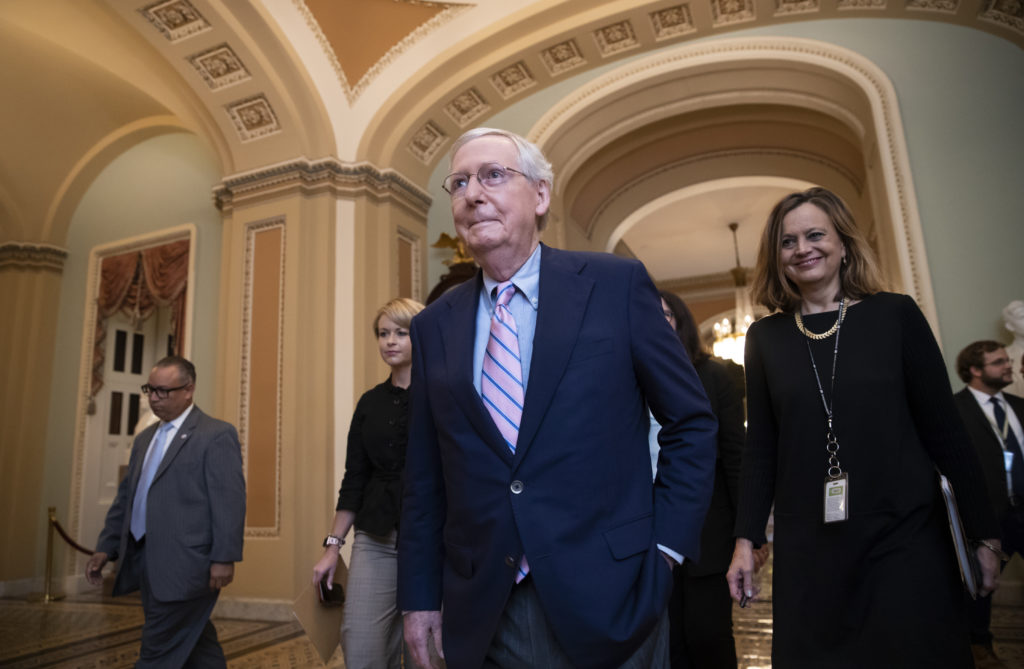
Shifting the gun violence debate, Senate Majority Leader Mitch McConnell says he now wants to consider background checks and other bills, setting up a potentially pivotal moment when lawmakers return in the fall. The Republican leader won’t be calling senators back to work early, as some are demanding. But he told a Kentucky radio station that President Donald Trump called him Thursday morning and they talked about several ideas. The president, he said, is “anxious to get an outcome, and so am I.” Stakes are high for all sides, but particularly for Trump and his party. Republicans have long opposed expanding background checks — a bill passed by the Democratic-led House is stalled in the Senate — but they face enormous pressure to do something after mass shootings in El Paso, Texas and Dayton, Ohio, that left 31 people dead. McConnell, who is facing protests outside his Louisville home, can shift attention back to Democrats by showing a willingness to engage ahead of the 2020 election. “What we can’t do is fail to pass something,” McConnell said. “What I want to see here is an outcome.” McConnell said he and Trump discussed various ideas on the call, including background checks and the so-called “red flag” laws that allow authorities to seize firearms from someone deemed a threat to themselves or others. “Background checks and red flags will probably lead the discussion,” McConnell told Louisville’s WHAS-AM. He noted “there’s a lot of support” publicly for background checks. “Those are two items that for sure will be front and center as we see what we can come together on and pass.” Trump has been interested in federal background checks before — and tweeted Monday about them — only to drop the issue later, a turnaround similar to his reversal on gun proposals after the 2018 high school shooting at Parkland, Florida. The powerful National Rifle Association and its allies on Capitol Hill have long wielded influence, but the gun lobby’s grip on Democrats started slipping some time ago, and it’s unclear how much sway the NRA and other gun groups still hold over Republicans in the Trump era. House Speaker Nancy Pelosi and Senate Democratic Leader Chuck Schumer said Trump assured them in phone calls Thursday he will review the House-passed bill that expands federal background checks for firearm sales. In a joint statement, they said Trump called them individually after Pelosi sent a letter asking the president to order the Senate back to Washington immediately to consider gun violence measures. Schumer and Pelosi said they told Trump the best way to address gun violence is for the Senate to take up and pass the House bill. Trump, they said, “understood our interest in moving as quickly as possible to help save lives.” The politics of gun control are shifting amid the frequency and toll of mass shootings. Spending to support candidates backing tougher gun control measures — mostly Democrats — surged in the 2018 midterms, even as campaign spending by the NRA declined. NRA chief Wayne LaPierre said in rare public statement Thursday that some federal gun control proposals “would make millions of law-abiding Americans less safe and less able to defend themselves and their loved ones.” The organization said proposals being discussed in Congress would not have prevented the mass shootings in Texas and Ohio that killed 31 people. McConnell has been under pressure from Democrats, and others, to bring senators back to Washington after the back-to-back weekend shootings. Earlier, more than 200 mayors, including those in Dayton and El Paso, urged the Senate to return to the Capitol. “Our nation can no longer wait,” they wrote. McConnell on Thursday rejected the idea of reconvening the Senate, saying calling senators back now would just lead to people “scoring points and nothing would happen.” Instead, the GOP leader wants to spend the August recess talking with Democratic and Republican senators to see what’s possible. Senators have been talking among themselves, and holding conference calls, to sort out strategy. “If we do it prematurely it’ll just be another frustrating position for all of us and for the public,” he said. The politics of gun violence are difficult for Republicans, including McConnell. He could risk losing support as he seeks reelection in Kentucky if he were to back restricting access to firearms and ammunition. Other Republicans, including those in Colorado, Maine and swing states, also would face difficult votes, despite the clamor for gun laws. GOP senators are also considering changes to the existing federal background check system, modeled on a law signed last year that improved the National Instant Criminal Background Check system, as well as increased penalties for hate crimes. While many of those proposals have bipartisan support, Democrats are unlikely to agree to them without consideration of the more substantive background checks bill. “We Democrats are not going to settle for half-measures so Republicans can feel better and try to push the issue of gun violence off to the side,” Schumer said Wednesday. Sen. Joe Manchin, a West Virginia Democrat who, along with Sen. Pat Toomey, Republican-Pennsylvania, is pushing a bill to expand background checks, said Trump’s support will be the determining factor in whatever gets done. “At this point in time leadership comes from President Trump,” Manchin said. By Lisa Mascaro and Matthew Daly Associated Press Associated Press writer Bruce Schreiner in Louisville, Kentucky, contributed to this report. Republished with permission of the Associated Press.
Donald Trump head to Dayton, El Paso, facing protest
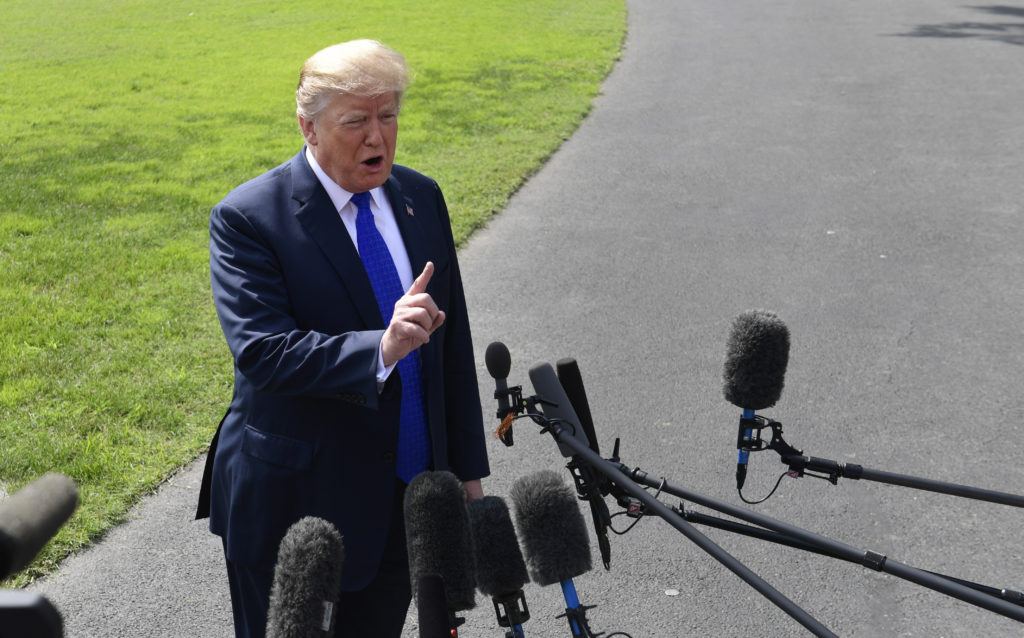
President Donald Trump headed to El Paso and Dayton on Wednesday to offer a message of healing and unity, but he will be met by unusual hostility in both places by people who fault his own incendiary words as a contributing cause to the mass shootings. The mayors of both cities are calling for Trump to change his rhetoric about immigrants. Multiple protests are planned. And Democratic presidential candidates continue to criticize him, including former Rep. Beto O’Rourke, who will hold a counter-rally in his hometown of El Paso during the president’s visit. As the president left the White House, he strongly criticized those who say he bears some responsibility for the nation’s divisions, returning to political arguing even as he calls for unity. “My critics are political people,” Trump said. “These are people that are looking for political gain.” He mentioned the apparent political leanings of the shooter in the Dayton killings, suggesting the man was supportive of Democrats. But the president also said that Congress was making progress on possible new gun legislation. “I’m looking to do background checks,” Trump said. But he would not embrace a call for an assault weapons ban, saying that there was no political appetite for it. He said anew that the most important thing is to keep guns out of the hands of the mentally ill. It is a highly unusual predicament for an American president to at once try to unite a community and a nation at the same time he is being criticized as contributing to a combustible climate that can spawn violence. Some 85 percent of U.S. adults believe the tone and nature of political debate has become more negative, with a majority saying Trump has changed things for the worse, according to recent Pew Research Center polling. And more than three quarters, 78 percent, say that elected officials who use heated or aggressive language to talk about certain people or groups make violence against those people more likely. White House officials said Trump’s visits would be similar to those he’s paid to grieving communities including Parkland, Florida, and Las Vegas, with the Republican president and the first lady saluting first responders and spending time with mourning families and survivors. “What he wants to do is go to these communities and grieve with them, pray with them, offer condolences,” White House spokesman Hogan Gidley said Tuesday. He said Trump also wants “to have a conversation” about ways to head off future deadly episodes.“We can do something impactful to prevent this from ever happening again, if we come together,” the spokesman said. That’s a tough assignment for a president who thrives on division and whose aides say he views discord and unease about cultural, economic and demographic changes as key to his reelection. Trump, who often seems most comfortable on rally stages with deeply partisan crowds, has not excelled at projecting empathy, mixing what can sound like perfunctory expressions of grief with awkward offhand remarks. While he has offered hugs to tornado victims and spent time at the bedsides of shooting victims, he has yet to project the kind of emotion and vulnerability of his recent predecessors. Barack Obama grew visibly shaken as he addressed the nation in the wake of the Sandy Hook elementary school massacre and teared up while delivering a 2016 speech on new gun control efforts. George W. Bush helped bring the country together following the Sept. 11 attacks, notably standing atop the smoking rubble of the World Trade Center, his arm draped over the shoulder of a firefighter, as he shouted through a bullhorn. Bill Clinton helped reassure the nation after the bombing of a federal building in Oklahoma City and the mass school shooting at Columbine High School. Trump, too, has been able to summon soothing words. But then he often quickly lapses into divisive tweets and statements — just recently painting immigrants as “invaders,” suggesting four Democratic congresswoman of color should “go back” to their home countries even though they’re U.S. citizens and deriding majority-black Baltimore as a rat-infested hell-hole. In the Texas border city of El Paso, some residents and local Democratic lawmakers said Trump was not welcome and urged him to stay away. “This president, who helped create the hatred that made Saturday’s tragedy possible, should not come to El Paso,” O’Rourke tweeted. “We do not need more division. We need to heal. He has no place here.” Trump, on the eve of his El Paso trip, snapped back on Twitter that O’Rourke “should respect the victims & law enforcement – & be quiet!” In Dayton, Mayor Nan Whaley said she would be meeting with Trump on Wednesday, but she told reporters she was disappointed with his scripted remarks Monday responding to the shootings. His speech included a denunciation of “racism, bigotry and white supremacy” and a declaration that “hate has no place in America.” But he didn’t mention any new efforts to limit sales of certain guns or the anti-immigration rhetoric found in an online screed posted just before the El Paso attack. The hateful manifesto’s author — police believe it was the shooter but investigation continues — insisted the opinions “predate Trump and his campaign for president.” But the words echoed some of the views Trump has expressed on immigration, including claiming that Democrats “intend to use open borders, free HealthCare for illegals, citizenship and more to enact a political coup by importing and then legalizing millions of new voters.”Whaley said simply, “Everyone has it in their power to be a force to bring people together, and everybody has it in their power to be a force to bring people apart — that’s up to the president of the United States.” Democrats vying to challenge Trump in the 2020 election have been nearly unanimous in excoriating him for rhetoric they warned has nurtured the racist attitudes of the El Paso shooter as they sought to project leadership during a fraught moment for a bruised nation. Former Vice President
