
John Merrill announces record-breaking 3.3 million voters registered in Alabama
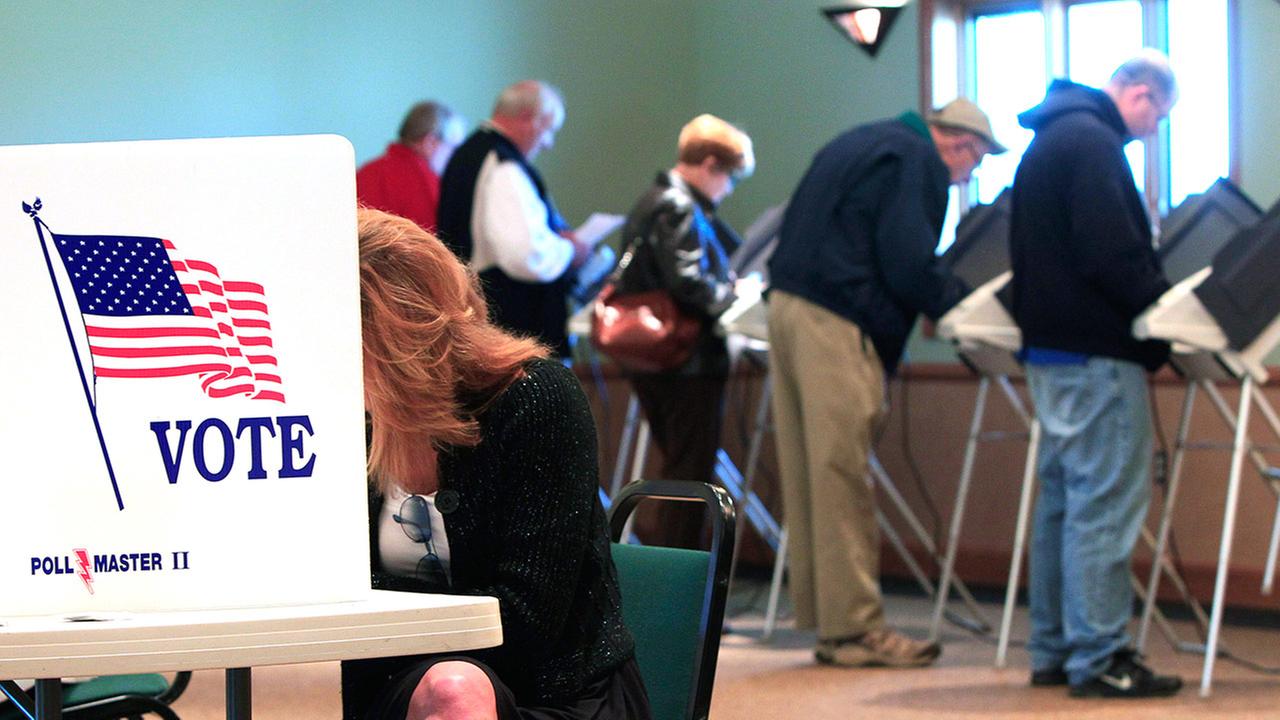
Alabama registered a record-breaking 3.3 million people to vote in the November election, the secretary of state’s office said Monday. “When we took office in January of 2015, we committed to make sure every eligible U.S. citizen that is a resident of Alabama be registered to vote and have a valid photo ID,” said Alabama Secretary of State John Merrill. “With the help of our very capable team and the people of Alabama we have made great strides to accomplish this goal, and for that I say thank you.” As of Monday morning, the number of registered voters is 3,330,802. Merrill credits the registration of an additional 584,252 voters this year to initiatives like online voter registration, the ERIC mailing, and a new partnership with the Alabama Law Enforcement Agency, among others. Alabama does not require residents to register by party, so it is unknown whether Republicans or Democrats gained the most new voters. This will be the first presidential election using Alabama’s new photo identification requirement for voting. Merrill continued, “On Nov. 8 don’t forget to bring your valid photo ID, and if you need one call us at (334) 242-7200! We want to see you at the polls!” Valid forms of photo ID include: Valid Driver’s License Valid Non-driver ID Valid Alabama Photo Voter ID Valid State-issued ID (Alabama or any other state) Valid Federal-issued ID Valid U.S. Passport Valid Employee ID from Federal Government, State of Alabama, County Government, Municipality, Board, Authority, or other entity of this state Valid student or employee ID from a college or university in the State of Alabama (including postgraduate technical or professional schools) Valid Military ID Valid Tribal ID The last day to register in time for the Nov. 8 Election was Oct. 24. Alabama voting links: Locate your polling place Proposed amendments on 2016 ballot Sample ballots Military and overseas voter services
As Donald Trump tries minority outreach, many blacks unconvinced
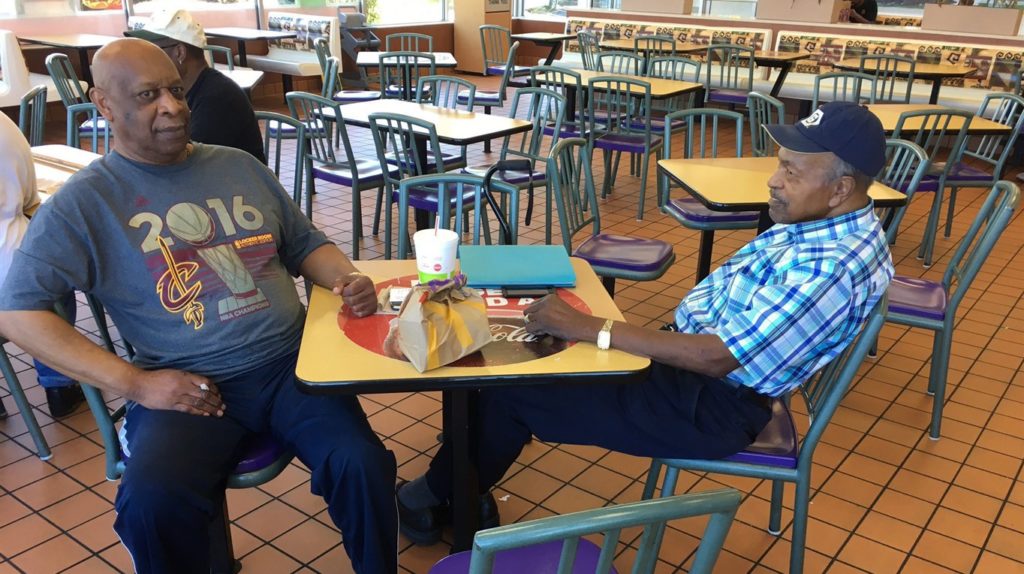
Black Republicans cheer Donald Trump for a newfound outreach to African-Americans, but say the GOP presidential nominee must take his message beyond arenas filled with white supporters and venture into the inner cities. Many rank-and-file black voters, meanwhile, dismiss the overtures as another racially charged pitch from a campaign aimed exclusively at whites, from Trump’s emphasis on “law and order” to his withering critiques of President Barack Obama, the nation’s first black chief executive. It was Trump in 2011 who fiercely challenged Obama’s U.S. birth. “Any minority who would vote for him is crazy, ought to have their head examined,” said Ike Jenkins, an 81-year-old retired business owner in the predominantly black suburb of East Cleveland. Foluke Bennett, a 43-year-old from Philadelphia, went further, labeling the GOP standard-bearer’s remarks as “racist,” pointing, among other things, to his referencing African-Americans as “the blacks.” Trump is scheduled to appear Wednesday in Jackson, Mississippi, an 80 percent African-American city and capital of the state with the nation’s highest proportion of black residents. It is unclear whether he will address black voters directly; so far, his appeal to them has been delivered before white audiences in mostly white cities. Mississippi is overwhelmingly Republican because of whites’ loyalties, as opposed to battlegrounds such as Ohio, Pennsylvania and Florida, states Obama won twice and where the largest cities offer at least a theoretical chance for Trump to pursue marginal shifts among significant black populations. Trump has previously rejected high-profile speaking slots at the NAACP’s annual gathering, along with events sponsored by the Urban League and the National Association of Black Journalists. “He’s got to take his arguments to the streets,” said Brandon Berg, a black pastor who drove Monday from Youngstown, Ohio, to hear Trump at the University of Akron. Berg said he’s an outlier: an undecided black Republican. For most African-Americans, Berg said, Trump must “meet them where they are.” Trump has scheduled an event Thursday billed as a roundtable with black and Latino leaders invited to his New York offices, and his aides say he is considering more rallies in heavily minority cities in swing states. The Washington Post first reported those plans, specifically mentioning charter schools, small businesses and churches in black and Latino communities. It’s a well-known electoral conundrum for Trump and Republicans: The United States population grows less white with each election cycle, so to defeat Democrat Hillary Clinton, the New York billionaire must attract more non-white voters or run up an advantage with white voters to a level no candidate has reached since Ronald Reagan’s 1984 landslide. Obama won 93 percent of black voters in 2012 and 95 percent in 2008, according to exit polls. This year, polls suggest Trump could fare even worse than the Republicans who lost to Obama. Trump has confronted his steep path in the last week, asking minorities, “Give Trump a chance!” In Wisconsin, he declared to minorities: “You live in poverty, your schools are no good, you have no jobs, 58 percent of your youth is unemployed? What the hell do you have to lose?” He argues illegal immigration disproportionately affects economic opportunities of blacks and Hispanics. In Ohio, he insisted without evidence that foreign “war zones” are “safer than living in some of our inner cities.” He pledged a Trump administration would “get rid of the crime,” allowing minorities to “walk down the street without getting shot.” Calvin Tucker, the lone black GOP convention delegate from Pennsylvania, says Trump’s arguments resonate with him. “We need a change agent,” said Tucker, 64, of Philadelphia. “He’s breaking down his overall economic platform and relating it to African-Americans,” Tucker added, extolling the GOP’s emphasis on entrepreneurial pursuits. Certainly, each Trump pronouncement drew roaring approval from his rally audiences. Many black voters, however, hear the appeal differently. As he sold Cleveland Cavaliers NBA championship swag, street vendor Steve T, 47, said the “disrespectful” comments represent “the real Trump.” “Not all of us live in poverty, crime,” he said. “You can’t get votes from people you don’t even understand.” In Philadelphia, Bennett said, “It’s crazy to think that he would have the audacity to ask us what we have to lose. If anything, his comments just made the line even more clear as to why black people won’t vote for him.” In East Cleveland, Jenkins and several other retirees gathered in a neighborhood restaurant echo many of Trump’s arguments. James Smith, a 79-year-old former butcher, points out the window and laments “a community that’s old and poor.” Jenkins says “handouts keep people in slavery.” Randall Darnell blasts an economy that traps laborers, black and white, in “legalized slavery.” But every one plans to vote for Clinton, and nearly all said they see Trump’s latest arguments aimed more at whites. “He’s talking about black people” when he mentions violence in cities, Smith said, “not to black people.” Republished with permission of The Associated Press.
Presidential Primary Brief: 414 days until Election Day
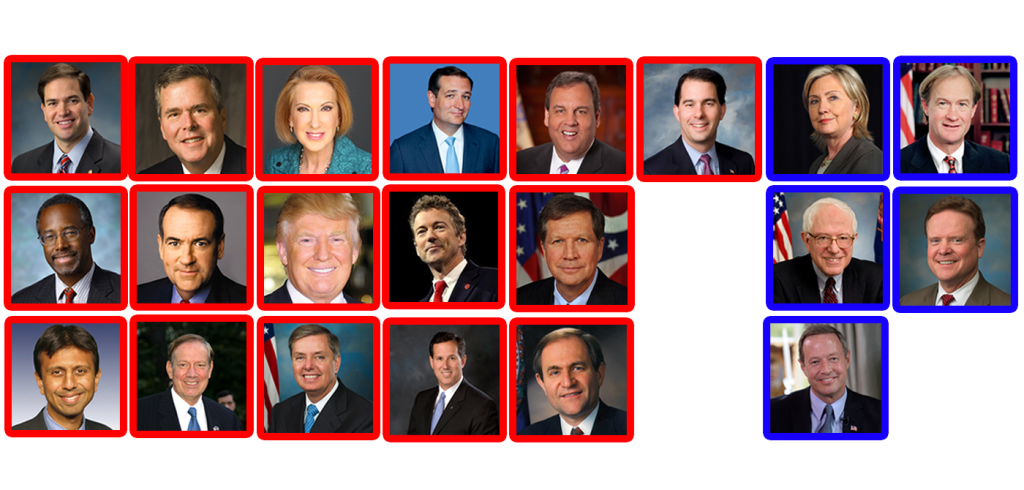
160 days until AL Presidential Primary 414 days until Election Day Convention Dates: Republican July 18-21 2016, Democratic July 25-28 2016 Weekly Headlines: Clinton, DNC face pressure to add debates Fiorina surges, Trump slips in CNN poll Joe Biden moves closer to joining presidential race Press Clips: Ben Carson: U.S. shouldn’t elect a Muslim president (CNN 9/20/15) Ben Carson says the United States should not elect a Muslim president. “I would not advocate that we put a Muslim in charge of this nation. I absolutely would not agree with that,” the retired neurosurgeon and Republican presidential candidate said Sunday on NBC’s “Meet the Press.” Carson’s comment comes on the heels of GOP front-‐runner Donald Trump taking a question from an campaign rally attendee who said, “We have a problem in this country; it’s called Muslims.” Black Lives Matter movement refuses to endorse any 2016 presidential candidate (The Guardian 9/19/15) The Black Lives Matter network will not give a presidential endorsement and will instead keep up its political activism by confronting candidates about the treatment of African Americans in the US, one of the group’s founders says. In an interview, Alicia Garza discussed the organization’s refusal to settle on a preferred candidate in the 2016 race to succeed President Obama and pledged to press ahead with protests and interruptions during the campaign season. “Sometimes you have to put a wrench in the gears to get people to listen,” said Garza, who spoke at the seventh annual Black Women’s Roundtable Policy Forum last week. Kasich urges Senate to take ‘nuclear option’ on Iran deal (Dayton Daily News 9/20/15) Gov. John Kasich urged Senate republicans to thwart Democratic delaying tactics and clear the way for GOP lawmakers to vote against the Iranian nuclear deal with a simple majority of 51. In an appearance Sunday on CNN’s State of the Union, Kasich said Senate Republicans “ought to say that we are not going to permit this to be blocked because of a filibuster,” referring to a traditional Senate tactic which allows 41 lawmakers to prevent the majority from voting on bills. “There ought to be a vote and there ought to be extreme measures taken in the United States Senate to achieve it,” said Kasich, who is seeking the 2016 Republican presidential nomination. Bernie Sanders NYC fundraiser draws campaign supporters who are ‘Feelin’ the Bern’ (IB Times 9/18/15) Outside of the Town Hall theater on West 43rd Street in Manhattan, a crowd of smiling and optimistic people Friday overflowed into the one-‐way street. Delivery trucks and yellow taxi cabs creeped by, their engines engaged in a shouting match with Bennet Weiss, a man who bore a fleeting resemblance to the Democratic presidential candidate they were all there to support. “We don’t have billions of dollars! All we have are people wearing Bernie pins,” Weiss yelled, a large black umbrella covered in Bernie Sanders campaign pins at his feet, catching drops of sweat from his brows. Jeb Bush’s rush through the revolving door (Politico 9/19/15) Jeb Bush stood before supporters in Tallahassee, the Florida capital over which he presided for eight years, and vowed in his first policy speech as a presidential candidate last June to halt the “revolving door” between Congress and K Street. “We need a president willing to challenge the whole culture in our nation’s capital — and I mean to do it,” Bush vowed at that June event. Sanders’ rhetoric full of money, not his bank account (Politico 9/18/15) In 1981, less than six months after he was elected mayor of Burlington, Vermont, Bernie Sanders was asked about money. “Accumulating money and material possessions aren’t my interests,” the self-‐described socialist told a freelance writer, according to a transcript of the interview filed in Sanders’ papers at the University of Vermont. “Having money is the freedom of not having to worry about paying off debts. I’d like to travel, but I have no great desire to be rich.”
Jeb Bush releases ad pushing his tax cut plan
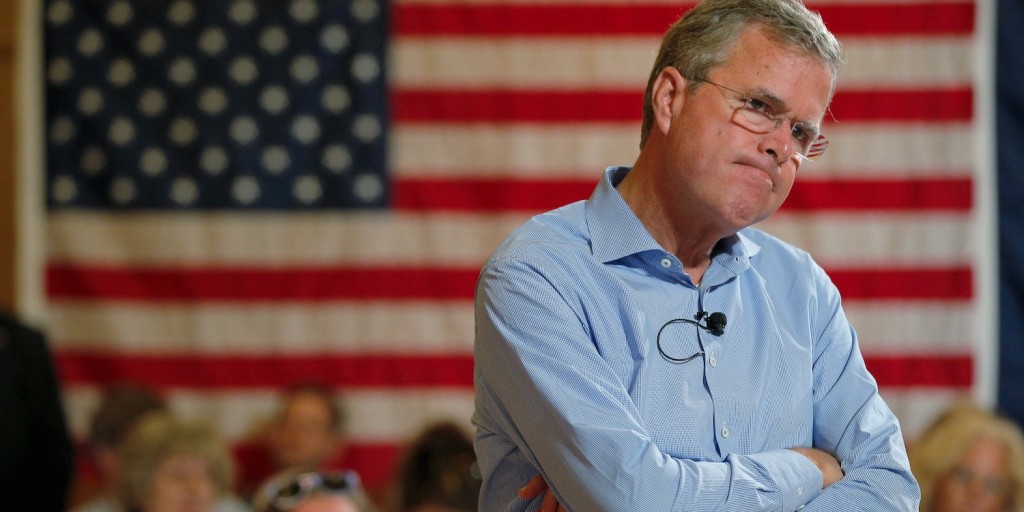
Jeb Bush unveiled his tax plan last week at a poultry-cooling equipment facility in North Carolina, and his campaign team has edited footage from that event into a new ad they released on Sunday. The plan would reduce the number of tax brackets that Americans pay into from seven to three, reducing the lowest amount that anyone would pay to 28 percent, which was the highest level when Ronald Reagan left office in 1988. Middle-class tax rates would fall to 10 percent for families with incomes up to $89,000 and to 25 precent for incomes up to $163,800. Corporate, capital gains and dividend taxes would all fall to 20 percent, while the estate tax is eliminated. Bush also would provide immediate expensing of plant and equipment for businesses, which the Tax Foundation says is the most pro-growth tax fix to create jobs and higher incomes. In a nod to the economic populism, he would also eliminate the advantage for private-equity and other high-dollar financial managers known as the “carried interest” loophole. “For years, wealthy individuals have deducted a much greater share of their income than everyone else,” Bush wrote in a Wall Street Journal op-ed. “We will retain the deductibility of charitable contributions but cap the deductions used by the wealthy and Washington special interests, enabling tax-rate cuts across the board for everyone.” Check out the video below:
