
Auburn University constructing $22 million Advanced Structural Testing Laboratory
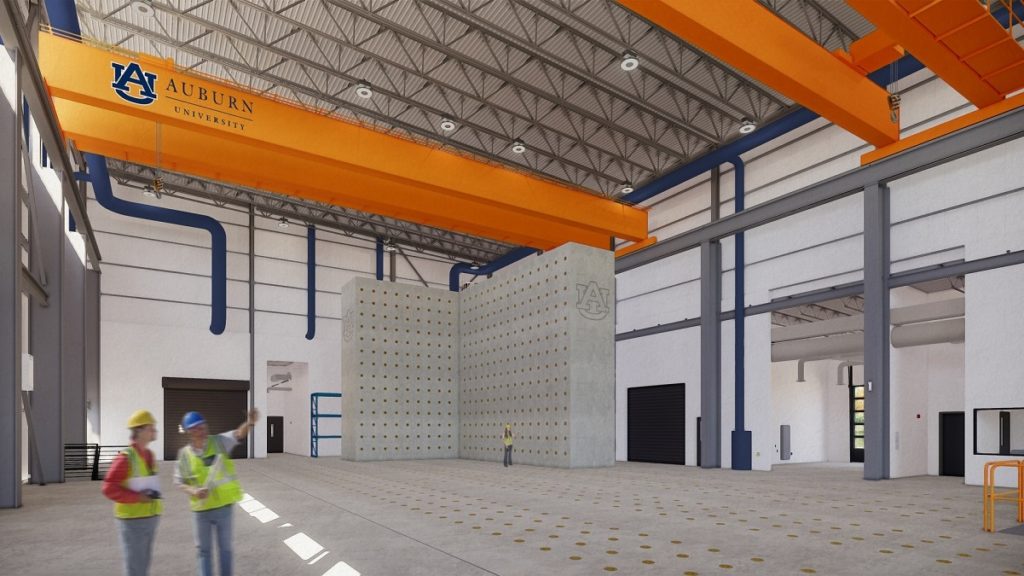
Auburn University is taking a big step as a leader in structural engineering research and instruction through the construction of a $22 million Advanced Structural Testing Laboratory. The 41,500-square-foot facility will include a high bay laboratory with specially engineered floors and walls capable of handling extreme structural testing loads; a geotechnical test chamber; a concrete materials research and testing laboratory; a wind testing facility, and faculty and graduate student spaces. The 4,700-cubic-foot geotechnical test chamber is one of the few across the nation included in a university laboratory. It will allow students and faculty to conduct testing that has been possible only in the field until now on structures such as foundations, anchorages and towers. In addition, the wind testing facility will allow replication of the dynamic wind loads induced by hurricanes, tornadoes and other extreme wind events on large-scale specimens. These unusual features, and many more, will accelerate research aimed at reducing the impacts during extreme events, and increase lifespan and safety of structures under all loading conditions. “Auburn is at the forefront of engineering education, and by providing our students opportunities for experiential learning, we’re ensuring our graduates emerge as industry leaders,” said Auburn University President Steven Leath. “This outstanding facility enables our researchers to deliver innovative solutions to pressing industry demands — something Auburn does best.” The laboratory will be near Auburn University Facilities Management offices on West Samford Avenue. The construction of the new facility will allow the Samuel Ginn College of Engineering to repurpose the structural laboratory space in the Harbert Engineering Center for other academic and research programs. “When you combine the strong floor and strong wall with the geotechnical testing capability and all the other materials testing capabilities, we think this will be one of the best laboratories in the country — if not the best,” said Steve Taylor, associate dean for research in the Samuel Ginn College of Engineering. “If I’m a civil engineering student who wants to be a structural engineer, this is going to be one of the best places to go to school in the nation.” This story originally appeared on Auburn University’s website.
Southern engineering firm Neel-Schaffer promotes three Alabama leaders
Neel-Shaffer —a multi-disciplined engineering and planning firm that today ranks as one of the largest privately held, employee-owned engineering firms in the South —has announced the promotion of three Alabama leaders within its company. The new leaders are Chris Sellers, John Murphy, and Alicia Rudolph. “I am extremely proud of each of these employees, for how they have helped our firm grow and prosper, and for what they are doing to make a difference in their communities,” said Hibbett Neel, co-founder, CEO and President of Neel-Schaffer. “Our goal is to hire quality employees who make a mark on the communities in which they live and work, and these individuals are great examples of that Details on each promotion can be found below: Chris Sellers has been promoted to Senior Vice President in the firm. Sellers joined the firm in 1999 and currently oversees the firm’s operations in Alabama, Georgia, and South Carolina. He is based in the firm’s Birmingham, Ala. office, and markets Neel-Schaffer services throughout the Southeast. John Murphy has been named a Vice President in the firm, Murphy joined the firm in 2013 and is currently the Senior Engineer Manager for Neel-Schaffer’s Mobile, Ala. office. He has over 40 years of engineering and management experience, including 36 years spent as an Assistant County Engineer for Mobile county. Alicia Rudolph has also been named a Vice President. She joined Neel-Schaffer in 2015 and currently serves as the Engineer Manager of the firm’s office in Tuscaloosa, Ala.. Rudolph has almost 25 years of experience in the transportation and aviation engineering fields.
Martha Roby: Highlighting outstanding 2nd District STEM programs

Studies increasingly show that the Science, Technology, Engineering, and Mathematics (STEM) fields are the drivers of our global economy and that these disciplines are the primary source of all innovation. Reports also show that many firms desperately need STEM-skilled employees but are struggling to find qualified individuals. It has become clear that we’re simply not producing enough individuals trained in STEM fields to fulfill current demand, and that’s a big problem if we want our country to remain globally competitive. I’m proud to report that our district’s own military installations, Maxwell-Gunter Air Force Base and Fort Rucker, are taking their own measures to expose elementary school students to the STEM fields and encourage students to pursue educations in these disciplines. This past Monday I had the opportunity to visit Starbase, Maxwell Air Force Base’s five-week STEM education program, that is available to 5th graders in the River Region. Students from Montgomery, Autauga, and Elmore Counties visit Maxwell Air Force Base for classes once per week for five weeks for classroom instruction and hands-on learning experiences leading up to a final robotics project. The Starbase experience is offered to all 5th graders, regardless of learning abilities, physical challenges, and disciplinary concerns. Starbase will serve approximately 2,000 students this year alone, but due to funding limitations, schools must rotate participation from year to year, meaning that each school participates in the program approximately every other year. I’m excited to report that Congress has restored $25 million to the national Starbase program in the 2018 National Defense Authorization Act (NDAA), which went to President Trump’s desk this week. I also recently had the opportunity to meet with COL Craig Taylor, Commander of the U.S. Army Aeromedical Research Laboratory (USAARL) at Fort Rucker, and he filled me in on their program called Gains in the Education of Mathematics and Science (GEMS). GEMS is an extracurricular STEM education program that enables 4th-11th grade students from the Wiregrass region of our state to engage in grade-appropriate, hands-on experiments. These students learn valuable math and science concepts, gain exposure to laboratory settings, and interact with military and civilian technicians, scientists, and engineers. USAARL’s GEMS program aims to reach those students who are underserved or underrepresented in STEM fields. GEMS is provided at no cost to students and since 2011 has been offered to more than 950 students from Fort Rucker, Enterprise, Ozark, Daleville, Dothan, and other communities. The Wiregrass is fortunate to have GEMS available to students in the area, and I’m excited to see its continued development of STEM students for our state. It is critically important that we train up future generations of STEM professionals in order to maintain our competitive edge in innovation. Our district’s military installations are answering that call in a big way, and we are fortunate to have the Starbase and GEMS programs available to our students. I’m proud of the work being done for STEM education at Maxwell and Fort Rucker, and I am eager to see it continue and flourish. ••• Martha Roby represents Alabama’s Second Congressional District. She lives in Montgomery, Alabama with her husband Riley and their two children.
