
January 6 panel prepares to unveil final report on insurrection
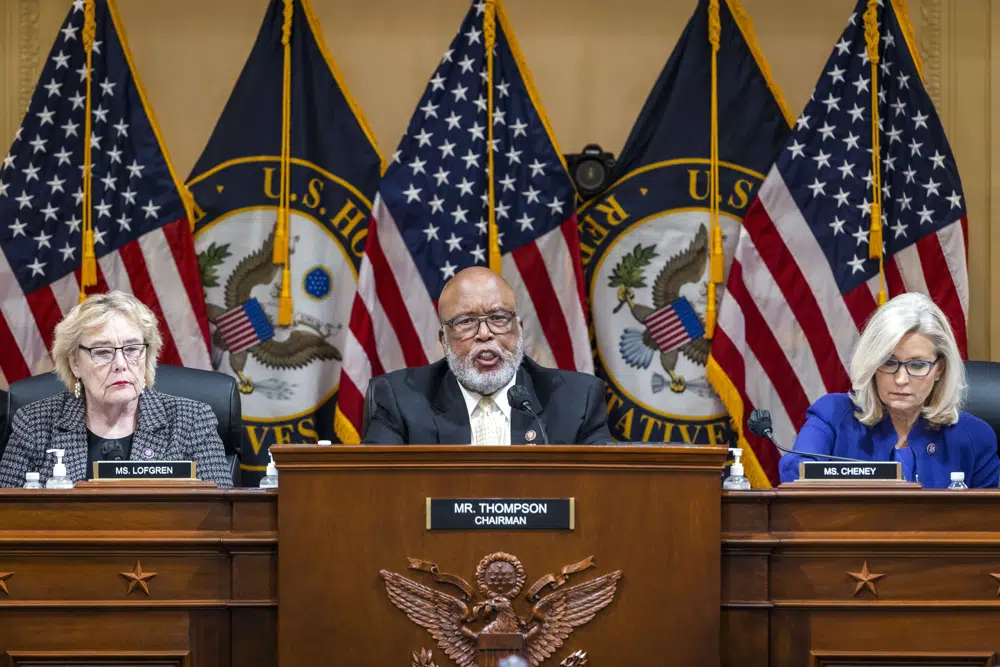
An 800-page report set to be released Thursday by House investigators will conclude that then-President Donald Trump criminally plotted to overturn his 2020 election defeat and “provoked his supporters to violence” at the Capitol with false claims of widespread voter fraud. The resulting January 6, 2021, insurrection of Trump’s followers threatened democracy with “horrific” brutality toward law enforcement and “put the lives of American lawmakers at risk,” according to the report’s executive summary. “The central cause of January 6 was one man, former President Donald Trump, who many others followed,” reads the report from the House January 6 committee, which is expected to be released in full on Thursday. “None of the events of January 6 would have happened without him.” Ahead of the report’s release, the committee on Wednesday released 34 transcripts from the 1,000 interviews it conducted over the last 18 months. Included in the release is testimony from the onetime leaders of two extremist groups, the Proud Boys and the Oath Keepers, both of whom were involved in planning ahead of the rioting. Oath Keepers founder Stewart Rhodes was convicted last month of seditious conspiracy for his role in the planning, and former Proud Boys leader Enrique Tarrio and four other members of the extremist group are in court on similar charges this month. The report’s eight chapters of findings will largely mirror nine hearings this year that presented evidence from over 1,000 private interviews and millions of pages of documents. They tell the story of Trump’s extraordinary and unprecedented campaign to overturn his defeat and his pressure campaign on state officials, the Justice Department, members of Congress, and his own vice president to change the vote. A 154-page summary of the report released Monday detailed how Trump, a Republican, amplified the false claims on social media and in public appearances, encouraging his supporters to travel to Washington and protest Democrat Joe Biden’s presidential election win. And how he told them to “fight like hell” at a huge rally in front of the White House that morning and then did little to stop the violence as they beat police, broke into the Capitol, and sent lawmakers running for their lives. It was a “multi-part conspiracy,” the committee concludes. The massive, damning report comes as Trump is running again for the presidency and also facing multiple federal investigations, including probes of his role in the insurrection and the presence of classified documents at his Florida estate. A House committee is expected to release his tax returns in the coming days — documents he has fought for years to keep private. And he has been blamed by Republicans for a worse-than-expected showing in the midterm elections, leaving him in his most politically vulnerable state since he won the 2016 election. It is also a culmination of four years of a House Democratic majority that has spent much of its time and energy investigating Trump, and that is ceding power to Republicans in two weeks. Democrats impeached Trump twice — both times he was acquitted by the Senate — and investigated his finances, his businesses, his foreign ties, and his family. But the 18-month January 6 probe has been the most personal for the lawmakers, most of whom were in the Capitol when Trump’s supporters stormed the building and interrupted the certification of Biden’s victory. While the lasting impact of the probes remains to be seen — most Republicans have stayed loyal to the former president — the committee’s hearings were watched by tens of millions of people over the summer. And 44% of voters in November’s midterm elections said the future of democracy was their primary consideration at the polls, according to AP VoteCast, a national survey of the electorate. “This committee is nearing the end of its work, but as a country, we remain in strange and uncharted waters,” said the panel’s chairman, Democratic Rep. Bennie Thompson of Mississippi, at the meeting Monday to adopt the report and recommend criminal charges against Trump. “We’ve never had a president of the United States stir up a violent attempt to block the transfer of power. I believe nearly two years later, this is still a time of reflection and reckoning.” The “reckoning” committee members are hoping for is criminal charges against Trump and key allies. But only the Justice Department has the power to prosecute, so the panel sent referrals recommending the department investigate the former president on four crimes, including aiding an insurrection. While its main points are familiar, the January 6 report will provide new detail from the hundreds of interviews and thousands of documents the committee has collected. Transcripts and some video are expected to be released as well over the coming two weeks. Republicans take over the House on January 3, when the panel will be dissolved. “I guarantee there’ll be some very interesting new information in the report and even more so in the transcripts,” Rep. Adam Schiff, D-Calif., told “CBS Mornings” on Wednesday. The summary of the report describes how Trump refused to accept the lawful result of the 2020 election and plotted to overturn his defeat. Trump pressured state legislators to hold votes invalidating Biden’s electors, sought to “corrupt the U.S. Department of Justice” by urging department officials to make false statements about the election, and repeatedly, personally tried to persuade Vice President Mike Pence to upend democracy with unprecedented objections at the joint congressional session, it says. Trump has tried to discredit the report, slamming committee members as “thugs and scoundrels” as he has continued to falsely dispute his 2020 loss. In response to the panel’s criminal referrals, Trump said that “These folks don’t get it that when they come after me, people who love freedom rally around me. It strengthens me.” The report will give minute-by-minute detail of what Trump was doing — and not doing — for around three hours as his supporters beat police and broke into the Capitol. Trump riled up the crowd at the rally that morning and then did little to stop his supporters for several hours as he watched the violence unfold on television inside the White House
Capitol rioter who breached Senate gets 8 months for felony
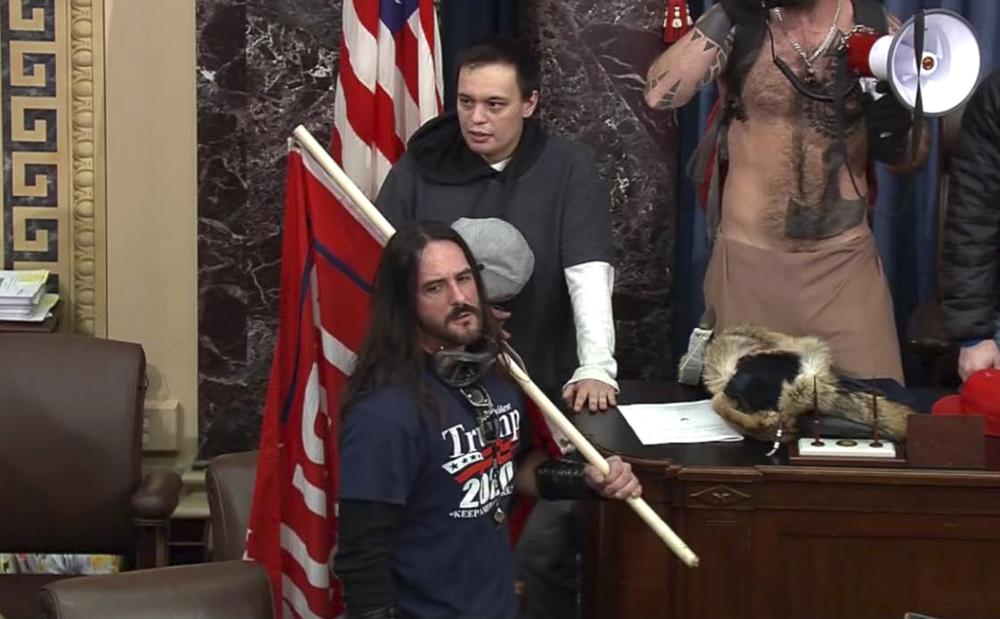
A Florida man who breached the U.S. Senate chamber carrying a Trump campaign flag was sentenced Monday to eight months behind bars, the first punishment handed down for a felony charge in the Jan. 6 Capitol riot and one that could help determine the severity of other sentences in hundreds of pending cases. In pronouncing the sentence on Paul Allard Hodgkins, U.S. District Judge Randolph Moss said the 38-year-old had played a role, if not as significant as others, in one of the worst episodes in American history. Thousands of rioters loyal to then-President Donald Trump stormed the Capitol and disrupted the certification of Joe Biden’s election win, in a stunning display of public violence. “That was not, by any stretch of the imagination, a protest,” Moss said. “It was … an assault on democracy.” He added: “It left a stain that will remain on us … on the country for years to come.” Moss acknowledged Hodgkins’ sentence could set a benchmark for future cases. And deciding an appropriate punishment was made more challenging because the case is unique and the court couldn’t look to previous sentencings as a guide. More than 500 people have been charged so far for their participation in the attack, and many like Hodgkins were accused of serious crimes but were not indicted, as some others were, for roles in larger conspiracies. They will have to decide whether to plead guilty or go to trial. Moss interrupted Hodgkins’ attorney, Patrick Leduc, to ask if granting the defense request to spare Hodgkins from prison could encourage others disgruntled by the results of a future election to besiege the Capitol. “If we allow people to storm the United States Capitol, what are we doing to preserve our democracy?” Moss asked. But the judge said Hodgkins deserved a lesser sentence than the 18 months prosecutors had requested, in part because he didn’t assault anyone, didn’t damage government property, and wasn’t among the lead attackers. Hodgkins apologized to the court and said he felt ashamed. Speaking calmly from a prepared text, he described being caught up in the euphoria as he walked down Washington’s most famous avenue, then followed a crowd of hundreds into the Capitol. “If I had any idea that the protest … would escalate (the way) it did … I would never have ventured farther than the sidewalk of Pennsylvania Avenue,” he told the judge. He added: “This was a foolish decision on my part.” He pleaded guilty last month to obstructing an official proceeding by participating in an attack that forced lawmakers to run and hide in fear. Five people died, including a police officer and rioter shot by police. Two other police officers who faced Jan. 6 rioters died by suicide days later. In requesting an 18-month prison sentence during the hearing in Washington, Assistant U.S. Attorney Mona Sedky likened the attack to “domestic terrorism.” Leduc, Hodgkins’ lawyer, said the government’s description of the Jan. 6 events was hyperbole. “I think it is gaslighting the country,” he said. What happened, he added, was “a protest that became a riot.” Moss interrupted Leduc again, noting that some of the Trump supporters seemed to be out to track down lawmakers, including House Speaker Nancy Pelosi. “There were people who were storming through the halls of the Capitol saying, ‘Where’s Nancy?’” the judge told the attorney. “That is more than a simple riot.” Sedky said that while Hodgkins didn’t engage in violence himself, he walked among many who did — in what she called “the ransacking of the People’s House.” And as he walked by smashed police barriers, he could see the smoke of tear gas and the chaos ahead of him. “What does he do?” she asked the court. “He walks toward it. He doesn’t walk away.” Hodgkins, she added, was in the midst of a mob that forced lawmakers to seek shelter and some congressional staffers to hide in fear, locked in offices, as hundreds swept through the building. Those in fear for their lives that day will she said, “bear emotional scars for many years — if not forever.” Under the June plea deal, Hodgkins agreed to plead guilty to the one count and pay $2,000 in restitution to the Treasury Department. In exchange, prosecutors agreed to drop less serious charges, including entering a restricted building and disorderly conduct. They also said they would ask for a reduced sentence for acceptance of responsibility and for saving the government from a costly trial. In earlier filings, Leduc described his client as an otherwise law-abiding American who, despite living in a poorer part of his hometown of Tampa, regularly volunteered at a food bank. He noted that Hodgkins is an Eagle Scout. His actions on Jan. 6 “is the story of a man who for just one hour on one day lost his bearings … who made a fateful decision to follow the crowd,” the attorney said. But Judge Moss said Monday that he didn’t accept that there was no forethought by Hodgkins or that he had no ill intentions. He brought rope and protective goggles with him to Washington, the judge said, and that demonstrated he came “prepared to defend his position and engage in whatever needed to be done.” Video footage shows Hodgkins wearing a Trump 2020 T-shirt, the flag flung over his shoulder and eye goggles around his neck, inside the Senate. He took a selfie with a self-described shaman in a horned helmet and other rioters on the dais behind him. Separately on Monday, Enrique Tarrio, the leader of the Proud Boys who was arrested in Washington two days before the insurrection, pleaded guilty to burning a Black Lives Matter banner that was torn down from a historic Black church in December. He also pleaded guilty to attempted possession of a large-capacity ammunition feeding device after police found two high-capacity firearm magazines when he was arrested. Republished with the permission of the Associated Press.
