
Tommy Tuberville praised by Republicans for standing up to Chuck Schumer
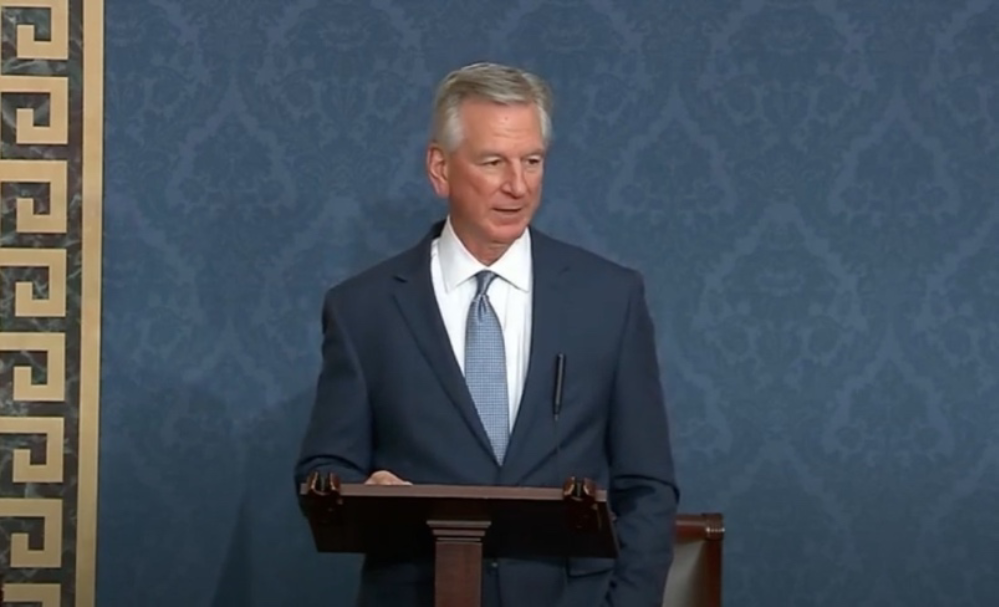
It has been seven months, and U.S. Senator Tommy Tuberville (R-Alabama) is still refusing to give unanimous consent on almost 300 military promotions. On Wednesday, Sen. Tuberville personally tackled the growing logjam of military leaders holding positions they have been nominated to as interims by attempting to bring up the nomination for Marine Corps Commandant Gen. Eric Smith. Majority Leader Chuck Schumer (D-New York) responded to Tuberville’s maneuver by bringing Smith and two other generals to the floor for Senate confirmation. In February, Sen. Tuberville imposed a hold on all senior military promotions after the Pentagon implemented a taxpayer-funded abortion-related travel policy that is ostensibly illegal. Coach Tuberville’s position has not changed: either the Pentagon can reverse its controversial and likely illegal policy, or Chuck Schumer can bring these nominations to the floor individually. For the past seven months, Schumer has refused to bring the nominations to the floor despite constantly complaining about “military readiness.” Former President Donald Trump said on Truth Social, “BIG WIN FOR TOMMY. Unlike McConnell and his group of automatic Democrat YES VOTES, Tommy T is willing to take on the Radical Left Fascists & Thugs that are destroying our Country. What a difference!!” Republican Presidential candidate Sen. Tim Scott said, “Listen, he was right to do what he said. The Hyde Amendment is clear. You cannot use a penny of federal dollars in support of abortion. Period. Transportation, any other way. I think it was seven or eight years ago, Hugh, I held promotions as well, because there was a move to take the Guantanamo Bay prisoners and bring them into Charleston, South Carolina. You have to be willing to take a stand. The Senate can, at some point, override you, and that’s what’s happened recently, but the truth is you only have certain weapons in your arsenal, and I must concede. Under President Biden, holding up promotions is not necessarily a bad thing. What we’ve seen in the top brass in today’s military is too much focus on ESG and DEI and gender issues, vaccine mandates as opposed to war fighting, lethality, and making sure that the resources and the equipment and the training that we need, that’s where the focus of this military should be.” Sen. Joni Ernst (R-Iowa) said, “Senator Schumer just proved he could have moved these military promotions months ago. He held our servicemembers hostage for purely political reasons.” Sen. Katie Britt (R-Alabama) said on X, “As I’ve said previously, Senator Schumer has the power to schedule votes on each of these nominees. Today’s move only confirms this has been true all along.” Sen. John Cornyn (R-Texas) said, “Senator Schumer could have broken this logjam months ago by filing cloture like he did today on the nominee for Chairman of the Joint Chiefs of Staff.” Sen. J.D. Vance (R-Ohio) said, “The military cannot be an arm of either admin’s social policy. There’s a law that says abortions will not be publicly funded and the Biden administration is circumventing that in a way that destroys credibility in the military.” Sen. Rick Scott (R-Florida) said, “Senator Tuberville did the right thing and showed today that this was all politics by the Democrats. And they don’t care that they’re violating the law.” Sen. Mike Lee (R-Utah) said on social media, “@SecDef brought this on himself and @DeptofDefense by adopting a policy designed only to flout 10 USC 1093. […] If confirmation delays really are imperiling national security, then @SecDef should immediately suspend his abortion-travel policy, which is what it will take to get the confirmation process expedited. He can’t blame @SecDefwithout implicating himself. […] Since when is funding for abortion travel—which @DeptofDefense never funded until six months ago—essential to American national security?” Congressman Barry Moore (R-AL02) said, “Schumer could have approved every military nominee by scheduling votes over the last several months, but he cared more about funding abortion travel than military readiness. Major win for Sen Tuberville!” Rep. Ronny Jackson (R-Texas) said, “Senator Tuberville has bravely and steadfastly held the line in the Senate by placing a hold on all DoD senior leader nominations until the DoD complies with federal law and ceases its abortion policies. DoD has complained this will harm national security, but DoD has the ability to stop this immediately. All they have to do is rescind this illegal policy.” Tuberville said he might bring future nominees to the floor through regular order in the Senate. Critics of Tuberville’s actions say this process is too time-consuming to be used repeatedly. To connect with the author of this story or to comment, email brandonmreporter@gmail.com.
Chuck Schumer brings votes on senior military commanders in response to Tommy Tuberville’s effort to bring military confirmations forward
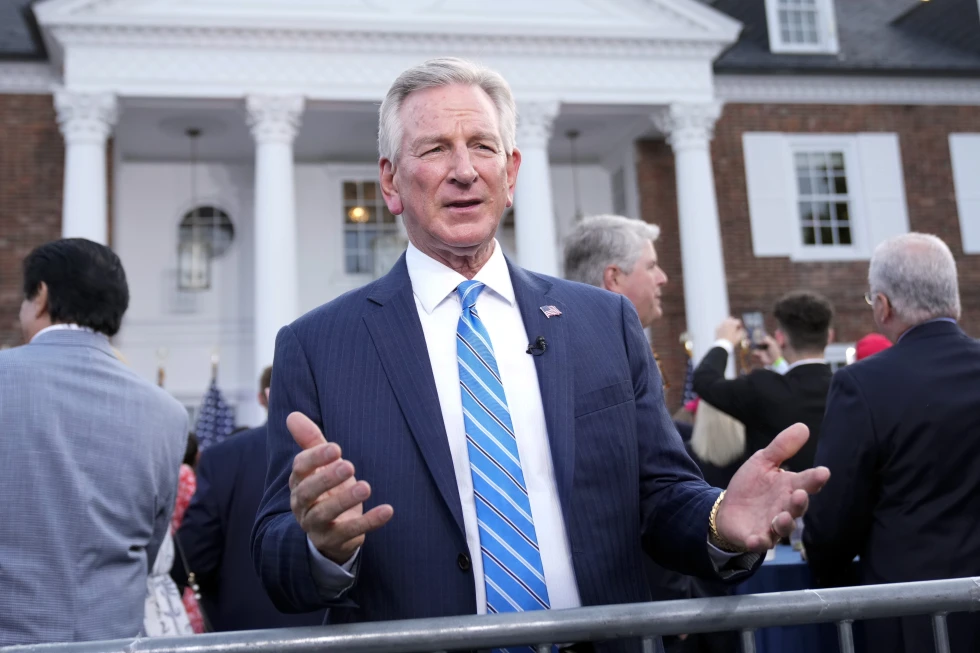
U.S. Senator Tommy Tuberville (R-Alabama) has been criticized for months for his holds on military promotions. On Wednesday, Tuberville attempted to bring the nomination of the candidate of General Eric Smith for Marine Corps Commandant to the floor. Senator Chuck Schumer (D-New York), in response, himself brought forward the nominations of senior officers – something that, as Majority Leader, he could have done at any time in this process. The Senate voted overwhelmingly Wednesday to advance President Joe Biden’s nomination of U.S. Air Force General Charles “C.Q.” Brown to become the next chairman of the Joint Chiefs of Staff. The Senate voted 89-8 to advance to a final vote on Brown’s nomination. Tuberville has refused to give unanimous consent to batches of senior-level Defense Department promotions for the last seven months until President Biden reversed his abortion policy, which was an end around Congress and state laws. Brown will replace outgoing Chairman Mark Milley, whose term ends October 1. A vote on final passage for Brown took place Wednesday evening, and Brown was confirmed 83 to 11. Tuberville was one of the 11 Republican Senators who voted to reject Brown’s confirmation. Schumer moved to set votes on three key military leaders: Brown, Gen. Eric Smith to become commandant of the Marine Corps, and Gen. Randy George to serve as chief of staff of the Army. Alabama Republican Party Chairman John Wahl released a statement praising Tuberville. “For months, Democrats and the mainstream media have been attacking Senator Tuberville with the claim that his holds on DOD promotions were putting our national security at risk,” Wahl said. “However, today’s actions by Chuck Schumer prove there was absolutely nothing stopping Senate Democrats from bringing up military promotions on a case-by-case basis. Instead of being honest and having an open debate on the root issue – using taxpayer money to fund abortions – liberal pundits and Democrat elected officials let this situation drag on as they played party politics. The reason? To vilify Alabama’s Republican senior Senator, who is simply trying to uphold the Hyde Amendment – which prohibits the use of taxpayer funds for abortion – and the Constitution, which gives the power of the purse to Congress.” “The Alabama Republican Party is thankful to Senator Tuberville for exposing the hypocrisy of the left, as well as the Pentagon’s unconstitutional use of taxpayer money to fund abortions,” Wahl continued. “Now that the truth on this issue has been revealed for all Americans to see, it is my hope that the Pentagon will end its unlawful policy. Until then, we will continue to support Senator Tuberville and his stand for life and fiscal responsibility.” Schumer’s maneuver was in response to Tuberville’s announced plan to force votes on Smith in the coming days, a move rarely put to use by rank-and-file senators in the minority. “To be clear, my hold is still in place,” Tuberville said Wednesday night on the floor of the Senate. “I reserve the right to seek another cloture position on the nominees in the future, so that’s where we stand today.” The Senate can confirm every Defense Department nominee through ordinary order, but that would require the Senators to spend much more time on the Senate floor doing their jobs: voting and going through normal parliamentary procedures. To connect with the author of this story or to comment, email brandonmreporter@gmail.com.
Republican’s hold on nominations leaves Marines without confirmed leader for 1st time in 100 years
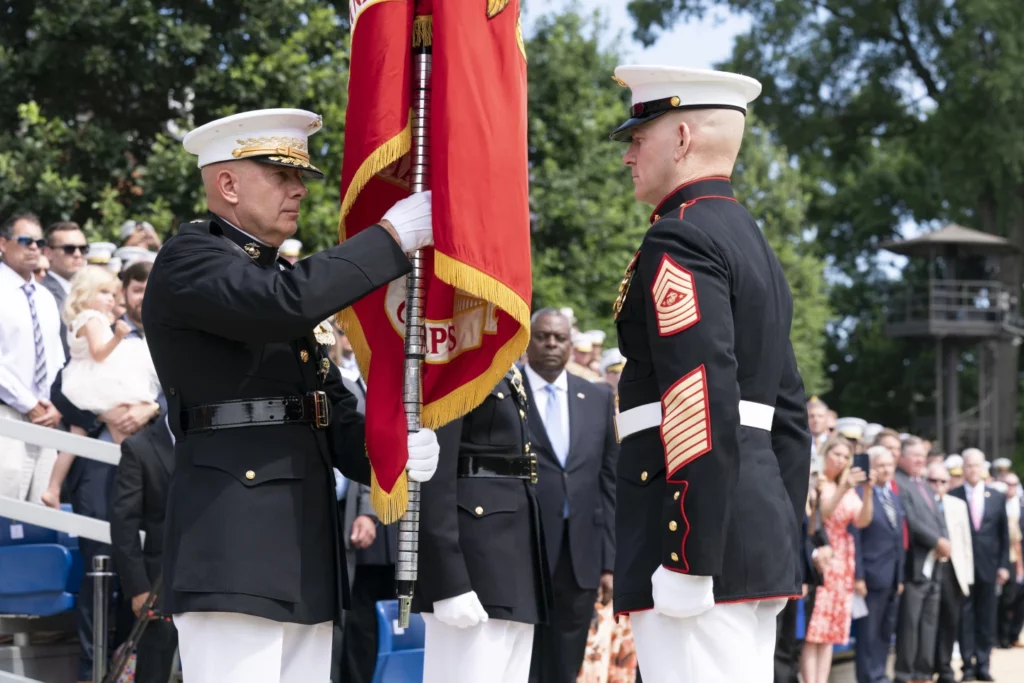
The U.S. Marine Corps is without a confirmed leader for the first time in a century as Gen. David Berger stepped down as commandant on Monday, and a Republican senator is blocking approval of his successor. Berger took over as the 38th commandant in July 2019 and is required to leave the job after four years. Gen. Eric Smith, currently the assistant commandant, has been nominated to be the next leader but will serve in an acting capacity because he hasn’t been confirmed by the Senate. Under the law, Smith can serve as the acting commandant, but he can do nothing that would presume confirmation. As a result, he can’t move into the main residence or the commandant’s office, or issue any new formal commandant’s planning guidance, which is traditional for a new leader. He has the authority to implement new policies such as budget, training, and other personnel decisions. Smith’s promotion delay is the first of what could be many top-level military officers held up by Sen. Tommy Tuberville, R-Ala. Tuberville has stalled all nominations for senior military jobs because he disagrees with Defense Secretary Lloyd Austin’s decision to have the Defense Department pay for travel when a service member has to go out of state to get an abortion or other reproductive care. Abortion is now illegal in Alabama. Speaking at a ceremony at the Marine Barracks Washington, just down the street from Capitol Hill, Austin and Berger called on the Senate to take action. “We need the Senate to do their job so that we can have a sitting commandant that’s appointed and confirmed. We need that house to be occupied,” said Berger, with a nod to the commandant’s quarters at the edge of the parade field. Austin and other Pentagon officials have pressed the Senate to move forward, saying that delays are already impacting more than 200 military officers and many key leaders. “You know, it’s been more than a century since the U.S. Marine Corps has operated without a Senate-confirmed commandant,” Austin said during the ceremony. Because of Berger’s requirement to step down in July, the Marine job is the first of the military chiefs to be affected by Tuberville. The Army, Navy, and Air Force are all expected to face the same delay later this year, as could the nomination of the next chairman of the Joint Chiefs of Staff. The current chairman, Army Gen. Mark Milley, leaves his job at the end of September. Gen. CQ Brown, the current chief of the Air Force, has been nominated to replace Milley and is scheduled to go before the Senate Armed Services Committee for his hearing on Tuesday. The hold, however, is also impacting scores of one, two, and three-star officers who are assigned to new commands but can’t move on. It also affects their families, who usually relocate over the summer to their new military communities so school-age children can settle in before fall. “Smooth and timely transitions of confirmed leadership are central to the defense of the United States and to the full strength of the most powerful fighting force in history,” said Austin. “Stable and orderly leadership transitions are also vital to maintaining our unmatched network of allies and partners. And they’re crucial for our military readiness.” Smith hit the thorny issue head-on during his remarks at the ceremony Monday — saying he wanted to get one thing out fast. “If you’re saying, ‘What am I supposed to call you?’ ACMC. That is my title, and one that I’m proud of,” said Smith, using the shorthand for his assistant commandant role. But he quickly added, “To make sure that there is no confusion — all orders, directives, and guidance, which were in effect this morning remain in effect unless I direct otherwise. Further guidance to the force will follow.” Sabrina Singh, a Pentagon spokeswoman, said Monday that as of last Friday, there were 265 senior officers whose promotions have been held up by Tuberville, and that number could leap to 650 by the end of the year if the issue isn’t corrected. She noted that in more than 100 cases, officers — like Smith — would be forced to do two jobs at the same time because no one can move up. She said the Pentagon is asking officers to delay planned retirements and stay on, while in other cases, officers are doing more senior-ranking jobs without getting the pay for that new rank. The last time the Corps was led by an acting commandant was in 1910. Then-Maj. Gen. George Elliott, who was the commandant, reached the required retirement age in November 1910 and left the office. Col. William Biddle served as the acting commandant until he was promoted to major general and became commandant in February 1911. Berger, a native of Woodbine, Maryland, graduated from Tulane University and was commissioned in 1981. He commanded at every level, including tours in Iraq and Afghanistan. During his tenure, he spearheaded a broad campaign to transform the Marine Corps to better be able to fight amphibious wars in the Pacific after years of battling terrorist groups in the Middle East. The plan was lauded by many in the Pentagon and Congress as a critical way for the Marines to prepare for a potential conflict with China. Smith, a career infantry officer, is a highly decorated Marine who served multiple tours in Afghanistan and Iraq, including time in Fallujah and Ramadi during heavy combat in 2004 and 2005 in Operation Iraqi Freedom. He later was the senior military adviser to Defense Secretary Ash Carter and, in 2019, took over as the deputy commandant for combat development. Republished with the permission of The Associated Press.
NOAA releases study on protecting endangered species while building offshore wind developments in Gulf of Mexico
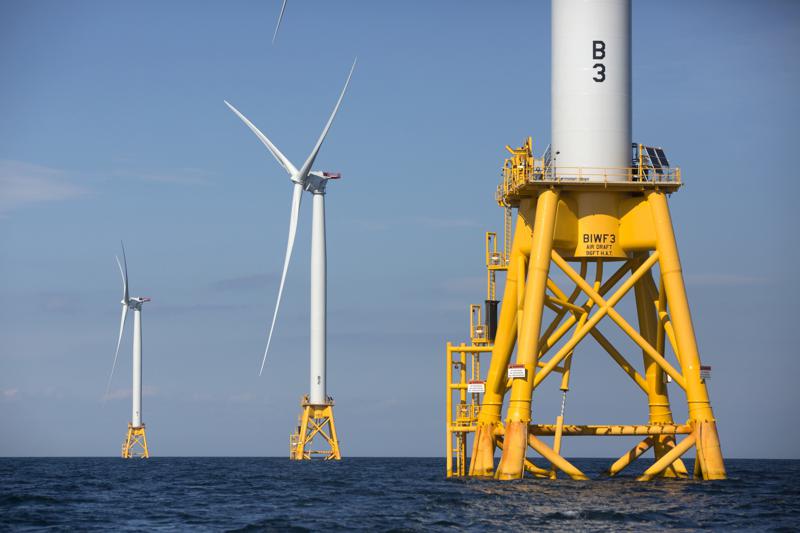
The Biden administration is looking at offshore wind farms in the Gulf of Mexico to reduce American dependence on fossil fuels. The National Oceanic and Atmospheric Administration’s Fisheries Division wants to be able to do this without negatively impacting the endangered marine species which it manages. On Monday, a new peer-reviewed study, “Protected species considerations for ocean planning: A case study for offshore wind energy development in the U.S. Gulf of Mexico,” was published in Marine and Coastal Fisheries. The study details NOAA’s efforts to accomplish both goals. It is part of a special theme issue of the online journal entitled “Offshore Wind Interactions with Fish and Fisheries.” The issue will feature several more NOAA Fisheries-authored papers on offshore wind energy topics as they are published. This paper details NOAA Fisheries’ development of scoring methods to assess potential protected species conflicts with offshore wind. NOAA National Centers for Coastal Ocean Science and the Bureau of Ocean Energy Management developed spatial models used in the study. The generalized scoring approach considers species conservation status and demographic information. In the spatial models, a score of one reflects an area with low siting conflicts. A score of zero reflects an area with high siting conflicts. The paper evaluated the spatial distributions for 23 species listed under the U.S. Endangered Species Act and Marine Mammal Protection Act, identifying high-use and low-use areas for each species and scoring these areas from 0.1 to 0.9. A score of 0.1 reflected a high-use area for an endangered species with a small and declining population; a score of 0.9 reflected a low-use area for a non-strategic MMPA stock. NOAA said that the researchers combined these layers spatially and integrated them into the siting model. The NOAA Fisheries combined layer informed relative risk for siting wind energy activities in a given area while accounting for the overlap of different protected species. This integration resulted in a 70 percent reduction in potential siting conflicts with protected species within the final selected wind energy area. These estimates are based on current and expected species occurrence and distribution patterns. This work represented a successful collaboration between NOAA Fisheries, NOAA National Centers for Coastal Ocean Science, and the Bureau of Ocean Energy Management. The goal was to proactively minimize potential interactions between renewable energy development and protected species. The approach is straightforward, repeatable, and transferable to other regions, to other sensitive or protected species, and to other marine spatial planning applications. However, these are static models. NOAA Fisheries needs continuous monitoring data to ensure models can be adapted to shifting species distributions due to climate change or ecosystem perturbations. NOAA hopes that this collaborative work will provide a foundation for early engagement and strategic marine spatial planning for offshore wind energy to reduce potential adverse effects on protected species. It also provides a reference for work conducted to inform this process and a template for other regions as these efforts expand. Last year the Biden Administration announced that the first two of its planned wind farms will be off the coast of Galveston, Texas, and Lake Charles, Louisiana. The Galveston wind farm will be developed 24 nautical miles off the coast of Galveston, covering a total of 546,645 acres and will power 2.3 million homes, according to the U.S. Interior Department’s Bureau of Ocean Energy Management. The Louisiana wind farm will be about 56 nautical miles off the coast of Lake Charles, Louisiana, and will cover 188,023 acres with the potential to power 799,000 homes. The Biden Administration has not yet announced its plans for the Alabama Gulf Coast. There are concerns that wind farms in the Gulf of Mexico will be cost-prohibitive and that hurricanes will do substantial damage to offshore wind farms making recovery from future hurricanes even more protracted. This is on top of the environmental concerns that the NOAA study seeks to address. There is also a significant cost element to this. One researcher estimates that it would cost four times as much money to produce electricity from Gulf of Mexico wind farms as it does to produce it from natural gas in Louisiana now. Producing more green energy will almost certainly result in substantially higher electric bills for American consumers. There are currently only two operational offshore wind farms in the U.S. – one off of the coast of Rhode Island and the other off of the coast of Virginia. To connect with the author of this story or to comment, email brandonmreporter@gmail.com.
