
State Dept. of Education seeks testing waivers to aid students with cognitive disabilities

The Alabama State Department of Education (ALSDE) will be seeking waivers from the Secretary of the U.S. Department of Education to allow students with cognitive disabilities to take the Alabama Alternate Assessment (AAA). The test — a performance task assessment administered as an alternate to the general education state assessment. It is administered to students with significant cognitive disabilities working on the Alabama Extended Standards, and is a paper-based multiple choice assessment administered in the areas of reading and mathematics in Grades 3-8 and 10 and science in Grades 5,7, and 10 — is part of the Every Student Succeeds Act (ESSA), signed into law in 2015 by then President Barack Obama. The program was intended to replace the No Child Left Behind Act; and ensures that students in the U.S. with a significant cognitive disability, are not excluded from learning beside their peers. Former-Gov. Robert Bentley then created an implementation task force in 2016 to assure the law’s success. The ESSA, “shifts the power of education from the federal government and returns power and control to the states.” Under ESSA, states are able to decide for themselves what is best for their students in regard to the “implementation of academic standards, testing, accountability, school improvement and teacher quality,” but also requires states to ensure that the number of students assessed using an alternate assessment does not exceed one percent of the students in the state who are assessed using Alabama statewide assessments. State is seeking a waiver as the ESSA places a 1 percent cap on the participation rate for each subject on the AAA. If a state anticipates it will exceed the 1 percent cap, it must seek a waiver. During the 2016-2017 school year, Alabama’s participation rate on the AAA was: 1.21 percent for reading, 1.21 percent for math, and 1.23 percent for science. Since Alabama exceeded the 1 percent cap for the 2016-2017 school year, it is anticipating exceeding the 1 percent cap for 2017-2018 school year. Thus, the ALSDE will be requesting a waiver for reading, math, and science from the Secretary of the U.S. Department of Education. The ALSDE is seeking public comment as part of this process. According to the ALDSE: You may send written comments on the request for a waiver to: Student Assessment, Alabama State Department of Education, P.O. Box 302101, Montgomery, AL 36130-2101. Mrs. Nannette Pence or Mrs. Maggie Hicks may be reached by phone at 334-242-8038, by fax at 334-242-7341, or through email at studentassessment@alsde.edu. Written comments will be accepted until June 15, 2018.
Betsy DeVos calls Kay Ivey, tells her US Dept. of Education approved Alabama ESSA plan

Governor Kay Ivey on Monday announced that Alabama’s Every Student Succeeds Act (ESSA) state plan was approved by the U.S. Department of Education (ED). Ivey received a phone call Monday morning from Education Secretary Betsy DeVos informing her of the decision. The Alabama ESSA state plan was submitted to the ED in October by the Alabama State Board of Education. The framework for the ESSA plan is provided by the ED; however, the indicators found in ESSA are specific to Alabama and many come directly from Alabama Ascending, the strategic plan for the future of education in Alabama. “I had a great conversation with Secretary DeVos about education in Alabama and was glad to receive her call regarding our state ESSA plan. A great deal of thanks must be given to interim State Superintendent Dr. Ed Richardson and Dr. Joe Morton who both worked deliberately and with diligence to help us craft a plan that would meet the requirements of the U.S. Department of Education but also do what is best for Alabama students,” Ivey said. “This plan will help guide Alabama to a better education start for all students and give them the foundation they need to be successful in their future careers.” Focus of the plan The state ESSA plan focuses on: the needs of students and teachers around the state including adding National Board Certified math and science teachers in hard to staff areas; and improving the Alabama Reading Initiative and increasing the overall number of highly qualified teachers. In the FY19 budget, Ivey requested a substantial increase to help hire National Board Certified Teachers in math and science into hard to staff areas, $4 million to improve the Alabama Reading Initiative, and $725,000 in scholarships for students training to teach math and science. Each of those requests were enacted for the upcoming fiscal year. ESSA timeline The state began work on its state ESSA plan in January 2016 and the draft plan was first released for public comment in July 2017. The finalized plan was submitted to the ED in October 2017. In December 2017, the ED sent a letter asking for more details on how Alabama planned to implement certain provisions of ESSA. The updated plan with input from many stakeholder organizations was submitted on February 13, 2018.
Mary Scott Hunter to Betsy DeVos: Keep your promises to the states
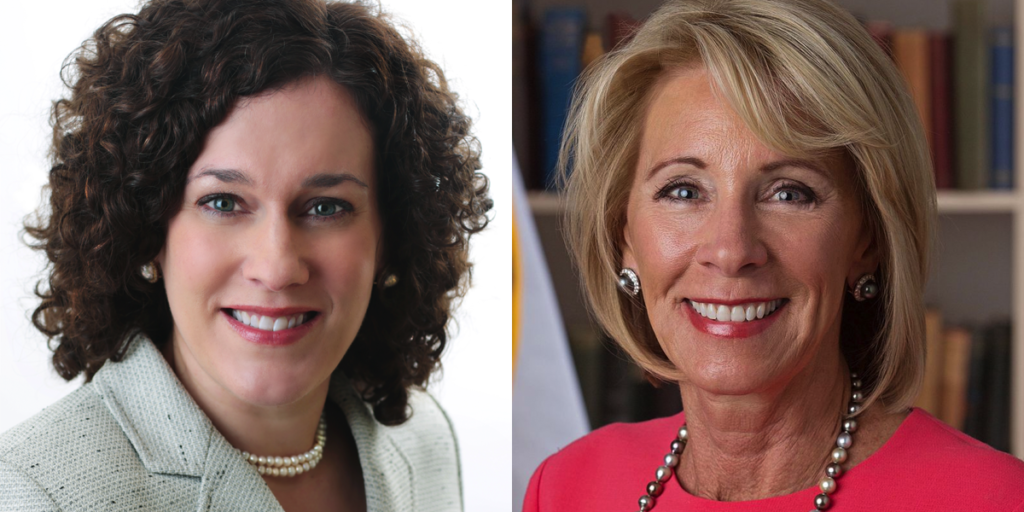
Despite being one of President Donald Trump‘s most controversial nominees, U.S. Department of Education Secretary Betsy DeVos had the “qualified” support of Alabama State Board of Education member Mary Scott Hunter from the jump. Now Hunter is putting her support of DeVos to the test. On Friday, she sent a letter to DeVos asking for standardized testing flexibility as the state seeks to drop the ACT Aspire test for its students in favor of alternative tests. Earlier this year, the DeVos called for states and local school districts to have greater say in education standards and issues, citing the Every Student Succeeds Act (ESSA) as the way to allow more local control. However, when Sentenace followed the ESSA approval process and submitted the state’s education plans to the federal government, the U.S. Department of Education rejected it. But Hunter is not taking “no” for an answer. Earlier this month, Alabama Superintendent of Education Michael Sentance requested flexibility from using ACT Aspire testing while we develop an Alabama test that is right for us. Over the last several years we have worked hard to implement rigorous standards that will best prepare our children and youths for living and working in the 21st century. We have shaped these standards with Alabama’s values in mind while keeping our eyes on what today’s students will need to thrive in the decades to come. At this point our best option is to receive a waiver for next year’s standardized test,” the letter continued. “This would allow us time to develop a test that aligns to our Alabama standards, is rigorous, and properly informs instruction. Alternately, we could use existing formative assessments to determine student growth. If your Department does not grant the waiver there is a strong likelihood we will administer three different summative tests in three years, Aspire this past year, a different test next year, and yet another test the year after next. Obviously this is very undesirable for both our students and teachers. Standardized testing is extraordinarily difficult. Getting it right has implications for Alabama for decades to come. We need time to do that. At the time of publishing, the U.S. Department of Education has yet to grant a waiver to Alabama. Read Hunter’s full letter below:
Martha Roby: Changing behavior requires oversight
Oftentimes, truly changing public policy for the better requires not only improving the law but also careful oversight in order to ensure proper implementation of that law. You may remember that late last year we scored a significant legislative victory by getting the strong “state authority” provisions I championed for almost three years included in the long-overdue replacement to the “No Child Left Behind” education law. That law and the behavior it allowed has served to frustrate school administrators, hamstring teachers, and erode parents’ trust in public schools. As Congress worked to overhaul the law through the Every Student Succeeds Act (ESSA), one of my top priorities has been to return decision-making in education back to states and local communities where it belongs. The provisions I advocated for strictly prohibit the U.S. Department of Education from using funding grants or special rule waivers to coerce states into adopting its preferred policies. In fact, the Wall Street Journal called the nation’s new education law “the largest devolution of federal control to the states in a quarter century.” With ESSA now the law of the land, my focus has turned toward making sure officials are adhering to the new law. At an Appropriations Committee hearing in March, I questioned U.S. Secretary of Education John King about his commitment to making sure the U.S. Department of Education adheres to the “state authority” provisions. While Secretary King committed to me that he would implement and enforce ESSA as written, I assured him I would be watching to make sure that happened. This past week I met with local school superintendents from throughout Alabama who gave me more reason to be concerned about ESSA implementation living up to the intent of Congress. That’s why I reached out to each member of the Alabama ESSA Implementation Committee in a letter asking for feedback on whether or not federal authorities are following Congress’ clear direction. “As someone who has been involved in crafting this law,” I wrote, “I am here to answer any questions you might have regarding the clear intent Congress had toward ensuring flexibility at the state and local level. I also ask that you please keep me apprised of any attempt on behalf of the U.S. Department of Education to disregard the intent of this new law and continue its coercive practices. “Should federal partners you work with in the implementation process fail to adhere to this clear directive from Congress, I want to know about it.” I have already heard back from several members of the committee and I look forward to working with them in our shared goal of ensuring the return of education decisions back to the states. Their feedback will help me hold the U.S. Secretary of Education and his staff accountable for the proper implementation of the nation’s new education law. ••• Martha Roby represents Alabama’s 2nd Congressional District. She lives in Montgomery, Alabama with her husband, Riley and their two children.
Robert Bentley creates implementation committee for Every Student Succeeds Act

Last week, Governor Robert Bentley announced the establishment of a state implementation committee for the Every Student Succeeds Act (ESSA), which was signed into law last year by President Barack Obama to replace the No Child Left Behind Act. According to a press release from the governor’s office, the new law “shifts the power of education from the federal government and returns power and control to the states.” Under ESSA, states will be able to decide for themselves what it best for their students in regard to the “implementation of academic standards, testing, accountability, school improvement and teacher quality.” As part of the law, each state is required to develop a comprehensive plan for implementing the new legislation. “Every state, school and classroom needs the certainty and fairness of a flexible education law,” Governor Bentley said in the statement. “I support the Every Student Succeeds Act because it provides governors a central role in implementation and governance and gives us the flexibility to shape our schools and prepare our students from early childhood into the workforce. This legislation is the greatest devolution of federal powers to the state in 25 years. I challenge Alabama’s implementation committee to create a plan that will continue to move Alabama’s education system forward while keeping in mind the needs of the students being taught.” The Alabama ESSA Committee will consist of the following members or a designated representative: Two vice chairs, appointed by the Superintendent, Alabama State Department of Education Two appointments by each Alabama State Board of Education member, excluding the Governor The Secretary, Department of Early Childhood Education The Education Policy Advisor, Office of the Governor Director, Governor’s Office of Minority Affairs Three representatives in workforce development programs or related entities, appointed by the Governor A representative of the Alabama Public Charter School Commission, appointed by the Governor One member from the Alabama Senate, appointed by the Senate President Pro Tem One member from the Alabama House of Representatives, appointed by the Speaker of the House of Representatives Additional members as needed, appointed by the Governor The committee will have to submit a plan for the full implementation of ESSA no later than December 1, 2016.
Alabama education advocates applaud passage of Every Student Succeeds Act

Wednesday, the U.S. Senate approved the Every Student Succeeds Act (ESSA), 85 to 12. Designed to update America’s public school system, the bill has now been sent to President Barack Obama for a signature. Education advocates say the new legislation, which replaces No Child Left Behind, gives states more control. Alabama GRIT – a statewide coalition of parents, teachers, military personnel, business leaders and civic organizations that advocates for high expectations in Alabama schools – agrees and supported the law’s passage. “For years, the democratically-elected Alabama State Board of Education’s efforts to raise academic expectations in our schools have been hampered by misconceptions about the federal government’s role in Alabama’s adoption of our College and Career Ready Standards, which were based on the Common Core State Standards,” said Caroline Novak, chair of Alabama GRIT and president of A+ Education Partnership. “This bill should put to rest any concerns Alabamians hold about who determines what is learned in Alabama’s classrooms,” Novak continued. “We hope that statewide conversations moving forward will now focus on what we can do together to provide students and teachers what they need to be successful.” Last week, the U.S. House of Representatives approved the same bill by a vote of 359 to 64. Among other provisions, this legislation restores control of education to state and local school boards by: Prohibiting any federal government entity from coercing or incentivizing states into adopting standards such as Common Core or specific assessments; Ending the U.S. Secretary of Education’s ability to influence state education policies through executive fiat and conditional waivers; Prohibiting the U.S. Department of Education from imposing any additional mandates on states and school districts in the areas of standards, assessments and state accountability plans, beyond what is specified in the legislation; and, Codifying that adoption of standards and assessments are solely the prerogative and responsibility of the states and not the federal government. “As we move forward, we are hopeful that we can now focus on what is taking place inside Alabama’s classroom instead of politics and misperceptions,” said Jessica Hammonds, executive director of Alabama GRIT. “By reducing the role of the federal government in education in Alabama, our state and local boards of education can create clearer paths to help every child in Alabama reach his or her full potential in life, whether they continue on to college or directly enter the workforce after high school.” The Alabama delegation, in both chambers, were split on the vote. Sen. Jeff Sessions (R-AL), Rep. Bradley Byrne (AL-01), Rep. Martha Roby (AL-02), Rep. Robert Aderholt (AL-04), Rep. Terri Sewell (AL-07) all voted in support of ESSA. Sen. Richard Shelby (R-AL), Rep. Mike Rogers (AL-03), Rep. Mo Brooks (AL-05), Rep. Gary Palmer (AL-06) all voted against it.
