
Birmingham’s 1963 Palm Sunday civil rights march commemorated with poetry, music
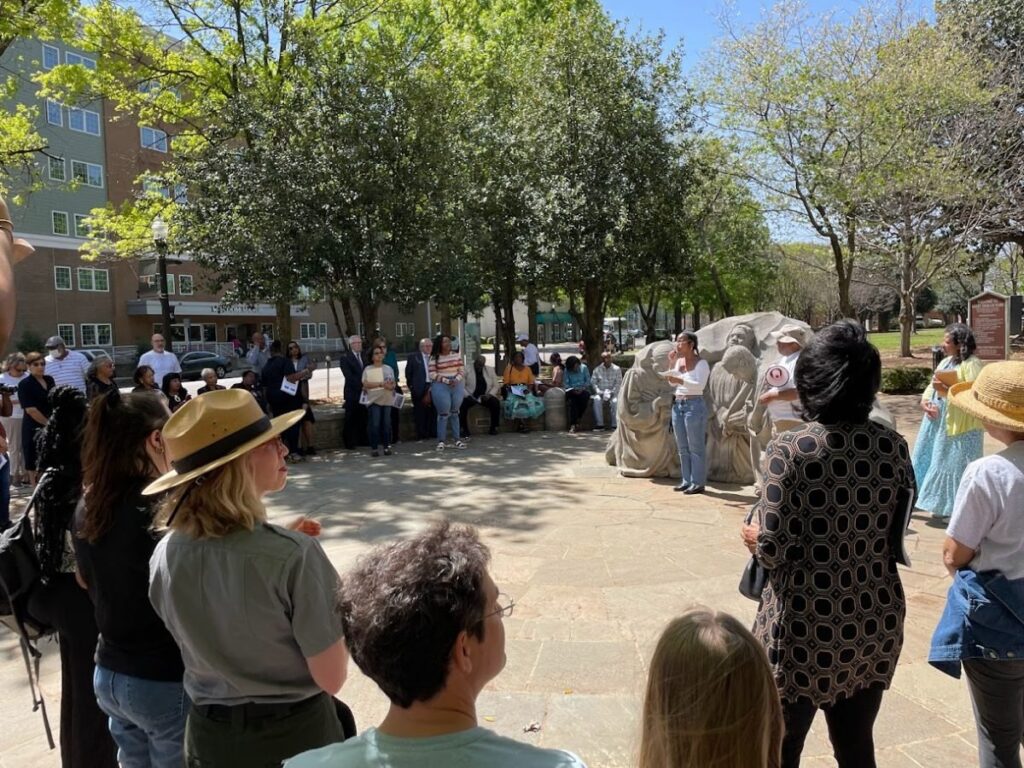
Sixty years ago, on Palm Sunday, three Black pastors led a march from Birmingham’s St. Paul United Methodist Church toward City Hall to protest the Jim Crow segregation laws and support racial equality and human rights. Police arrested 26 people and used police dogs to disperse Black onlookers. On April 1, an interracial group of citizens gathered at St. Paul to recreate the historic march, which was part of the organized campaign in 1963 to dismantle Birmingham’s unjust system of racial separation. Last Saturday’s event included “Poetry in the Park,” starting from the Three Kneeling Ministers sculpture in Kelly Ingram Park, where some of the most violent clashes with police took place during the 1963 campaign. The sculpture commemorates when the local ministers leading the march, John Thomas Porter, Nelson H. Smith Jr., and A.D. King, brother of Martin Luther King Jr., knelt to pray on the sidewalk in front of segregationist Public Safety Commissioner Eugene “Bull” Connor. More than 1,000 people marched that day. The recent event drew about 100 people, as marchers heard from poets at the sculpture and at other locations around the Birmingham Civil Rights National Monument site. Ashley M. Jones, Alabama’s Poet Laureate, joined the events that included a program at St. Paul, as well as music, children’s activities, and food trucks. Supporters of the event included St. Paul United Methodist Church, the Birmingham Civil Rights Institute, the Methodist Foundation of North Alabama, Greater Birmingham Ministries, Magic City Poetry Festival, Scrollworks Music School, and the Alabama Cooperative Extension System. “Protests in April and May 1963, such as the Palm Sunday March, which departed from St. Paul United Methodist Church, elevated civil rights from a Southern issue to a pressing national issue,” said Kathryn Gardiner, park ranger at the Birmingham Civil Rights National Monument. “It was an honor to commemorate the elders and ancestors who took a stand, alongside our many community partners.” Rev. Richard Lane Stryker III, pastor at St. Paul, said the event was a great success, combining a commemoration of important civil rights history with inspirational messages, poetry, and music. “Hopefully, through the poetry and the program, we can inspire a new generation of changemakers,” Stryker said. Learn more about the three kneeling ministers and the sculpture at Kelly Ingram Park here. Republished with the permission of The Alabama NewsCenter.
Ex-PSC President Kenneth Hammond, Sr. dies at 90

The Alabama politician who ended the career of Eugene “Bull” Connor died October 22 in his hometown of Valley Head. Kenneth Hammond, Sr. had represented DeKalb, Cherokee, and Jackson Counties in the State Senate before defeating Connor for PSC President in 1972. He later served two terms as Mayor of Valley Head. Services for Hammond will be Monday, October 24. Visitation is at Burt Chapel in Valley Head at 11 a.m. Graveside service is 1:30 p.m. at Valley Head Cemetery. His death at his home followed a long illness. Hammond was elected to the state senate in 1962. In 1965, he was part of a team of senators who engineered the defeat of a constitutional amendment proposed by then-Gov. George Wallace. It would have removed the ban on Alabama governors succeeding themselves, allowing Wallace to run in the 1966 gubernatorial race. After the amendment failed to pass the senate, the Wallace team ran his wife, Lurleen Wallace, in the 1966 gubernatorial race. She won the Democratic primary, defeating nine candidates without a runoff. She won the governorship in the November general election, defeating Congressman Jim Martin (R) of Gadsden. None of the State Senators who opposed the Wallace amendment were re-elected. Hammond was the only anti-Wallace senator who later achieved a comeback, winning his seat back in the 1970 election. In 1972, Hammond ran in a six-way race for President of the Public Service Commission. He came in second but forced a runoff with incumbent Connor. Connor gained notoriety in the 1960s as Public Safety Commission of Birmingham. He ordered dogs and fire hoses to repel civil rights protesters, including women and children. Video and still photos of the event were covered extensively by national and international news media. In the 1972 race against Connor, Hammond won the support of Black voters, including the Alabama Democratic Conference. In 1975, Hammond was indicted by a Montgomery County grand jury on a felony charge of misusing his office. He was convicted by a jury and automatically removed from office. He served a year in the DeKalb County jail. In the 1990s, Hammond made a comeback and was twice elected Mayor of Valley Head, Alabama. Hammond is survived by Ken Hammond, Jr., who starred as a lineman at Vanderbilt and played two years for the Dallas Cowboys before being injured. Other survivors are his wife, Carol Payne Hammond, children Tonni, Tina, and Byron Armstrong, and Pam Hartline; sister Patsy LaJean Mathews; numerous grand and great-grandchildren and nieces and nephews. Jim Zeigler is the current State Auditor for the State of Alabama. He was elected in 2014 and re-elected in 2018. Zeigler previously served on the Public Service Commission.
Activist who helped desegregate Birmingham library dies
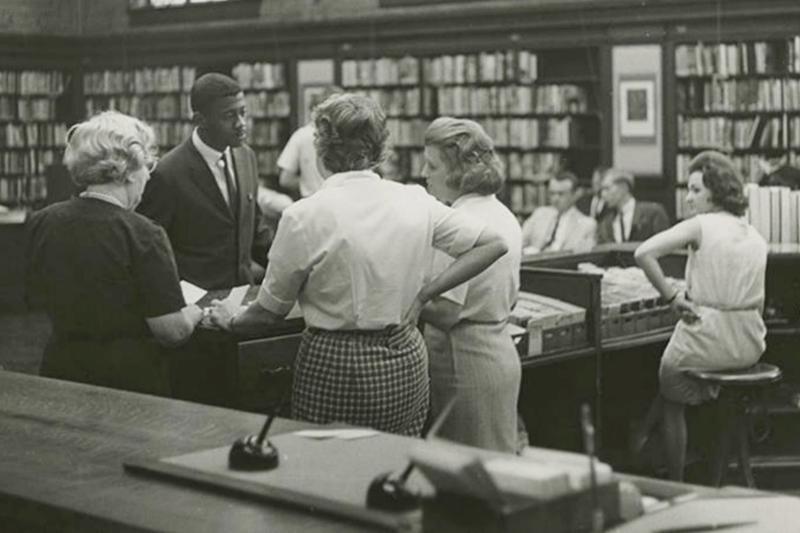
A Black Army veteran who helped peacefully desegregate an Alabama city’s library with a sit-in protest in 1963 has died, according to the library and an obituary published by his family. Shelly Millender Jr. of Birmingham died on Saturday. He was 86. Millender already was a veteran when he attended Miles College, a historically Black school where he was student government president and became active in the civil rights movement. Recruited by Southern Christian Leadership Conference director Wyatt T. Walker, Millender was among the students who staged a sit-in at Birmingham’s main downtown library on April 10, 1963, to demonstrate against a policy that banned Black people. “Shelly Millender engaged the librarian who told him you should be going to the colored library. Shelly said, ‘No, I want to use this library,’” Wayne S. Wiegand, who wrote “The Desegregation of Public Libraries in the Jim Crow South: Civil Rights and Local Activism,” said in an interview with a library official in 2018. “The librarian must have called the police. The police came but didn’t bother to arrest them. Because they weren’t arrested, the students then left because they were there to be arrested,” Wiegand said. Library leaders agreed to end segregation soon after in what was described as one of the few peaceful desegregation efforts in Birmingham, a flashpoint of civil rights demonstrations because of its strict enforcement of race-based separation and oppression. Wiegand said library leaders were worried about the reputation the city was gaining because of white segregationist Eugene “Bull” Connor, the police commissioner who unleashed dogs and fire hoses on civil rights demonstrators. “The fact the library became integrated peacefully in the middle of that violent summer is kind of lost on people. It was the sole site of racial conciliation in the middle of a town that was hosing African Americans and turning dogs on them,” Wiegand said. Millender spent decades selling cars and served as host of a radio show after retirement. Survivors include two sisters, three children, a lifelong companion, and her son, the obituary said. Republished with the permission of the Associated Press.
