
Evangelical tussling over anti-Donald Trump editorial escalates
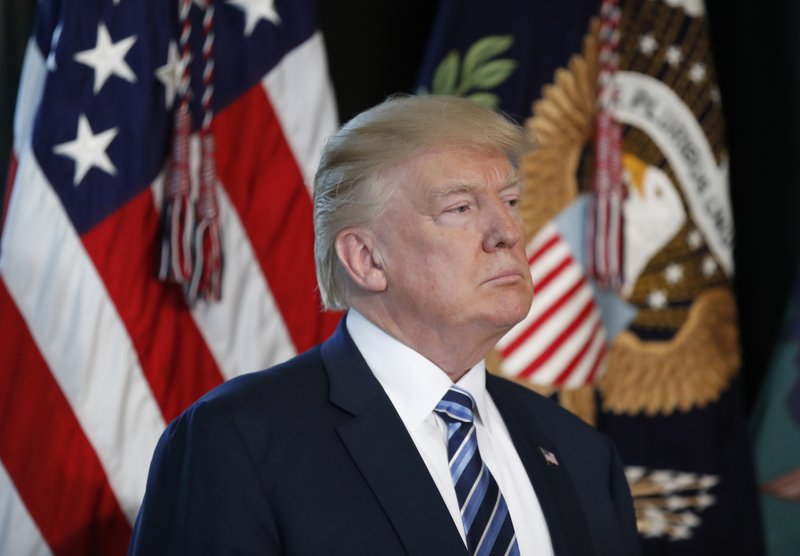
As the political clamor caused by a top Christian magazine’s call to remove President Donald Trump from office continues to reverberate, more than 100 conservative evangelicals closed ranks further around Trump on Sunday. In a letter to the president of Christianity Today magazine, the group of evangelicals chided Editor-in-Chief Mark Galli for penning an anti-Trump editorial, published Thursday, that they portrayed as a dig at their characters as well as the president’s. “Your editorial offensively questioned the spiritual integrity and Christian witness of tens-of-millions of believers who take seriously their civic and moral obligations,” the evangelicals wrote to the magazine’s president, Timothy Dalrymple. The new offensive from the group of prominent evangelicals, including multiple members of Trump’s evangelical advisory board, signals a lingering awareness by the president’s backers that any meaningful crack in his longtime support from that segment of the Christian community could prove perilous for his reelection hopes. Though no groundswell of new anti-Trump sentiment emerged among evangelicals in the wake of Christianity Today’s editorial, the president fired off scathing tweets Friday accusing the establishment magazine – founded by the late Rev. Billy Graham in 1956 — of becoming a captive of the left. The letter to the magazine’s president sent on Sunday also included a veiled warning that Christianity Today could lose readership or advertising revenue as a result of the editorial, which cites Trump’s impeachment last week. Citing Galli’s past characterization of himself as an “elite” evangelical, the letter’s authors told Dalrymple that “it’s up to your publication to decide whether or not your magazine intends to be a voice of evangelicals like those represented by the signatories below, and it is up to us and those Evangelicals like us to decide if we should subscribe to, advertise in and read your publication online and in print, but historically, we have been your readers.” Among the signatories of the letter are George Wood, chairman of the World Assemblies of God Fellowship; Rev. Tim Hill of the Church of God; former Arkansas governor and GOP presidential hopeful Mike Huckabee; and former Minnesota GOP Rep. Michele Bachmann. Galli told CBS’ “Face the Nation” on Sunday that he views the chances of Trump leaving office, either through a reelection loss or post-impeachment conviction by the Senate, as “probably fairly slim at this point.” The editor-in-chief defended his editorial as less of a “political judgment” than a call for fellow evangelicals to examine their tolerance of Trump’s “moral character” in exchange for his embrace of conservative policies high on their agenda. “We’re not looking for saints. We do have private sins, ongoing patterns of behavior that reveal themselves in our private life that we’re all trying to work on,” Galli said Sunday. “But a president has certain responsibilities as a public figure to display a certain level of public character and public morality.” Galli referred comment on Sunday’s evangelical letter to Dalrymple, who on Sunday published his own strongly worded defense of the magazine’s anti-Trump commentary. Countering Trump’s suggestion that the magazine had shifted to favor liberals, Dalrymple wrote that the publication is in fact “theologically conservative” and “does not endorse candidates.” “Out of love for Jesus and his church, not for political partisanship or intellectual elitism, this is why we feel compelled to say that the alliance of American evangelicalism with this presidency has wrought enormous damage to Christian witness,” Dalrymple wrote. Asked about the editorial’s indictment of Trump by “Fox News Sunday,” Marc Short – chief of staff to Vice President Mike Pence, himself a prominent evangelical Christian – cited some of the policy positions that have helped endear the president to many in that voting bloc. “For a lot of us who are celebrating the birth of our Savior this week, the way that we look at it is that this president has helped to save thousands of similar unplanned pregnancies,” Short said Sunday, adding that “no president has been a greater ally to Israel than this president.” Roughly 8 in 10 white evangelical Protestants say they approve of the way Trump is handling his job, according to a December poll from The AP-NORC Center. The Trump campaign is planning a Jan. 3 event in Miami called “Evangelicals for Trump.” Associated Press religion coverage receives support from the Lilly Endowment through the Religion News Foundation. The AP is solely responsible for this content. This story has been corrected by deleting a reference to Samuel Rodriguez as among those who signed a letter Sunday, which he was not. By Elana Schor Associated Press Republished with the Permission of the Associated Press.
New whistleblower may give house democrats fresh information
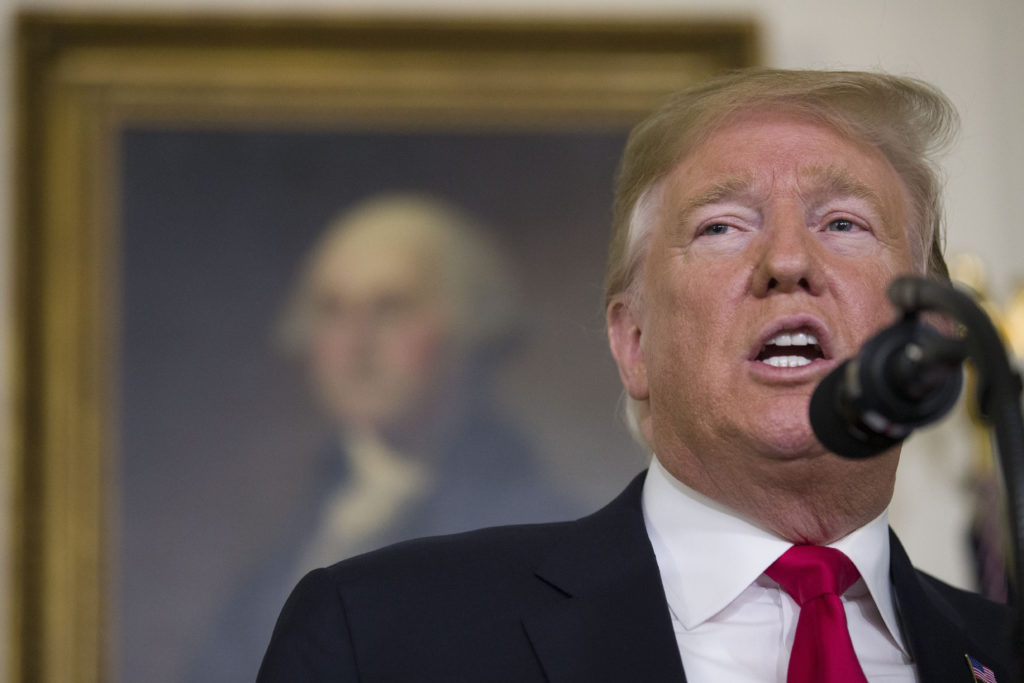
House Democrats leading an impeachment inquiry of President Donald Trump’s dealings with Ukraine may have fresh information to work with after a new whistleblower stepped forward with what the person’s lawyer said were firsthand knowledge of key events. With Congress out for another week and many Republicans reticent to speak out, a text from attorney Mark Zaid that a second individual had emerged and could corroborate the original whistleblower’s complaint gripped Washington and potentially heightened the stakes for Trump. Zaid, who represents both whistleblowers, told The Associated Press that the new whistleblower works in the intelligence field and has spoken to the intelligence community’s internal watchdog. The original whistleblower, a CIA officer, filed a formal complaint with the inspector general in August that triggered the impeachment inquiry. The document alleged that Trump had used a July telephone call with Ukraine President Volodymyr Zelenskiy to investigate a political rival, Joe Biden, and his son Hunter, prompting a White House cover-up. The push came even though there was no evidence of wrongdoing by the former vice president or his son, who served on the board of a Ukrainian gas company. Trump and his supporters deny that he did anything improper, but the White House has struggled to come up with a unified response. A second whistleblower with direct knowledge could undermine efforts by Trump and his allies to discredit the original complaint. They have called it politically motivated, claimed it was filed improperly and dismissed it as unreliable because it was based on secondhand or thirdhand information. A rough transcript of Trump’s call with Zelenskiy, released by the White House, has already corroborated the complaint’s central claim that Trump sought to pressure Ukraine on the investigation. Text messages from State Department officials revealed other details, including that Ukraine was promised a visit with Trump if the government would agree to investigate the 2016 election and a Ukrainian gas company tied to Biden’s son — the outline of a potential quid pro quo. Rep. Jim Himes, Democrat-Connecticut, a member of the House Intelligence Committee, said word of a second whistleblower indicates a larger shift inside the government. “The president’s real problem is that his behavior has finally gotten to a place where people are saying, ‘Enough,’” Himes said. Democrats have zeroed in on the State Department in the opening phase of their impeachment investigation. The Intelligence, Oversight and Foreign Affairs committees have already interviewed Kurt Volker, a former special envoy to Ukraine who provided the text messages, and least two other witnesses are set for depositions this week: Gordon Sondland, the U.S. ambassador to the European Union, and Marie Yovanovitch, who was abruptly ousted as the U.S. ambassador to Ukraine in May. Sen. Lindsey Graham, Republican-South Carolina, one of Trump’s most vocal backers, provided perhaps the strongest defense of the Republican president. He said there was nothing wrong with Trump’s July conversation with Zelenskiy and said the accusations look like a “political setup.” As for Trump, rather than visiting his nearby golf course in Sterling, Virginia, for a second day, he stayed at the White House on Sunday, where he tweeted and retweeted, with the Bidens a main target. “The great Scam is being revealed!” Trump wrote at one point, continuing to paint himself as the victim of a “deep state” and hostile Democrats. Aside from Trump’s attempt to pressure Zelenskiy, the July call has raised questions about whether Trump held back near $400 million in critical American military aid to Ukraine as leverage for an investigation of Burisma, a Ukrainian gas company. Hunter Biden served on the board of Burisma at the same time his father was leading the Obama administration’s diplomatic dealings with Ukraine. Though the timing raised concerns among anti-corruption advocates, there has been no evidence of wrongdoing by either Biden. Joe Biden, a leading candidate for the 2020 Democratic presidential nomination, wrote in The Washington Post that he had a message for Trump and “those who facilitate his abuses of power. … Please know that I’m not going anywhere. You won’t destroy me, and you won’t destroy my family.” Additional details about the origins of Trump’s July 25 call with Zelenskiy have emerged over the weekend. Energy Secretary Rick Perry had encouraged Trump to speak with the Ukrainian leader, but on energy and economic issues, according to spokeswoman Shaylyn Hynes. She said Perry’s interest in Ukraine is part of U.S. efforts to boost Western energy ties to Eastern Europe. Trump, who has repeatedly has described his conversation with Zelenskiy as “perfect,” told House Republicans on Friday night that it was Perry who teed up the July call, according to a person familiar with Trump’s comments who was granted anonymity to discuss them. The person said Trump did not suggest that Perry had anything to do with the pressure to investigate the Bidens. Himes appeared on CBS’ “Face the Nation” while Graham spoke on Fox News Channel’s “Sunday Morning Futures.” By Eric Tucker, Richard Lardner and Jill Colvin Associated Press Associated Press writers Alan Fram, Ellen Knickmeyer and Mary Clare Jalonick contributed to this report. Republished with the permission of the Associated Press.
Marco Rubio, Ted Cruz jostle to claim ‘alternative-to-Donald Trump’ vote
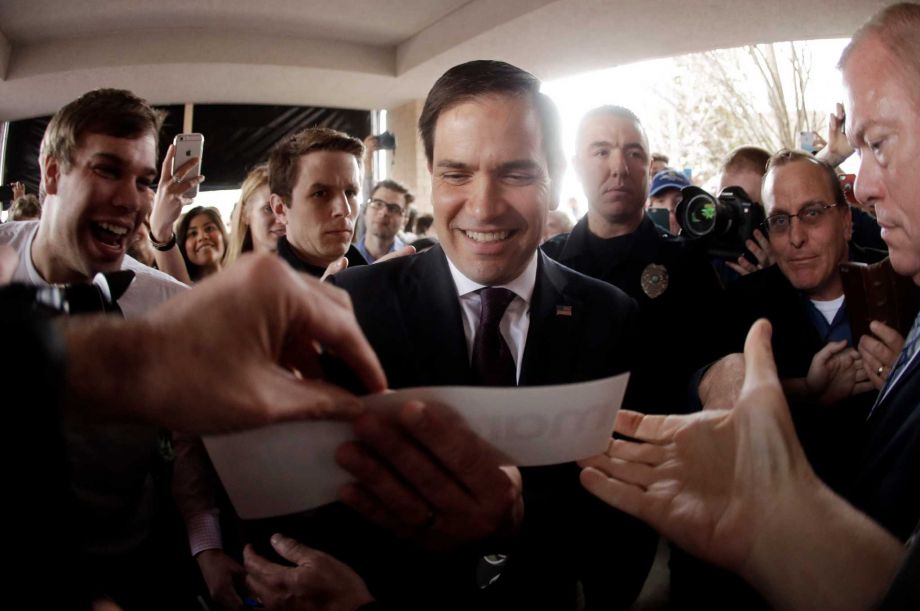
Republicans Marco Rubio and Ted Cruz battled to emerge as the true anti-Trump on Sunday as the billionaire businessman took an ever-so-brief break from his trademark braggadocio to say his drive for the GOP nomination isn’t unstoppable — yet. Fresh off a commanding victory in South Carolina, Donald Trump declined to say the nomination was his to lose. But he quickly went on to declare, “I’m really on my way.” Soon enough, in a television interview, he was toting up electoral math all the way through Election Day and concluding, “I’m going to win.” The candidates’ diverging flight plans demonstrated how the campaign spreads out and speeds up now. Nevada’s GOP caucuses are Tuesday, and then a dozen states vote in the March 1 Super Tuesday bonanza. Trump was in Georgia exulting over his latest victory, Cruz headed for Nevada, and Rubio embarked on a Tennessee-Arkansas-Nevada trifecta. On the Democratic side, Hillary Clinton savored her weekend win in the Nevada caucuses as Bernie Sanders acknowledged that while his insurgent campaign has made strides, “at the end of the day … you need delegates.” He looked past Tuesday’s Democratic primary in South Carolina to list Colorado, Minnesota, Massachusetts and Oklahoma as places where he has a “good shot” to do well. Rubio and Cruz used the Sunday morning news shows to spin rosy-road-forward scenarios after complete but unofficial returns in South Carolina put Trump way up top, with Rubio squeaking past Cruz for second. But with roughly 70 percent of Republicans in national polls declining to back Trump, Cruz and Rubio tried to cast themselves as the one candidate around whom what Rubio calls the “alternative-to-Donald-Trump vote” can coalesce. Rubio also took an aggressive run at Trump, faulting him for a lack of specifics on policy. “If you’re running for president of the United States, you can’t just tell people you’re going to make America great again,” he said on CBS’ “Face the Nation.” At a later rally in Franklin, Tennessee, a Nashville suburb, Rubio took note of the smaller GOP field after Jeb Bush‘s departure from the race, and celebrated his biggest crowd of the campaign, estimated at more than 3,000 people. Rubio avoided criticizing his GOP rivals, instead highlighting his efforts to help middle-class families. Cruz, for his part, stressed his conservative bona fides and said he was the lone “strong conservative in this race who can win. We see conservatives continuing to unite behind our campaign,” he told NBC’s “Meet the Press.” With Bush gone from the race, Rubio was hoping to pick off past donors to the Bush campaign and looking to benefit as well from a cessation in the millions of dollars in negative ads run by the Bush campaign and its allies. Rubio also suggested it was only a matter of time before John Kasich and Ben Carson folded as well. He hinted it would be better to get that winnowing over with, saying, “the sooner we can coalesce, the better we’re going to be as a party in general.” Not so fast, Kasich countered. “We’re getting big crowds everywhere we go,” the Ohio governor insisted, listing Vermont, Massachusetts and Virginia as places he can shine. Cruz tried to brush right past his apparent third-place finish in South Carolina and instead hark back to his victory over Trump in leadoff Iowa. “It is becoming clearer and clearer that we are the one campaign who can beat Donald Trump,” Cruz told reporters before a campaign stop in rural Nevada. The Texas senator said his path to victory calls for a strong showing on Super Tuesday, and that Texas was “clearly the crown jewel” of that day. Rubio, a Florida senator, highlighted the big delegate take available in the five-state round of voting on March 15, which includes his home state. He noted that round offers victors a “winner-take-all” share of delegates rather a proportional share. Cruz scoffed at Rubio’s strategy, saying: “They’re trying to wait until March 15 to win a state.” Trump suddenly had nice things to say about Bush, the candidate he had hammered so relentlessly when they were rivals. As for Rubio, Trump told “Fox News Sunday” that “I start off liking everybody. Then, all of a sudden, they become mortal enemies.” At a rowdy Atlanta rally, Trump crowed over his big South Carolina win, saying “we’re just doing one after another.” Spitting out the superlatives, he called his sweep of all 50 delegates there “amazing,” ”beautiful,” ”conclusive” and “very, very decisive.” Clinton was happy with her Nevada win but acknowledged she has work to do in persuading voters that she has their best interests at heart. “I think there’s an underlying question that maybe is really in the back of people’s minds and that is, you know, is she in it for us or is she in it for herself?” Clinton said on CNN. “I think that is a question that people are trying to sort through.” Working to increase his support among black voters, Sanders visited a Baptist church luncheon following services in West Columbia, South Carolina, and talked up the country’s economic recovery under President Barack Obama. Republished with permission of the Associated Press.
Marco Rubio brings optimistic conservative message to Sunday shows
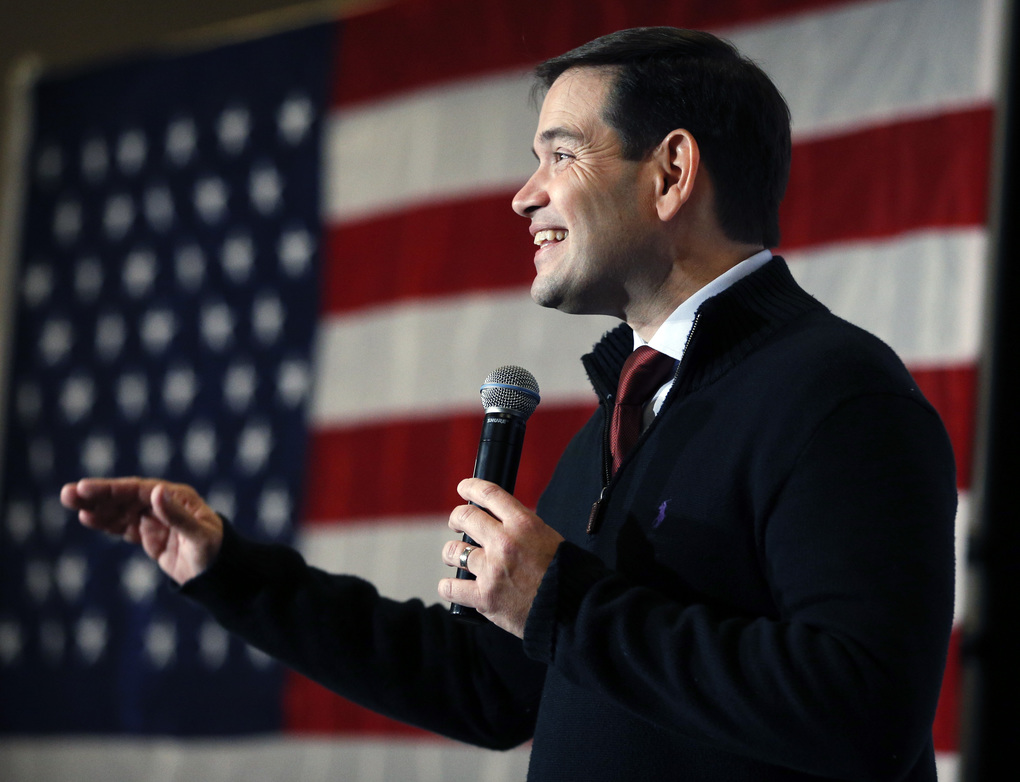
On all four broadcast network Sunday shows, Marco Rubio attempted to position himself as the “optimistic conservative” in a three-man race for the GOP nomination. On Meet the Press, Rubio was asked why he should “feel good” about coming in a “distant second” in South Carolina. Rubio’s answer boiled down to being the logical alternative to Trump. “Seventy percent of Republicans want someone other than Donald Trump as the nominee” and “more and more, that ‘alternative to Trump’ vote is coming to us.” Rubio asserted that Trump will find it increasingly hard to “crowd people out” with “outrageous statements” as the field narrows, leaving an opening for his campaign which is “very realistic about the challenges” ahead, yet “very optimistic about the future.” Rubio was asked about his previous immigration position, one that synced up neatly with that of the President, as a relatively devastating attack ad that had Rubio and Obama talking points paralleling each other indicated. “People don’t care about it,” Rubio said, “it doesn’t matter.” Rubio pivoted to his proposed course of action now: the “only way forward is by doing it in pieces,” and that first piece is “securing the border.” Rubio then discussed his national strategy going forward, headed into Super Tuesday, stopping short of guaranteeing an outright win anywhere, while insisting his was a “national campaign.” “All of these states award delegates differently,” and the Winner Takes All states are “where we need to win.” On Fox News Sunday, Rubio likewise was on message, saying that the narrowing field will allow “the remaining 70 percent [of non-Trump support] to coalesce” as the field shrinks to three “full-scale national campaigns.” Rubio pushed the narrative of Reaganesque optimism when asked to compare his effort to Trump’s, saying his presentation was “very optimistic about the future” with “real answers to real problems,” as opposed to Trump’s constant messaging about “how bad things are.” “I look forward to having a policy debate,” Rubio said, “if we can make it” one. Rubio also addressed Ted Cruz, who is “very weak on national security,” and whose campaign “tenor” has “voters increasingly troubled.” When asked if Cruz had the integrity or character to be President, Rubio noted that “from his campaign it’s missing,” citing robocalls in South Carolina that charged that Rubio was cutting his campaign short and would end it altogether if he didn’t win South Carolina. Rubio also messaged against the attendance-record criticisms that have simmered around his stints in the Florida House and the Senate. In the House, he said being majority whip necessarily hampered his ability to make some committees, such as the special committee on 9/11 related issues. And in the Senate, scheduling likewise was a burden. Often, he said, “three committees are meeting at the same time,” making it hard to “be at every hearing” when another committee “could be having votes. ABC’s This Week offered some variations on the theme. Rubio addressed Trump’s recent retweet that Rubio and Cruz may face eligibility issues related to being native born, by pointing out the media coverage of every time “Trump says something edgy and outrageous,” a tactic that’s “not working with the narrowing field.” Regarding why he hasn’t gone on the offense against Trump, Rubio kept it positive, saying the “election’s about who is most capable of leading” the party, before casting doubt on Trump’s ability to lead on day one. “Putin’s not going to [provide] a six-month honeymoon period,” Rubio said, adding that the “world’s not going to wait” for Trump to get his bearings. Rubio also was asked if Mitt Romney was poised to endorse him, a meme floated by the Huffington Post. Romney, Rubio said, is “not scheduled to endorse me,” which is a nice turn of phrase, and that added that “if he were, we wouldn’t announce it on the Huffington Post.” Rubio brought his message to Face the Nation, reiterating his contention that 70 percent of the GOP electorate is up for grabs in a three-man race, and that, unlike Trump, he’s “very realistic about our challenges” yet “optimistic about our future.” “You can’t just tell people you’re going to Make America Great Again. You’ve got to explain how you’re going to do it, policy-wise.” Rubio also described Trump’s views of Putin as “troubling,” saying that the frontrunner “doesn’t understand who Putin is, or what he’s trying to do.” Rubio has policy questions about “everything” related to Trump policy positions, ranging from Obamacare to Supreme Court philosophy. “The Democrats, if we nominate somebody who’s nebulous about these things, they will eat our lunch.” The narrowing of the field, Rubio said, was on schedule with his campaign’s initial read of the race, before the “Winner Take All states.”
One-time presidential favorites engage longshot rivals
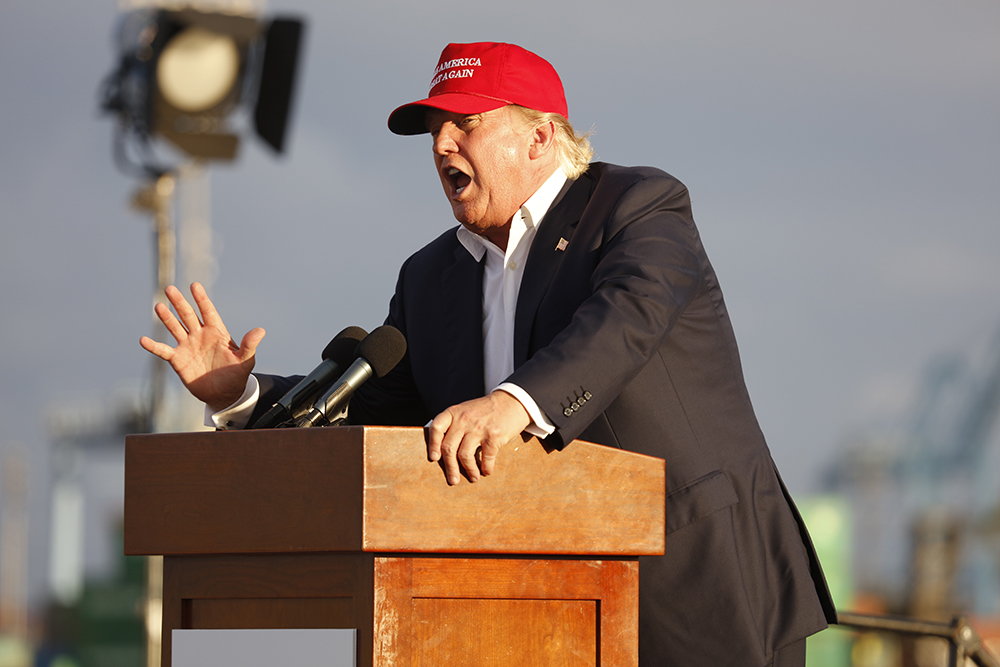
Parallel political clashes were igniting Sunday in the volatile presidential primary races, as one-time Republican and Democratic favorites battled once-unlikely rivals in their own party over guns and foreign policy ahead of the Feb. 1 Iowa caucuses. Fueling the back-and-forth: President Barack Obama‘s address heralding two developments in U.S. relations with Iran as triumphs for “smart” diplomacy. Across the Sunday talk shows hours before their next debate, Hillary Clinton battered Bernie Sanders over his new opposition to a law that shields gun manufacturers from lawsuits. On the Republican side, Donald Trump pounded rival Ted Cruz for not reporting bank loans that Cruz had called an oversight. The Texas senator stuck to his debate sneer that Trump represents “New York values.” And from the margins, far from the front-runner position that was once presumed his, Jeb Bush condemned some of his rivals — especially Trump. “The guy’s entertaining, for sure. But his ideas aren’t gonna help people,” the former two-time Florida governor said on NBC’s “Meet the Press.” ”He’s not going not win the nomination. And I am.” That’s far from clear just two weeks before the Feb. 1 Iowa caucuses, given the unsettled Republican field and Bush’s fade. But ambiguity rules the Democratic contest too: Sanders, the Vermont senator and self-described democratic socialist, was giving former secretary of state and first lady Hillary Clinton a strong challenge in Iowa and New Hampshire. On the eve of the debate, Sanders may have handed Clinton the tool she’s seeking. Sanders on Saturday night abruptly announced he now supports legislation that would expose gun manufacturers to some legal liability. Clinton jumped on the “flip-flop” and said on several Sunday shows that she hopes he changes his mind about other proposals tightening gun policy. Sanders denied he was changing position. In the past, he has said his support for the 2005 was in part an effort to protect small shops in home-state Vermont. The new proposal includes an amendment that would require the government to monitor and report on the law’s effect on small stores that serve the hunting community in rural areas. Among Republicans, as Cruz surged in Iowa, Trump grumbled that the Texas senator is “nasty” and said he would bring up Cruz’s loans that had been unreported. Cruz has said that was an oversight. Even President Barack Obama made an appearance during the Sunday morning shows to highlight back-to-back developments on Iran that he held up as victories: the release of Americans long-held by the Islamic Republic as part of a prisoner swap and the end of some sanctions against Iran as part of nuclear talks. “This is a good day,” Obama said. Republicans said they were glad the hostages were being released, but they cast the tangle of deals and developments as ultimately risky. “A very dangerous precedent,” is how Cruz, who is surging in Iowa, described the agreement’s implementation on Fox News’ “Fox and Friends.” ”The result of this, every bad actor on earth has been told, ‘Go capture an American’ … President Obama is in the let’s-make-a-deal business.” Clinton, formerly Obama’s secretary of state, backed the developments but said the U.S. needs to monitor Iran’s behavior on other matters. “If you’re committed to making the world safer and to show strong American leadership, you have to engage in patient, persistent diplomacy with people who are not your friends,” she said on CBS’ “Face the Nation.” Republished with permission of The Associated Press.
Jeb Bush: Donald Trump “scary,” too “uninformed” to be president
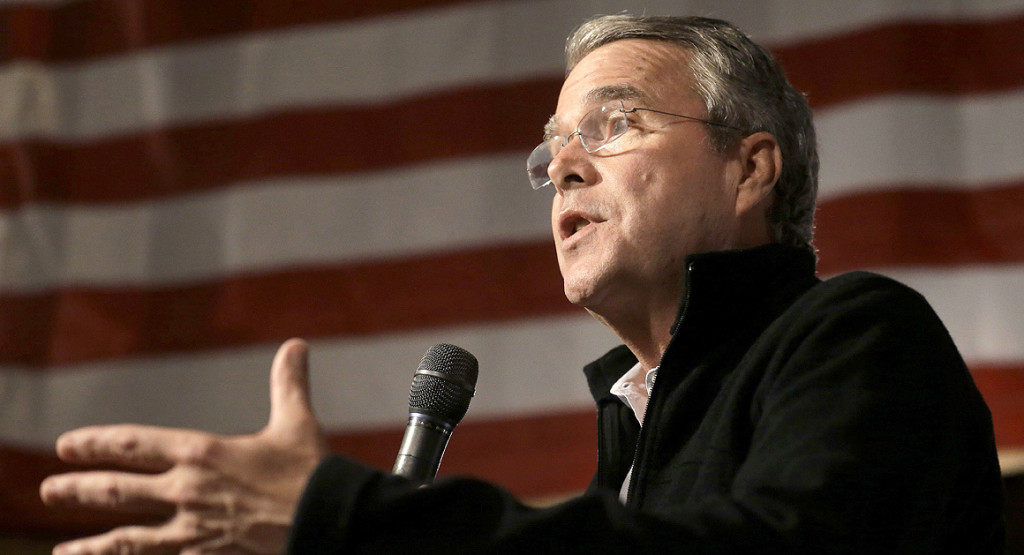
Jeb Bush once again criticized rival presidential candidate Donald Trump, calling the Republican front-runner “scary” and suggested was too “uninformed” to lead the nation. Louis Nelson of POLITICO reports that Bush, in an interview on CBS’s “Face the Nation,” blasted the billionaire real estate tycoon for changing positions on Syrian refugees and how to fight the Islamic State, also known as ISIS. “The simple fact is that he’s been wrong on Syria and on the refugees pretty consistently,” Bush said. “And no one’s holding him to account. He first said we had no interest in being involved in Syria. And then he said let the Russians take out ISIS. And then he said let ISIS take out [Syrian President Bashar] Assad.” “Back and forth it goes,” Bush continued. “And the net effect of this is in these really serious times he’s not a serious leader.” Bush did offer words of praise for Trump’s media strategy, which he said plays reporters “like a fiddle,” with outrageous statements engineered to gain attention. Although Bush said he would support the eventual GOP nominee, the former governor did insist that Trump’s attraction will begin to fade. “Anybody is better than Hillary Clinton,” Bush said. “Let me just be clear about that … But I have great doubts about Donald Trump’s ability to be commander in chief. I really do.” Bush added that he will give Trump “the benefit of the doubt” to see how his campaign progresses. “But if you listen to him talk,” he said, “it’s kind of scary to be honest with you because he’s not a serious candidate.” Trump is “all over the map,” at best misinformed, and at worst playing on people’s fears. Eventually, it will be the voters who decide about Trump, Bush noted. “I’m pretty confident that the more they hear of him, the less likely he’s going to get the Republican nomination.”
Rivals unmoved by Ben Carson’s complaints on scrutiny of his bio
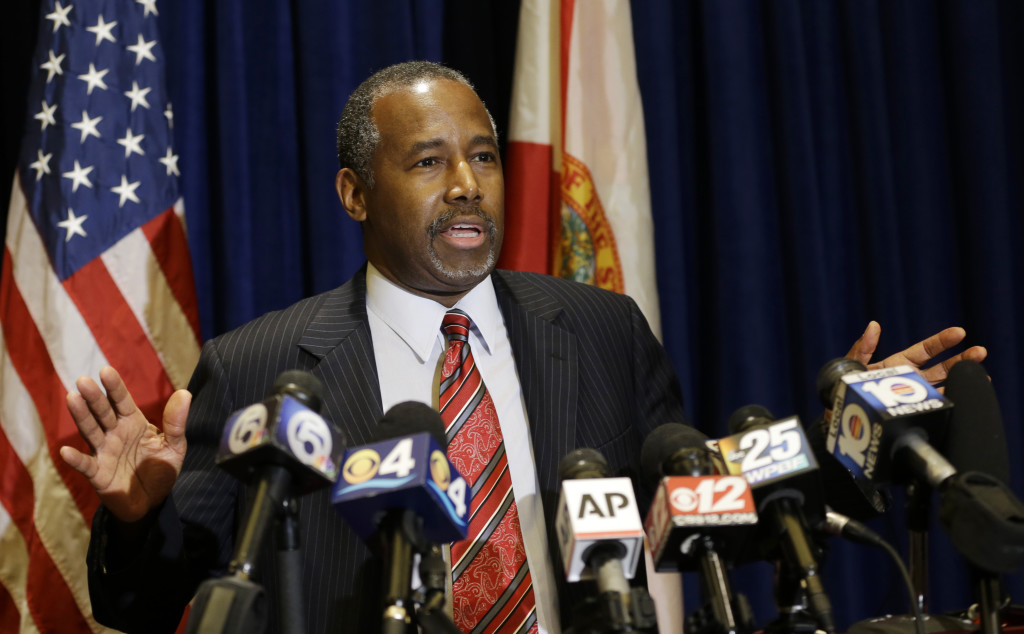
Ben Carson says it’s time to move on from questions about the accuracy of his life story. But Tuesday’s Republican debate makes that unlikely, and some of his GOP rivals say such scrutiny is part of running for president. The retired neurosurgeon said Sunday that questions about discrepancies in his autobiography are distractions from “much more important” matters facing the country and that he’d discuss any “real” scandal uncovered about his past. He strongly disputed any dishonesty or wrongdoing. “Every single day, every other day or every week, you know, they’re going to come out with, ‘Well, you said this when you were 13,’ ” Carson said on CBS’ “Face the Nation” Sunday. “The whole point is to distract the populace, to distract me,” he added. Carson got no sympathy Monday from a pair of Republicans who are trailing him in the presidential polls and said they had endured years of personal scrutiny as governors. “We’re responsible for the personal stories we tell about our lives and we need to be asked about them,” New Jersey Gov. [Chris] Christie said about Carson on MSNBC’s “Morning Joe.” Mike Huckabee, a former Arkansas governor, said when he heard Carson’s complaints about the media, “I’m thinking pal, you ain’t seen nothing yet.” “You know that if you run for office you’re going to be put through the sausage grinder,” Huckabee told MSNBC. Moving on, at least in the short term, is unlikely for Carson. The accuracy of his autobiography has dominated his campaign in the past few days, and more questions are likely during Tuesday’s debate. The intensified questioning reflects Carson’s transformation from political outsider to the top of the polls in the unsettled nomination fight, second only to billionaire developer Donald Trump. And in early-voting Iowa, some polls show Carson leading. Trump tried Sunday to keep the allegations alive. On several news shows, he mentioned examples from Carson’s autobiography, “Gifted Hands,” about Carson’s bad temper when he was young. Carson claimed that he tried to hit his mother with a hammer and unsuccessfully tried to stab someone. Several times, Trump quoted Carson as describing his younger self as having a “pathological” temper — and then demurred on his own opinion of Carson’s character and veracity. “I just don’t know. I mean, I’m not involved. I don’t really know,” Trump said on CNN’s “State of the Union.” Carson insists no other candidate has received the level of scrutiny that he has. Asked on NBC’s “Meet the Press” whether he is being scrutinized more than President Barack Obama and former President Bill Clinton, Carson replied: “Not like this. Not even close.” Republican Party chairman Reince Priebus criticized the intense questioning Monday, saying that while he considers candidate vetting by the media appropriate, “I do believe this is a totally, crazy obsession over incredible detail from 30 or 40 years ago.” “The fact is, you know, we wish the media would be just as obsessed with Hillary Clinton’s lies over the years,” Priebus said in an interview on NBC’s “Today” show. Scrutiny of one’s past is par for any major candidate for president. Obama’s citizenship was questioned, including by Trump, and the president later released a birth certificate showing he was born in Hawaii. Clinton’s marital dalliances were probed during the 1992 campaign. The Miami Herald staked out then-Sen. Gary Hart‘s townhouse in 1987 and caught him in an extramarital affair. Hillary Rodham Clinton, the front-runner for the Democratic presidential nomination, last month testified about the private email server she kept at her house and used for government business while she was secretary of state. Carson is a newcomer to presidential politics, so much about his life, career and published works are being raked over for the first time, and his longtime status as an American success story is being examined. Carson strongly disputed that there was any dishonesty intended. Gone Sunday was the anger he showed during a news conference on Friday, when the usually even-tempered Carson demanded that reporters explain why, in his opinion, Obama had not been subjected to the same level of scrutiny. “My job is to call you out when you’re unfair, and I’m going to continue to do that,” he said. “Gifted Hands” is central to much of the scrutiny. It tells the story of Carson’s rise from a childhood in inner-city Detroit to director of pediatric neurosurgery at Johns Hopkins Hospital in Baltimore. In it, he tells of trying to stab a close friend when he was a teenager. CNN reported it could not find friends or confidants to corroborate that story. Politico published a piece examining Carson’s claim of receiving a scholarship offer to attend the U.S. Military Academy at West Point. The Wall Street Journal said it could not confirm Carson’s anecdotes from his high school and college years. The academy does not offer scholarships, instead extending all expenses paid to students it admits. Carson never applied for admission. Last month, police in Baltimore said they didn’t have enough information to verify Carson’s account of being held at gunpoint at a fast-food restaurant there more than 30 years ago. In a GOP debate last month, Carson said it was “absolutely absurd” to say he had a formal relationship with the medical supplement company Mannatech. He is featured in the firm’s videos, including one from last year in which he credits its supplements with helping people restore a healthy diet. Republished with permission of the Associated Press.
Guest lineups for the Sunday news shows

Guest lineups for the Sunday TV news shows: ABC’s “This Week” — Republican presidential candidate Donald Trump; Democratic presidential candidate Bernie Sanders; Reps. Peter King, R-N.Y., and Adam Schiff, D-Calif.; Defense Secretary Ash Carter. ___ NBC’s “Meet the Press” — Trump, Sanders; Republican presidential candidate Carly Fiorina; Sen. Dianne Feinstein, D-Calif. ___ CBS’ “Face the Nation” — Trump; Republican presidential candidate Ben Carson; Sen. Kirsten Gillibrand, D-N.Y. ___ CNN’s “State of the Union” — Trump; Republican presidential candidate Rand Paul. ___ “Fox News Sunday” — Republican presidential candidate Chris Christie; Rep. Michael McCaul, R-Texas. Republished with permission of the Associated Press.
Guest lineups for the Sunday news shows

Guest lineups for the Sunday TV news shows: ABC’s “This Week” — Democratic presidential candidate Bernie Sanders; Republican presidential candidate Ben Carson; Reps. Adam Kinzinger, R-Ill., and Tulsi Gabbard, D-Hawaii. ___ NBC’s “Meet the Press” — Republican presidential candidate Ted Cruz; Reps. Adam Schiff, D-Calif., and Mike Pompeo, R-Kansas. ___ CBS’ “Face the Nation” — Reps. Trey Gowdy, R-S.C., and Elijah Cummings, D-Md. ___ CNN’s “State of the Union” — 2012 Republican presidential nominee Mitt Romney. ___ “Fox News Sunday” — Republican presidential candidate Donald Trump. Republished with permission of the Associated Press.
Bernie Sanders pushes for more debates
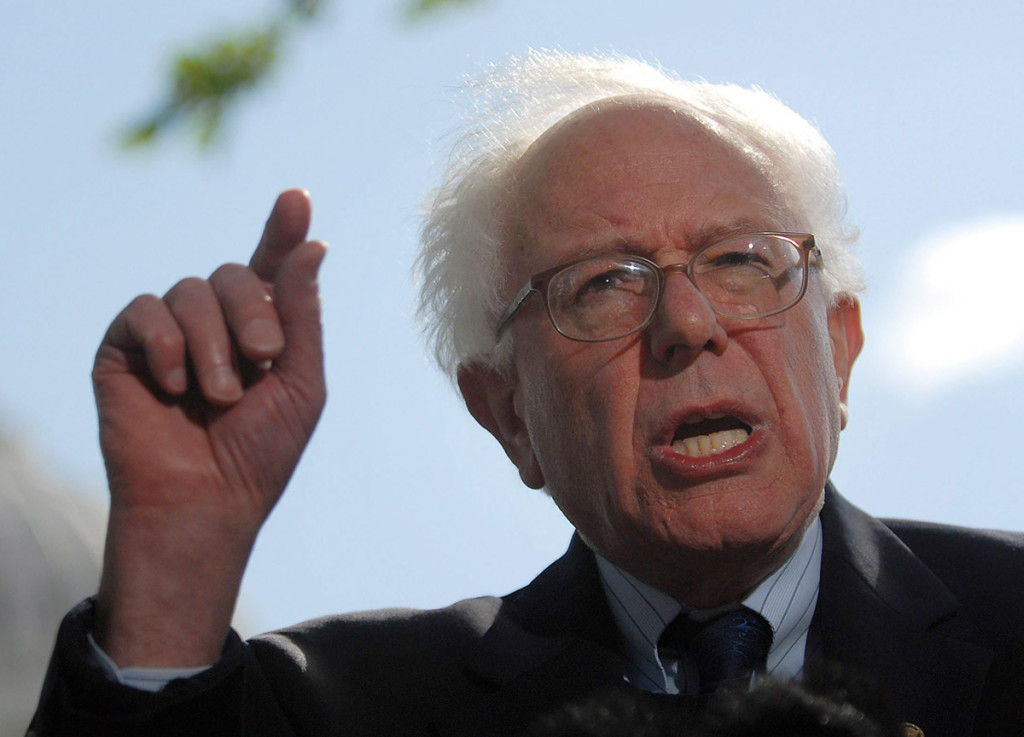
Here’s the latest news on the 2016 race for president. (All times local): 12:35 p.m. There’s no debate about it for Bernie Sanders. Any chance there will be more than the six debates already sanctioned by the Democratic National Committee? “I have the feeling that there will be,” the Vermont senator tells CBS’ “Face the Nation.” Supporters of Sanders and former Maryland Gov. Martin O’Malley are pressing for more. Hillary Rodham Clinton‘s campaign has said the front-runner is open to more debates. Sanders says debates promote “a serious decision in our democracy.” 10:35 a.m. Donald Trump is “a master brander,” someone with “a lot of pizazz and zip.” That’s not from a news release from the Republican presidential candidate’s campaign. The description comes from a seasoned Democratic politician — former President Bill Clinton. Can Trump win the GOP nomination? “I think so” is Clinton’s assessment, though he also adds on CNN, “I mean, how do I know?” The two-term president says he’s hasn’t run for office in a long time and doesn’t “have a good feel for this.” Clinton says he’ll “do what I can” to help one candidate in the 2016 race — his wife, Hillary Rodham Clinton. 10 a.m. From cyberspace to space itself, Republican presidential candidate Ben Carson says “strength is really the defense against aggressiveness by others” from cyberspace to space itself. Carson tells ABC’s “This Week” that he favors offensive cyberattacks against anyone who attacks the United States — “they need to understand that there will be consequences.” The retired neurosurgeon also talks about the need to harden the country’s power grid and have “several layers of alternate energy.” And then there’s space — the final frontier. Carson says the U.S. must “get back into space” because in the future, “he who controls space will control the Earth.” 9:45 a.m. Jeb Bush says he can win the New Hampshire primary. In an interview Sunday on Fox News, the former Florida governor says the polls now showing Donald Trump in the lead don’t mean much five months before New Hampshire Republicans vote. He says the polls count people who may not cast a ballot. Currently, billionaire businessman Donald Trump is the front-runner in New Hampshire and national polls in the race for the GOP nomination. Bush says: “I’m confident I can win New Hampshire for sure.” Republished with permission of the Associated Press.
Dominating TV, Donald Trump a ratings draw
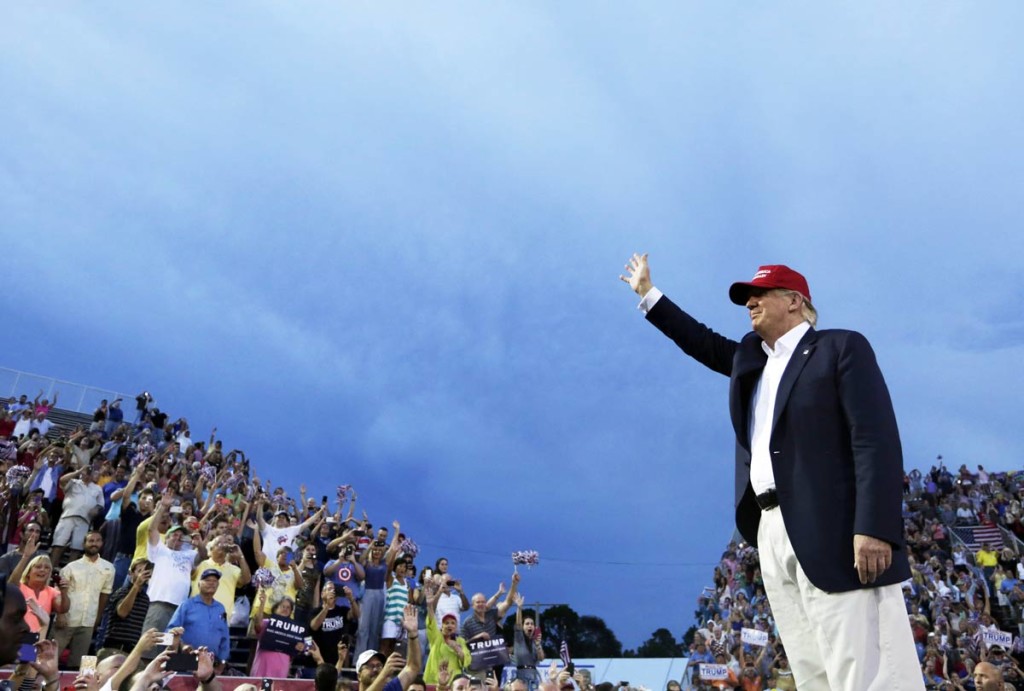
Opinion polls are one thing, but Nielsen numbers speak more loudly to television executives: Republican presidential frontrunner Donald Trump‘s ability to pull in viewers makes him catnip for news programs and wins a level of coverage that feeds on itself. NBC’s “Meet the Press” had its biggest audience in more than a year for its Trump interview on Aug. 16, leading that show’s biggest competitors — ABC’s “This Week” and CBS’ “Face the Nation” — to feature phone interviews with the New York businessman this past Sunday. After CNN turned Jake Tapper‘s interview with Trump into a prime-time special last week and earned its best ratings at that hour in a month, the network repeated it two nights later. Two Trump interviews on Sean Hannity‘s Fox News Channel show this month both brought in around 2.2 million viewers, well above his typical audience. Trump is generally considered the biggest reason why Fox reached a startling 24 million people for the first GOP presidential debate earlier this month — the most watched program in Fox News history. That instantly made him a big “get” for TV producers, and the media savvy ex-reality show host has eagerly played along. Keenly aware of his drawing power, Trump suggested in a Time magazine interview that he could ask CNN to pay $10 million to charity for his participation in the next GOP debate. “He’s getting a lot of attention that he should get because he’s doing so well in the polls and he’s getting a lot of attention because he’s Donald Trump, and you never know what he’s going to say,” said David Bohrman, a television consultant and former CNN Washington bureau chief. “It’s not negligence to cover him,” he said. Aware of that drawing power, cable news outlets cover Trump events with an intensity the other 16 Republican candidates can only envy. A town hall meeting in New Hampshire last week drew live coverage. CNN and Fox News both cast aside regular programming Friday to pick up Trump speaking at a rally in Alabama. Trump’s unpredictability is a bonus. His critical comments about Fox’s Megyn Kelly for her debate questions, made during an interview with CNN’s Don Lemon on what would normally be a sleepy August Friday night, put that show in headlines for the entire weekend. Viewership during the seven call-in interviews that Trump has given to MSNBC’s “Morning Joe” since June 18 rose 22 percent from what the talk show averaged 10 minutes prior to his call, the Nielsen company said. On July 24, the size of the audience jumped 47 percent in only a few minutes when Trump spoke. Danny Shea, editorial director of The Huffington Post, compared the attention news networks are giving to Trump to CNN’s non-stop coverage of the missing Malaysian airliner last year. He was on “Morning Joe” last week to defend HuffPo’s declaration that it would only cover Trump’s candidacy in its entertainment section, a decision that grows harder to defend with each new poll. “There’s an open secret that (Trump’s campaign) is a joke and a spectacle,” Shea said, “and by going wall-to-wall on it you’re just legitimizing it.” Morning Joe co-host, Joe Scarborough, rejected the argument that Trump had more ratings than news value. During off-the-air meetings, “nobody ever says, ‘OK, Donald Trump is great for ratings.’ What we say is, ‘what the hell is going on? Can you believe this? What is happening?’ He is a very real story, and the longer he stays in front, the more of a story he’s going to be.” In past campaigns, the media’s “invisible primary” gave bursts of early attention to candidates before voters settled things, to which Gary Hart, Howard Dean, John McCain, Jimmy Carter can attest. None matched Trump for attention, said Thomas Patterson, acting director of the Joan Shorenstein Center on the Press, Politics and Public Policy at Harvard University’s Kennedy School of Government. Only two months ago the GOP had a shapeless field of candidates, and now the non-Trumps are so starved for attention that some will struggle to survive until voting begins. Bohrman said Trump is getting a level of attention he normally doesn’t see until spring of an election year, when nominations are all but decided. “It’s kind of a ‘no time for losers’ policy in the newsroom,” Patterson said. Trump frequently mixes it up with the media, often through Twitter. Sometimes he’s playful, like suggesting that “Morning Joe” co-host Mika Brzezinski be paid more than Scarborough. Often he’s quite serious, and his reaction to Fox’s Kelly struck some who heard it as offensive. At the Alabama rally, Trump asked the audience what they thought of cable networks. Fox got cheers and MSNBC boos, making the latter network’s decision not to televise the speech live fortunate. At this point, it’s hard to tell how much attention Trump is receiving because he’s a frontrunner, and how much is because producers know he’ll provide a reliable ratings bump. “At the end, does it really matter if both are valid reasons for covering him?” Bohrman said. “There’s not a lot of other compelling stuff on television now. It’s the reality show of the season.” Republished with permission of the Associated Press.
