
Don’t shoot: University of Alabama using virtual reality, neuroscience to improve police training

University of Alabama researchers are using a novel approach to learn how police officers react to “shoot, don’t shoot” situations: measuring brain waves during virtual reality police training. For the past year, Drs. Rick Houser (counselor education), Dan Fonseca (engineering) and Ryan Cook (clinical mental health counseling) have used a mobile electroencephalogram, or EEG, amplifier to measure the brain activity of three law enforcement officers to determine which regions of the brain are active during simulations of potentially high-threat situations. Preliminary EEG findings, combined with an algorithm used to calculate the sources within the brain, show that one of the five brain waves, in this case the “beta” wave most often associated with thinking, has the highest activity in certain brain regions. “Preliminary analyses show that officers may activate more beta or thinking brain waves in the right temporal-parietal junction in making decisions associated with responding to high-threat situations,” Houser said. “The right temporal-parietal junction is associated with predicting intentions of others, consistent with a major theory in psychology – ‘Theory of Mind.’ “An officer who is able to understand the intentions of others may be more effective in making these high decisions and consequently lower the risk of shooting a community member, particularly those who are unarmed or an accidental shooting.” Finding the right words The researchers also measure the effectiveness of verbal commands used to de-escalate situations. They note the commands and the time as it relates to the EEG and rely on two seasoned officers to evaluate the responses and establish reliability. Per terms of the agreement between the researchers and the law enforcement agency, the researchers cannot reveal the identities of the officers participating in the study or the agency to which they’re attached. Data are collected at the law enforcement agency, which owns and uses the VR simulator in existing training procedures. Houser, Fonseca and Cook have additional data to analyze, but they hope to secure funding to continue the research at a larger scale, which would yield a larger sample size and eventually see them acquire the space and technology to conduct training sessions on campus. While that process unfolds, the findings can create a meaningful dialogue rooted in scientific data, Cook said. “There’s a disconnect between researchers and what happens in the real world,” Cook said. “One of the criticisms is that, too often, research doesn’t have applications, but this is the perfect example of research informing community practices, and what’s happening in the real world informing research. What more impactful way can we do that than to shape the way officers interact with members of their communities?” Studying the ‘MacGyvers’ Houser and Fonseca have collaborated on several projects, including the use of neuroscience to study the impact of low-current brain stimulation to promote students’ math performance in pre-calculus. Those studies sparked a question: How can neuroscience, understanding brain activity and identification of corresponding regions of the brain be used to help police officers and first responders in high-stress situations? “There are always officers and first-responders who will make decisions under duress that are not typical of most people – we call them ‘MacGyvers,’” Fonseca said. “We don’t know what it is or why, but how they handle that just isn’t typical of people in those fields. We want to encapsulate that knowledge in order to improve training of officers and positively affect the hiring process.” The conceptualization of focusing on officers and other first responders’ reaction to stress began roughly six months before the August 2014 high-profile shooting of an unarmed citizen – former Ferguson, Missouri police officer Darren Wilson’s shooting of Mike Brown – sparked nationwide dialogue about police training, particularly in “shoot, don’t shoot” scenarios. And as similar cases in which the use of lethal force has continued to be questioned – both in social and news media — since 2014, protocols and training curricula have been influenced by a number of methods, including virtual reality, which has seen its research applications grow as believability and pricing of hardware and software have improved. Refining the procedures The trio received an internal grant in 2015 to purchase a mobile EEG unit, which includes a spandex cap with electrodes and the receiver fitted into a backpack to record data. Officers use a 9 mm pistol, which has a recoil action and a laser in place of live rounds. The simulator tracks each shot and incorporates the exact location of the shot and its outcome. The supervising officer tracks verbal commands of trainees and can alter each encounter relative to the scenario and protocol. Researchers collect the data and also interview officers after each session, which helps them refine their research procedures. “We talk a great deal about what we learn each time – what the officer was thinking and what they saw that led to the decision they made,” Houser said. “It’s very complex, and I have a much greater appreciation and understanding for the difficulty of the job.” Ultimately, the researchers would like to see the officers enhance their ability to understand and predict the intentions of others, based on “Theory of Mind.” Additionally, researchers hope to one day stimulate the different regions of the brain that are commonly active during these encounters through transcranial direct stimulation, which they’ve used in other studies. This story originally appeared on the University of Alabama website. Republished with permission of Alabama NewsCenter.
Jeff Sessions: Ferguson emblem of tense relationship with police

Ferguson, Missouri, has become “an emblem of the tense relationship” between law enforcement and those it serves, especially minority communities, Attorney General Jeff Sessions said Friday during a visit to St. Louis. Sessions, speaking to a gathering of law enforcement leaders at the federal courthouse that sits roughly 12 miles from Ferguson, said the Justice Department will work with them to battle the rising tide of violent crime in America. He said he supports “proactive, up-close policing — when officers get out of their squad cars and interact with everyone on their beat — that builds trust, prevents violent crime, saves lives and creates a good atmosphere.” But Sessions said that sort of police work has become increasingly difficult in what he called “an age of viral videos and targeted killings of police.” “Unfortunately, in recent years law enforcement as a whole has been unfairly maligned and blamed for the crime and unacceptable deeds of a few in their ranks,” Sessions said. “Amid this intense public scrutiny and criticism, morale has gone down, while the number in their ranks killed in the line of duty has gone up.” Ferguson, he said, has become “an emblem of the tense relationship between law enforcement and the communities we serve, especially our minority communities.” Ferguson became a flashpoint after 18-year-old Michael Brown, who was black and unarmed, was killed by white officer Darren Wilson on Aug. 9, 2014. Months of often violent protests followed the shooting. A St. Louis County grand jury and the Justice Department cleared Wilson of wrongdoing in November 2014, and he resigned that same month. But the Justice Department investigation under then-Attorney General Eric Holder found significant racial profiling and bias in both Ferguson’s police department and municipal court. The city and the Justice Department settled a lawsuit last year that requires significant changes in policing. That process is ongoing. Sessions is taking a far different approach than Holder. Civil rights investigations of police were common during the Obama administration. Sessions has suggested that civil rights investigations hinder police, causing them to back off out of fear of scrutiny of their every move. In fact, some have labeled the phenomenon the “Ferguson Effect.” Ferguson Police Chief Delrish Moss, who attended the speech, said he was encouraged by Sessions’ commitment to battling violent crime. And Moss believes the Justice Department remains steadfast in working with Ferguson leaders to eliminate racial bias. “We’re working with the Department of Justice, in fact, on a weekly basis,” Moss said. “They remain as committed as they always have been to the reforms we’ve agreed upon.” President Ronald Reagan chose Sessions for a federal judgeship in the 1980s, but the nomination was rejected amid concerns about racially charged comments and his failed prosecution of three black civil rights activists on voting fraud charges. Denise Lieberman, a St. Louis lawyer with the civil rights group Advancement Project, said Sessions’ approach is concerning at a time when allegations of violence by police are at an all-time high. “We also know that the role of the Department of Justice is absolutely critical to ensuring that policing agencies are complying with the law, and they are a crucial step in bringing accountability to policing,” Lieberman said. “We see that right here in Ferguson.” Sessions told the St. Louis audience he has ordered the creation of a crime-fighting task force that brings together the leaders of the FBI, DEA, ATF and U.S. Marshals Service. He said battling the heroin and opioid epidemic is a crucial element of the fight to stem violent crime. Republished with permission of The Associated Press.
Artwork depicting Ferguson removed from Capitol display
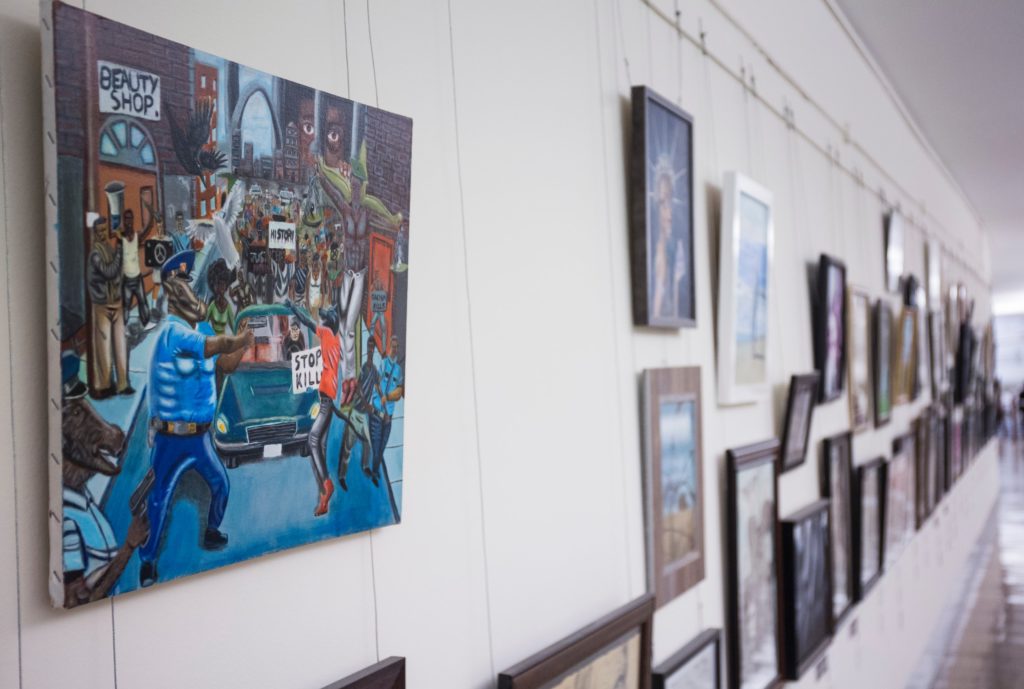
A student’s painting that divided members of Congress for its depiction of Ferguson, Missouri, has been removed from its Capitol Hill display, this time perhaps permanently. Several Republicans had complained about the painting, which shows a pig in a police uniform aiming a gun at a protester, and even took down the artwork temporarily. The lawmakers argued that the painting violated rules for a national student arts competition by showing subjects of contemporary political controversy or of a sensationalistic or gruesome nature. In August 2014, a white police officer shot and killed Michael Brown, an unarmed black teenager, in Ferguson, setting off weeks of protests. Architect of the Capitol Stephen Ayers informed lawmakers late Friday that the painting would be removed. On Tuesday, with House lawmakers back home for the week, the painting was gone. The painting was among hundreds completed by high school students that are featured in a tunnel leading to the Capitol and had been hanging for months. But some conservative media outlets called for its removal and Republican lawmakers repeatedly took it down and returned it to Rep. William Lacy Clay‘s office. Clay put it back up, saying its removal violated a constituent’s First Amendment rights to freedom of expression. That constituent, David Pulphus, co-wrote a column with Etefia Umana, published in the St. Louis Post-Dispatch that said they surely would have been arrested if they had dared to enter the Capitol and removed the statue of slavery advocate John C. Calhoun, a vice president and senator from South Carolina who served before the Civil War. Umana and Pulphus wrote that anger toward the painting was misplaced and fails to address critical issues pertinent to conditions in African-American communities. “Art imitates life, but no critic has asked the fundamental question the painting begs: Why would a young student with hope, promise and purpose perceive our community and the police in such a manner?” the pair wrote. The column concluded with: “David’s only comment is, ‘The art speaks for itself.’ It has spoken loudly. Now, who will protect American civilization, including our Constitution and democracy?” Clay called the decision arbitrary and insulting. He said the painting would have a “place of honor in my Capitol Hill office.” “This is now about something much bigger than a student’s painting. It is about defending our fundamental First Amendment freedoms which include the right to free expression; even when that creativity is considered objectionable by some, and applauded by others,” said Clay, who promised to seek a quick reversal of the decision. Ayers wrote a letter to Clay saying that he consulted with industry experts and reviewed the painting itself before determining that it didn’t comply with the House Office Building Commission’s prohibitions for the Congressional Arts Competition Rep. David Reichert, R-Wash., said the painting hung in clear defiance of rules established for the arts competition and was a slap in the face to law enforcement officers. His letter to the architect of the Capitol initiated the painting’s removal. Republished with permission of The Associated Press.
Hillary Clinton says Confederate flag has no place in US
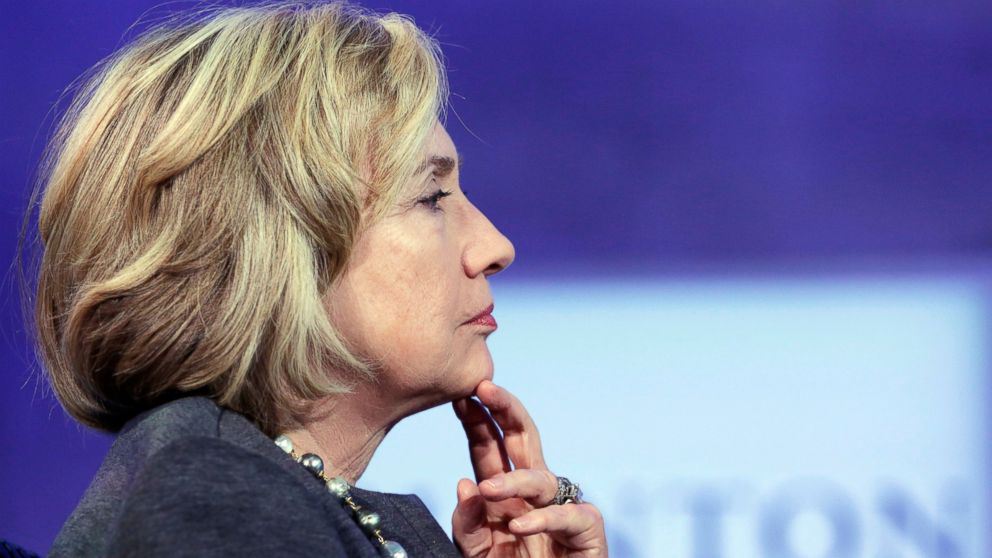
Hillary Rodham Clinton said Tuesday the Confederate battle flag should not be displayed “anywhere,” weighing in as South Carolina lawmakers seek to remove it from the grounds of their statehouse. The Democratic presidential candidate called the deadly shootings of nine black church members in Charleston, South Carolina, “an act of racist terrorism perpetrated in a house of God.” Clinton called the Confederate flag a “symbol of our nation’s racist past that has no place in our present or our future. It shouldn’t fly there. It shouldn’t fly anywhere.” Clinton joined with church members in the St. Louis suburbs, near the violent protests touched off last year in nearby Ferguson after the death of Michael Brown, an unarmed young black man who was shot by a white police officer. Clinton said she appreciated the work of South Carolina Gov. Nikki Haley, a Republican, and state lawmakers who are working to remove the Confederate flag from the statehouse grounds. She also commended Wal-Mart Stores Inc., the Arkansas-based company on whose board she once served, for announcing it would remove any product from its stores that features the Confederate flag. She encouraged other companies to follow that example while noting that Amazon, eBay and Sears have done so. Clinton has put America’s struggle with race relations at the forefront of her presidential campaign in recent weeks and urged church members here to find ways to turn their grief, anger and despair into purpose and action. The Clinton campaign said she was initially scheduled to discuss economic issues during her stop in Missouri, but after the Charleston shooting, she said she wanted to hold the event in a church and discuss race. Clinton largely avoided giving race relations a prominent place in her 2008 Democratic campaign against Barack Obama, who was vying to become the nation’s first black president at the time. Yet she’s leaned into a number of issues closely watched by African-Americans this time, discussing the need to change the criminal justice system, improve access to voting and help minority small business owners. Clinton’s campaign hopes to mobilize black voters in large numbers in the 2016 election, building upon the coalition of minority, young and liberal voters who powered Obama’s two White House campaigns. The message has taken on fresh urgency since last week’s church massacre in Charleston, South Carolina, which happened shortly after Clinton campaigned in the city. In Florissant, Clinton proposed a package of policies to promote racial equality, including tax breaks for struggling communities, help for minority and female entrepreneurs, early childhood education, “common sense” gun restrictions and universal voter registration. She told congregants that “all lives matter,” a variation of the “Black Lives Matter” slogan that arose from the Florida shooting death of black teenager Trayvon Martin. Clinton cited her background growing up in the Methodist church, recalling: “I grew up in an all-white middle-class suburb. I didn’t have a black friend, neighbor or classmate until I went to college and I am so blessed to have so many in my life since.” Pointing to the Charleston shooting, she urged attendees, “Do not be overcome with evil but overcome evil with good.” The former secretary of state was greeted by the Rev. Traci Blackmon, pastor of Christ the King United Church of Christ, which hosted the event. She told the audience that the Charleston shooting shows “we also must take this moment to not just focus who pulled the trigger that day but on the policies, the people and the structures that are pulling the trigger daily.” Republished with permission of The Associated Press.
Problems facing poor inch into 2016 presidential race
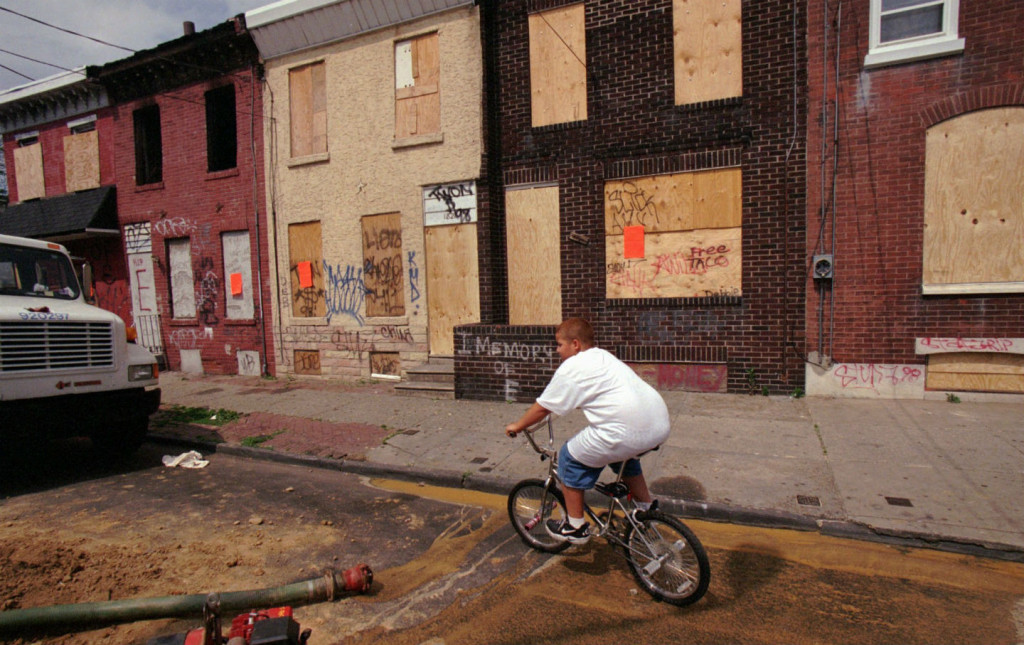
In a presidential campaign where candidates are jockeying to be champions of the middle class and asking wealthy people for money, the problems facing the poor are inching into the debate. Tensions in places such as Baltimore and Ferguson, Mo., have prompted candidates to explore the complicated relationship between poor communities and the police, and the deep-seated issues that have trapped many of the 45 million people who live in poverty in the United States. But addressing the long-running economic, education and security troubles in underprivileged neighborhoods is a challenge with few easily agreed-upon solutions. A frustrated President Barack Obama challenged the nation to do “some soul-searching” after riots in Baltimore followed the death of 25-year-old Freddie Gray in police custody. There have been other deadly altercations between police and black men or boys in Ferguson, New York’s Staten Island, Cleveland and North Charleston, S.C. “I’m under no illusion that out of this Congress we’re going to get massive investments in urban communities,” Obama said. “But if we really want to solve the problem, if our society really wanted to solve the problem, we could.” To some of the Republicans running to replace Obama, his call for spending more money in poor areas underscores the problem with many current anti-poverty programs. The GOP largely opposes new domestic spending and party officials often say federally run programs are bloated and inefficient. “At what point do you have to conclude that the top-down government poverty programs have failed?” said Jeb Bush, the former Florida governor and expected presidential candidate. “I think we need to be engaged in this debate as conservatives and say that there’s a bottom-up approach.” Republicans have struggled in recent years to overcome the perception that the party has little interest in the plight of the poor. Mitt Romney, the GOP presidential nominee in 2012, was criticized for saying he was “not concerned about the very poor” and that it was not his job to worry about the 47 percent of Americans who he said “believe that government has a responsibility to care for them.” More than 60 percent of voters who made less than $30,000 per year backed Obama over Romney in that campaign, according to exit polls. Blacks and Hispanics, who overwhelmingly backed Obama in the past two presidential elections, are most likely to be poor. According to the census, about 27 percent of blacks and 25 percent of Hispanics were poor in 2012, compared with 12.7 percent of whites. Bush has been among the most vocal Republicans discussing the need to lift the poor out of poverty and reduce income inequality, though he has yet to flesh out many of his policy proposals. He has been most specific about the need for greater educational choices and opportunities. Bush frequently cites his work in Florida, where he expanded charter schools, backed voucher programs and promoted high testing standards. Kentucky Republican Sen. Rand Paul has long called for overhauling criminal sentencing procedures that he says disproportionately imprison low-income black men. He has promoted “economic freedom zones” where taxes would be lowered in areas with high long-term unemployment in order to stimulate growth and development. Paul, who has made a point of reaching out to black communities, has drawn criticism for comments he made during the Baltimore unrest. In a radio interview, Paul said he had been on a train that went through the city and was “glad the train didn’t stop.” Sen. Marco Rubio of Florida also has talked frequently about the poor. His anti-poverty proposals include consolidating many federal programs to help the poor into a “flex fund” that states would then manage. Democrats, too, are trying to incorporate plans for tackling poverty into economic campaign messages that otherwise center on the middle class. After the Baltimore turmoil, Hillary Rodham Clinton made a plea for criminal justice changes that could aid urban communities. Among her ideas: equipping every police department with body cameras for officers. She said the unrest was a “symptom, not a cause” of what ails poor communities and she called for a broader discussion of the issues. Former Maryland Gov. Martin O’Malley, who is expected to challenge Clinton for the Democratic nomination, has been at the center of the discussions about Baltimore’s issues. He was mayor from 1999 to 2007 and enacted tough-on-crime policies. While O’Malley is not backing away from those practices, he is trying to put criminal justice issues in a larger context. He wrote in an op-ed that the problem in Baltimore and elsewhere is as much about policing and race as it has about “declining wages and the lack of opportunity in our country today.” In some places that have dealt with recent unrest, residents say they welcome the campaign discussions on poverty and policing, but hope the issues will not fade away when the next big campaign focus arises. “Hopefully these protests are something they’ll wrap themselves around, and we can make sure these issues get addressed,” said Thavy Bullis, a Baltimore college student. Republished with permission of The Associated Press. Photo Credit: Wiki Commons
Hillary Clinton: Baltimore shows justice system “out of balance”
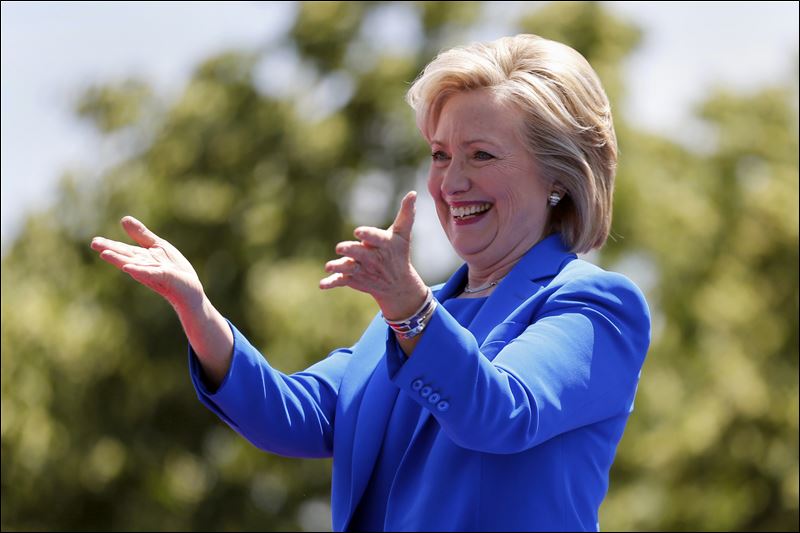
Pointing to a wave of violence in Baltimore, Hillary Rodham Clinton said Wednesday that the nation’s criminal justice system has gotten “out of balance” and must be restored through steps such as the use of body cameras by every police department in the country. “It’s time to change our approach,” Clinton said in her first major policy address since launching her presidential campaign earlier this month. “It’s time to end the era of mass incarceration.” Clinton spoke in the days after violence and protests have swept through the streets of Baltimore since the death of Freddie Gray, a 25-year-old black man who received a spinal-cord injury while in police custody. Clinton condemned those instigating further violence, saying it disrespected the Gray family and only compounded the tragedy. “The violence has to stop,” she said. In a speech at Columbia University, Clinton spoke of protests over policing in Ferguson, Mo.; Charleston, S.C.; and in New York, and repudiated policies dating to her husband Bill‘s presidency that lengthened prison terms while putting more officers on the streets. “We need a true national debate about how to reduce our prison population,” she said. “We don’t want to create another incarceration generation.” She voiced support for alternative punishments for lower-level offenders. She said criminal justice reform had found some bipartisan consensus in Congress, noting the work of Kentucky Sen. Rand Paul, a Republican seeking his party’s presidential nomination, along with that of New Jersey Sen. Cory Booker, a Democrat. “It is rare to see Democrats and Republicans agree on anything today but we’re beginning to agree on this,” she said. “We need to restore balance to our criminal justice system. Of course it is not enough just to agree … we actually have to work together to get the job done. We have to deliver real reforms that can be felt on our streets.” In December, President Barack Obama asked Congress for $263 million for police body cameras and additional law enforcement training. The request came after Obama held a series of meetings with law enforcement officials, Cabinet members and civil rights leaders following the death of 18-year-old Michael Brown in Ferguson. The president’s proposal would have allocated $75 million over three years to help states purchase body cameras. The money would have paid for about 50,000 devices, though Congress never acted on the president’s request. In her remarks at Columbia, Clinton also cited the unfairness of black men being more likely to be stopped and searched by police officers, charged with crimes and sentenced to longer prison terms. Clinton spoke at the David N. Dinkins Leadership and Public Policy Forum, named after the former New York mayor. Republished with permission from The Associated Press.
Steve Kurlander: There’s no constitutional right to riot
By Steven Kurlander Another African-American young adult confronts police, another death results, another riot ensues. Another Ferguson. Cries of police brutality once again seek to justify unmitigated rioting and to justify not allowing riot police to prevent destruction and restore law and order by necessary force. This time, it was Baltimore. It’s becoming business as usual in 21st century America. 2015 meets 1967. In this era, it’s playing live on social media and television, with CNN and MSNBC “reporters” pontificating at the scene about the social causes of the violence. Reporters stood there justifying the violence, actually encouraging it, instead of just reporting in a neutral journalistic manner. They gave front stage to idiotic thugs as they cut fire hoses being used by beleaguered firemen to fight mob-set fires, all in front of millions of Americans. Once again, the violence went unabated, and Americans, numb from the significance of the violence taking place across their country, watched awhile, then turned their attention to The Voice, a baseball game or Bruce TransJenner reality shows. In the era of Obamaesque political correctness, the lessons that should be learned from Ferguson, Staten Island and now Baltimore are lost. We should be reevaluating the September 11 justification for the militarization of our local police as both social and constitutional issues. Instead, it’s become just another act in the Theater of the American Absurd in our 24-7 cycle, just as much as Jenner’s sex change has become the obsession of the American people. Baltimore Mayor Stephanie Rawlings-Blake set the stage for violence in her city when, in describing police restraint in the face of weekend demonstrations over the death of Freddie Gray, she told a news conference, “We also gave those who wish to destroy space to do that as well.” What an idiot. She basically told Baltimore it’s OK to riot, to attack the police with bricks, to burn their neighborhoods, all in the name of protesting police brutality and their terrible way of life in their city’s festering slums. Instead of saying that violence will not be tolerated, Rawlings-Blake enunciated a new, politically correct tolerance for the destruction of private property as a new, politically correct First Amendment right to protest. So neighborhoods in Baltimore erupted into unchallenged violence Monday night. Looters, gang members, and those who came from out of the city to destroy Baltimore neighborhoods got the green light to “burn baby burn.” Rioters, particularly high school students, took a page from the Arab Spring in using social media to rally protesters to a mall to begin a “protest” for a peaceful march over Gray’s death that quickly turned into an assault on police and looting in the streets. To justify the unlawfulness, youthful organizers of a protest on Monday purposely emulated The Purge, a film centered on lawlessness in the future. As much as the Arab Spring has turned a number of Arab countries into swaths of anarchy and destruction, America now stands on the precipice of similar anarchy in its inner city ghettos. Much as Jenner has turned into a woman, America is turning into a tolerated state of anarchy. The lesson of Baltimore should be that Americans need to wake up in front of their tablets and televisions and notice how the misuse of words and arguments in Baltimore, and Ferguson too, leads to violent behavior that must be questioned and not tolerated. Never should there be a right to riot, or a tolerance of it on any city street. Steven Kurlander blogs at Kurly’s Kommentary (stevenkurlander.com) and writes for Context Florida and The Huffington Post and can be found on Twitter @Kurlykomments. He lives in Monticello, N.Y. Column courtesy of Context Florida.
Conservatives enraged by NYT Selma photo “cropping” George W. Bush
Once again, the New York Times “liberal bias” has raised the ire of conservatives. For the 50th anniversary of the march on Selma, Alabama, the front page of the Times ran a photo of President Barack Obama, his family, and a group of civil rights leaders at the Edmund Pettus Bridge. Cropped from the photo, but only slightly on the right, are former President George W. Bush and his wife, Laura. Much of the accompanying story was on the shooting death of Michael Brown in Ferguson, Missouri, even as local and federal investigators found the incident was not racially motivated and would not bring charges. Conservatives noted that the picture – curiously enough – failed to show the full front line of marchers, leaving the Bushes noticeably absent. While mentioning Ferguson and Brown 8 and 3 times respectively, the March 7 Times piece by Peter Baker and Richard Fausset only mentions the 43rd President in passing: “Joining Mr. Obama on Saturday was former President George W. Bush, who signed the reauthorization of the Voting Rights Act in 2006, as well as more than 100 members of Congress … While sitting onstage, Mr. Bush made no remarks but rose to his feet to applaud Mr. Obama, and the two men hugged afterward.” Among those criticizing the photo were Republican National Committee Communications Director Sean Spicer, who wrote on Twitter: “Suprise, suprise: @nytimes Crops Out George W. Bush From Their #Selma50 Front Page Picture” Fox News also pointed out that the official White House photograph cropped Bush while prominently featuring Obama and his family. However, they noted the caption did mention the Bushes were there. Michele McNally, Times photo editor, told the newspaper’s public editor, Margaret Sullivan, there was “no cropping.” “This was the photo as we received it,” McNally said. Photographer Doug Mills, who took the shot, explained in an email to the Times that Bush was in “bright” sunlight. “I did not even send this frame because it’s very wide and super busy and Bush is super-overexposed because he was in the sun and Obama and the others are in the shade,” reported the Hill . Suprise, suprise: @nytimes Crops Out George W. Bush From Their #Selma50 Front Page Picture via @trscoop https://t.co/WDE3FW08SX — Sean Spicer (@seanspicer) March 8, 2015
Regardless of race, we should be talking about Ferguson: opinion
I’m a young, white, Catholic, politically conservative woman. I am active in the Tea Party. I am active in our community. I am 100 percent against police violence and brutality. I’m against racial discrimination and offensive and ill-informed stereotypes. Trust me, I’ve seen my share of hate and ignorance for embracing the Tea Party label. When Michael Brown was initially killed and unrest broke out in Ferguson, Missouri, I found friends posting a blog on XOJane titled “I Don’t Know How to Talk to White People About Ferguson,” on social media. I read it several times as I tried to process the author’s problem as she posed it. “How do I talk to white people about this!? How can I possibly explain the rage, fear, sadness, and every other emotion I don’t have a name for yet as I watch these events unfold?” My answer is simply that you discuss it honestly and openly and without the preconceived idea that I can’t understand. I don’t know a person, regardless of race, who hasn’t felt the emotions named above. I don’t know a person watching the events in Ferguson unfold who doesn’t want the truth to come out or for the community to find peace. Right now, as the community around Ferguson is on high alert bracing for the grand jury’s decision on charging the officer involved, my Facebook timeline is full of strong opinions on what should happen. There are national stories discussing the fear of continuing civil unrest and the threat of violence should the jury not move towards an indictment. It seems to me that we should take this window of time to talk to one another openly and honestly about not just this case but about the racial difference that still exist. The differences that become more apparent in times of crisis such as this but exist on a day-to-day basis between times of crisis. While I respect our nations legal system I believe with all my heart that George Zimmerman should be spending his life in jail for the senseless and tragic death of Trayvon Martin. That could have been my little brother in the hoodie I bought him for Christmas years ago walking home that night. He’s not black but he’s young, covered in tattoos and full of attitude. I dare not think of how he would have responded to Zimmerman following him along those dark streets just hours from where we grew up. Several months ago a young toddler was badly injured when police SWAT teams threw a flash grenade into the playpen he was sleeping in. You’ll note I said toddler, not white toddler. The reason – race is irrelevant. They police were wrong! A child was injured. I was then and still remain angry. I am hurt for his family. I am hurt for what lies ahead in his recovery. I am no more or less angry for this child or his family because of the color of his skin. I can’t imagine that a black mother would hear about this case and feel any different than I do right now. Several years ago it was determined that law enforcement officers working for Sheriff Joe Arpio in Phoenix mishandled dozens of sexual assault cases. I read the reports and was disappointed and outraged. The women were disproportionately Hispanic and it was theorized that the distrust of law enforcement played into the ability of officers to shelve the cases and botch investigations. The only way we can address these problems is to see them through the perspective we are given and hope that while our starting point may be different we come to the same conclusions. Justice, fairness and compassion are color blind. Most law enforcement officers are honest and caring people. Those who seek out these jobs typically do so because they want to uphold the law not make a mockery of it. That said, the increased use of force within some local law enforcement agencies is worth a discussion nationally. That conversation needs to occur regardless of racial lines. How do you start a dialogue with a white person on racial issues? By coming at it openly and honestly, putting aside the idea that we/”they” can’t understand. My life experiences are different than those of a black woman but I have no doubt we can learn from one another. Race can be among the starting points that drive our experiences but it is not the whole of who we are. Let’s come to some solutions with an honest discussion, not just jump to conclusions and skip the hard part. Apryl Marie Fogel is a new Alabama resident who works as a conservative political activist. This column originally appeared on AL.com.
