
Robert Bentley resignation shows voters are only willing to put up with so much
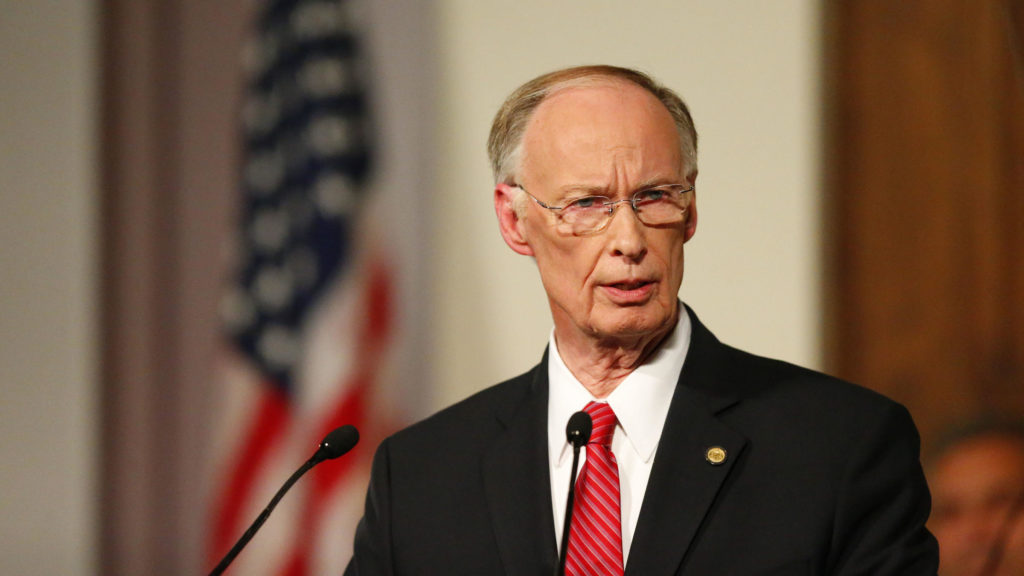
Alabama Gov. Robert Bentley’s resignation shows that even in a single-party environment, voters are only willing to put up with so much said Harry Enten of FiveThirtyEight.com. “Bentley is a Republican, and Alabama’s state legislature and electorate are both overwhelmingly Republican,” Enten wrote. “In these uber-partisan times, it can seem like Democrats always back Democrats and Republicans always back Republicans. That didn’t happen in Alabama.” Bentley resigned as part of a deal that saw him plead guilty to two misdemeanor campaign violations, agree to perform 100 hours of community service and to never hold public office again. The charges stemmed from his alleged use of his office and campaign funds to cover up an extramarital affair. New Gov. Kay Ivey was sworn into office just hours after the plea deal went public. Enten’s article points to a Cooperative Congressional Election Study from last year that showed the two-term Republican governor had the lowest approval ratings from voters in his own party of any governor in the country. That survey found 54 percent of Alabama GOP voters disapproved of the job Bentley was doing, while just 42 percent approved. Yes, Bentley was more disliked among party faithful than New Jersey Gov. Chris Christie, who is going through a spell of historically low popularity after some scandals of his own. He managed a plus-six rating among GOP voters. In fact, Bentley’s net-negative rating was unique among sitting governors, with the next-closest, Gov. Mary Fallin of Oklahoma, posting a plus-five rating among Republican voters in that state. “Partisanship goes a long ways these days. But there are limits,” Enten wrote.
Joe Henderson: Assault on polling begins in ShameFest 2016

As we approach the home stretch of ShameFest 2016 — otherwise known as the election — we should take a moment to ponder one of the great moments the last time the nation chose a president. It was election night in 2012 and Fox News, accurately as it turned out, declared President Barack Obama had won Ohio and, thus, a second term as commander in chief. But GOP operative Karl Rove didn’t agree. He argued live on camera that his own network was wrong. He argued that his numbers told a different story, and that Mitt Romney would win. So anchor Megyn Kelly was dispatched to the Fox number-crunching room, where the people charged with making that call patiently explained why they were 99.5 percent correct on their projection. When Rove persisted, saying his calculations told a different story, Kelly asked, “Is that math you do as a Republican to make yourself feel better?” It was the runaway best quote of the election season. We are seeing an assault on polling again, particularly by the Donald Trump camp. At every rally, he tells the faithful that the polls are wrong and it always gets big cheers. I’ll admit this morning I did a double-take Friday morning when Rasmussen Polling showed Trump with a 43-41 percent lead nationally. Where in the world did that come from, especially when even News shows Hillary Clinton with a 7-point advantage? There are too many polls for the average voter (or, I hate to admit, the average journalist) to keep up with. And since polls show only a snapshot of the moment, no one can say with certainty who will or won’t win until all the votes are counted. So it’s really a case of which ones you trust most. I tend to believe Nate Silver’s fivethirtyeight.com site is on the mark way more often than not. In case you’re curious, his site has a section devoted to grading the accuracy of all the polls. The ranking is based on several criteria, including the percentage of races it has called correctly. He has the Monmouth University poll at the top of a lengthy list of polls. It was one of six polls, including the ABC/Washington Post poll, to get an A-plus rating. For what it’s worth, he gives the Rasmussen poll a C-plus. Silver’s own forecast has Hillary Clinton with an 84.4 percent chance of winning the election. He gives her a 72 percent chance of winning Florida’s 29 electoral votes. Remember, though, that’s just a snapshot. The site advises it will be updating its forecasts every time new data is available until the election, because things do change. In the end, though, numbers never lie even when politicians do. ___ Joe Henderson has had a 45-year career in newspapers, including the last nearly 42 years at The Tampa Tribune. He covered a large variety of things, primarily in sports but also including hard news. The two intertwined in the decade-long search to bring Major League Baseball to the area. Henderson was also City Hall reporter for two years and covered all sides of the sales tax issue that ultimately led to the construction of Raymond James Stadium. He served as a full-time sports columnist for about 10 years before moving to the metro news columnist for the last 4 ½ years. Henderson has numerous local, state and national writing awards. He has been married to his wife, Elaine, for nearly 35 years and has two grown sons – Ben and Patrick.
Ben Pollara: Donald Trump, Bernie Sanders and fuzzy math

I am not a big fan of sports metaphors or former Defense Secretary Donald Rumsfeld, but both can be used to demonstrate the inanity and intellectual dishonesty driving the cries of unfairness coming out of the campaigns of Donald Trump and Bernie Sanders. Both are pushing similar messages about their respective parties’ nominating and delegate allocation processes, and those messages are either dishonest or demonstrate ignorance of said processes. Or both, I suppose. So to use the sports metaphor, what would be the public response to a losing basketball team complaining that certain shots are worth three points, while others are worth only one or two? That is essentially what the Sanders and Trump camps are saying about the “unfairness” they perceive in the delegate acquisition game. And it’s a game they both signed up for, ostensibly with some, if not intricate, knowledge of the rules. Well, sorry gentlemen. To quote Rummy, “you go to war with the army you have, not the army you want.” As a Democrat, I should apologize for lumping Sanders in with The Donald. I’m sorry, Bern. Actually, Trump’s case is in some ways more rational than Sanders’. Trump is likely to enter the Republican convention with a clear plurality of his party’s delegates, but perhaps not the majority required to secure the nomination on the first ballot. He will likewise enter the convention with a substantial lead in actual votes. Sanders is virtually certain to have neither. I recently wrote for FloridaPolitics.com inveighing upon the Republican Party to respect Trump’s advantages going into Cleveland and give him the nomination. My case was a political one, and I still believe it. However, the party’s rules are quite clear and have been so since well before Trump entered the primary. The Sanders case is considerably more head-scratching. Yes, he has won a near-sweep of the most recent round of primary and caucus states, but so what? According to an analysis by fivethirtyeight.com from April 8, he has won only 42 percent of Democrats’ raw votes, nearly 2 million fewer primary votes than Hillary Clinton. Yet, his supporters continue to decry the “undemocratic” process by which their party chooses its nominee. Oh, and speaking of undemocratic, Sanders has received roughly 46 percent of pledged delegates, 4 percent higher than his actual share of the vote. But the Bern Bros aren’t bitching about “earned” delegates, where Clinton is dominating. The gripes are about “super delegates,” who Clinton dominates even more thoroughly. I happen to “feel the Bern” here and believe that media outlets should stop including “super delegates” in their delegate counts. When you remove those “Super Delegates,” you remove the illusory notion that Clinton’s lead is built on the backs of party insiders versus the reality of the lead she has earned through actual votes. It’s a lead that looks much smaller, but is in reality essentially insurmountable. Clinton’s earned delegate lead has been consistently north of 200. In 2008, with a popular vote count that Clinton arguably won by a narrow margin, Barack Obama’s earned delegate margin never exceeded much more than 100. I understand the need to occasionally litigate issues in public opinion that you simply cannot win on the facts and the law, but both of these instances seem particularly ripe with hypocrisy and sour grapes. Trump, on the one hand, has benefited significantly from the complex delegate-allocation scheme that he has decried of late. His substantial lead is built largely on “winner take all” states such as Florida and others that have allocated proportionately in such a way that he has captured all or nearly all of a state’s delegates while receiving only a plurality of the raw vote. On the other hand, Sanders has cried foul on the undemocratic nature of the “superdelegate” system, while he has dominated the arguably undemocratic caucus system — the exceptions, of course, being Iowa and Nevada. In Nevada, however, despite losing the state to Clinton by five points, it appears possible that Sanders may ultimately get more delegates because of his dominance in the state party’s multi-step delegate nomination and allocation process. Huh. I understand that facts and logic don’t dictate the rules of political engagement. To quote the rapper El-P, “I might have been born yesterday, sir; but I’ve been up all night.” I’m fond of saying that hypocrisy and hyperbole are the salt and pepper of the kitchen of political campaigning. All that having been said, Trump and Sanders are still full of crap when it comes to their delegate-related complaints. You go to war with the army you have, not the army you want. *** Ben Pollara is a political consultant and a founding partner of LSN Partners, a Miami Beach-based government and public affairs firm. He runs United for Care, the Florida medical marijuana campaign and is a self-described “hyper-partisan” Democrat.
