
J. Pepper Bryars: Alabama should wait and watch before considering Medicaid

If only Alabama’s leaders had a magical Medicaid “Choose Your Own Adventure” book, so they could flip ahead and see the different outcomes we could expect by expanding the government insurance program that was originally designed for the poor and disabled. Would it end in a stronger economy, more jobs and a vibrant system of rural hospitals? “Medicaid expansion remains an economic development opportunity without equal,” said David Becker, an economics professor at UAB, in an Al.com article. Or would it bankrupt our already cash-strapped state budget and further sink our country into unsustainable levels of national debt? “When you expand Medicaid, the administrative costs and the cost of expansion will eventually swamp the state,” warned U.S. Rep. Gary Palmer, Republican-Hoover, during an interview on the Matt & Aunie Show on Talk 99.5 FM in Birmingham. “It has in other states. Illinois is about to go bankrupt.” Each side makes a strong case, but the truth seems hidden behind a fog of experts, statistics and forecasts that confuse more than clarify. The Economic Impact A UAB study conducted by Becker and paid for by the Alabama Hospital Association found that even when Alabama starts paying 10 percent of the expansion’s costs, the move would create thousands of new jobs and generate $2.7 billion a year in economic activity. Becker wrote that the expense would be “almost entirely offset” by new tax revenue and state spending reductions on current Medicaid enrollees and other health programs. And another study funded by the same association concluded that “state savings and other economic gains from expansion could be reinvested in the health care system in Alabama, including to support expansion and other state priorities.” But critics say those predictions are extremely unrealistic and point to how widely off the mark such estimates have been elsewhere. States that expanded Medicaid have signed up more than twice as many “able-bodied adults” than expected and per-person costs have exceeded original estimates by a whopping 76 percent, according to a 2018 report by the Foundation for Government Accountability. This led to cost overruns of 157 percent, the report showed, with Medicaid now accounting for one of every three state budget dollars. Many expect the same overruns in Alabama, which would exacerbate our already challenging budget. “We will have to find $250 million more in the state general fund every year, even when revenues decline in recessions,” said Daniel Sutter, an economics professor and director of the Manuel H. Johnson Center for Political Economy at Troy University, in an email. “Alabama’s perennial budget crisis is due largely to having to pay for Medicaid every year. Medicaid expansion makes this pressure worse.” Hospital Closures Supporters of Medicaid expansion most often mention that 12 Alabama hospitals have closed this decade, with many being in rural areas possibly leaving residents without critical care nearby. Expanding the program, they contend, may have saved those hospitals, and could still save many that are at risk. “Those are critical dollars for us as our hospitals currently spend more than $500 million each year in care for which they receive no reimbursement,” said Owen Bailey, chairman of the board of the Alabama Hospital Association and CEO of USA Health, in a press release. “Providing insurance through Medicaid expansion is vital to maintain access to care for everyone.” While an influx of Medicaid cash would help these hospitals in the short term, it’s unclear if it solves the underlying problems that created their instability in the first place. Hospitals are losing money and closing for a variety of reasons, according to The New York Times — shrinking rural populations, hospital mergers, consolidated services, regulatory burdens, low reimbursement rates, and a decrease in hospital care due to outpatient services and speedier care that requires less hospital time. Officials at one Kansas hospital that closed in 2015 told The Times that additional Medicaid funds would have been significant but probably would not have helped them survive in the long run. Meanwhile, help could come from elsewhere. The federal agency that oversees Medicare recently announced that its “tweaking” the formula used to reimburse hospitals in Alabama, a move that AL.com noted could increase payments to rural hospitals. A way forward When economists are arguing vastly different forecasts and outcomes, it’s often helpful to fall back to a few simple yet immutable conservative principles. Chief among them is the principle of prudence, which basically says we shouldn’t rush big decisions – decisions that have long-term consequences and that cannot easily be reversed, if at all. Medicaid expansion is clearly one of those decisions. And even without that magical Medicaid “Choose Your Own Adventure” book, there have already been unexpected plot twists, and clear deathtraps, for other states who decided to expand the program. Alabama should wait and watch to see if the promises, or the fears, are realized. We should also patiently observe states taking alternate storylines through Medicaid waivers, partial Medicaid expansion requests, and block grant plans. Otherwise, if Alabama takes the bait and expands Medicaid, we might turn the final page only to see that ominous yet sadly predictable word. Bankrupt. J. Pepper Bryars is a senior fellow at the Alabama Policy Institute. Follow him on Twitter at @jpepperbryars.
Phil Kerpen: Farm bill should reform more than food stamps

Republicans are set to move landmark welfare reform in this year’s farm bill, which includes language requiring able-bodied adults to work or participate in a job training program to be eligible for food stamps. Democrats in Congress, however, have decided to litmus test opposition to work requirements and have therefore walked away en masse from supporting the usually bipartisan farm bill. That gives conservatives leverage to push for free-market reforms to the other 20 percent of the bill – and they should. The food stamp program accounts for about 80 percent of the cost of the farm bill, and work requirements are overwhelmingly popular with the public. They enjoy a robust 82 percent approval among all voters and are supported by even 71 percent of Democrats according to a recent poll commissioned by the Foundation for Government Accountability. If the farm bill accomplished nothing else, it would be worth supporting for this popular, critical reform that would incentivize Americans to reenter the workforce and get back on the ladder of economic opportunity – while helping grow an economy that is being held back by chronic shortages of workers in many industries. But a farm bill that reforms the food stamp program while reauthorizing farm welfare programs without reforms – and in some cases even with expansions – is an unnecessary political gift to Democrats, who can spin their opposition to sensible work requirements by accusing Republicans of hypocrisy. The bill loosens the loophole that allows non-farmers to collect agricultural subsidies of up to $125,000 per year. Current law allows immediate family members of farmers to collect even if they don’t live on the farm – the proposed farm bill expands the definition to include urban-dwelling cousins, nieces, and nephews. And they aren’t required to work to collect the money. And commodity support programs are available for couples making up to $1.8 million per year – hardly the needy – rather than following the much more sensible proposal in President Trump’s budget to cap eligibility at $500,000. The bill also reauthorizes the Soviet-style sugar program, which the great anti-cronyism writer Tim Carney has accurately identified as a test of whether Republicans “understand the distinction between pro-business and pro-market.” The sugar program is a hidden tax of $2.4 to $4 billion per year according to an analysis by the American Enterprise Institute – and it pushes candy companies to move to Mexico so they can buy sugar at the much lower world price. Census Bureau estimates show the sugar program has destroyed about 123,000 American jobs. But it continues because the sugar industry is politically powerful, especially in the key state of Florida. There might be enough votes in the House to reform the sugar program, but we won’t find out unless leadership allows a vote. Ultimately, conservatives may find it impossible to resist voting for a bill with a key policy reform (work requirements) applied to the single program (food stamps) that accounts for 80 percent of farm bill spending. But if they can use the leverage gained from Democrats walking away from the table to force reforms on the farm side of the bill they will achieve an even bigger victory while saving leadership from an obvious political vulnerability created by the current bill. ### Philip Kerpen is an American free-market policy analyst and political organizer, president of American Commitment, a conservative organization he founded in 2012.
Gary Palmer receives FGA award for health care reform efforts
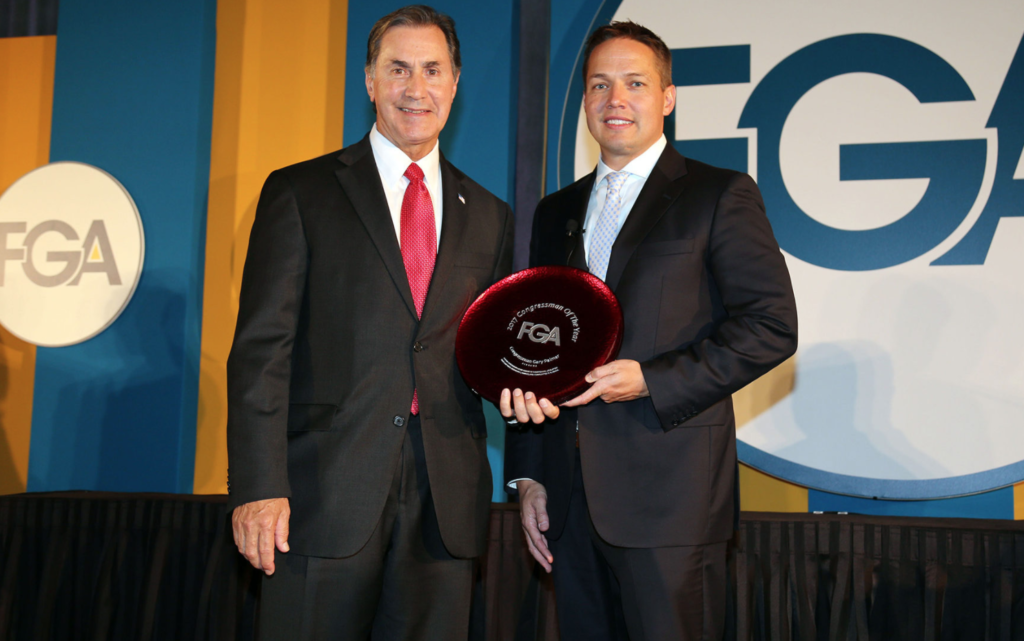
Alabama 7th District U.S. Rep. Gary Palmer was honored with the Foundation for Government Accountability’s (FGA) 2017 Congressman of the Year Award for his commitment to reversing the devastating impact of Obamacare. “ObamaCare has devastated Americans who are no longer able to afford skyrocketing premiums and has left state budgets crippled under its weight. Congressman Palmer’s dedication to relieving the pressure of Obamacare on people across the nation with the inclusion of an invisible risk-sharing program should be applauded,” said Tarren Bragdon, CEO and President of FGA. The award recognized Palmer’s diligent work in repealing and replacing Obamacare, particularly his role in drafting the Palmer-Schweikert Amendment to the GOP’s American Health Care Act (AHCA). The Palmer-Schweikert Amendment, which would have created a federal invisible-risk sharing program, was crafted in order to provide relief for Americans struggling with the unsustainable cost of Obamacare. A federal invisible risk-sharing program would result in lower premiums, coverage for those with pre-existing coverage, and fewer uninsured Americans. Bragdon continued, “Congressman Palmer worked tirelessly to develop a solution that would help stabilize state budgets, lower costs for individuals across the country, and protect the truly needy. I am honored to award Congressman Palmer with FGA’s 2017 Congressman of the Year Award for his diligence and hard-work.” Palmer said he’s honored to receive the award. “It is an honor to receive this award from the Foundation for Government Accountability,” said Palmer. “FGA was indispensable in developing the amendment that I introduced on invisible risk sharing. This innovative approach would have driven down the cost of health insurance premiums and helped ensure that those with pre-existing conditions had access to affordable coverage. FGA is a tremendous asset and I look forward to more opportunities to work together to find solutions for major issues”
