
Joe Biden to release 15M barrels from oil reserve, more possible

President Joe Biden will announce the release of 15 million barrels of oil from the U.S. strategic reserve Wednesday as part of a response to recent production cuts announced by OPEC+ nations, and he will say more oil sales are possible this winter, as his administration rushes to be seen as pulling out all the stops ahead of next month’s midterm elections. Biden will deliver remarks Wednesday to announce the drawdown from the strategic reserve, senior administration officials said Tuesday on the condition of anonymity to outline Biden’s plans. It completes the release of 180 million barrels authorized by Biden in March that was initially supposed to occur over six months. That has sent the strategic reserve to its lowest level since 1984 in what the administration called a “bridge” until domestic production could be increased. The reserve now contains roughly 400 million barrels of oil. Biden will also open the door to additional releases this winter in an effort to keep prices down. But administration officials would not detail how much the president would be willing to tap, nor how much they want domestic and production to increase by in order to end the drawdown. Biden will also say that the U.S. government will restock the strategic reserve when oil prices are at or lower than $67 to $72 a barrel, an offer that administration officials argue will increase domestic production by guaranteeing a baseline level of demand. Yet the president is also expected to renew his criticism of the profits reaped by oil companies — repeating a bet made this summer that public condemnation would matter more to these companies than shareholders’ focus on returns. It marks the continuation of an about-face by Biden, who has tried to move the U.S. past fossil fuels to identify additional sources of energy to satisfy U.S. and global supply as a result of disruptions from Russia’s invasion of Ukraine and production cuts announced by the Saudi Arabia-led oil cartel. The prospective loss of 2 million barrels a day — 2% of global supply — has had the White House saying Saudi Arabia sided with Russian President Vladimir Putin and pledging there will be consequences for supply cuts that could prop up energy prices. The 15 million-barrel release would not cover even one full day’s use of oil in the U.S., according to the Energy Information Administration. The administration could make a decision on future releases a month from now, as it requires a month and a half for the government to notify would-be buyers. Biden still faces political headwinds because of gas prices. AAA reports that gas is averaging $3.87 a gallon. That’s down slightly over the past week, but it’s up from a month ago. The recent increase at prices stalled the momentum that the president and his fellow Democrats had been seeing in the polls ahead of the November elections. An analysis Monday by ClearView Energy Partners, an independent energy research firm based in Washington, suggested that two states that could decide control of the evenly split Senate — Nevada and Pennsylvania — are sensitive to energy prices. The analysis noted that gas prices over the past month rose above the national average in 18 states, which are home to 29 potentially “at risk” House seats. Even if voters want cheaper gasoline, expected gains in supply are not materializing because of a weaker global economy. The U.S. government last week revised downward its forecasts, saying that domestic firms would produce 270,000 fewer barrels a day in 2023 than was forecast in September. Global production would be 600,000 barrels a day lower than forecast in September. The hard math for Biden is that oil production has yet to return to its pre-pandemic level of roughly 13 million barrels a day. It’s about a million barrels a day shy of that level. The oil industry would like the administration to open up more federal lands for drilling, approve pipeline construction and reverse its recent changes to raise corporate taxes. The administration counters that the oil industry is sitting on thousands of unused federal leases and says new permits would take years to produce oil with no impact on current gas prices. Environmental groups, meanwhile, have asked Biden to keep a campaign promise to block new drilling on federal lands. Biden has resisted the policies favored by U.S. oil producers. Instead, he’s sought to reduce prices by releasing oil from the U.S. reserve, shaming oil companies for their profits, and calling on greater production from countries in OPEC+ that have different geopolitical interests, said Frank Macchiarola, senior vice president of policy, economics, and regulatory affairs at the American Petroleum Institute. “If they continue to offer the same old so-called solutions, they’ll continue to get the same old results,” Macchiarola said. Because fossil fuels lead to carbon emissions, Biden has sought to move away from them entirely with a commitment to zero emissions by 2050. When discussing that commitment nearly a year ago after the G-20 leading rich and developing nations met in Rome, the president said he still wanted to also lower gas prices because at “$3.35 a gallon, it has profound impact on working-class families just to get back and forth to work.” Since Biden spoke of the pain of gas at $3.35 a gallon and his hopes to reduce costs, the price has on balance risen another 15.5%. Republished with the permission of The Associated Press.
Joe Biden considers gas tax holiday amid nearly $5 national average
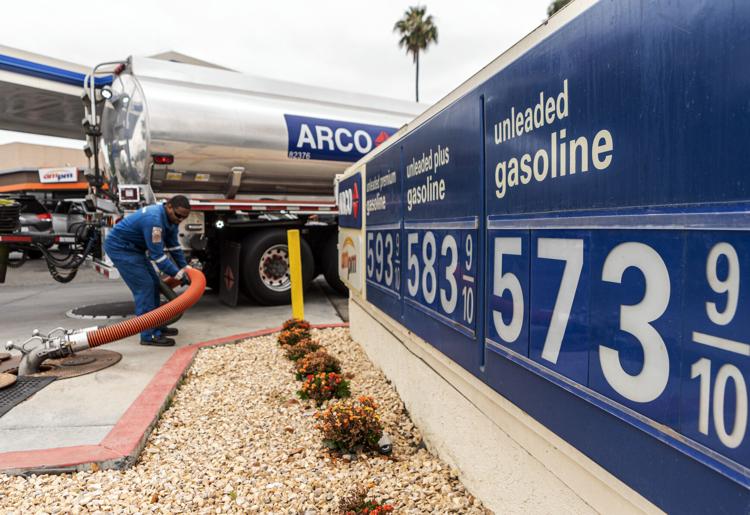
President Joe Biden said Monday he would decide on a potential gas tax holiday by the end of the week. Biden’s comments come after U.S. Treasury Secretary Janet Yellen made similar remarks during an interview with CNN’s “State of the Union” on Sunday. “That’s an idea that’s certainly worth considering,” Yellen said, referring to the gas tax holiday. Biden was asked about the holiday Monday when he told reporters about his coming decision. The federal gas tax is 18.4 cents per gallon. The president’s pledge comes after a string of record-breaking gas price benchmarks earlier this month with regular unleaded gas surpassing $5 per gallon nationwide. Regular gas took a slight dip to a national average of $4.98 per gallon Monday, according to AAA. Diesel is at a national average of $5.82 per gallon after hitting a record high again over the weekend. Some states have suspended their respective gas taxes because of the high prices, but those decisions raise additional problems since the levies are a key source of funding for infrastructure improvements. Critics have said the holiday will not address the root causes of the gas price hike, which they say is largely attributable to Biden’s restrictions on pipeline development and drilling. “Gasoline has more than doubled since Day 1 of the Biden presidency – from under $2.40 a gallon to more than $5 per gallon,” said Joel Griffith, an economic expert at the Heritage Foundation. “The president’s war on fossil fuels – including killing the Keystone XL oil pipeline, placing millions of acres of federal land off-limits to exploration, and regulatory hurdles blocking new pipelines and refineries – promises to suppress supply of abundant, affordable fuels for decades to come.” Griffith said the move would “allay just 1/10th of the surge in gas prices.” “Instead of borrowing $52 billion to mask a small fraction of this pain, the president should halt his war on energy and expand supply by unleashing American energy producers,” he said. “The massive federal spending financed by money printing at the federal reserve is causing prices in other sectors to soar as well, costing the typical American family more than $2,500 annually. It’s time for Biden to acknowledge the pain his policies are causing. A gas tax holiday does nothing to address this reality.” Other critics called it a short-term fix. “While policymakers seem to recognize the impact of rising energy costs on American families, some continue to turn to short-term fixes that aren’t likely to provide lasting relief for consumers,” said Frank Macchiarola, senior vice president of policy, economics, and regulatory affairs at the American Petroleum Institute. “The best way to ensure Americans have access to the affordable and reliable energy they need is to promote policies that incentivize U.S. production and send a clear message that America is open for energy investment.” Republished with the permission of The Center Square.
Democrats call on Joe Biden to lower gas prices, support tax hikes, other regulations on the industry

Eleven U.S. Senate Democrats have called on President Joe Biden to do something about rising gas prices while also expressing support for policies that energy industry says are contributing to seven-year high costs at the pump, including oil and gas tax increases embedded in the Build Back Better Act. The 11 senators wrote this month that they support the president’s commitment to the development of “clean, renewable energy” but “must ensure that Americans are able to afford to fill up their cars at the pump in the meantime.” The average cost for a gallon of gasoline Friday was $3.41 a gallon, according to AAA. That’s $1.20 more a gallon than this time last year. Under the Donald Trump administration, the U.S. led the world in oil production and was energy independent. Under the Biden administration, gas prices are the highest they’ve been since 2014 within eleven months of him taking office. In their home states, the Democratic senators write, “high gasoline prices have placed an undue burden on families and small businesses trying to make ends meet, and have proven especially burdensome as our constituents continue to recover from the economic fallout of the COVID-19 pandemic.” They blame rising gas prices “on the Organization of the Petroleum Exporting Countries (OPEC) and others to purposefully manipulate gas prices by constraining supply, as well as the choice of domestic leaseholders and producers to continue to export U.S. petroleum.” They asked Biden to consider “all tools available” at his disposal to lower U.S. gasoline prices, including releasing oil from the Strategic Petroleum Reserve and banning crude oil exports. Biden instead responded by calling on the Federal Trade Commission to look into possible illegal conduct in the oil and gas industry that could be causing gas prices to rise. Those in the oil and gas industry say the reason for increasing prices is because of lower supply due to restrictions imposed on the industry by the Biden administration, including canceling the Keystone Pipeline, halting new leases for existing operations on federal lands, among other policies. American Petroleum Institute SVP Frank Macchiarola told The Center Square that Biden’s call was a distraction from his own energy policies, including restricting access to America’s energy supply and canceling important infrastructure projects. “Rather than launching investigations on markets that are regulated and closely monitored on a daily basis or pleading with OPEC to increase supply, we should be encouraging the safe and responsible development of American-made oil and natural gas,” Macchiarola said. Todd Staples, president of the Texas Oil and Gas Association, agrees, arguing, “The solution,” he says, “is not to disrupt energy opportunities that have been a driver to more economic gains for our state and nation.” Instead, all Americans, “should ask their elected officials to support the abundance of affordable, reliable energy available here at home.” U.S. energy policy “shouldn’t forfeit energy freedom for energy dependence,” Staples added. Instead, it must “encourage smart, science-based policies that advocate for homegrown production, domestic jobs, and economic advancement that benefit all Texans and every American. Unfortunately, we are feeling the repercussions of misguided policies that have encouraged foreign energy instead of encouraging American pipeline projects, domestic production, and trade opportunities.” One policy includes the “Methane Emission Reduction Act of 2021,” embedded in the BBBA, which imposes new taxes on all oil and gas producers for “ambient methane emissions.” Costs would be passed onto the consumer, the industry says, making gas prices even higher for the foreseeable future. Ed Cross, president of the Kansas Independent Oil and Gas Producers Association, said the plan requires the industry to measure “ambient methane emissions,” using technology that doesn’t currently exist or be taxed. “The tax is based on ambient methane emissions measurements,” Cross wrote in an op-ed published by the Kansas City Star. “The measurements would have to distinguish between oil and natural gas production, agricultural emissions – about a third of U.S. methane emissions – and landfill emissions – about a third of U.S. methane emissions. “And the measurements would have to be continuous – 24 hours/day every day. No such system exists and cannot be created in the foreseeable future.” Methane emissions are already highly regulated. Because of American technological innovation, natural gas production in the U.S. has lowered emissions, making the U.S. the world leader in emission reductions, industry leaders point out. The Texas Independent Producers and Royalty Owners Association argue the proposed taxes and fees on the industry “could cripple small Texas oil and gas operators and severely burden American taxpayers.” Additional taxes would “have a ripple effect through the entire U.S. economy, negatively impacting American jobs, domestic energy production, household energy bills and the cost of goods and services, including the price of gasoline,” TIPRO President Ed Longanecker said. “The U.S. oil and natural gas industry has demonstrated its commitment to reducing emissions through innovation, collaboration, and investment of hundreds of billions of dollars in greenhouse gas mitigating technologies throughout the value chain, and with quantifiable success. “Turning back the clock on carbon dioxide emissions and every other major air pollutant, natural gas leads the way,” he added. Increased natural gas production “through innovation and efficient practices brought back manufacturing jobs and saved American families $204 billion a year through lower electricity, oil, and natural gas prices. That’s the equivalent of $2,500 a year for a family of four.” During the statewide shutdown in 2020, when the oil and gas industry experienced a “bloodbath” of losses, Texas companies still produced 43% of the nation’s crude oil and 26% of its marketed natural gas. Nearly one-fourth of the nation’s operable refineries and one-third of the U.S. total refining capacity are in Texas, the Energy Information Administration (EIA) reports, with 31 petroleum refineries processing a combined total of almost 5.9 million barrels of crude oil per day. Texas also produces more electricity than any other state, EIA notes, generating nearly twice as much as Florida, the second-highest electricity-producing state. Roughly one-fourth of U.S. dry natural gas reserves and three-tenths of the 100
