
New study ranks Alabama as the 28th freest state in America
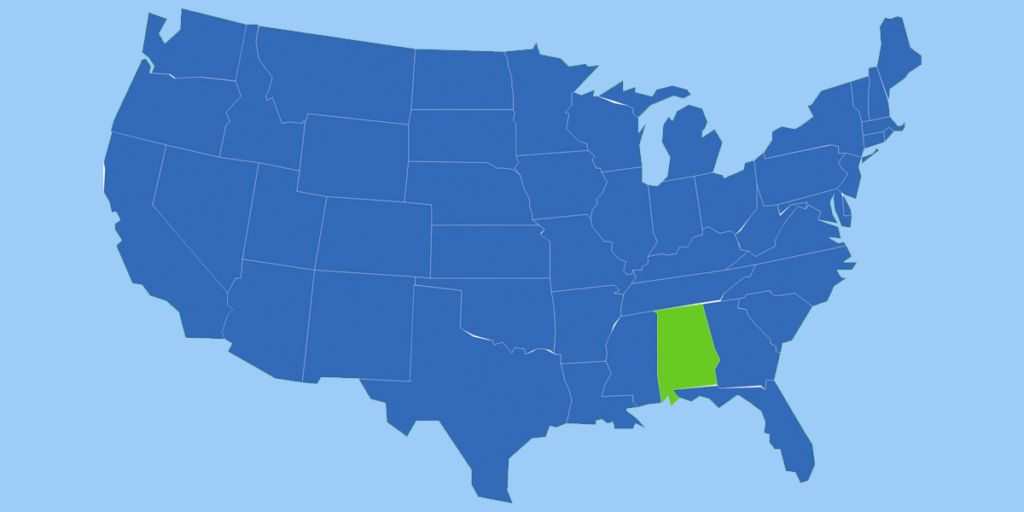
America may be the land of the free, but apparently the same can’t be said about Alabama. In a new study released Tuesday by the Cato Institute — a libertarian think tank dedicated to the principles of individual liberty, limited government, free markets, and peace — Alabama was ranked the 28th freest state in the nation. By individual category, Alabama scores 19th in fiscal policy, 23rd in regulatory policy, and 49th in personal freedom. The study, Freedom in the 50 States, ranks each U.S. state by how its public policies promote freedom in the fiscal, regulatory, and personal freedom spheres. To determine these rankings, authors William Ruger and Jason Sorens examined state and local government intervention across a range of more than 230 policy variables — from taxation to debt, eminent domain laws to occupational licensing, and drug policy to educational choice. According to the study: As a socially conservative Deep South state, it is unsurprising that Alabama does much better on economic freedom than on personal freedom. But three of its four neighbors do substantially better on economic freedom (Florida, Tennessee, and Georgia), with only Mississippi doing worse. Alabama’s overall freedom level has remained essentially flat since year-end 2014, while it has improved a bit since 2000 even in terms of non-federalized policies. Alabama has always been one of the lowest taxed states in the country. Its combined state and local tax collections, excluding motor fuel and severance, were an estimated 8 percent of adjusted personal income in fiscal year 2017. Alabama’s debt burden is also fairly low compared to other states. On regulatory policy, Alabama does especially well on land-use and labor policy. In fact, it scores first in that area. However, it does well below average on its tort system and certain cronyist policies. Indeed, it ranks 35th in the cronyism index. The state is one of the worst in the country on personal freedom, despite benefiting from the Supreme Court’s Obergefell decision. Other factors keeping its personal freedom score low include high beer and spirit taxes, above-average wine taxes and a ban on direct wine shipment, and harsh cannabis laws where it is possible to receive life imprisonment for a single marijuana trafficking offense. To improve on its freedom rankings, the authors suggest several remedies, including: encouraging the privatization of hospitals and utilities to bring government employment down closer to the national average. Private utility monopolies will, however, require careful rate regulation; improving the civil liability system by tightening or abolishing punitive damages and abolishing joint and several liability; reducing its incarceration rate with thorough sentencing reform, including abolishing mandatory minimums for nonviolent offenses and lowering maximum sentences for marijuana offenses and other victimless crimes. “Measuring freedom is important because freedom is valuable to people,” write Ruger and Sorens. “State and local governments ought to respect basic rights and liberties, such as the right to practice an honest trade or the right to make lifetime partnership contracts, whether or not respecting these rights ‘maximizes utility.’ Even minor infringements on freedom can erode the respect for fundamental principles that underlie our liberties. This index measures the extent to which states respect or disrespect these basic rights and liberties; in doing so, it captures a range of policies that threaten to chip away at the liberties we enjoy.”
Taylor Dawson: What does freedom mean to me?
When most of us think about the Fourth of July, we think about pool parties, cooking out, fireworks, and spending time with friends and family. Others think about our love for America. Some of us even wait all year for an occasion to wear a t-shirt that has the Declaration of Independence printed on it. Is that just me? I can’t hide it—I’m a huge fan of the Declaration of Independence. Almost every time I’ve visited Washington D.C., even if it’s only for a weekend, I make time to visit the National Archives just to see it. It’s not changing, but I still can hardly make it longer than a year without looking at it. When you look at the Declaration of Independence, one of the things you may notice is that most of the text is written in a script that is barely legible. A few words, however, are written in a script that is much clearer and easier to read. Three of those words are “free and independent.” America’s founders risked their lives to create a nation where citizens could truly be “free and independent”. As children, a lot of us learned—when we were told we couldn’t do something—just to say, “it’s a free country! I can do whatever I want!” While that didn’t get me anywhere most of the time, aside from being swiftly sent to my room when I said it to the wrong audience, I’m glad I learned that phrase. I’m glad I grew up declaring that freedom was at the core of my country’s values, whether or not I realized that was what I was doing. So now, as a millennial in the political sphere, I find myself thinking, “what does freedom really mean to me?” Freedom, to me, means the ability to think, speak, worship, work, and make decisions for myself with minimal—if any—government interference. That’s how the founders set up our republic. As a woman, I’m told I have to support certain movements. As a millennial, I’m told I have to vote a certain way. But as an American, I know that I have the freedom to say what I want, believe what I choose, and vote for who and what I think is best, whether others agree with me or not. In some ways, it seems like freedom is losing these days. I sometimes find myself afraid to speak freely out of fear of being shouted down for my opinions. Sure, my freedom to express myself is being respected by the government, and I absolutely respect the freedom of others to disagree with me. But when we see things like Kanye West speaking positively about President Trump on Twitter and causing a media firestorm, or college students and professors being shut down for expressing their opinions, it can be disheartening. While the media and social media often make it look like much of the country is trending toward a departure from freedom, the fight for freedom is going strong. For example, just last week, the United States Supreme Court handed down two decisions that decisively upheld the First Amendment. The decision in Janus v. AFSCME restored free speech rights to millions of government workers, and in NIFLA v. Becerra, the Court ruled that California could not require pro-life pregnancy centers to promote state-provided abortion services to their clients. Additionally, earlier this year right here in our own state, the Foundation for Individual Rights in Education gave Auburn University its highest rating for free speech policies on college campuses. It may seem like freedom is being threatened in America, but in reality, freedom is on the move. Do not get discouraged, as I all too often do. This Fourth of July, embrace the freedom given to us by the founders. Many men and women have fought hard to preserve it. That is why the Alabama Policy Institute exists—to defend and promote your freedom. You have my word that for as long as we can, we will fight for freedom in America and in Alabama. ••• Taylor Dawson is Director of Communications at the Alabama Policy Institute (API). API is an independent, nonpartisan, nonprofit research and educational organization dedicated to strengthening free enterprise, defending limited government, and championing strong families. If you would like to speak with the author, please e-mail communications@alabamapolicy.org or call (205) 870-9900.
Katherine Robertson: Reflections on freedom as Independence Day approaches
Raised to love my country and our flag, and because it’s reserved for time with my family, the Fourth of July is a day that I look forward to from the very first signs of summer. For me, at least, I sense that this year will somewhat bittersweet. When we celebrate America’s independence, we necessarily celebrate freedom — unprecedented and unmatched by any other nation. For the first time in my life, I fear that my own freedom might actually be at stake. As the left tirelessly labels as hateful anyone expressing the slightest disappointment over the Court’s ruling on marriage, any objective constitutional scholar has to admit that this decision goes well beyond the simple act of requiring that marriage licenses be issued to any couple who seeks them. Rather, it tips the scales of justice against one of our nation’s foremost freedoms: the free exercise of religion. As you have likely read and heard numerous times over the weekend, the court has designated the right to marry as one that is “fundamental.” Assigning that status to same-sex marriage places it on equal footing with the free exercise of religion, a freedom enumerated in the First Amendment. Such a designation for same-sex marriage has vast implications, of course, for anyone with a religious objection to it. Precedent dictates that government action may limit a fundamental right if the action promotes a compelling or overriding state interest. Sadly, the court made no effort in last week’s decision to assure the protection of religious liberty in the face of this new state interest in same-sex marriage. The majority writes, “[m]any who deem same-sex marriage to be wrong reach that conclusion based on decent and honorable religious or philosophical premises, and neither they nor their beliefs are disparaged here. But (emphasis mine) when that sincere, personal opposition becomes enacted law and public policy, the necessary consequence is to put the imprimatur of the State itself on an exclusion that soon demeans or stigmatizes those whose own liberty is then denied.” In other words, if exercising your First Amendment rights, including that of religion, is interpreted as demeaning the fundamental right to a same-sex marriage, then your religious right will be deemed inferior. To that end, Justice Samuel Alito did not mince words: “[The decision] will be used to vilify Americans who are unwilling to assent to the new orthodoxy. In the courts of its opinion, the majority compares traditional marriage laws to laws that denied equal treatment for African-Americans and women. The implications of this analogy will be exploited by those who are determined to stamp out every vestige of dissent.” Justice Clarence Thomas similarly opined, “[i]t appears all but inevitable that the two [rights] will come into conflict, particularly as individuals and churches are confronted with demands to participate in and endorse [same-sex marriages]. The majority appears unmoved by that inevitably.” This new, very real threat to our previously taken-for-granted freedoms will have one of two effects on those who revere the First Amendment. Some may decide that the current is just too strong, the left’s talking points too convincing, and that a strict adherence to the Constitution or our own religious beliefs is no longer feasible. On the other hand, and hopefully more likely, others will awaken from complacency. They will choose to be more intentional about who they allow to influence their stances, more confident in their convictions, and more thoughtful in how they go about expressing them. As renowned legal scholar, Judge Robert Bork, wrote in 1993, “[i]n our current culture wars, perhaps the most important of the virtues for conservatives is fortitude — the courage to take stands that are not immediately popular, the courage to ignore the opinion polls. Otherwise, we will never change the polls. That is what true conservatism means, or it means nothing.” This Independence Day, let’s reflect on the fortitude of the generations before us who fought for our freedoms and refuse to be the apathetic generation that lets them slip away. Katherine Robertson is vice president for the Alabama Policy Institute (API), a nonprofit research and education organization dedicated to the preservation of free markets, limited government and strong families.
