
GOP’s Justin Amash, impeachment supporter, quits conservative group

Rep. Justin Amash, the lone Republican calling for President Donald Trump’s impeachment, has quit the Freedom Caucus of House conservatives, his spokeswoman confirmed Tuesday. The split comes a few weeks after Amash called for the House to impeach Trump based on the details of special counsel Robert Mueller’s report. Several members of the Freedom Caucus said they were blindsided by Amash’s move, but he has stood by it, repeating his argument in detail on Twitter. Trump and many of his allies on Capitol Hill say the report and the Democrats’ investigations of Trump are drummed-up partisan exercises. Amash’s departure from the caucus — he was one of the group’s founders — is a reflection of how closely the group is now tied to the president. While Amash’s views on small government have not changed, his break on impeachment has strained ties with his GOP colleagues. Asked about Amash on Tuesday, House Minority Leader Kevin McCarthy, Republican-California, criticized his voting record and said Amash “can determine his own future.” Philosophically, he said, Amash is “probably in a different place than the majority of all of us.” Trump also has said he’s not impressed by Amash. But the Grand Rapids-area Republican hails from a state that Trump swiped from Democrats in 2016 and is driving to win again in 2020. For his part, Amash has not said whether he will run for re-election to his House seat. He has left open the prospect of running for president in 2020 as a Libertarian, which could take away support from Trump. At a town hall in his district May 28, he received standing ovations from many who saluted his “courage.” Amash also sparred with some former supporters who faulted him for embracing a Democratic “smear attack” against Trump. Citing Mueller’s report, Amash said Trump had asked former White House counsel Don McGahn to create a “false record” denying that he had asked for Mueller’s removal as special counsel. “Things like that to me reflect incredible dishonesty and really harm the office of the presidency. I don’t think that you can just let that stuff go,” Amash told his constituents. “I think you have to have proceedings to deter this kind of conduct even if ultimately the person is not convicted.” Amash’s resignation from the Freedom Caucus was confirmed by spokeswoman Poppy Nelson and was first reported by CNN. Republished with the permission of the Associated Press.
Border security bargainers trade offers as deadline nears

Congressional bargainers traded offers and worked toward a border security compromise Friday that would avert a fresh federal shutdown and resolve a clash with President Donald Trump that has dominated the opening weeks of divided government. differences Both sides’ negotiators expressed optimism that an accord could be reached soon on a spending package for physical barriers along the Southwest border and other security measures. Participants said the agreement would all but certainly be well below the $5.7 billion Trump has demanded to build his proposed wall, and much closer to the $1.6 billion that was in a bipartisan Senate bill last year. “That’s what we’re working toward,” said Rep. Lucille Roybal-Allard, Democrat-Calif., one of the bargainers. Besides the dollar figure, talks were focusing on the type and location of barriers, participants said. Also in play were the number of beds the federal Immigration and Customs Enforcement agency could have for detained migrants, and how much aid for natural disaster relief would be included. Money for high-tech surveillance equipment and more personnel was also expected to be included. No one ruled out that last-minute problems could emerge, especially with Trump’s penchant for head-snapping turnabouts. But the momentum was clearly toward clinching an agreement that Congress could pass by next Friday. The next day, government agencies would have to close again for lack of money, if no deal is reached. Negotiator Rep. Chuck Fleischmann, Republican-Tenn., said the latest Democratic offer was “much more reasonable.” And Democratic bargainer Rep. Pete Aguilar of California said, “Each time an offer and a counter is going back and forth the number of open items is reducing. That is progress.” Rep. Mark Meadows, Republican-N.C., who leads the hard-right House Freedom Caucus, said he spoke Thursday night to Trump, who he said was in “wait and see” mode. Meadows said he expects an agreement to provide something closer to $1.6 billion. “I’m not optimistic it’ll be something the president can support,” Meadows said. A conservative House GOP aide said to back a deal, Freedom Caucus members wanted at least $2 billion for barriers and no restrictions on new construction, land acquisition or new types of barriers that could be built. The aide also said the agreement need not contain the term “wall” — a word that was a premier plank of Trump’s presidential campaign, and which Trump has lately alternated between embracing and abandoning. The person would talk only on condition of anonymity to describe private talks. Meadows’ assessment of Trump’s view clashed with one expressed Thursday by Sen. Richard Shelby of Alabama, the chief GOP bargainer. He described the emerging deal to Trump in the Oval Office and told reporters the session was “the most positive meeting I’ve had in a long time.” Shelby said that if the final agreement followed the outline currently under discussion, he believed Trump “would sign it.” Trump has modest leverage in the battle. Besides facing unified Democratic opposition, there is virtually no GOP support in Congress for another shutdown. When congressional talks began, Trump called them a “waste of time.” “They’ve got to come to a solution that actually does what they promised they would do, which is protect the American people,” White House spokesman Hogan Gidley said on Fox News. Trump faces an aggressive, Democratic-led House that is ramping up investigations into Russian involvement in his campaign and businesses and trying to get access to his income tax returns. But ending the border security fight would close one chapter that’s bruised him, including his surrender after a 35-day partial federal shutdown that he started by unsuccessfully demanding taxpayer money to build the border wall. Even with a deal, it was possible Trump might try using claims of executive powers to reach for more wall funding. That could spark votes by Congress to block him, which Trump could veto but would still inflict political damage. Sen. Lindsay Graham, Republican-S.C., said Thursday that an accord could be “a good down payment” and added, “There are other ways to do it and I expect the president to go it alone in some fashion.” Acting White House Chief of Staff Mick Mulvaney said on Fox News Channel’s “Hannity” on Wednesday, “If Congress won’t participate or won’t go along, we’ll figure out a way to do it with executive authority.” Members of both parties have expressed opposition to Trump bypassing Congress by declaring a national emergency at the border, a move that would be certain to produce lawsuits that could block the money. Lawmakers have grown accustomed to expecting the unexpected from Trump. Before Christmas, both parties’ leaders believed he’d support a bipartisan deal that would have prevented the recently ended shutdown, only to reverse himself under criticism from conservative pundits and lawmakers. “There’s a small light at the end of the tunnel,” said Sen. Pat Roberts, Republican-Kan. “We just hope it’s not a train coming the other way.” Republished with permission from the Associated Press
Conservative revolt over immigration sinks House farm bill
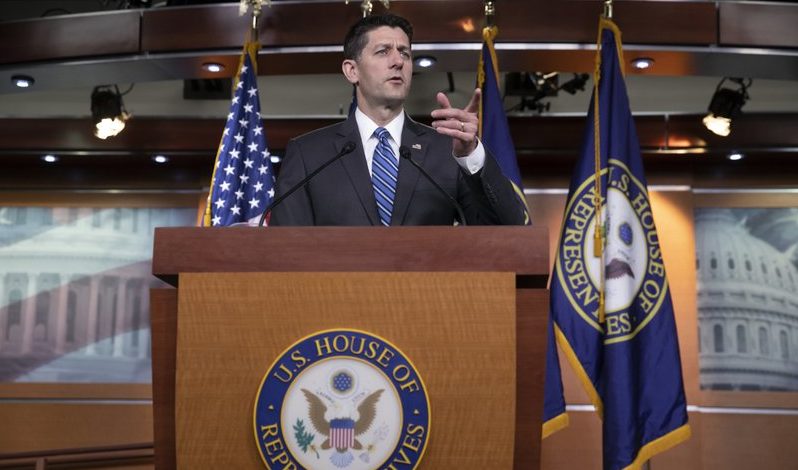
In an embarrassment for House Republican leaders, conservatives on Friday scuttled a bill that combines stricter work and job training requirements for food stamp recipients with a renewal of farm subsidies popular in GOP-leaning farm country. Hard-right conservatives upset over the party’s stalled immigration agenda opposed the measure, which failed by a 213-198 vote. Some 30 Republicans joined with every chamber Democrat in opposition. The vote was a blow to GOP leaders, who had hoped to tout its new work requirements for recipients of food stamps. The work initiative polls well with voters, especially those in the GOP political base. More broadly, it exposed fissures within the party in the months before the midterm elections, and the Freedom Caucus tactics rubbed many rank-and-file Republicans the wrong way. “You judge each piece of legislation on its own,” said Rep. Tom Cole, R-Okla. “You don’t hold one thing hostage for something that’s totally different and has nothing to do with it. I would say that’s a mistake in my view.” Key conservatives in the rebellious House Freedom Caucus opposed the measure, seeking leverage to win conservative policies an advantage in a debate on immigration next month. Negotiations with GOP leaders Friday morning failed to bear fruit, however, and the unrelated food and farm measure was defeated. Conservative Rep. Jim Jordan, R-Ohio, said some members had concerns over the farm bill, but said, “That wasn’t my main focus. My main focus was making sure we do immigration policy right” and “actually build a border security wall.” House Speaker Paul Ryan, R-Wis., took steps to call for a re-vote in the future but it’s not clear when the measure might be revived. A handful of GOP moderates opposed the bill, too, but not enough to sink it on their own. The farm bill, a twice-per-decade rite on Capitol Hill, promises greater job training opportunities for recipients of food stamps, a top priority for House leaders. Democrats are strongly opposed, saying the stricter work and job training rules are poorly designed and would drive 2 million people off of food stamps. They took a victory lap after the vote. “On a bipartisan basis, the House rejected a bad bill that failed farmers and working families,” said Minority Leader Nancy Pelosi, D-Calif. “Republicans wrote a cruel, destructive Farm Bill that abandoned farmers and producers amid plummeting farm prices and the self-inflicted damage of President Trump’s trade brinkmanship.” Currently, adults 18-59 are required to work part-time to receive food stamps, officially called the Supplemental Nutrition Assistance Program, or agree to accept a job if they’re offered one. Stricter rules apply to able-bodied adults 18-49, who are subject to a three-month limit of benefits unless they meet a work or job training requirement of 80 hours per month. Under the new bill, the tougher requirement would be expanded to apply to all adults on SNAP, with exceptions for of seniors, pregnant women, caretakers of children under the age of 6, or people with disabilities. “It sets up a system for SNAP recipients where if you are able to work, you should work to get the benefits,” said Ryan, R-Wis.” And if you can’t work, we’ll help you get the training you need. We will help you get the skills you need to get an opportunity.” The measure would have greatly expanded funding for state-administered job training programs, but Democrats and outside critics say the funding for the proposed additional job training would require huge new bureaucracies, extensive record-keeping requirements, and that the funding levels would fall far short of what’s enough to provide job training to everybody covered by the new job training requirements. “While I agree that there are changes that need to be made to the SNAP program, this is so clearly not the way to do it,” said Rep. Colin Peterson of Minnesota, top Democrat of the Agriculture Committee. “The bill cuts more than $23 billion in SNAP benefits and will result in an estimated 2 million Americans unable to get the help they need.” He said it “turns around and wastes billions … cut from SNAP benefits to create a massive, untested workforce training bureaucracy.” In addition to food stamps, the measure would renew farm safety-net programs such as subsidies for crop insurance, farm credit and land conservation. Those subsidies for farm country traditionally form the backbone of support for the measure among Republicans, while urban Democrats support food aid for the poor. On Thursday, supporters of the agriculture safety net easily defeated an attempt to weaken the government’s sugar program, which critics say gouges consumers by propping up sugar prices. The measure mostly tinkered with farm programs, adding provisions aimed at boosting high-speed internet access in rural areas, assist beginning farmers, and ease regulations on producers. But since the measure makes mostly modest adjustments to farm policy, some lawmakers believe that the most likely course of action this year is a temporary extension of the current measure, which expires at the end of September. In the Senate, the chamber’s filibuster rules require a bipartisan process for a bill to pass. There, Agriculture Committee Chairman Pat Roberts, R-Kan., promises a competing bill later this month and he’s signaling that its changes to food stamps would be far more modest than the House measure. Republished with permission from the Associated Press.
On more than one issue, Republican Donald Trump sounds like a Democrat

As he tries to charm Republicans still skeptical of his presidential candidacy, Donald Trump has a challenge: On several key issues, he sounds an awful lot like a Democrat. And on some points of policy, such as trade and national defense, the billionaire businessman could even find himself running to the left of Hillary Clinton, his likely Democratic rival in the general election. Trump is a classic Republican in many ways. He rails against environmental and corporate regulations, proposes dramatically lower tax rates and holds firm on opposing abortion rights. But the presumptive GOP nominee doesn’t fit neatly into a traditional ideological box. “I think I’m running on common sense,” he said in a recent interview with The Associated Press. “I think I’m running on what’s right. I don’t think in terms of labels.” Perhaps Trump’s clearest break with Republican orthodoxy is on trade, which the party’s 2012 platform said was “crucial for our economy” and a path to “more American jobs, higher wages, and a better standard of living.” Trump says his views on trade are “not really different” from the rest of his party’s, yet he pledges to rip up existing deals negotiated by “stupid leaders” who failed to put American workers first. He regularly slams the North American Free Trade Agreement involving the U.S, Mexico and Canada, and opposes a pending Asia-Pacific pact, positions shared by Democratic candidate Bernie Sanders. “The problem is the ideologues, the very conservative group, would say everything has to be totally free trade,” Trump said. “But you can’t have free trade if the deals are going to be bad. And that’s what we have.” Trump long has maintained that he has no plans to scale back Social Security benefits or raise its qualifying retirement age. The position puts him in line with Clinton. She has said she would “defend and expand” Social Security, has ruled out a higher retirement age and opposes reductions in cost-of-living adjustments or other benefits. “There is tremendous waste, fraud and abuse, but I’m leaving it the way it is,” Trump recently told Fox Business Network. It’s a stance at odds with the country’s top-ranked elected Republican, House Speaker Paul Ryan of Wisconsin, who has advocated fundamental changes to Social Security and other entitlement programs. But it’s also one that Trump argues keeps him in line with the wishes of most voters. “Remember the wheelchair being pushed over the cliff when you had Ryan chosen as your vice president?” Trump told South Carolina voters this year, referring to then-vice presidential candidate Ryan’s budget plan. “That was the end of that campaign.” Ryan was Mitt Romney‘s running mate in 2012. Complicating the efforts to define Trump is his penchant for offering contradictory ideas about policy. He also has taken recently to saying that all of his plans are merely suggestions, open to later negotiation. Trump’s tax plan, for instance, released last fall, called for lowering the rate paid by the wealthiest people in the United States from 39.6 percent to 25 percent and slashing the corporate tax rate from 35 percent to 15 percent. Trump described it as a massive boon for the middle class. Outside experts concluded it disproportionately benefited the rich and would balloon the federal deficit. Close to clinching the nomination, Trump now appears to be pulling away from his own proposal. While he still wants to lower taxes for the wealthy and businesses, he now says his plan was just a starting point for discussions and he would like to see the middle class benefit more from whatever changes he seeks in tax law. “We have to go to Congress, we have to go to the Senate, we have to go to our congressmen and women and we have to negotiate a deal,” Trump said recently. “So it really is a proposal, but it’s a very steep proposal.” Trump has a similar take on the minimum wage. Trump said at a GOP primary debate that wages are too high, and later made clear that he does not support a federal minimum wage. Yet when speaking about the issue, he says he recognizes the difficulty of surviving on the current minimum wage of $7.25 an hour. “I am open to doing something with it,” he told CNN this month. On foreign policy, Trump already appears working to paint Clinton as a national security hawk who would too easily lead the country into conflict. “On foreign policy, Hillary is trigger happy,” Trump said at a recent rally, He listed the countries where the U.S. had intervened militarily during her tenure as secretary of state and pointed to her vote to authorize the Iraq war while she was in the Senate. Trump’s own “America First” approach appears to lean more toward isolationism. One of his foreign policy advisers, Walid Phares, recently described it as a “third way.” “This doesn’t fit any of the boxes,” Phares said. Clinton has advocated using “smart power,” a combination of diplomatic, legal, economic, political and cultural tools to expand American influence. She believes the U.S. has a unique ability to rally the world to defeat international threats. She argues the country must be an active participant on the world stage, particularly as part of international alliances such as NATO. Trump has criticized the military alliance, questioning a structure that sees the U.S. pay for most of its costs. “The best thing about Donald Trump today is he’s not Hillary Clinton, but he’s certainly not a conservative, either,” said GOP Rep. Tim Huelskamp, a member of the ultra-conservative Freedom Caucus and a Ted Cruz supporter in the 2016 race, in an interview with “Fox News Sunday.” Republished with permission of The Associated Press.
Majority Leader Kevin McCarthy withdraws his candidacy for speaker
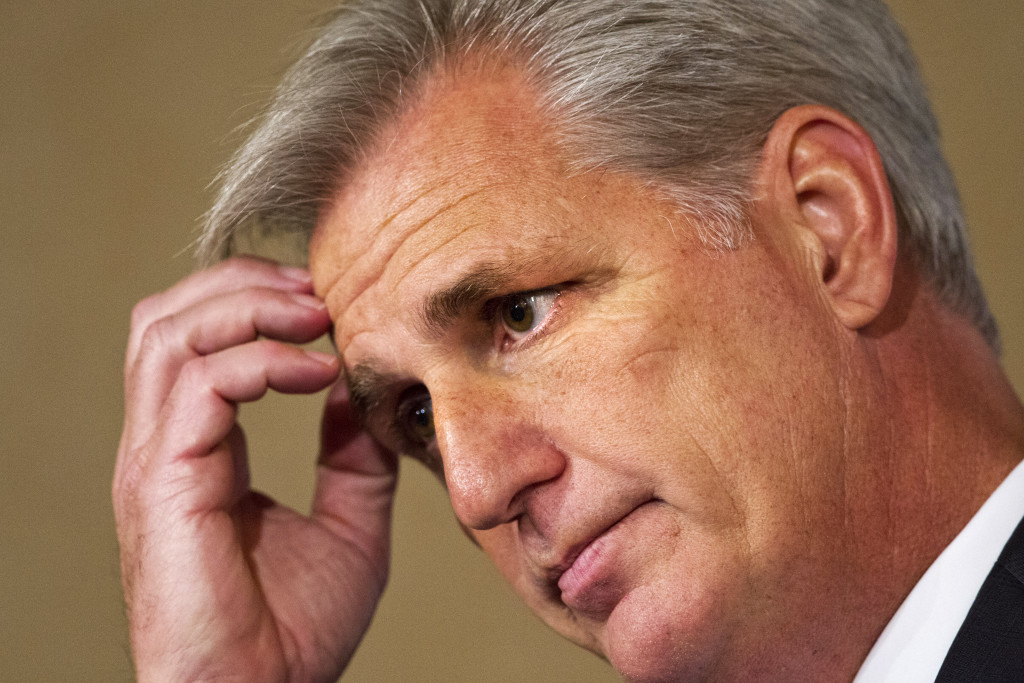
In a stunning move, Majority Leader Kevin McCarthy withdrew his candidacy for House speaker Thursday, throwing Congress’ Republican leadership into chaos. McCarthy was heavily favored to win his GOP colleagues’ endorsement for the post, but a vigorous challenge from hardline House conservatives threatened a smooth ratification when the full House voted Oct. 29. It is uncertain now when that vote will occur to replace Speaker John Boehner, who is to retire at the end of the month. McCarthy shocked his colleagues at the start of Thursday’s closed meeting, telling them he was not the right person for the job. He recommended that the election be postponed and Boehner delayed it. “There was total shock, and then total silence,” said Rep. Robert Pittenger, R-N.C. Lawmakers were in near disbelief at the announcement, which came as Republicans began a meeting for what they thought would be the election of a new speaker nominee. “I’ve never seen anything like this,” said Rep. Ryan Costello, R-Pa. Rep. John Fleming, R-La., said he was “thunderstruck.” “We don’t know why he did it,” said Rep. Mick Mulvaney, R-S.C. McCarthy’s decision plunged the House GOP into further turmoil, just weeks after Boehner’s decision to resign had left Republicans reeling. Just hours earlier, McCarthy and his two rivals to replace Boehner addressed a closed-door meeting of the GOP rank and file in the basement of the Capitol, making final pitches ahead of elections. Rep. Kevin Brady of Texas, who supported McCarthy, said the 50-year-old Californian pitched himself as “a proven leader, a generational change in the speakership.” “Plus he listens very carefully,” Brady said, “and as a result our conference will continue to have more power over the agenda, which is what we all want.” But McCarthy had failed to win over a small but crucial bloc in the House GOP: the hardline Freedom Caucus. This group of 30-plus uncompromising conservatives drove Boehner to resign by threatening a floor vote on his speakership. On the eve of Thursday’s vote they announced they would oppose Boehner’s No.2, McCarthy, and back one of his rivals instead, Rep. Daniel Webster of Florida, a former speaker of the Florida House. That was a blow to McCarthy, although there had been little expectation that the group would back the Californian. “Power doesn’t like to give up its power, and so that’s why many of us have gotten behind Mr. Webster,” Rep. John Fleming of Louisiana, a Freedom Caucus member, said outside Thursday’s meeting. “We feel that conservatives have been greatly marginalized by the current leadership.” Despite the opposition, McCarthy clearly had been expected to emerge the winner Thursday over Webster and a third rival, Republican Rep. Jason Chaffetz of Utah, who chairs the House Oversight and Government Reform Committee. That would have made McCarthy the House GOP nominee for speaker. But his true test will come Oct. 29, when the full House will vote for speaker in open session. With Democrats certain to back Minority Leader Nancy Pelosi, a Republican will need to win a 218-vote majority to prevail. If no candidate wins that majority, it would send the House into uncertain territory. It hasn’t happened in decades, but in years past speaker elections have required multiple ballots before any candidate prevailed. Some of the more establishment-aligned lawmakers are voicing fears about such an outcome on Oct. 29. Republished with permission of the Associated Press.
