
AGs ask Supreme Court to overrule restrictions on enforcing homeless camping bans
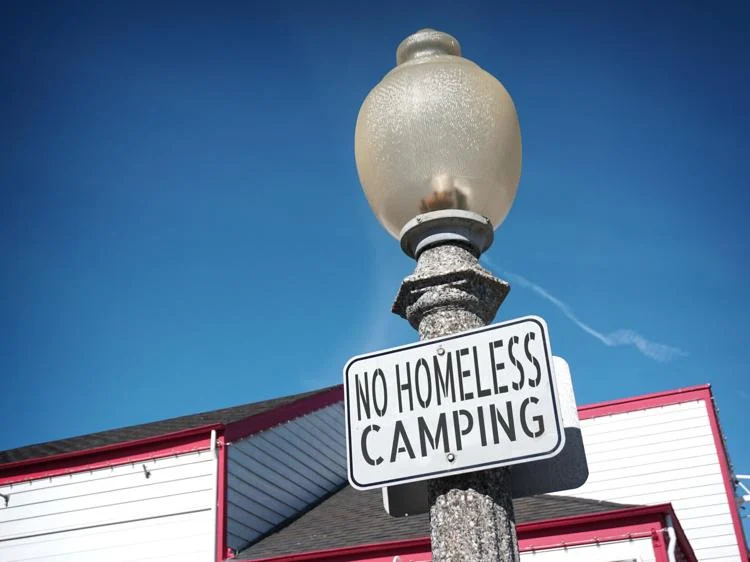
A group of 20 attorneys general want the U.S. Supreme Court to overrule a lower court’s restrictions on local governments enforcing homeless camping bans. In their petition regarding Johnson v. City of Grants Pass, the attorneys general wrote that the 9th Circuit Court of Appeals was wrong to prohibit state and local governments from enforcing laws that bar public spaces from being used as homeless encampments. “The Constitution nowhere strips States of the power to regulate use of public spaces,” the attorneys general wrote. “It empowers States and guarantees an inviolable sovereignty meant to address local issues like homelessness.” Meanwhile, the attorneys general said the 9th Circuit “relied on this Court’s ‘evolving standards of decency’ jurisprudence,” something they said “lacks textual, historical, or structural support.” “The Court should put that troublesome jurisprudence to bed once and for all,” they added. In 2018, the 9th Circuit ruled that the Eighth Amendment allows for the right to sleep and camp in public spaces. Earlier this year, the appeals court held that the amendment also prevents fines for people “engaging in involuntary, unavoidable life-sustaining acts.” However, the attorneys general argue that cities – especially those across the western U.S. – are having a difficult time combating homelessness because of the ruling. “When it comes to public encampments, States have significant land interests,” the attorneys general said. “States regulate public encampments to protect natural resources, prevent wildfires, preserve the value of recreation, and maintain an area’s dignity and public value. The petition was filed by attorneys general from Alabama, Alaska, Arkansas, Florida, Idaho, Indiana, Kansas, Louisiana, Mississippi, Missouri, Montana, Nebraska, North Dakota, Oklahoma, South Carolina, South Dakota, Texas, Utah, Virginia and West Virginia. Democratic California Gov. Gavin Newsom also submitted a brief for the Supreme Court to review the case. Republished with the permission of The Center Square.
California ban on standard-capacity gun magazines overturned

By Kenneth Schrupp | The Center Square Federal judge Roger Benitez overturned California’s ban on standard-sized ammunition magazines, with California Attorney General Rob Bonta filing an immediate notice of appeal. The injunction on the ban will be stayed for 10 days, which means that the ban’s overturn will likely not take effect as the decision is appealed. “Unless we enshrine a Right to Safety in the Constitution, we are at the mercy of ideologues like Judge Benitez,” said California Governor Gavin Newsom in a public statement responding to the decision. “This is exactly why I’ve called for a Constitutional amendment, and this is why I’ll keep fighting to defend our right to protect ourselves from gun violence.” Standard-capacity magazines have been illegal to manufacture, import, keep, or offer for sale, give, or lend since 2000, and illegal to purchase or receive in any way since 2013. Proposition 64, passed by California voters in 2016, made it illegal to possess even legally-acquired standard-capacity magazines with more than 10 rounds under the rationale such a measure would limit mass shootings. Anyone who did not turn in their standard-capacity magazines by July 1, 2017, could have faced up to a year in prison before an earlier injunction by Benitez. The most popular firearm sold in 2022, a Sig Sauer P320 pistol, comes with a 15-round magazine except where otherwise limited, such as in California. “There is no American history or tradition of regulating firearms based on the number of rounds they can shoot, or of regulating the amount of ammunition that can be kept and carried,” wrote Benitez in his latest ruling. Benitez first struck down Proposition 63’s rule in June 2017, right before enforcement began, noting only six mass shootings between 2006 and 2013 used the banned magazines, and that “entitlement to enjoy Second Amendment rights and just compensation is not eliminated simply because they possess ‘unpopular’ magazines holding more than 10 rounds.” In 2018, a 2-1 panel of the Ninth Circuit Court affirmed Benitez’s ruling on the confiscations. In 2019, Benitez ruled against the ban on the acquisition of standard-capacity magazines, citing varying outcomes of women’s self-defense cases where having additional bullets made the difference between life and death. This decision was upheld in a 2020 panel of the Ninth Circuit Court, then overturned by an en banc decision of the same court in 2021. The United States Supreme Court vacated the Ninth Circuit Court’s en banc decision in 2022 and remanded it back to Benitez for a new decision. Benitez’s latest ruling, if upheld in the appeals process, could allow for the resumption of legal sale of standard-capacity magazines in California. Republished with the permission of The Center Square.
Hunter Biden will plead guilty in a deal that likely averts time behind bars in a tax and gun case
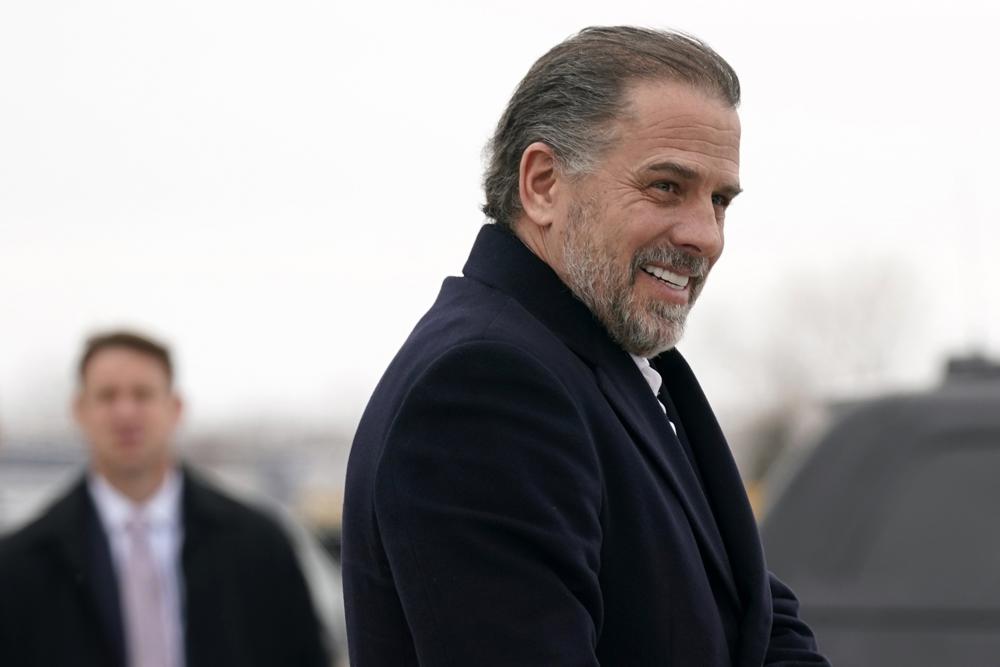
President Joe Biden’s son Hunter Biden will plead guilty to federal tax offenses but avoid full prosecution on a separate gun charge in a deal with the Justice Department that likely spares him time behind bars. Hunter Biden, 53, will plead guilty to the misdemeanor tax offenses as part of an agreement made public Tuesday. The agreement will also avert prosecution on a felony charge of illegally possessing a firearm as a drug user, as long as he adheres to conditions agreed to in court. The deal ends a long-running Justice Department investigation into the taxes and foreign business dealings of President Biden’s second son, who has acknowledged struggling with addiction following the 2015 death of his brother Beau Biden. It also averts a trial that would have generated days or weeks of distracting headlines for a White House that has strenuously sought to keep its distance from the Justice Department. The president, when asked about the development at a meeting on another subject in California, said simply, “I’m very proud of my son.” The White House counsel’s office said in a statement that the president and first lady Jill Biden “love their son and support him as he continues to rebuild his life.” While the agreement requires the younger Biden to admit guilt, the deal is narrowly focused on tax and weapons violations rather than anything broader or tied to the Democratic president. Nonetheless, former President Donald Trump and other Republicans continued to try to use the case to shine an unflattering spotlight on Joe Biden and to raise questions about the independence of the Biden Justice Department. Trump, challenging President Biden in the 2024 presidential race, likened the agreement to a “mere traffic ticket,” adding, “Our system is BROKEN!” House Speaker Kevin McCarthy compared the outcome to the Trump documents case now heading toward federal court and said, “If you are the president’s son, you get a sweetheart deal.” Florida Gov. Ron DeSantis, another presidential challenger, used the same term. Two people familiar with the investigation said the Justice Department would recommend 24 months of probation for the tax charges, meaning Hunter Biden will not face time in prison. But the decision to go along with any deal is up to the judge. The people were not authorized to speak publicly by name and spoke to The Associated Press on the condition of anonymity. He is to plead guilty to failing to pay more than $100,000 in taxes on over $1.5 million in income in both 2017 and 2018, charges that carry a maximum possible penalty of a year in prison. The back taxes have since been paid, according to a person familiar with the investigation. The gun charge states that Hunter Biden possessed a handgun, a Colt Cobra .38 Special, for 11 days in October 2018 despite knowing he was a drug user. The rarely filed count carries a maximum sentence of up to 10 years in prison, but the Justice Department said Hunter Biden had reached a pretrial agreement. This likely means as long as he adheres to the conditions, the case will be wiped from his record. Christopher Clark, a lawyer for Hunter Biden, said in a statement that it was his understanding that the five-year investigation had now been resolved. “I know Hunter believes it is important to take responsibility for these mistakes he made during a period of turmoil and addiction in his life,” Clark said. “He looks forward to continuing his recovery and moving forward.” The agreement comes as the Justice Department pursues perhaps the most consequential case in its history against Trump, the first former president to face federal criminal charges. The resolution of Hunter Biden’s case comes just days after a 37-count indictment against Trump in relation to accusations of mishandling classified documents on his Florida estate. It was filed by a special counsel, appointed by Attorney General Merrick Garland to avoid any potential conflict of interest in the Justice Department. That indictment has nevertheless brought an onslaught of Republican criticism of “politicization” of the Justice Department. Meanwhile, congressional Republicans continue to pursue their own investigations into nearly every facet of Hunter Biden’s business dealings, including foreign payments. Rep. James Comer, the Republican chairman of the House Oversight Committee, said the younger Biden is “getting away with a slap on the wrist,” despite investigations in Congress that GOP lawmakers say show — but have not yet provided evidence of — a pattern of corruption involving the family’s financial ties. Democratic Sen. Chris Coons of Delaware, on the other hand, said the case was thoroughly investigated over five years by U.S. Attorney David Weiss, a Delaware prosecutor appointed by Trump. Resolution of the case, Coons said, “brings to a close a five-year investigation, despite the elaborate conspiracy theories spun by many who believed there would be much more to this.” California Gov. Gavin Newsom, who was scheduled to campaign with the president Tuesday evening, reaffirmed his support for Biden’s reelection. “Hunter changes nothing,” Newsom told the AP on Tuesday. Misdemeanor tax cases aren’t common, and most that are filed end with a sentence that doesn’t include time behind bars, said Caroline Ciraolo, an attorney who served as head of the Justice Department’s tax division from 2015 to 2017. An expected federal conviction “is not a slap on the wrist,” she said. Gun possession charges that aren’t associated with another firearm crime are also uncommon, said Keith Rosen, a past head of the criminal division in the U.S. Attorney’s Office in Delaware. For people without a significant criminal history, the total number of multiple types of illegal possession cases filed every year in Delaware amounts to a handful, he said. The Justice Department’s investigation into the president’s son burst into public view in December 2020, one month after the 2020 election, when Hunter Biden revealed that he had received a subpoena as part of the department’s scrutiny of his taxes. The subpoena sought information on the younger Biden’s business dealings with a number of entities, including
Steve Marshall joins 18 attorneys general who want California’s emissions rule for trucks reversed
Nineteen attorneys general are challenging the Environmental Protection Agency’s decision to allow California to enforce its own regulations requiring zero-emission heavy-duty trucks. In 2021, the California Air Resources Board requested the EPA waive regulations in the federal Clean Air Act. The EPA approved the waiver in March. Democratic California Gov. Gavin Newsom said the EPA’s decision allowed his state to be the world’s first government to require zero-emission trucks and paved the way for clean trucks and buses across the globe. California’s Advanced Clean Trucks rule requires manufacturers to have 40% of semi-tractor sales to be zero-emissions by 2035. All heavy-duty vehicles in California must have no carbon exhaust emissions, wherever feasible, by 2045. Last week, Republican Iowa Attorney General Brenna Bird led a coalition of 19 states challenging the EPA’s decision. “The EPA and California have no right or legal justification to force truckers to follow their radical climate agenda,” Bird said in a statement. “America would grind to a halt without truckers who deliver our food, clothes and other necessities.” Eight other states have moved to adopt or are working to adopt California’s truck regulations, according to Newsom’s office. In 1967, Congress created a waiver provision for state regulations and it was amended in 1990 to include emissions. The Clean Air Act stated there would be only two ways to enforce emission standards from new motor vehicles – EPA regulations and California laws. Other states can only adopt standards identical to California. “This statutory scheme struck an important balance that protected manufacturers from multiple and different state emission standards, while preserving California’s pivotal role as a laboratory for innovation in the control of emissions from new motor vehicles,” Michael Regan, EPA administrator, wrote in a 38-page article published in the Federal Register in April. “Congress recognized that California could serve as a pioneer and a laboratory for the nation in setting new motor vehicle emission standards and the development of new emission control technologies.” “Further, Congress intentionally structured this waiver provision to restrict and limit EPA’s ability to deny a waiver,” he added. “The provision was designed to ensure California’s broad discretion to determine the best means to protect the health and welfare of its citizens.” The attorneys general argue California’s regulations will increase operating costs for the truck industry, lower demand for diesel and biodiesel, and eliminate jobs. “Joe Biden is partnering with California to attempt to upend Missouri’s economy through the federal administrative state, and my office isn’t going to stand for it,” Republican Missouri Attorney General Andrew Bailey said in a statement. Joining Iowa in the petition to the U.S. District Court of Appeals in the District of Columbia are Alabama, Arkansas, Georgia, Indiana, Kansas, Kentucky, Louisiana, Mississippi, Missouri, Montana, Nebraska, North Dakota, Ohio, Oklahoma, South Carolina, Utah, West Virginia, and Wyoming. Republished with the permission of The Center Square.
Harmeet Dhillon defends faith in RNC Chair fight with Ronna Romney McDaniel

On Saturday, the 21-member Alabama Republican Party Steering Committee voted “no confidence” in incumbent Republican National Committee (RNC) chair Ronna Romney McDaniel. Harmeet Dhillon is McDaniel’s opponent. There are media reports that some of McDaniel’s supporters in Alabama have criticized the Steering Committee with embracing a non-Christian candidate for RNC Chair in a whisper campaign. California RNC delegate and attorney Harmeet Dhillon is a Sikh. Sikhs are a minority religion in India, where Dhillon was born – the daughter of a doctor and granddaughter of an Indian general. Dhillon is the McDaniel challenger. Dhillon has released a statement responding to the criticism from some of her Alabama detractors. “I would like to take a minute to address concerns that have been raised by a small handful of Alabama Republican Party activists regarding my faith and how that would impact my ability to champion our nation’s Judeo-Christian values that are encapsulated in our Party Platform,” Dhillon said. “In our founding documents, the Founding Fathers gave us a divinely inspired charter for America and for the first time in history declared that our Creator, not government, grants us our rights,” Dhillon continued. “Our Founders recognized how important faith, and our ability to freely exercise it, would be to the long-term success of our great nation. In fact, they considered religious liberty to be so foundational that it is the very first item referenced in the very first amendment of our Bill of Rights.” “As a civil rights and constitutional attorney for thirty years, I have been fighting the woke mob to preserve religious liberty and our constitutionally protected rights for decades,” Dhillon said. “Since 2020 alone, my law firm and nonprofit led three separate COVID-related religious liberty cases to victory at the U.S. Supreme Court, taking on Gavin Newsom and the lower courts for having violated Americans’ right to freely worship and pray together as guaranteed by the First Amendment. Let me be clear, the fact that my clients’ religion differed from my own was immaterial to me and my team’s willingness to defend their God-given right to exercise their faith free from the tyranny of government intrusion. In fact, my firm has represented over a dozen Christian and Jewish congregations and faith leaders in federal and state courts in just the last three years, and many people of faith seeking to enforce their First Amendment rights in the years before that.” Dhillon emphasized her opposition to McDaniel. “After overseeing three consecutive losing election cycles, the current RNC Chairwoman Ronna McDaniel has decided to run for an unprecedented fourth term,” McDaniel said. “I’m here to offer this party an alternative. I’m here to redefine what this party sees as victory. Victory can no longer be about raising the most money, winning the most press conferences, or owning the most libs. It must be about winning the most elections, battling back the cultural Marxists, and taking back all of the hills we so shamefully sacrificed. Our party can either adapt or die. I choose adaptation. I believe I can bring the change our party needs to begin the process of taking this country back.” The word Sikh means ‘disciple’ or ‘learner.’ The Sikh religion was founded in Northern India in the fifteenth century by Guru Nanak Dev Ji. It is a monotheistic religion that draws from both Islam and Hinduism. Sikhism stresses the equality of all men and women. Sikhs reject caste and class systems and believe in prayer and charity. Sikhism is the fifth-largest religion in the world. There are 700,000 Sikhs in the United States. Sikh men are often seen wearing turbans. The Alabama Republican Party has expressed shock that anyone in Alabama has criticized Dhillon for her faith. “Harmeet Dhillon’s letter came as a surprise to the committee,” an ALGOP spokesperson told the Alabama Media Group. “We had not heard anything about her faith or an issue with it before or after Saturday’s meeting.” McDaniel, a Mormon, denied being behind the attacks on Dhillon’s faith. “I wholeheartedly condemn religious bigotry in any form,” McDaniel said in a statement Wednesday. “We are the party of faith, family, and freedom, and these attacks have no place in our party or our politics. As a member of a minority faith myself, I would never condone such attacks. I have vowed to run a positive campaign and will continue to do so.” The RNC, under McDaniel, has spent $900,000 with Dhillon’s law firm. Alabama has three voting delegates on the RNC Committee that will elect the next chair later this month. To connect with the author of this story, or to comment, email brandonmreporter@gmail.com.
Kay Ivey gets a ‘D’ in report card stacking up U.S. governors’ fiscal policies
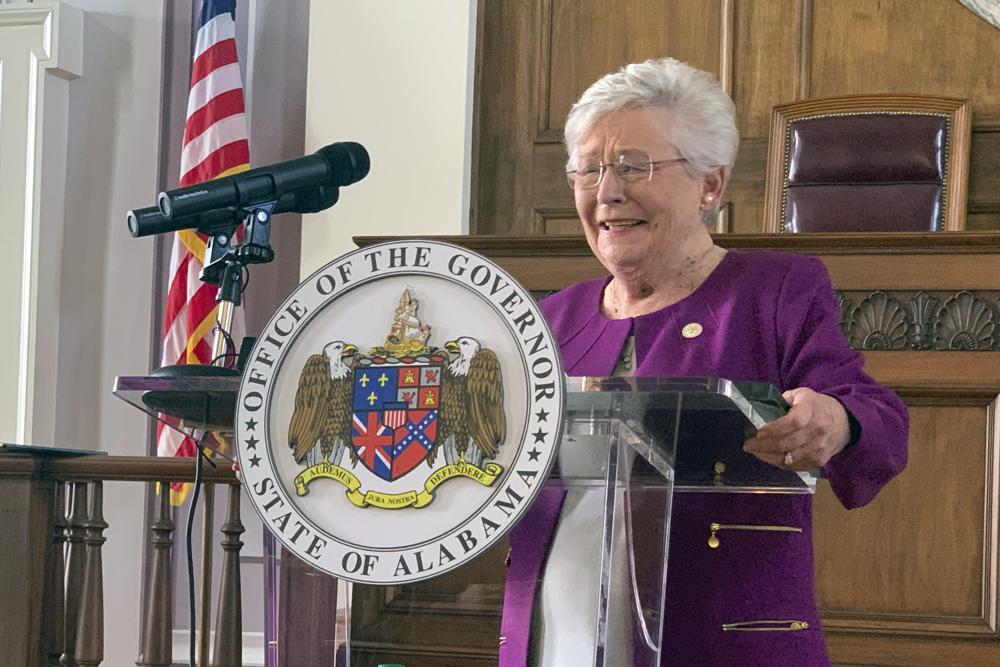
Gov. Kay Ivey’s years-long support of an increased gas tax in Alabama landed her in the bottom tier of a new report grading states’ top-level leaders on their fiscal policies. The Cato Institute, a public policy organization focused on limited government, recently released its 2022 Fiscal Policy Report Card on America’s Governors. Co-authors Chris Edwards and Ilana Blumsack gave Ivey, who is seeking a second full term in office this fall, a score of “D.” In their analysis of Ivey’s fiscal performance throughout her first full term in office, Edwards and Blumsack elaborated on why they gave the governor a low score. “Running for a full term in office in 2018, Ivey said she opposed tax increases,” Edwards and Blumsack wrote. “Nonetheless, she has raised some taxes, including the gas tax by 10 cents per gallon in 2019 and an assessment on nursing home facilities in 2020.” In their report, the authors did note some of Ivey’s more recent tax-cutting overtures in her run-up to reelection and against the backdrop of inflation. “Ivey switched direction recently and approved modest tax cuts, including raising the standard deduction, exempting $6,000 of retirement income from taxes, increasing an adoption credit, and exempting small businesses from the business privilege tax,” Edwards and Blumsack wrote. Early this year, during the most recent legislative session, Ivey also touted her support of House Bill 231, which she signed into law in February. “I am proud to sign this needed tax relief into law so that money will return directly into the hands of hardworking Alabamians,” Ivey said in the news release. Ivey’s support of a gas tax, and her denial of cutting it back this spring, has been a source of criticism since she first signed the legislation into law in 2019. Proceeds from portions of the increased gas tax have been poured into Ivey’s 2019 Rebuild Alabama Act, which required the state’s Department of Transportation to annually allocate $10 million from excised gas taxes. “Since becoming governor, with the support of Rebuild Alabama, we have embarked on more than 1,500 new road and bridge projects worth more than $5 billion,” Ivey said in March. “We certainly have more work in front of us, and I am proud to continue those efforts today.” While the Cato Institute’s newest report did not have a clear-cut partisan divide in the granular state-by-state rankings, there was a prevailing theme. The top-performing governors in this year’s report were Republican, while the lowest-scoring leaders were Democrats. “The results are data-driven. They account for tax and spending actions that affect short-term budgets in the states,” Edwards and Blumsack said of their methodology. “But they do not account for longer-term or structural changes that governors may make, such as reforms to state pension plans.” Five governors, all Republican, received an “A” in this year’s Cato Institute report: Doug Ducey of Arizona; Brad Little of Idaho; Kim Reynolds of Iowa; Pete Ricketts of Nebraska; and Chris Sununu of New Hampshire. On the bottom end, eight Democrat governors received an “F” in the Cato Institute’s analysis of their fiscal policies: Kate Brown of Oregon; Jay Inslee of Washington; Phil Murphy of New Jersey; Gavin Newsom of California; J.B. Pritzker of Illinois; Tim Walz of Minnesota; Gretchen Whitmer of Michigan; and Tom Wolf of Pennsylvania. Republished with the permission of The Center Square.
Joe Guzzardi: DOJ May Intervene in Florida, Texas Transport Plans

Hillary Clinton, Yale Law School ’73, said on MSNBC that sending 50 illegal immigrants to Martha’s Vineyard was “literally human trafficking” by Florida Gov. Ron DeSantis, Harvard Law School, ‘05. The MSNBC co-host, Joe Scarborough, University of Florida School of Law ‘90, accused DeSantis of using innocent people as political pawns. Texas Sen. Ted Cruz, Harvard Law School ‘95, suggested that DeSantis and fellow Texan Gov. Greg Abbott, Vanderbilt University Law School, ’84, should send more migrants to blue cities and states. Cruz, pointing to the millions of illegal immigrants that the administration has admitted, bussed, and flown around the nation, called President Joe Biden, Syracuse University School of Law ’68 and former Senate Judiciary Chair, “the biggest human trafficker on the face of the planet.” Biden demanded that the governors stop their “un-American” political stunts. Clinton, Scarborough, and Biden have support from like-minded lawyers. Professors from Notre Dame, Georgetown, and other universities, along with civil rights advocates, came down hard on DeSantis and Abbott. The harshest criticism came from Calif. Gov. Gavin Newsom, who requested that the Department of Justice open an investigation into the Martha’s Vineyard flights on charges that the migrants were “kidnapped.” Move along. Nothing to see here; just angry lawyers going after each other, hammer and tongs. The voting public, however, is grappling with a contradiction. If the Biden administration can order Customs and Border Patrol to put thousands of aliens on buses and planes to send them throughout the interior of the United States, then the same flexibility should apply to the governors, assuming, of course, that the migrants agree to be flown to Martha’s Vineyard or driven to Washington, D.C. or New York. Jonathan Turley, George Washington University law professor, provided his perspective. Turley wrote that to call transporting aliens kidnapping is “to take a flight from one’s legal senses.” On his blog, Turley stated that human trafficking, a legal term, is altogether different than moving humans in traffic. The governors’ actions aren’t an attempt to put humans, through fraud, coercion, or force, into peonage, involuntary servitude, or sex slavery. In conclusion, Turley wrote that many objections could be made to the governors’ transport programs, but not kidnapping and human trafficking. The tensions between the states and the cities are just beginning. DeSantis promised to fly more migrants to other sanctuary cities, but not necessarily Martha’s Vineyard. That way, DeSantis explained, the sanctuaries can “put their money where their mouth is.” A possible 2024 presidential candidate, DeSantis may sense that while some American voters support immigration, they object to Biden-style open borders. Political expediency is at play in Texas, too. Abbott is up for re-election in November, and he’s counting on removing illegal immigrants as integral to his victory. The border invasion is expensive. As part of its $4 billion Operation Lone Star program, Texas has installed more than 42 miles of concertina wire along its Southern border near Eagle Pass and Del Rio, two communities through which millions have passed. A potential roadblock – a boulder, really – may stand in the governors’ way. In a statement, the Boston nonprofit, Lawyers for Civil Rights, promised to investigate “the inhumane manner in which they [the Martha’s Vineyard migrants] were shipped across the country, to determine the responsible parties, whether state or federal criminal laws against human trafficking and kidnapping were violated, and what other legal remedies are available.” Even though no evidence exists that the migrants were treated inhumanely, and as Turley warned, trafficking and kidnapping are specious charges, LCR will press on. The legal advocates hope to gather pro bono attorneys, immigration experts, law enforcement, and social services providers. If that’s not enough, Deputy Attorney General Lisa Monaco confirmed that the DOJ is reviewing inquiries like Newsom’s calling for an investigation. The DOJ’s involvement, inevitable in the Biden administration, especially if the governors escalate, would be the end of the line for the governors’ strategy to give sanctuary cities a tiny taste of their own medicine. Not a single voice among the many urged border enforcement. Joe Guzzardi is a nationally syndicated newspaper columnist who writes about immigration and related social issues. Joe joined Progressives for Immigration Reform in 2018 as an analyst after a ten-year career directing media relations for Californians for Population Stabilization, where he also was a Senior Writing Fellow. A native Californian, Joe now lives in Pennsylvania. Contact him at jguzzardi@pfirdc.org.
Stark political divides loom as U.S. governors gather

With stark political divides on abortion, gun violence, and other issues threatening to overshadow their meeting, the nation’s governors sought to find common ground — on other issues. The National Governors Association formally kicked off its summer gathering Thursday, the first in-person meeting since 2019, before the COVID-19 pandemic. It follows recent U.S. Supreme Court rulings that have deepened the rift between red and blue states by overturning Roe v. Wade and striking down gun restrictions in New York. Leaders say there’s still room for bipartisanship. “It’s about trying to find things that we can work on together, and that’s plentiful,” said Arkansas Gov. Asa Hutchinson, a Republican who is wrapping up his yearlong term as the association’s chair. Hutchinson is handing the reins of the group to Democratic Gov. Phil Murphy of New Jersey, who will serve as its next chair. The two governors last month announced a bipartisan task force to make recommendations on preventing mass shootings following the massacre at a Texas elementary school that killed 19 children and two teachers. The task force was announced before President Joe Biden signed into law a sweeping, bipartisan gun violence measure that includes billions in new funding for mental health and school safety. The task force is comprised of eight governors, equally divided between Republicans and Democrats. Hutchinson said he sees the group helping shepherd that law’s implementation at the state level. Republican Gov. Spencer Cox of Utah, a member of the task force, acknowledged that any change to gun policy would invite controversy in his state, yet he encourages politicians to listen to proposals from across the political spectrum, including funding for school security, counselors, gun buybacks and red flag laws. “I’ve asked everyone to be open to every conversation,” Cox, the association’s incoming vice chairman, said in a press conference last month. The public agenda at the event in Maine avoided any high-profile partisan issues. Sessions on Thursday featured Intel CEO Patrick Gelsinger and the leader of a global robotics competition for a discussion of computer science education. Another session focused on travel and tourism. The governors also held several other events, including a mixer Wednesday evening and a scheduled lobster bake Thursday evening. Security was tight with road closures and a large police presence. Organizers declined to say if there was a specific threat or concern. Nineteen governors, including the governor of Puerto Rico, attended the event. Missing were governors of several large states, including California Gov. Gavin Newsom, Texas Gov. Greg Abbott, New York Gov. Kathy Huchul, and Florida Gov. Ron DeSantis. Hutchinson said he doesn’t see the governors association addressing abortion following the reversal of Roe. That ruling has pitted states against each other, with “trigger” bans taking effect almost immediately after the ruling in a number of states. Republicans in some states are looking at ways to prevent women from going out of state for abortions, steps that could include going after abortion providers. In response, some Democratic governors have signed measures banning their state’s law enforcement agencies from enforcing other states’ abortion bans. That includes Democratic Gov. Janet Mills, who formally welcomed the governors to her state on Thursday. When she signed an executive order last week, Mills said she “will stand in the way of any effort to undermine, roll back or outright eliminate the right to safe and legal abortion in Maine.” Partisanship was underscored on the eve of the gathering as New Hampshire Gov. Chris Sununu campaigned alongside fellow Republican Paul LePage, a former Maine governor who hopes to unseat Mills. Newsom, the governor of California, has even run a campaign ad in Florida criticizing that state’s Republican leaders. And protesters supporting reproductive choice gathered outside an event some of the governors attended on the Portland waterfront. Nonetheless, Hutchinson said the group has been able to work together on other issues, being a voice for the states during the COVID-19 pandemic and during negotiations over the bipartisan infrastructure package. Massachusetts’ Republican Gov. Charlie Baker said the governors tend to get along with each other — and they tend to focus on things where they can get results instead of areas of disagreement. “While we will disagree on different issues, we as a group have much more in common than what sets us apart,” said Mills, the host governor. Hutchinson’s chairmanship of the group has elevated his national profile as he considers running for president in 2024. The two-term governor, who leaves office in January, has criticized former President Donald Trump and has urged fellow Republicans to move on from the 2020 election. Murphy is coming into the chairmanship after narrowly winning reelection as governor last year. An unapologetic progressive, he recently signed legislation enshrining abortion rights into law and a new package of gun control bills. Even though they’re at opposite ends of the political spectrum, Hutchinson had words of praise for his successor. “Part of being a human being is that you recognize good quality that you see in people, even though we disagree fundamentally, and you’re on a different team. I think that’s needed in America today,” he said. Republished with the permission of The Associated Press.
States divided on gun controls, even as mass shootings rise

Washington Gov. Jay Inslee was quick to react to this week’s carnage at a Texas elementary school, sending a tweet listing the gun control measures the Democratic-controlled state has taken. He finished with: “Your turn Congress.” But gun control measures are likely going nowhere in Congress, and they also have become increasingly scarce in most states. Aside from several Democratic-controlled states, the majority have taken no action on gun control in recent years or have moved aggressively to expand gun rights. That’s because they are either controlled politically by Republicans who oppose gun restrictions or are politically divided, leading to a stalemate. “Here I am in a position where I can do something, I can introduce legislation, and yet to know that it almost certainly is not going to go anywhere is a feeling of helplessness,” said state Sen. Greg Leding, a Democrat in the GOP-controlled Arkansas Legislature. He has pushed unsuccessfully for red flag laws that would allow authorities to remove firearms from those determined to be a danger to themselves or others. After Tuesday’s massacre at Robb Elementary School in Uvalde, Texas, that left 19 students and two teachers dead, Democratic governors and lawmakers across the country issued impassioned pleas for Congress and their own legislatures to pass gun restrictions. Republicans have mostly called for more efforts to address mental health and to shore up protections at schools, such as adding security guards. Among them is Texas Gov. Greg Abbott, who has repeatedly talked about mental health struggles among young people and said tougher gun laws in places like New York and California are ineffective. In Tennessee, GOP Rep. Jeremy Faison tweeted that the state needs to have security officers “in all of our schools,” but stopped short of promising to introduce legislation during next year’s legislative session: “Evil exists, and we must protect the innocent from it,” Faison said. Wisconsin Gov. Tony Evers has repeatedly clashed with the GOP-controlled Legislature over gun laws. He has called for passage of universal background checks and “red flag” laws, only to be ignored by Republicans. Earlier this year, Democrats vetoed a Republican bill that would have allowed holders of concealed carry permits to have firearms in vehicles on school grounds and in churches located on the grounds of a private school. “We cannot accept that gun violence just happens,” Evers said in a tweet. “We cannot accept that kids might go to school and never come home. We cannot accept the outright refusal of elected officials to act.” On Wednesday, a day after the Texas shooting, legislative Democrats asked that the Wisconsin gun safety bills be taken up again, apparently to no avail. Republican Senate Majority Leader Devin LeMahieu and Assembly Speaker Robin Vos did not return messages seeking their response. In Pennsylvania, an effort by Democratic lawmakers Wednesday in the GOP-controlled Legislature to ban owning, selling, or making high-capacity, semi-automatic firearms failed, as House Republicans displayed their firm opposition to gun restrictions. The GOP-majority Legislature has rejected appeals by Democratic governors over the past two decades to tighten gun control laws, including taking steps such as expanding background checks or limiting the number of handgun purchases one person can make in a month. The situation is similar in Michigan, which has a Democratic governor and Republican-controlled Legislature. On Wednesday, Democrats in the state Senate were thwarted in their efforts to advance a group of bills that would require gun owners to lock up their firearms and keep them away from minors. “Every day we don’t take action, we are choosing guns over children,” said Democratic Sen. Rosemary Bayer, whose district includes a high school where a teen was charged in a shooting that killed four in November and whose parents are charged with involuntary manslaughter, accused of failing to lock up their gun. “Enough is enough. No more prayers, no more thoughts, no more inaction.” Republican state Sen. Ken Horn responded by urging discussion about the other potential causes of gun violence. “I would just point out that there are political solutions, but there are just as many spiritual solutions,” he said. “We don’t know what’s really happening in this world, what’s happening in this country, what’s happening to young men.” Florida stands out as a Republican-controlled state that took action. The 2018 shooting at a high school in Parkland that left 14 students and three staff members dead prompted lawmakers there to pass a law with a red flag provision that lets law enforcement officers petition a court to have guns confiscated from a person considered a threat. Democrats now want that expanded to allow family members or roommates to make the same request of the courts, but there has been little appetite among Republicans to amend the law. Instead, Republican Gov. Ron DeSantis said he wants lawmakers to allow people to carry handguns without a permit. The state currently requires a concealed weapons license. While Republicans have supported red flag laws in some other states, most legislative action around gun control in recent years has been in states led by Democrats. In Washington state, the governor earlier this year signed a package of bills related to firearm magazine limits, ghost guns, and adding more locations where guns are prohibited, including ballot counting sites. In California on Wednesday, Gov. Gavin Newsom and top Democratic legislative leaders vowed to fast-track gun legislation, identifying about a dozen bills they plan to pass this year. Newsom highlighted a bill that would let private citizens enforce a ban on assault weapons by filing lawsuits – similar to a law in Texas that bans most abortions through civil enforcement. Oregon’s Democratically controlled Legislature has passed bills that require background checks, prohibit guns on public school grounds, allow firearms to be taken from those who pose a risk, and ensure safe storage of firearms. On Wednesday, a group of six Democrats said more must be done after the mass shooting in Texas and the racially motivated massacre in Buffalo, New York. They pledged additional action next year. “We ran for
Dan Sutter: War, policy, and high gas prices
Russia’s invasion of Ukraine sent already rising oil prices even higher. Record gas prices are fueling the highest inflation rate in forty years. President Joe Biden blames high gas prices on Mr. Vladimir Putin, but administration policies are hampering U.S. oil production. Markets are forward-looking and incorporate new information almost instantaneously. Anticipated events will affect commodity and stock prices before they occur. Experts’ surprise at the full-scale invasion suggests that this likely explains the price rise from $90 to $120 per barrel over the next two weeks. But the increase from $40 in October 2020 to $90 in February seems hard to blame on Mr. Putin. The Institute for Energy Research (IER) maintains a scorecard on Biden energy policies. Mr. Biden canceled the Keystone XL pipeline on Inauguration Day. The XL segment was not going to be completed until 2023, so White House Press Secretary Jen Psaki is correct that this is not reducing oil supplies today. But by foreshadowing administration policies, it could easily have driven up prices. The Biden administration has stopped development in the Arctic National Wildlife Refuge and the Alaska National Petroleum Reserve and halted new leases on Federal lands and waters. A court ruling blocking a large Gulf of Mexico lease has not been appealed. Ms. Psaki repeatedly cites 9,000 unused Federal leases as demonstrating industry culpability for high prices. As IER explains, oil production involves two steps: leases and drilling permits. Companies first sign leases for exploration and then apply for drilling permits where oil is found. A near doubling of the permit approval time under President Biden has produced a backlog of 4,000 applications. President Biden has reversed President Donald Trump’s reforms of the National Environmental Protection Act and the Clean Water Act. The policy process previously allowed environmental groups to endlessly litigate required environmental reviews, tying up production and pipelines for years. Wise policy should balance environmental costs and economic benefits and proceed when we decide that the benefits outweigh the costs. Prior to the Trump reforms, environmental groups nearly possessed veto power. Mr. Biden is simply, in IER’s view, delivering on his 2020 election pledge: “No ability for the oil industry to continue to drill period. It ends.” And now the President is asking Iran, Venezuela, and Saudi Arabia to pump more oil. Everyone, it seems, except America. Anyone believing that climate change poses an existential threat to humanity must advocate such policies. Meeting the new goal of limiting temperature rise to 1.5 degrees Celsius will require an end to the use of fossil fuels within ten or twenty years, not the distant future. Prices and quantities are related. At a sufficiently high price, the quantity consumers are willing and able to purchase (the textbook definition of demand) will be zero. Banning gasoline pushes the quantity to zero but can also be interpreted as driving the price to infinity. High and rising gas prices are not a flaw of fighting global warming, they are the plan. The only glitch is perhaps that the Ukraine invasion gave us 2023’s price of gas in March 2022, resulting in more pain sooner than intended. California Governor Gavin Newsome, who wants to ban the sale of gas-powered cars by 2030, now generously proposes rebates to Californians as relief from $6 a gallon gas. We may be approaching a point of no return for domestic oil and natural gas production. Developing oil and gas involves enormous capital investment in wells, storage, transportation (pipelines or railroads), and refining or processing. These investments require years of use to recoup. I do not support ending fossil fuel use to fight global warming, and you may wish to discount my investment insight. But how can drilling oil or natural gas wells to be used for only twenty (or perhaps now fifteen or ten) years be profitable? A four-year reprieve from a Republican president may soon be irrelevant. A credible commitment not to ban fossil fuels may soon be necessary to significantly increase production. Daniel Sutter is the Charles G. Koch Professor of Economics with the Manuel H. Johnson Center for Political Economy at Troy University and host of Econversations on TrojanVision. The opinions expressed in this column are the author’s and do not necessarily reflect the views of Troy University.
Ross Marchand: Overlooked postal ‘reform’ provision spells trouble for USPS
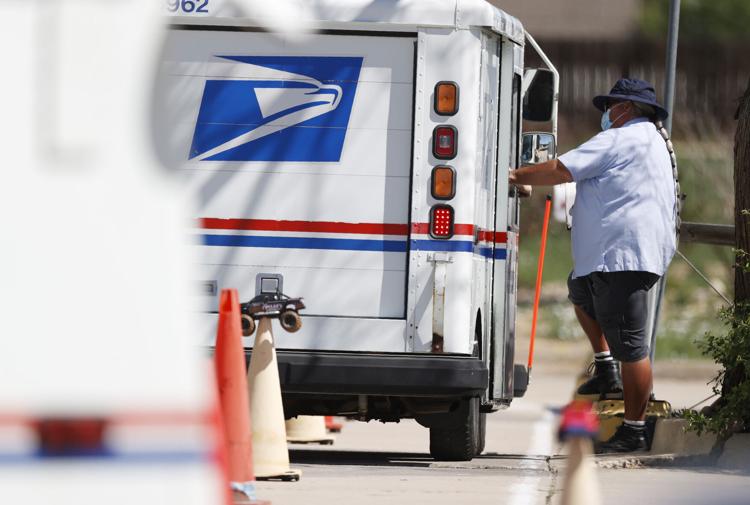
The United States Postal Service (USPS) isn’t exactly known for its financial acumen. The agency has lost more than $90 billion over the past 15 years, including nearly $15 billion since the start of the pandemic. Delivery speeds have rebounded since the middle of 2020, and the agency has a historic amount of cash-on-hand, but leadership has failed to stop the fiscal bleeding. And now, lawmakers are set to make things even worse by passing the deeply misguided H.R. 3076, the Postal Service Reform Act of 2021. This bundle of changes would shift retirement costs around and put the USPS on the hook for ill-defined “nonpostal services.” Congress should steer clear of H.R. 3076 and work toward genuine postal reform. The Postal Service Reform Act would change plenty about how the USPS operates. The most widely discussed change is the “integration” of retiree health benefits into Medicare. The legislation would split the existing Federal Employees Health Benefits (FEHB) program, which covers about 8 million federal and postal workers, retirees, and family members, into two. Out of this divorce would emerge a new general FEHB and a separate Postal Service Health Benefits (PSHB) Program linked financially to the Medicare program. Virtually all USPS employees would eventually be covered by Medicare, absolving America’s mail carrier of considerable healthcare costs. This “reform” does little, though, to actually save taxpayer money. It merely shifts a costly burden from one federal agency to another. Medicare expenditures now total more than $800 billion per year, and the program’s main trust fund is expected to hit insolvency by 2026. Adding postal retirement liabilities onto an already-bloated program seems like an odd way to keep costs under control. The grand Medicare “fix” receives far more attention than an even more alarming provision of the postal proposal. Section 103 of the act authorizes the USPS to “establish a program to enter into agreements with an agency of any State government, local government, or tribal government to provide property and services on behalf of such agencies for non-commercial products and services…” The limited-sounding scope of the provision seems to rule out the possibility that the USPS will take up banking (which many agency watchers reasonably feared). In reality, the legislative language gives the USPS wide license to dabble in banking and other problematic endeavors. To see how, consider that states such as New Jersey and California have been toying around with the idea of opening public sector banks. In 2019, California Gov. Gavin Newsom (D) signed into law a bill allowing counties and cities to create their own financial institutions that could take deposits and facilitate certain low-interest loans. And, New Jersey has been busy studying the implementation of its own public banking initiatives. One problem for public officials is cost. If taxpayer-funded banks provide inexpensive financial services, that money must come from somewhere. Enter the USPS, which can grab taxpayer subsidies and low-interest Treasury loans if it fails to balance its books. If H.R. 3076 becomes the law of the land, expect states and localities to try and partner up with the federal agency to provide ostensibly “non-commercial” financial services. And, if the USPS’ check-cashing pilot is any indication, expect that effort to end in disaster. If lawmakers really want the USPS to get back into the black, they’ll need to push the agency to focus on its core strength … delivering the mail. This will mean adequately pricing packages to ensure that artificially cheap parcels don’t swamp mail volumes and slow down mail delivery. There’s some promising language in H.R. 3076 ordering the Postal Regulatory Commission to review how products are priced. But, this will accomplish little if all the other problematic provisions become law. The USPS can continue delivering for the American people, but only if lawmakers avoid the misguided policies contained in postal “reform” legislation. Ross Marchand is a senior fellow for the Taxpayers Protection Alliance.
U.S. hospitals letting infected staff members stay on the job
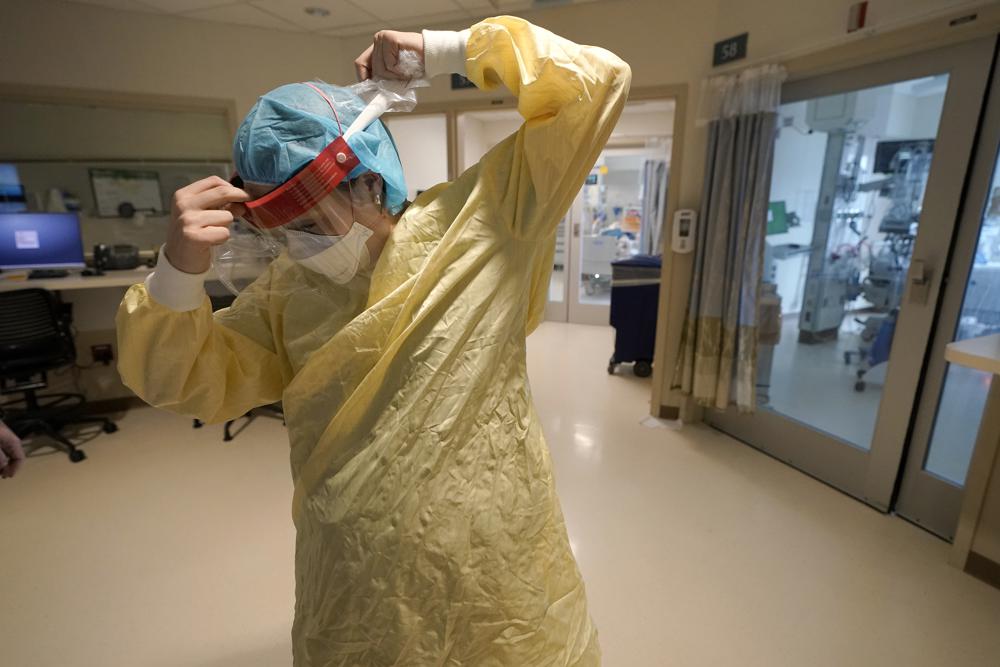
Hospitals around the U.S. are increasingly taking the extraordinary step of allowing nurses and other workers infected with the coronavirus to stay on the job if they have mild symptoms or none at all. The move is a reaction to the severe hospital staffing shortages and crushing caseloads that the omicron variant is causing. California health authorities announced over the weekend that hospital staff members who test positive but are symptom-free can continue working. Some hospitals in Rhode Island and Arizona have likewise told employees they can stay on the job if they have no symptoms or just mild ones. The highly contagious omicron variant has sent new cases of COVID-19 exploding to over 700,000 a day in the U.S. on average, obliterating the record set a year ago. The number of Americans in the hospital with the virus is running at about 108,000, just short of the peak of 124,000 last January. Many hospitals are not only swamped with cases but severely shorthanded because of so many employees out with COVID-19. At the same time, omicron appears to be causing milder illness than the delta variant. Last month, the Center for Disease Control and Prevention said that health care workers who have no symptoms can return to work after seven days with a negative test, but that the isolation time can be cut further if there are staffing shortages. France last week announced it is allowing health care workers with mild or no symptoms to keep treating patients rather than isolate. In the Phoenix area, Dignity Health, a major hospital operator, sent a memo to staff members saying those infected with the virus who feel well enough to work may request clearance from their managers to go back to caring for patients. “We are doing everything we can to ensure our employees can safely return to work while protecting our patients and staff from the transmissibility of COVID-19,” Dignity Health said in a statement. In California, the Department of Public Health said the new policy was prompted by “critical staffing shortages.” It asked hospitals to make every attempt to fill openings by bringing in employees from outside staffing agencies. Also, infected workers will be required to wear extra-protective N95 masks and should be assigned to treat other COVID-19-positive patients, the department said. The 100,000-member California Nurses Association came out against the decision and warned it will lead to more infections. Gov. Gavin Newsom and other state health leaders “are putting the needs of health care corporations before the safety of patients and workers,” Cathy Kennedy, the association’s president, said in a statement. “We want to care for our patients and see them get better — not potentially infect them.” Earlier this month in Rhode Island, a state psychiatric hospital and a rehabilitation center allowed staff who tested positive for COVID-19 but were asymptomatic to work. Republished with the permission of the Associated Press.
