
White House pushes ahead with Mideast peace plan
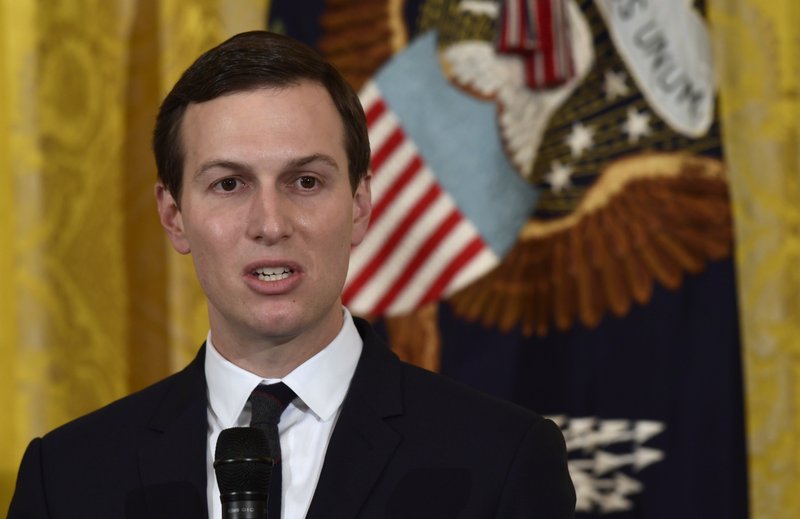
The Trump administration is aiming to roll out its much-hyped but long-delayed Middle East peace plan next month amid signs it may further alienate the Palestinians by slashing millions of dollars in funding for humanitarian and development projects in the West Bank and Gaza. Five U.S. officials and a congressional aide say the administration intends to release the peace plan in mid- to late-June, shortly after the end of the Muslim holy month of Ramadan, although they cautioned that the timing could slip depending on developments in the region. They say the plan’s main authors — President Donald Trump’s son-in-law and senior adviser Jared Kushner and Trump’s special envoy for international negotiations Jason Greenblatt — have already begun quietly briefing select allies and partners on elements of the proposal. Yet any Palestinian willingness to even consider the plan would require conditions to improve and anger to subside considerably in the coming weeks, an unlikely scenario as the Palestinians say evidence of one-sided Trump giveaways to Israel continues to pile up. U.S. allies in Europe and the Persian Gulf also have felt compelled to criticize the administration for its approach. Ostensibly, Trump would need buy-in from those same countries to build enough momentum for any peace plan to succeed. The administration has been resisting congressional demands to fully close the Palestine Liberation Organization office in Washington because Greenblatt and Kushner want to keep that channel open in case the Palestinians are open to re-entering negotiations with Israel based on the plan. The office was ordered closed by former Secretary of State Rex Tillerson last November, but has been allowed to stay open for limited purposes under the administration’s interpretation of the law requiring it to be shut down in the absence of peace talks. The prospect of Palestinian interest in the peace proposal appears dim, however, particularly since Palestinian leader Mahmoud Abbas recalled the mission’s chief earlier this week to protest Monday’s opening of the new U.S. Embassy in Jerusalem. The embassy move is said to have contributed to violent protests in Gaza that were met with deadly force from Israel. Nearly 60 Palestinians were killed Monday by Israeli forces, drawing condemnations and calls for restraint from Europe and elsewhere. The U.S. declined to join those calls and, while regretting the loss of life, opposed efforts at the U.N. to open an international investigation into the violence. Trump’s recognition of Jerusalem as Israel’s capital, the embassy move and the administration’s unreserved defense of Israeli Prime Minister Benjamin Netanyahu’s policies have alienated and angered the Palestinian leadership, which accuses the administration of abandoning its role as a neutral arbiter in the conflict. Saeb Erekat, the chief Palestinian negotiator, said any deal needs to be between the Palestinians and Israel — not the United States. “I don’t need Jason Greenblatt. I don’t need Kushner,” Erekat said. “It’s our lives.” That sense of betrayal may deepen significantly this summer as millions of dollars in U.S. assistance to the Palestinians appears likely to be cut and the funds re-allocated to other regions. That money has been on hold since last year and existing funding for some projects will start to run out in just months if it is not approved in the next two weeks. If that does not happen, the State Department and the U.S. Agency for International Development will have to notify aid recipients that continued U.S. funding is not forthcoming and those programs will begin to be shut down. Local staffers would be laid off and U.S. officials running the projects would be reassigned elsewhere. Of $251 million in U.S. aid planned for the Palestinians in 2018, only $50.5 million has been reported spent, according to the government’s online tracker, www.foreignassistance.gov. The remaining more than $200 million is currently on hold, a figure that does not include an additional $65 million in frozen U.S. assistance to the U.N. Relief and Works Agency, which provides services to Palestinians in the West Bank, Gaza, Jordan and Lebanon. The U.S. aid pays for programs on education, health, good governance and democracy promotion as well as disaster preparedness and security. For several months the White House has been sitting on State Department and USAID recommendations to spend at least some of the money, according to the officials. Three officials said there is no indication those recommendations will be acted upon any time soon despite appeals from lawmakers and even expressions of concern from Israel, which sees value in the assistance especially in the security sector. One official said there was “an overwhelming lack of urgency” about making a decision on the funding. The other two said there was no sign that the end-of-May timeframe would be met. “The administration is currently reviewing U.S. assistance to the Palestinians,” USAID said in a statement to The Associated Press. “USAID is in discussions with all affected implementing partners on the status of the review, and is working closely with the interagency, as the administration concludes its review.” At immediate risk are between five and 10 of the some 20 USAID projects in the West Bank and Gaza, along with proposed new initiatives, the officials said. Without a quick decision those will run out of money by the end of 2018, they said. Nearly all of the others will run out of money in early 2019 unless the U.S. funding is unblocked, they said. Republished with the permission of the Associated Press.
Mike Pompeo says Israel, Palestinian peace still a U.S. priority
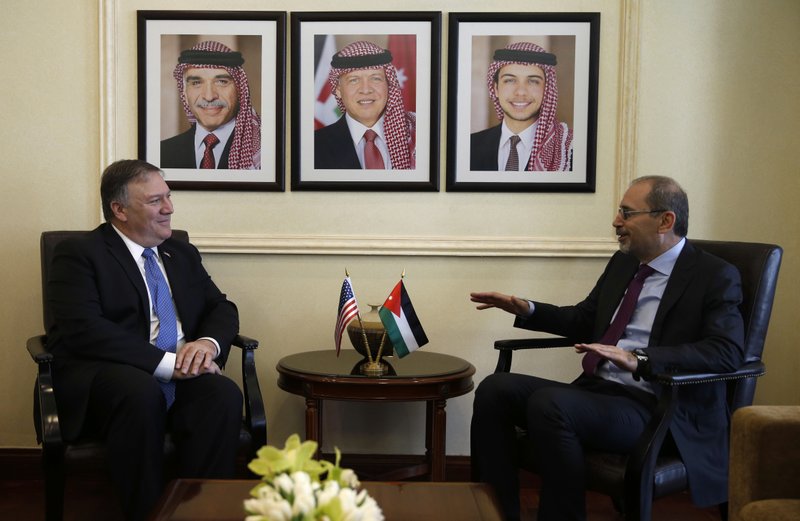
U.S. Secretary of State Mike Pompeo said Monday that a resolution to the Israeli-Palestinian conflict remains a priority for the Trump administration, despite its recognition of Jerusalem as Israel’s capital and its planned move of the U.S. Embassy to the holy city over Palestinian protests. Pompeo also said the U.S. is “fully supportive” of Israel’s right to defend itself and declined to criticize the Israeli military for its use of live fire against Palestinian protesters along the Gaza border. He spoke in the Jordanian capital of Amman as he wrapped up the Middle East leg of his first overseas trip as America’s top diplomat. Pompeo called on the Palestinians to return to long-stalled peace talks with Israel. He said the United States is open to a two-state solution to the conflict if both parties agree, calling it a “likely outcome.” But he would not agree with Jordanian Foreign Minister Ayman Safadi’s characterization of the conflict as “the main cause of instability” in the region. “The parties will ultimately make the decision as to what the correct resolution is,” Pompeo told reporters at a joint news conference with Safadi. “We are certainly open to a two-party solution as a likely outcome.” But, he said, the Palestinians had to return to a political dialogue to get there. “An important piece of achieving Middle East stability is to resolve this conflict,” he added. “Precisely how to rank it among all the various challenges, I’ll defer on that. Know that it is an incredible priority for the United States to provide whatever assistance we can to allow the two parties to come to a resolution.” Safadi had opened the news conference with an apparent appeal for the U.S. to boost efforts to end the conflict. “This is the main cause of instability in the region and its resolution is the key to achieving the peace and stability we want,” he said. “Yes, the two-state solution is being challenged. Yes, there are many obstacles. But what is the alternative? We cannot give up in our efforts and there is no viable alternative.” Pompeo’s comments came at the end of a two-day visit to Israel and Jordan during which he did not meet Palestinian representatives. The Palestinians have essentially boycotted contacts with the U.S. since Trump announced in December that the United States was recognizing Jerusalem as Israel’s capital. The Palestinians claim east Jerusalem — captured by Israel in 1967 and then annexed — as the capital of a future state. Pompeo’s visit is also taking place just two weeks before the planned May 14 opening of the new U.S. Embassy in Jerusalem and expected massive Palestinian protests the following day. Over the past month, 39 Palestinians have been killed and more than 1,600 wounded in weekly border protests along the Gaza border, prompting human rights groups to ask Israel’s Supreme Court on Monday to restrict or ban the use of live ammunition. They say the military’s use of lethal force against unarmed protesters is unlawful. Israel’s military argues that the border protests are part of a long-running conflict with Gaza’s ruling Hamas, which it considers a terror group, and that the rules of armed conflict apply. Asked about the situation, Pompeo demurred, referring to “activities in Gaza over the past days and weeks.” “We do believe the Israelis have the right to defend themselves and we are fully supportive of that,” he said. In addition to the Jerusalem decisions, the Trump administration has also angered the Palestinians in recent months by ordering their office in Washington closed, although it remains open for business related to negotiations, slashing funding for the U.N. agency that supports Palestinians in the West Bank, Gaza and elsewhere in the region, and putting on hold all bilateral assistance to the Palestinians. Although the White House sponsored a conference on aid to Gaza last month, the Palestinians did not attend. And, a peace plan devised by Trump’s son-in-law and senior adviser Jared Kushner and his special envoy for international negotiations Jason Greenblatt appears to be on hold. Republished with the permission of the Associated Press.
