
GE Aviation managers in growing Alabama plant share training duties
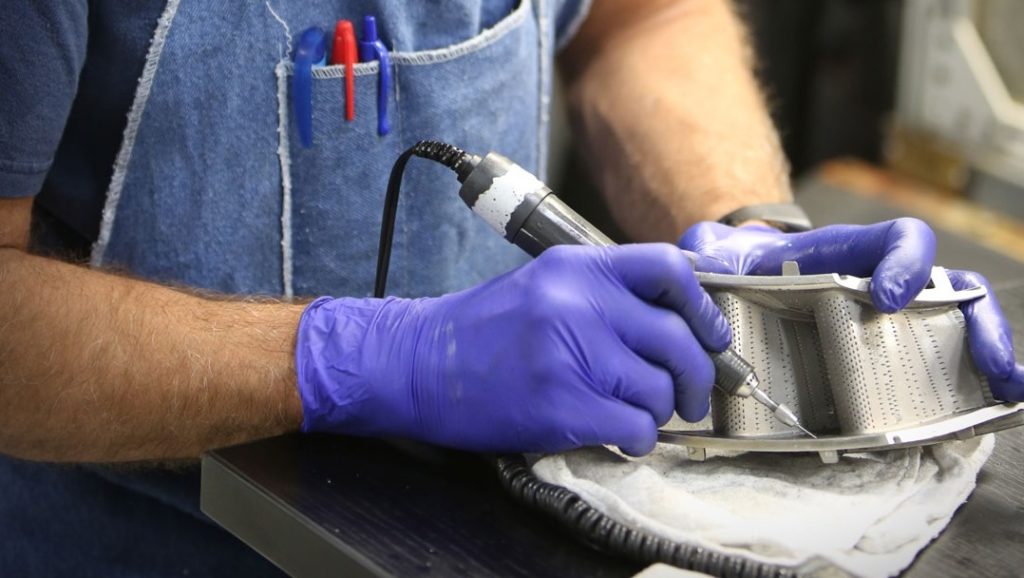
Joseph Moore works days on the shop floor at GE Aviation’s fast-growing jet engine factory in Auburn – then teaches his experiences at night in the classroom. He’s one of several operations managers at GE’s Auburn site with a teaching role during the month-long vocational training sessions at Southern Union State Community College near Auburn to prepare GE’s growing roster of hourly workers About four sessions are held annually to handle the demand for more trained workers in the GE Auburn factory. In addition to the Southern Union instructors, the program includes Moore and his GE colleagues each leading a three-hour evening of instruction each week. “I really enjoy the interaction,” said Moore, who teaches lean manufacturing, Six Sigma quality practices and compliance. “Being part of the training also allows us to get a good look at the people we are evaluating for positions at the plant.” The close cooperation between GE Aviation, Southern Union and the Alabama Department of Commerce is another example of GE Aviation preparing workers for the skill sets required in its new modern factories across the U.S. “Alabama has long been a leader in workforce development, and it’s critical that we partner with industry leaders like GE Aviation to develop cutting-edge training programs like this one,” said Ed Castile, director of AIDT and deputy secretary of the Alabama Department of Commerce. “With new technologies rapidly changing how factories and other workplaces operate, our workers must be equipped with the in-demand skills to succeed in the future.” GE’s Auburn facility uses sophisticated equipment to machine advanced turbine airfoils and structural components for jet engines. Machine operators vying for positions are first trained at Southern Union with a curriculum developed by the Commerce Department’s AIDT division and by local GE plant leaders. GE Auburn produces components for the fastest-selling jet engine in commercial aviation history, the “LEAP” engine for CFM International, the 50/50 joint company of GE and Safran Aircraft Engines of France.GE is actively involved in the training process because GE Auburn is ramping up fast. Employment reached 200 people in March and is expected to grow to 280 by year’s end, according to plant manager Ricardo Acevedo. More than 14,000 LEAP engines are on back order to power three airplanes: the Airbus A320neo (soon to be made in Alabama), Boeing737 MAX and China’s COMAC C919. The Airbus and Boeing airplanes are now in airline service. The GE and Safran factories delivered 459 LEAP engines in 2017. The LEAP delivery goal is up to 1,200 engines for 2018 and in the 1,800-engine range in 2019. In addition to machining parts, the Auburn site this year will produce more than 34,000 fuel nozzle injectors for the LEAP engine using additive manufacturing machines. Auburn’s 37 additive machines is expected to grow to 45 by midyear to handle the needed higher volume. These employees require six weeks of in-house training. GE is looking at ways to engage the local community colleges in offering additive manufacturing as part of their curriculum. GE Aviation is also engaging with engineering students at Auburn University in additive manufacturing projects as part of a groundbreaking partnership. ‘Great careers’ Training for GE’s Auburn employees is not limited to community college classes. The plant also offers training in non-destructive testing in which employees become certified to evaluate jet engine components scanned in advanced X-ray machines. “There’s a skills shortage in this field,” said Tory Landry, the plant’s human relations leader. “It’s hard to find the people. We offer in-house training to candidates who can then experience a significant pay increase.” Among the factors Acevedo attributes to high retention at the plant is the GE investment in training. “There are great careers in advanced manufacturing,” he said. Over the past decade, GE Aviation has opened eight new facilities in the United States, including the new factory in Auburn and a $200 million advanced materials production center in Huntsville. Republished with the permission of Alabama Newscenter.
GE selects Auburn University for additive manufacturing program
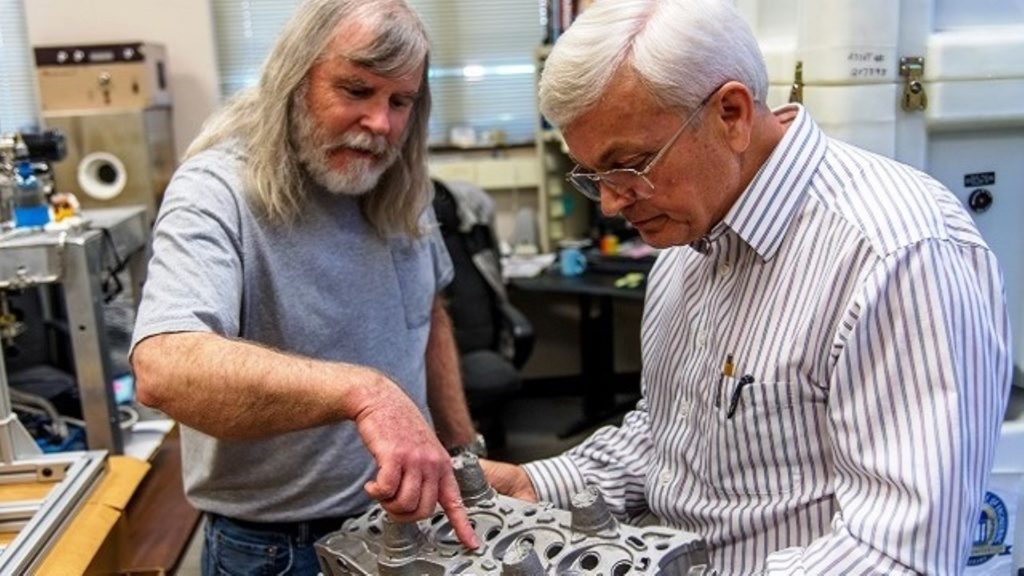
A leader in additive manufacturing technologies, GE, has selected Auburn University as one of just eight universities from around the world to participate in a groundbreaking program focusing on 3-D printing research and education initiatives. Auburn, which has been strategically expanding its activities in additive manufacturing, will receive a state-of-the-art Concept Laser MLAB 100R metal printer as part of the GE Additive Education Center. The printer is valued at $250,000. Manufacturers are increasingly using additive manufacturing to produce intricate metal components with complex geometries. (Contributed) “Auburn Engineering is a national leader in industrialized additive manufacturing,” said Christopher B. Roberts, dean of Auburn’s Samuel Ginn College of Engineering. “Companies such as GE have asked for our help in graduating engineers who are well versed in additive manufacturing and prepared to lead American industry into the future.” A GE advisory group composed of engineers and additive manufacturing specialists chose Auburn out of more than 250 applicants because of its established additive manufacturing curriculum and extensive research initiatives within the engineering school. GE’s Additive Education Program was created to support colleges and universities such as Auburn that are educating students in additive manufacturing technologies. Through the program, GE is investing $8 million over five years to provide up to 50 metal additive machines to higher education institutions around the world. “Additive manufacturing and 3-D printing is revolutionizing the way we think about designing and manufacturing products,” said Mohammad Ehteshami, vice president of GE Additive. “We want a pipeline of engineering talent that have additive in their DNA. This education program is our way of supporting that goal.” Leadership position Greg Canfield, secretary of the Alabama Department of Commerce, said Auburn’s concentration on additive manufacturing is positioning its engineering school as a leader in the game-changing technology. GE Aviation produces fuel nozzles using additive manufacturing at a plant in Auburn. (Contributed) “Additive manufacturing represents a significant breakthrough that will reshape how manufacturers produce all kinds of products, and it’s critical that Alabama’s workforce is prepared for this technology,” Canfield said. “The partnership between GE and Auburn University will help ensure that we’re ready for future advances,” he added. GE already has a strong presence in Auburn. Its GE Aviation unit is using additive manufacturing to mass produce fuel nozzle injectors at a plant in the city’s Technology Park West. The company says the nozzle is the first complex jet engine component produced with 3-D printing technology. Advancing additive Roberts said Auburn has moved to greatly expand its programs in additive manufacturing. An artist’s rendering shows the renovated Gavin Engineering Research Laboratory. When it opens later this year, the laboratory will feature dedicated space for Auburn University’s additive manufacturing research. (Contributed) “We responded by developing new curricula so students learn how to design for additive manufacturing systems,” he said. ‘We are also investing millions of dollars in the latest 3-D printing technology and hiring world-class faculty to teach our students. “This award further strengthens our relationship with GE, and we look forward to even greater collaboration with them in our education and research programs.” Auburn Engineering faculty members are also researching other ways to employ additive technology, such as producing next-generation rocket engines for space flights to Mars or developing intricate medical implants for use during surgery. In addition, Auburn has created a new Center for Industrialized Additive Manufacturing, directed by materials engineering professor Tony Overfelt, and hired internationally known faculty working in this growing field of research. The university’s newly renovated Gavin Engineering Research Laboratory opens later this year and will feature dedicated space for Auburn’s additive manufacturing research, including upgraded and expanded testing equipment. In addition, Auburn has signed a Space Act Agreement with NASA to jointly explore and advance the applications of 3-D printing technologies. How it works Additive manufacturing of metal parts is typically conducted using a laser or an electron beam to heat input materials during the printing process. (GE Additive) Additive manufacturing involves fabricating parts layer-by-layer from metals, plastics or other materials based on a 3-D computer-aided design model. Because parts are made by building upon each layer, additive technology reduces waste in the manufacturing process, improves production speed and can create parts that are lighter and more durable than those made using traditional manufacturing methods. With the ability to create highly complex parts in a fraction of the time, additive technology is revolutionizing the manufacturing industry and creating new opportunities for engineers to explore. GE Aviation says the fuel nozzle produced at its Auburn plant is 25 percent lighter and five times more durable than conventional models that took longer to produce. This story originally appeared on the Alabama Department of Commerce’s Made in Alabama website. Republished with permission of Alabama NewsCenter.
