Democrats filibuster plans to bring up General Fund budget next week
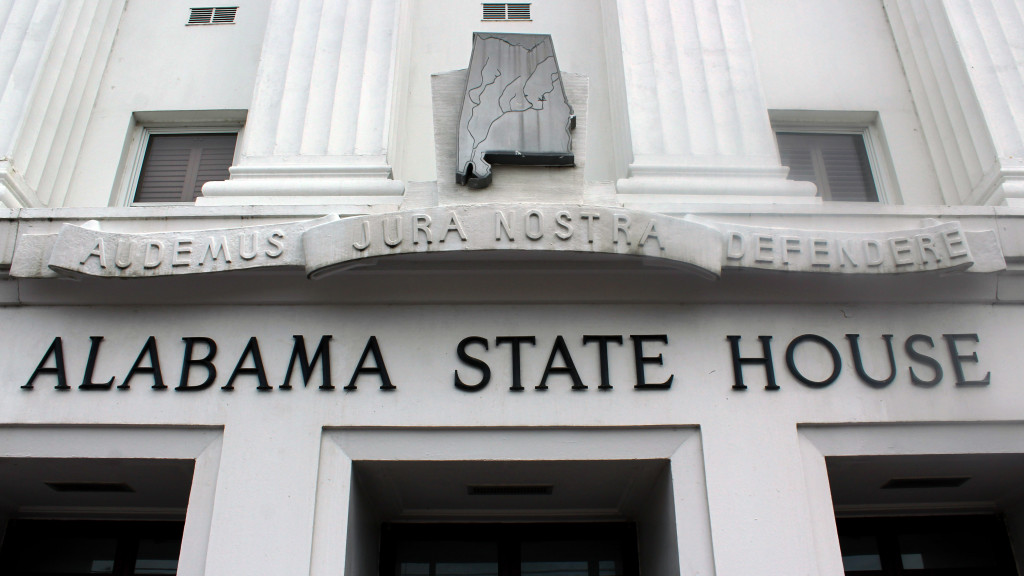
Word came through the pipeline early Thursday from an intern of Rep. Craig Ford (D-Gadsden) that House Democrats would be filibustering the introduction of the Special Order Calendar, approved by the Rules Committee, which aims to bring forth the General Fund budget for discussion next week. True to form, Dems did just that when Rep. Mac McCutcheon (R-Huntsville) moved for approval of the calendar. Rep. John Knight (D-Montgomery) spoke first and chastised members of the Rules Committee for putting forth legislation for discussion which hasn’t addressed paramount problems of the state. “If we’re not going to fund Medicaid, there’s no need for us to have any kind of order,” Knight said. “There will be no order in this House until we decide to fund Medicaid.” Knight said more than 500,000 Alabama children use Medicaid and choosing not to adequately fund the program would take away those children’s health care. Knight encouraged members to meet with Gov. Robert Bentley and others to find a solution, possibly cutting other programs to fund it. “If we can’t do that, there’s no need in us being here,” Knight said. “We were elected to do our jobs. We came together on the education budget, so we must do the same thing as it relates to the General Fund budget.” Rep. Mary Moore (D-Birmingham) also railed against the calendar, urging lawmakers to do whatever is required to provide relief to Alabama’s most needy citizens and make sure that Medicaid funding is a priority for the state. Rep. Ralph Howard (D-Greensboro) spoke out against the General Fund’s failure to adequately fund Medicaid, leaving an about $100 million shortfall in the program and obliterating Alabama’s plans to institute the Regional Care Organization (RCO) plan. “I represent a lot of poor people and healthcare is something that’s very important to them,” Howard said. “I just wanted to convey to this body that we really need to take a look at what we do for those poor people.” Howard noted that Perry County hasn’t had a hospital in many years and rural hospitals are being decimated by the state’s failure to fund Medicaid. “It needs to be the will of this body, and the Senate and the governor, to really try to make Alabama a better place,” Howard said. “And I don’t think there’s a better place to start than healthcare. Those are good people in rural Alabama and they deserve better.” As Howard completed his statements, Rep. Danny Crawford (R-Athens) made a motion to adjourn and the House agreed.
Proposed constitutional amendment would dictate how oil spill money can be spent

Rep. Randall Davis (R-Daphne) has introduced a bill which would propose an amendment to the Alabama Constitution to “provide for the distribution and use of certain payments received by the state from settlements and other monies.” HB360, known also as the Alabama Strategic Investment Initiative, would also require lawmakers to pass legislation creating an authority to issue revenue bonds using money from the Deepwater Horizon Oil Spill Disaster to fund bond payments. The bill would further require the distribution of such funds for specific purposes. The bill details that funds from the oil spill settlement can be used to repay the $161.5 million taken from the General Fund Rainy Day Account to prop up the General Fund. Further, funds can be used to supplement funds being allocated to Mobile and Baldwin counties, not to exceed $439 million, in the following manner: to the Department of Transportation to assist in completing the Highway 98 project, the I-10 to I-65 Beach Expressway project and the Rangeline Road Extension project. $50 million for the Strengthen Alabama Homes Fund, for “residential property owner grants to retrofit insurable property to resist loss due to hurricane, tornado, or other 22 catastrophic wind events.” Oil spill allocations in this fashion would be decreased if any additional funding, such as federal or local matching funds, and if any is left over it would be used to repay the money taken from the Education Trust Fund between 2013 and 2015. A recent move by Gov. Robert Bentley to use oil spill money to renovate a beach-side mansion has attracted the fury of some state lawmakers and, though it does not specifically mention those efforts, the bill does spell out how the money can be used and leaves little leeway for spending it otherwise. If approved by the legislature, the amendment could go to the public for a vote as early as November.
Senate passes $1.8 billion general fund budget framework
The Alabama Senate passed a taut $1.8 million budget framework for non-education spending on Thursday, level-funding most state agencies and passing no tax increases that might increase revenue next year. Montrose Republican Sen. Trip Pittman said the Senate’s proposed budget, while lean, provides adequately for basic services Alabamians rely on. “This is a tough but workable budget for the people of Alabama,” said Pittman, who chairs the Senate General Fund Budget Committee. “It level-funds many state agencies, while increasing funds for Public Health and our National Guard units. I look forward to the House’s input and ideas on the budget.” According to the Senate Majority Caucus, the FY17 budget increases by $2.5 million the funding for both Mental Health and the Department of Human Resources, and gives Public Health an additional $10 million over last year, on the heels of a tuberculosis outbreak in west Alabama. Senate President Pro Tem Del Marsh offered his praise to Pittman for his work on wrangling a budget proposal early on in the process, to ensure plenty of time for lawmakers to hammer out their inevitable differences. “I want to commend Senator Pittman’s diligent work on getting the General Fund out on the 10th Legislative Day, one of the fastest in recent memory. Getting started on the budget process prior to the beginning of session no doubt helped everyone involved. I believe everybody in the Legislature was eager to pass the General Fund in a timely manner to avoid a summer of special sessions,” Marsh said. The House will now take up the General Fund budget and release their own proposal. If the two chambers are able to agree on a final budget plan, it will move on to the desk of Gov. Robert Bentley, who has line-item veto authority.
Clay Scofield: Here’s my plan so future generations enjoy our state parks
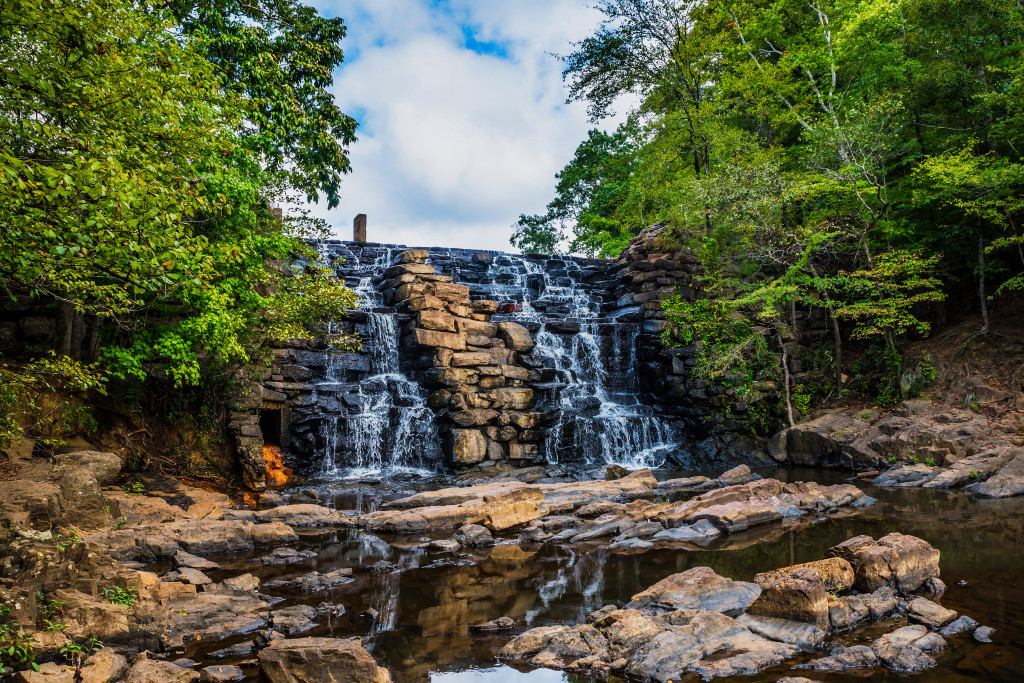
Alabama’s State Parks are treasures that should be cherished and protected for future generations. Unfortunately, over the past few years, the parks system has suffered from multiple budget transfers to fund other General Fund agency shortfalls. I have a plan that will help to permanently fund our state parks and keep these God-given resources available for future generations. Our state’s General Fund has faced great challenges the past few years in terms of identifying adequate funding for state services. To fill those shortfalls, funds were transferred from the Department of Conservation and Natural Resources (DCNR) and the State Parks to fund other areas of government. Since 2012, $30 million has been transferred from the DCNR, and $15 million of this came directly from the parks system’s accounts. I have a plan to stop this unfair practice of taking money directly from our parks to fund other areas of government. I’ve proposed a constitutional amendment that would allow citizens to vote this November to protect Alabama State Parks’ funding forever. This constitutional amendment would prohibit any further transfers from the parks system’s funds to the state’s General Fund. The people of Alabama deserve the opportunity to have a voice about the future of their State Parks. Alabama State Parks have always operated on a slim budget and are unique. Unlike other state agencies, which receive appropriations from the state’s General Fund each year, state parks earn most of their own funds through guest fees. Unfortunately, millions of dollars made at the parks have been transferred to other state agencies over the past few years. Half of the more than 4.5 million visitors to Alabama State Parks come from out of state. The parks provide an economic boost of more than $375 million, a significant return on investment compared with most other state agencies. The Alabama State Parks System is also unique in the minimal support received from tax dollars. The parks generate more than $30 million from guest fees each year, which makes up 80 to 90 percent of the parks system’s annual budget. Other state parks systems in the Southeast, and across the country, receive considerable contributions from taxpayers. In Florida, Georgia and Mississippi, state parks’ revenues account for only about 65 percent of the total cost of operating the parks. In Tennessee, less than 45 percent of the operating costs of the parks are made at the parks; the rest comes from tax dollars. Other states heavily contribute to the success of their parks system with tax dollars. In Alabama, we take from the parks to fund other government agencies. The continued loss of this revenue has caused our parks system to begin implementing emergency contingency plans across the state. What does that mean? To cut costs, the system has been forced to close five parks. There are now seasonal closures for facilities at a number of other parks, and one park has transitioned to day-use only and made other operational changes to save money. In addition, it is likely the fees for services already offered at our State Parks will have to be increased in the near future. Again, this has not been caused by anything the State Parks are doing wrong or inefficiently. As a matter a fact, even after terrible natural disasters — such as Hurricane Ivan, which destroyed the state’s most profitable park on the Gulf Coast, or the tornadoes of 2012 that ripped through the campground at Guntersville — the parks’ staff and its supporters rallied to ensure the parks system continued to prosper even during these difficult times. Like many Alabamians, I have spent countless hours making memories in our State Parks, and I want to ensure that all families in the state can continue this legacy. I’ve always been amazed at the wide array of people who use and enjoy our parks. They are people of all interests and income levels – state residents and tourists alike. It’s time we let the people of Alabama decide if our parks will be a priority. I have no doubt the outcome will be an overwhelming “Yes.” Before this measure can reach the citizens on the ballot in November, the Legislature must first vote in favor of this amendment to protect our parks funding. Reach out to your local state representative and state senator and ask them to support this constitutional amendment. • • • Clay Scofield is a state senator from Guntersville, Alabama. He represents the 9th district. He represents Blount, DeKalb, Madison and Marshall counties.
Mike Hubbard, Del Marsh look back on eventful week
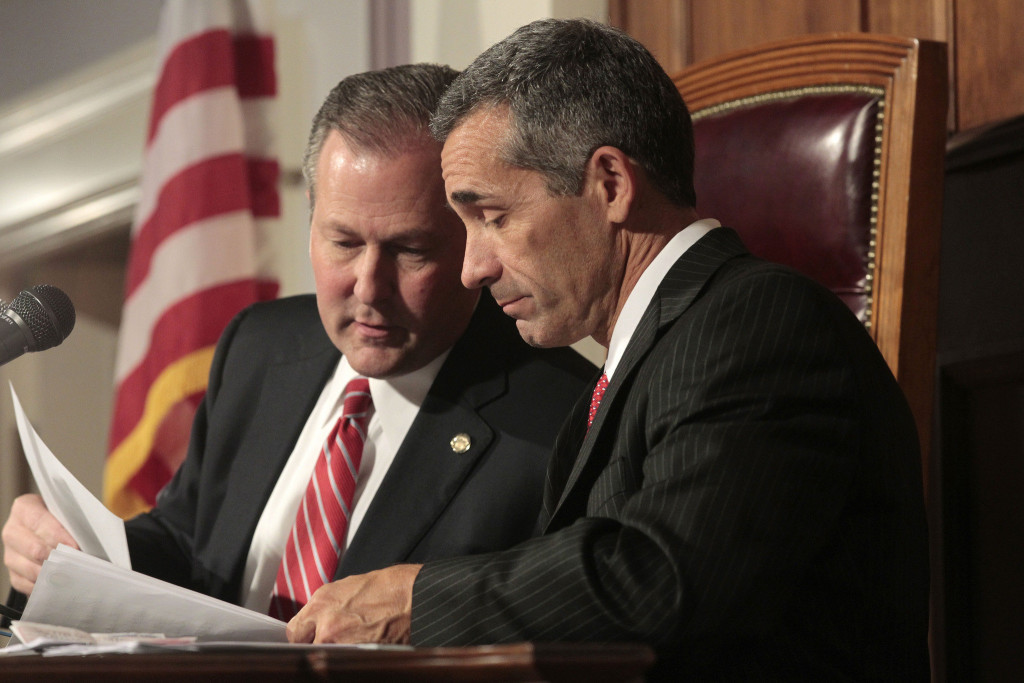
Both House Speaker Mike Hubbard (R-Auburn) and Senate Pro Tem Del Marsh (R-Anniston) seemed enthused by the amount of work accomplished in their respective chambers this week. The scene in the House was often more heated than that in the Senate, as House members took up several key Republican agenda items while Senators toiled away at a pile of Sunset Law bills. “I think it was a very productive week,” Hubbard said, praising the work of House Republicans in passing issues important to the party. Among the bills which cleared the House this week were a bill enshrining Alabama’s status as a “Right-to-Work” state in the constitution. The House also passed the “Unborn Infants Dignity of Life Act” and the “Uniform Wage and Right-to-Work Act.” All three bills faced stiff opposition from House Democrats, with the “Right-to-Work Act” from Rep. Arnold Mooney (R-Shelby) even facing defeat earlier in the session. Hubbard is looking at beginning work on the General Fund and Education Trust Fund budgets as early as next week, as well as a bill that would make Alabama the first state in the nation to provide all of its schools with internet access. Marsh echoed most of Hubbard‘s statements. “It was a great week,” Marsh said. “I think we got a great start.” Marsh praised Senators for passing a wide array of Sunset Law bills with little difficulty and a calendar which limited the amount of controversial bills coming up for discussion in the early weeks of the session. Marsh noted that it is his intention to address budget issues next week as well, along with those bills which passed through the House and Senate committees this week. Many of the bills which created discontent among Democrats in the House will likely face the same fate in the Senate, including the bill to prohibit municipal minimum wage increases from Rep. David Faulkner (R-Jefferson), which Marsh had no comment on. Hubbard, who opposes the institution of a state lottery, also hopes to see language added to the lottery bill from Rep. Alan Harper (R-Northport) to indicate where profits from the perceived lottery would be directed.
State Senate Republicans identify jobs, education and families among top priorities
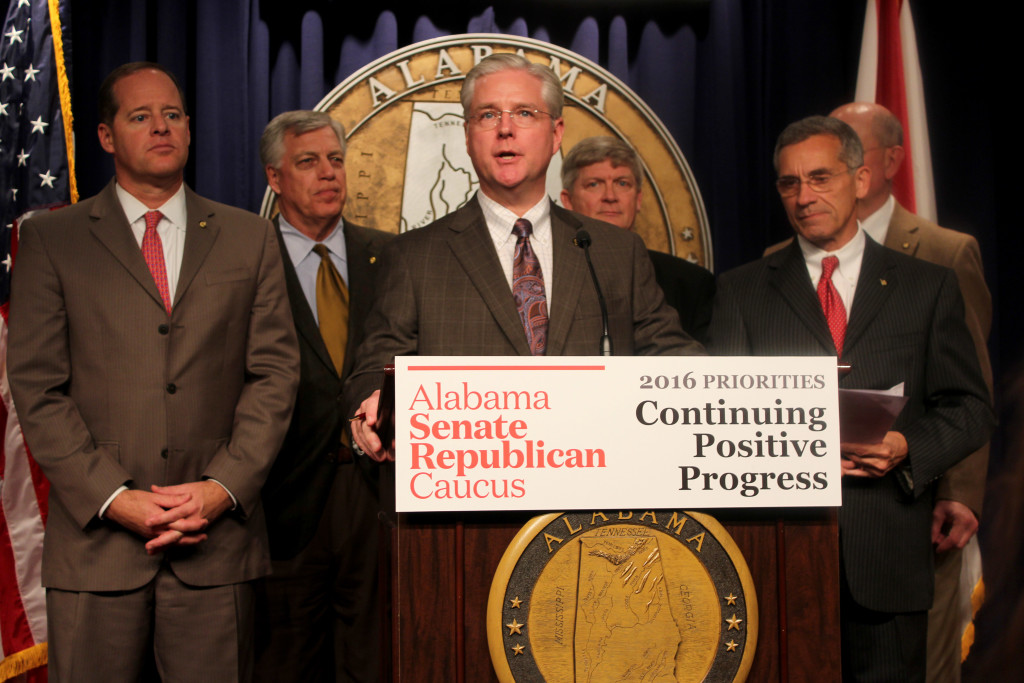
Senate Republicans announced their agenda for this year’s legislative session, calling it “Continuing Positive Progress,” during a brief news conference Tuesday. Senate Majority Leader Greg Reed (R-Jasper) and Senate President Pro-Tem Del Marsh (R-Anniston) were on hand with others from the Senate Republican Caucus to discuss the group’s priorities for this year, which include spurring economic growth, protecting children and families and encouraging education excellence. “While addressing our primary goal of passing balanced, responsible budgets, Senate Republicans will also tackle our legislative priorities,” Reed said in a news release. “The people of Alabama elected us to focus on jobs, education, and families – and we’re doing just that.” In an effort to “spur economic growth,” Republicans plan to create “more flexibility to craft responsible, pay-as-you-go incentive packages” to create more jobs in the state. Further, Republicans plan to provide economic incentives to have companies use Alabama’s ports to ship products to the state – such products are often shipped to other ports and then brought into Alabama – which “will generate exponentially more tax revenue and jobs.” In its effort to “protect children and families,” Senate Republicans plan to pass both child abuse bills brought up in this morning’s judiciary hearing in an effort to protect Alabama’s “most vulnerable victims of abuse.” Republicans also plan to equip K-12 teachers with the tools needed to curb the rate of youth suicide in the state, which they say is a significant problem in the state. In its efforts to “encourage education excellence,” the Republican Caucus will support a pay raise for Alabama’s teachers, per Gov. Robert Bentley‘s proposal, and “incentivize accountability, specialized hiring and retention” by finding ways to rid the sate of ineffective educators and reward those who go above and beyond. During the press conference, Marsh commented on his RAISE Act, which has received a lot of negative attention from educators claiming it links teacher raises to test scores and student achievement. Marsh said the act does not link the two, it simply creates a five-year tenure track that can be reversed if teachers prove ineffective in preparing students. “We’re doing things I think are very positive,” Marsh said. “At the end of the day, we all want our children to do better.” Asked whether a proposal by Bentley to move Education Trust Fund dollars into the General Fund would gain traction in the Legislature, Reed said he didn’t know whether “there is a significant appetite” for such a move. In reference to a question on whether the repeal of Common Core curriculum standards would make it to the floor this year, Marsh said he is “not convinced those votes are there,” adding that it should be up to the state school board to make that decision.
Budget calls for un-earmarking education funds to square General Fund
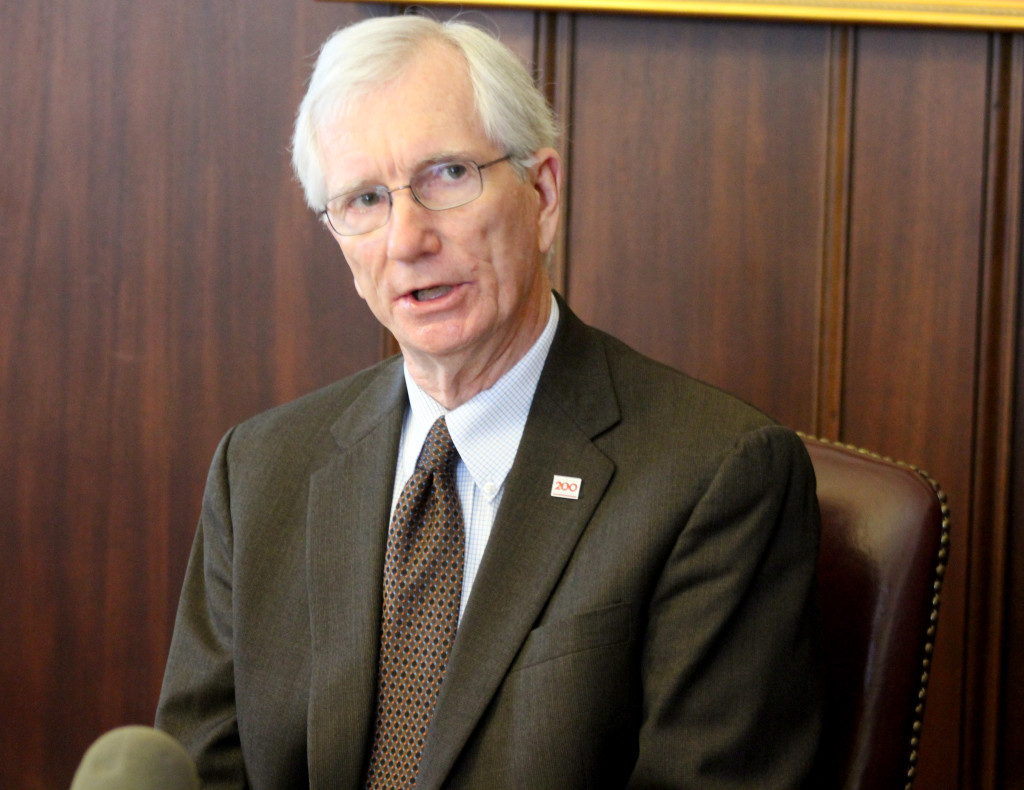
Alabama Finance Director Bill Newton held a newss conference Tuesday to break down proposals from Gov. Robert Bentley concerning this year’s General Fund and Education Trust Fund (ETF) budgets. The governor proposed un-earmarking $181 million from the ETF, $150 million from use taxes and $31 million from insurance premium taxes, in an effort to square the General Fund. This year’s General Fund budget will total $1.93 billion, up from last year’s $1.85 billion budget, and provide a $100 million increase to Medicaid, a $70 million increase to the Department of Corrections, a $10 million increase to the Alabama Department of Public Health and a $5 million increase for the Department of Human Resources. The budget also calls for a 2.5 percent decrease in funding for the legislative branch, district attorneys, the finance department and the forensic science department, as well as a 5 percent decrease for agriculture and industry, military and the Department of Youth Services. The proposal also includes a 2 percent cost of living raise for education and state employees, with level funding for state employees’ healthcare at $825 monthly for each employee. Newton also addressed Bentley’s plan to close all of Alabama’s prisons and open four new facilities, saying the “significant savings” from eliminating the inefficient facilities would pay for the cost of construction, which is slated to be completed within three years. This year’s ETF will have an appropriation of $6.31 billion, up from last year’s $5.95 billion, of which the $181 million moved to the General Fund will be made up from the Budget Stabilization Fund, one of the state’s two savings accounts. K12 programs in the state will see an increase to $3.99 billion from last year’s $3.84 billion and an increase for universities from $1 billion last year to $1.08 billion this year. A new line item includes $40 million to fund the governor’s proposal to provide broadband internet to rural parts of the state. Additionally, an increase of more than $5 million will be allocated for textbooks, providing about $60 per student.
Robert Bentley supportive of lottery plan, with a catch

Gov. Robert Bentley came out in support of a lottery plan that is circulating among Montgomery law makers – but with one condition. Bentley has said he would change his stance on the issue if the revenues flow into the state’s General Revenue fund, as opposed to being earmarked for education purposes only as one going proposal would provide. The governor has by and large been opposed to any expansion of gambling, though that has softened in recent months. If the lottery is “clean” and resultant revenues flow into GR, “I would be willing to talk about it positively, but if it’s not I will have to go the other way,” Bentley said. The stipulation that the money go into the general budged, however, will likely reduce support among many lawmakers and Alabama voters, who see a lottery as worthwhile only if goes directly to the education budget. “If we put this before a vote of the people and it fails, I don’t think it will ever pass again,” said state Rep. Craig Ford, the House’s Democratic caucus leader. “I think it is more palatable to the people of Alabama if it goes to the education trust fund,” Ford said. Asked whether Bentley’s position is designed to ensure a lottery does not pass, Ford said: “It could be.” Bentley would not be able to veto or otherwise scuttle the bill by himself since the measure would be on the ballot during 2016 General Election in November, though he could throw his weight either behind or against the bill on the stump or through an advertisement campaign.
Robertson/Barth/Jahera: Legislators step up to tackle Alabama’s underfunded pensions

On November 9, a newspaper in North Alabama published an editorial suggesting that any legislative interest in our state’s public pension system would inevitably spell “disaster” for retirees. The editorial also claims that legislators may be plotting to “shore up” the General Fund through the “cash cow” of Alabama’s public pension system. In reality, a handful of Alabama legislators are undertaking the mammoth task of ensuring that our state can fulfill the obligations owed to current and future public retirees. This is no small task, as Alabama’s public pensions are underfunded by at least $15.2 billion. To put this number into perspective, every household in Alabama would need to contribute $8,274 to fully fund the system. To the casual observer, an unfunded pension liability is about as abstract a concept as the national debt. Many taxpayers may wonder why it even matters–will the bill ever really come due? Politicians in both cases often get away doing nothing, because they know that they won’t be around when the bill does come due to future generations. And every year that these problems aren’t dealt with, they worsen. Alabama’s public pensions, unlike most private sector pensions, are based on a defined benefit formula. This means that state employees pay into their retirement accounts, as do their state employers, and the Retirement Systems of Alabama (RSA) invests that money with a guaranteed return of 8%. Whether or not the investments actually return 8% matters little to state employees, who will receive the same contractual benefit no matter what. How is this possible? Because the Alabama Legislature-led by the same individuals now being wrongfully accused of trying to raid the pension system–has been faithfully paying a large sum of taxpayer dollars to RSA each year to cover its shortfalls. This year alone, legislators sent RSA nearly $1 billion. And they didn’t have to. The state is not legally required to pay the “annual required contribution” (known as the ARC), yet the legislature has never failed to make that payment–even when it has been painful to do so, as it was this year. The ARC is the yearly amount needed to fund current and future retirement benefits and liabilities. Why has the legislature made this payment? To keep the system solvent for our public retirees. Legislators in states like Illinois, New Jersey, and Pennsylvania chose not to fund the ARC, obligating taxpayers to further subsidize these drastically underfunded pensions. What Alabama’s legislators have begun to realize, however, is that it’s getting harder and harder to make that substantial annual payment to RSA, especially with no end in sight (it’s expected to increase by 3.4% this year). The legislature’s pension study committee, led by Senator Arthur Orr and Representative Lynn Greer, is taking this concern seriously. The reforms that the committee is contemplating will have no impact on the benefits of any current retiree or state employee; however, these changes would aid in protecting the retirement that these individuals have already earned. To do so, the rise of our unfunded liability (which has increased by an astounding 625% since 2003) must be halted. The defined benefit plan exposes the State of Alabama (the employer) to the maximum risk of future funding shortfalls. As long as we continue to add new employees to this plan, we risk going even deeper into pension debt. To avoid this situation, the legislative study committee is looking at pension options for future employees that would reduce the state’s long-term risk of pension underfunding and allow Alabama to pay down its current pension debt. It’s a painstaking task, but one that could have a sizable and lasting payoff for state employees and taxpayers alike. Over the years, a number of state leaders have tried but failed to accomplish pension reform for many of the same reasons that congressmen have given up on fighting debt limit increases. For instance, there’s a great deal of misinformation surrounding the debate that heavily clouds the merits and necessity of reform. Some will argue that the $15 billion pension debt isn’t even problematic. The general public is largely apathetic to the plight of state employees, who have better retirement benefits than many Alabamians, and state employees are led to believe that reform efforts signal that someone is after their retirement. In spite of these troubling realities, a few key legislators have decided to roll up their sleeves and attempt to deal with this critical issue. They should be applauded–by state employees, for working to safeguard their retirement funds; by their colleagues, for taking on a weighty assignment that nobody else wanted; and by taxpayers, who may not care much about public pensions, but have been and will continue to be called upon to “shore up” Alabama’s retirement system unless reforms are made. Katherine Green Robertson serves as Vice President of the Alabama Policy Institute. Dr. James R. Barth is the Lowder Eminent Scholar of Finance and Dr. John S. Jahera is the Lowder Professor of Finance at Auburn University.
Daniel Sutter: Gambling is about freedom, not government revenue

The Alabama legislature considered a lottery and expansion of casino gambling this year to generate new revenues for the state. Freedom, not state government finances, is the reason we should expand gambling. The legal status of gambling reflects the character of our society and government. Do we want to be a nation where people try to force their life choices on others, or one where we accept our differences and cooperate when possible? Libertarian political theory applies the non-initiation of force principle to guide our actions toward others. We can use force to protect ourselves against others, but not initiate its use. The core function of government is to protect our rights against criminals or foreign invaders. Gamblers do not use force against others when they buy lottery tickets or play blackjack, so I start with a strong presumption that gambling should be legal. Can a good argument other than protection against force be made to restrict a consensual activity like gambling? Sadly many Americans with gambling problems have brought ruin upon themselves and their families. Societal self-constraint to reduce the harm caused by problem gambling represents the strongest argument for government restriction of gambling. Of course Alabama can’t prevent other states from having legal gambling. But if Alabamians must travel to Biloxi or Las Vegas to gamble or Florida or Georgia to buy lottery tickets, perhaps problem gamblers will not ruin themselves before they can get help. We do not, however, prohibit all activities and products, which can cause harm. For example, even though 38,000 Americans died from accidental poisonings and 3,000 died from unintentional drowning in 2013, and we do not ban keeping cleaners or chemicals in our homes or outlaw swimming pools. We do not ban credit cards because some people run up excessive debts or ban cars because they can be used as get away vehicles in robberies. Furthermore, prohibiting an activity does not prevent it from occurring. Efforts to enforce the law are costly, and the costs of enforcement must be factored into the equation. Problem gamblers may harm themselves worse when betting illegally than in a casino. Prohibition as societal self-constraint must balance the harm avoided against the costs imposed, including the restriction of freedom for responsible gamblers. Ideally we should combine freedom with increasingly rigorous restrictions on those exhibiting signs of problem gambling. I believe that legal gambling is more likely to achieve this than prohibition. Some gambling foes point to allegedly higher rates of crime in places where gambling is legal as grounds for prohibition. But any such association is irrelevant because people can, and millions of Americans do, gamble without stealing or committing assaults. We do not close parks or other places where crimes often occur, but instead employ police and punish the criminals. Prohibition based on some peoples’ dislike for gambling, I think, is a poor argument. Why should one group of citizens be allowed to impose their preferences on how to live life on others? When government is allowed to ban consensual activities, ultimately any activities lawmakers decide are sufficiently disliked can be banned. Why should we set up a political process in which our own favorite leisure activities can be banned if they fall into disfavor? Furthermore, politicizing consensual activities unnecessarily creates conflict. Alabamians would not be required to buy lottery tickets or visit casinos, so non-gamblers can still live as they wish with expanded gambling. The Golden Rule provides wise counsel that we shouldn’t go down this conflict-filled path at all. Does gambling provide a good revenue source for state governments? Because people largely pay gambling taxes voluntarily, the economic costs of collecting a gambling tax will be small, which is a factor in favor of taxation. A gambling tax is disproportionately paid by lower income households, and so is what is known as a relatively regressive tax. But legal gambling does not have to be heavily taxed, and the argument for legalization is based on freedom, not a relatively small amount of revenue. Gambling would only saddle low income households with a heavy tax burden if we chose to tax gambling heavily. Daniel Sutter is the Charles G. Koch Professor of Economics with the Manuel H. Johnson Center for Political Economy at Troy University and host of Econversations on TrojanVision
Alabama ABC Board: decision to close stores protects consumers, fiscally sound

The recent decision by the Alabama Alcoholic Beverage Control Board to close or consolidate 15 state-run liquor stores at the end of the year because of budget cuts has generated a great deal of discussion in the media – and commentaries critical of the decision. Unfortunately, some of the opinions expressed are based on misinformation or a lack of understanding of the ABC Board’s operations. As administrator of the ABC Board, I want to help clarify the issue. I will start by pointing out the Alabama ABC Board does not cost Alabama taxpayers one red cent. Through the operation of its liquor stores and warehouse, the ABC Board generates millions of dollars in badly needed revenue to not only pay for its functions, but to help fund other state agencies as well. Only those who purchase spirits pay anything to the state to help it or the ABC Board. Last year, the ABC Board contributed $215 million to the state – after paying for the costs of its operations. This year, that figure should top $225 million. This money supports the General Fund, Department of Human Resources, Department of Mental Health, the Alabama Law Enforcement Agency, public education, cities and counties. To get an idea of the size of the contribution the ABC Board makes to the General Fund, note that the General Fund budget passed by lawmakers in September totaled about $1.75 billion. The $215 million from the ABC Board accounted for nearly 13 percent of that amount. The decision to close or consolidate 15 stores came after the Legislature arbitrarily reduced the ABC Board’s spending authority by transferring $5.5 million from our budget to the General Fund. The Legislature appropriates nothing to the ABC Board, but sets the amount we are allowed to spend from the revenues we generate. The reduction left the ABC Board – similar to other state agencies facing decreases in their budgets – with difficult decisions to make in order to ensure that our costs do not exceed our spending authority. In making those decisions, the ABC Board had to balance the needs of the residents we serve against those cuts. Not every ABC liquor store makes money. Some operate to meet the needs of local residents, even if the operation of the store – say, in a rural community – does not result in a net profit. It would be unfair to rural residents to deny them a service that Alabamians who live in urban areas receive. That is why some stores which have not been profitable will remain open. It is true that some stores which have been profitable will be closed. Some of these stores will be consolidated with other stores or reopened in areas where traffic patterns and population centers have shifted, thereby reducing costs and making them even more profitable. Unfortunately, some writers compared the decision by ALEA to close some driver licenses offices in rural counties to the ABC Board’s decision to close some of its stores and keep some open. They noted that some counties without a driver license office will continue to have a state liquor store. The operation of ABC stores has nothing to do with the operation of driver license offices. The decision by the ABC Board and the decision by ALEA were made independently of each other. The decision about what stores to close and what stores to keep open was based on sound business practices and our responsibility to meet the needs of residents, wherever they live. That decision was made by the ABC Board. In other words, the State of Alabama didn’t “choose liquor over driver licenses.” Each agency made difficult decisions based on its needs and finances. Finally, I want to address the matter of taxes and the price of liquor. Much has been made of the fact that Alabama’s liquor taxes are high compared to those of other states. It is true, Alabama’s liquor tax of $18.23 per gallon is higher than neighboring Georgia’s $3.79 per gallon, Tennessee’s $4.46, Florida’s $6.50 and Mississippi’s $7.41 (Tax Foundation figures). But it is the Alabama Legislature, not the ABC Board that sets tax rates. The Legislature can lower the rates, if it chooses to do so. Of course, that would reduce revenue to the already challenged state General Fund. I realize some of the negative commentaries directed toward the ABC Board are from those who want to see all ABC stores closed. Some have even suggested that the private sector would do a better job with price, quality and selection. Anyone who has shopped at ABC stores and private package stores knows that is simply not the case. ABC stores are well known for providing competitive prices, premier service and greater selection. And, ABC stores’ well-trained employees do an extraordinary job of not selling to underage buyers and those who already have had too much to drink. The Alabama Legislature created the ABC Board in 1937, after the repeal of Prohibition, to regulate the sale of alcoholic beverages, promote temperance and protect public safety and health. It is doing just that, while at the same time generating much needed revenue for the state and helping keep Alabamians’ overall tax burden low. Mac Gipson is administrator of the Alabama Alcoholic Beverage Control Board, which controls the sale of alcoholic beverages in the state through distribution, licensing, compliance enforcement and education.
Phil Williams: Finding a new way to budget is key for Alabama’s future

The Dickens’ classic Oliver Twist transcends time and was a catalyst for social change in its day. As we enter the second special session of the Alabama Legislature to focus on the anemic and malnourished General Fund budget, I am reminded of a specific, iconic scene from Dickens’ novel. Young Oliver underfed and with circles under his eyes, finished his small bowl of gruel and decided he must ask the unthinkable. With deep contrition, he approached the overseer of the workhouse and held up his empty bowl and asked, “Please sir, may I have some more?” It is a poignant scene and unfortunately reminds me of the negotiating process between Alabama’s equally important, but unequally treated budgets. This year the Legislature passed one of the strongest education budgets in years. Reflecting an increase in overall spending at nearly $6 billion, the Education Trust Fund is set to experience a nearly $400 million surplus by the end of fiscal year 2016. Let that sink in for a minute. In the midst of constant calls for new taxes, we actually have a projected surplus well in excess of what is needed to fund both budgets. Alabamians have sent far more to Montgomery than is needed. The problem is not a lack of revenue but rather the unequal distribution of existing revenues. Every year the scene is repeated in Dickensian style as the General Fund looks to the Education Trust Fund and asks, “Please sir, may I have some more?” And the overseers decide if a bit more gruel will keep the little waif mollified. Make no mistake: I am proud of the education budget and I do not plan to reduce it. I was the deciding vote on the 2015 budget and a willing “yes” vote on the 2016 budget. I am a product of public education and have a family filled with public education employees. But I am asking for my fellow legislators to have the broader, statesmanlike view of the state as a whole. If we provide our citizens with a solid education but leave them with a state that does not properly fund medical needs, mental health, National Guard soldiers, prisons, the court system, State Troopers, senior meals, child advocacy, and all of the other crucial components of the General Fund, then they will take that state-funded education and go somewhere else. We can build the best state in the nation. We can have a state in which quality of education and quality of life coexist without one having to beg from the other. And believe it or not, we can do so without raising taxes. Unbeknownst to many Alabamians, a very simple bill has been introduced twice this year and promptly shelved by the gatekeepers who refuse to allow any crossover between the budgets. The bill authored by my conservative colleague Senator Paul Sanford simply allows for a perpetual split of recurring revenues: 78% to the Education Trust Fund, and 22% to the General Fund. This would increase the General Funds revenue base by an estimated $156 million and maintain a strong reserve for education. It is the right thing to do. It is systemic change and does not require new taxes. It is the change that I am prepared to fight for. The tax-raising bullies have been loud and boisterous lately. It is time for the citizens who have asked me over and over not to raise taxes to make themselves heard. It is time for the General Fund to be treated as an equal and not as a little beggar from a 19th century workhouse. Phil Williams represents Etowah, Cherokee, DeKalb and St. Clair Counties in the Alabama Senate. You may reach Senator Williams by phone at (334) 242-7857 or by e-mail at phil@williamsstatesenate.com.