
House delays votes on tax increase proposals
The Alabama House of Representatives on Tuesday delayed debate on proposed tax increases that have divided some Republican legislators, despite being backed by the GOP caucus. The House effort to fill a hole in the General Fund stumbled at least temporarily with just nine meeting days remaining in the Legislative Session. “We are running out of time,” Gov. Robert Bentley said Tuesday. “They’ve got to make up their mind what they’re going to do in the House, because it has to originate in the House, but here again, I’m somewhat optimistic that at least some or maybe all of these bills will pass.” The House Rules Committee had proposed a debate agenda for the GOP proposal, which was anchored by a 25-cent-per-pack cigarette tax increase. The Rules Committee replaced the debate agenda for the day with a slate of unrelated bills, but could bring the tax bills again as soon as Thursday. “Some of the budget bills are being prepared for consideration on the floor. We felt it best today that we want that calendar to be right before we bring it on the floor,” Rules Committee Chairman Mac McCutcheon, a Republican of Capshaw, said. House Minority Leader Craig Ford of Gadsden asked McCutcheon whether that meant they were “still looking for votes.” McCutcheon responded that the budget bills needed to be “right” because the state is facing a “real crisis.” Some Republican legislators have said they oppose the bills that were brought by their caucus. Guntersville Republican Will Ainsworth said he planned to vote against the bills. “I ran on no new taxes,” Ainsworth said. “I’m going to honor that commitment to the voters of my district.” Alabama faces a projected General Fund shortfall of about $280 million in the fiscal year that begins Oct. 1. Bentley proposed a $541 million tax increase to avoid what he has described as draconian cuts to state services, such as the closing state parks and prison facilities, and deep cuts to mental health services. The governor, however, has found limited support. The House GOP caucus last week announced support for a plan to raise $150 million in new revenue. Other bills include proposals to raise the title fee on automobiles from $15 to $25, to raise the business privilege tax, and to change how motor oil is taxed. “It’s about 35 percent of the money that we truly need to solve this problem long term,” Bentley said. “But it is a start in the right direction, and I’m very pleased that they have started that and hopefully they will vote on that on Thursday.” Bentley said he thought the delay in the House vote would allow more time for those against new taxes to reconsider. “I’m not sure that they’ll pass all of them, but I do believe that they will pass at least some of the taxes. … We will have to come back for some more later on in the summer, because we need to solve this once and for all … and we can do that,” he said. Senate President Pro Tem Del Marsh, an Anniston Republican, was less optimistic. “I’ll believe a revenue bill from the House when it comes up from the House,” Marsh said. Republished with permission of The Associated Press.
Senate panel to hear debate over proposal to revamp state budget structure
A proposal to cover General Fund expenses using surplus education funds will get a public hearing this week. The Senate finance and taxation committee will hear reasoning on both sides of the debate over whether pooling the state’s two major funds, the Education Trust Fund and the General Fund, could guard against future budget shortages. Senate Bill 12, sponsored by Sen. Paul Sanford, would establish a new fund to capture money allocated for both the Education Trust Fund and the General Fund. Every month, the Department of Revenue would cover the state’s expenses by dividing the balance of the new Alabama Recurring Expense Fund as needed. In a presentation to lawmakers last March, the Legislative Fiscal Office projected a $287 million surplus in the Education Trust Fund and a $290 million shortfall in the General Fund. Some have questioned whether the practice of earmarking tax revenues for the Education Trust Fund – then creating a barrier between the education and General Fund – is the root cause of the state’s current budget shortfall. In a speech to lawmakers last year, Gov. Robert Bentley said that the General Fund was stretched thin because the fund covers the cost of prisons, courts, and Medicaid. However, state revenue from income, sales, and utility taxes are earmarked for the Education Trust Fund. The governor has argued for $581 million in tax increases as a way to drive revenue to the General Fund. The public hearing will be held 10:30 a.m. Wednesday.
Katherine G. Robertson, Caleb Crosby: Gaming a bad idea for Alabama

We have known for months that a deal was in the works to expand gambling operations in Alabama either through a lottery, a tribal compact, or privately run casinos. Such a move under Republican leadership is disheartening, but not surprising. Any chance at a money grab, be it through tax increases or gambling, is far easier than taking a scalpel to the drivers of the current budget shortfall. The General Fund woes present a very real challenge for our leaders, but the public is being fed a number of false choices as to how the problem must be solved. We should not be forced to choose which revenue generator is the least offensive. There are still plenty of good ideas and even bills on the table that would help the state do what the private sector does — scale back spending in a down year. The appeal of easy money through gambling is the idea that those tough decisions can be sidestepped, but not without repercussions. The Policy Institute’s position on using either of these tactics to generate money for the state has been well- publicized throughout our 25-year history. The success of lotteries and gambling, of course, depends upon the participation of the poor and vulnerable. The state then becomes addicted to such funding streams, politicians actually desire more, and more individuals and families recklessly spend their money that way. Calls to further expand gambling will become incessant and government will be expanded right along with it. Simultaneously, Alabama’s leaders will become owned by gaming entities whose power and influence is made possible via money lost by our state’s gamblers. Because of saturated gaming markets, the only people visiting Alabama’s casinos will be Alabamians, especially its poorest. Then local economies will be left to bear the brunt of this bad decision by state leaders. While casino gaming is being advertised as a job creator, the jobs that typically come with gambling tend to be low-wage positions that, because of falling demand, are short-lived. In the past year alone, two casinos in Mississippi have closed. In Atlantic City, N.J., four casinos have closed or will close soon, including its newest one, the $2.4 billion Revel. Thousands of workers in both states who thought that gambling would be their ticket to success have been laid off. The irony in all of this is that 20 other states face budget shortfalls. Most of their shortfalls are substantially larger than ours. Guess how many of the “shortfall states” have lotteries? All but one of them. Guess how many have casinos? 14 of them. Unless a state’s spending problems are fixed — most of which are related to Medicaid, prisons, and public pensions — new revenues can’t keep pace with the rising costs of these services or programs. For instance, Alabama’s share of Medicaid costs has doubled in the past 10 years and shows no signs of slowing down. As a result, the state’s need for more of your money through one mechanism or another will never cease to be necessary. API has proposed or supported a number of ideas that, if implemented, would help fill the budget gap. We’ve researched and recommended various cost-saving reforms to our public pensions, Medicaid prescription reform, eliminating vacant positions within state government, privatizing ABC and bidding out various nonessential government services, exploring tax amnesty to generate revenue already owed to the state, and bringing health insurance premiums of state employees more in balance with those of private-sector workers. Some of those ideas are making their way through the Legislature and some are not. All of them would be challenging to pass — they are all disfavored by one group or another — but none of them exploit the poor. Using the excuse of a budget shortfall to pave the way for more gambling is irresponsible. The effects of it would plague our state long past the political careers of those leading the charge. ••• Caleb Crosby is president and CEO and Katherine Robertson is vice president for the Alabama Policy Institute, a nonprofit research and education organization dedicated to the preservation of free markets, limited government, and strong families. If you would like to speak with the authors, please email communications@alabamapolicy.org or call (205) 870-9900. Note: This column is a copyrighted feature distributed free of charge by the Alabama Policy Institute (API). Permission to reprint in whole or in part is hereby granted, provided the author(s) and API are properly cited.
Robert Bentley continues to press tax increase plan
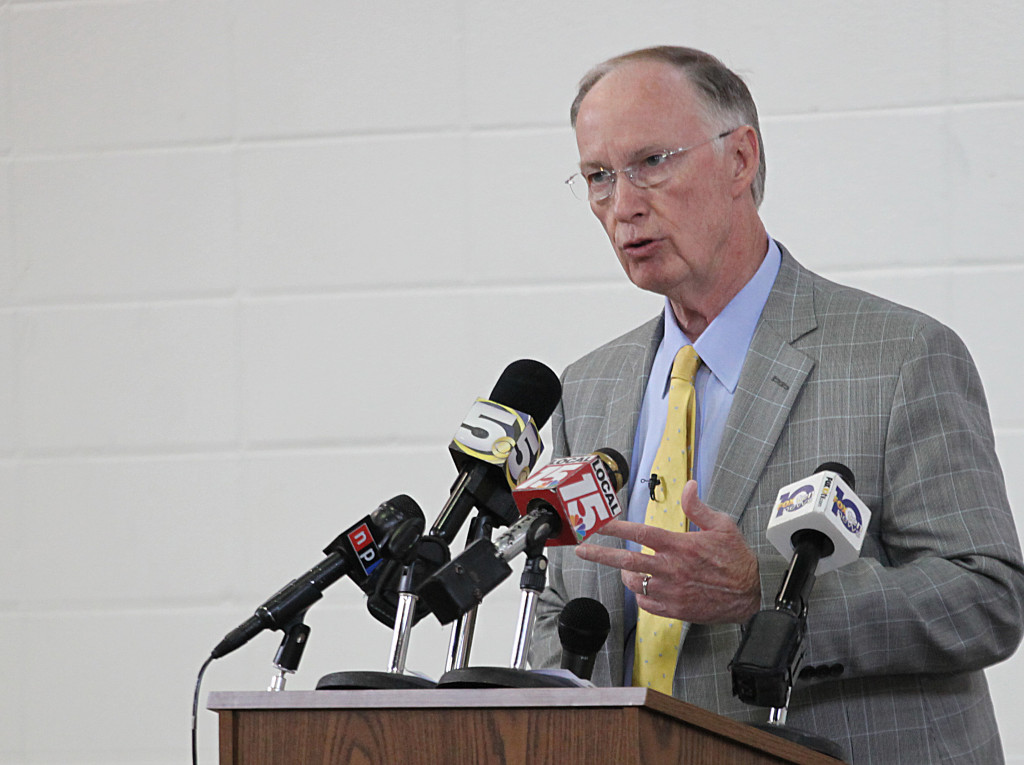
Alabama Gov. Robert Bentley continues his tour of speaking engagements to try to build public support for a tax proposal. The governor will discuss the General Fund budget crisis in a Tuesday speech in Montgomery to members of the Shelby County Chamber of Commerce. Bentley in speeches this past week said that the state is facing deep cuts in services and state programs unless lawmakers find a way to fill a budget hole The Republican governor said the reductions could range from closing state parks to substantial cuts to programs for children and seniors. Bentley has proposed $541 million in tax increases, including increases in tobacco taxes and automobile sales taxes. However, so far lawmakers have not voted on any of his proposals. Republished with permission of The Associated Press.
Angi Stalnaker: Break government logjam, so great ideas get through
The Alabama Constitution is the longest of its kind in the world. No other state and no other nation has a governing document that comes close to ours in its sheer volume. Yet, in all of its 117,000 words, it only specifies one absolute duty of the Legislature and that’s to pass a balanced budget. This year, that budget is in dire straits and the fact that there is a severe shortage of revenue is a fact that nearly all elected officials can agree on. The political divide appears when the discussion of solutions to the state’s fiscal woes enters the conversation. Some promote taxes and some advocate for more cuts to General Fund agencies. Some argue more can be cut and others insist that further cuts would be disastrous and would prohibit our state from adequately providing basic services. The correct answer is unclear but one thing is for sure, if you want the truth, go to the source and nobody has done that. More than 25,000 hardworking Alabamians are employed by the state of Alabama. They are each witnesses to the everyday processes of state government. Most of them see things every day that are wasteful or inefficient. Many of them have ideas on ways that things could be changed to make government operate more efficiently and to save precious taxpayer dollars. The problem is that the layers of government are so plentiful that it is difficult for many state employees to express their ideas to a decision maker and then even more difficult to get real change enacted. Government operates on inertia and the idea of doing something a certain way because that is the way it has always been done is standard operating procedure at most levels. These desperate budget times mandate a change in that mindset and that will require elected officials and decision makers to go to the source for revenue savings. State employees haven’t had a raise since before Auburn won a National Championship. The last time they saw a real salary increase, Barack Obama was still a U.S. senator. Yet, in all that time, nobody has gone to this group of eyewitnesses to everyday government and asked them how to operate more efficiently and effectively. It’s time to ask state employees for their ideas to cut costs and operate more efficiently and reward them for it. Launch a website and ask current state employees to submit their ideas and, if an idea is instituted, give that employee a one-time bonus equal to 5 percent of the savings accrued by their idea in the first year. Ideas will come in. Some will be feasible and some won’t be. The submitted ideas may only save a few million dollars or there could be tens of millions of taxpayer dollars saved. We will never know until we go to the source. Angi Horn Stalnaker is founder of Virtus Solutions, a government relations and communications firm.
