
Americans offer hope, prayer in assessing Donald Trump’s 100 days

They are young and old: a high school student who can’t yet vote, a Vietnam vet who did so proudly. They hail from all corners of the United States and very different walks of life: a “downhome boy” from Kentucky, a third-generation Mexican-American from Texas, a stay-at-home mom in Pennsylvania, an Iranian immigrant in Los Angeles. Some oppose Donald Trump and all that he stands for, while others voted enthusiastically for him. Now, they are critiquing him. One hundred days into Trump’s presidency, The Associated Press returned to some of the everyday people interviewed these past months to ask them to write a letter to the president, evaluating the job he’s done so far and looking ahead to the months to come. One supporter tells the president he “might have fallen a little short” — on Obamacare, in particular — but he signs off “with hope.” A refugee implores Trump to “make America more friendly,” but finds optimism in the president’s reaction to this month’s chemical attack in Syria: “I hope this is a turning point.” A Trump objector calls his biggest accomplishment “waking up the public to fight.” She offers this advice: “Make decisions with your heart. It will give you wisdom.” ___ FROM RURAL AMERICA, A SUPPORTER SEES HOPE IN TRUMP’S PRESIDENCY Alan Halsey, 31, is a self-described “downhome boy” from Campton, Kentucky, who along with his wife owns and operates The Swift Creek Courier, a weekly newspaper, and Halsey’s Country Store, “a small business that is a chunk of 1950 set down in 2017.” He says he works seven days a week to try to provide for his family, but is struggling and tired of government regulation and red tape. He wrote: ” … I supported you quite strongly in the 2016 election, even to the point of hanging one of your signs on the front door of my business. I particularly related to your foreign policy of ‘America First,’ and your promise to bring business back to the United States. So far, I believe you’re heading in the right direction on that front, and I find a glimmer of hope in the future of the American economy. “Overall, I think you might have fallen a little short on your first 100 days, but I don’t put a lot of weight into a time frame that small. Provided you serve two terms, 100 days is about 4 percent of that. I still feel that something needs to be done with the Affordable Care Act, although I’m not certain exactly what. … I know many ACA recipients that visit a doctor more than once a week, while those that purchase their own insurance wait until a visit to a doctor is imperative to their survival. There must be a middle to that scenario. …” He signed his letter: “With Hope.” ___ CANCER SURVIVOR WORRIES OVER TRUMP’S PROPOSED BUDGET CUTS, BUT PRAYS FOR HIM Rebecca Esparza, 45, is a freelance writer in Corpus Christi, Texas, who didn’t vote for Trump. A cancer survivor, Esparza fears proposed budget cuts targeting the nation’s premier medical research institution, the National Institutes of Health, will hurt Americans who battle illness. She wrote: “. I cannot say I’m proud of your work so far. However, I have respect for the Office of the President, even if I disagree with your political aspirations. … I could write a dissertation on the many ways I disagree with your political ideals. I’m a third-generation Mexican-American, born and raised in South Texas. Your disdain for Mexico, its descendants and immigrants in general troubles me. Your plan to dismantle the Affordable Care Act, leaving millions of Americans with no other health insurance options, leaves me anguished. “But what distresses me most is your plan to cut nearly $6 billion in funding from the National Institutes of Health (NIH). On Thanksgiving Day in 2001, at age 30, I was diagnosed with ovarian cancer. … Cancer research saved my life. … The cuts you are proposing are disconcerting not only for cancer survivors, but for millions of Americans suffering from many types of chronic and rare diseases. … “I’ll be praying for you, President Trump. … I pray you will carefully consider how your decisions have life or death consequences for hard-working Americans.” Read more about Esparza. ___ ONE-TIME OBAMA VOTER FEELS PRIDE IN TRUMP’S WORK Laverne Jones Gore, 60, owns an executive leadership development company in Cleveland and voted for Trump after previously supporting Barack Obama. Gore calls herself a “middle-class American who happens to be black” and says she felt uncomfortable voicing her opinion during the Obama years, but Trump has “made me proud to be an American again.” Part of a military family — her deceased husband was a Marine and a son graduated from West Point — Gore’s one hesitation these past 100 days is over Trump’s airstrike in Syria. She wrote: ” … Mr. President you have absolutely met my expectations. I actually believe you have shown a strength that I had not given to you, and I am surprised by your willingness to meet head on the challenges and resistance within your governing bodies. I don’t believe you have been afforded an opportunity to really show us what you have to offer in the form of leadership of our nation. “I have no issue with you as it relates to ‘Russians.’ I personally believe most of it was contrived. I have no issue with you as it relates to immigration. I think the issues were in need of control. … I have some reservations about your use of Twitter, but I understand the difficulty you have getting your intended message out. “Yes, you surprised me with the Syria strike and I am not certain how I feel about another war or thought of war. I am still contemplating your action and observing the responses to come from the world theatre as they absorb your full intent.” ___ ‘YOUR SIGNATURE CRUSHED MY FAMILY’ Marjan Vayghan, 32, an artist and writer
Senate confirms Alex Acosta as Donald Trump’s secretary of labor
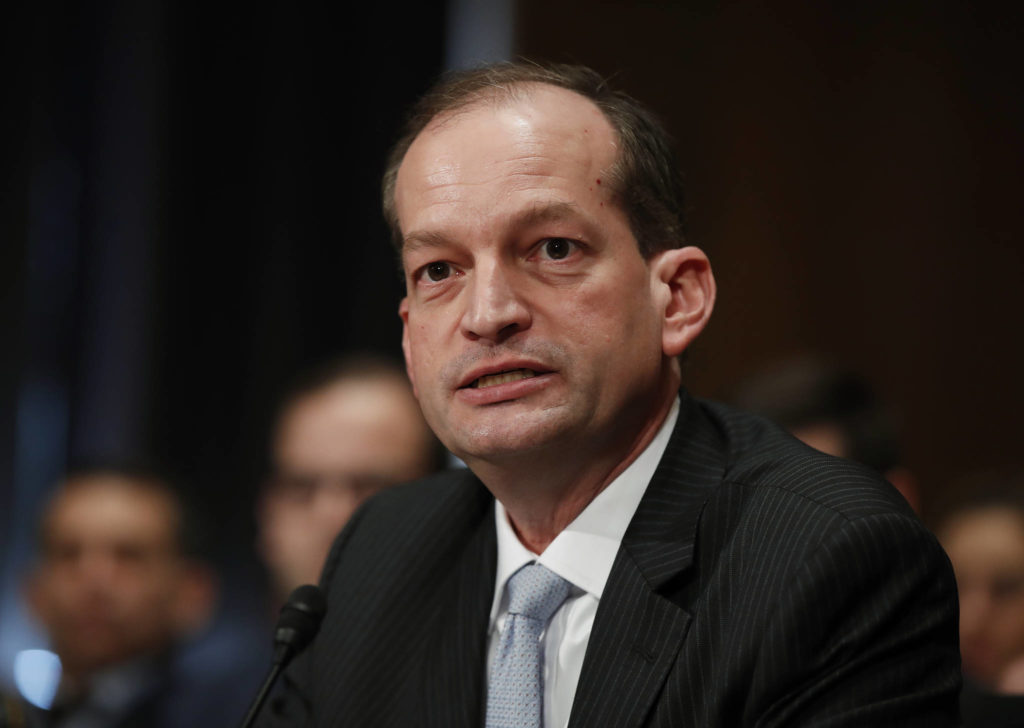
The Senate on Thursday confirmed Alex Acosta as Labor secretary, filling out President Donald Trump‘s Cabinet as he approaches his 100th day in office. The 60-38 vote confirms Acosta to the post. Once sworn as the nation’s 27th Labor secretary, the son of Cuban immigrants will lead a sprawling agency that enforces more than 180 federal laws covering about 10 million employers and 125 million workers. Sen. Tim Scott, R-S.C., spoke for many Republicans with a statement issued just after the vote saying he hopes Acosta’s focus will be “promoting labor policies that are free of unnecessarily burdensome federal regulations.” Scott said he wants Acosta to permanently revoke rules governing financial advisers and adding Americans eligible for overtime pay. Democrats said any Labor secretary should advocate for the American workers to whom Trump promised so much during his upstart presidential campaign. They said Acosta has given no such commitment. “Acosta failed this basic test,” tweeted Sen. Elizabeth Warren, D-Mass. Acosta has been a federal prosecutor, a civil rights chief at the Justice Department and a member of the National Labor Relations Board. He will arrive at the top post with relatively little clear record on some of the top issues facing the administration over key pocketbook issues, such as whether to expand the pool of American workers eligible for overtime pay. Acosta wasn’t Trump’s first choice for the job. Former fast food CEO Andrew Puzder withdrew his name from consideration last month, on the eve of his confirmation vote, after becoming a political headache for the new administration. Puzder acknowledged having hired a housekeeper not authorized to work in the U.S. and paying the related taxes years later — after Trump nominated him — and came under fire from Democrats for other issues related to his company and his private life. Acosta’s ascension would come at a key moment for Trump, just two days before he reaches the symbolic, 100-day marker. The White House has sought to cross the threshold with its own list of Trump’s accomplishments. Trump can say the Acosta vote was bipartisan, because eight Democrats and one independent voted yes. Joining the Republicans in his favor were Democratic Sens. Catherine Cortez Masto of Nevada, Heidi Heitkamp of North Dakota, Joe Manchin of West Virginia, Claire McCaskill of Missouri, Bob Menendez of New Jersey, Bill Nelson of Florida, Jon Tester of Montana and Mark Warner of Virginia. Independent Sen. Angus King of Maine also voted for Acosta. Labor secretary is the last Cabinet post for Trump to fill. Trump’s choice for U.S. trade representative, a job considered Cabinet-level, is awaiting a Senate vote. From the beginning, Acosta’s was a quiet march to confirmation that stood out because it didn’t attract the deep partisan battles faced by some of Trump’s other nominees, including Education Secretary Betsy DeVos and Secretary of State Rex Tillerson. Justice Neil Gorsuch‘s nomination provoked such a fight that majority Senate Republicans used the “nuclear option” to remove the 60-vote filibuster barrier for Supreme Court picks. Thursday’s vote marks the fourth time Acosta has been confirmed for the Senate. Democrats and most labor groups were mostly muted in their response to Acosta’s nomination. At his confirmation hearing, Democratic Sens. Patty Murray of Washington and Warren hammered Acosta for answers on a selection of issues important to labor and whether Acosta would cave to political pressure from Trump. Acosta refused to answer the policy questions until he’s confirmed, and he vowed to be an independent and fair voice for workers. Both senators said they had great concerns, and both voted no. Our standard can’t be ‘not Puzder,’” Murray said Wednesday on the Senate floor. But tellingly, even as Acosta’s nomination wound through the Senate, Democrats and their allies also tried to move on to other, labor-related issues — namely, a minimum wage hike to $15 an hour, which Trump opposes. Meanwhile, the Labor Department’s online landing page bears a glimpse of Acosta’s policy priorities: “Buy American, Hire American.” That’s the title of Trump’s executive order this week directing the secretaries of labor and other agencies to issue guidance within 60 days on policies that would “ensure that, to the extent permitted by law” federal aid “maximize the use of materials produced in the United States, including manufactured products; components of manufactured products; and materials such as steel, iron, aluminum, and cement.” Republished with permission of The Associated Press.
Donald Trump tax cut: Huge, vague and likely mild boost for economy

President Donald Trump‘s team boasted Wednesday that its tax-cut plan would lighten Americans’ financial burdens, ignite economic growth and vastly simplify tax filing. Yet the proposal so far remains short of vital details, including how it would be paid for. And based on the few specifics spelled out so far, most experts suggest that it would add little to growth while swelling the budget deficit and potentially handing large windfalls to wealthier taxpayers. Trump’s plan would replace the current seven income tax brackets with three, and the top bracket would drop from 39.6 percent to 35 percent. It would also slash the corporate rate from 35 percent all the way to 15 percent, a boon to most companies even though many don’t pay the full tax now. With tax credits and other loopholes, most corporations pay closer to 20 percent, according to calculations by JPMorgan. Perhaps the most contentious plank would enable taxpayers with business income — including those wealthy enough to pay the top tax rate — to instead pay the new 15 percent corporate rate. That’s because Trump would apply the corporate rate to “pass through” businesses. Pass-throughs include partnerships such as law firms and hedge funds as well as most small businesses — from the local florist to the family-owned restaurant on Main Street. What’s more, some privately held large companies — including Trump’s own real estate empire — are structured as pass-throughs and would benefit, too. Here’s a closer look at Trump’s proposal and its likely impact: ___ WHO BENEFITS? It’s hard to say because the administration has released so few details. The three new income tax rates would be 10 percent, 25 percent and 35 percent. But Trump’s top economic adviser, Gary Cohn, and Treasury Secretary Steven Mnuchin, weren’t ready Wednesday to say at what income levels these new rates would kick in. Tax experts said far more details were needed to determine how average Americans would be affected. “The impact on Joe Taxpayer is unknown,” said Marc Gerson, vice chair of the tax department of law firm Miller & Chevalier in Washington. “There’s not enough specificity. It’s hard for taxpayers to determine where they’ll come out.” Cohn asserted that the plan would cut taxes “especially for low and middle income families.” It purports to do so in part by doubling the standard deduction, which is used by taxpayers who don’t itemize their tax deductions. At the same time, the Trump plan would eliminate the estate tax and the alternative minimum tax, thereby benefiting some of the richest taxpayers. And that’s on top of shrinking the corporate tax rate that many affluent individuals could likely capitalize on. ___ WHY CUT CORPORATE TAXES? By making corporations more profitable, the Trump administration hopes to encourage more business spending on equipment — from computers to factories and machinery. Doing so, in turn, could make the economy more efficient and accelerate growth and hiring. Economic growth has been stuck at about 2 percent a year since the recession ended in 2009. Mnuchin says the administration wants to accelerate it above 3 percent, a pace it hasn’t touched since 2005. The corporate tax cuts are also intended to encourage more businesses to stay in the United States, which now has the highest corporate rate among advanced economies. Many large corporations are enthusiastic about lower rates and say they support the elimination of loopholes, which both reduce revenue and make taxes more complicated. ___ WHO’D BENEFIT FROM THE CORPORATE RATE CUT? Aside from most large companies, many partnerships and small businesses would benefit because they’re structured as pass-throughs, which derives from the fact that they pass on their profits to their owners. Those owners now pay individual income tax rates, which top out at 39.6 percent. With the pass-through rate dropped to 15 percent, those taxpayers could enjoy an enormous tax cut. The Trump team stressed the benefits that might flow to small businesses. But the richest windfalls would flow to the wealthy — lawyers, hedge fund managers, consultants and other big earners. Nearly 75 percent of pass-through income flows to the 10 percent wealthiest taxpayers, according to the liberal Center on Budget and Policy Priorities. “It would tremendously help high earners,” says Brian Thompson, a certified public accountant in Chicago. In Kansas, Gov. Sam Brownback eliminated state taxes on pass-throughs, which turned out to be a boon for Bill Self, the coach of the University of Kansas’ men’s basketball team. He had previously set up his own company, according to state media reports. As a result, he paid little state income tax despite earning nearly $3 million a year. Many people, particularly wealthy Americans, could set up companies and reclassify their paychecks as “business income” and have it taxed at 15 percent, experts say. In Kansas, the number of pass-through businesses jumped to more than double the level the state expected, according to the nonpartisan Tax Policy Center. That cost the state revenue without spurring more job creation. Mnuchin said the Treasury would issue rules to prevent wealthy people from capitalizing on the lower rate. But many experts are skeptical. “Good luck with that,” said Mark Mazur, director of the nonpartisan Tax Policy Center and a former Treasury official under President Barack Obama. “The tax agencies tend to be at least a couple of steps behind the businesses.” ___ HOW ELSE WOULD BIG BUSINESSES BENEFIT? The administration is also proposing to tax only corporate income earned in the United States. This is known as a “territorial” system. It would replace the current worldwide system, under which corporations pay tax on income earned in the U.S. and overseas. Yet companies can avoid the tax if they keep their foreign earnings overseas. Many businesses have kept hundreds of billions of dollars outside the United States. Mnuchin said Trump’s plan would encourage corporations to return the money to the United States and invest it in plants and equipment. Some analysts counter that corporations might instead use the money to pay dividends to
White House Press Secretary Sean Spicer suggests that Adolf Hitler didn’t use chemical weapons

White House Press Secretary Sean Spicer suggested Tuesday that Adolf Hitler didn’t use chemical weapons. Hitler killed Jews during the Holocaust using gas chambers at concentration camps. Spicer, comparing Hitler to Syria’s Bashar Assad, said Hitler “didn’t even sink to using chemical weapons.” An April 4 chemical weapons attack in northern Syria left nearly 90 people dead, and the U.S. has blamed Assad. Turkey’s health minister said Tuesday that test results confirm sarin gas was used. Spicer later tried to clarify his statement, saying Hitler didn’t use chemical weapons on his own people “in the same way” as Assad. Republished with permission of The Associated Press.
FBI reviews handling of terrorism-related tips
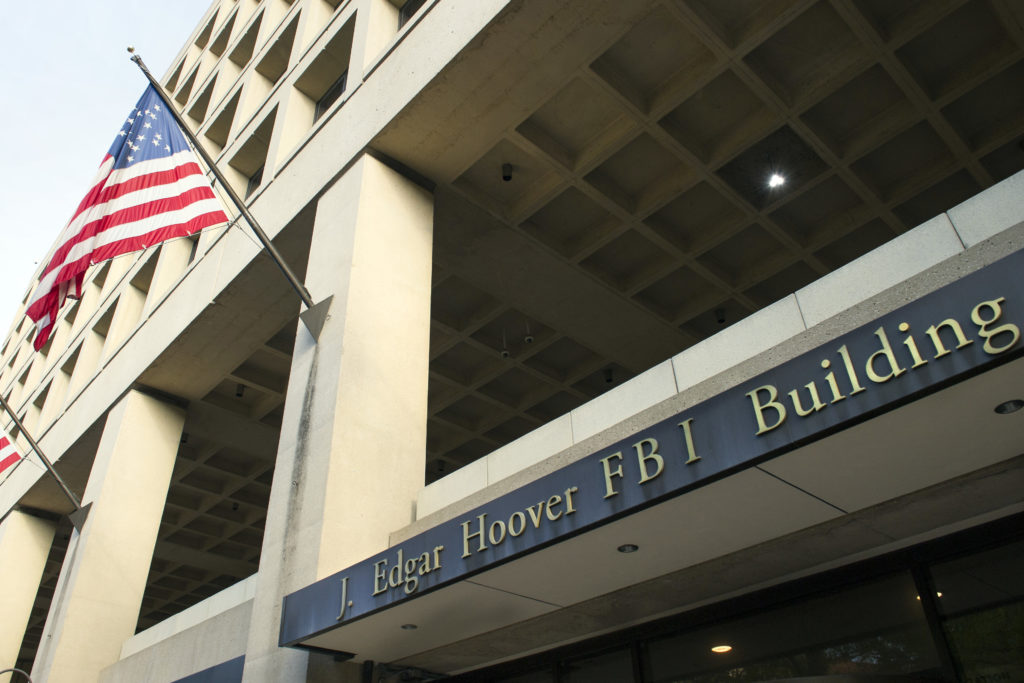
The FBI has been reviewing the handling of thousands of terrorism-related tips and leads from the past three years to make sure they were properly investigated and no obvious red flags were missed, The Associated Press has learned. The review follows attacks by people who were once on the FBI’s radar but who have been accused in the past 12 months of massacring innocents in an Orlando, Florida, nightclub, injuring people on the streets of New York City, and gunning down travelers in a Florida airport. In each case, the suspects had been determined not to warrant continued law enforcement scrutiny months and sometimes years before the attacks. The internal audit, which has not been previously reported, began this year and is being conducted in FBI field offices across the country. A senior federal law enforcement official described the review as an effort to “err on the side of caution.” The audit is essentially a review of records to ensure proper FBI procedures were followed. It’s an acknowledgment of the challenge the FBI has faced, particularly in recent years, in predicting which of the tens of thousands of tips the bureau receives annually might materialize one day into a viable threat. Investigations that go dormant because of a lack of evidence can resurface instantly when a subject once under scrutiny commits violence or displays fresh signs of radicalization. FBI Director James Comey has likened the difficulty to finding not only a needle in a haystack but determining which piece of hay may become a needle. Though there’s no indication of significant flaws in how terrorism inquiries are opened and closed, the review is a way for the FBI to “refine and adapt to the threat, and part of that is always making sure you cover your bases,” said the law enforcement official, who was not authorized to discuss the matter by name. The pace of the FBI’s counterterrorism work accelerated with the rise of the Islamic State group, which in 2014 declared the creation of its so-called caliphate in Syria and Iraq and has used sophisticated propaganda to lure disaffected Westerners to its cause. By the summer of 2015, Comey has said, the FBI was “strapped” in keeping tabs on the group’s American sympathizers and identifying those most inclined to commit violence. Social media outreach by IS has appealed to people not previously known to the FBI but also enticed some who once had been under scrutiny to get “back in the game,” said Seamus Hughes, deputy director of George Washington University’s Program on Extremism. “The fact that there was a physical location and a caliphate announced, it helped kind of drive folks back in when they might have drifted away,” Hughes said. The review covers inquiries the FBI internally classifies as “assessments” — the lowest level, least intrusive and most elementary stage of a terror-related inquiry — and is examining ones from the past three years to make sure all appropriate investigative avenues were followed, according to a former federal law enforcement official who spoke on condition of anonymity to discuss the process. Assessments are routinely opened upon a tip — whether from someone concerned about things such as activity in a neighbor’s garage, a co-worker’s comments or expressions of support for IS propaganda — and are catalogued by the FBI. The bureau receives tens of thousands of tips a year, and averages more than 10,000 assessments annually. FBI guidelines meant to balance national security with civil liberties protections impose restrictions on the steps agents may take during the assessment phase. Agents, for instance, may analyze information from government databases and open-source internet searches, and can conduct interviews. But they cannot turn to more intrusive techniques, such as requesting a wiretap or internet communications, without higher levels of approval and a more solid basis to suspect a crime or national security threat. The guidelines explicitly discourage open-ended inquiries and say assessments are designed to be “relatively short,” with a supervisor signing off on extension requests. Many assessments are closed within days or weeks when the FBI concludes there’s no criminal or national security threat, or basis for continued scrutiny. The system is meant to ensure that a person who has not broken the law does not remain under perpetual scrutiny on a mere hunch that a crime could eventually be committed. But on occasion, and within the past year, it’s also meant that people the FBI once looked at but did not find reason to arrest later went on to commit violence. In the case of Omar Mateen, that scrutiny was extensive, detailed and lengthy. Mateen, who shot and killed 49 people at an Orlando nightclub in June, was investigated for 10 months in 2013 and interviewed twice after a co-worker reported that Mateen had claimed connections to al-Qaida. As part of a preliminary investigation, agents recorded Mateen’s conversations and introduced him to confidential sources before closing the matter. That kind of investigation is more intensive than an assessment and permits a broader menu of tactics, but it also requires a stronger basis for suspicion. Mateen was questioned again in 2014 in a separate investigation into a suicide bomber acquaintance. Comey has said he has personally reviewed that inquiry’s handling and has concluded it was done well. The FBI in 2014 also opened an assessment on Ahmad Khan Rahimi, who last September was charged in bombings in Manhattan and New Jersey, based on concerns expressed by his father. The FBI said it closed the review after checking databases and travel and finding nothing that tied him to terrorism. Esteban Santiago, the man accused in the January shooting at the Fort Lauderdale, Florida, airport that killed five people, had also been looked at by the FBI. He had walked into the bureau’s office in Anchorage, Alaska, two months earlier and claimed his mind was being controlled by U.S. intelligence officials. In that case, too, the FBI closed its assessment after interviewing family members and checking databases. Each act of
Analysis: For Donald Trump, the weight of world’s problems sink in
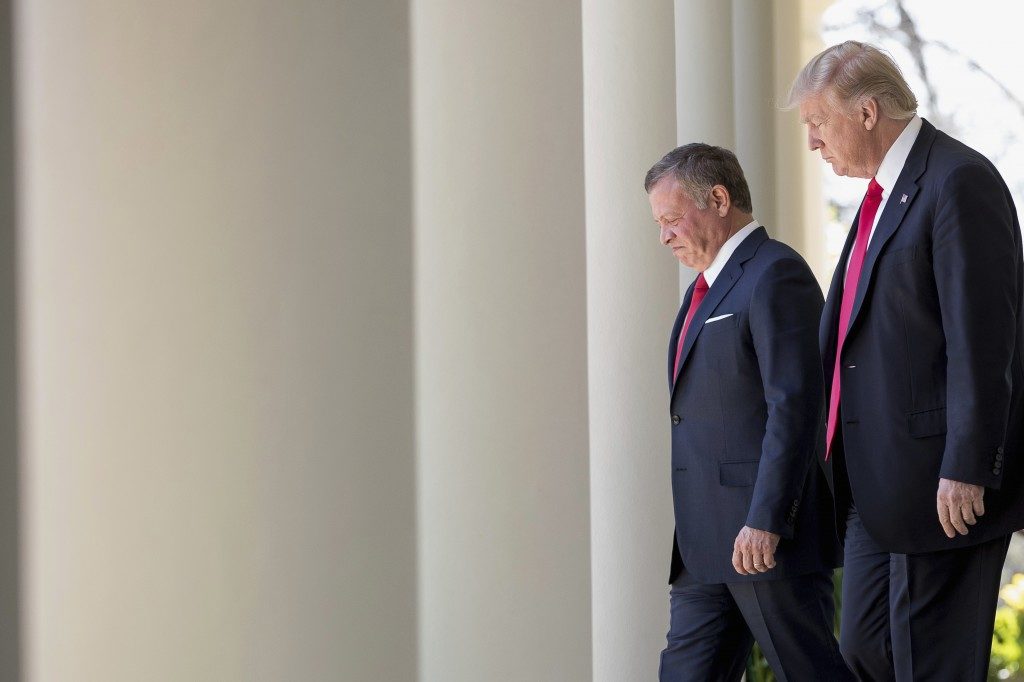
For Donald Trump, the reality of the world’s problems may be starting to sink in. Standing in the sunny White House Rose Garden, the president said Wednesday that the gruesome chemical weapons attack in Syria had changed his views on the quagmire of a conflict that he’d previously indicated he wanted to steer clear of. He mourned the deaths of the youngest victims — “innocent children, innocent babies” — and said brutality had “crossed a lot of lines for me.” “It is now my responsibility,” he declared. The president’s words were far from a declaration that he intends to act, and he notably avoided discussing what retaliatory options he would be willing to consider. Ultimately, his rhetoric may well land among the litany of harsh condemnations of Syrian President Bashar Assad by Barack Obama and other world leaders that did little to quell the six-year civil war. Yet Trump’s willingness to accept that he now bears some responsibility for a far-away conflict marked a significant moment for an “America First” president who has vowed to focus narrowly on U.S. interests. His comments also suggested a growing awareness that an American president — even an unconventional one like him — is looked to as defender of human rights and a barometer of when nations have violated international norms. The bloodshed in Syria is just one of the intractable international problems piling up around Trump. North Korea appears intent on building up its nuclear program, despite vague threats from his administration. The Islamic State group is still wreaking havoc in Iraq and Syria, while a Pentagon review of U.S. strategy sits on his desk. Trump conceded Wednesday that of all the world’s problems, the Middle East is one area he would rather avoid. His decision to at least rhetorically take a measure of responsibility was all the more striking given his frequent shoveling of blame for problems big and small onto anyone but himself. In public, he faults Obama for leaving him “a mess” and says his campaign opponent Hillary Clinton is behind the flood of revelations possibly linking his campaign to Russia. In private, he berates his staff for failing to fix the self-made crises that have battered the White House, including his pair of travel bans blocked by the courts and the failure to pass health care legislation. Trump initially took the same blame-shifting approach in addressing the deadly attack in Syria. In a short written statement Tuesday, he said the carnage was “a consequence of the past administration’s weakness and irresolution.” In 2013, Obama pulled back from planned airstrikes against Syria following a chemical weapons attack, despite having declared that the deployment of deadly gases would cross a “red line” for him. Obama’s decision was widely criticized in the U.S. and by Middle Eastern allies, and undermined later attempts to compel Assad to leave office. “The regrettable failure to take military action in 2013 to prevent Assad’s use of chemical weapons remains a blight on the Western world,” said Sen. Bob Corker, R-Tenn., the chairman of the Senate Foreign Relations Committee. Still, foreign policy officials within the Trump administration were irritated by the president’s eagerness to focus on his predecessor in his first reaction. Some wanted him to focus more on condemning Assad and highlighting U.S. resolve. Their objections did little to sway the president at the time. But just a day later, Trump appeared more willing to embrace the gravity of the situation and his new role in it. His posture may well have been impacted by the fact that his remarks in the Rose Garden came after meeting with Jordan’s King Abdullah, whose country has borne the brunt of the refugee crisis spurred by the Syrian war. Jordan is among Washington’s most important partners in the region and is significantly dependent on the United States. Abdullah, who worked closely with Obama, enthusiastically embraced Trump’s condemnation of the chemical weapons attack. During a joint news conference, he said to Trump, “I believe under your leadership we will be able to unravel this very complicated situation.” Eliot Cohen, a Trump critic who served in the State Department under President George W. Bush, said that whether Trump intended to or not, he now has put himself in the same position as Obama, raising the stakes for action in Syria, perhaps without having thought out whether he plans to follow through. “The deep irony here is you may see a lot of the same failures that the Obama administration had except delivered with a different style,” Cohen said. Republished with permission of The Associated Press.
Congress seen as not likely to pass tax overhaul quickly

After their humiliating loss on health care, Republicans in Congress could use a quick victory on a big issue. It won’t be an overhaul of the tax code. Overhauling the tax code could prove harder to accomplish than repealing and replacing Barack Obama‘s health law. Congressional Republicans are divided on significant issues, especially a new tax on imports embraced by House Speaker Paul Ryan. And the White House is sending contradicting signals on the new tax, adding to the uncertainty. House Republicans also can’t decide whether to move on from health care. Ryan canceled a scheduled vote on a House GOP plan after it became obvious that Republicans didn’t have the votes. He said he will continue to work on the issue but one of his top lieutenants on health care, Rep. Kevin Brady, R-Texas, says he is now “100 percent” focused on a tax overhaul. Ryan says Congress can work on both at the same time. It won’t be easy. Here’s why: ___ REPUBLICAN DIVIDE House and Senate Republicans largely agree on the broad outlines of a tax overhaul. They want to lower tax rates for individuals and corporations, and make up the lost revenue by scaling back tax breaks. But they are sharply divided on a key tenet of the House Republican plan. The new “border adjustment tax” would be applied to profits from goods and services consumed in the U.S., whether they are domestically produced or imported. Exports would be exempt. House GOP leaders say the tax is key to lowering the top corporate income tax rate from 35 percent to 20 percent. But good luck finding a single Republican senator who will publicly support the tax. Sen. Rob Portman, R-Ohio, is the latest in a long line of Republican senators to come out against the tax. ___ ABSENT DEMOCRATS Senate Finance Committee Chairman Orrin Hatch, R-Utah, says he wants to work with Democrats to overhaul the tax code. “A bipartisan bill would allow us to put in place more lasting reforms and give the overall effort additional credibility,” Hatch said. Majority Leader Mitch McConnell, R-Ky., has said it is bad policy to pass major legislation without bipartisan support. “Without some meaningful buy-in, you guarantee a food fight,” McConnell wrote in his memoir last year. “You guarantee instability and strife.” But in the House, Republicans haven’t reached out to Democrats in any meaningful way. ___ WHERE’S THE WHITE HOUSE? “Obviously we’re driving the train on this,” White House press secretary Sean Spicer said. But President Donald Trump‘s administration has been all over the map on tax reform. Trump at one point said the House border tax is too complicated, then said it’s in the mix. Treasury Secretary Steven Mnuchin told a Senate panel that “there would be no absolute tax cut for the upper class” in Trump’s tax plan. However, the plan Trump unveiled during his presidential campaign would provide big tax breaks to high-income households. Since taking office, Trump has promised “massive” tax cuts for the middle class. A former Treasury official under President Barack Obama says the White House needs to stake out clear goals on tax overhaul to guide the debate in Congress. “I think it’s important for the administration to signal early the general shape” of what they would like to accomplish so that there are fewer proposals vying for attention, said Michael Mundaca, a former assistant Treasury secretary now at Ernst & Young. ___ TAX CHANGE IS DIFFICULT There is a reason it’s been 31 years since the last time Congress rewrote the tax code. Since then, the number of exemptions, deductions and credits has mushroomed. Taxpayers enjoyed $1.6 trillion in tax breaks in 2016 — more than the federal government collected in individual income taxes. That huge number could provide plenty of tax breaks that lawmakers can scale back so they can lower tax rates significantly. There is just one problem — all of the biggest tax breaks are very popular and have powerful constituencies. Nearly 34 million families claimed the mortgage interest deduction in 2016. That same year more than 43 million families took advantage of a deduction of state and local taxes. The House Republicans’ tax plan would retain the mortgage deduction and eliminate the deduction for state and local taxes. ___ HEALTH CARE Both Trump and Republicans in Congress made big campaign promises to repeal and replace Obama’s health law, so the issue won’t go away. However, several players say negotiations on a way forward are non-existent. In the meantime, Trump is stoking animosity among a key voting bloc by criticizing them on Twitter. Two factions in the House GOP had members oppose the health plan: the hard-right Freedom Caucus and the moderate Tuesday Group. Ryan has suggested that they get together to sort out their differences, but it’s not happening, according to one key lawmaker. “We are not currently negotiating with the Freedom Caucus. There was never a meeting scheduled with the Freedom Caucus. We will never meet with the Freedom Caucus,” said Rep. Chris Collins, R-N.Y., a member of the Tuesday Group. Trump tweeted: “The Freedom Caucus will hurt the entire Republican agenda if they don’t get on the team, & fast. We must fight them, & Dems, in 2018!” To quote a favorite saying of the president, Not nice. Republished with permission of The Associated Press.
House Freedom Caucus chairman says there’s ‘no deal’ on the GOP health care legislation after White House meeting

The Latest on the upcoming health care vote in the House (all times local): 1:35 p.m. The chairman of the conservative House Freedom Caucus says there’s “no deal” on the GOP health care legislation after a meeting at the White House with President Donald Trump. The assertion from Congressman Mark Meadows of North Carolina throws plans for a vote on the bill later Thursday into doubt. Two dozen or so Freedom Caucus members have opposed the legislation pushed by GOP leaders, saying it doesn’t go far enough to repeal “Obamacare.” But the group had been negotiating directly with the White House in hopes of reaching agreement to eliminate additional requirements on insurers. Without a deal with the Freedom Caucus, and with moderate-leaning members defecting, it seems unlikely GOP leaders will have the votes they need to go forward with a vote later Thursday as they had planned. ___ 10:06 a.m. Former President Barack Obama is celebrating the seventh anniversary of his landmark health care law, saying in a statement on Thursday that “America is stronger because of the Affordable Care Act.” Obama does not directly address GOP efforts to repeal his law, which are coming to a head Thursday as House leaders push toward a vote on their repeal legislation. Republicans remain short of votes. The former president does say that if Republicans are serious about lowering costs and expanding coverage, and are prepared to work with Democrats, “That’s something we all should welcome.” But, Obama says, “we should start from the baseline that any changes will make our health care system better, not worse for hardworking Americans.” He notes 20 million Americans gained coverage under his law. ___ 9:40 a.m. President Donald Trump is urging people to call their lawmakers to express support for the Republican legislation to repeal and replace “Obamacare.” Trump posted a video on Twitter Thursday asking people to get behind the plan. He says that people were “given many lies” about the Affordable Care Act. Trump added that the legislation was “terrific” and “you’re going to be very, very happy.” The GOP legislation was on the brink hours before Republican leaders planned to put it on the House floor for a showdown vote. Trump was spending the final hours trying to close the deal with conservatives who have opposed the plan. ___ 9:00 a.m. The GOP’s long-promised legislation to repeal and replace “Obamacare” stands on the brink, just hours before Republican leaders planned to put it on the House floor for a showdown vote. The stakes are high, and Republicans are staring at the possibility of a failure that would throw prospects for their other legislative goals into uncertainty. Speaking to members of the conservative Freedom Caucus mid-day Thursday, Trump is pitching concessions to representatives who want to limit the requirement for health plans to include benefits including substance abuse and maternity care. But those changes appear to be scaring off at least some moderate Republicans. In a count by The Associated Press, at least 26 Republicans say they opposed the bill, enough to narrowly defeat the measure. Republished with permission of The Associated Press.
Paul Manafort had plan to benefit Vladamir Putin government

President Donald Trump‘s former campaign chairman, Paul Manafort, secretly worked for a Russian billionaire to advance the interests of Russian President Vladimir Putin a decade ago and proposed an ambitious political strategy to undermine anti-Russian opposition across former Soviet republics, The Associated Press has learned. The work appears to contradict assertions by the Trump administration and Manafort himself that he never worked for Russian interests. Manafort proposed in a confidential strategy plan as early as June 2005 that he would influence politics, business dealings and news coverage inside the United States, Europe and the former Soviet republics to benefit the Putin government, even as U.S.-Russia relations under Republican President George W. Bush grew worse. Manafort pitched the plans to Russian aluminum magnate Oleg Deripaska, a close Putin ally with whom Manafort eventually signed a $10 million annual contract beginning in 2006, according to interviews with several people familiar with payments to Manafort and business records obtained by the AP. Manafort and Deripaska maintained a business relationship until at least 2009, according to one person familiar with the work. “We are now of the belief that this model can greatly benefit the Putin Government if employed at the correct levels with the appropriate commitment to success,” Manafort wrote in the 2005 memo to Deripaska. The effort, Manafort wrote, “will be offering a great service that can re-focus, both internally and externally, the policies of the Putin government.” Manafort’s plans were laid out in documents obtained by the AP that included strategy memoranda and records showing international wire transfers for millions of dollars. How much work Manafort performed under the contract was unclear. The disclosure comes as Trump campaign advisers are the subject of an FBI probe and two congressional investigations. Investigators are reviewing whether the Trump campaign and its associates coordinated with Moscow to meddle in the 2016 campaign. Manafort has dismissed the investigations as politically motivated and misguided, and said he never worked for Russian interests. The documents obtained by AP show Manafort’s ties to Russia were closer than previously revealed. In a statement to the AP, Manafort confirmed that he worked for Deripaska in various countries but said the work was being unfairly cast as “inappropriate or nefarious” as part of a “smear campaign.” “I worked with Oleg Deripaska almost a decade ago representing him on business and personal matters in countries where he had investments,” Manafort said. “My work for Mr. Deripaska did not involve representing Russia’s political interests.” Deripaska became one of Russia’s wealthiest men under Putin, buying assets abroad in ways widely perceived to benefit the Kremlin’s interests. U.S. diplomatic cables from 2006 described Deripaska as “among the 2-3 oligarchs Putin turns to on a regular basis” and “a more-or-less permanent fixture on Putin’s trips abroad.” In response to questions about Manafort’s consulting firm, a spokesman for Deripaska in 2008 — at least three years after they began working together — said Deripaska had never hired the firm. Another Deripaska spokesman in Moscow last week declined to answer AP’s questions. Manafort worked as Trump’s unpaid campaign chairman last year from March until August. Trump asked Manafort to resign after AP revealed that Manafort had orchestrated a covert Washington lobbying operation until 2014 on behalf of Ukraine’s ruling pro-Russian political party. The newly obtained business records link Manafort more directly to Putin’s interests in the region. According to those records and people with direct knowledge of Manafort’s work for Deripaska, Manafort made plans to open an office in Moscow, and at least some of Manafort’s work in Ukraine was directed by Deripaska, not local political interests there. The Moscow office never opened. Manafort has been a leading focus of the U.S. intelligence investigation of Trump’s associates and Russia, according to a U.S. official. The person spoke on condition of anonymity because details of the investigation were confidential. Meanwhile, federal criminal prosecutors became interested in Manafort’s activities years ago as part of a broad investigation to recover stolen Ukraine assets after the ouster of pro-Russian President Viktor Yanukovych there in early 2014. No U.S. criminal charges have ever been filed in the case. FBI Director James Comey, in confirming to Congress the federal intelligence investigation this week, declined to say whether Manafort was a target. Manafort’s name was mentioned 28 times during the hearing of the House Intelligence Committee, mostly about his work in Ukraine. No one mentioned Deripaska. White House spokesman Sean Spicer said Monday that Manafort “played a very limited role for a very limited amount of time” in the campaign, even though as Trump’s presidential campaign chairman he led it during the crucial run-up to the Republican National Convention. Manafort and his associates remain in Trump’s orbit. Manafort told a colleague this year that he continues to speak with Trump by telephone. Manafort’s former business partner in eastern Europe, Rick Gates, has been seen inside the White House on a number of occasions. Gates has since helped plan Trump’s inauguration and now runs a nonprofit organization, America First Policies, to back the White House agenda. Gates, whose name does not appear in the documents, told the AP that he joined Manafort’s firm in 2006 and was aware Manafort had a relationship with Deripaska, but he was not aware of the work described in the memos. Gates said his work was focused on domestic U.S. lobbying and political consulting in Ukraine at the time. He said he stopped working for Manafort’s firm in March 2016 when he joined Trump’s presidential campaign. Manafort told Deripaska in 2005 that he was pushing policies as part of his work in Ukraine “at the highest levels of the U.S. government — the White House, Capitol Hill and the State Department,” according to the documents. He also said he had hired a “leading international law firm with close ties to President Bush to support our client’s interests,” but he did not identify the firm. Manafort also said he was employing unidentified legal experts for the effort at leading universities and
House GOP health bill facing fresh House committee test

The White House and Republican leaders are talking to rank-and-file lawmakers about revising the GOP health care overhaul, hoping to keep a rebellion by conservatives and moderates from snowballing and imperiling the party’s showpiece legislation. Four days after a congressional report projected the bill would pry coverage from millions of voters, signs of fraying GOP support for the legislation were showing. The measure would strike down much of former President Barack Obama‘s 2010 overhaul and reduce the federal role, including financing, for health care consumers and is opposed uniformly by Democrats. In a fresh test of Republicans’ willingness to embrace the legislation, the House Budget Committee was considering the measure Thursday. Republicans expressed confidence the bill would be approved, but the vote could be tight. The panel can’t make significant changes but was expected to endorse non-binding, suggested changes to nail down votes. The bill would eliminate the tax penalty that pressures people to buy coverage and the federal subsidies that let millions afford it, replacing them with tax credits that are bigger for older people. It would cut Medicaid, repeal the law’s tax increases on higher earning Americans and require 30 percent higher premiums for consumers who let coverage lapse. Overt GOP opposition grew after the nonpartisan Congressional Budget Office projected Monday that the legislation would push 24 million Americans off coverage in a decade and shift out-of-pocket costs toward lower income, older people. Obama’s law has provided coverage to around 20 million additional people House Speaker Paul Ryan, R-Wis., told reporters Wednesday that leaders could now make “some necessary improvements and refinements” to the legislation. But he declined to commit to bringing the measure to the House floor next week, a schedule Republican leaders have repeatedly said they intended to keep. At a late rally in Nashville Wednesday, President Donald Trump said: “We’re going to arbitrate, we’re all going to get together, we’re going to get something done.” Vice President Mike Pence met with House GOP lawmakers and pressed them to unite behind the legislation. “‘It’s our job to get it out of here and get it to the Senate,’” Pence told Republicans, according to Rep. Dennis Ross, R-Fla. That would let Trump pressure “Democrats in these red states to come on board,’” Ross said, referring to Republican-leaning states where Democratic senators face re-election next year. But insurgents still abound. Conservatives want to end Obama’s expansion of Medicaid to 11 million additional low-income people next year, not 2020 as the bill proposes. They say a GOP proposed tax credit to help people pay medical costs is too generous, and they want to terminate all of Obama’s insurance requirements, including mandatory coverage of specified services like drug counseling. Rep. Mark Meadows, R-N.C., head of the hard-line conservative House Freedom Caucus, continued pushing for changes. He claimed at least 21 members of his group would oppose the measure as written; the bill would fail if 22 Republicans join all Democrats in opposing it. But underscoring the push-pull problem GOP leaders face in winning votes, moderates feel the tax credits are too stingy, especially for low earners and older people. They oppose accelerating the phase-out of the Medicaid expansion and are unhappy with long-term cuts the measure would inflict on the entire program. Terminating the Medicaid expansion in 2020 and not 2018 “is sacrosanct to me,” said moderate Rep. Tom MacArthur, R-N.J. In a new complication, Sen. Charles Grassley, R-Iowa, said the measure lacked the votes to pass in the Senate, where Republicans hold a precarious 52-48 majority. That left House members angry over being asked to take a politically risky vote for legislation likely to be altered. Moderates “don’t like the idea of taking a vote in the House that may go nowhere in the Senate,” said Rep. Charlie Dent, R-Pa. Amid the maneuvering, a federal report said more than 12 million people have signed up for coverage this year under the very statute that Republicans want to repeal. That figure underscored the potential political impact of the GOP’s next move. Republished with permission of The Associated Press.
Fueled by Donald Trump opponents, Rachel Maddow’s popularity rises
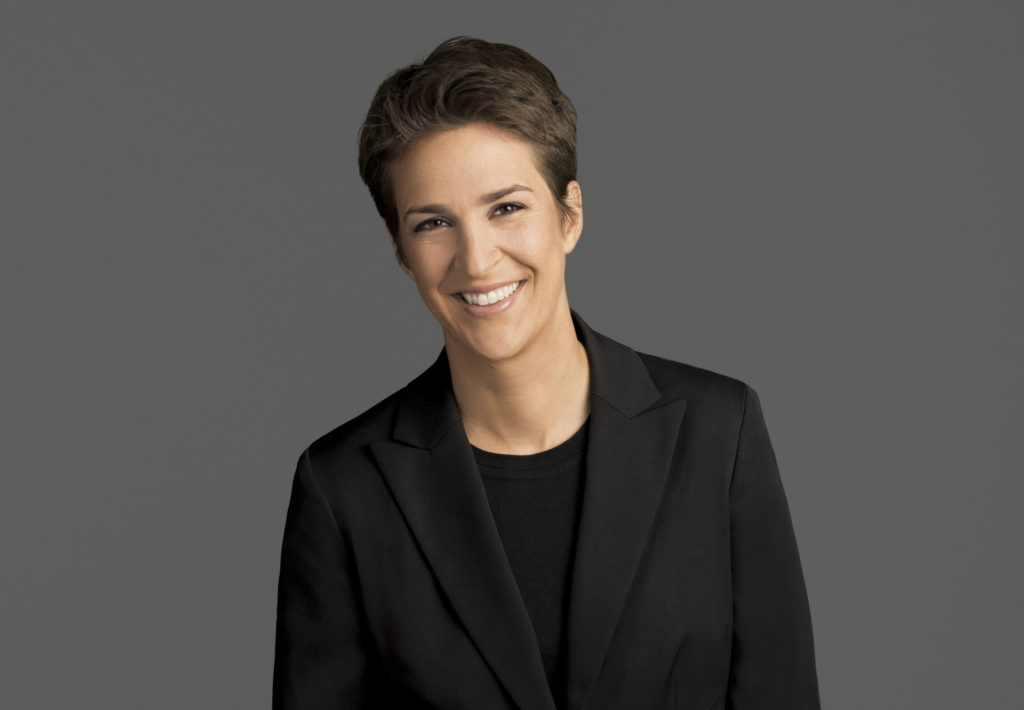
Rachel Maddow can trace the mood of her audience by looking at the ratings. Her MSNBC show’s viewership sank like a stone in the weeks following Donald Trump‘s election, as depressed liberals avoided politics, and bottomed out over the holidays. Slowly, they re-emerged, becoming active and interested again. Maddow’s audience has grown to the point where February was her show’s most-watched month since its 2008 launch. Maddow has emerged as the favorite cable news host for presidential resistors in the opening days of the Trump administration, just as Fox News Channel’s Sean Hannity is one for supporters or Keith Olbermann was the go-to television host for liberals in George W. Bush‘s second term. Trump fascination has helped cable news programs across the political spectrum defy the traditional post-presidential election slump, few as dramatically as Maddow’s. Her show’s average audience of 2.3 million in February doubled its viewership over February 2016, in the midst of the presidential primaries, the Nielsen company said. “I’m grateful for it,” Maddow said one recent afternoon. “It is nice for me that it is happening at a time when I feel we are doing some of our best work.” Those two things — ratings success and Maddow’s pride in the work — don’t always intersect. “We’re making aggressive editorial decisions in terms of how far we’re willing to get off of everyone else’s news cycle,” she said, “but it’s paying off because the news cycle more often than not is catching up with us after we do something.” Maddow has decided to cover the Trump administration like a silent movie, so the show could pay more attention to what is being done rather than what is being said. The central focus is on connect-the-dots reporting about Trump’s business interests and dealings with Russia. Her show is a news cousin to HBO host John Oliver‘s “Last Week Tonight” in its willingness to dive into complex subjects that don’t seem television-friendly, and follow the stories down different alleys. Maddow sounds long-winded when it doesn’t work. When it does, it’s like an absorbing novel stuffed with characters. “It’s not like I am a teacher who is trying to extend the attention span of the American news viewer,” said Maddow, a Rhodes scholar. “I have no goal of trying to privilege complexity. It just so happens that I tend to think in 17-minute bursts.” Maddow said she and her staff try to break news, like reporting on a Department of Homeland Security report on Trump’s immigration policy, and she was aggressive in bringing the Flint, Michigan, water crisis to a national audience. More often than not, she sees her role as explaining how things work. The program spent considerable time last week on a New Yorker magazine piece about foreign investments by Trump’s real estate company. She’s determined not to get lost in the noise, particularly since she believes Trump is skillful at distracting the media with a new story — even an unflattering one — when he doesn’t like the attention being paid to another. “I pray for the day when the most important thing about the Trump administration is that the president said something inappropriate on Twitter,” she said. “There are bigger and more valuable stories to be chasing than that.” When some news organizations were upset at being barred from an informal press briefing held by White House Press Secretary Sean Spicer two weeks ago, Maddow understood why. But the story didn’t really interest her. Since she doesn’t trust much of what the administration says, Maddow wondered what these reporters were really missing by not being there. “Her approach to reality and the president’s couldn’t be further apart,” said Jeff Cohen, an Ithaca University professor and liberal activist. During busy news periods, “certain voices cut through,” said NBC News Chairman Andrew Lack. “And her work is so consistently strong. She doesn’t disappoint, and she’s got a work ethic that is consistently off the charts. … She is a very original and unique voice.” While Maddow delivers opinion pieces instead of straight news, they are well-informed, he said. Lack doesn’t see Maddow as a voice of the resistance. Neither does she. “People want to draft me as an activist all the time, ascribe that role to me,” she said. “I’m not. The reason I know I’m not is that I stopped doing that in order to be the person who explained the news and delivered the news instead. It’s a very clear line to me.” Republished with permission of The Associated Press.
The new civics course in schools: How to avoid fake news

Teachers from elementary school through college are telling students how to distinguish between factual and fictional news — and why they should care that there’s a difference. As Facebook works with The Associated Press, FactCheck.org and other organizations to curb the spread of fake and misleading news on its influential network, teachers say classroom instruction can play a role in deflating the kind of “Pope endorses Trump” headlines that muddied the waters during the 2016 presidential campaign. “I think only education can solve this problem,” said Pat Winters Lauro, a professor at Kean University in New Jersey who began teaching a course on news literacy this semester. Like others, Lauro has found discussions of fake news can lead to politically sensitive territory. Some critics believe fake stories targeting Democratic presidential nominee Hillary Clinton helped Donald Trump overcome a large deficit in public opinion polls, and President Trump himself has attached the label to various media outlets and unfavorable reports and polls in the first weeks of his presidency. “It hasn’t been a difficult topic to teach in terms of material because there’s so much going on out there,” Lauro said, “but it’s difficult in terms of politics because we have such a divided country and the students are divided, too, on their beliefs. I’m afraid sometimes that they think I’m being political when really I’m just talking about journalistic standards for facts and verification, and they look at it like ‘Oh, you’re anti-this or -that.’” Judging what to trust was easier when the sources were clearer — magazines, newspapers or something else, said Kean senior Mike Roche, who is taking Lauro’s class. Now “it all comes through the same medium of your cellphone or your computer, so it’s very easy to blur the lines and not have a clear distinction of what’s real and what’s fake,” he said. A California lawmaker last month introduced a bill to require the state to add lessons on how to distinguish between real and fake news to the grade 7-12 curriculum. High school government and politics teacher Lesley Battaglia added fake news to the usual election-season lessons on primaries and presidential debates, discussing credible sites and sources and running stories through fact-checking sites like Snopes. There were also lessons about anonymous sources and satire. (They got a kick out of China’s dissemination of a 2012 satirical story from The Onion naming Kim Jong Un as the sexiest man alive.) “I’m making you guys do the hard stuff that not everybody always does. They see it in a tweet and that’s enough for them,” Battaglia told her students at Williamsville South High School in suburban Buffalo. “It’s kind of crazy,” 17-year-old student Hannah Mercer said, “to think about how much it’s affecting people and swaying their opinions.” Stony Brook University’s Center for News Literacy pioneered the idea of educating future news consumers, and not just journalists, a decade ago with the rise of online news. About four in 10 Americans often get news online, a 2016 Pew Research Center report found. Stony Brook last month partnered with the University of Hong Kong to launch a free online course. “To me, it’s the new civics course,” said Tom Boll, after wrapping up his own course on real and fake news at the Newhouse School at Syracuse University. With everyone now able to post and share, gone are the days of the network news and newspaper editors serving as the primary gatekeepers of information, Boll, an adjunct professor, said. “The gates are wide open,” he said, “and it’s up to us to figure out what to believe.” That’s not easy, said Raleigh, North Carolina-area teacher Bill Ferriter, who encourages students to first use common sense to question whether a story could be true, to look at web addresses and authors for hints, and to be skeptical of articles that seem aimed at riling them up. He pointed to an authentic-looking site reporting that President Barack Obama signed an order in December banning the Pledge of Allegiance in schools. A “.co” at the end of an impostor news site web address should have been a red flag, he said. “The biggest challenge that I have whenever I try to teach kids about questionable content on the web,” said Ferriter, who teaches sixth grade, “is convincing them that there is such a thing as questionable content on the web.” Some of Battaglia’s students fear fake news will chip away at the trust of even credible news sources and give public figures license to dismiss as fake news anything unfavorable. “When people start to distrust all news sources is when people in power are just allowed to do whatever they want, said Katie Peter, “and that’s very scary.” Republished with permission of The Associated Press.
