Elusive Quest for Momentum is On as Democrats Dash to Iowa

No candidate is a clear leader as the Iowa caucuses draw near.
Bradley Byrne: The light and life of President George H.W. Bush
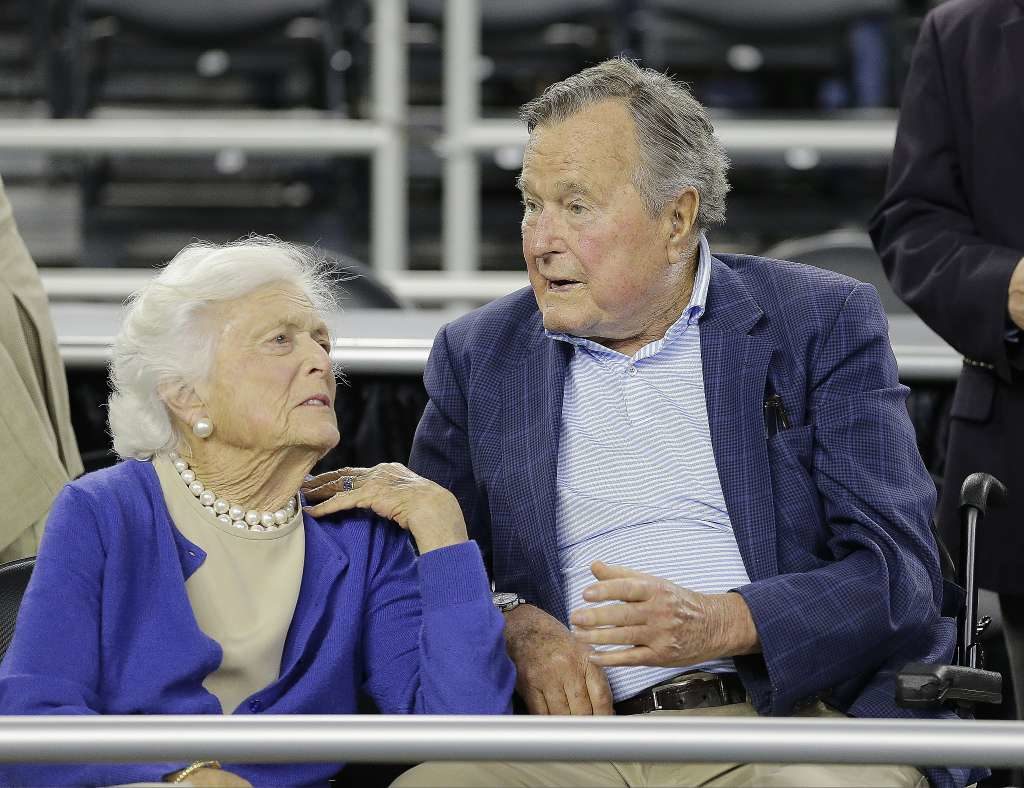
Our nation came together last week as we mourned the loss of a truly great American. No matter our race, religion, creed, or political party, we were drawn toward the light that was President George H.W. Bush. His life spanned nearly one hundred years of American history and was dedicated to serving the United States. History often records the works of great leaders. George Washington, Abraham Lincoln, Winston Churchill all led with a sense of service and devotion to their people. But what makes a leader truly special is humility, humor, and a deep moral code guiding their every day. President Bush embodied those very attributes. His biographer, Jon Meacham, summed up the Bush life code best in his eulogy: “Tell the truth. Don’t blame people. Be strong. Do your best. Try hard. Forgive. Stay the course.” In every walk of life, President Bush did just those things. Integrity guided everything he undertook, and his lifetime of achievements testify to this. He was a decorated war hero in the Navy during WWII, an extremely successful businessman in Texas, Congressman, Ambassador to the United Nations, Chairman of the Republican National Committee, Chief of the U.S. Liaison to the People’s Republic of China, Director of the Central Intelligence Agency, Vice President, and President of the United States of America. His sense of humor was always charming, sometimes teasing, but never out of malice or needling. He knew how to tell and take a good joke, and he loved to make people laugh. He took everything he did seriously and with dignity. His first and foremost goal was to serve the American people to the best of his ability and let the thousand points of light in our communities shine bright by one small act of kindness and devotion to each other at a time. In his inaugural address, President Bush emphasized this point: “What do we want the men and women who work with us to say when we are no longer there? That we were more driven to succeed than anyone around us? Or that we stopped to ask if a sick child had gotten better, and stayed a moment there to trade a word of friendship?” Since his presidency, George H.W. Bush has remained an example of leadership. For him, it was never about accolades as much as it was about service to the American people. He was the brightest of those thousand points of light in everything he did. The light that shone through him came from his devotion to his country, to his family, and to God. I had the honor to pay my respects to President Bush in the Capitol Rotunda and attend the funeral service held in the National Cathedral last week. It was the most moving church service I have ever attended. The testimony shared by everyone there spoke to a life well lived and firmly grounded. He loved life and loved the people he spent it with. As his son, President George W. Bush, said at the service, “The idea is to die young as late as possible. … As he aged, he taught us how to grow old with dignity, humor and kindness. And, when the good Lord finally called, how to meet Him with courage and with joy in the promise of what lies ahead.” President George H.W. Bush will be remembered as a true American leader: someone who served totally, cared deeply, laughed fully, and loved completely. As we move on to the New Year, I hope that in some small way we can embody just a small measure of those traits. If we do, one can only imagine how much brighter the light of our nation will shine. • • • Bradley Byrne is a member of U.S. Congress representing Alabama’s 1st Congressional District.
Martha Roby: Honoring the life and legacy of President George H.W. Bush
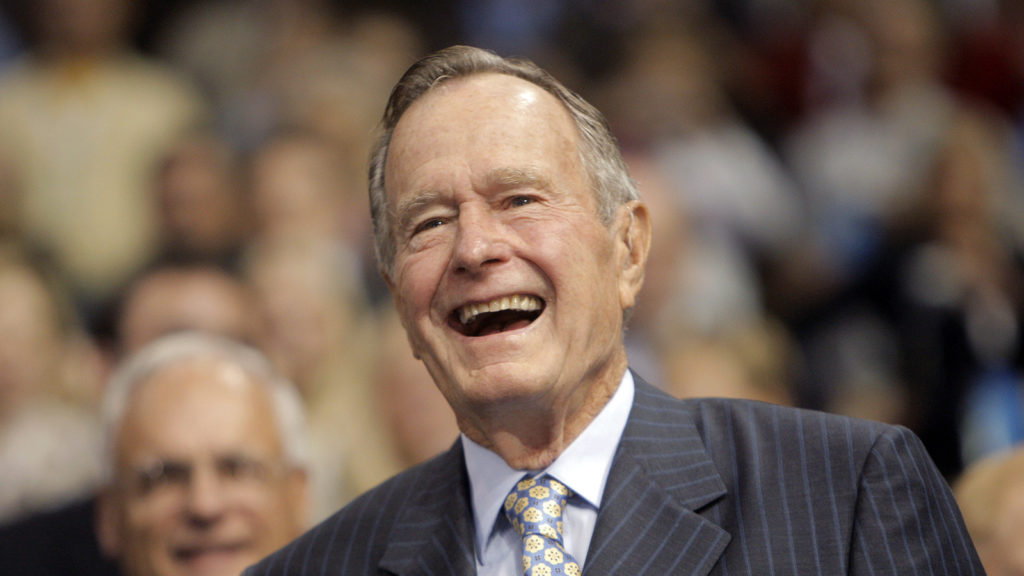
As Americans, one of our most important, solemn duties is to honor our great heroes and patriots as we lay them to rest. On November 30, 2018, President George Herbert Walker Bush, the 41st President of the United States, passed on from this life surrounded by some of the people he loved most in this world. He was a great leader and a truly good man, and our country will be forever shaped by his legacy. George H.W. Bush was born on June 12, 1924, to Prescott Sheldon Bush and Dorothy Walker Bush. He graduated from high school on his 18th birthday and immediately enlisted in the U.S. Navy, becoming one of the youngest naval aviators. In September of 1943, George Bush was assigned to the squadron that would end up being victorious in the Battle of the Philippine Sea, one of the largest air battles of World War II. A year later, junior Lieutenant Bush piloted one of the four planes that attacked the Japanese on Chichijima. His plane was shot down, and he was stranded for hours in an inflated raft before being rescued by a U.S. submarine. Between 1943-1944, Bush flew 58 combat missions for which he received the Distinguished Flying Cross, three Air Medals, and the Presidential Unit Citation. He was honorably discharged from the Navy in September of 1945, one month after Japan’s surrender. During his final year of naval service, George Bush married Barbara Pierce, and they had six children together, five of which are still living. Their second child and oldest daughter Robin passed away at age three from leukemia. At the time of Barbara’s death earlier this year, the couple had been married for 73 years, the longest presidential marriage in American history by nearly 20 years. Upon receiving his military discharge, George Bush enrolled at Yale University where he continued his remarkable leadership track by serving as his fraternity’s president and captain of the university’s baseball team. After graduating, he moved his family to West Texas where he became very successful in the oil industry. In 1966, George Bush was elected to serve Texas’ Seventh Congressional District in the U.S. House of Representatives. He was reelected in 1968, and then unsuccessfully ran for the Senate in 1970. In 1971, George Bush was appointed by President Richard Nixon to serve as Ambassador to the United Nations. During his impressive career, he also served as the U.S. Liaison to China and Director of the Central Intelligence Agency (CIA). Bush was President Ronald Reagan’s Vice President from 1981-1989. He succeeded Reagan as President in 1989 and completed one term, losing his reelection bid to former President Bill Clinton in 1993. While President George H.W. Bush’s resume is certainly impressive, it’s not his professional achievement that will stand out in the hearts and minds of Americans for generations to come. President Bush was a devoted husband, father, grandfather, and great grandfather. He was also a dedicated public servant who placed significant emphasis on volunteering as a way to improve American communities. He often used the “thousand points of light” theme to describe the power American citizens have to solve problems. In his 1989 inaugural address, President Bush said, “I have spoken of a thousand points of light, of all the community organizations that are spread like stars throughout the nation, doing good.” Four years later, he offered an update to the country on the Points of Light Movement, saying, “Points of light are the soul of America. They are ordinary people who reach beyond themselves to touch the lives of those in need, bringing hope and opportunity, care and friendship. By giving so generously of themselves, these remarkable individuals show us not only what is best in our heritage but what all of us are called to become.” President George H.W. Bush lived his life as a shining example of these words he spoke. He is truly among what is “best in our heritage.” President Bush gave our country the very best of himself, and thereby inspired countless Americans to voluntarism and public service. May we never forget his outstanding leadership and his remarkable legacy. I hope you will join me in keeping the entire Bush family in your prayers as our country mourns the passing of their loved one. ••• Martha Roby represents Alabama’s Second Congressional District. She lives in Montgomery, Alabama, with her husband Riley and their two children.
Ceremonies for George H.W. Bush draw together presidents, world envoys

The nation’s capital bids its final farewell to the late former President George H.W. Bush on Wednesday in a service of prayer and praise that is drawing together world envoys, Americans of high office and a guy from Maine who used to fix things in Bush’s house on the water. A viewing for the 41st president at the hushed Capitol Rotunda closed Wednesday morning. A ceremony at Washington National Cathedral, the nexus of state funerals, will cap three days of remembrance by dignitaries and ordinary citizens as they honored the Republican president who oversaw the post-Cold War transition and led a successful Gulf War, only to lose re-election in a generational shift to Democrat Bill Clinton in 1992. The four living ex-presidents are coming — among them, George W. Bush will eulogize his father — and President Donald Trump will attend but is not scheduled to speak. Also attending: one king (Jordan), one queen (Jordan), two princes (Britain, Bahrain), Germany’s chancellor and Poland’s president, among representatives of more than a dozen countries. Also expected in the invitation-only crowd: Mike Lovejoy, a Kennebunkport electrician and fix-it man who has worked at Bush’s Maine summer estate since 1990 and says he was shocked and heartened to be asked to come. On Tuesday, soldiers, citizens in wheelchairs and long lines of others on foot wound through the Capitol Rotunda to view Bush’s casket and honor a president whose legacy included World War military service and a landmark law affirming the rights of the disabled. Former Sen. Bob Dole, a compatriot in war, peace and political struggle, steadied himself out of his wheelchair and saluted his old friend and one-time rival. After the national funeral service at the cathedral, Bush’s remains will be returned to Houston to lie in repose at St. Martin’s Episcopal Church before burial Thursday at his family plot on the presidential library grounds at Texas A&M University in College Station. His final resting place will be alongside Barbara Bush, his wife of 73 years who died in April, and Robin Bush, the daughter they lost to leukemia in 1953 at age 3. Trump ordered the federal government closed Wednesday for a national day of mourning. Flags on public buildings are flying at half-staff for 30 days. As at notable moments in his life, Bush brought together Republicans and Democrats in his death, and not only the VIPs. Members of the public who never voted for the man waited in the same long lines as the rest, attesting that Bush possessed the dignity and grace that deserved to be remembered by their presence on a cold overcast day in the capital. “I’m just here to pay my respects,” said Jane Hernandez, a retired physician in the heavily Democratic city and suburbs. “I wasn’t the biggest fan of his presidency, but all in all he was a good, sincere guy doing a really hard job as best he could.” Bush’s service dog, Sully, was taken to the viewing, too — his main service these last months since Barbara Bush’s death in April being to rest his head on her husband’s lap. Service dogs are trained to do that. The CIA also honored Bush, the only spy chief to become president, as three agency directors past and present joined the public in the viewing. In the midst of the period of mourning, first lady Melania Trump gave Laura Bush, one of her predecessors, a tour of holiday decorations at the White House, a “sweet visit during this somber week,” as Mrs. Bush’s Instagram account put it. And the Trumps visited members of the Bush family at the Blair House presidential guesthouse, where they are staying. Former President George W. Bush and his wife greeted the Trumps outside before everyone went in for the private, 20-minute visit. Although Trump will attend Bush’s service, he is not among the eulogists. They are, in addition to Bush’s eldest son, Alan Simpson, the former senator and acerbic wit from Wyoming; Brian Mulroney, the former Canadian prime minister who also gave a eulogy for Ronald Reagan; and presidential historian Jon Meacham. People lined up before dawn to pay respects to the 41st president, a son and father of privilege now celebrated by everyday citizens for his common courtesies and depth of experience. “He was so qualified, and I think he was just a decent man,” said Sharon Terry, touring Washington with friends from an Indianapolis garden club. Said her friend Sue Miller, also in line for the viewing: “I actually think I underestimated him when he was in office. My opinion of him went up seeing how he conducted himself as a statesman afterward.” Fred Curry, one of the few African-Americans in line, is a registered Democrat from Hyattsville, Maryland, who voted for Bush in 1988, the election won by the one-term president. “Honestly I just liked him,” he said. “He seemed like a sincere and decent man and you couldn’t argue with his qualifications.” Inside the Capitol, Sully, the 2-year-old Labrador retriever assigned to Bush, sat by the casket in the company of people who came to commemorate Bush’s signing of the Americans with Disabilities Act, the 1990 law that, among its many provisions, required businesses that prohibit pets to give access to service dogs. “After Mrs. Bush’s death, general companionship was a big part of Sully’s job,” John Miller, president and CEO of America’s VetDogs, said in a phone interview. “One of the things that I think was important to the president was the rest command, where Sully would rest his head on the president’s lap.” The law was just one point of intersection for Bush and Dole, now 95, who was one of its leading advocates in the Senate. They were fellow World War II veterans, Republican Party leaders, fierce rivals for the 1988 Republican presidential nomination won by Bush (“Stop lying about my record,” Dole snapped at Bush) and skilled negotiators. Dole, an Army veteran hit by German machine gunfire in Italy, has
GOP laments George H.W. Bush’s death as end of ‘a culture of civility’
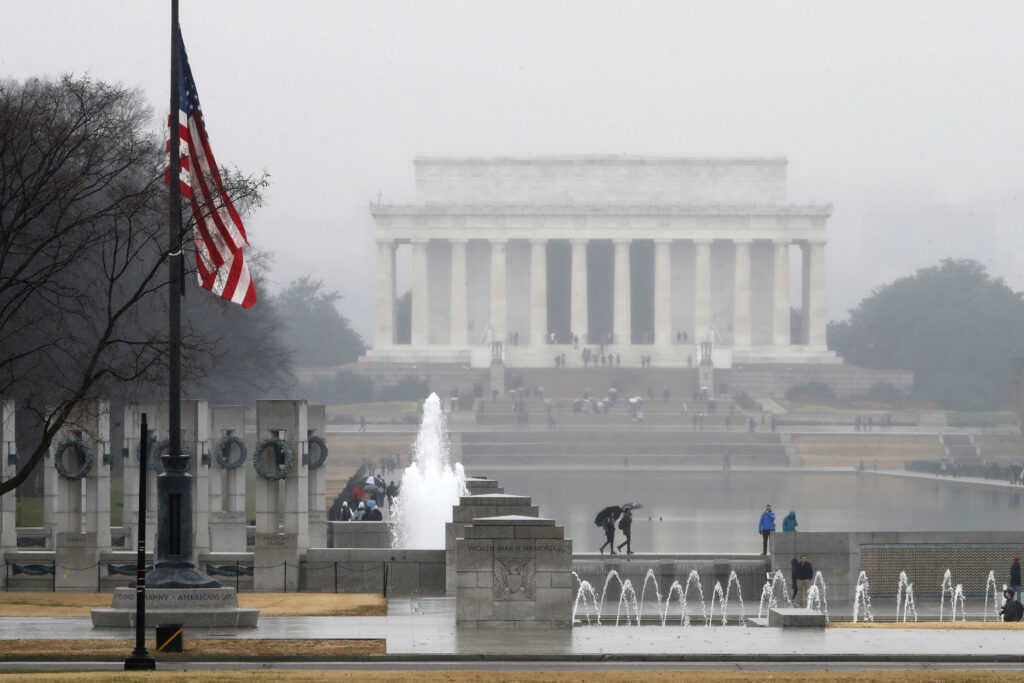
Facing the nation for the first time as its president, George H.W. Bush vowed to lead with humility, moral principle and a spirit of unity. Deep successes “are made not of gold and silk but of better hearts and finer souls,” Bush said in 1989, adding: “America is never wholly herself unless she is engaged in high moral principle. We as a people have such a purpose today. It is to make kinder the face of the nation and gentler the face of the world.” Nearly three decades later, Bush’s inaugural address stands in sharp contrast with that of President Donald Trump, a fellow Republican whose brand is defined by material success, unrestrained aggression toward his rivals and disdain for traditional coalitions at home and abroad. Their presidencies separated by a single generation, the nation’s 41st and 45th presidents shared little in personality or worldview. And beyond personality, the conflicting presidencies underscore just how little remains today of the Grand Old Party that Bush once led. Trump’s GOP has undercut long-cherished Republican pillars of free trade, federal spending and environmental protection. One of Bush’s former senior aides, Ron Kaufman, now a Republican national committeeman from Massachusetts, said Bush’s death marked “the end of a culture — a culture of civility.” Above all, Kaufman and other Republican leaders — many Trump supporters — lamented the partisan divide that dominates modern politics in America, made even starker when compared to the style and substance of Bush. “The Bush family raised the level of public decency in American politics,” former South Carolina GOP Chairman Matt Moore said. “They’re just kind and generous. We need more of that, frankly, in American politics.” Public service was the norm for Bush, who held diplomatic posts at the United Nations and in China — along with leading the Republican National Committee and the CIA — before taking office. Bush promoted the value of cooperation as commander in chief, leading the United States into the first Persian Gulf War only after assembling a broad international coalition to help repeal Iraqi forces from Kuwait. And at home, Bush was a master of smaller gestures that highlighted his belief in the value of personal relationships. He wrote personal notes, sent gifts and stayed in touch with political allies and adversaries alike. Just two years ago, Bush sent Kaufman what he says may be his favorite Christmas gift of all time: a picture of the five living presidents signed by each of them. “I defy you to find someone now, anywhere, who doesn’t like George Herbert Walker Bush,” Kaufman said. By contrast, Trump is best known for a brash style marked by self-promotion and personal attacks against his rivals. During the 2016 campaign, he lashed out at former Florida Gov. Jeb Bush, Bush’s son, as “low-energy.” He continued the rain of insults from the Oval Office. In recent weeks, the president described separate rivals as “horseface,” ”a thief,” ”a total lightweight” and “a crazed and stumbling lunatic.” And while he had little experience on the world stage coming into office, Trump has been equally willing to criticize long-standing international alliances. He has repeatedly heaped praise on autocrats like Russian President Vladimir Putin and North Korean leader Kim Jong Un, only to lash out at allies like Canadian Prime Minister Justin Trudeau, whom Trump in June attacked as “very dishonest and weak.” The U.S. president has also described NATO as “obsolete” and suggested that the United Nations might be “a waste of time and money.” The conflicting styles of an establishment Republican and a political outsider are easy to see even for veteran GOP operative Henry Barbour, who worked in the Bush administration and supports Trump as a Republican national committeeman from Mississippi. “He was a diplomat, having served in China, so he wasn’t rash in his responses. Always thoughtful, deliberate, and I think it served him well,” Barbour said of Bush. “Complete class act.” Bush’s class, of course, wasn’t enough to help him win re-election. He is the last sitting president to lose his bid for a second term. His political downfall, however, was hastened by his willingness to work with others. The 41st president compromised with Democrats to craft a spending package that included higher taxes, a direct violation of his “No new taxes” campaign pledge. “He told us, ‘I’m signing my death warrant for the second term,’” Kaufman said. “But it was the right thing to do.” Trump has shown no willingness to strike deals with the opposition party. Just the opposite, he has used the power of the presidency to fuel new levels of partisan division. Among the issues on which he hasn’t sought compromise: climate change. Within days of taking office, Trump signed executive actions to advance the construction of oil pipelines passionately opposed by environmental activists. He said last week that he simply didn’t believe an assessment produced by his own administration and scores of scientists warning that climate change posed a profound threat to the health of the nation. Bush, like the Republican Party of his day, was far more focused on environmental protection. In 1989, his administration penned a memo insisting that “we simply cannot wait” to address climate change: “The costs of inaction will be too high.” Beyond policy, those who knew Bush say he will always be remembered as a family man. While the current president has been married three times and faces allegations of extramarital affairs, Bush was married to the same woman for more than 70 years. His family affectionately referred to him as “Poppy.” “Even though in some respects the political direction of the country is off in another direction, we’ll never forget George H.W. Bush and the contributions he made,” said Bruce Ash, a Republican national committeeman from Arizona. “It wasn’t just his patriotism, and it wasn’t just his service. It was his decency.” “I’m glad he’s associated with the Republican Party,” he said. Republished with permission from the Associated Press.
Trumps to attend state funeral for George H.W. Bush
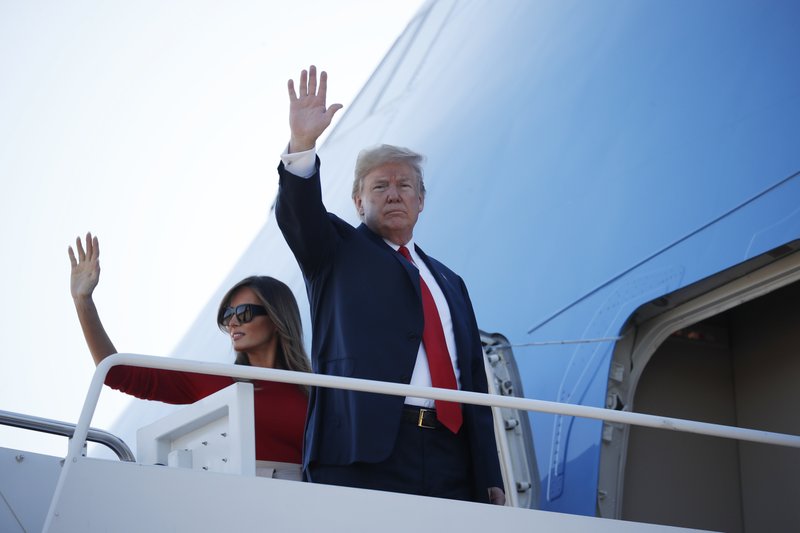
President Donald Trump and first lady Melania Trump on Saturday mourned the passing of former President George H.W. Bush, remembering him as a man of “sound judgment, common sense and unflappable leadership.” In a statement issued hours after Bush’s death on Friday night, the Trumps said that Bush had “inspired generations of his fellow Americans to public service.” Bush, who served as president from 1989 to 1993, was 94. The White House announced Saturday morning that the Trumps would attend a state funeral for the former president at Washington’s National Cathedral. “President Bush guided our nation and the world to a peaceful and victorious conclusion of the Cold War,” the Trumps wrote. “As President, he set the stage for the decades of prosperity that have followed.” “And through all that he accomplished, he remained humble, following the quiet call to service that gave him a clear sense of direction.” The Trumps were informed of Bush’s death late Friday while in Buenos Aires, Argentina, for the Group of 20 summit of rich and developing nations. Trump, who upended the GOP establishment with his insurgent presidential campaign, has had a fractious relationship with the Bush family over the years. He ran against one of Bush’s sons, Jeb Bush, in the GOP presidential primaries in 2016, and he was sharply critical of the presidency of another son, George W. Bush. Trump was set to speak by phone Saturday with George W. Bush, White House press secretary Sarah Sanders said, to “offer his condolences on behalf of himself, the first lady, and the entire country.” He will also designate Wednesday as a national day of mourning. In August 2015, Trump tweeted a dig at the presidency of George H.W. Bush, writing: “The last thing we need is another Bush in the White House. Would be the same old thing (remember “read my lips, no more taxes”). GREATNESS!” Those harsh assessments were set aside in the Trumps’ statement on Saturday. They wrote that those whom Bush had inspired to public service were “illuminating the greatness, hope and opportunity of America to the world.” Trump, the 45th president, paid tribute to “the life and legacy of 41.” Republished with permission from the Associated Press.
What they’re saying: Alabama politicians react to the passing of former President George H.W. Bush
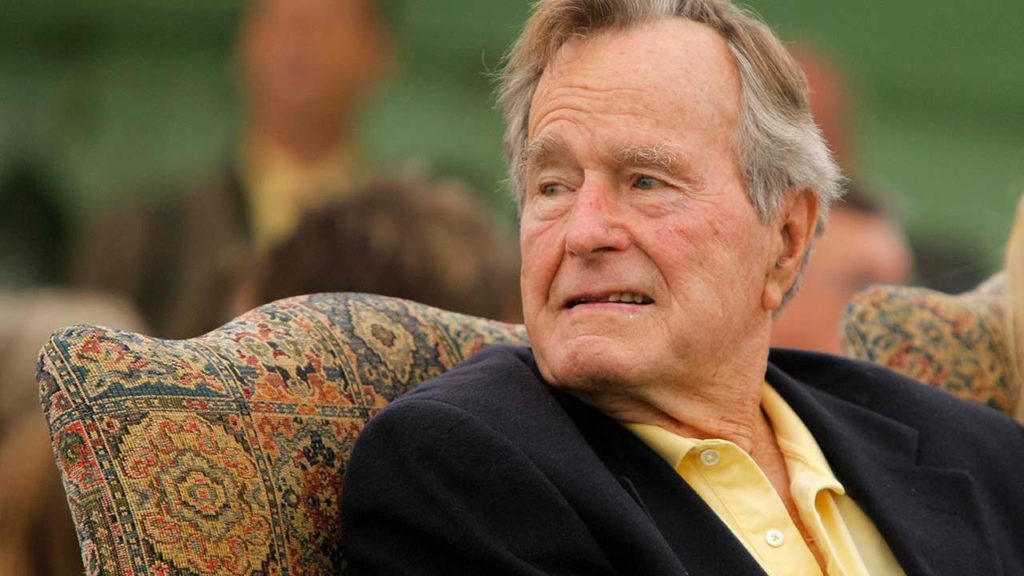
George H.W. Bush, the 41st president of the United States, died Friday night at age 94, and the tributes and condolences have poured in for the man remembered as a World War II veteran, the Cold War president who saw the fall of the Iron Curtain and the collapse of the Soviet Union, and a loving family man. Here’s what Alabama politicians are saying about his passing: Gov. Kay Ivey: President George H.W. Bush was a true statesman and patriot who served our country in the U.S. Navy during World War II and later as Congressman, Ambassador, CIA Director, Vice President and President. The honor he showed our people will live on long after today. He was a leader for us all, and his presence will be truly missed. I pray for the Bush Family as they mourn the death of their father, grandfather, great-grandfather and our 41st President. U.S. Sen. Richard Shelby: President George H.W. Bush was a true American statesman and hero. He dedicated his life to serving the country he loved for more than 70 years. From a young Naval aviator shot down in WWII to Commander-in-Chief, President Bush led our nation with integrity, honor, and measure. Annette and I join all Americans in mourning his passing. His legacy of humility and devotion will never be forgotten. U.S. Sen. Doug Jones: I was deeply saddened this morning by the news of President George H.W. Bush’s passing. President Bush served the United States of America throughout his life with honor and dignity, both at war and here at home, as a Navy pilot, a diplomat, and a statesman. He made the most of his 94 years of life and he set an example we should all strive to follow, especially his unwavering dedication to his family and to our country. Louise and I send our heartfelt condolences to the entire Bush family as they grieve the loss of their beloved patriarch. Alabama 1st District U.S. Rep. Bradley Byrne: George H.W. Bush was an American hero and icon. Throughout his 94 years, he served our nation in so many ways, and he accomplished so much. Despite all of this, I think the life of George H.W. Bush is best summed up in a very simple phrase: he was a good man. May God be with the Bush family and a grateful nation as we mourn and remember a good man and an American hero. Alabama 2nd District U.S. Rep. Martha Roby: Sad news tonight as we mourn the passing of our 41st President, George H.W. Bush. He was a remarkable American who served this country honorably. He will be dearly missed. My prayers are with the Bush family during this time. Alabama 3rd District U.S. Rep. Mike Rogers: Sending heartfelt prayers to the Bush family this morning after the passing of President George H.W. Bush. The world lost a great man today who will be remembered for a lifetime of service. Alabama 4th District U.S. Rep. Robert Aderholt: I’m very sorry to hear of the passing of former President George H.W. Bush. He was not only our 41st President, but a hero of WWII who was the epitome of the Greatest Generation. Alabama 5th District U.S. Rep. Mo Brooks: It is with heavy hearts Martha and I learn of President George H.W. Bush’s passing this morning. We join the Nation in mourning the death of a great man, who before serving as President of the United States honorably served as a Navy pilot during World War II, a U.S. Congressman, Ambassador to the United Nations, Chief U.S. Liaison to China, CIA Director, and Vice President of the United States. Throughout his impressive service to our Nation, President Bush set the standard for leadership and integrity. President Bush was deeply devoted to his family, and it showed in their love for him. Our thoughts and prayers are with the entire Bush family at this time of grief. Alabama 7th District U.S. Rep. Terri Sewell: In the Navy, the CIA, and in the Oval Office, President George H.W. Bush dedicated his life to service. He was a true patriot who put his country first. Today my prayers are with the whole Bush family. Alabama Speaker of the House, Monrovia-RepublicanMac McCutcheon: President George H.W. Bush epitomized all that is great about public service. A man of means who could have lived a life of comfort and relaxation, he chose instead to open himself to the criticism that politics and difficult decisions often bring. Our nation is better off for the service that he gallantly offered both in office and as a veteran of World War II. During his presidency, the Berlin Wall fell, the Iron Curtain was finally parted, and our world became more stable and secure under his watch. President Bush is now reunited with his beloved Barbara and the daughter, Robin, that they lost. History will be kind to him, which is just and deserved. Alabama State House Majority Leader Nathaniel Ledbetter on behalf of the House Republican Caucus: The members of the Alabama House Republican Caucus join the rest of the nation and freedom-loving people around the world in mourning the loss of President George H.W. Bush. He will be considered among the greatest of our one-term presidents, and most will agree that our nation would have been spared much drama and turmoil had he been elected to a second term. He was both a gentleman and a gentle man who offered an example for others to follow. Our thoughts and prayers are with his family as they celebrate 94 years of a life well lived. Other notable Alabamians William J. Canary | Former President of the Business Council of Alabama, who served as a Special Assistant on the White House staff of President George H.W. Bush and as Director of the First Family during the 1989 Presidential Inaugural President George H.W. Bush, a man to whom family and friendship was quite simply all, now belongs to the ages.
President George H.W. Bush, 41st president of the United States, dies at 94

George H.W. Bush, the 41st president of the United States, died Friday at the age of 94. George Herbert Walker Bush passed away at 10:10 p.m. ET his spokesperson Jim McGrath confirmed. His death follows his wife Barbara‘s who passed on April 17 of this year. His son, and 43rd president of the United States, George W. Bush released a statement Friday night on behalf of him and and his siblings, “Jeb, Neil, Marvin, Doro, and I are saddened to announce that after 94 remarkable years, our dear Dad has died.” “George H.W. Bush was a man of the highest character and the best dad a son or daughter could ask for,” he said. “The entire Bush family is deeply grateful for 41’s life and love, for the compassion of those who have cared and prayed for Dad, and for the condolences of our friends and fellow citizens.” Statement by President George W. Bush on the death of his father, President George H.W. Bush https://t.co/wDD0vnlN8U pic.twitter.com/t7UsDYSKY8 — George W. Bush Presidential Center (@TheBushCenter) December 1, 2018
Justice Department move on health law has risks for GOP
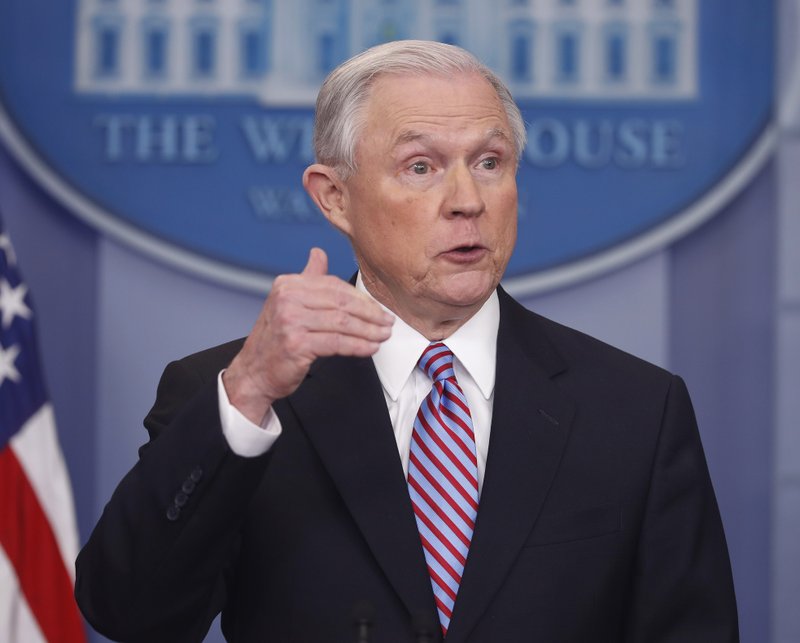
The Trump administration’s decision to stop defending in court the Obama health law’s popular protections for consumers with pre-existing conditions could prove risky for Republicans in the midterm elections — and nudge premiums even higher. The Justice Department said in a court filing late Thursday that it will no longer defend key parts of the Affordable Care Act, beginning with the unpopular requirement that people carry health insurance, but also including widely-supported provisions that guarantee access for people with medical problems and limit what insurers can charge older, sicker adults. Friday, the insurance industry warned in stark terms of “harm that would come to millions of Americans” if such protections are struck down, causing premiums “to go even higher for older Americans and sicker patients.” Weighing in on a Texas challenge to the health law, the Justice Department argued that legally and practically the popular consumer protections cannot be separated from the unpopular insurance mandate, which Congress has repealed, effective next year. That argument is likely to be lost on consumers, said Robert Blendon, a polling expert at the Harvard T.H. Chan School of Public Health — particularly in the heat of an election that will determine control of Congress. “The pre-existing condition thing is what the ads will be run on,” said Blendon. “Pre-existing conditions have gotten to be an issue that people walking on the streets understand … it’s very emotional.” Some Democratic politicians didn’t waste much time. “Democrats will not allow Republicans to get away with quietly trying to strip away pre-existing conditions protections for millions of Americans through a legal backdoor,” said Rep. Frank Pallone, D-N.J., a spokesman for his party on health care. Senate Democratic Leader Chuck Schumer of New York urged President Donald Trump to reverse the decision. Administration officials at the departments of Health and Human Services and Treasury would not comment, instead pointing to the Justice Department filing, which said other parts of the health law would continue to stand, including its Medicaid expansion covering about 12 million low-income people. HHS and Treasury administer the health law’s coverage and subsidies. Loosening the health law’s rules on pre-existing conditions and on charging more to older adults is a key goal for the Trump administration. Partly that’s because those consumer protections also raise premiums across the board, as the cost of covering the sick is spread among all customers, including healthier people who previously benefited from lower rates. Indeed, people who pay the full cost of their individual health plans and aren’t eligible for subsidies under the health law have been clamoring for relief from several years of double-digit premium increases. Economist Gail Wilensky, who’s advised Republicans, said she’s not sure about the timing of the administration’s action. “You can definitely assume Democrats will use it to whip up their side,” said Wilensky, administrator of Medicare under former President George H.W. Bush. “For the people not affected by the ACA, or not particularly supportive, I don’t know that it will matter much.” The issues in the court case are unlikely to be resolved quickly, but some experts said the added uncertainty could prompt insurers to seek higher premiums in 2019 for health plans sold to individuals. “Insurance companies hate uncertainty, and when they face uncertainty they tend to increase premiums and hedge their bets,” said Larry Levitt of the nonpartisan Kaiser Family Foundation. America’s Health Insurance Plans, the main industry trade group, bemoaned the Justice Department’s stance, saying it could upset a market that is becoming “more steady” for most consumers. “Zeroing out the individual mandate penalty should not result in striking important consumer protections,” the group said. It will lead to “renewed uncertainty in the individual market” and a “patchwork of requirements in the states” and make it more challenging to offer coverage next year. The lawsuit, filed in February by Texas and other GOP-led states, is in many ways a replay of the politically divided litigation that ended with the Supreme Court upholding the health care overhaul in 2012. In this case, California is leading a group of Democrat-led states in defending the law. The Trump administration’s stance is a rare departure from the Justice Department’s practice of defending federal laws in court. Attorney General Jeff Sessions said in a letter to Congress that Trump, who campaigned on repealing the law and nearly did so his first year in office, approved the legal strategy. Donald Verrilli Jr., President Barack Obama’s top Supreme Court lawyer who defended the law, called the decision “a sad moment.” “I find it impossible to believe that the many talented lawyers at the department could not come up with any arguments to defend the ACA’s insurance market reforms, which have made such a difference to millions of Americans,” Verrilli said. Shortly before the government’s court filing Thursday, three career lawyers at the Justice Department withdrew from the case and were replaced by two political appointees, according to court filings. Republished with the permission of the Associated Press.
Is Donald Trump right about judges’ leanings? Maybe, review shows
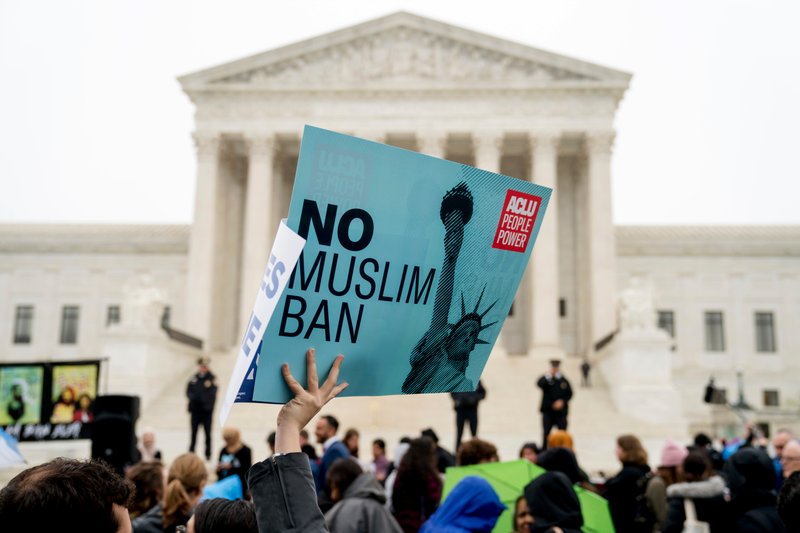
President Donald Trump has called courts unfair and political and repeatedly assailed the 9th Circuit, the U.S. court system’s westernmost division, where some of his key immigration policies have stalled. Other observers describe America’s judges as conservative or liberal, implying they bring an ideology to their decision-making that goes beyond a careful assessment of law and precedent. That view has made the U.S. Senate’s confirmation of federal judges fraught, with each party battling to block nominees they view as unsympathetic to their positions. But is there any evidence politics plays a role in judicial opinions? An Associated Press review suggests it might. The AP looked at opinions by nearly 40 federal district court and appellate judges about Trump’s ban on travelers from mostly Muslim countries. It found only one judge nominated by a Democratic president has supported Trump’s authority to keep out all travelers or deport those who arrived just as the first ban took effect. With some exceptions, Republican nominees have taken a broader view of presidential power and rejected limits on the executive orders. The travel ban is now in its third iteration and under consideration by the U.S. Supreme Court. HOW HAS THIS SPLIT PLAYED OUT IN THE COURTS? One of the first federal judges to consider the ban gave it the all-clear, saying Trump provided a legitimate reason for his January 2017 executive order and that a lawsuit challenging it was likely to fail. The decision by U.S. District Judge Nathaniel Gorton in Boston came days after a federal judge in Los Angeles, Andre Birotte, reached the opposite conclusion and ordered the administration to allow immigrants with valid visas into the U.S. The judges considered different lawsuits in different courts 3,000 miles (4,830 kilometers) apart. But they were also nominated to the bench by presidents from different parties — Gorton by Republican George H.W. Bush and Birotte by Democrat Barack Obama. For the most part, the judicial split along party lines has continued as the ban’s various versions have made their way through federal courts. The three bans have had a tortuous legal journey that has taken them before dozens of district court and appellate judges nominated by presidents from both major parties. The AP completed an extensive review of that journey, examining 26 decisions by 38 judges. The two key findings: — A majority of the judges — 24 — were nominated by Democratic presidents. Only one of those judges supported Trump’s power to block all travelers. In February, 4th U.S. Circuit Court of Appeals Judge William Traxler, nominated by President Bill Clinton, said in a dissenting opinion that the administration provided “logical conclusions and rationale” for the third ban and addressed his earlier concerns that it was motivated by anti-Muslim bias. — In contrast, 10 of the 14 Republican judges in the group sided with the administration and moved to uphold restrictions on foreign travelers. One of the notable exceptions is James Robart in Seattle — a nominee of President George W. Bush —, who issued a nationwide order blocking the first ban. AREN’T JUDGES SUPPOSED TO BE APOLITICAL? The code of conduct for federal judges says they should not allow “family, social, political, financial or other relationships to influence” their judgment. Judges generally refrain from overt partisanship and often hold themselves up as neutral arbiters of law. But the law can be unclear and open to varying interpretations. In a widely cited 2006 book, “Are Judges Political,” Harvard University’s Cass Sunstein and other researchers studied thousands of decisions by three-judge federal appellate court panels. Some areas of the law — such as appeals of criminal convictions — produced no significant difference in the decisions of Republican and Democratic judicial nominees. But in other areas, political affiliations were good predictors of judges’ rulings. Affirmative action and environmental regulations were among the issues on which Republican nominees were more likely to take a conservative view, while their Democratic counterparts were more likely to go in a liberal direction, the researchers found. “The reality is, there are certain hot button issues where you’ve got these splits, and there’s not that many people in the middle,” said David Levine, a professor at the University of California, Hastings College of the Law who has followed the travel ban cases. WHERE DO REPUBLICAN AND DEMOCRATIC NOMINEES DIFFER ON THE TRAVEL BAN? Democratic nominees have pointed to the president’s campaign rhetoric about barring Muslims from entering the country as evidence the bans are illegally motivated by religious prejudice. They said the administration provided insufficient evidence for its claim that the bans are needed for U.S. security. “The ‘initial’ announcement of the Muslim ban, offered repeatedly and explicitly through President Trump’s own statements, forcefully and persuasively expressed his purpose in unequivocal terms,” U.S. District Judge Theodore Chuang in Maryland, who was nominated by Obama, said in an October ruling blocking the third ban. Republican judicial nominees have assailed their Democratic counterparts for second-guessing the president’s national security claims by looking beyond his order to campaign statements. “Even if we have questions about the basis for the President’s ultimate findings — whether it was a ‘Muslim ban’ or something else — we do not get to peek behind the curtain,” 9th U.S. Circuit Court of Appeals Judge Jay Bybee, a President George W. Bush nominee, said in March 2017. Bybee was dissenting from the 9th Circuit’s decision not to revisit its ruling keeping the first travel ban on hold. Four other judges — all Republican nominees — signed the dissent. WHAT’S NEXT? The U.S. Supreme Court will have the final word. It heard arguments April 25 about the ban’s latest version, which restricts travel to the United States by residents of five majority-Muslim countries — down from seven in the first ban — as well as North Korea. It also restricts travelers from Venezuela. The justices in December allowed that version to take full effect even as the legal fight over it continued. They appeared split during the hearing, though it
Former President George H.W. Bush out of intensive care, making progress
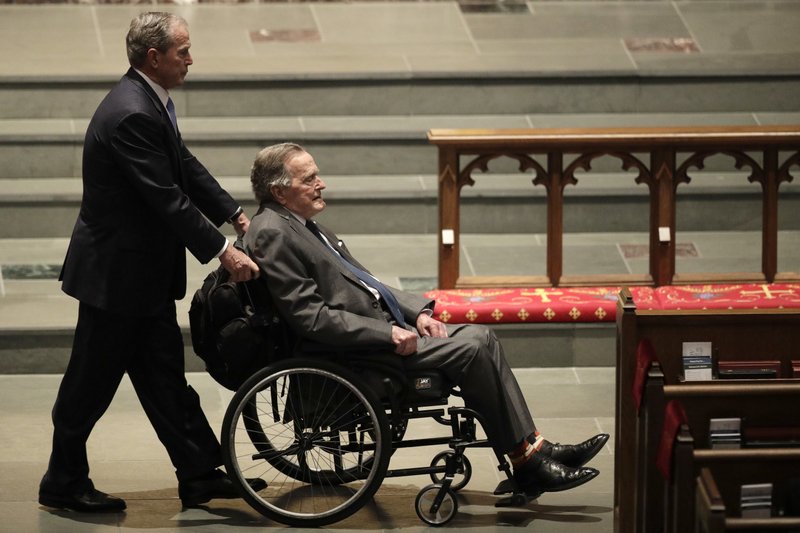
Former President George H.W. Bush was moved out of intensive care and into a regular patient room at a Houston hospital on Wednesday as he recovers from an infection that required his hospitalization a day after his wife’s funeral, a family spokesman said. The nation’s 41st president is expected to remain at Houston Methodist Hospital for “several more days,” spokesman Jim McGrath said. Bush, who is 93, is being treated for an infection that spread to his blood. “He is alert and talking with hospital staff, family and friends, and his doctors are very pleased with his progress,” McGrath said in a statement. He noted that Bush was more focused on the Houston Rockets playoff series against the Minnesota Timberwolves “than anything that landed him in the hospital.” Bush, frequently accompanied by his wife, has long been a fixture at Houston sporting events. During a Wednesday appearance at Brown University in Providence, Rhode Island, former Florida Gov. Jeb Bush said his father will be leaving the hospital on Friday. He called his father “stronger than an ox” and the “greatest man alive.” Bush was hospitalized on Sunday, a day after he attended the funeral and burial of his wife, Barbara. Married for 73 years, the Bushes were the longest-married presidential couple in U.S. history. Barbara Bush was 92 when she died on April 17 at their Houston home. Bush sent a tweet earlier Wednesday thanking Houston for its “professionalism and obvious care” during the memorials and services for his wife. He specifically cited Houston Mayor Sylvester Turner, the city’s police and transit agency “and really all Houstonians” for “making Barbara’s visitors and funeral guests feel so welcomed.” He also thanked St. Martin’s Episcopal Church, where the funeral was held and where he and his wife worshipped for years, and Second Baptist Church, which served as a staging area a few miles away for city buses that carried thousands of visitors to St. Martin’s for a public viewing a day before the funeral. McGrath said the former president is thankful for everyone sending prayers and good wishes. Republished with permission from the Associated Press.
Former first lady Barbara Bush dies at age 92
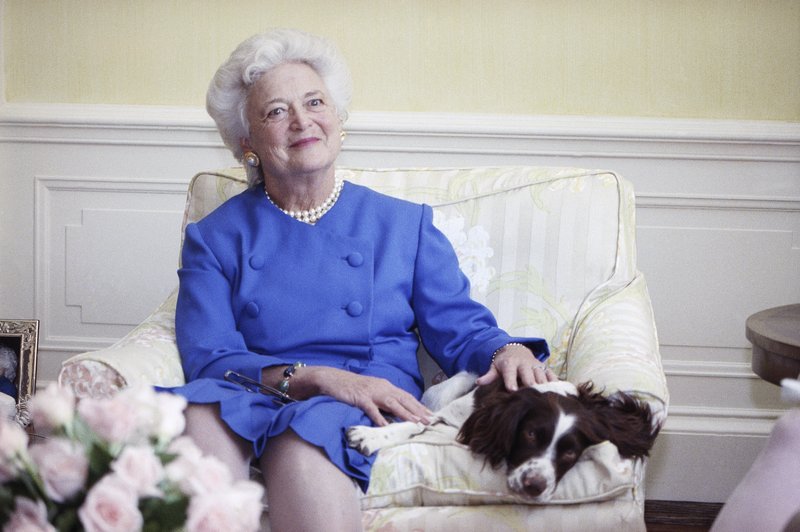
Barbara Bush, the snowy-haired first lady and mother of a president whose plainspoken manner and utter lack of pretense made her more popular at times than her husband, President George H.W. Bush, died Tuesday, a family spokesman said. She was 92. Mrs. Bush brought a grandmotherly style to buttoned-down Washington, often appearing in her trademark fake pearl chokers and displaying no vanity about her white hair and wrinkles. “What you see with me is what you get. I’m not running for president — George Bush is,” she said at the 1988 Republican National Convention, where her husband, then vice president, was nominated to succeed Ronald Reagan. The Bushes, who were married Jan. 6, 1945, had the longest marriage of any presidential couple in American history. And Mrs. Bush was one of only two first ladies who had a child who was elected president. The other was Abigail Adams, wife of John Adams and mother of John Quincy Adams. “I had the best job in America,” she wrote in a 1994 memoir describing her time in the White House. “Every single day was interesting, rewarding, and sometimes just plain fun.” On Sunday, family spokesman Jim McGrath said the former first lady had decided to decline further medical treatment for health problems and focus instead on “comfort care” at home in Houston. She had been in the hospital recently for congestive heart failure and chronic obstructive pulmonary disease. In 2009, she had heart valve replacement surgery, and she had a long history of treatment for Graves’ disease, a thyroid condition. “My dear mother has passed on at age 92. Laura, Barbara, Jenna, and I are sad, but our souls are settled because we know hers was,” former President George W. Bush said in a statement Tuesday. “Barbara Bush was a fabulous First Lady and a woman unlike any other who brought levity, love, and literacy to millions. To us, she was so much more. Mom kept us on our toes and kept us laughing until the end. I’m a lucky man that Barbara Bush was my mother. Our family will miss her dearly, and we thank you all for your prayers and good wishes.” George H.W. Bush held his wife’s hand all day Tuesday and was at her side when she died, according to Jean Becker, chief of staff at George H.W. Bush’s office in Houston. A funeral is planned Saturday at St. Martin’s Episcopal Church in Houston, which Mrs. Bush and her husband regularly attended. Mrs. Bush will lie in repose Friday at the church for members of the public who want to pay respects. Saturday’s service will be by invitation only, according to the George Bush Presidential Library Foundation. “Barbara Bush challenged each of us to build a better world by empowering people through literacy. As only one of two women in American history who can be called First Lady and First Mother, she was matriarch of a family that remains as dedicated to public service as it was to politics,” said former Secretary of State and White House Chief of Staff James Baker III. The publisher’s daughter and oilman’s wife could be caustic in private, but her public image was that of a self-sacrificing, supportive spouse who referred to her husband as her “hero.” In the White House, “you need a friend, someone who loves you, who’s going to say, ‘You are great,’” Mrs. Bush said in a 1992 television interview. Her uncoiffed, matronly appearance often provoked jokes that she looked more like the boyish president’s mother than his wife. Late-night comedians quipped that her bright white hair and pale features also imparted a resemblance to George Washington. Eight years after leaving the nation’s capital, Mrs. Bush stood with her husband, the 41st president, as their son George W. was sworn in as the 43rd president. They returned four years later when he won a second term. Unlike Mrs. Bush, Abigail Adams did not live to see her son’s inauguration. She died in 1818, six years before John Quincy Adams was elected. Mrs. Bush insisted she did not try to influence her husband’s politics. “I don’t fool around with his office,” she said, “and he doesn’t fool around with my household.” In 1984, her quick wit got her into trouble when she was quoted as referring to Geraldine Ferraro, the Democratic vice presidential nominee, as “that $4 million — I can’t say it, but it rhymes with rich.” “It was dumb of me. I shouldn’t have said it,” Mrs. Bush acknowledged in 1988. “It was not attractive, and I’ve been very shamed. I apologized to Mrs. Ferraro, and I would apologize again.” Daughter-in-law Laura Bush, wife of George W., said Mrs. Bush was “ferociously tart-tongued.” “She’s never shied away from saying what she thinks. … She’s managed to insult nearly all of my friends with one or another perfectly timed acerbic comment,” Laura Bush wrote in her 2010 book, “Spoken from the Heart.” In her 1994 autobiography, “Barbara Bush: A Memoir,” Mrs. Bush said she did her best to keep her opinions from the public while her husband was in office. But she revealed that she disagreed with him on two issues: She supported legal abortion and opposed the sale of assault weapons. “I honestly felt, and still feel, the elected person’s opinion is the one the public has the right to know,” Mrs. Bush wrote. She also disclosed a bout with depression in the mid-1970s, saying she sometimes feared she would deliberately crash her car. She blamed hormonal changes and stress. “Night after night, George held me weeping in his arms while I tried to explain my feelings,” she wrote. “I almost wonder why he didn’t leave me.” She said she snapped out of it in a few months. Mrs. Bush raised five children: George W., Jeb, Neil, Marvin and Dorothy. A sixth child, 3-year-old daughter Robin, died of leukemia in 1953. In a speech in 1985, she recalled the stress of raising a family while married